Tag Archives: science

481. Asimov’s Good Life

I couldn’t sleep last night so I lay awake thinking of an article to write and I’d think and think and cry at the sad parts. I had a wonderful night.
                         Asimov, from It’s Been a Good Life, p. 157
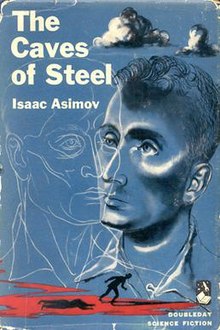
When I was new to reading science fiction in the early sixties, Clarke, Heinlein, and Asimov were everybody’s big three. Bradbury was in the next rank, but not for me. I found him unreadable. Andre Norton was still out in the cold for most people, but she, Clarke, and Heinlein were my personal big three. Asimov didn’t make the cut. I read a few of his novels, didn’t like them, and moved on.

Recently I ran across his summary autobiography, It’s Been a Good Life, edited by Janet Jeppson Asimov. It reminded me that I knew very little about the man, so I took it home.

Asimov has three full autobiographies, and a list of publications that goes on for eighteen closely packed pages. After his death, Janet Asimov published autobigaphical excerpts under the title It’s Been a Good Life. At 238 sprightly pages, 98 percent by Asimov himself, it was just right for someone who wanted to be fair to an author who is an acknowledged master.

Searching my memory and his bibliography, I found that I had read four of his novels: Lucky Starr and the Moons of Jupiter, The Stars Like Dust, and a couple of his early robot novels, each only a few years after they were published. I thought the first two were just adequate and the robot novels were dull. By the time I got to Foundation, I decided to skip it, along with anything else he might write. My local county library was full of science fiction I enjoyed, so why bother with Asimov.

It occurs to me now that might have been an error.

Asimov says (p. 143) The 1950’s [were] the decade of my greatest science-fiction triumphs, [but as] the 1950’s ended, I [ended] most of my involvement with the field. (see below)

From 1960 onward, Asimov wrote everything on every subject. It seemed to me that he had written every third book in the library. I dived into one or another from time to time doing research for my own writing. They were accurate, easy to read, and cursory, which is exactly what they were supposed to be.

When the novel The Gods Themselves came out in 1972 it was his first SF novel in fourteen years. (Not counting one novelization of a movie.) He had gone from SF novels, to non-fiction, then back to SF novels as a more mature writer. That was a biographical arc I couldn’t appreciate when I was first reading him as a teenager, for the simple reason that it had not happened yet. When it did, I had already lost interest. Not trying his new works, given his reputation, was certainly my mistake

By the eighties he was writing SF novels and winning awards once again. In 1989, he wrote Nemesis. He said this about it, “My protagonist was a teenaged girl and I also had two strong adult women characters. I placed considerably more emotion in the novel than was customary for me.” That sounds more my style, since lack of emotion was my complaint about his early work. I think I’ll check it out.

One last note for writers and would-be writers: This book is a treasure trove. I agree with pretty much everything he says about writing, but go read it from a man with far more credentials than I have.

=======

The brackets in the quotation are from Janet Asimov. She uses them to give context and continuity to excerpts which would otherwise be unintelligible. It is competently and smoothly done.

=======

Full disclosure time: After completing this post, I obtained a copy and read the first few pages of Nemesis. Sorry, I still don’t like Asimov’s writing style, but that’s all right. Not everybody likes Shakespeare, either.

477. They Never Flew (2)


NASP

Continuing from 472. Teaching Space and 474. They Never Flew (1), this post will discuss three manned space programs that never happened.

Eisenhower, Kennedy, Johnson, and Nixon were the presidents who took us into space. Whatever you think of any of them, they will always have that marked down on the positive side of their ledger.

Other presidents aspired to join them. How much of their thinking was patriotic for America, patriotic for all of mankind, or pure political calculation, is way outside the realm of my knowledge. I’m going to give them all benefit of the doubt and just talk about the programs themselves. You can spin motives any way that suits you.

Regan proposed NASP, the National AeroSpace Plane, also called the X-30. In his 1986 State of the Union, he said that we should produce a vehicle which would be “a new Orient Express that could, by the end of the next decade, take off from Dulles Airport and accelerate up to twenty-five times the speed of sound, attaining low earth orbit or flying to Tokyo within two hours.” It was an exciting idea, coming out of DARPA where it had begun as a black project.

NASP was supposed to produce two prototype planes, but neither was ever built. That doesn’t mean that it was a political scam. The technological difficulties of the project were staggering.

In detail, NASP was cutting edge. As an idea, the horizontal launch of a spacecraft was old in science fiction. There it was usually accomplished by electromagnetic technology, with ground based and powered launchers and only maneuvering fuel on the vehicle itself. See many early Heinleins, especially Starman Jones and The Moon is a Harsh Mistress.

One reason rockets take off vertically is to get mostly out of the atmosphere before achieving speed. That way, massive friction is only a reentry issue, when it can be used to advantage.

NASP was a jet, not a rocket. It had to operate primarily inside the atmosphere. This has the advantage of avoiding carrying oxidizer, but has a series of disadvantages. Friction heating is an obvious one. In addition, its engine would have to operate in three modes — as a relatively conventional jet at takeoff, as a ramjet once sufficient speed had been achieved, then as a scramjet (supersonic ramjet) once it passed the speed of sound.

At that time, no one had successfully built a scramjet, and NASP didn’t make it happen. The first scramjet, the X-43, made a brief flight in 2001, eight years after NASP was cancelled.

No one has successfully built a skin that can withstand reentry level heating on a continuous basis, either. NASP was too far ahead of its time. I spent a few years explaining to my kids how it was supposed to work — before it didn’t work, and silently crept away.

Then came Venturestar, which, if it had been successfully completed, would have done what the Space Shuttle was originally designed to do. It was to be a vertically launched, completely reusable, single stage to orbit vehicle with a wider and more efficient lifting body that would have allowed it to land, in emergencies, on shorter runways than the Space Shuttle.

To do all this, it would require new and untested technologies, including composite material LH tanks, a new tile-free heat resistant skin, and an aerospike engine. The project was divided into two parts. To demonstrate the feasibility of the new technologies, a one-third size, unmanned model of the VentureStar, called the X-33 was to be built and tested, and only then was a full sized VentureStar to be constructed.

Things did not go well. When the X-33 was partially completed a version of its composite LH tank was tested and failed to hold pressure. Alternatives existed, but the decision was made to cancel the project. The funding for the X-33 was a complex mixture of commercial and governmental funds, and continuation depended on all parties agreeing. That didn’t happen. The Air Force was still part of the mix, as with MISS and the Dyna-Soar, as with the black missions by the Space Shuttle, but their request for continued funding was denied. The Air Force eventually got the X-37b instead. The X-33, and with it the VentureStar, disappeared. For a view that the cancellation should not have happened, click this link.

From the perspective of a science teacher, VentureStar had been a godsend, full of all the excitement the Shuttle and NASP had lacked. Once it failed, my kids had no future in space that they could personally dream about.

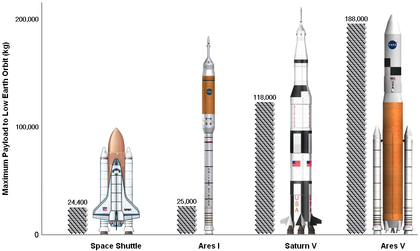
Then came Project Constellation. By that time, my days as a teacher were coming to a close, so I did not have to face the daunting task of generating enthusiasm for a cobbled up rerun. Ares I, the small booster, was built out of Space Shuttle leftovers and Ares V, the large booster looked suspiciously like a Saturn V reboot. The Orion Crew Exploration Vehicle was an oversized Apollo capsule and the Altair moon lander was a LEM on steroids. Not only was Project Constellation going to do again what had been done forty years earlier, it was going to use essentially the same hardware.

I didn’t buy it. I didn’t try to sell it to my kids. It died four years after it was floated.

The future isn’t dead. The Space Launch System continues where Constellation failed and private enterprise has more strongly entered the mix. Today’s science teachers should be able to say, “You might be the first person on Mars,” with a straight face. I continue to hope.

474. They Never Flew (1)

Continuing from 472. Teaching Space, this and the upcoming April 5 post will discuss the manned space programs that never happened.

Wikipedia lists seven manned pace programs which were canceled before they were launched, but this list is only technically accurate.

MISS, Man in Space Soonest, was a project from the early days when the Air Force planned to dominate space. The preliminary work was transferred to NASA when it was formed and became Project Mercury. Technically, MISS never flew; looked at more reasonably, MISS became Mercury, which was quite successful.

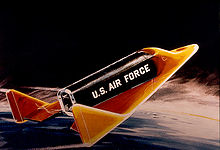
Dyan-Soar was a follow up Air Force project which planned to put a winged craft into low earth orbit, and subsequently turn that into an ultra-long range space bomber. It was contemporary to Project Mercury. There was not enough money or will to keep them both, so Dyna-Soar was cancelled, only to be reborn, in a manner of speaking, as the Space Shuttle. For details see 342. Dyna-Soar.

The Manned Orbital Development System, Blue Gemini, and the Manned Orbital Laboratory were successive names for the same secret project, designed to use modified Gemini craft to service an early one-use space station as an orbital observation post. It got to the point of one unmanned launch before being cancelled. It was made obsolete before it went into service by advances in unmanned reconnaissance satellites. For details see 256. The Space Station that Never Was.

By the time I started teaching, the era of manned space exploration was over, but there were plenty of manned space flights. The shuttle had 135 manned missions; Mercury, Gemini, Apollo, Skylab, and Apollo-Soyuz combined had only flown 35 manned mission. However, none of the Shuttle flights were explorations.

The early Shuttle flights were exciting and technologically innovative, but they only went where Mercury had gone two decades earlier. The flights quickly became routine. They were dangerous — Challenger and Columbia proved that — but danger alone does not bring excitement. Commuting on a freeway is dangerous, but only exciting during moments of imminent disaster.

The Space Shuttle was supposed to be a cost saving way to space, but it proved quite expensive. It was supposed to be reusable, but that turned out to be only partially true. It was supposed to be single stage to orbit, but it never was. Each launch had four components, not one. The fuel tank was only used once. The two solid fuel boosters had to be recovered from the ocean and refurbished each time. Only the orbiter was fully reusable, and it had massive problems with failing tiles.

A vast number of its flights were spent building and maintaining the International Space Station. Many scientists tried to stop the construction of the ISS, claiming that not much science would be done there, but the cost would cripple other exploration. They were not listened to. Politically, the ISS was a demonstration that the cold war was over and the US and Russia were now pals. You know how well that turned out.

From the viewpoint of science, plenty of exploration was going on in my kids’ era, but it all involved unmanned craft. From the viewpoint of a teacher trying to excite middle school kids, a Mars rover landing was great, but if it couldn’t be followed up by a statement like, “You may go there someday,” if fell relatively flat. None of the kids I taught in the eighties are going to Mars; by the time anyone gets there, those kids will be retired, and they knew it at the time.

The only manned space craft of my kids’ generation was the Space Shuttle, and it was only flying to low earth orbit. A lot of good science got done by the shuttle (and a lot of political nonsense) but it wasn’t the same. Mercury, Gemini, and Apollo were like going down the Amazon in a dugout canoe, with adventure around every corner. The shuttle was like driving to Sacramento on Highway 99. Dangerous, yes, but not exciting.

But every year there was hope. New manned space projects kept being proposed, and I studied all of them so I could teach my kids something that would excite them.

Regan had NASP; Clinton had VentureStar; Bush Two had Project Constellation. We’ll look at all three on April 5, and try to recapture the genuine excitement they generated, before they faded into history

472. Teaching Space

I am writing this on February 10, three days after the first launch of Falcon Heavy. I’m impressed by the achievement, and amused by a mannequin in a Tesla floating through space. You would never have seen that during the days of Apollo.

For all the shift from government to private space flight, some things remain the same. All rockets have always been made by private companies, and the primary customer has always been the government. The degree of participation by private industry on the consumption side has changed considerably. Still, if it were not for the government contract to supply the International Space Station, it is unlikely that the original Falcon would have lived long enough to beget Falcon Heavy.

Falcon Heavy is a big deal, but not a total revolution. That doesn’t keep me from doing handsprings at its launch.

I know that teachers all over America are going to be using Falcon Heavy as motivation for their students to work hard and get ready to join the movement into space. Students who are in middle school today will be walking on Mars in thirty years. Any kid who isn’t fired up about that, doesn’t deserve to go.

Exciting tomorrow’s astronauts is the job of science fiction writers and science teachers, as well as those who are doing the actual work of exploration. I’ve been involved in two and a half of those enterprises.

For me it started with science fiction, first Tom Swift, Jr. and Rick Brant, then all the glorious writers of the thirties through the fifties when I finally got access to a real library. By the time I reached my teens about 1960, I was hooked.

That was about the time real astronauts first appeared. (And the time the words astronaut and cosmonaut appeared, so that we had to give up that wonderful word spaceman.) I also became aware of the X-planes, which had been making aerospace history since my birth year. It was an exciting time, culminating in a series of moon landings.

High school kids like me didn’t get to work at NASA, but I did research at the level available to me. Since my two science loves were space and ecology (starting before ecology became part of the public consciousness), I developed an “Ecosystem Operable in Weightlessness” as a junior and continued as a senior with “A Study of the Nutrient Uptake of Chlorella Algae”, both as science fair projects. That is the “and a half” from three paragraphs back. Those got me a summer job as a science intern and got me into college with a scholarship. I started in biology, switched to anthropology, got drafted, survived, went back to grad school then ended up being seduced by writing.

I wrote science fiction. I still do, but for twenty-seven years, a $ad lack of fund$ caused me to also teach middle school science.

Teaching math is teaching math, and teaching history is teaching history. Teaching science, however, is more than passing on skills and information; it is also firing up your students to become future scientists, or at least future citizens who understand and appreciate the role of science in our world. You really need to love your subject to do that, and I did.

It is also an easy subject to generate enthusiasm about. While others are teaching adverbs, food groups, the three branches of government, and quadratic equations, science teachers get to teach about explosions, dead animals rotting at the side of the road, poop, and the exploration of space. I pity my colleagues on a warm day in spring when every eye is out the window. I got to take my students out to throw baseballs into the air and analyze how the baseballs’ trajectories were the same ballistic path as a Redstone rocket with Alan Shepard aboard.

Middle school students are just the right age for this, and I loved teaching them. That probably tells you more about how my mind works that I should admit to.

The exploration of space, if you start about the time of Goddard and carry through Von Braun and his V-2s all the way to the moon, is the story of mankind in the twentieth century. You can’t teach it properly without including World War I and the rise of aircraft, the rise of the Soviet Union, World War II, the Cold War, the promise and danger of nuclear power, and the ugly political motivations behind the glorious achievements of Apollo.

History is a good starting point for firing up young scientists, but it has to be followed by a proper answer to the question, “All right, fine, but what will I get to do.” That part was tough. From the mid-eighties to the turn of the millennium was an era in which manned space exploration was undergoing a drought of imagination, will and accomplishment. Project after project failed to deliver, but those failures were not evident at the outset. Year after year I told my students, “This is your future.” And year after year, those futures faltered and died.

Maybe these non-starters don’t deserve to be remembered, but if you don’t know about the drought, you can’t appreciate the rain that follows. On March 26 and April 5 I’ll explore those projects which began with a flurry of excitement, then died quickly and quietly.

444. Last Men on the Moon

left to right: Schmitt, Cernan (seated), and Evens

The last Apollo mission occurred forty-five years ago this week, with final departure from the moon on December 14th..

The three men who went to the moon on Apollo 17 were not the original choice. Astronaut crews during Apollo were selected well in advance, with primary and backup crews for each mission. The backup crew, as a unit, was supposed to fly on a subsequent mission, but not the very next one. That plan was frequently disrupted by events. Everyone probably remembers from the movie Apollo 13 that Mattingly was originally part of the Apollo 13 crew, but was bumped at the last minute in favor of Swigert because Mattingly had been exposed to rubella. The actual shuffling that took place was far more complicated than that.

As Apollo wound down and missions 18, 19, and 20 were cancelled, (see 441. The Last Apollo) nine astronauts were going to lose their chance at the moon. One of these men was Harrison Schmitt who had been slated for Apollo 18. He was one of the scientist astronauts recruited by NASA. Given the schedule at the time Apollo 18 was cancelled, none of these scientists would have flown. This was unacceptable to the scientific community; they lobbied for and got Schmitt moved up to Apollo 17, which cost Joe Engle his mission.

What happened to the men who got the Apollo axe? Obviously that is worth at least one post, possibly more, but my rotation pushes that into January or later.

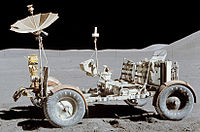
Eugene Cernan and Harrison Schmitt landed on the moon December 11. Their mission was J type, as were Apollo 15 and 16, which meant these missions were designed for a three day stay and included a Lunar Rover. This dune buggy looking vehicle allowed one or two astronauts to move further away from the Lunar Lander and greatly increased the usefulness of the mission.

Apollo 17 landed in the Taurus-Littrow region of the moon. This site allowed sampling a wide range of types of rock, as it consisted of an ancient lava flow, with surface broken by subsequent meteor strikes, and included secondary strikes. This means that ejecta from the nearby Tycho crater came to earth (came to Moon?) causing secondary, smaller craters at the Taurus-Littrow site. This allowed Schmitt to sample Tycho material even though an Apollo landing at Tycho never happened.

A few minutes before eleven PM, Greenwich Time, December 14, 1972, the last manned mission to the moon lifted off, to later rendezvous with the CSM and return to Earth. Gene Cernan was the last to enter the lunar Lander before take off. We’ll give him the final words:

“Too many years have passed for me to still be the last man to have left his footprints on the Moon. I believe with all my heart that somewhere out there is a young boy or girl with indomitable will and courage who will lift that dubious distinction from my shoulders and take us back where we belong. Let us give that dream a chance.”

==========

I’ve read a large number of memoirs by astronauts and others involved in space exploration. The Last Man on the Moon by Eugene Cernan and Don Davis is one of the best. If you want more of this story, that is the place to go for it.

441. The Last Apollo

“We leave as we came, and, God willing, we shall return, with peace and hope for all mankind.”        Cernan’s closing words on leaving the moon at the end of Apollo 17

Forty-five years ago, at 12:33 AM Eastern Time, the last manned moon flight took off from Cape Canaveral.

It was a stunt from the get-go. Kennedy’s speech, setting a goal of landing a man on the moon and returning him safely to the Earth, was a Trump-worthy brag. If we had failed, it would be laughed at today as just another empty promise made by a politician.

One man laid down the challenge and thousands of men and women carried out the promise.

But it was still a stunt. When Kennedy made his speech on May 25, 1961, Russian had put a man into orbit. We had not, although we had managed a sub-orbital flight. Atlas boosters were still blowing up on launch, so a smaller Redstone was used for Alan Shepard’s flight on May fifth.

NASA had only been in existence for three years. By any real or imagined yardstick, the Russians were far ahead in space.

By herculean efforts, NASA forged ahead through Mercury and Gemini. The fire aboard “Apollo One” set American efforts back significantly, and when launches began again, it looked like the Russians were going to land on the moon first.

There were Soviet problems however, particularly the repeated failure of their N-1 rocket. These doomed their attempt to reach the moon first, but NASA was not aware at the time.

NASA had problems of its own. The lunar lander was not ready when Apollo 7, the first actual manned Apollo flight, left for low Earth orbit in October of 1968. Only a year remained on Kennedy’s timeline, and the Soviets — we thought — were poised to land on the moon ahead of us. Something had to be done.

That something was the Apollo 8 journey to and around the moon, without a lander, for the Christmas season of 1968. We had been to the moon first (by an ad-man’s stretch of the truth), even if the Soviets became the first to land.

Apollo 9 tested the lunar lander in low Earth orbit. Apollo 10 (the most frustrating almost in human history) returned to the moon, deployed the lunar lander, and flew it to within wishing distance of the moon without landing.

Apollo 11 landed a man safely on the moon, and returned him safely to the Earth.

Now what?

For the Soviets, the answer was to turn away from the moon. Their N-1 mega-rocket had failed, and their manned modules and lander were stored away. The Soviets began a series of long flights and space stations, studying space from low Earth orbit.

For NASA there were nine more Saturn V rockets waiting to launch Apollo 12 through 20. It didn’t turn out that way. Apollo 12 landed in a different part of the moon, Apollo 13 suffered and explosion, didn’t land, and barely made it home.

Even before Apollo 13, Apollo 20 was cancelled so its Saturn V could be used to launch Skylab. Even before Apollo 14 landed, Apollo 18 and 19 were cancelled. Why? Because it was a stunt from the get-go. Apollo 11 met the deadline. To coin-counting bureaucrats, that was enough.

For those of us who see space exploration as the future of humanity, Apollo 11 was only the  beginning. Lunar exploration, a moon base, Mars. Venus — there should have been no end.

Bureaucrats did not agree. On Thursday, 1972, at 12:33 AM Eastern Time, the last manned moon flight took off from Cape Canaveral.

more next Thursday, the anniversary of the last liftoff from the Moon

438. Machine P

               Friends, I am amending this post as of June 1, 2018. I am changing it’s title from Machine P o r n. I have had more hits on this post than on anything I have written, but I have obviously just been generating frustration among those who clicked on purely because of the word P o r n. You will notice that I have also hidden the word itself from the view of crawlers.
              I like hits as much as the next blogger, but I’m not into misrepresentation. I am leaving the post otherwise intact, since it does have something non- p o r n ographic to say.

================================================

On Monday, we started talking about steampunk, then wandered into changes in science fiction and in real world technology. Picking up where we left off . . .

I always watch the PBS program A Craftsman’s Legacy. It is very steampunk, although that may not be obvious until later in this post. The most recent episode was a jeans maker. If I weren’t already hooked on the program, that’s something I would never have watched. In actual fact, the making of jeans was boring, but the program turned out to be twenty-five minutes of pure Machine P o r n. Through the whole show, every scene was an orgy of early twentieth century sewing machines of every specialized type, all whirring and clunking with their working parts in naked sight.

The only thing moving on a modern sewing machine is the needle, but there is a computer screen where you can tell it what to do. One modern machine will do more than a warehouse full of old ones, but but everything is hidden. It is a classic black box. It does stuff, but you don’t get to see how.

You can see the procession from hands-on to hands-off, and from visible to hidden in boy’s fiction. Tom Swift (later called Senior) could build anything with his own hands back in the twenties. Tom Swift Junior in the fifties and sixties could design anything, but he usually turned it over to his chief engineer to build the prototype. In the first Rick Brant book (1947), work on their moon rocket was delayed when they couldn’t get a certain type of tube (that’s valve in the British half of the world). By book number nine (1952), Rick was learning how to make printed circuits and was introduced to transistors. We watched him build a control unit, but once it was finished, it was sealed and no one else would ever see its guts.

Real science has followed the same progression. Galileo did his experiments by rolling lead balls down ramps. Today science requires a Large Hadron Collider.

Do I miss the good old days? Not at all. I’ve been living in the future since I was eight years old. I am pointing out that one byproduct of the Good New Days is that the working parts of everything are hidden, and that has consequences.

I spent the majority of my teaching career trying to make up for this loss. When I taught pulleys, I used homebuilt equipment with heavy weights so the kids could actually feel the difference when they changed the mechanical advantage. Every year, students were divided into teams of three or four and they all built gizmos, which were devices of their own design that carried out an assigned task. It was a different task every year and they were not allowed to take their work home, so Dad or older brother couldn’t cheat. All they had to work with was a shop full of tools, a pile of donated materials, and what they had learned. They had to see their gizmos in their heads and build them with their hands. No black boxes here.

Steampunk fits in here, as well. Steampunk is the meeting of the past and the future. As part of the past, it is familiar and understandable. It is also full of all the nineteenth, twentieth, and twenty-first centuries’ hopes and fears. Retrofuturistic is one word used to describe it, and it fits. Of course, as a word, retrofuturistic is as strange as the thing it points toward.

The clockwork aspect of steampunk is certainly one of its charms, especially in steampunk DIY and illustrations. We look at the pictures on the page, or the pictures in our mind while we read, and think, “I understand that. I could build that.”

And we could. Or at least the better, smarter self we all become when we sit down to read science fiction could.

In clockwork, once you take the back off the watch, everything is visible. If you look long enough, you can figure our what makes it tick.

437. Steampunk Clockwork

A great deal of the charm of typical (if such a thing exists) steampunk is that it replicates the sense of wonder of early science fiction, something that is missing 147 years after its beginnings. My math refers to the publication of Twenty Thousand Leagues Under the Sea in 1870. There have been a lot of stories in that century and a half, so it is just a little hard to come up with something new.

Fortunately for science fiction, there is a new crop of readers every generation. Things that seem old and overdone to long-time readers, seem new to them. When I first saw Weir’s The Martian I thought, “Again?”, but a half million readers on Goodreads rated it highly.

In old fashioned science fiction, the hero could do anything. And therefore, so could the reader.

Among that “anything” was a world of inventions that any boy genius could whip up in his basement. When I first read Tom Swift and his Electric Rifle (published 1911; it was left behind by my grandfather and I found it in the early fifties), Tom was just putting the finishing touches on his electric rifle, but before he headed for Africa with it, he whipped up a new flyer which was half aeroplane and half dirigible to use on the trip. Easy; any boy wonder could do it.

I haven’t seen that schtick since I was a kid in the fifties, and then it was usually in books from the thirties. I think we can blame Apollo. We all saw an entire nation spend a decade of time and billions of dollars to get to the moon. Thousands of workmen (and women) in all parts of the nation made the billion parts it took to undertake a moonshot. It no longer seems possible, even in science fiction, for Sheldon to build a moon rocket in a shed out back of the house.

When I was a kid, if I wanted to build a robot, it would have been made from tin cans, old sewing machines parts, and imagination. Now kids can build real ones (if their parents have enough money) out of plug and play components. Is that better? Is it worse? Decide for yourself, but it is different in a fundamental way.

It is all part of the digitalization of the world. And no, I’m not complaining. I’m writing this while sitting in front of a computer that makes my present life not only better, but possible.

Let’s hop into our time machine and watch it all happen. Let’s make it an even century.

In 1917, if you wanted to listen to the radio, the first thing you would do was build one, out of wire, a variable resistor, a capacitor, an appropriate piece of crystal, and a set of earphones. If you were really ambitious (or more likely, really poor) you could build the variable resistor and the capacitor as well. Everything would be in plain sight there on a pine board in front of you.

The next step was tube radios (that’s valve radios in the land of Britain). Tubes were an offshoot of incandescent light bulbs with more parts inside. Like light bulbs, you could see everything through the glass casing. Things had become more complicated, but you could still see the parts and follow their wiring.

Televisions worked like this as well, and as late as my childhood, hardware stores had a device with hundreds of sockets on top where you could plug in a tube from your TV or radio and check to see if it was burned out. They burned out frequently. If it was bad you could buy a replacement right there and fix the radio or TV yourself.

Then came printed circuits. You could still follow the wiring, but you had to turn the board over and look at the back side.

Then came transistors. They took the place of tubes, but they were tiny, anonymous nuggets with three wires and you could no longer see what their guts looked like. It was the beginning of major progress, and the beginning of the end of understanding.

Finally, integrated circuits arrived, and now you could no longer see the parts or the wires that connected them.

Now if something breaks, you throw it away. That isn’t really a problem, because things are cheaper, and the replacement is usually better than the thing discarded. In terms of practicality, things are better than ever.

In terms of understanding how our machines work, much has been lost.

But steampunk brings it all back. (more Wednesday)

430. The Rocket’s Red Glare

from Congreve’s original work.

“Oh, say can you see . . .”

No, this is not going to be about the NFL. It’s going to be about the rockets which figure into the anthem, into history, and into the steampunk novel The Cost of Empire, which I am now writing.

Rockets got their start in China, where they were used as fireworks and as military weapons. Just keep that in the back of your mind. We are going to start in the present and move backward in time, but not all the way to China.

When the average American sings the Star Spangled Banner — or mouths it, since it is a hard song to sing — it is unlikely that the image in his mind looks anything like the rockets which actually burst in air over Fort McHenry. My generation has V-2 rockets in our DNA, largely because early SF films used actual films of V-2 rockets as stand-ins before special effects were perfected. A later generation has Saturn-V rockets imprinted on their brain. To both, rockets are pointy ended cylinders with the flames coming out of the bottom.

Not so in 1814. The rockets that rained down on Fort McHenry looked more like fireworks rockets. They were called Congreves and a page of drawings of them is given at the top of the post. Some were explosive tipped. Some were parachute flares, which “gave proof through the night that our flag was still there.” All were guided, more or less, by a long stick that acted like a rudder, similar in function to the fins on a V-2.

They were nothing like accurate. That was the way of things before modern times. If you recall the battle of Agincourt in the movie version of Henry V, the English longbow men drew back together and fired hundreds of arrows simultaneously at a high trajectory, which rained down en masse on the French. The battle of Hastings was lost when King Harold Godwinson looked up at a bad moment and caught such an incoming arrow in the eye. Muskets in that era were also nothing like accurate, so lines of musket men firing together in the same direction managed to hit somebody, but probably not the targets they were aiming at.

William Congreve (not the playwrite and poet) gets credit and naming rights for the Congreve rocket, and he did make improvements, but his work was based on rockets captured in India.  Which brings me to why I’m writing this post. Here is a quote from The Cost of Empire. An Englishman who has gone native in India is speaking:

“About a hundred years ago this whole region was called Mysore and Hyder Ali was in charge. He fought the British and all the Indian princes around that kept shifting from the British side to his and back again. After he was killed, his son Tipu Sultan took over and formed an alliance with the French.

“It’s an old story. The same pattern happened all over India, as we British took over one region at a time. But this story has a kicker. Rockets.

“Rockets came from China. Everybody knows that, but they were widely used in India as well. Hyder Ali and Tipu Sultan used them extensively; some of their rocket brigades had over a thousand men. Rockets were made that exploded, that set fires, and even that had sword blades attached so when they came down spinning, they made a bloody mess of British ground troops.

“When the Mysore wars were over, the winners sent hundreds of captured rockets back to England. Congreve studied them and replicated them. The Congreve rockets we used all throughout the Napoleonic wars were just English versions of what Hyder Ali had used against us.”

The old guy is telling this story because a group calling themselves the Sons of Hyder Ali have built an arsenal full of rockets. They have bad feelings toward the British and a plan concerning the flotilla of dirigibles our hero is serving on.

I would tell you more, but that would be a spoiler.

429. Scales, digital and ridiculous

Ah, the good old days. They really sucked.

Even the phrase sucked falls into that category. I know that most of those who read this will not remember, but there was a time when nobody said sucked. It ranked up there with the “F” word. I remember when it arrived on the scene in my middle school students’ vocabularies, how it was an issue for a short time, and how two years later teachers were saying it. That’s what happens when a perfectly good forbidden word becomes common; it loses its flavor.

============

I have a great respect for Science Olympiad, but I never liked coaching, so I always volunteered to judge events instead. I enjoyed taking on new events that needed to be shepherded through their first year of implementation, and that led me to build a lot of gadgets to use in judging the contestants’ gadgets.

The people who think up new events in Science Olympiad often show an Olympian detachment (pun intended) from reality. Case in point — and forgive me if my numbers are off, I’m writing from memory — in two events students had to build light structures and test them to destruction. First it was a bridge, and a few years later, a tower. The lightest bridge or tower that held the most weight before failing won the event. There was a formula for weight vs. load, and specifications for what constituted failure.

The students applied the weight by pouring sand into a suspended bucket and there was a set maximum. If the structure held the maximum, the lightest structure won. If the structure failed, the weight vs. load formula was invoked. All in all, it was a well thought out event.

Except for one thing. The load was in pounds — up to ten, as I remember — and the weight of the structure was in grams. Let’s do the conversion.

1 pound equals 16 ounces
1 ounce equals 28.35 grams
Therefore, 10 pounds equals 4536 grams
And 9 pounds equals 4082.4 grams
That is a difference of 453.6 grams

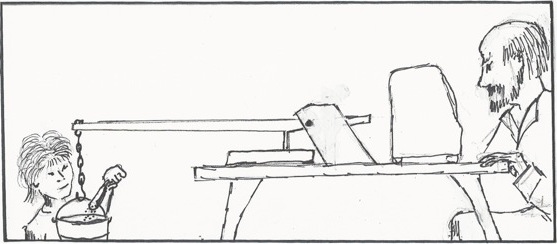
Did I lose you? Just look at the cartoon at the top for a moment, regain your equilibrium, and come back to me. There is no final exam on this. This is just memoir about how much fun teaching science can be on a small budget.

To measure mass in grams, you could use a triple beam balance available in any science class. To measure ten pounds, you have your bathroom scale. But wait a minute, that ten pound maximum-weight bucket of sand has to be measured in grams! How do you do that?

You do it with levers, using the gizmo pictured at the top of the page. I actually built it, and used it all the years I was associated with that event. The lever makes the scale read about 160 pounds when there are 10 pounds in the bucket. That spreads out the difference between two similar weights. The box the adult is staring at is my old Mac SE, with a preprogrammed formula in a database. The formula is:

Scale reading in pounds after the sand has been added (times) conversion factor to grams (minus) weight of bucket in grams ——- all this fed into the formula for comparing load in grams to weight of the bridge or tower in grams, a formula provided by Science Olympiad.

At the event, all I had to do was watch the contestant, and stop her/him at the moment the structure failed. He/she was only given ten pounds of sand to work with, so overfilling could not happen. I typed in the reading from the bathroom scale and the computer gave me the score — after I had built and tested the device, programmed the database, and provided ten pounds of sand, calculated to the nearest gram on the same device.

Fun? Of course it was fun. I volunteered to do this, remember?

Was it accurate? No and yes. No, there was too much friction for the gram readings to be accurate, but the friction was the same for every trial, so yes, the ranking of the contestants was completely reliable.

About three years after Science Olympiad retired the event, digital scales which would measure that much sand to the nearest gram became available for under five bucks at every-guy’s-public-man-cave, Harbor Freight. Thank goodness it didn’t come earlier and ruin my fun.