Tag Archives: seasons

284. Menhir, a winter’s tale 5

This is one installment of a twelve part excerpt from Valley of the Menhir. Check December 29 for an introduction to the novel.

When she was ready, Baralia let herself be fully seen. She was sitting at the high table when Marquart entered the great hall. He stopped, scowling at her presence; then he realized she was his phantom. He crossed to her and saw that the chair was quite visible through her body. He did not call her ghost. That word is not found in Lankhara, nor Renthian, nor in the language of the Inner Kingdom. Nor is the concept.

On Marquart’s world the souls of the dead are either enreithed or fade into nothingness within days. His world knows neither heaven nor hell, nor any other form of afterlife except the one that all men aspire to, the joining together at death through enreithment into a besh. Disembodied souls are abahara. An abahara that does not fade away cannot exist, so there is no word for such a creature.

Marquart said, “What are you and where do you come from?”

He took for granted that she was not of his world. There were other worlds, and menhirs were the gates to reach them; this Marquart knew. The Comanyi had come through the menhir on the top of Mount Comai to rule as Gods for a thousand years, and his world’s more recent Gods, Rem Ossilo and Hea Santala, had come in through the very menhir for which the Valley was named. Shapeshifters had come from Lorric; kakais and tichan had come in with the Comanyi. Marquart’s world had no concept of ghosts or heaven, but other worlds were well known to them.

There were even reputed to be dziais, men of power from Marquart’s world, who could tap the power of the menhirs and travel through them to other worlds.

Then, as Marquart looked closer, he realized that this apparition could be of his world, could even be from this region. Her dark hair, broad cheekbones and copper face could belong to the daughter of one of his own serfs.

Baralia saw that recognition, and answered, “I am of this place. This is my world.”

“How can this be?”

Hea’s geas had placed many constraints on Baralia, but telling the truth was not one of them. However, Baralia chose to simplify her lies by staying close to the truth. She said, “I died, and Hea Santala took me before I was enreithed and made me her servant.”

“To what end?”

“Ours is the menhir of her entry into our world, and she holds it precious. The worshippers of Rem Ossilo had it for a time, but Hea took it back so that the priests of our menhir now worship only the Damesept.”

Marquart nodded. This was common knowledge.

“Now there has been a change in the Remsept, and she felt the need for another, unseen watcher over that which is Hers.”

So close to the truth, as all good lies are.

“If unseen, then why do I see you?”

“Because I choose to let you see me.”

“Again, why me?”

“The menhir is Hers, the land is yours. It may be that to serve Her, I must first aid you.”

And she faded, leaving Marquart to stare at an empty chair and ponder how to deal with this supposed messenger from the Damesept. continued tomorrow
283. Menhir, a winter’s tale 4

This is one installment of a twelve part excerpt from Valley of the Menhir. Check December 29 for an introduction to the novel.

It was hard into midwinter when Marquart first caught sight of Baralia. To carry out the geas that had been laid upon her, Hea Santala had given the abahara the power to make herself seen and heard by Marquart, but she did not use this power until she knew him well.

When he first saw her, she was down a hall from him and she moved quickly around a corner. He rounded the corner after her, and saw no one. A day later she let him see her out of the corner of his eye at evenmeal, and disappeared as quickly. When Marquart inquired, none of the servants knew of anyone who matched her description.

She called Marquart’s name, standing invisible at his side as he watched the sunset. 

She let him see her reflection clearly in a polished breastplate as he worked at swordplay with his men, but when he turned, she was not there.

Later, when he had become attuned to her, she let him feel her presence without letting herself be seen. At night, as she stood at his bedside, staring malignantly down at Dael, he would waken and light a candle in the apparently empty room.

She went everywhere in the manorhouse. She saw every deed of malice, every slacking of work when no one else was looking, every thing that was stolen, every quick thumping of furtive loins when it was supposed to be worktime.

She watched Marquart undress at night, aching to touch his body, but unable. Sometimes when he woke in the morning, with a stiffened rod of flesh, she closed her translucent hands about it and felt nothing, as he remained unaware. She hated him. She lusted for him. She wanted to fly around the manorhouse and report to him everything she saw, and make him omniscient. She wanted to tell just the right lies, to send him to his death. He was the reason she was hung half way between death and life; and he was the only contact she had with the living.

She watched Dael when she sat naked on the bedside. She watched her breasts and longed to touch them, as she longed to have human hands caress her own transparent nipples. She watched when Dael lay back and spread her legs to reveal her secret place to her husband, and knew that no man would ever plumb her own depths again. As the weeks passed, she watched the slow thickening of Dael’s waist, and the rounding beneath her navel, and knew that this child would grow and be born, and that Dael would live to hold and nurse him. And she hated. Perhaps more fully than anyone had ever hated before. And could do nothing. When she ripped her fingers, clawlike, through Dael’s eyes, Dael never knew. continued Monday

282. Menhir, a winter’s tale 3

This is one installment of a twelve part excerpt from Valley of the Menhir. Check December 29 for an introduction to the novel.

“Clevis said that I should confide in you. That’s hard for me, but I will try, if you want me to.”

Dael was silent as she watched him, hunched over, rubbing his hands together. She had observed him closely this last month, as only a woman who has cast her entire fate and future into the hands of a stranger can watch. She knew how hard this speech had been for him, and she recognized it for the gift it was. 

She said, “I pledged you my loyalty, and you have it. I pledged you my body, and you have it. I pledged you children, and you will have them. I gave you all that when I did not know you, because you asked me, and because my brother’s letter assured me you were good and honorable. But if we could become more than just allies and bedmates, that would be wonderful!”

#             #             #

They moved to the bed quickly then, tearing at each other’s clothing. They were not alone. Baralia watched, as she watched every hour. When they fell together, Baralia gasped. When Dael cried out, Baralia groaned. Her hand moved to touch herself, but to no avail. She could no more touch herself than she could touch others. She screamed in the agony of her loneliness, and no one heard.

#             #             #

Marquart had arrived at Instadt two months earlier, carrying a bundle of letters from Reece s’Imbric. He had just left Limiakos’ service to take up lordship of the Valley, and Reece’s home was along the way. Imbric had given a warm welcome to his son’s friend and ex-commander, and it was there Marquart had met, courted, and married Dael.

Reece had told his family all he knew, but there was much Reece did not know. So that when Dael asked Marquart, out of the darkness of their shared bed, “What happened between you and the High King?”, he was not surprised that she wondered.

He gathered her hands between his and said, “I took Port Cantor in my own way, carefully, with much planning, so that both death and loss of property were kept small.”

Her hand, caught in his, pressed fingers against his palm, and she said, “Yes, I can see that that would be your way.”

“When the High King called me to an accounting, he was not impressed. He had wanted blood and slaughter.”

“But . . . why?”

“So that he could wander the battlefields where my troops had gone, feeding on the ai of the newly dead.”

“I have heard those rumors,” Dael said, “but surely . . .”

“They are not rumors. Limiakos told me himself, and threatened to have me killed so he could feast on my ai.”

Dael tore her hands loose from Marquart’s and threw her arms around him. He patted her shoulder and went on, “Instead, he said he had another job for me. Not as a commander in his armies – I wasn’t bloody enough – but as the lord of a small but troublesome demesne. This one.”

Dael asked, “Are we in danger?”

“No. Limiakos would have killed me and fed, right there in Port Cantor if the mood had struck him. When he said that I could still be of some small use to him here, he meant exactly that. He had no reason to lie. By now he has forgotten that I ever existed.”

For a time, Dael listened to Marquart’s breathing. Then she said, “This can be a good life here. A really good life.”

“Aye,” he grunted. “Lord of the Valley of the Menhir. Jor would kill to have that title and those prerogatives. But I was large in the world, and becoming larger. Now, this is as great as I will ever be.” continued tomorrow

281. Menhir, a winter’s tale 2

This is one installment of a twelve part excerpt from Valley of the Menhir. Check December 29 for an introduction to the novel.

Late in the afternoon of the fifth day, the storm abated, and by evening, it was gone. Marquart went out to the rimwall surrounding the top of the manorhouse to watch the sunset and try to guess how long the lull would last. He wanted to visit each of his wardens in his own house before the deep snow made travel more difficult.

The snow had stopped, but the sky was of low, unbroken clouds. The sun was setting red-bronze toward the western hills, painting the mounded snow in blue-gray and mauve.

Marquart leaned on the rimwall and smiled contentedly. Then he heard the cook’s cry; it was time for the evening meal. As he turned away, he realized that a part of his contentment came from anticipation. He was looking forward to seeing Dael. That he was looking forward to seeing her, was both a pleasure and a relief.

There had been plenty of women in Marquart’s life, but he had rarely spent more than a few days with any one of them. Fighting his way up through the ranks, he had always intended to marry, once he reached the station that required a wife. He had never particularly looked forward to marriage, nor was he prepared for the actuality of it, but here it was. And he was finding that he liked it.

In their chambers later, Dael shed her woolens for a light silk robe that clung to her lovely young body. He embraced her, kissed her deeply, and pulled her down beside him on the bed. He said, “What do you think of Clevis?”

Dael had not expected conversation. She said, “He is attentive and respectful to me, and he seems loyal to you. I like him better than the other two you brought with you.”

Marquart smiled. “Yes. Conger, and especially Hein, are a bit rough. They came with me out of loyalty, and that is worth a great deal, but they really don’t fit in here. Clevis is different. Clevis is like your brother Reece. They each came under my command when they were young, and as I trained them in my way of handling men, they became friends.”

“I’m glad you have a friend.’

“Dael, why did you agree to marry me?”

She wanted to give a stock answer, something out of a troubadour’s tale of romance, but she correctly judged that this was a time for honesty. She said, “Because you asked me.”

“I’m glad I did.”

She smiled and laid her head on his shoulder. “Thank you for that.”

“Did you know that Clevis was once married?”

“Clevis again!” she laughed, then sobered at once. “I am sorry,” she said, “Go on.”

“He said that I should confide in you; that I should tell you things I don’t even tell him. That’s hard for me. I almost never confide anything in anyone, but I will try, if you want me to.” continued tomorrow

280. Menhir, a winter’s tale 1

This is one installment of a twelve part excerpt from Valley of the Menhir. Check December 29 for an introduction to the novel.

The first blizzard of winter moved in, and for a week Marquart stayed close to home, studying maps, records and journals. He had a banner made with the sign of the striking hawk in black on a field of blue, and set it flying above the manorhouse. It was the first time his kladak had been used for anything but marking his personal goods, and it gave him pleasure. The Valley of the Menhir might be small, backward, and forgotten, but it was his.

The Valley was roughly round, roughly forty miles across. The River Gull divided it in two, flowing in through a gap in the western hills, picking up half a dozen minor tributaries and debouching through a wide, low gap on the east.  It was navigable only for nine miles, from the sea to the place where the menhir lay. On the coast was a small seaport, Port of the Gull, through which the valley’s exports passed, when there were exports.

The Weathermistress must have been in a nasty mood the day the Valley was created. When protracted winds from the west brought in hot, dry air from the Dzikakai plains, there was drought. When spring rains rode the seawinds from the south or east, there were floods. In all seasons, there was uncertainty.

On the north side of the Gull were Marquart’s direct holdings. To his east was Jor’s land. Technically, it was Marquart’s; if he ever chose to give it to another warden, it would be his right. But Jor had lived there all his life, and had the use of the land from his father, who had it from his father, who had originally been granted wardency by some lord whose name Marquart did not even know. So Marquart had decided to leave him in place, at least for now, and see if he had learned a lesson. Marquart’s soldier’s instinct said that Jor had not, but there was nothing to gain in precipitate action.

There were four other wardens, each with land and a fortified house. Wardency was a normal and reasonable way of distributing responsibility for the valley, but there was a catch. Like Jor, they had all lived for generations on lands they thought of as theirs. After generations of peace, every warden’s family was bloated with useless uncles and aunts and nephews and cousins. The serfs could not produce enough to feed them all.

“What this place needs,” Marquart said to himself, “is a good war to weed out the warrior class.” But he didn’t mean it. He had seen too much of war to want it visited on his new home. continued tomorrow

279. Introduction to A Winter’s Tale

My novel Valley of the Menhir starts with the coming of the Gods. An abbreviated version of this appears in 239. Morning of the Gods. Rem and Hea separate upon arrival. Rem begins to raise an army and sires a son, the Shambler, who will be the bane of his new world – and of Rem, himself. Hea, with the best of intentions, sets into motion forces she underestimates and soon cannot control.

In the world of the menhir, a soul, at death, is joined (enreithed) to a menhir, where it finds  both peace and a dissolution of individuality. The souls of those who die alone, or far from a menhir, shortly dissipate, dissolve, and cease to be. Every soul faces one fate or the other; there is no half-way state. There are no ghosts in the world of the menhir.

Yet.

Hea has a problem. She has placed a geas of infertility on Rem’s rampant son and has hidden his only child from him, both without the Shambler’s knowledge. That hidden child has grown and sired two sons of his own. Hea has seen that the offspring of the next generation will be a force to save or destroy the world of the menhir. She does not know which. The unborn’s power clouds the runeboard, leaving her uncertain of what path to take.

The Shambler is driven out by his father, then returns to kill him and take control of the army he has raised. Now Hea has to act, but without a clear knowledge of what will result from her actions.

Hea does know that she cannot let the Shambler find out about his offspring. But to watch over them herself would, by her own presence, bring them to the Shambler’s attention. She makes a fatal compromise. She chooses to stand between the soul of a newly dead, Baralia, and her enreithment. Hea makes Baralia a tortured ghost — a soul hung half way between death and her final rest — and forces her to watch over Marquart, who will be the father of the coming nexus of power. It is a fatal error.

If Baralia cannot know peace while Marquart lives, then he will not live long.

            *             *

That’s a lot of narrative to densepack into the first eighteen pages of a manuscript. Marquart will be our main character until Tidac, his son, eclipses him in our affection.

We meet Marquart as he enters the Valley of the Menhir. The High King has given him lordship over the Valley, but he isn’t happy about it. He has been dismissed from service, and given this troublesome valley to rule. You’ll get the details over the next two weeks.

Marquart finds that another has taken his place as Lord of the Valley, subdues him handily, and makes a life-long enemy. No matter; he is quite capable of dealing with human enemies. The ghostly figure of Baralia, who will attach herself to him like his personal Iago, is another matter.

The story of Marquart’s first months in the Valley of the Menhir is A Winter Tale, driven by hunger for power, hunger for importance, and the sheer hunger of starvation. Marquart has inherited a land where there are not enough serfs to provide for the mass of useless nobles, and still have enough food for themselves. This is the first problem Marquart sets out to solve.

Normally all this would be presented in Serial, but Raven’s Run will have that side of the double blog tied of for some time yet. A Winter Tale will appear in A Writing Life through the first three weeks of January. 

Enjoy.

278. The Veil is Thin

Christmas, the most beloved holiday, has passed. Five days ago, the sun ended its southing and began its return, but still the days of darkness are upon us. The veil is thin between the worlds, and for a time, the order of things is turned upside down.

Now the calendar year is ending and there are festivals, but sometimes they don’t make sense because they have migrated beyond their origins. They grew up in one place, and are now celebrated in another. Christmas in Europe and America means snowmen and a roaring fire in the fireplace. Christmas in Australia means sunbathing, surfing, and a barbie on the beach. (That’s barbecue, not the excessively-skinny doll.)

Thanksgiving is an American holiday, full of New England foods like pumpkin pie, cranberries, and turkey. Right? Maybe. Under the microscope, it is exactly that. Looked at from a greater distance, it is one of a hemisphere-wide set of harvest festivals. This is not a global phenomenon, however. These festivals are tied to the temperate zone, where the cycle of the seasons rules all human life.

My interest in all this began with Christmas, but I came to realize that Thanksgiving, Halloween, Christmas, New Year, St. Nicholas Day, Boxing Day, and a host of other holidays are all variations on the same theme.

There are three facets which these holidays share, in varying degrees. First is food, precious, and only temporarily abundant. Before Santa Claus and Walmart made Christmas a lynchpin of the economic system, gifts were small, and often consisted of food: apples, oranges, and cookies or other sweets.

You might remember from any of the movie versions of A Christmas Carol, that Bob Cratchit buys apples for his brood, while Tiny Tim wishes he could have oranges. Oranges were imported from the tropical realms of the British Empire and would only be found on the tables of the rich. In agricultural Europe, the harvest season filled the larders of the rich, but not so much the larders of the poor. With the onset of industrialization – the world of Bob Cratchit – this disparity became even more pronounced.

This is the second facet of these holidays, that those below beg or demand their share from those above — wassailing, often riotous, in the past — trick-or-treat today.

The third facet is the thinning of the veil between the worlds, with visitations from the dead. We don’t usually think of Christmas that way, but wait. The sub-title of A Christmas Carol is A Ghost Story of Christmas. And there are the four ghosts. Yes, four — don’t forget Marley, who says:

“It is required of every man . . . that the spirit within him should walk abroad among his fellow-men, and travel far and wide; and if that spirit goes not forth in life, it is condemned to do so after death. It is doomed to wander through the world – oh, woe is me! – and witness what it cannot share, but might have shared on earth, and turned to happiness!’’

So mix and match to suit yourself, and you will see that all these holidays of fall and winter are defined by the same three facets.

          *           *

I polished my understanding of the interrelationship of the holidays during this last decade, but much earlier I understood to role of food and the onset of winter. Early in my writing career, I began the Menhir series, set in a realistic fantasy world where the hand of hunger lies heavy.

Midwinterfest was in a time of plenty. The tichan and cattle who were least valuable to the herds had been slaughtered as soon as the cold had set in reliably. Frozen carcasses hung in meatsheds all over the Valley – indeed, all over the Inner Kingdom. Hunger would come in late winter, as it always did.

The hardest months of winter are not the first, nor are the deepest the most cruel. As spring approaches, and the days lengthen, winter hangs on, well schooled in snow and ice and cold, and unwilling to relinquish its hold. Then, when the first green of spring is only a month away, comes the dying time.

An excerpt from that series, called Menhir: a winter’s tale, begins tomorrow.

277. Fire and Ice

Some say the world will end in fire,
Some say in ice.
From what I’ve tasted of desire
I hold with those who favor fire.
But if it had to perish twice,
I think I know enough of hate
To say that for destruction ice
Is also great
And would suffice.
            Robert Frost

Both Dante’s inferno and a comment to Frost by astronomer Harlow Shapley are given as the inspiration for Frost’s poem. I’m in no position to argue with scholars, but for me it reeks of the North, of Up Helly Aa, of Bifrost and Valkyries, mead halls and winter warfare among Viking people.

Imagine yourself there, in your stave hall before the fire. Surrounded by your kinfolk, safe from the howling wind and deep frost outside your walls. Feasting on meat and mead.

Midwinter has come and gone. You have celebrated with bonfires. Now begins the long wait for spring, for the return of the absent sun.

It is a time for feasting, and for the telling of tales. Tales of Frost Giants and the Fenris Wolf. Tales of Odin sacrificing his eye for wisdom. In the great north, even the Gods live a harsh life. See him there in the corner, in the shadows near the roofbeam, just an image carved in swirling smoke, with Huginn and Muninn on either shoulder.

Old tales and new.

Agnar is speaking now. A third mead has loosened a tongue normally silent. He tells of last summer, of the fogs and waves and heaving seas, of cliffs towering black and high, wet with spume and crowned by the massed nests of fulmars. And of the soft coast, the green coast, the coast of Ireland where soft monks in black robes keep food and drink in quantity and spend their days illuminating manuscripts.

Look at the manuscript there, leaning against the wall at Dagmar’s elbow. Drawings of strange men tangled with curling letters that no one in the hall can read. Tales, no doubt, but of what value? Soft tales, by soft monks, without blood or fire.

The monks had no fire, no courage, but they had blood. Agnar and his men set that blood free to wet down the stones of their chapel. A short fight, and much treasure. Not much battle for a Viking’s tale, but sometimes it is good to tackle an easy foe.

Then Fannar raised his hand and hissed, and all fell silent. Fannar’s ears were legendary. He could hear a sword whispering from an oiled sheath, or a fur clad foot falling in a snowdrift.

They all heard, now, what Fannar had already heard. A thump and hiss, followed by another, and then a third. Soft. Almost like a clump of snow falling from a pine.

Or like torches falling on thatch.

There were no windows in the hall and only one door. They had told their tales and drunk their mead in darkness, lighted only by the hearthfire, but now it began to grow light as the thatch above began to glow, and to stare down at them with a hundred crimson eyes.

Then came the shout. Fifty voices if there was one; fifty strong male voices. In Agnar’s hall were nine men, and their women, and their children. The men leaped to their feet together and went weaving and staggering to take up their swords and axes. Hanne, Agnar’s younger wife bent double, placing her body between the child she was nursing and the burning thatch that now began to fall like rain.

Even if nine could win against fifty, the hall was burning. There would be no more shelter and no more food. It took the heart out of a man, and they screamed out their hatred to bring fire back to their blood, so they would not die soft, like the monks of summer.

Agnar threw open the door, axe in hand. Hanne crouched on the floor, protecting her infant a few seconds more, though her hair and clothing were afire.

Agnar plunged out into the frigid night. Hanne curled tighter around her daughter.

Some say the world will end in fire,

Some say in ice.

Take your choice.

276. Wild Parties Never End

154px-uphellyaa7anneburgess30jan1973Wild parties never end, they just get organized. And maybe slightly domesticated. Consider Mardi Gras. Better still, consider Up Helly Aa.

It is said that fishermen can never get far enough north. Fishermen from Indiana go to Michigan. Fishermen from Michigan go to Ontario. Fishermen from Ontario head for the Arctic.

I found the same thing to be true when I visited Scotland. The first trip I made it north to Caithness. The second trip I made it to the Orkneys. Eventually I made it to Shetland, and once there I worked my way up to the northernmost point on the British Isles.

I didn’t see Up Helly Aa. It comes the last Tuesday in January, and in January I will always be in California, not standing in the wind off the pack ice. But I wouldn’t mind beaming in, watching the festivities, then beaming back before my liver froze.

Up Helly Aa is a relatively new celebration of the end of the Christmas season, mixed with a revival of old Viking themes. As early as 1824, on Christmas eve, a diarist recorded:

the whole town (of Lerwick, Shetland’s capital) was in an uproar; from twelve o clock last night until late this night blowing of horns, beating of drums, tinkling of old tin kettles, firing of guns, shouting, bawling, fiddling, fifeing, drinking, fighting.

If you followed the posts on The Battle for Christmas, this will sound very familiar. Christmas has been domesticated since this report, but the spirit of riot is well represented in Up Helly Aa.

It began as “tar-barreling”. Mobs of masked young men dragged barrels of burning tar through the streets of Lerwick, often colliding with other mobs, and clogging the narrow streets of the town as they made their way toward the harbor. Sober citizens were not amused. The Town Council appointed constables to keep things in check.

About 1870, the participants themselves began to change the proceedings. They invented the name Up Helly Aa, began a torchlight procession, and introduced ‘guizing – going in disguise. Soon Viking themes became common. By the 1880, Viking longships were being dragged through the streets instead of flaming tar barrels, and the ‘guizer Jarl (Jarl is the Viking equivalent of Earl) had become master of ceremonies.

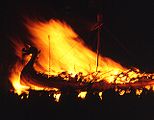
Is there anyone who doesn’t know that dead Viking chiefs were put on their longships, and the ships burned? That’s what happens in modern Up Helly Aa. The purpose-built longship is dragged by torchlight, by masses of young men in Viking costume, down through he narrow streets to the harbor where the torches are all tossed aboard for the fiery finale.

Then the drinking starts in earnest. Who wouldn’t love that?

The day after Up Helly Aa is an official holiday so everyone can recover.

275. Christmas for Lupe

Today is Thursday, December 22, 2016. Christmas will be Sunday, and this is my last post until then.

I’m going to tell you a story about a little girl I know. This is how she will spend her time today, as you enjoy preparing for Christmas.

*          *          *

Ramon came in, stamping the snow from his feet, and shook the snow from his jacket before closing the door. The sun was low in the eastern sky behind him as Lupe moved up and hugged his leg. He smelled of sweat and manure and soured milk, but she didn’t mind. She had hugged him this way every morning for as long as she could remember, and he always smelled the same. For Lupe, the smell was as familiar and welcome as his cold fingers on the top of her head.

Every morning Ramon rose before the sun was up, and left the house. His daughter greeted him when he returned hours later, and saw him off again in the afternoon. She was usually asleep when he came home at night.

It is hard work milking cattle twice a day, and the pay is low. The cattle march in from the muddy lots to take their turns in the stalls, where fast moving men attach the milking machines. The cattle resent the process and the workers have to move quickly to avoid having their hands caught against he stanchions. It goes on for hours, in heat or cold, beginning every morning before daylight, and continuing again every evening until long after dark.

Lupe stepped aside to make room for her mother. Today she seemed worried; her voice was unusually sharp as she asked, “What did he say?”

Ramon said, “I didn’t tell him.”

I translate, of course. Every word was in Spanish.

“You got your money for the week?”

Lupe’s father nodded, “I told him I needed it today, to buy things for Christmas. I was afraid to tell him the truth. He is a good man, but it seemed best that he should not know.”

Lupe’s sister came out of the single bedroom with a cardboard box in her arms, tied up with twine. Lupe looked up with interest. It was not wrapped in paper, but any box is interesting so close to Christmas. Carmella put the box down on the floor and returned a moment later with blankets and bedding, also rolled up and also tied up with twine. Lupe asked what she was doing, but Carmella ignored her.

Her father carried the box and roll outside. Her mother came out of kitchen with a box of food, and that began a procession of boxes, coming from various parts of the house and out to the car. Lupe’s mother and sister had gathered their possessions during the pre-dawn, while Lupe slept.

Now Lupe dragged at her mothers leg asking questions, but she was ignored until Carmella pulled her aside and said, “We are going away.”

“Where?”

“I wish I knew Lupita. I wish I knew.”

“But why?”

“It’s only a month until he becomes President. Everyone here knows who we are. We have to go away, somewhere where people don’t know us.”

“But why? I was born here. This is home.”

“So was I, Lupe, but mother and father were not.”

When they pulled out an hour later, Lupe stared back at the little house where she had spent her whole, short life, until it disappeared around a bend. Then she looked out the windshield, past her mother and father’s silent heads. It was a long road, wet with melted snow. Her father would not leave the house tonight before the sun went down and go to the cows. There would be no more money, no more warmth, no more little house. It would be again as it had been, before the job at the cows, before she was born. Lupe knew what that was like from hearing her parents talk. Now it would be like that again.

*          *          *

Is Lupe real? She was born from the hundreds of little Mexican-American girls I taught over twenty-seven years. How many were undocumented? I never knew. I never asked. I didn’t need to know.

Is she real? She is as real as heartache. She is as real as fear. She is as real as dislocation, cold, hunger, and injustice.