Tag Archives: seasons

274. Solstice: a poem

DSCN4794This is the day that the sun has turned it face furthest away from our northern lands. The veil between the worlds is thin today. Among pagans, there is expectation of visitation from those who have gone on before, and among all men there is an understanding that individuals, like the years they inhabit, have ends as well as beginnings.

Solstice

It hardly seems an hour
since the sun rose up
into the crystal sky.

Now it sinks westward into clouds
like a crimson bird, descending
slowly into gray.

A bitter wind cuts deep.

I was young this morning
and worried already
about the end.

Now that I’ve known
both youth and age . . .
They are no different

Tonight I am cold,
        but I’ve been cold before.
I’ll sleep well under blankets
        that trap what little warmth remains.

Good evening, sun.
I thank you for the day you gave me.
Now the long night begins.


I will see you in the morning
           And if not
That will be all right, too.

272. The Hard and the Soft

DSCN1841Welcome to winter. For northern folk, and that’s what we all are in Europe and America, the coming of winter is an inevitability that rounds out our lives and prefigures the end of our lives.

The poem which follows is not full of summer graces, nor flowers, nor joy. I wrote it in August, when the temperature outside was above a hundred, but it is still a winter poem. I would say I don’t know where it came from, but that would only mean that it came unbidden when I was working on other things. It was committed to paper in five minutes, in its first form, and polished in twenty. That is rare for me.

In truth, I know where it came from, and so will you.

The Hard and the Soft

There is a soft season and a hard season,
And now the hard season has come.

Through the springtime and the summer,
When green was the color of the world,
Fruits of the earth abounded.
Children were conceived in joy
And brought forth in fullness.

Now is the hard season,
The color of the earth is stone gray,
The water is hard and the ground is stony hard.
Children of this season come out hungry
Crying with harsh voices that give no joy,
Troubled by deep hungers that allow no rest.

She was born of summer,
He was born of winter.

They joined together, and she made him whole,
     for a space,
          for a little space.
But now it is the season of cold
And he has turned back
     to his true nature.

267. Books Under the Christmas Tree

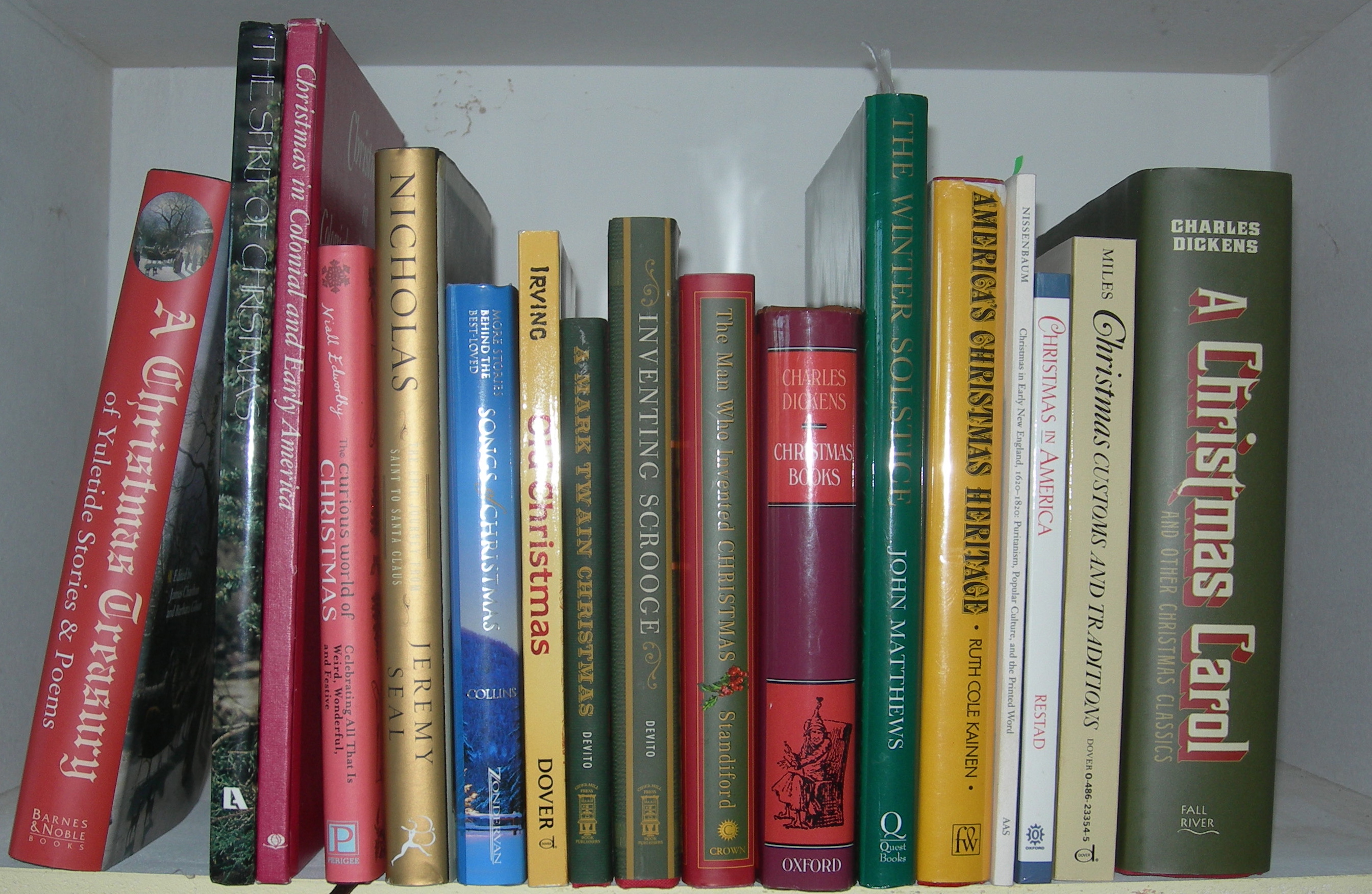
DSCN3974This is a slight reworking of post 60. Thank You, Harold Goodwin

I have a December birthday, which worked out well as a kid since books were my favorite gifts, and winter is a prime time for reading. The books I got were locally sourced and cheap, mostly published by Grosset and Dunlap, Whitman, or Golden. For anything by a normal publisher, I depended on libraries.

Nobody, not even Heinlein, wrote better juveniles than Harold Goodwin, although the comparison is apples to oranges. Heinlein’s juveniles were set in space and used future science reasonably extrapolated from the present. Goodwin’s stories, with one exception, were set in the present and built on extant science.

If you’ve never heard of Goodwin, its largely because he worked under the pseudonyms Blake Savage and John Blaine. If he gets no respect, it’s largely because he was published by Grosset and Dunlap. That meant Goodwin’s Rick Brant books shared bookstore space with Tom Swift, Jr and the Hardy Boys – series that were written to outline by anonymous authors.

I read all three G & D lines as a kid. They taught me to read and to love reading. But when I try to reread Hardy Boys books today, they come off dull and dumb. Tom Swift, Jr. – well, I can’t force myself through them.

Rick Brant holds up. A few years ago I reread the whole series from start to finish and they were as good as I remembered them. The same was true of Goodwin’s single outer space adventure, sometimes titled Rip Foster Rides the Gray Planet and sometimes Assignment in Space with Rip Foster. You won’t find Rip in a used bookstore, although he shows up occasionally in antique stores, right next to the BB guns and old, rusted roller skates. (See Monday’s post for a source.)

Rick Brant lived the perfect life. I would have traded with him in a heartbeat. He had adventures, twenty-six eventually, which he shared with Scotty (Don Scott) who was the ideal older brother figure. They appeared to be seventeen and eighteen in the first book and were still the same age forty-three years later. That’s good work if you can get it.

Rick lived with his family on Spindrift Island where his father was the head of a diverse group of scientists. Each had a different specialty, allowing for a wide range of stories, and they formed a dozen of the best uncle figures any boy could imagine.

Rick was bright and a bit precocious, but he wasn’t a wunderkind. Elsewhere he might have seemed nerdy, but on Spindrift he simply seemed a bright young scientist among brilliant experienced older scientists. He was always learning. He often saved the day, but he never had to save the world. In short, he seemed real.

The same timeliness that made the Rick Brant series perfect for its time makes it seem a bit dated today. A kid with a smart phone is not likely to be impressed when Rick invents a miniature walkie talkie, and that’s too bad. However, if you have a kid with an e-reader, and you can’t keep him supplied with enough good books, Rick Brant is available on the internet. For fifteen minutes of your time and no dollars, you can send him to Spindrift. The experience might surprise both of you.

Or maybe you remember reading one or two of these books yourself and want to indulge in a little nostalgia. Christmas is a good time for that. I’ll give you the details tomorrow.

259. Turkeys Under the Oak Tree


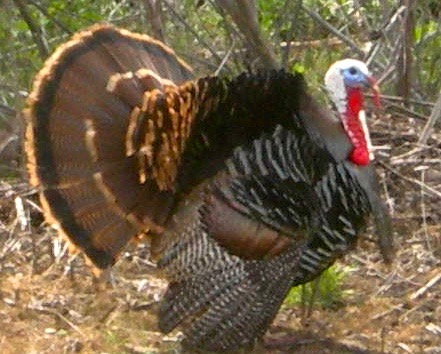
dscn0719dscn0693These birds were photographed on a spring drive through the foothills, about twenty miles from my house. The puffed up, greeting card version is what the males look like in season, when they are strutting their stuff and looking for love. The other bird is what most turkeys look like, most of the time.

You are reading this on Thanksgiving, but I am writing on September 27, about something that happened yesterday. My wife came to the door of the little building out back where I work and said, “Come here. Quietly.” There were ten wild turkeys eating bugs and acorns along the east side of the house.

We don’t get turkeys very often right up to the house, although seeing them in the neighborhood is a common occurrence. We stood for twenty minutes watching in the hundred degree heat of the tag end of summer before they casually wandered off.

Turkeys are the symbol of Thanksgiving, but I was thankful to see them because wild things fill my life with joy.

I grew up on a farm in Oklahoma in another century. I worked long hours when I was growing up, but I worked outdoors, so it might have well have been play. The music that filled my life was the churr of cicadas on summer evenings and the howl of coyotes echoing through the frosty night air in winter.

I left the farm for college, then spent my adult life in a small city, and moved to the foothills when I retired. Now my human neighbors are near enough for help in emergencies, but far enough away that I don’t hear them when they fight. I don’t even know if they fight.

Several times I have seen packs of coyotes running through my yard. Once a mother duck with nine ducklings following single file paraded through. Deer come in from time to time. They mostly prefer the low ground, and we live on a hill, but they come for water as the long days of summer dry out the last of their water holes. I keep water in bird baths for the birds, and water basins on the ground for everybody else.

The deer also have an uncanny knack of knowing when the tomatoes are ripe. Oh, well.

I see a bobcat about once a year, somewhere nearby. Twice they have come into our yard. Once I looked out the window to see a bobcat in the fenced back yard where stray cats stay out of reach of coyotes. My wife and I watched out the window as he sauntered along, unaware of us, then casually jumped the six foot fence without touching it.

We were even visited one holiday by the Christmas Pig. It was a three hundred pound porker who had obviously escaped from some farmer. I saw him several times after, so I’m maintaining hope that he was never found, and escaped becoming bacon and sausage.

So, happy Thanksgiving to you. And also to the turkeys and ducks and bobcats and raccoons and possums and the one lone pig.

In my house, Thanksgiving means turkey (from the supermarket, of course), stuffing, cranberries and pumpkin pie. Being thankful means looking out my window and never knowing what kind of critter might be looking back.

255. Fire

dscn2539For writers – or anyone who is leading a thoughtful life – every day brings experiences that add to our understanding of the world around us. For the last half decade, my tutor has been fire.

I took the photo at the top of this post a few years ago, while standing in my front yard. The smoke was only about three miles away and my first thought was, this is finally it. Fortunately, it was on the other side of a lake that lies in the valley between my house and its location. We drove to a vantage point and spent an hour watching a scoop-equipped helicopter dropping down to the lake for loads of water, and dropping them on the fire. It took several days to put it out, so for a week we could not open any windows because of the smell of burning.

There have been weeks in late summer almost every year recently, when the smell of burning kept us indoors. You could blame our long-running drought, but that isn’t it. When there is little winter rain, things become unnaturally dry, and there is fire. When there is abundant winter rain, the grass and weeds grow tall and lush, and there is more fuel for the fires that still come.

Arthur Clarke wrote a story called Report on Planet Three, in which Martians, observing Earth through telescopes, concluded that life could not survive here because the atmosphere was so rich in oxygen that Earth might have open fires as a natural phenomenon! When I first read the story as a youth in Oklahoma, I found it humorous. Now that I live in the foothills of California, I say, “Yep, Arthur, you got another one dead right.”

A few years ago, a target shooter started a fire that burned into Yosemite. Three years ago, north of here, an illegal campfire was the spark. Two years ago, east of a foothill town I visit frequently, it was untrimmed trees rubbing against a power line. This year, someone pulled off the road into dry grass and his hot muffler started a thousand acre burn just a few miles from my home. That was the fire that caused me to write this post.

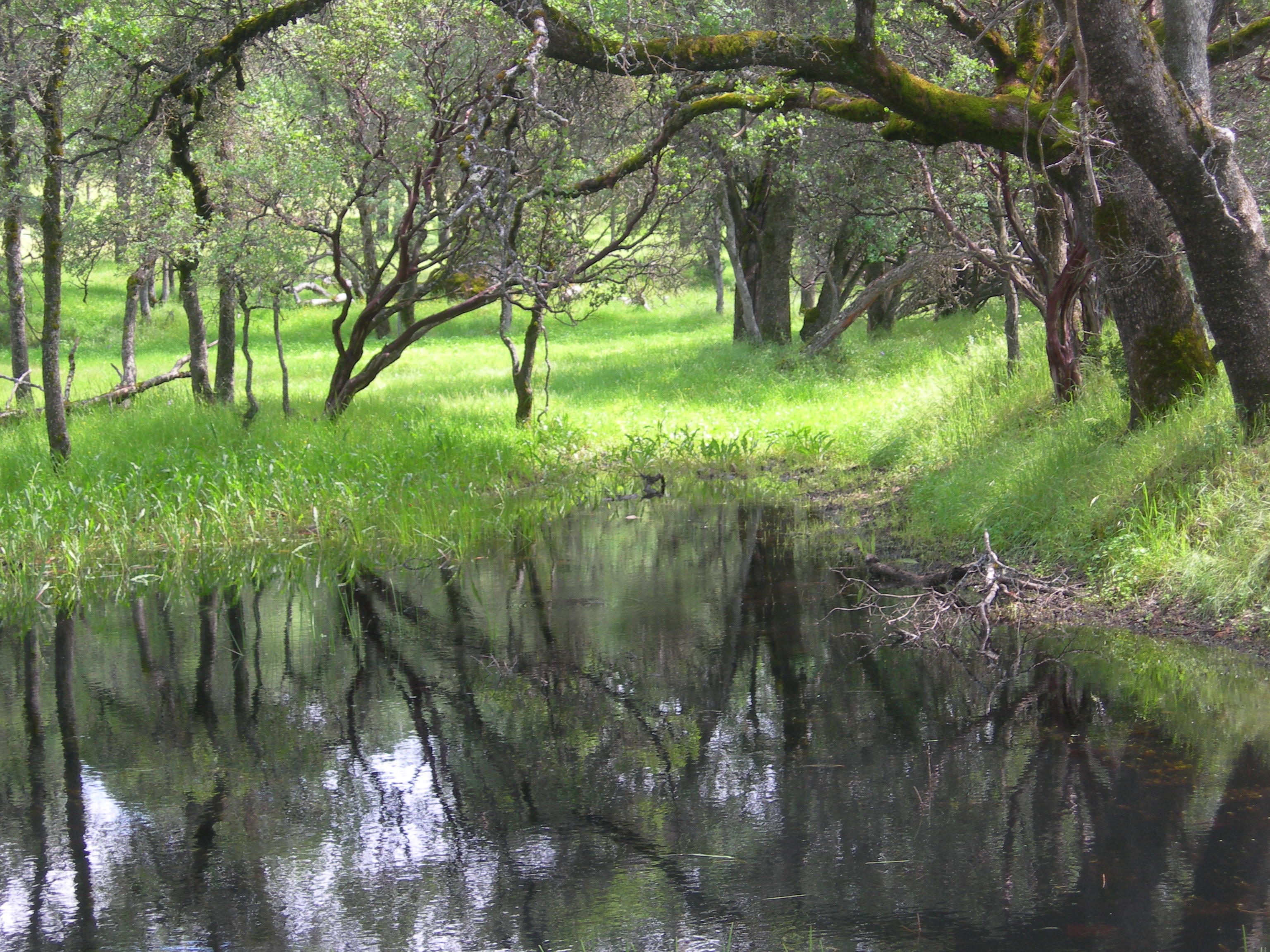
dscn4753Here is one of my favorite places. It is a vernal pond; man made, but fleeting. Right now it is probably filling with water, as it does every fall. It will look this beautiful until spring – maybe.

In the coverage of the fire this year, a newscast showed a reporter standing on a black top road. One side was untouched; the other was fire blackened. It was the point at which the fire had started, and I recognized it as the place I park when I go to the pond. I couldn’t tell whether the reporter was facing north or south, so I don’t know if my favorite place was saved, or destroyed. I haven’t yet had the heart to drive up and find out.

In my writing, I have brought nuclear war to Earth in two different fictional universes. It’s easy. I don’t see many movies, but everyone sees their trailers on TV. Massive, ubiquitous destruction prevails. A kid with his own camera and computer could illegally produce his own apocalyptic vision, using FX stolen from Blue-ray. Washington and New York have each gone up a dozen times in the last few years. He would have an abundance of destruction to call upon.

Bringing massive destruction over there is easy and cathartic. Dealing with even small destructions right here is another matter. I had no problem blowing up the Earth, twice, but I dread driving up to see if my favorite pond is still there.

244. Walking by Night

outhouseHere in California, Halloween doesn’t look like itself any more. I suspect the same metamorphosis is taking place across the country. Images from the Mexican Day of the Dead are everywhere, competing with Anglo witches, ghosts, goblins, and jack-o-lanterns.

It’s no surprise, really, since Halloween has become a $econd Chri$tmas, in terms of commerce. I have no trouble understanding why retailers are producing big-eyed, flower painted skulls for sale. I have some trouble understanding why anyone is buying them.

As a matter of full disclosure, I don’t care for Halloween, and at both ends of my life I have had little to do with it. In the middle, when I lived in cities, I hosted the trick-or-treaters who came to my door, just like everyone else. I admit the mid-level kids were fun and putting up with a little pleasant extortion was just being a good grown-up. I wasn’t much impressed by the adults with infants in arms, or the overaged teenagers who grunted and threatened like gang bangers. But many Americans have no sense of age appropriateness, so they were no surprise.

Anyway, I would be a hypocrite if I hated trick-or-treaters after all my praise of Christmas last year. After all, trick-or-treat and wassailing are the same ritual.

I haven’t had a trick-or-treater at my door since I retired to the foothills, and that brings me full circle. When I was young – during the fifties in very rural Oklahoma –  we didn’t trick-or-treat. We were simply too spread out. It would have been impossible to walk to anyone’s house, and in those days parents weren’t about to drive their children all over the county just for their amusement.

Instead, the local tradition was ritualized vandalism by teenagers. That was the night outhouses got turned over – and yes, people still used them. Windows got egged, toilet paper got tossed, there was even some graffiti. In Oologah, the next town south, I saw a business sign which had been tagged with Oologah hoars. Vandals couldn’t spell back then either.

As October rolled around, all the adults started telling outhouse stories from their misspent youths, and current youths started planning. I took no part in any of it, but I heard it all, and one story in particular caught my fancy. I think it was true; at least I knew the old lady in question.

She lived in a little house in town, with no plumbing and an outhouse out back. Every year somebody turned it over on Halloween, and she was tired of it. This year, she went out when it was still light and settled in to wait with a shotgun across her knees. Eventually it got dark, and eventually she heard whispers and the first creak as the local teenagers got a grip the outhouse. She threw the door open, leaped out and gave a mighty scream, and fired both barrels into the air. When the echoes cleared, there was no sound but retreating footsteps.

The old woman went to bed with a smile on her face. The would-be vandals, once they recovered from their fright, had the memory of a priceless adrenaline rush and a story to tell for the rest of their lives.

I love it when everybody wins.

237. Rain

dscn4753This is a vernal pond, a few miles from my home. It will fill with water by Christmas and be dry again by Easter.

Let’s take a break from the world of politics and check into the latest meteorological phenomenon.

It rained last night.

That may not be a big deal to you, but here in the foothills of the Sierras it represents the change from one season to another in a climate that only has two seasons – dry and wet.

Our last rain came in mid-April. Six months without a drop. You may have heard that we are in a drought, but this is a different phenomenon. It is normal here for the last rain to come in mid-April, and normal for the first rain of the rainy (if that is the word) season to come in mid-October. Our drought is because we haven’t been getting enough rain between October and April.

So what does that have to do with my world of writing science fiction? Everything, really.

When I was young, my three favorite SF authors were Clarke, Heinlein, and Norton. Clarke’s stories always took place in artificial environments. Heinlein’s characters inhabited space ships, orbiting habitats, or frontier worlds; it didn’t matter, as long as they could talk incessantly, they were happy. Andre Norton characters, whether they were explorers, soldiers, spies, or interstellar traders, always spent their time outdoors, in wilderness or something like wilderness. The only cities you were likely to see in a Norton novel were in ruins, or the slums of the Dipple which any one of several young men were quick to flee from, usually into more trouble than they could imagine.

That suited me just fine. Her worlds were my world. In rural Oklahoma, I spent from May to September every year outside, usually driving a tractor, through rain, wind, dust, and heat. There were years when I watched the crops dry up and die under the relentless sun – and watched my Dad see six months work disappear before his eyes. There were other years when the rains came on time, the crops were good, and the pastures grew up heavy with grass; when the nights were a symphony of insect whirrings and the days were filled with bird songs and butterflies. Cliché? Paradise always sounds like a cliché.

It was the only life I knew, and I loved it, good years and bad, but I had to leave it, first for college, then to make a living. When I wrote my first book, I sent my protagonist into the mountains and lost him there, then let him find his way out. For my second book, Jandrax, I marooned a shipload of colonists on a barren, unexplored world, and watched them find a way to survive. In Cyan, coming out in a few months, I send a crew of ten to explore a rich new planet, then send them back to colonize.

I lived in a small city for most of my life. I could write about cities, but I don’t want to. My world is the world of nature –  even if it is nature on another planet.

So— it rained last night. About an inch, which isn’t much, even by Oklahoma standards, but the foothills only get thirteen inches in an average year. All the creekbeds remain empty and the hills remain covered with tall, dead grass in shades of brown, but within the soil, the change has begun. Seeds that have lain dormant since spring will be sprouting now, out of sight, and within a week there will be a faint haze of green, invisible beneath the long grass, but showing in the road ditches. This year’s grass will begin to flex its vegetive muscles, forcing its way upward through last year’s dead roots. Unnoticed, those roots will begin to loosen and be shoved aside until one day, a month from now, seemingly all at once, the old year’s grasses will tilt and fall, to disappear beneath the new green.

Suddenly all the brown will be gone and the new year’s grass will clothe every hillside. While the snows of winter cover the midwest, these Sierra foothills will be spring green, and the wildflowers will return.

171. Solstice Measured

so me

This is a follow on to Monday’s post. If you haven’t read it, you might want to give it a glance.

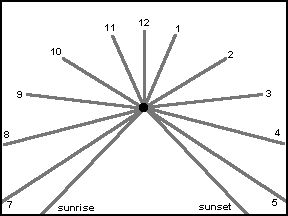
I’m going to show you how to construct a simple instrument to measure sun angles. It works especially well at the solstice, but a few days late won’t hurt if you are only out to amuse yourself and maybe learn something. I first used this when I was considering where to place windows in a building to get north light without afternoon glare. You could use it to pick out the optimum placement for solar panels, or decide how deep to make a south-facing porch.

FYI to my followers in Brazil, New Zealand, and Australia. I am going to write as if everybody lived in the north latitudes; I’m sure you are used to modifying that kind of writing to meet your own needs. Sorry, but it’s just too clumsy to qualify every statement.

All you need to measure sun angles is a board with a vertical dowel or wire set into it near the center. You could use a carpenter’s square for that. You will need a spirit level to level the board, and it wouldn’t hurt to then use the level to see if the dowel is still vertical (what carpenters call plumb). You will mark the shadows as they fall directly on the board.

This is what I used the second year. The first year i drove a rusty used pipe into the ground and drove stakes into the shadows. Same principle, but far too clumsy.

Next, you need your local sun time. Subtract daylight savings time, but that isn’t enough. Noon, by the sun, is when the sun is directly south of you. Clearly that is an hour earlier on the east side of your time zone than it it on the west side, so you need your longitude and some simple arithmetic.

There are twenty four time zones, each 15 degrees wide. The first time zone is at zero longitude in Greenwich, England but, again, it’s not that simple. Time zones center on their base longitude. The first zone lies from seven and a half degrees east longitude to seven and a half degrees west longitude, and the other zones follow suit. Then all is adjusted to match up with political boundaries, but we can ignore that.

Let’s choose Oklahoma City as a neutral site, so I can give  a shout out to their wonderful Fleming Fellowship, celebrating its sixtieth anniversary this month. OKC is at 97.5 west longitude. If you ignore political gerrymandering, OKC’s time zone centers on 90 degrees longitude, so OKC is on the western boundary of the theoretical time zone; the political time zone ends on the western border of the state. The sun is south of OKC when your watch says 1:30 PM, if your watch is accurate and you have it set for daylight savings time.

To find solar noon for the longitude where you live, add or subtract 3 minutes for every degree you are west or east of the theoretical center of you time zone.

I like to set my board up the day before and rotate it so that the (solar) noon shadow lies parallel to this sides of the board. That isn’t necessary, but it makes for a neater project. Then I’m ready to record the shadow that falls at sunrise.

Sunrise is problematical. You can look it up for your area, but it’s not that simple. (Have I said that before?) If you live on a mountaintop, sunrise will come earlier. If you live in a valley – or, in my case, on the west side of the Sierras – it will come later. How much can’t be calculated. It depends on how far west of that hill you are, and how high that hill is, and whether today’s sunrise happens to fall behind your neighbor’s house, or behind that big oak tree. It will come when it will come. Have a straight edge handy and draw a line from the dowel down the center of its shadow, then write down the time. Continue through the day. I try to make a mark every hour on the (solar) hour.

Early and late shadows will probably run off the board, but for the rest you can calculate the sun’s vertical angle because you will know the height of the dowel and the length of the shadow. Personally, I take the measurements, redraw the triangle on another piece of paper, and measure with a protractor; but then, I grew up before calculators.

You do realize that this is the year’s extreme for north tending sunrise and sunset and for high sun angles, and that every other day until December will be slightly different.

Even if you never design windows for north light without afternoon glare, or plan the placement of solar panels, or decide how deep to make a new porch, taking the sun’s angles throughout the day will give you a better feel for your personal environment, and a new appreciation for the complexities of astronomical observations.

Extreme astronomy geeks will repeat the process at the equinox and winter solstice, but good luck if you try. I’ve never been able to pull off any shadow measurements in December because of clouds.

170. Middle School Astronomy

We learn our astronomy from books, but that isn’t how the science started. The ancient Greeks learned about the stars by looking at the stars. Their understanding was a mixture of observation and myth, with myth sometimes predominating.

When we are young, we also learn astronomy from casual statements we hear from adults. I’ll give you an example. Mars has recently been at a close approach; every evening lately, when I step out my front door (miles from the nearest city) to look at the sky before bed, there it is, red and bright, about halfway to zenith in the south-eastern sky. Now imagine that I say to a child, “Mars is really getting close.” Just that, with no other comment. What images might pop into that child’s mind?

*****

“The seasons change because of changes in the Earth’s tilt.” You might find a statement like that in an old middle school science textbook along with an illustration like this:

ma1

Not true. Not a lie, but an oversimplification that may be fine for the average student, but does not do justice to the brightest kid in the room. A better statement would be, “The seasons change because of apparent I changes in the Earth’s tilt”, coupled with an illustration like this:

ma2

Now we are more accurate but we’ve confused 90% of the students.

It should be obvious by now that this is a bit of a how-to based on long experience. Even if you aren’t a teacher, you will probably someday have to explain this kind of thing to your own kids.

Let me suggest a third option. First explain things in your best lecture voice with reference to the textbook and with drawings on the board. Then pick a student sitting in the middle of the classroom; out of kindness, choose someone who likes attention. Say, “Helen, don’t move. For the next few minutes, your head is going to be the sun.” Then establish where Polaris lies, for the sake of the demonstration. Your classroom may not allow you to use real north. If some bright, smart-mouth kid catches you out, don’t get mad. Rejoice that someone is paying that much attention and make it a teachable moment.

Now walk around the classroom with the classroom globe tilted toward your Polaris and talk them through the seasons, pointing out that the tilt never changes in relationship to Polaris, but it appears to change in relationship to Helen, our sun. Pat your worst troublemaker on the shoulder as you pass him, wink at the shy girl in the back corner who never volunteers, and say, “Excuse me, Earth coming through,” when you have to dodge around desks.

There is a rule of thumb for teaching science (which probably doesn’t work for algebra). If you enjoy teaching, and you let your students enjoy learning, they probably will.

*****

That exercise was for letting students visualize things they can’t see for themselves. You can also help them see things that happen in their everyday world, but normally go unnoticed.

Observing the path of the sun through the seasons is an Earth’s-eye-view version of the tilted globe carried through the classroom. How do you compress a year’s worth of observation into one 40 minute session, using the real sun instead of charts and graphs? It can be done, but it takes nine observations on your part, spread over three days, with those three days spread over half a year. It also takes a small can of paint and a paintbrush.

When I set this up, I picked a solid, upright, eight foot steel pole which was set up away from the shadows of structures and which I knew would not be disturbed for years to come — a volleyball net pole out on the playground. At 10 AM, noon, and 2 PM (sun time, not daylight savings time) one summer solstice I painted three inch circles (same diameter as the pole) at the pole shadow’s tip.

I repeated those actions during the fall equinox, which was intriguing for my students. I had a paint can and small brush at the ready during my ten and two classes, and on the stroke of the hour, I ran out of the classroom, painted the circle, and ran back in while they watched from the windows. The noon painting had an even bigger audience because of noon recess. As you might guess, I told those who asked questions, “You’ll find out what this is all about — some day.” On Christmas break I painted the last three circles during the winter solstice.

That spring, and for years afterward, I arranged to teach solar motion as near as possible to the spring equinox. The solstices fall outside school days, and the fall equinox is often cloudy in California. I explained everything with lectures, and reading, and drawings on the board, but then we all went out to those nine circles on the playground. As I talked them through the lesson, we all watched the pole’s shadow move. It is fascinating in our mile-a-minute world to take the time to watch a shadow inch its way across the ground. Even if it wasn’t 10 or noon or 2, everyone could see that the shadow’s tip either had or would touch all three of the middle circles.

I explained how I had placed the circles and invited students to lie down with their head on a circle and look past the tip of the pole to see where the sun would be (or would have been) at noon or 10 or 2 on the first day of summer or the first day of winter.

They paid attention. On days they pay attention, learning happens. It isn’t easy, but it works.

169. North Light at Solstice

Some years ago, I had an epiphany at solstice time, all about north light.

North light is one of those concepts we accept without thinking it through. Artists prefer north light for their studios – we learn this young if we are thinking about being painters. Most of us never become artists and never have a studio, so the notion falls into the category of unexamined concepts.

I learned to paint and draw, but my skill level never rose above adequate. I didn’t become an artist, or any of another double-dozen fleeting ambitions, but I did become a writer and later a teacher. As I was nearing retirement, I bought a three acre parcel with house in the foothills of the Sierras.

For the first time, I had the chance to build something bigger than furniture or musical instruments. I was wandering around the back yard on blistering summer afternoon, thinking about north light and about building a shop with big widows pulling in masses of lovely natural light, when I looked at the north wall of my new house and saw that it was in full, hot, withering sunlight.

That’s not supposed to happen. But it does.

I live at latitude 37, roughly in line with San Francisco, Tulsa, and Washington, D. C. Here the sun is so far north (apparently) by mid-summer that it rises well north of east and sets well north of west, traversing a curved path so that at noon it is still south of zenith. The result is that the north sides of structures receive cool morning sunlight, shade during most of the day, and blistering sunlight in late afternoon.

I should have known, but in the cities where I had spent my life there were always trees and the shadows of multiple buildings to hide the effect. I had studied astronomy, but that is about the big picture, not about what is happening in your own backyard. I should have known from a youth spent outdoors, but then I was always on a tractor and in motion, concentrating on the windrow of hay I was creating, not on how sunlight fell on structures.

As a childI was aware of the motion of sunsets across the western horizon as the seasons progress, because every evening I was in the dairy barn looking out its west facing windows. I still love that phenomenon. There is a place near my foothill home where my wife and I go to watch the sunset. The spot faces west, on the western side of the westernmost hill in our area, so the vista carries all the way across the San Joaquin Valley to the coast range, and to the the buildup of clouds beyond where the cold waters of the Pacific spill fog over San Francisco. Mount Diablo, the highest peak in this section of the coast range, lies directly west of our lookout. Every spring and autumn equinox, the sun sets directly behind it. As summer progresses, each sunset is further north until we reach the summer solstice. Then they drift back, pass Mount Diablo, and head south until the winter solstice turns them back north again.

This is how astronomy began, with observations of visible phenomena. There were no ideas of orbiting bodies; that came later. Today, however, we know too much. We learn our astronomy from textbooks, not from our own observations. And then the reality in our own back yard catches us by surprise. more tomorrow and Wednesday

*****

For the record, I scratched the itch to build a building. My wife and I rebuilt a sagging 11 x 24 tool shed, put in big windows and a fancy facade. It is our quilting studio, where I also write. I’m sitting in in it now, watching the sun rise through the east window.