
Tag Archives: space travel

185. The Flying Bedstead

300px-LLRV_2Tomorrow is the anniversary of the Apollo 11 moon landing. For most of the followers of this blog, it is part of history. I saw it happen, on a grainy black and white TV in the lounge of a college dorm. (see 27. That Was My Childhood)

You can’t land on the moon by parachute, nor by wings. No air. The only choice the Apollo program had was to land tail first, by rockets, something that had been a science fiction staple for decades, but was nothing like easy to manage. (see yesterday’s post)

Designing a craft to do the work was within the limits of the technology of the day. Vertical landings on Earth had been successfully accomplished. Pilot control on Apollo was expedited by having the astronauts stand to fly the Lunar Lander; the problem with VTOL planes had been that the pilots were strapped into a seat that kept them facing the wrong way when they landed.

The craft could be built, the astronauts were the best test pilots America had to offer. But how do you train?

Simulators? Maybe. Resurrect Pogo or Vertijet? Perhaps. Build a new craft just to use as a trainer? Better. But how do you build a trainer to react as if it were in a 1/6 gee field while landing in on Earth? You can’t just make gravity go away – or can you.

The answer is almost, more-or-less, and good enough to do the job. The first iteration of the trainer was the Lunar Landing Research Vehicle, nicknamed the flying bedstead. You may have seen it. Neil Armstrong ejected from one of them after the controls failed; the footage of the crash is both exciting and brief, which gets it a lot of air play in retrospective specials, especially on anniversaries like tomorrow.

If you see footage of the LLRV not crashing, or of the advanced version LLTV (Lunar Landing Training Vehicle), you can easily see what it is all about. The vehicle consists of an open framework of tubing with the pilot sitting upright in the front (in an ejection seat, thank goodness) with a batch of somewhat shrouded equipment balancing the rear. In the middle, attached vertically, pointing downward and clearly throwing flames, is a jet engine. The craft is uneasily hovering.

Note, I didn’t say hovering on its jet. That is what it looks like, but that is not what is happening. Not quite. When the jet is fired up at takeoff, the LLRV or LLTV simply sits there. The jet has 5/6 of the thrust needed to lift the craft. While hovering, the rest of the thrust is provided by a separate set of hydrogen peroxide thrusters which are controlled by the pilot. If the pilot were to simply turn off his thrusters, the LLTV would crash to the ground at the same speed it would crash to the moon.

The jet subtracts enough of the LLTV’s mass to make it react as if it were in a 1/6 gee gravity field, allowing the pilot to maneuver his craft as if he were coming in for a lunar landing. Armstrong made over fifty LLTV landings before he landed on the moon.

If you want to know more about this craft, there is a half hour special full of information, old footage, and interviews with retired LLRV pilot and an engineer from the project. Huell Howser is the host. If you live in California, and you watch PBS, you know Huell. He is an acquired taste that I have never quite been able to acquire, but sometimes what he covers makes up for his idiosyncrasies. This is one of those cases. The program is California’s Gold #13003 – LUNAR LANDING. Try your local PBS station or check with the Huell Howser Archives at Chapman University.
184. Tail First

The first manmade object to leave the atmosphere and enter space wasn’t American or Russian. It was German. In 1942, V-2 rockets, first as prototypes, then as weapons, entered space routinely at the top of their high-arching flightpath.

That was the picture of spaceflight that lived in the heads of the kids of my generation. On Saturday morning TV shows, heroic young spacemen went off to save the universe and all their spacecraft looked like V-2 rockets. No wonder; this was pre-George Lucas and special effects were minimal. However, captured German footage provided plenty of shots of V-2s taking off.

These Saturday morning specials also landed upright on their tailfins. (Yeah, you guessed it. They ran the films backward.) On Dec 21, 2015, Elon Musk and SpaceX finally pulled that off in the real world. It makes me wonder what he was watching when he was a kid.

In the early days of serious thinking about space, when WW II was freshly over and the V-2 had shown the way, there seemed to be only two ways to land a spacecraft: either tail-first at a prohibitive cost in fuel, or by flying back in a winged craft. Neither was possible with the technology of the day, but the folks at Edwards Air Base were working on the latter, culminating in the X-15 (see 164. Flight Into Space). Later came the Space Shuttle.

In my novel Cyan, VTOL rocket shuttles are used extensively on Earth, and of course are the basis for landing craft on unexplored worlds. There won’t be any runways when we reach Alpha Centauri.

There is actually has a long history of craft designed to explore tail first landings.

X-13 Ryan Vertijet took off vertically, rolled over to horizontal while the pilot changed to a separate set of controls, carried out its mission in horizontal mode, then, at altitude, transitioned again to vertical mode. The pilot then slowly dropped toward the ground to land. The limitations that make this a technology demonstrator rather than a workable aircraft all become obvious near the ground.

Before takeoff, the Vertijet reached the airfield horizontally, hooked to and riding on a trailer. The trailer then lifted like a drawbridge until the Vertijet was vertical, dangling from a cable that hooked under the Vertijet’s nose. It took off from that position, and then returned to the trailer to land. As it approached the ground, traveling nose skyward, the pilot would slide his craft carefully sideways until the nose of his jet came in contact with a horizontal bamboo pole. Using that as a guide, the pilot then moved his craft toward the trailer until his nosehook came into contact with the cable. Then he cut his power; he had landed by reaching a condition of dangling from the cable, bellied up to the vertical bed of the trailer. The trailer was then lowered to horizontal, Vertijet attached.

Not very practical, but it did work. Only two Verijets were built and only a few operational flights were attempted.

The X-14 was of different configuration, with vanes to deflect its thrust. It took off vertically, but with the plane itself horizontal, in the manner of a modern Harrier.

The Lockheed XFV-1 had the power and the configuration for vertical takeoff and landings, but they never managed to work out the issue of pilot control. No successful vertical takeoffs or landings were made. It flew only conventionally with makeshift landing gear bolted to its belly.

The Convair XFY Pogo took off vertically, transitioned to horizontal, and made vertical landings, but only with great difficulty, and only with extremely experienced pilots. It was impractical, largely because the pilot had to look over his shoulder at the ground during vertical landings.

If we could salvage the rear vision camera from any 2016 sedan and send it back by time machine, any one of these craft would have been successful, but in the fifties the idea of looking at the ground while your eyes were skyward was pure science fiction.

Reaching on the moon would require a vertical descent and landing. They built a special craft to train astronauts for that mission. We’ll look at it tomorrow.

183. Roll Call for the Unremembered

Next week contains the anniversary of the first moon landing, and I intend to dedicate all posts to that event.

I grew up with Mercury, Gemini, and Apollo, but even I could not call out the names of all twelve men who landed on the moon without a crib sheet. The past seems to fade from memory as soon as it disappears from the rear view mirror. In the case of the early space program, that is a shame.

Here’s that crib sheet —-

Apollo 1 — Almost two dozen unmanned launches by various boosters tested hardware during the unmanned phase of Apollo. The scheduled first manned launch, AS-204, was renamed Apollo 1 after the capsule fire which killed Gus Grissom, Roger Chaffee, and Ed White on February 21, 1967. There had been growing anger in the astronaut corps over shoddy workmanship in the Apollo capsule, which boiled over after this unnecessary loss of life.

Apollo 7 — Don’t worry about the numbering oddity. It’s a mare’s nest which is not worth untangling. Apollo 7 was the first manned Apollo flight. Apollo 1 was not a launch, since the disaster took place on top of an unfuelled rocket. Wally Schirra, Walt Cunningham, and Donn Eisele left the pad on October 11, 1968 to spend eleven days in orbit. Schirra had been particularly relentless in pushing for quality and safety during the year and a half delay. He retired from NASA after the flight, the only man to fly for all three programs.

Apollo 8 — The lunar lander was not ready and the Russians looked like they were about to attempt a moon landing., so NASA decided to gamble. Frank Borman, Bill Anders, and Jim Lovell launched December 21, 1968 for the moon without a lander. They entered lunar orbit, circled the moon ten times, then returned to Earth. They were the first humans to see the back side of the moon directly, although pictures had been sent back as early as 1959 – by the Russians.

Apollo 9 — James McDivitt (Commander), Rusty Schweickart (Lunar Module Pilot), and David Scott (Command Module Pilot) launched into Earth orbit on March 3, 1969 for a ten day mission. This was the first flight of a Lunar Excursion Module, and the first time the designations of individual astronauts became fully meaningful. After entering orbit, the command module with service module attached, moved away from the final stage of the Saturn, reversed, docked with the lunar excursion module which had been carried beneath it, and extracted the LEM. This head to head orientation allowed McDivitt and Schweickart to enter the LEM, detach it and test it in free flight while CM pilot Scott stayed in the command module.

Apollo 10 — The dress rehearsal. Launched May 18, 1969, Apollo 10 achieved lunar orbit, where Tom Stafford and Gene Cernan entered the lander, leaving John Young in the command module. They fired retros and descended to within 16 kilometers of the surface of the moon, did not land, reentered lunar orbit, and rendezvoused with the command module.

I have always felt that this has to be the most frustrating event in the history of space travel. Except, maybe, for Apollo 13. Or, maybe, for the six command module pilots who watched their crewmates successfully land on the moon.

Apollo 11 gets its own post next Wednesday, and the rest of the crib sheet comes after that.

168. A Woman in Space

53 years ago today, the first woman flew in space. Her name was Valentina Tereshkova. The Soviets hailed her as a hero of the People (see131. Chasing Cosmonauts), and as proof that Russia was ahead of the US in social advancement as well as in space travel.

The US treated her as a joke.

Both assessment were wrong, although both contained kernels of truth. Even today, half a century after the event, it is difficult to come to a balanced appraisal of the flight of Vostok 6. Russian propaganda and American dismissal still cloud the picture.  I am taking a shot at accuracy here, but a workman is only as good as his tools, so keep a measure of skepticism in mind.

Tereshkova’s father was MIA during WWII, leaving her mother to raise Tereshkova alone. She left school early to join her mother working in a state textile mill. There she joined a parachute club, which was a military auxiliary, and became an expert parachutist as well as secretary of the local Komsomol.

Early in the Soviet space program, there was a movement to add female cosmonauts, mostly for propaganda purposes. Candidates did not need flight experience since the Vostok craft were fully automated, but the did need extensive parachute experience, since at that early stage cosmonauts finalized their landings by personal parachute (see130.  First Into Space). Tereshkova was one of fifty-four candidates interviewed, and one of five who made it through training.

Tereshkova was personable, doctrinally sound in communism, from the peasant and workers class, hard working, willing, and an expert parachutist. She was not well educated nor an experienced pilot. Ponomaryova and Solovyova, female cosmonaut trainees who had those additional qualifications, were scheduled for a later, more sophisticated flight, and Tereshkova was scheduled for the Vostok 5/6 dual flight.

Vostok 5, crewed by  Valery Bykovsky, was launched on June 14, scheduled for an eight day flight, but a low orbit forced it to be shortened to five. Vostok 6, crewed by Tereshkova, was launched on June 16 and remained in orbit for three days. They passed within five kilometers while in space.

During the flight, Tereshkova discovered that the automatic orientation system had her flying sideways in orbit, an error that would have been fatal during reentry. Ground control confirmed and corrected. Whether she activated her final reentry personally or not is still unclear.

In those early days, landing accuracy had not been perfected. When she ejected from her craft, she found herself coming down into a large lake, and was only saved from downing by a strong wind that carried her to a rough landing on shore.

American astronauts, all of whom were test pilots, had little respect for the skills of Soviet cosmonauts. They used Tereshkova’s flight to justify their ridicule, saying that the Russians had simply pulled a woman off the line in a factory and sent her up into space as a glorified passenger. There was a bit of justification in their assessment. It was a propaganda stunt, but that didn’t mitigate the dangers. Tereshkova was uneducated, but by six years later she had taken advantage of her situation to earn a degree in engineering. She was not a pilot when chosen for training, but by the time of Vostok 6 she had learned to fly jets and had made 120 additional jumps to hone her skills as a parachutist.

Alan Shepard was a superb test pilot when he flew his Mercury mission, but he had almost no control over his capsule and nobody called him spam-in-a-can. Well, actually, Chuck Yeager did, but that’s what too much testosterone will do to your thinking.

Tereshkova’s contribution to space flight was real, but the Soviet commitment to equality was not. Ponomaryova and Solovyova’s flight was cancelled, and it would be nineteen years before another Soviet woman flew in space. It would be twenty years before the first American woman, Sally Ride, entered space, even though thirteen American female astronauts had been chosen and trained during the early sixties. Like Ponomaryova and Solovyova, they never flew.

167. On the Brink of Glory

Not everyone who does the work endures the danger is there to reap the glory.

Take Eliot See and Charles Bassett for example. Both were chosen for the second group of astronauts, and were assigned as the crew of Gemini 9. They were flying together in a T-38 trainer en route to prepare for that mission when they went down on approach to Lambert field in bad weather. Both were killed, crashing into the building where their spacecraft had been built, not 500 feet from the Gemini 9 itself.

Gemini 9 would have been the first spaceflight for each man.

Everyone knows the names Grissom, White, and Chaffee, who died on the launchpad in the “Apollo One” fire. Grissom and White were veteran astronauts. Roger Chaffee was among the third group of astronauts chosen. He worked through the Gemini program without being given a mission, then was chosen to replace Donn Eisele, who had been injured during training, on the first scheduled Apollo mission. That flight ended in fire, on the ground during routine preparations; Chaffee never got to fly in space. Eisele recovered from his injuries and flew on the next (and first successful) Apollo mission.

Robert Henry Lawrence Jr. was the first African-American astronaut. (Ed Dwight had been an astronaut candidate earlier, but was forced out.) At Edwards Air Force Base, Lawrence investigated unpowered glide return characteristics using an F-104 Starfighter, contributing greatly to knowledge necessary to the Space Shuttle program. He was assigned to the Air Force’s Manned Orbiting Laboratory program, but before he flew in space, he was killed in a crash landing while acting as a pilot instructor to a trainee. When the MOL project was abandoned, many of it’s astronauts transferred to NASA, where they became the backbone of the early Space Shuttle missions. Lawrence would almost certainly have been among them.

Milburn Apt became the first man to reach Mach 3, and died in the same flight. It was his his first flight in the X-2 rocket plane. He achieved the mission objectives, but found that his flight had carried him unexpectedly far from Edwards. Because of the X-2’s noted instability, he was not scheduled to begin return maneuvers until his speed had dropped, but that would have carried him too far for a safe return glide. He began to turn back at above optimum speed, and lost control as turbulence knocked him unconscious. When he regained awareness, he ejected his safety capsule – the forward section of the craft – but did not survive.

Apt received unwanted posthumous fame. The cockpit camera recorded the final seconds of his flight, and that film became required viewing for all subsequent pilots preparing for hypersonic flight.

Apt’s daughter was two years old when he died. She later became a writer, and her Letter to My Father Concerning the State of the World is a moving exploration of what it meant to her to be the daughter of a test pilot who did not survive.

164. Flight into Space

The golden age of (fill in item of your choice) is thirteen.

I first read that phrase in reference to science fiction, but it works for quite an array of things. Certainly the music of our youth is the music we will always prefer, although that may come to us a couple of years after thirteen. It certainly works for automobiles and aircraft.

For me that golden age revolves around the F-104 and the X-15.

***

The entire focus of Edwards AFB, including most of the X-craft, was to fly higher and faster. The higher part caused problems with loss of control as the atmosphere thinned. The faster part brought about heating problems from atmospheric friction. Both lines of research culminated in the X-15.

The X-15 was first contracted in 1954. Early in its development, a follow-up aircraft to be called X-15B was considered. It was to be launched atop a Navaho missile in order to reach into space. NASA dropped the idea in favor of the Mercury program. The Air Force followed up with the proposed X-20, but that too was cancelled after Mercury became successful. Actual flight into orbit by a winged craft would not occur until the first Space Shuttle launch.

The first X-15 flight took place in 1959 and it was still flying nine years later, less than a year before the first moon landing. Like the earlier X-planes, the X-15 was dropped from a larger plane, in this case a converted B-52 bomber. Rather like a two stage rocket, this piggybacking allowed the X-15 a head start. The first 8.5 miles of altitude and 500 mph of speed came out the the B-52’s fuel tank, leaving the X-15’s fuel supply intact for the final push.

During that near decade, there were almost 200 flights. Thirteen of those flights went above 50 miles. The maximum speed reached in level flight was 4,520 mph.

The Air Force awards astronaut wings for flights above 50 miles – international rules do not agree. Two of those thirteen flights went above 100 kilometers. The Federation Aeronautique Internationale counts 100 kilometers as the edge of space, making Joseph Walker officially the thirteenth man in space. (Also the fourteenth.) One of those who gained Air Force astronauts wings was Joe Engle who later flew the Space Shuttle. Neil Armstrong flew the X-15 seven times, but never above fifty miles. He had to settle for a consolation prize on July 20, 1969 when he landed on the moon.

To successfully fly at such altitudes requires a series of small rocket motors strategically placed around the spacecraft to control attitude when the rudder, elevator, and ailerons have nothing to work against.

On high speed flights by the rebuilt X-15A-2, an ablative coating was sprayed onto the surface of the aircraft to protect it from overheating due to atmospheric friction, an issue that the SR-71 and the Space Shuttle would also have to face.

For my generation, the X-15 was the ultimate, and it looked the part. It’s pilots flew to the edge of space; they were not blown there in a capsule on top of a converted ICBM. Mercury and Gemini were wonderful. I followed them religiously. But the X-20, proposed descendant of the X-15, riding on top of a Titan missile would have done it with more class. And it would have landed under the pilot’s control, not on the end of a parachute in the middle of the ocean.

Scott Crossfield, the X-15’s designer and first pilot said it was one of the few aircraft that caused grown men to cry upon its retirement.

163. X-craft

Jay Miller wrote a book called The X-planes: X-1 through X-31, and later revised it to include craft through X-45. (Presently, the number is up to X-56.) If you are any kind of a space aficionado, you need to look it up in your local library. The only thing wrong with the book is its title; not all X-craft were planes.

When I was growing up, I was in love with the F-104 Starfighter and the X-15 rocket plane, two aircraft with markedly similar outlines. The F-104 was designed, a few prototypes were built and tested, then it went on to become one of the most successful fighter jets in history. The X-15 was designed, three were built (and rebuilt after various incidents), and tested. There were never any more X-15s, nor had there ever been a plan to build more. The X-15 was never a prototype, because a prototype is a first iteration, built to be tested, perfected and turned into a series. That is true whether you are talking about fighter jets or can openers, but not true of X-craft.

X-craft were something different. They were flying laboratories – a much overused term, but still accurate, although technology demonstrator is preferred.

After World War II, advances in flight by Germans, British, and Americans, along with nascent cold war tensions, put us on the edge of an unknown frontier. The “sound barrier” loomed as the best known obstacle to further advances in aviation, but there were a hundred other unknowns that never made it into the popular press. Wind tunnels could only tell so much, computer modeling was decades in the future, and it made no sense to build a squadron of high-performance aircraft that might or might not fly.

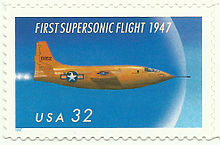
First_Supersonic_Flight_1997_Issue-32c

A glance at the first X-plane, the Bell X-1, gives clues to what was known and what was not known. We already knew that turbulence off the wing would foul up the tail controls at high speed, so the horizontal stabilizer was attached high up on the vertical stabilizer, not on the body. It was not known what negative effect the cockpit bubble would have, so the windscreen was faired into the shape of the fuselage. It was shaped like a 50 caliber bullet – everybody says that without explaining. It is a reference to the machine guns carried on fighter planes. Fired from a ground rest, those bullets would have been sub-sonic. The planes they were mounted on flew at subsonic speeds, but bullets fired from a plane in flight had been going supersonic for a long time.

An aside here for the non-nerd. Planes flying slower than the speed of sound are subsonic. That includes all commercial aviation except the Concorde. Planes flying faster than the speed of sound are supersonic. The X-1 and its follow-ons proved that supersonic flight is not problem. The problem is the transition zone, the trans-sonic region. Slower than sound, the accumulated shock wave is out in front of you. Faster than sound, it is behind you. At the speed of sound, it is right in your lap, trying to tear your plane apart. No modern, supersonic plane lingers at that speed.

The X-1 broke the sound barrier (i.e., passed through the transonic region into the supersonic region) on October 14, 1947, with Chuck Yeager at the controls.

Since this is A Writing Life, I’ll add that I was born about two months after the sound barrier was broken. I was present on the planet for almost all of the early X-craft explorations, although far too young to notice. When I became aware of the X-craft, I fell gloriously in love with them and the infatuation never passed.

The X-2 was a more normal looking aircraft, with swept wings and a pilot’s bubble. It carried supersonic speeds to new heights, but killed its pilot in the process. I will tell that story next Wednesday.

The X-3 was an extreme aircraft, stretched out and incredibly streamlined right down to the tip of its needle nose. It looked faster than any plane before or since, but it wasn’t. All that streamlining couldn’t make up for the fact that the engine slated for the plane wouldn’t fit, and the one that did fit was underpowered. The fastest (looking) plane in the sky flew slowly.

The X-4 was tailless and not successful. The X-5 tested variable sweep wing technology. The X-6 was an aborted project testing out the possibility of a nuclear powered aircraft. The X-8 was a small, unmanned rocket designed for upper atmospheric research. The X-7, and X-9 through X-12 were test beds for missile research. X-13 and X-14 were early attempts at Vertical TakeOff and Landing (VTOL).

Then came the coolest aircraft/spacecraft in the history of mankind, the X-15, which will be the subject of tomorrow’s post.

158. The Cost of Starflight

Whatever his faults, Saloman Curran, from the novel Cyan,  is no coward, as he shows at a news conference called when the USNA government tries to shut down the colonization of Cyan because of the high casualty rate associated with cold sleep.

“Chairman Curran,” the reporter asked, “how can you advocate cold sleep, even plan an entire colonization project around it, when it will result in a ten percent mortality rate. That seems more than a little inhumane.”

“A bit cold?” Curran asked. A grudging chuckle greeted his gallows humor. “Your facts are not quite right,” he continued. “That figure of ten percent is inaccurate.”

“You aren’t going to tell us that it is lower. We have that figure from NASA research.”

“Ten percent was the estimated loss for a five year cold sleep. We will be sleeping our people twenty years. We expect a mortality of 19.7 per cent.”

That silenced the room for a moment. Curran went on, “What you are missing is a lesson history has to teach. When the Irish were driven to America by the famine of the mid-nineteenth century, reliable historians estimate that more than twenty percent of them died of disease, starvation, or shipwreck on the way across the Atlantic. When your ancestors crossed the American prairie by covered wagon, they died by the thousands. Indians killed some, but mostly they died as they always had, of cold, hunger, infection from wounds received in their everyday work, and from disease. Influenza, tuberculosis, and a dozen other diseases that no longer exist sapped their strength and killed them wholesale. 

“Settlement of a new land has never been easy. It has never been for the timid. It has been for those whose faith in the future led them to defy the odds.

“And there is more. The Irish who did not leave Ireland, died in even greater numbers. The Americans who did not cross the prairie, faced the same wounds and overwork and diseases, and faced poverty and hunger besides. For all the dangers, the toil, and the hardships faced by the ones who went on ahead, there were as great dangers and greater hardships behind them. They went forth to find a future, but also to leave behind an unacceptable present.

“Look around the USNA. What do you see? Hunger, crowding, and death. What other motivation does a brave man or woman need to risk death, with the odds four to one in his favor?

“No one is being coerced. Every colonist will be a volunteer and we expect a hundred volunteers for every colonist we can take. Maybe a thousand for every one we can take. You may not have that kind of courage. Your viewers may not. If not, they should not apply. But the colonists who go out to settle Cyan will have that kind of courage.

“Will I find enough to accompany me? I will find a million who will cry bitterly that they were not chosen.”

Curran paused to adjust his jacket, with the look of a man overcoming an emotional outburst.

“To come back to your original question,” he continued; “Is cold sleep safe? No, it is not! But I will go to Cyan in cold sleep, and if I die en route, my life will have been well spent.”

131. Chasing Cosmonauts

This is a continuation of yesterday’s post First into Space.

I had the great good fortune of being born with the space age, less than two months after Chuck Yeager broke the sound barrier. I was thirteen when Alan Shepard took his first sub-orbital flight and just coming back from my honeymoon when Armstrong and Aldrin landed on the moon. (see 27. That Was My Childhood)

I followed the American manned space programs closely, but the Russians were a mystery. They gleefully announced their victories – first satellite in orbit, first living creature in orbit, first man in orbit, first woman in orbit, first space walk, first space station – but there were no details. I developed a curiosity that never went away.

Time marched on. The race to the moon was won – by us, after a painfully slow start. The cold war ended. The pioneers of space drifted mostly out of public consciousness. Everybody remembers Armstrong, but Buzz Aldrin morphed into Buzz Lightyear, and Jim Lovell came to wear the face of Tom Hanks in public memory. And who remembers Gordo, or Deke, or Ed White?

Well, I do, actually. I also remember the Russians, who were pioneers just like we were, and often got there first.

In 1987, Douglas Hart produced The Encyclopedia of Soviet Spacecraft which has been my go-to source for decades. I recommend it highly for information preceding its publication date.

Another book that I recently hacked my way through, like a noxious jungle, is Russians in Space by Evgeny Riabchikov. I found it at the *** Library, my favorite impoverished institution, a public library filed with seventy year old books and few new ones. Russians in Space was written in Russia, for Russians, during the sixties. It’s translation copyright is 1971 and I doubt if this copy has been read ten times in all those years.

Do you remember Chekov from the original Star Trek, who was always telling everyone that Russia invented everything? He was a comic version of late sixties reality, when Russian bombast made everything in Pravda sound like it was written by Donald Trump. Russians in Space is of that type.

I fought my way through the bombast and bad writing in search of the details I had not found elsewhere. No such luck. I took as my touchstone, the chapter on the Voskhod 2 flight, which I had recently researched (see 116. Spacecraft Threatened by Bears). Everything that made the flight memorable was missing. Riabchikov made it seem routine, when in fact, it was the planning and mechanical failures on the mission that spotlighted the incredible courage and skill of the cosmonauts.

Our brave, valiant, plucky boys in space – that could have been the subtitle of Riabchikov’s book. It reminded me of an alternate reality prequel to the Lensmen series. Kimbal Kinnison would have fit in well with the square jawed, sturdy, blue eyed, strong but gentle supermen who made up Riabchikov’s version of the cosmonaut corps. They were comrades who always helped each other, never fought among themselves, and were ready like all good workers to do their part for the USSR. The cosmonauts who welcomed the female cosmonaut group were courteous and supportive, always ready to help them overcome any hurdle. Like big brothers who blushed when their hands touched. That is from a quotation I wrote down, then lost. You should thank me for the lapse.

So why bother telling you about a book so bad? Because something else came through, despite its manifold failings. There was a sense of pride in the Soviet space program, and particularly in its cosmonauts, that was felt throughout Soviet society. Without glossing over any of the failings of the Soviet system, an American reader can see that the Russian people admired Yuri Gagarin in exactly the same way Americans admired John Glenn. It is clear that they felt a pride in Soviet successes that mirror-matched the frustration we felt at American failings during the same era.

The story of the Soviet manned space program deserves better than Riabchikov, and I am still searching for the book that tells that story succinctly and well.

I have some leads. I’ll tell you soon how they pan out.

130. First into Space

220px-Vostok_spacecraftI grew up wanting to be a spaceman. I didn’t say astronaut, and I didn’t say cosmonaut. When I was just getting old enough to dream about the future, neither of those words were in use. Spacemen were the stuff of fiction, and the stuff of the far future.

The future arrived before I was ten in the form of Sputnik, an unwanted gift from the USSR that passed beeping over America and scared the whole nation out of its wits, and into a race for space. That was fine with me. I loved every minute of it, even though I knew I was never going to go. I was smart enough, and strong enough, but I couldn’t see across the room without glasses. Of course there were a thousand other hurdles I didn’t know about, but here we are talking about the dreams of youth.

I followed the introduction of our astronauts, and learned all I could about the craft they would fly. There wasn’t a whole lot of information available in Talala, Oklahoma in 1959.

Then, 55 years ago today, the Russians beat us into space – again – and in a much bigger way. Yuri Gagarin, cosmonaut, became the first human in space and the first to achieve orbit. Our guy Alan Shepard went up a few weeks later on a lesser flight, and America was outraged at the contrast.

Not me. I was thrilled that a human being had reached space; Russian, American, Finn, Bolivian, it didn’t matter. Space travel was real. The future had arrived. No one could ever again say, “We can’t go.”

But for all my enthusiasm, there was almost no information about Gagarin’s flight. For nearly another thirty years, Russian triumphs and disasters would be hidden from the world. Now we know enough to appreciate Gagarin’s feat.

The launch vehicle was an A-1, little different from the Soviet ICBM fleet, or the vehicle that launched Sputnik. Unlike the US, the Soviets have stayed with variations of a single workhorse vehicle through most of their space program. Also unlike American procedures, both Yuri Gagarin and Gherman Titov were suited up and ready at the pad, so that even in the event of a last second glitch, the launch would have been made by the backup pilot.

The space craft was Vostok 1. It consisted of a sphere holding the cosmonaut and a separate life support module, a style adopted by the US during Gemini and Apollo. The launch was successful and only one orbit was planned. The Soviet style was to make many launches, each incrementally more daring than the last. Unlike some subsequent launches by both countries, Vostok 1, possibly the most important launch in the history of spaceflight, went off without error.

Russia had a large land mass, a small navy, and a penchant for secrecy. Consequently, all Russian missions landed inside the Soviet Union. Technology during the Vostok missions could not yet provide soft landings, so Gagarin and his immediate successors flew their missions on ejection seats, which they used after heat shields and spacecraft mounted parachutes had brought them near the surface and slowed them to a survivable speed. They completed their missions by means of personal parachutes.

Four months later Gagarin’s backup pilot, Gherman Titov, became the second man to orbit the Earth, staying up for 17 orbits and 24 hours. more tomorrow