Tag Archives: teaching

177. Why Do I Do This?

Why, indeed?

I am writing this on May 14th. I’ve been writing this blog for about a year now. The first post was August 31 of last year, but I hate deadlines, so I wrote these mini-essays for several months and stowed them away before I began posting them. Even now, a year later, I don’t feel comfortable if I have less than a month of posts in the queue.

Fear of failure? Not exactly; more like fear of writer’s block.

Earlier today I was writing posts 164 and 167 when I had a particularly lucid moment. Everything felt familiar and I realized that what I am doing now is an extension of my whole life.

I am still teaching.

I began this website because my novel Cyan was going to be published and I wanted to build a readership to support it. That explains why I started; it does not explain why after three hundred plus posts (counting Serial) I am not yet out of breath, nor out of ideas.

The world is a glorious and terrifying place. If you are alive in the world, it you are paying attention, especially if you read widely and think about what you’ve read, you will find that you have a lot to say. I’ve been been soaking it all in for 68 years and I want to share what i’ve learned.

That’s why I started writing in the first place. Then, after ten years, I had two books published by major publishers, with one translated into German, and I was starving to death. I had to get a day job. I fell into teaching and found that I hadn’t changed professions at all.

There are many kinds of teachers and that’s a good thing, because there are many kinds of students. I guarantee you, no matter how good you are at teaching, some of your students will hate you. And no matter how bad you are (within limits) some students will love you. Every student comes with his or her own unique set of needs.

For me, teaching was storytelling – but I have to clarify that. The teacher (we’ve all had them) who spends his days telling tales instead of teaching deserves to be fired.

The connection of teaching to storytelling is through the act of finding all the things the world has to offer, choosing those things that are within you purview, sorting and winnowing facts, discovering connections where they are not obvious, finding analogies that bring those connections to life, organizing your presentation to match the background and attention span of your audience, and paying attention to feedback.

In short, the teaching storyteller and the writer are two shades of the same hue.

So, after I began this website to support Cyan, I found that writing the blogs was a familiar and satisfying process. The world is a huge and fascinating place; I still want to tell everybody what I’ve learned by studying it.

Most of those who respond to A Writing Life are other bloggers. A larger audience beyond the blogosphere still eludes me. No matter. I don’t give up. And as for all those posts I write that countless millions do not read – I’m used to that. I taught middle school for 27 years, and you would be amazed at how much they don’t listen.
171. Solstice Measured

so me

This is a follow on to Monday’s post. If you haven’t read it, you might want to give it a glance.

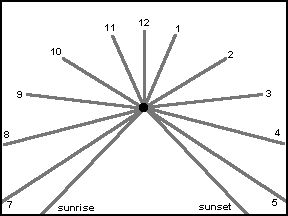
I’m going to show you how to construct a simple instrument to measure sun angles. It works especially well at the solstice, but a few days late won’t hurt if you are only out to amuse yourself and maybe learn something. I first used this when I was considering where to place windows in a building to get north light without afternoon glare. You could use it to pick out the optimum placement for solar panels, or decide how deep to make a south-facing porch.

FYI to my followers in Brazil, New Zealand, and Australia. I am going to write as if everybody lived in the north latitudes; I’m sure you are used to modifying that kind of writing to meet your own needs. Sorry, but it’s just too clumsy to qualify every statement.

All you need to measure sun angles is a board with a vertical dowel or wire set into it near the center. You could use a carpenter’s square for that. You will need a spirit level to level the board, and it wouldn’t hurt to then use the level to see if the dowel is still vertical (what carpenters call plumb). You will mark the shadows as they fall directly on the board.

This is what I used the second year. The first year i drove a rusty used pipe into the ground and drove stakes into the shadows. Same principle, but far too clumsy.

Next, you need your local sun time. Subtract daylight savings time, but that isn’t enough. Noon, by the sun, is when the sun is directly south of you. Clearly that is an hour earlier on the east side of your time zone than it it on the west side, so you need your longitude and some simple arithmetic.

There are twenty four time zones, each 15 degrees wide. The first time zone is at zero longitude in Greenwich, England but, again, it’s not that simple. Time zones center on their base longitude. The first zone lies from seven and a half degrees east longitude to seven and a half degrees west longitude, and the other zones follow suit. Then all is adjusted to match up with political boundaries, but we can ignore that.

Let’s choose Oklahoma City as a neutral site, so I can give  a shout out to their wonderful Fleming Fellowship, celebrating its sixtieth anniversary this month. OKC is at 97.5 west longitude. If you ignore political gerrymandering, OKC’s time zone centers on 90 degrees longitude, so OKC is on the western boundary of the theoretical time zone; the political time zone ends on the western border of the state. The sun is south of OKC when your watch says 1:30 PM, if your watch is accurate and you have it set for daylight savings time.

To find solar noon for the longitude where you live, add or subtract 3 minutes for every degree you are west or east of the theoretical center of you time zone.

I like to set my board up the day before and rotate it so that the (solar) noon shadow lies parallel to this sides of the board. That isn’t necessary, but it makes for a neater project. Then I’m ready to record the shadow that falls at sunrise.

Sunrise is problematical. You can look it up for your area, but it’s not that simple. (Have I said that before?) If you live on a mountaintop, sunrise will come earlier. If you live in a valley – or, in my case, on the west side of the Sierras – it will come later. How much can’t be calculated. It depends on how far west of that hill you are, and how high that hill is, and whether today’s sunrise happens to fall behind your neighbor’s house, or behind that big oak tree. It will come when it will come. Have a straight edge handy and draw a line from the dowel down the center of its shadow, then write down the time. Continue through the day. I try to make a mark every hour on the (solar) hour.

Early and late shadows will probably run off the board, but for the rest you can calculate the sun’s vertical angle because you will know the height of the dowel and the length of the shadow. Personally, I take the measurements, redraw the triangle on another piece of paper, and measure with a protractor; but then, I grew up before calculators.

You do realize that this is the year’s extreme for north tending sunrise and sunset and for high sun angles, and that every other day until December will be slightly different.

Even if you never design windows for north light without afternoon glare, or plan the placement of solar panels, or decide how deep to make a new porch, taking the sun’s angles throughout the day will give you a better feel for your personal environment, and a new appreciation for the complexities of astronomical observations.

Extreme astronomy geeks will repeat the process at the equinox and winter solstice, but good luck if you try. I’ve never been able to pull off any shadow measurements in December because of clouds.

170. Middle School Astronomy

We learn our astronomy from books, but that isn’t how the science started. The ancient Greeks learned about the stars by looking at the stars. Their understanding was a mixture of observation and myth, with myth sometimes predominating.

When we are young, we also learn astronomy from casual statements we hear from adults. I’ll give you an example. Mars has recently been at a close approach; every evening lately, when I step out my front door (miles from the nearest city) to look at the sky before bed, there it is, red and bright, about halfway to zenith in the south-eastern sky. Now imagine that I say to a child, “Mars is really getting close.” Just that, with no other comment. What images might pop into that child’s mind?

*****

“The seasons change because of changes in the Earth’s tilt.” You might find a statement like that in an old middle school science textbook along with an illustration like this:

ma1

Not true. Not a lie, but an oversimplification that may be fine for the average student, but does not do justice to the brightest kid in the room. A better statement would be, “The seasons change because of apparent I changes in the Earth’s tilt”, coupled with an illustration like this:

ma2

Now we are more accurate but we’ve confused 90% of the students.

It should be obvious by now that this is a bit of a how-to based on long experience. Even if you aren’t a teacher, you will probably someday have to explain this kind of thing to your own kids.

Let me suggest a third option. First explain things in your best lecture voice with reference to the textbook and with drawings on the board. Then pick a student sitting in the middle of the classroom; out of kindness, choose someone who likes attention. Say, “Helen, don’t move. For the next few minutes, your head is going to be the sun.” Then establish where Polaris lies, for the sake of the demonstration. Your classroom may not allow you to use real north. If some bright, smart-mouth kid catches you out, don’t get mad. Rejoice that someone is paying that much attention and make it a teachable moment.

Now walk around the classroom with the classroom globe tilted toward your Polaris and talk them through the seasons, pointing out that the tilt never changes in relationship to Polaris, but it appears to change in relationship to Helen, our sun. Pat your worst troublemaker on the shoulder as you pass him, wink at the shy girl in the back corner who never volunteers, and say, “Excuse me, Earth coming through,” when you have to dodge around desks.

There is a rule of thumb for teaching science (which probably doesn’t work for algebra). If you enjoy teaching, and you let your students enjoy learning, they probably will.

*****

That exercise was for letting students visualize things they can’t see for themselves. You can also help them see things that happen in their everyday world, but normally go unnoticed.

Observing the path of the sun through the seasons is an Earth’s-eye-view version of the tilted globe carried through the classroom. How do you compress a year’s worth of observation into one 40 minute session, using the real sun instead of charts and graphs? It can be done, but it takes nine observations on your part, spread over three days, with those three days spread over half a year. It also takes a small can of paint and a paintbrush.

When I set this up, I picked a solid, upright, eight foot steel pole which was set up away from the shadows of structures and which I knew would not be disturbed for years to come — a volleyball net pole out on the playground. At 10 AM, noon, and 2 PM (sun time, not daylight savings time) one summer solstice I painted three inch circles (same diameter as the pole) at the pole shadow’s tip.

I repeated those actions during the fall equinox, which was intriguing for my students. I had a paint can and small brush at the ready during my ten and two classes, and on the stroke of the hour, I ran out of the classroom, painted the circle, and ran back in while they watched from the windows. The noon painting had an even bigger audience because of noon recess. As you might guess, I told those who asked questions, “You’ll find out what this is all about — some day.” On Christmas break I painted the last three circles during the winter solstice.

That spring, and for years afterward, I arranged to teach solar motion as near as possible to the spring equinox. The solstices fall outside school days, and the fall equinox is often cloudy in California. I explained everything with lectures, and reading, and drawings on the board, but then we all went out to those nine circles on the playground. As I talked them through the lesson, we all watched the pole’s shadow move. It is fascinating in our mile-a-minute world to take the time to watch a shadow inch its way across the ground. Even if it wasn’t 10 or noon or 2, everyone could see that the shadow’s tip either had or would touch all three of the middle circles.

I explained how I had placed the circles and invited students to lie down with their head on a circle and look past the tip of the pole to see where the sun would be (or would have been) at noon or 10 or 2 on the first day of summer or the first day of winter.

They paid attention. On days they pay attention, learning happens. It isn’t easy, but it works.

169. North Light at Solstice

Some years ago, I had an epiphany at solstice time, all about north light.

North light is one of those concepts we accept without thinking it through. Artists prefer north light for their studios – we learn this young if we are thinking about being painters. Most of us never become artists and never have a studio, so the notion falls into the category of unexamined concepts.

I learned to paint and draw, but my skill level never rose above adequate. I didn’t become an artist, or any of another double-dozen fleeting ambitions, but I did become a writer and later a teacher. As I was nearing retirement, I bought a three acre parcel with house in the foothills of the Sierras.

For the first time, I had the chance to build something bigger than furniture or musical instruments. I was wandering around the back yard on blistering summer afternoon, thinking about north light and about building a shop with big widows pulling in masses of lovely natural light, when I looked at the north wall of my new house and saw that it was in full, hot, withering sunlight.

That’s not supposed to happen. But it does.

I live at latitude 37, roughly in line with San Francisco, Tulsa, and Washington, D. C. Here the sun is so far north (apparently) by mid-summer that it rises well north of east and sets well north of west, traversing a curved path so that at noon it is still south of zenith. The result is that the north sides of structures receive cool morning sunlight, shade during most of the day, and blistering sunlight in late afternoon.

I should have known, but in the cities where I had spent my life there were always trees and the shadows of multiple buildings to hide the effect. I had studied astronomy, but that is about the big picture, not about what is happening in your own backyard. I should have known from a youth spent outdoors, but then I was always on a tractor and in motion, concentrating on the windrow of hay I was creating, not on how sunlight fell on structures.

As a childI was aware of the motion of sunsets across the western horizon as the seasons progress, because every evening I was in the dairy barn looking out its west facing windows. I still love that phenomenon. There is a place near my foothill home where my wife and I go to watch the sunset. The spot faces west, on the western side of the westernmost hill in our area, so the vista carries all the way across the San Joaquin Valley to the coast range, and to the the buildup of clouds beyond where the cold waters of the Pacific spill fog over San Francisco. Mount Diablo, the highest peak in this section of the coast range, lies directly west of our lookout. Every spring and autumn equinox, the sun sets directly behind it. As summer progresses, each sunset is further north until we reach the summer solstice. Then they drift back, pass Mount Diablo, and head south until the winter solstice turns them back north again.

This is how astronomy began, with observations of visible phenomena. There were no ideas of orbiting bodies; that came later. Today, however, we know too much. We learn our astronomy from textbooks, not from our own observations. And then the reality in our own back yard catches us by surprise. more tomorrow and Wednesday

*****

For the record, I scratched the itch to build a building. My wife and I rebuilt a sagging 11 x 24 tool shed, put in big windows and a fancy facade. It is our quilting studio, where I also write. I’m sitting in in it now, watching the sun rise through the east window.

144. Who Said You Were Mexican?

Happy May fifth, although I’ve already covered Cinco de Mayo in a sneaky way in my post on Saint Patrick’s Day. This last post for Teacher Appreciation Week is also about teaching Mexican-American students.

I was once asked to chose the races of my students.

If you’ve followed A Writing Life at all, you know my belief that we are all one gene pool.  All “blacks” have some “white” ancestors, and all “whites” have some “black” ancestors. There may be a few statistical anomalies that fail to bear this out, but probably not.

Look at any post between January 18 and February 18 of 2016, and you will find out more than you want to know on the subject.

If this is true of the USA, it is doubly true of Mexico. The English came to America as families, and avoided Indians or fought with them. The Spanish came to Mexico as soldiers and married the native women. That’s painting with a broad brush, but it’s a reasonably accurate overview.

Back to the story. When I was a relatively new teacher, I was preparing to administer the yearly state-wide standardized test to my students. I was given a computer printout with their names and told to fill in the appropriate race for each. White, hispanic, black, eskimo . . .  You’ve probably seen similar lists.

I asked how I was to know? I didn’t get a good answer, but it was apparent that I wasn’t supposed to ask the kids themselves. Given the history of Mexico, the Mexican-Americans were all white, at least partially, but that would not have been acceptable.

Okay, there they sit. Help me choose.

What about using skin color as a criterion? I had no student that year that anyone would have called black, so that simplifies things. What about that boy? Is he Mexican, or did he just spend the summer playing shirtless in the sun? What about Khrishna Srinivas; he’s dark enough?

Maybe names will tell us. What about Maria de la Rosa, that pale blonde whose parents just moved here from Madrid? If I don’t put her name down, anyone who just reads these names will think I cheated.

What about Paul Rogers, son of Bill Rogers and Delores Sandoval? White, of course.

But what about his cousin Raul? His father is Jorge Sandoval, Delores’s brother, and his mother is Beth Rogers, Bill’s sister.

Raul Sandoval – Mexican, of course.

If you don’t find this humorous, don’t worry; neither do I. The event actually happened. I made up the examples, but there were real ones I could have used.

This all happened thirty years ago. Things are better now, aren’t they? Maybe? Try this on for size. The man on the six o’clock news says that the latest poll determined that 73 percent of Latinos prefer Hillary Clinton.

Really? How does he know?  Who said the members of the survey group were Latinos? Who set up the criteria for what it takes to be a Latino?

And doesn’t this all sound just a little absurd?

143. Class on Cyan

This is the third post for Teacher Appreciation week.

Until I retired, I called myself a novelist who taught, rather than a teacher who wrote books. It was a bit like a British officer dressing for dinner in his tent while serving in India – not a denial of the moment, but a reminder-to-self that present circumstances were only temporary.

My attitude was not disrespectful. I dedicated my complete energy to teaching for nearly three decades, and counted it an honorable profession. I just had further plans.

Some of the things I learned as a teacher spilled over into my writing. I wrote  a teaching novel (35. Symphony in a Minor Key) and Keir, the lead character in Cyan, took up teaching ecology and survival education to the colonists’ children, walking quite literally in my footsteps.

***

The snow started in the afternoon, first as scattered flakes, but soon clinging to the kaal stalks and frosting the gray-purple bowl of the valley with white.  Will turned to Keir for advice, something he rarely had to do any more.

“I wouldn’t worry about it,” Keir replied. “It looks like this snow shower will pass quickly.  We’ll push on a few more kilometers and make camp by the river. When we set up the tents, have them staked carefully. Ramananda said we could expect heavier weather when Procyon sets.”

Will nodded and turned away to organize his troop. Then he touched his throat mike and relayed Keir’s advice to Marci’s group who were coming in from another angle and still out of sight in the forest that rimmed the valley.

Most of Will’s kids were about twelve, and this was their graduation exercise. After two years of laying the groundwork, Keir had convinced the council to devote most of the seventh year of the colony’s school to Cyanian ecology and survival techniques. Keir had taught the first few years, but since they had turned sixteen, Will, Marci, and Sven Aressen had taken over the day to day teaching. Keir remained as mentor, and planned each graduation trip.

A few of these kids had seen snow trickling down onto city streets on Earth when they were six or seven, but none of them, including their young leaders, had ever seen snow falling in a natural environment. They were wide eyed with wonder.

They had taken a cargo skimmer eight hundred kilometers north from Crowley and had come the last hundred kilometers on foot. Except for the brief sweep through the region which Keir and Gus had made three weeks earlier, no one had ever explored this area. That was the essence of the exercise; it was real. The land was new and the dangers were only partially known.

The second party broke out of the trees across the valley. Keir glassed them. Marci Nicholas was waving her arms about, pointing out something, still teaching. She was a natural. Gus stumped along beside her.

Keir turned back to his own group, who had quickly moved ahead of him. Each child carried a massive pack and a fletcher in a holster at his side. Only Will could have handled the recoil of one of the scout’s automatics, but those polymer rocket launchers were recoilless, just as deadly, and only a fraction of the weight.

These children were the cream. Of the four hundred children of their age group, these were the thirty who had passed every test, mental, physical, and moral, that Keir could devise. They had learned everything Keir had to teach them. Cyan’s Olympians. Keir smiled with pride, then hurried so they did not leave him behind.

142. Still Worthy of Praise

WOPYesterday, I compared my elementary experiences with what happens in our schools today. Today I’ll talk about my high school, repeating a post from last October.

I started out to be a scientist, then defined myself as a writer, but along the way I became a teacher. Not an educator; that term is ruined for me by the fools in high places who have all but destroyed our schools.

I want to acknowledge some of my own teachers, but since I didn’t live a traditional childhood, this won’t be traditional praise. None of what follows will make sense unless you remember that my elementary school class had only eight students and my consolidated high school only brought the number up to thirty-seven. A larger school would have led to a different experience, even in Oklahoma in the early sixties.

My typing teacher was tough, knuckle slapping perfectionist, and she wasn’t afraid of public opinion. We called her The Warden. She was the only teacher who ever gave me a B. Dyslectic fingers killed me, no matter how hard I tried. She gave me exactly what I deserved and I respected her for it.

Later, when I was teaching science, my favorite exercise was a long term project where students had to build a gizmo to perform some physical feat. It was different every year, and they could only build it in class to keep their parents’ sticky fingers out of the works. Every year kids who only knew computer games and multiple-choice tests found themselves depending on their teammates who knew how to use hammers and wrenches. It was humbling to them; I smiled serenely and remembered The Warden.

My math teacher had a sense of fun. Whenever an unknown appeared in an equation, he would draw something barely recognizable as the back view of a bunny and say “That represents the number of rabbits in Rogers County”. His grin was infectious; he always looked like he was about to break into laughter. He kept us moving at top speed and made it impossible to hate or fear math. From him, I learned how to teach.

In science, I typically had read the textbook by the fourth week. I sat quietly in class and answered only enough questions to show I knew the material, then let the other students take their turns. My science teacher’s gift to me was trust. He let me work in the lab unsupervised except for his presence next door. I spent my study halls there building science projects, and that is where my science education really happened.

My English teacher gave me similar freedom out of a mixture of wisdom and laziness. I turned in every assignment early and better than required; in exchange I frequently wandered the school at will when I was supposed to be in his classes. I would never let one of my students do that, but it worked for me. I spent my time running errands for teachers, building things for the school, or working in the science lab.

It would have been a disaster for most kids, but it was the perfect education for me.

At home, my parents were hyper-controlling. Freedom was not an option. When I scored high on the National Merit Scholarship test and wanted to go to Michigan State University, they would not let me apply. It would have let me to move beyond their control.

My high school counselor let me fill out the application forms in his office and use the school as a return address, so my parents would not know until it was too late. He was putting his career in jeopardy, but I think he saved my life.

141. K-8 in Another Century

This is Teacher Appreciation Week, and I’ve known a lot of them. The good ones are a treasure beyond price and the bad ones ought to be shot – metaphorically, at least. Fortunately the bad ones are fairly rare and they usually don’t last.

Back in October I praised my high school teachers in a post that I plan to run again tomorrow. After high school and a couple of decades of assorted adventures, I became a teacher myself. I didn’t plan it that way; in fact, it was the shock of a lifetime.

I grew up in a different world. In many ways, a farm in Oklahoma in the fifties was closer to the nineteenth century than to the twenty-first. The same could be said about my elementary school. Those old ways were not necessarily better. Neither are our new ways, but a comparison can be useful.

I started school in first grade. Kindergarten existed in the cities, but not where I lived, and preschool was unheard of. Talala School had shrunk over the years as the town lost population. The building was half full of students when I enrolled. Mrs. Stout taught first and second grades in one room. There were eight first graders and about ten in second graders. We first graders were taught reading, then we worked on our own while the second graders were taught reading. Then we were taught spelling; then we worked alone while she taught spelling to the second graders. And so forth. We spent half of every day working uninstructed, but under her eagle eye. By the end of the year, we had heard everything she taught to the second graders. The next year, we heard it again, in the same room, with new kids in our old first grade desks.

Third and fourth grades meant a new room, a new teacher, but the same pattern. Fifth and sixth meant the same pattern again, except that in fifth grade the Russians launched Sputnik and science was added to the curriculum. By sixth grade the high school was consolidated and gone; we moved to the high school end of the building, but still with two classes per teacher. For the last three years of its existence, Talala School was seven-eighths empty and haunted by the few students who remained. When I was in eighth grade, there were still eight students in my class, but the only two remaining in seventh grade. They were moved on to the consolidated school and for the first time in my elementary career, we had a full-day teacher all to ourselves.

Educationally deprived? Don’t you believe it. For seven years we had worked and learned all day, every day, and that was plenty. Having a full time teacher in eighth grade was no better, and no worse.

Fast forward through high school, college, military service, more college, becoming a writer, more college, until thirty years later I found myself teaching sixth, seventh, and eighth graders. Now we had Kindergarten, and pre-school, and pre-pre-school, and nursery school, and before school help, and after school help, and tutors, and ———

A true believer might say that students needed all that help. A moralist might say that they had to be made to work more hours because they were lazy. A cynic might say that somebody had to warehouse the kids until their parents got home – whenever that might be.

Algebra was moved from the ninth grade to the eighth. The theory was that  they needed readiness, which is code for, “If they aren’t smart enough do learn algebra in the ninth grade, start teaching it in eighth. If that doesn’t work, start in seventh.” All down the line, I watched subjects get moved earlier and earlier, while the students’ scores went lower and lower, and pre-school started a year sooner.

The goal, clearly, was pre-natal algebra.

Somewhere in the middle of my career, a local high school announced that they were going to begin teaching Advanced Placement classes. That sounded like a program where I would fit in as a teacher, so I attended their orientation. Maybe I misjudged them (I don’t think so) but I heard nothing about better teaching or deeper understanding. Instead, I heard a lot about more hours, more work, more reports, a chance to get ahead of the other guy, and to earn college credits while still in high school.

I was not impressed. I returned to teaching challenging things which were age and skill appropriate – to filling my students’ days with knowledge, while leaving their nights and weekends free for the other lessons life would teach them.

While you’re learning, learn. While you’re playing, play. If you’re in high school, get what high school has to offer. If you are too advanced to do that, move to college.

If this be treason, make the most of it.

115. St. Patrick’s Day With Juan O’Malley

full title
Juan Angus Georg Angelo O’Malley celebrates St. Patrick’s Day
by drinking tequila and while wearing lederhosen under his kilt.

It is cliche to say that we are a nation of immigrants. We are also a nation of holidays celebrating our immigrant origins – Cinco de Mayo, Octoberfest, Tartan Day, Chinese New Year, and of course, St. Patrick’s Day.

The middle school where I taught for nearly three decades was not racially diverse. We had an occasional student of East Indian heritage, a very occasional black student, but the rest of the students were divided roughly equally between Mexicans (mostly Catholic) and Anglos (mostly Mormon).

I didn’t say Mexican-Americans. The phrase seems politically correct, but it lumps some very different groups together, and not all of them like the name. There were students of Mexican heritage whose ancestors had been in California longer than I had, students whose ancestors were here before the 49ers, students who were children of recent citizens, students who were children of field workers with visas, and students who had just come over the border illegally. Some were Mexican, some were Mexican-American, and some were more American than the DAR.

The newcomers had an understandably harder attitude. A few of my students wore a T-shirt with a message that said it all:

Not Mexican-American
Not Hispanic
Not Chicano
MEXICAN!

As you might guess, Cinco de Mayo was a tense holiday for the teaching staff, but St. Patrick’s Day was neutral. I took sneaky advantage of that to tell a double story.

Pardon an aside: I got away with a lot because I liked middle school kids and I was a good science teacher. Most good science teachers escape to High School at the first opportunity. My kids always scored high on the science portion of standardized tests because I taught what was in the book first, then added what else I thought was needed. One year our seventh grade science teacher was an incompetent who was invited not to return. The following year I shoehorned four weeks of biology into my physical science class so his students would not reach high school without basic knowledge. For a few insane years, math teachers were forbidden to remediate; I squeezed remedial math into my science class. In the physics of motion chapter, I always taught the space program, including a brief history of the cold war so they would know why we went to the moon.

And I always taught the Irish immigrant story on St. Patrick’s Day.

It is a moving story, which eighth graders are old enough to appreciate. Potatoes from the new world were perfect for Irish soil; where a crop of oats had supported four people, a crop of potatoes would support eight; when previously hungry people were no longer hungry, they had more babies. Then the potato blight struck, and there was no going back to oats because the population had grown.

The land was largely owned by the English. They continued to export grain throughout the famine. Vast numbers of Irish starved. Those who could raise the money took ship for America.

The passage was hard. Ten percent of those who left Ireland died on the way. Their quarters were cramped, filthy, and unhealthy. Eighth graders both love and hate this part of the story; they have a very human capacity to be simultaneously moved and grossed out. I would walk about the room, measuring out the cubicles with hand movements, mimicking the heaving of the ship in a storm, telling of the bilge seeping up from below, pointing out the sound and smell of vomiting from seasickness, and reminding them that the cedar bucket behind that blanket at the end of the central aisle-way would fill to overflowing with human waste on the bad days when the hatches had to remain battened down.

Then I would quote a passage from a letter sent back to Ireland by an immigrant, who described the passage then said, “But I would endure all that ten times over, rather than see my children hungry.”

Once in the United States, things were still hard. The Americans who were already here didn’t want them. They could only obtain the jobs no one else wanted. Many were Gaelic speakers and did not speak English. They were segregated into the poorest part of the cities. They were disrespected.

They bettered themselves, generation by generation. They learned American democracy, and elected their own kind to office. They learned American capitalism and many became rich. Eventually, they elected one of their own, John F. Kennedy, to be president.

Along the way, they began to celebrate themselves. St. Patrick Day parades are an American invention. They have only recently begun to be celebrated back in Ireland, but they have been important in America for more than a century.

*****

You have to talk fast to get all that into forty minutes and still have time for the payoff, because the story is a lead-in to a realization, which is elicited by questions.

Who else came to America from elsewhere? (Mexicans is the answer you get, but you have to point out that the same could be said about Italians or Jews or Viet Namese or almost any immigrant group.) Who else didn’t speak the language? Who else was treated badly by the one’s who came before?

St. Patrick’s Day isn’t about shamrocks and leprechauns. Its about Irish pride. Its about saying, “I’m as good as anyone.” It can even say, “I’m here – deal with it.” St. Patrick’s Day is American, not Irish, because America is where the Irish had to speak up for themselves.

Cinco de Mayo is an American holiday. It is not widely celebrated in Mexico. Just as St. Patrick’s Day is Irish Pride Day, Cinco de Mayo is Mexican Pride Day.

It is a message I got across most years, but no one would have listened if I had not first captured their emotions with the story of a politically neutral and sympathetic people with whom both Anglo and Mexican students could identify.

80. And Don’t Begin With And

yol 8This is the last of eight how-to posts on writing. I haven’t exhausted the subject, but I want to quit before I exhaust my readers.

Your Own Language:
And don’t begin with and

Here is a rule that was strictly enforced in the antediluvian days of my youth. I think today’s teachers have largely given up, and thank goodness. The rule is: Don’t begin a sentence with a conjunction.

This sentence is acceptable:     “Every morning he saddled his horse carefully, and every evening he wiped him down with equal care.”

According to the rule, this construction is not acceptable:     “Every morning he saddled his horse carefully. And every evening he wiped him down with equal care.”

And yet, this third version is “correct” again.     “Every morning he saddled his horse carefully. Every evening he wiped him down with equal care.”

What? This makes no sense – unless you first accept the fallacy that each sentence should be complete in itself. This is the same completeness fallacy that leads teachers to teach paragraphs in isolation (see yesterday’s post).

In any story, essay, letter, email, or post, the writing flows from the first word to the last. How we break up that writing – where we put periods, commas, paragraphs, dashes, colons, and semicolons – is entirely a matter of pacing.

Whether you prefer eighteenth century novels with sentences a hundred words long and a paragraph break every other page, or something modern with rapid fire, disjointed chattering, every story has to engage the reader at its beginning, then carry through to some reasonable level of closure.

It’s that simple.

Children have no problem with closure in their stories. At the end, the hero wakes up. Hemingway usually had no problem either; at the end of a typical Hemingway novel, the hero dies. But even that isn’t complete closure. When Robert Jordan is lying on the hillside at the end of For Whom the Bell Tolls, the enemy is closing in and there is no doubt he’s about to die. But what will happen to Maria? Will his coming sacrifice save his comrades? We don’t know.

As the holy men told the Prince of Exile, “Every true story ends in death, but no true story ever ends.” Closure is necessary, but never complete.

How much closure do you need? Thomas Anderson has said twice in reviews that the endings of my novels leave him feeling unsatisfied. Fair enough, yet they satisfy me. It is entirely a matter of taste.

Of course, there are limits. I once read a novel by an otherwise reputable author who ended it in mid-sentence because, just as his character has come to understand the meaning of life, he gets hit by a bus. That’s cheating.

There are more novels and blogs yet to write, and that’s closure enough for now.