Tag Archives: Westercon

Welcome to Summer

Hi, just a personal note, here; not one of my usual mini-essays.

I went to Tempe, Arizona to Westercon over the Fourth of July weekend. It was from 109 to 111 or thereabouts, but I felt no pain because the Mission Palms was well air conditioned. I have a report on that scheduled for the 11th.

I came home to find things weren’t much cooler. Yesterday was 109 here in the foothills of the Sierras, so my wife and I cut out for the coast and spent a few hours walking along the beach at Carmel. Today I’m home, hiding under the air conditioner, working out the details of a new novel that was sparked at Westercon.

I am also watering our non-native trees. When I just went out to change the sprinkler, I saw two mother wild turkeys with twenty-one gawky, half-grown chicks in our yard. They were panting, and looking miserable.

They and I are both asking — is it fall yet?

379. Westercon

You know that I write these posts in advance, and it’s a good thing because today I am leaving for Tempe, Arizona and Westercon 70.

Westercon is a western US regional science fiction and fantasy convention. It has been around since 1948, when the Los Angeles Science Fantasy Society organized it for those who could not travel to the east coast where most Worldcons were held at that time.

This will be my third Westercon. I attended Westercon 33 in Los Angeles the year Zelazny was the guest of honor. I stepped out for air during the afternoon and a lovely young woman told me I looked lonely (I wasn’t), told me she was a wannabe actress – actually she said “I’m just an LA nobody” – and told me the story of her life. I know what you’re thinking. There is no romantic ending, no money changed hands, and she didn’t steal my wallet. I think she was just exactly what she said she was.

Later that night I was cornered at a party by a guy who wanted to tell me about his screenplay. He wouldn’t take the hint that I wasn’t interested, or that I was in no position to further his career. The screenplay turned out to be for a space opera about a ray gun shooting femme fatale. He whipped out a copy of Playboy and showed me a beautiful naked black girl on the centerfold. He said she was the one he had in mind to play the part.

I don’t remember his name (a high functioning forgettery is a very useful tool) but he is probably living in a big house in Hollywood today. The plot was just dumb enough to sell.

I don’t think most Westercons are that weird, costumes notwithstanding. I think it was just LA.

The next year Westercon 34 was in Sacramento. It was a bit more sedate and I gave the paper “How to Build a Culture”. There was a good turnout; as best I can remember a couple of hundred attendees in a small auditorium. I had prepared a piece of mat board with a hand-drawn circle, divided into four pie-slices with the words environment, technology, world view, and biological structure hand written in the quadrants. It was makeshift because my first computer was still five years in the future.

When I said, “Which brings me to my visual aid”, I stood it up and, to cover it’s crudity, added “We have spared no expense!”

The joke got the small chuckle it deserved, but the sound died instantly. A young man in the middle of the auditorium was saying, in a conversational voice, “He is showing a chart. It’s circular, divided into quadrants . . .” We all realized that he was describing the chart to a blind companion, and for the length of time it took him to give his description, you could have heard a feather drop in the room. The respectful silence from crowd made me proud to be a part of the moment.

Last year I wanted to go to Westercon 69 in Portland. I hadn’t gone during all the years of my dry spell; it just didn’t seem like it would be fun under the circumstances. Then Cyan’s release was delayed again, so I skipped Portland. Now that Cyan is out, I am off to Tempe.

It will be good to be back.

375. Science vs. Magic (1)

This is another set of posts which acts as a backdrop to one of the panels I am scheduled to be on at Westercon this year. In this case the panel is Science & Technology versus Magic: what makes this such a compelling trope? In part it draws on a very old post, 37. Fantasy, Whatever that is.

It has been a grand ride.

Since I started reading science fiction and fantasy in the late fifties, I have seen the rise of Amber, Witch World, the Dorsai, the Lensmen, LeGuin, Zelazny, Ellison, Varley, Ballard, and hundred of others. I was there for the Tolkien revival and the revival of other fantasy writers under Ballantine.

Through the years, avid readers waged war on one another over the most trivial of notions — just like any other family. It used to be that, if you called science fiction “sci fi” (never mind SyFy) you were being disrespectful. You had to call the genre science fiction, or maybe SF.

However, if you called it SF, then you had to argue whether that stood for science fiction of speculative fiction or . . . I’ve forgotten what the lesser contenders were.

Mimeographs and postage stamps were the internet of the early sixties. Whole forests went to the pulp mills to make paper to support arguments about what was or was not science fiction, whether fantasy was worth considering, and where one ended and the other began. Then Heinlein published Glory Road and sent shock waves through the SF community by landing with one foot squarely in each camp.

I mention all this because, although my publications so far have been science fiction, I have spent more time and taken more satisfaction writing fantasy.

Things have changed — somewhat. Today, everything goes, but you still have to declare yourself. I recently dealt with a publisher who required that you shoehorn your submission into one of about forty SF/fantasy sub-categories. Let’s call this generating chaos through an excessive allegiance to order.

All of this is probably subsumed under Clarke’s Third Law. Or, look at it this way: the Creation as given in Genesis is fact, allegory, or fantasy depending on whether you are a fundamentalist, a religious liberal, or an atheist.

Put still another way, if it tastes like fantasy, it is (for you) and if it tastes like science fiction, it is (for you).

But maybe not for the rest of us.

Clarke’s third law:
Any sufficiently advanced technology is indistinguishable from magic

Heinlein on technology:
I try never to get a machine sore at me. There’s no theory for that but every engineer knows it.

“The car won’t start unless you hold your mouth just right.”
folk wisdom known to all owners of elderly automobiles

So what do we mean by science and technology, and what do we mean by magic?

Does anybody care?

I think the general answer is, “No”. Most readers just want a fun ride, whether with ray guns or magic wands. You, on the other hand, did sign up for Science & Technology vs. Magic, so I’m going to assume you do care. Before we go any further, let’s try to answer the question. It may prove difficult — especially if there really isn’t any difference — but let’s try.

Science is a rigorous and careful attempt to discover the nature of the universe by observation and experimentation. Okay, that seems reasonable. I think we can be provisionally satisfied with that, and move on.

Technology is a little trickier. A computer is technology, sure. But so is a flaked stone spear point. That spear point didn’t flake itself. But what about the stick that a chimp picks up and uses to get ants out of an anthill?

Nothing is ever easy, is it? Let’s just file technology as a sub-set of science and move on, or we we’ll never get to the fun stuff.

Magic is harder to define. We’ll tackle that next Tuesday, because on Monday I have to devote a post to things that are happening with Sprit Deer, over on the Serial side of the website.

Click here for next post.

367. Alien Autopsy (5)

The other four Alien Autopsy posts were in Serial last week. After they were finished, I realized that I needed to give you a better picture of the Cyl. They are kind-of my favorites.

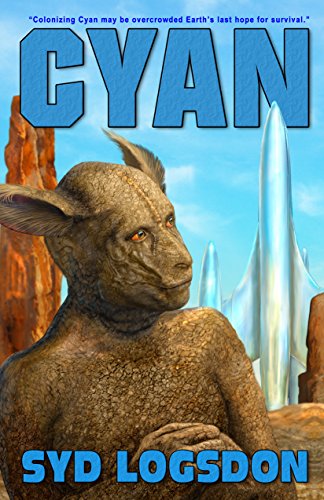
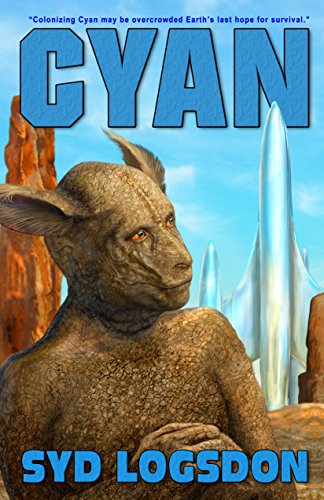
On Cyan, the dominant alien species of the torrid zone are the Cyl.  Viki Johansen, the scout specializing in Anthropology.—

. . . began a campaign of attrition and, after eight months, managed finally to enter the Cyl camp without disturbing them. They had become so used to her presence that they largely ignored her, and first-hand she confirmed her suspicions that the Cyl were of Australopithecine level intelligence

Their ears, she discovered, conveyed a complex emotive language that no one could hope to translate. Every position, every nuance of stance, was replete with meaning, and immense complexities of feeling could be portrayed by counterpoising irreconcilable emotions against one another. Yet there was no communication of ideas.

The Cyl are physiologically incapable of speech. After some changes you’ll have to read the book to find out about, “they” are taught to sign. Much later, Keir Delacroix meets up with a Cyl leader, and describes her —

The leader was an old female. Her scale filaments were sparse and shaggy, and her gel glands were puckered and no longer functioning. It was the first close up look Keir had had of a living Cyl. When she squatted at rest, her powerful hind legs jutted forward at a sharp angle and she rested her tiny forearms across her huge, scarred knees. Her mouth was broad and toothy, her bare facial skin stretched taut over massive bones and utterly impassive. She had no need of facial expression while her ears played symphonies of feeling.

Still later, Viki and her Cyl come to Beryl, Debra, and Tasmeen, needing help, and there is a dangerous moment of interspecies distrust.

The Cyl heads swiveled back toward Beryl and Debra again. There was no change of expression. There never would be, never could be, any change of expression on those bony faces. That fact alone would always keep humans and Cyl from completely trusting each other, for the humans, with their immobile, underdeveloped ears were as expressionless to the Cyl as the Cyl were to humans.

It comes near to a bloodletting as Beryl stands, armed, between the Cyl she has never seen, and her child. But then . . .

The Cyl ears moved in a symphony of sudden understanding, and of appreciation for the humanity of these strange creatures who would die — just as a Cyl would die — to protect their young.

The lead Cyl leaned forward and placed her darts, crossed, on the floor in front of Beryl and Debra. Her two companions quickly copied the motion, then all three shuffled backward. They were awkward inside the dome where the furnishings of the place made a maze for them to negotiate. As bounders, they were creatures of the unobstructed open plain. This human habitation was utterly foreign to them, not because of the steel from which it was made, or the interlocking triangles of its geodesic construction, but because it was cluttered. How could one hope to move about in it?

Beryl just stared at the Cyl. Their huge heads, their stone faces, and the heavy teeth showing through the thin slash of their lips, were too much for her to trust.

Cooler heads prevail, and Viki explains their need. Tasmeen is quick to come to their defense.

Viki was signing to her Cyl as Tasmeen spoke. It was not a translation. Cyl thought was too different for that. What she signed were a string of independent concepts. Had she been Cyl, the positions of her ears would have placed the concepts in an emotional context and tied them together into a rich and complex whole. When the Cyl spoke to Viki, that was what she received, the great subtlety of hands and ears in concert, but when she spoke, it was, to the Cyl, as if she were a halting child. She said:

WOMAN. LEADER. POWER. (my) PRIDE. TRUST (her).

The lead Cyl signed that Viki’s trust in Tasmeen was like the trust of the entire Cyl race for Viki; that in trusting Viki, they therefore trusted Tasmeen; that they too recognized the power in this woman; and that it was a lovely irony (the Cyl live for irony) that the sister of the mother of the race of Cyl was of an age to be the daughter of the mother of the race of Cyl, and therefore this woman of power who was their mother’s-sister was also their agemate-sister, so that the emotions of love and respect that they must necessarily have for her as the savior of their race were also the emotions they would choose to have for one who was both mother and sister to them all.

This she said in a three-second flurry of ear and hand motions.

Beryl watched, wondering if this hulking, stupid-looking creature was really of human intelligence, or if Viki was merely fooling herself.

A little irony never hurts.

The best aliens not only look different, but think differently as well.

Alien Autopsy (4)

In Jandrax, I was happy to use modified mammals and birds. That was all the story needed. When I wrote Cyan, I faced a different situation. My crew was set down on an alien planet for one year, with the task of coming to understand its weather, geology, and ecology in order to prepare for colonization. They were all scientists, so their actions and conversations called for a deeper understanding of their new world than any other kind of science fiction novel would have required. That challenge was half the fun.

When I began Cyan, I had been studying ecology for about twenty years, starting back when I had to explain what the word meant. I later came to understand the essence of Earth’s taxonomy in the most rigorous possible way — I had had to condense it to a level which middle school students could understand without dying of boredom.

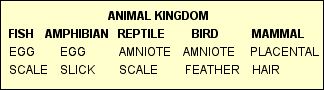
Terrestrial taxonomy looks something like this:taxon

Drop a salmon egg on the gunwale of your canoe and it will dry out in minutes. A chicken or turtle egg would survive the same treatment. This is the meaning of amniote egg (although there are other, competing meanings). Creatures who lack them, must lay their eggs in water. The rest of the chart should be clear, although simplified. For example, birds have scales on their legs as well as feathers elsewhere, and I skipped Dinosauria altogether.

I built up Cyan from the taxonomic level. If I had hadn’t been showing the planet through the eyes of a team of scientists, I would never have started out there.

It had to be weird but recognizable — that’s the key to all science fiction invention. It also required restraint. You can only explain so much to your reader without losing them, and beyond a certain point, your backstory is wasted effort.

I took grasses and weeds for granted. I gave my trees multiple trunks bound together, like a strangler fig without its victim. For something like insects, I made Chitropods – chitro sounds like chitin, and pod means foot, so the reader can be expected to infer an exoskeleton. Continuing the idea of inference, if we call the flying creatures who eat the chitropods pouchbats, the reader will draw a better picture in his mind that we could on paper.

The number of legs is important to Terrestrial arthropods, but I bypassed that by giving all chitropods many legs, but with only one joint each where each meets the body. This gave them a rolling gait “like caterpillars on crutches”.

These are throw-away inventions. They could have been applied to any ecosystem and they are not systemically related to each other. They alone would be good enough for most science fiction novels, but not for one about scientists teasing out the essence of their planet.

Here we need a key differentiation, from early in evolution, from which a thousand lesser differences can be derived. I decided that on Cyan, early in the development of chordate life, the vertebral column doubled at the posterior, giving Cyanian sea life twin tails. That changed everything. Earth fishes evolved legs from their fins. Cyanian “fishes” evolved legs from their split tails, so every Cyanian land creature is a tail-less hopper, fundamentally different from anything on Earth.

On Cyan, the classes are Pseudo-pisces, Amphibia, and Inturbia. No reptiles, no birds, no mammals, no dinosaurs. The Amphibia are cold blooded. Inturbia are inefficiently warm blooded. The term Inturbia should imply “internal body temperature un-perturbed by external changes”. Not every reader will get that, but writers should reward their best readers by not spelling everything out.

There are a thousand other details, but for that, you will just have to download Cyan.

All this is not to say that I didn’t invent interesting alien creatures. Kavines are incredibly fierce. Dropels, especially after they became domesticated, are cute and tasty. In the southern part of the upper continent, the Cyl developed something close to sapience, leading Viki to . . . nope, sorry, that’s a spoiler. I just started with taxonomy so they would all fit together.

Of course, too much consistency without outliers would be boring, so I added the globe wombs. The explorers see them shining in the treetops from their first minutes on the planet, and it takes a while for them to figure out what they mean.

Inturbia have live birth. Cyanian amphibs have to return to water to lay their eggs, except for one group, the Sphaeralvids, who produce globewombs. When a Sphaeralvid mother comes to term, she moves to a sunny spot in the treetops and exudes a transparent, leathery sac filled with a clear fluid like seawater. Into this she deposits fertile ova, then defecates. Algae from the Sphaeralvid mother’s bowels convert the feces into biomass and the Sphaeralvid nymphs fed off the algae.  When the feces are gone, the globewomb walls break down, leaving the now sizable nymphs free to face Cyan on their own.

Neat, huh? That is entirely too much detail for most books, but Cyan was written to show, realistically, what exploration of a new world might be like. This is just the kind of detail a crew of scientists would be recording.

Aside:      Shortly after posting this, I received a digital copy of the print-on-demand version of Cyan to proof. I spent May 29 and 30 in close reading of all 315 pages. The taxonomy and ecology of Cyan are backstory, dribbled out in bits here and there, but what the reader sees up front and in their faces are the individual alien beings. I realized that I need a fifth Alien Autopsy post to devote to the Cyl (the cover critter), but there is no space for it here. You will find it next Thursday over on the A Writing Life side of this website.

#               #               #

I began Cyan a few years after I wrote Jandrax, and set it in the same universe but hundreds of years earlier.

I also have in mind a third novel set in the same universe, but very different. It will take place on Stormking, a prison planet with a Uranian inclination to the ecliptic. The people who make up its population are not scientists, but outcasts. They have no interest in taxonomy. They meet the creatures native to their world one by one, and all they care about are which ones can they eat and which ones want to eat them. This time I’ll stop worrying about how these alien creatures make up a logical system, and just weird them up big time. That ought to be fun, too.

Alien Autopsy (3)

Imagined alien life forms can range from nearly human to outrageously strange. They can be imagined to meet story needs, or imagined first, with stories arising from their peculiarities.

Actually we can do even more. We can imagine whole ecologies. And again, we can go from minimalist to extreme. Arzor from Norton’s Beast Master is suspiciously like the American southwest, but Dune is a desert with an ecology quite a bit developed beyond any desert on Earth.

My first science fiction novel Jandrax [see note at the bottom of the page] is set on a deeply frozen planet, with only the equatorial region ice free. The only area I developed was a plain roughly a thousand miles across, centering on a massive freshwater lake. I stranded a starship with a load of fundamentalist passengers and a relatively unreligious crew, and watched the fireworks as they found two quite different ways of coping with the local ecology.

The area in question never sees rain, but during the cold season, snow and sleet falls, then melts during the (slightly) warm season. Viewed locally, this results in a dead season of snow, a brief season of wild plant growth during which massive migratory herds move through, and then a long season of dry, warm aftermath until the churned and destroyed vegetation is covered with new snow, where it and its seeds will wait for the next melt.

Viewed from the starship stranded in orbit, there is a moving line of green, eating up a mass of white, and followed by a growing gray, brown temporary desert.

I won’t tell you what happens to the people. That would be a spoiler to a book I’m hoping you will still read. Instead, let’s look at the alien creatures, starting with the herbivores.

Herbies are burrow bodied, tapir headed, fleet and harmless. Humpox don’t get much description, but don’t need it, with that name. Trihorns are as deadly as they sound. All are mammals, as are the carnivorous longnecks and krats. There are also huge carnivorous toothed birds called leers. They ended up on the cover.

These are the deliberately realistic creatures, all mammals and birds, devised in an era when warm blooded dinosaurs had not yet reached public awareness. In another part of the book, there is an interlude on an island which may be a hallucination or perhaps an encounter with the local version of God. Here the rules of realism don’t fully apply, and we find winged people who would never stand up to the laws of aerodynamics, and an insufferably cute, seal-faced, plump flying mammal called a dilwildi.

The example of Jandrax goes straight to the notion of purpose. Weird critters for the sake of weird critters is entirely valid. I love a weird critter novel. But Jandrax was my first full fledged novel, designed to show human interaction in a harsh, ice-age environment. It contains an entire religion, devised for the purpose of providing conflict. The ecology of the world was central to the story, and it was developed, but the individual alien creatures just needed to look right in an ice age environment. Nortonian minimalism is at work here.

#               #               #

I was in high school when I  first read Richard McKenna ’s novella Hunter, Come Home. It was a deeply moving, human story of manhood, honor, and love. It also had a second dimension, the description of an entire sentient ecosystem in peril and fighting back.

Here is a brief summary. Mordinmen were descendants of a lost Earth colony which had fought a generations long war against the dinosaur-like creatures which inhabited their planet. Manhood had become symbolized by the killing of a dino, but now the dinos were scarce and poor families, like Roy Craig’s, could no longer afford a hunt.

Mordinmen had now claimed another planet and were setting about to destroy its native ecosystem, in order to rebuild it in the image of their home planet. Red dots (successful hunters) were running the show, assisted by blankies like Roy who was working toward the time he could make his kill on the new planet. Hired as specialists, the Belconti biologists were providing the virus-like Thanasis used to destroy the native life.

When the story begins, the fight to transform this new planet has been going on for decades, and it is failing. Now the Mordinmen, against warnings by the Belacaonti, are about to unleash newer, harsher, more dangerous plague on the planet.

That’s about as far as I can summarize without a spoiler alert. Roy Craig wants more than anything to be a full fledged member of his machismo society, but his blanky status leaves him marginalized and frustrated. At the same time, he is drawn to the relatively gentle society of the Belaconti with whom is is working, symbolized for him by the woman Midori Blake.

Other than the dinosaur like creatures imported by the Mordinmen, there is only one other alien species — the entire planet they are all on. The native life of the planet is totally interconnected, essentially a one-world-tree (shades of Gaia).

There is a three way contrast in Hunter, Come Home. The Mordinmen, from a macho society built on killing are placed in contrast to the Belaconti, scientists who understand and treasure the ecosystem they are trying to destroy, and they in turn are contrasted to the interlocked, semi-sentient native life of the planet. Roy and Midori are each caught in conflicting loyalties as the planned apocalypse moves forward.

This is one of those cases where world building, culture building, and alien species building work together seamlessly. more tomorrow

Click here for next post.

[You can find Jandrax in used book stores. It is also available on this website, in an annotated form. Eventually it will be placed in Backfile, but I’ve been busy. I you want to read it here and now, your best bet for navigation is to begin by clicking the March 2016 archive and find Jandrax 2, then read and slide up, skipping every other post — archives alternates posts from the two blogs on this site. It is a bit of a pain. You can get Jandrax most days through Amazon’s cadre of used book stores. If you want the annotated version, in which I explain the various foibles of a young author, I plan to put it into an easily accessed form in Backfile, as soon after Westercon as I can find the time.]

Alien Autopsy (2)

This material is the second post of four for the panel “Alien Autopsy: the biology of ET” Posts for the rest of the panels will be published in A Writing Life.

You can write a story and make up aliens – sentient or otherwise –  to fit. Or, you can make up aliens, and write a story about some peculiarity of their makeup. Decades of stories were about human mutants (not technically alien, but close enough) with psi powers. if you didn’t live through the fifties, you probably don’t realize how many ESP wielding mutants there were in science fiction, long before Professor X and his X-men made it to the comic books.

Sometimes a single biological factor, with its secondary ramifications, may suggest a whole species and their culture, as in Gardner Dozois novel Strangers.

It is the bittersweet story of a love affair between an Earth man and an alien woman of a people called the Cian. Throughout the novel, Dozois drops hints about the central paradox of Cianian culture, but Farber, his hero – if that is the right word – doesn’t pick up on them. Because he doesn’t understand his wife’s culture, he chooses to have children by her, thinking that is what she wants, and in the closing chapters Dozois drops a house on all of us when Farber – and we – discover that Cianian culture is all built around the fact that, because of a biological defect, its women always die in childbirth.

Technically, this is a gimmick story, but it is so well done that it doesn’t feel like one. Strangers is build around Cianian culture, but Cianian culture is built around the structure of its aliens’ reproductive biology.

There have also been a lot of less salutary books written about aliens with odd reproductive structures, but lets not go down that road.

(Aside: My novel Cyan, named after the planet which was named after the color, has no relationship to Dozois Cian, or the thousand other Cians — characters, book titles, and authors names — to be found if you type cian into Goodreads.)

Those of us that grew up with the original Star Trek knew aliens as humans with big masks and padded clothing. CGI made quite a bit of progress in removing that limitation in movies and subsequent TV programs, but the wildest aliens aren’t products of technology. They have been around for more than a century in novels. Remember War of the Worlds? Great monster. Even better radio broadcast.

Larry Niven’s Puppeteers might be hard to reproduce in a movie, but that doesn’t stop readers of Ringworld from enjoying them. In fact, that may be part of the appeal. We science fiction readers enjoy having a cadre of writers producing phalanxes of weird critters that would leave lesser readers shaking their heads.

No one has read all of science fiction, but I’ve read a lot. And in my slice of the SF universe, I have never found a writer who created more or weirder creatures than E. E. Smith, PhD; aka Doc Smith.

Smith was not available in either of the two libraries that were the centers of my childhood universe, but when I got to college, one of my roommates was a fan. He wisely started me on Galactic Patrol, and I read through to the end, then circled back. Take my word for it — keep the same order. If you start on the putative book one, Triplanetary, you’ll probably never make it past page five.

(Another aside: books four through six were written from 1937 through 1948, all appearing in Astounding. Smith wrote “book one” in 1934, unconnected to the rest. When he got a chance to see the complete series published, he rewrote Triplanetary to fit the others, wrote an entire new “book two”, First Lensman, and tweaked the rest. They fit together, and the first two have moments of excellence, but the last four are the essence of the tale. If you find the style too old fashioned after two chapters of Galactic Patrol, move on; you were born too late.)

You will, however,  miss a menagerie of strange aliens, both sentient and otherwise. I’ll describe just two; first Worsel:

. . . there was hurtling downward toward them a veritable dragon: a nightmare’s horror of hideously reptilian head, of leathern wings, of viciously fanged jaws, of frightfully taloned feet,  of multiple knotty arms, of long, sinuous heavily-scaled serpent’s body.

This is the creature who will become the second most formidable Lensman, and Kennison’ s best friend. The third second-stage Lensman was Tregonsee:

This . . .apparition was at least erect, which was something. His body was the size and shape of an oil-drum. Beneath this massive cylinder of a body were four short, blocky legs upon which he waddled about with surprising speed. Midway up the body, above each leg, there sprouted out a ten-foot-long, writhing, boneless, tentacular arm, which toward the extremity branched out into dozens of lesser tentacles, ranging in size from hair-like tendrils up to mighty fingers two inches or more in diameter. Tregonsee’s head was merely a neckless, immobile, bulging dome in the center of the flat upper surface of his body — a dome bearing neither eyes nor ears, but only four equally-spaced toothless mouths and four single, flaring nostrils.

These are the minions of civilization; the baddies look worse.

Part of the power of these descriptions comes from E. E. Smith’s writing style. In flipping through the internet while writing this, I ran across a comment that if the Lensmen series were to be offered for publication today, it would not be accepted. That is absolutely true, but it is also true that without the Lensmen series, there would be no Star Wars, nor any other space opera. The Lensman series set the pattern that all others would follow, and nothing that came after was as good as the original.

Heinlein was Smith’s friend, and our best picture of him, from RAH, shows Smith as the original of the Gray Lensman, and shows his wife as the original of Clarissa MacDougal. Much of the charm of the series lies in Kennison’s Boy Scout incorruptibility. Those who say he has no personality are wrong. He simply has a personality that is out of the modern norm. Like Jesus. Which is exactly what he should be, as the end product of thousands of years of Arisan work in perfecting human DNA.

All this works, and the hundreds of weird aliens work, because E. E. Smith’s writing style is essentially naive. His rolling cascades of description could only come from someone who is so sure of himself that he is incapable of embarrassment.

It’s been a long time since that kind of writer has been in vogue. more tomorrow

Click here for next post.

360. Eternal Ballads

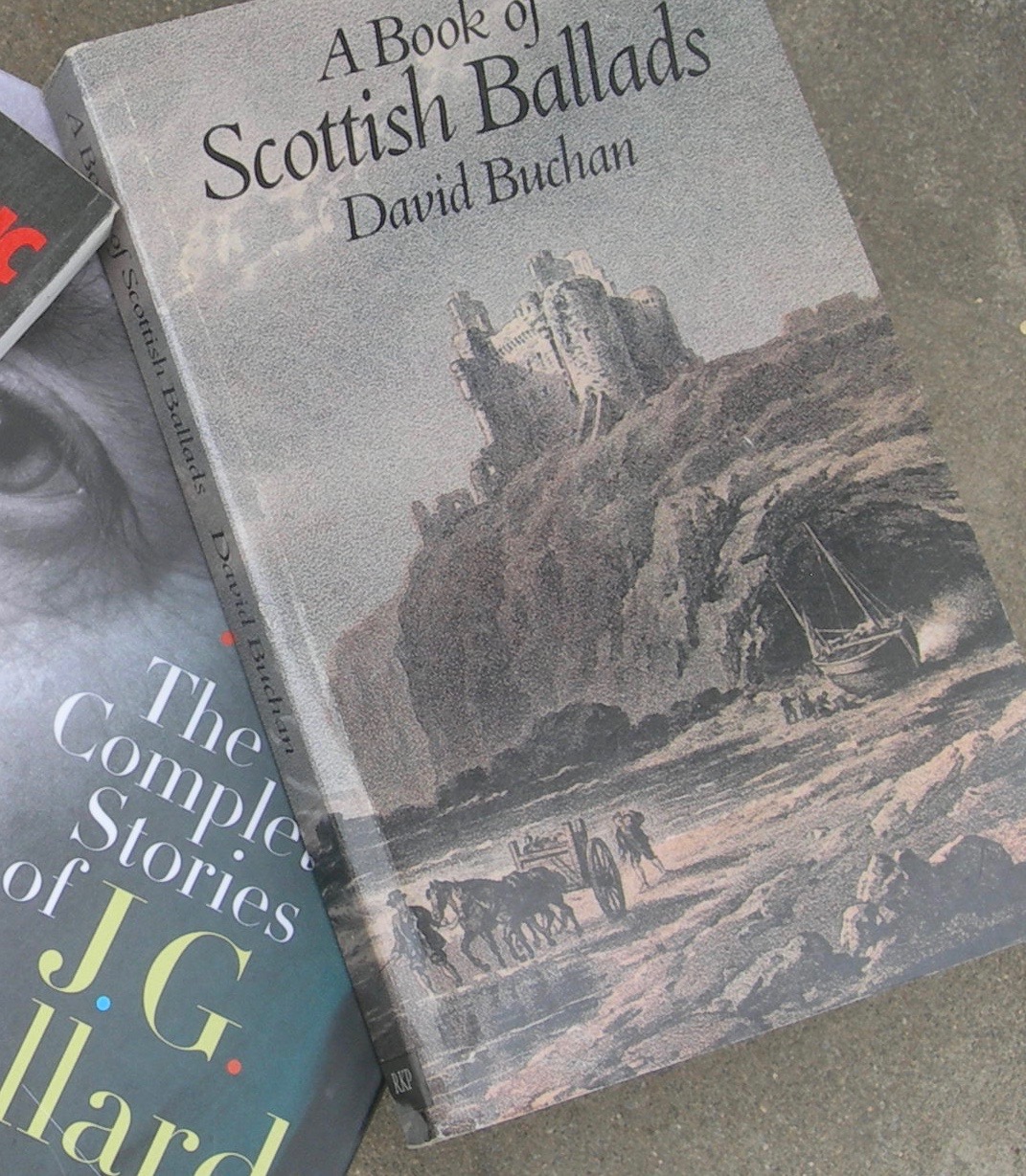
Just before noon on May 22, I was writing the posts leading up to the Golden Age panel I will be doing at Westercon. I wanted to know the name of a particular J. G. Ballard short story for the post. I remembered the story, not its name, so I pulled out my compilation of his work. It is massive, and by the time I had found the story in question (Deep End) I was approaching a state of depression. Ballard can do that. I suggest taking him in small doses; one story a week maximum.

That was when this story occurred to me. I wrote it in about an hour. Once it was finished, I realized that it might seem a very strange story — if you don’t know Ballard, and particularly Deep End.

=================

He was an old man already when they caught him. The crime, if it was a crime, and if he had done the deed, occurred so long ago that there were few witnesses left. Three, to be exact. One placed him on the scene. One testified that he had seemed to know too much about the crime, in conversation, a week after it was done. One said he saw it happen, and saw the old man, when he was a young man, and testified that they were the same person. None of the witnesses told exactly the same story two days running, but they were all old, so you could expect that.

The accused was found guilty and sentenced to ten years. It was a lenient sentence for the crime, but no one thought he would live long enough to serve it.

They placed him in a cell of the new type. For decades solitary confinement had been deemed cruel and unusual, so only the most dangerous endured it. The old man was not dangerous. He swayed when he walked and he was always short of breath.

But there were new rules now, designed to protect prisoners from each other. The old man was so clearly frail and helpless, that they applied to him. They put him in a cell, four meters by three, with a toilet and shower in an alcove, an opening that presented food three times a day, and a steel door that was closed once and forever, not to be opened for ten years, or until the old man died. This would keep him safe from the other prisoners who might have tormented him.

There was a camera at the ceiling, through which he could be observed.

Before he was incarcerated, they asked him what book he wanted with him. He would only get one. Most prisoners asked for the Bible. A few asked for the Koran. Buddhists never asked, as they carried their god within themselves.

The old man was not religious, but he loved the sound of human voices. It was the thing he anticipated missing the most, so he said, “Ballads,” thinking he could sing them and ease the eternal silence of the cell.

They gave him his book, pushed him through the doorway, and the last human sound he heard was the clanging of the door, and the oiled sliding of the lock. He sat on the bed. It was made of plastic, semi-soft, vastly durable, designed to outlast him. He was naked because once a prisoner had stuffed his mouth and nostrils with torn clothing, and slipped his hands into pre-tied manacles of denim, and had escaped into death.

After an hour of silence, eyes downcast to avoid the gray walls, the old man took up his book, but they must have misunderstood him. It was the complete short stories of J. G. Ballard. The old man had never heard of Ballard. With a sigh, he opened to the first page and read, “I first met Jane Ciraclides during the recess . . .”

#              #              #

When the proctors came to let him out at the end of ten years, they went first to the observation station. There were one hundred screens on the wall, ten rows of ten, all tied to the cameras in the cells for which this observer was responsible. The observer quickly darkened all but one screen, as protocol demanded. He had spent thirty hours a week in this room for eighteen years, viewing a hundred prisoners who could not look back. His outlook had become narrow, but his body had grown large.

The proctors were hardened to viewing the results of solitude, but even they were startled by the old man’s appearance. His head was shaggy in parts, bare and raw in other parts where he had torn out his hair by the handful. His body was a skeleton wrapped in wrinkled skin. The walls of his cell were covered with graffiti made with excrement. It must had smelled terrible.

Following protocol, they watched him for two hours, waiting for the moment his sentence would be up. He lay most of the first hour, foetal on the bed. Then he staggered up. There was no sound from the room, except the sliding of bare feet on concrete. The old man had uttered his last curse eight years before, and every day since then had been wordless. But not utterly without sound.

Now he approached the book, and opened it. He let pages flutter past, until he found a starting place, and then he read. After a moment, there was a faint groaning. After five minutes, that gave way to an ululation on two notes that grew in volume as his body began to shake. Eventually he leaped up and hurled himself against a wall, beating it with his fists until blood flowed, and sinking to the ground in whimpers.

The observer remained unmoved, sitting in his place like a fat Buddha who no longer saw the world’s pain. He leaned forward and rotated the camera, and said, “I thought so. Deep End. That always upsets him the most.”

One of the proctors said, “How can he have survived like this?”

The observed replied, “Everybody lives forever in Hell.”

Alien Autopsy (1)

Kinnison and Tregonsee well visualized,
with Worsel drawn badly as an alligator.
Interior illustration from a 1941 Astounding.

Raven’s Run concluded Monday, May 22. A new novel, Spirit Deer, will begin in Serial on June 5. Meanwhile, I am scheduled to participate in five panels at Westercon this year. Posts relating to the panel “What Makes the Golden Age Golden?” were presented in Serial last week.

This material is for the second panel “Alien Autopsy: the biology of ET”. Posts for the rest of the panels will be published in A Writing Life.

Take one human being. Count his parts. Now start changing the appearance, number, or configuration of those parts. You might come up with:

A two headed mutant on a century ship.
A seven foot humanoid with curving horns coming out of his forehead.
A human who consists of “four-hundred-odd pounds of rawhide and whalebone”, because his ancestors colonized a high gee planet.

See how easy it is. And that, by the way, was a quiz. All three examples are from major writers of science fiction. Their identities are at the bottom of the page. Sometimes, a little tweak all it takes, and for that you don’t need any help. Anyone could do it, although not everyone does it equally well.

     The first of these three was a monster/villain type, and that was all the critter building required to let him do his job.
     The second was an ersatz Amerindian and everybody knew it. By the way, the term Amerindian was used by anthropologists for a short time before Native American took over, and this author may be the only one to have used it in science fiction. Hint, hint.
     The last human variant was a fairly major character, with an actual personality (albeit a cardboard one) and he looked like he did because he had to, in order to play the role assigned to him.

These are all humans, or the galactic equivalent of human. Sentient beings. HILFs. A HILF is a Highly Intelligent Life Form, a term coined by Ursula Le Guin, which should have replaced sentient being, but never caught on. Sentient actually means “having sensation”, not “having intelligence”. An earthworm is sentient in the dictionary sense, but science fiction speaks its own language.

Non-sentient (in the SF sense) beings can also be created by simple tweaks.

The people of Gorth in Star Gate ride larngs; I’m referring to the original novel by Norton, unrelated to the movie or TV series using the same name. A larng is shaggy, clawed, and has a bad temper, but basically he is just a hairy horse with an attitude. On Arzor — Norton, again, in Beast Master and its sequels — humans have to watch out for yoris (think alligators with a poison gland) while they herd frawns (analog to big-horn sheep) across a landscape suspiciously like the American southwest.

I’m not complaining. Beast Master is one of my favorite Norton novels. There is plenty of intrigue, adventure, battle, and family turmoil. It didn’t need a full scale exercise in critter building. In fact, more imagination devoted to that aspect of the novel would just have slowed things down.

Marion Zimmer Bradley, in Hunters of the Red Moon and its sequel The Survivors,  gave us a mammalian snake, complete with nipples, and a giant hyper-fast weasel. She also gave us some sentient beings — there was the cat-critter and the dinosaur-critter. Again, I am not making fun. These sentients had plenty of individuality and charm, but it came from their cultures, not their body structures.

You might call this the minimalist approach; it’s surprising how often it works. Norton was the master of the technique. Gordon Dickson could paint a whole landscape in twenty words. If you have a story to tell, and that story just requires local color, it’s often best not to waste your efforts and your reader’s time in excessive descriptions of the local flora and fauna.

You can combine the minimalist approach with an occasional zinger that brings you reader up short. Marion Zimmer Bradley did that in The Survivors with the proto-saurian Aratak. In the middle of the action, he gets a pheromone soaked calling card from an enemy proto-saurian and disappears. Weeks later he comes back with a smile on his face, ready to take up the quest where they were when he deserted his companions.

I have read hundreds of stories with minimally different aliens. They were all as good, or bad, as the underlying story allowed. I never felt cheated.

However, if you want to go to the next level, and make your aliens really different, that works too. We’ll look at that tomorrow.     

Click here for next post.

================

Oh, yes, I almost forgot. The quiz. The examples were from:

Robert Heinlein, Orphans of the Sky
Andre Norton, the Norbies from Beast Master
E. E. Smith, Galactic Patrol, referring, of course, to Peter vanBuskirk.

359. Westercon Who?

I always think of Westercon as a big deal, but really, most people have never heard of it. Star Trek conventions, sure. Comicon, oh yes: especially since The Big Band Theory showed our four nerds in attendance.

Worldcon is the mother of all science fiction conventions, genealogically, although not in size. It began in 1939. Hugo Awards are handed out at Worldcon.

In 1948, local science fiction fans in the Los Angeles area decided to hold their own convention, because Worldcons were being held on the east coast, and coast to coast travel in 1948 was no small chore. The first Westercon drew 77 people — the first Worldcon had drawn 300.

You might say they have both grown since then. Conventions have also fragmented into specialty venues for fans of fantasy, comics, Star Trek, Star Wars, zombies, manga/anime and who knows how many others.

I love science fiction, but I’m not a fan. That means I read it a lot, read everything my favorite authors write, re-read frequently, and eventually became a writer myself. But since I’m not gregarious, and no one in my world shared my interest, I never talked to anyone about science fiction. Until this blog, that is.

Fans talk about their favorites, and also the %*#*@ jerks who are ruining the genre. They used to write fanzines, and now they produce webzines, websites, and pod casts. And they produce conventions, go to conventions, and volunteer at conventions.

I guess this website takes me half-way into fandom, since I have written quite a few appreciations of Heinlein, Clarke, Norton and others of my favorites. And now I’m volunteering as a presenter at Westercon 70 in Tempe, Arizona over the fourth of July weekend this year.

I’ve actually done this before (see How to Build a Culture), but it has been a while. I’m tentatively scheduled to be on five panels:

What made the golden age golden?
Fantasy world building
Alien autopsy: the biology of ET
Science & Technology versus Magic: what makes this such a compelling trope?
Fake it ’til you make it: a survivor’s guide for the introverted author

I’m not the kind of guy who can flop down behind a table with three or four people I’ve never met and pontificate. Not gregarious; as I said above. I will be preparing my thoughts on these topics over the next month, and as I do, I’ll be sharing them in the form of posts. That way you will be in on things, even it you don’t make it to Tempe. This will work well with Spirit Deer in Serial. That short, short novel is going to turn into a bit of a how-to through posts over on this side, and that will work well alternating with how-to posts made in preparation for Westercon.

This should be fun.