
Tag Archives: Westercon

Golden Age of Science Fiction (3)

Raven’s Run concluded Monday, May 22. A new novel will begin soon.  Meanwhile, this is the third of three posts of material for the panel “What Makes the Golden Age Golden?”, to be presented at Westercon.

.  .  .  Some say the golden age was circa 1928; some say 1939; some favor 1953, or 1970 or 1984. The arguments rage til the small of the morning, and nothing is ever resolved.
         Because the real golden age of science fiction is twelve.
                                   David Hartwell

That the golden age of science fiction is twelve — or thirteen — has some validity, but also has limitations. If you are a thinking reader, the golden age of science fiction begins when your maturity begins.

For fun, let’s put that into pseudo-mathematical terms:

MATURITY = ENTHUSIASM – CALLOWNESS

Old age comes when you also subtract enthusiasm — some of us will never reach it. A mature reader loves the good stuff (by his/her lights) but doesn’t love everything.

I had a life crisis just short of my sixteenth birthday that drop kicked me into maturity. From sixteen to college was Hell. Then I escaped. Once I was on my own, I grew like a weed after a rain storm — fast, sprawling, and a little bit prickly. I reveled in being part of a community of scholars, but I didn’t ignore that rack of science fiction paperbacks at the back of the college book store.

I had read The Way of All Flesh in high school. Samuel Butler was good. I read Davy after I was on my own. Pangborn was better.

I had read the stories in the Old Testament in church, sitting in the back pew, with my Bible in my lap so I could look like I was listening to the preacher. They weren’t bad. I read A Wizard of Earthsea after I escaped. Le Guin was better.

I don’t disparage the classics, but consider this. Setting aside the universals of the human experience (which are reason enough to go to the classics), Dickens and Butler were fighting the battles of their day. Those battles were won or lost before we were born. The best science fiction writers are fighting the battles of today and tomorrow.

Is Dickson as good as Dickens? I doubt it. But the Friendlies, the Exotics and the Dorsai are probably more relevant to today than Oliver Twist. Aside from the universals, that is.

My college roommate introduced me to Marvel comics, something that wasn’t allowed in my childhood home. That led to a decade long addiction. I finally kicked Marvel cold turkey, so I would have money enough to eat. I swear the idea of crossovers would make Wall Street proud.

My roommate also introduced me to the Lensman books. Thanks, Bob. It’s hard to read them fifty years later without lip-syncing, but I still do.

If you read enough, and treasure the good stuff, you will create your own golden age.

You can find my golden age in tattered paperbacks on the shelves of my writing room. They are the ones I didn’t get rid of, out of the thousands I read. You will find Ursula Le Guin there, but shoved to the back. Her fantasies would be at the top of my fantasy list, and a long way above Lord of the Rings, but not her science fiction. They are all thoughtful, intelligent, meaningful, and powerful. The problem is the people with whom she populated them. They were all Mrs. Brown’s of both genders (including both genders in alteration in Left Hand of Darkness). How someone who created Sparrowhawk/Ged could fail to write any science fiction protagonist I could like, even while I was enjoying her stories and respecting her skill, is a continuing mystery to me.

You will find Pavane on those shelves. It is my second favorite fantasy and near the top in science fiction. Technically an alternate timeline story, Pavane tastes like fantasy. If they ever put on a panel, “Is there any difference between science fiction and fantasy?”, I’ll propose Pavane as exhibit number one, for the prosecution and the defense.

The Road to Corlay is there, along with everything Zelazny wrote; also everything from Dickson’s Childe Cycle, but very little of his other writing. Everything from Heinlein is there, even For Us the Living. I don’t understand why, but I re-read Heinlein more than any other author. If I could solve the conundrum of Heinlein, and apply it to my own writing, I could make a million dollars and be equally loved and hated by the whole science fiction community.

I could go on for hours, but you would quit reading. It doesn’t really matter what makes up my personal golden age. It only matters what makes up yours.

#              #              #

And then there was New Age.

No concept as fuzzy as New Age has boundaries. It’s even hard to point to a center. Is Michael Moorcock part of it? Certainly. Harlan Ellison? Maybe. Defining New Age is like trying to nail fog to the wall.

During the sixties and seventies, everybody was talking about the New Age. It was going to save moribund science fiction from itself. It was going to destroy science fiction by drowning it in a sea of whining. It depended on who you were listening to.

I never was clear on who was or wasn’t New Age. I just knew there was a lot of weird new stuff coming down and I really liked a lot of it.

J. G. Ballard blew my mind. I never knew where-the-hell his stories were going while I was reading them. I often wasn’t sure after I had finished. If you ever despair of the decency of humanity, don’t read “Deep End”, and least not if you have the means of suicide ready to hand.

Harlan Ellison was the best writer of short stories ever. No qualifiers. If you want a clinic on how to craft the perfect last line, without gimmicks, read “Pretty Maggie Moneyeyes”.

If you want a clinic on how to write a soap opera, in the sense of a story that goes on and on with each sub-climax leading to new start, with suspense and resolution, but no final resolution — in short, a story that can go on forever and keep its readers happily following book after book — read Zelazny’s Amber series. It will take a while. Or if you want to sample Zelazny in a short novel that doesn’t commit you to a lifetime of reading, try Isle of the Dead.

I think there is one golden age that I missed. About mid-eighties I hit a dry spell in my writing — or more accurately, in my selling. It had consequences. When I saw a newly published science fiction novel that wasn’t as good as mine, I got angry. When I saw a newly published science fiction novel that was better than mine, I got depressed.

I was still re-reading old science fiction, and new novels by old favorite authors. I found some new favorites — John Varley, David Brin, and others come to mind — but I largely bypassed a generation of new writers. Recently I have been reading Neil and Neal, Gaiman and Stephenson, but I know I must have missed a feast of others.

I have probably missed more than one feast. Is there a Golden Age of Steampunk? Probably, but I don’t know the sub-genre well enough to talk about it.

So now I’m off to Westercon to participate in a few panels, including the Golden Age panel that prompted this series of posts. While I’m on that stage, I’ll not only be sharing my thoughts, but also taking notes. I have some catching up to do.

These posts called out a short story, which will show up Monday, over in the A Writing Life side of this website.

==================================

This is an insert, placed in the last days before Westercon. The change in the Golden Age panel caused me to write additional material on the subject of political correctness getting in the way of reading old books, but the earliest space available for that post is on July 13. Click here to go there. If you saw me at Westercon, and have arrived here via the Westercon page, I think you can get to the post early. If you click and nothing happens, try again after the 13th. Sometimes posting seems to have all the paradoxes of time travel.
Golden Age of Science Fiction (2)

Raven’s Run concluded Monday, May 22. A new novel will begin soon.  Meanwhile, this is the second of three posts of material for the panel “What Makes the Golden Age Golden?”, to be presented at Westercon.

Yesterday, we looked at Jules Verne. Meanwhile, over in England, there was a fellow named H. G. Wells, but I place him with all the other unreadable Victorians. In my opinion, if he had been a German or a Spaniard or — God forbid — a Hindu, we would never have heard of him. Actually, that is probably true of most of the denizens of British Literature 101. Others differ on this opinion.

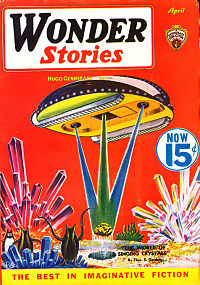
Science fiction, as we know it, got its start in France and England. The next major event in science fiction history, possibly not a golden age, but at least an efflorescence, was the era of the magazines, starting with Hugo Gernsback’s Amazing Stories in 1926 and extending, much attenuated, until today.

The era of John Campbell’s Astounding from 1939 is probably the most cited period in the search for a golden age, and a list of stories from that venue is compelling. The list of authors from the Campbell era is of almost unbelievable quality.

At that time, science fiction was mostly a literature of short stories. Novels existed, but were typically presented serially — a technique that has been in play at least since Charles Dickens. All that changed around the time of the end of World War II, with the rise of mass market paperbacks. It is a complicated story with dozens of players, but no one was more influential than Donald A. Wollheim.

Wollheim began as a fan, went on to write novels and short fiction, and eventually found his métier as an editor. He began with fanzines, moved to the editing of anthologies, then became an editor at Avon books. In 1952 he moved to Ace, where he introduced Ace Doubles. These were twin novels, published together back to back, head to foot. Two for the price of one was a real selling point in the era when paperbacks were introducing cheap literature to the masses. That’s me; I was part of the masses.

Was this a Golden Age? In terms of the availability of new writers like Delany, Le Guin. Zelazny and Brunner, certainly. And Andre Norton’s works finally got to shed their tattered cloth library look and to sport bright, new multicolored covers, sometime two on one double. But technically, this might not be a true golden age, since large numbers of the titles were recycled from the John Campbell era magazines.

It sure felt like a golden age to those of us who were reading the hundreds of titles that were suddenly available to us.

Here lies one of the answers to what makes a golden age. Any time you publish material, some of it will be golden. If your output is large enough, there will be enough gold to make an age, notwithstanding all the rest of the sludge-flow that carries it along. The influx brought about by Ace doubles and the rest of the paperback revolution made huge numbers of new works, and equally large numbers of lost classics from the past, available on every street corner for prices that everyone could afford. If that isn’t a golden age, I don’t know what it takes.

With no intention to disparage the genius of Le Guin, Zelazny, or any other, I am reminded of an old Irish story:

A group of men in an Irish bar were solving the world’s problems one by one. Deep into the night, one of them asked the group, “If every poet in Ireland were all killed tonight, how many years would it take before a new generation of poets rose up?” Another of the group raised his hand with one finger showing, and the rest nodded in agreement.

It is my opinion that for every literary genius who arises, there are a hundred like her or him that we will never know. For every award winning novel, there are many more as good moldering away in typescript, awaiting their author’s death and their final trip to the trash bin.

Literary genius is a part of the whole human race. A golden age comes when opportunity arises for the distribution of genius. Change the venue, change the world.

Today there is a mass of unread eBooks, self published through Amazon. You wanna get rich? Invent the algorithm that winnows through this crop of eBooks, and separates genius from the rest. Of course, if you do, would-be authors everywhere will hate you.

Why? Let’s consider traditional editors as Valkyries. (I didn’t say vultures, I said Valkyries.) They cruise above the field of battle and choose those worthy of Valhalla, or at least publication. Self-publication bypasses this process. An algorithm to decide on quality would be an AI-editor. Now there’s a scary science fiction concept.

The onslaught of paperbacks was not the last golden age. Beginning with the original Star Trek, there was a golden age of television science fiction, although its quality was never very pronounced. CGI, starting with Star Wars, brought a golden age of movies, at least visually. I watch them occasionally, but I have yet to see one which rises to the quality of a good novel. That may be just a personal prejudice.

I watched the Wild Wild West in its original run, and had no idea I was there for the birth of steampunk. I’m still trying to figure out what steampunk is, as something more than a sales tag. Jules Verne, plus sex? That’s puzzlement, not disparagement. I have liked the steampunk I’ve read and watched, but it won’t come into focus for me as a movement. more tomorrow

Click here for next post.

Golden Age of Science Fiction (1)

I am scheduled to participate in several panels at Westercon this year, July forth weekend in Tempe, Arizona. I intend to research the topics of each panel, and place posts outlining the ideas I will be carrying with me to the convention. Unlike normal posts, I will continue revising these right up to the moment I leave, including after they are published.

This material is for the panel “What Makes the Golden Age Golden?” Material for the other four panels will be published between now and the July 4th weekend, probably some in A Writing Life and some in Serial.

Now for the change-up. After I had written and posted all this, I finally got a proper description of the panel. 

Heinlein and Asimov are two pillars of the Golden Age of Sci-Fi. But reading those works with modern eyes can reveal attitudes that would be unacceptable in modern times. What can we learn from the classics when we look past the sexist and racist attitudes that pervaded the works of that time? Can we still appreciate works that present unacceptable ideologies?

What I had thought would be a panel on SF history is clearly going to be something different. I don’t mind. I am always ready to take up arms in the fight against political correctness, and this looks like it’s going to be a grand brawl!

#                    #                   #

The golden age of science fiction is thirteen. Some say twelve. Yes, that’s an old chestnut, but it’s still around, and people are still repeating it, because it’s true. (The golden age of fantasy would be a whole other panel, which I won’t talk about here.)

You can see it at work in Goodreads, where it can be encapsulated in this theory: The number of stars a novel will get is inversely proportional to the age at which the reviewer first read it.

That doesn’t always work of course, but it goes a long way toward understanding all those low star ratings of Harry Potter by grumpy old people who cut their teeth on Lord of the Rings, and all the five star reviews by people who were young when they first read him.

What makes thirteen a golden age? Duh! Youth, newness, our first realization of our personal uniqueness, and our first real sense of making our own choices. It also makes thirteen the golden age of baseball, science, making money, sexuality, and every other thing that makes life fun.

As for a list of books from my personal version of that golden age — sorry, can’t do it. Most of the science fiction books that gave me joy in the fifties are too dated to be enjoyed by moderns, with the exception of the early Nortons. Since Andre set her stories outdoors and stated her technological wonders without explaining them, they are largely immune to changes in the “real world”. They work when you are thirteen, and still work as long as you can see the words on the page.

We science fiction types always like to invoke Sturgeon’s Law — 90% of everything is #%*%#.” Turn that on its head, and we can say that every era has produced at least some good science fiction. In other words, there is not one golden age, but several, if you ignore the dreck. Let’s look at some of them

The first golden age of imagination was the ancient world. Thor lived then, and he still does. Gilgamesh lived then, and he lives again today, after a long hiatus. Zelazny’s works keep ancient Egypt alive. An odyssey is an odyssey, whether it is carried out by Odysseus or Dave Bowman.

Half-men half-animals, from Ra to the Centaur, abounded in the ancient world and they never really went away. Witness the were-critters inhabiting today’s bookstores. Demigods were everywhere, and they still are. Hercules is still among us and Tarzan is his modern cousin.

The trouble with starting in the ancient world is that it is ancestral to everything in heroic myth, from James Bond to Wyatt Earp to Luke Skywalker to Spiderman. Science fiction proper is not so old.

The first golden age of science fiction is found in the works of Jules Verne. Verne had the advantage of being so far back in science fiction history that he was respected. His works, in France at least, were viewed as literature, not as novelties. Now some modern science fiction writers are now being taken seriously again, but personally, I think this has more to do with sales figures than genuine acceptance.

Between Verne and today stretches the Valley of Critical Disdain, which takes up 99% of the history of science fiction.

Jules Verne invented science fiction, but he didn’t invent all his inventions. His technique was very much the same as the one science fiction writers use today. He took contemporary events and technology, and extrapolated them. That, not his “inventions”, makes him the father of science fiction.

Verne’s Nautilus was not the first submarine. As early as the 1500s there were diving bells and plans for sealed, submerged rowboats. There were numerous unbuilt plans before Drebbel’s first successful submarine in 1620. Every good American knows about Bushnell’s Turtle of 1776.

Kroehl’s relatively modern submarine made its maiden voyage in 1866. Twenty Thousand Leagues Under the Sea was serialized in 1869-70. Verne’s Nautilus was not the first submarine but it was infinitely advanced over the real submarines of the day. That is the manner in which science fiction still operates. 

Americans know Twenty Thousand Leagues Under the Sea, mostly from movies, comic books and juvenile editions, and some Americans know a half dozen other Verne titles. But Verne published from 60 to 80 novels, depending on which list you read. (The difference lies in whether you count French editions or English editions, and how you count the ones that were published in parts and later placed under one cover.) He was a force in French literature, and for at time was studied in French schools as an exemplar of excellence in the French language.

In the English speaking world, we have fewer titles. They are are often indifferently translated, and frequently abridged for the juvenile trade. One of my fantasies-that-will-never-happen is to learn French in order to read Verne in the original. more tomorrow

Click here for next post.