Tag Archives: writing

507. Sita as Symbol

Be warned: this post is about symbols, double entendre, hidden meanings, fecundity, and has a few references to the religions of India.

Over in Serial today, Marquart is engaged in a symbolic exchange. He gives three gifts, and a young man and his wife give a pledge of lifelong loyalty. When the ceremony is over . . .

. . . the boy, who as son of a serf had been nobody, gained status and lost freedom. And the girl, who had been of the village, lost freedom and gained a husband.

That insert is the first sentence in tomorrow’s post. Things don’t always come out even when you serialize something that was written as a whole.

All this is nothing new to fiction, or life. It closely resembles a young man becoming a squire, or a successful warrior being knighted. There is an exchange — fealty for security in the master’s service — and there is both a gain and a loss as someone passes from one status to another.

The thing that makes Marquart’s exchange a bit different is that the young actors in the drama are lowly. You might call them peasants or serfs, which are technically not the same thing, but which share being low on the scale of status.

I go low all the time. I grew up on a farm, wading through cow manure. At school I used a slide rule (google it) but at home I used a shovel. I feel comfortable with lowly folks; with working folks. Even though Tidac is a god, he doesn’t know it and ends up being raised . . . Oops, I nearly let a spoiler slip there!

The girl receives an iron pot, and Marquart says:

May your hearth be always warm, and the pot and your belly always full.

The audience laughs. Marquart could have said that differently — more coarsely — but that would have been offensive. As it is, “the girl blushed and the villagers giggled”. Unmarried, in a culture like this one, the girl was a danger and was in danger. Once married, pregnancy becomes appropriate, and even desired. The “full belly” refers to hunger satisfied and pregnancy.

Marquart says the right words at the right time. The moment is ritualized, and ritual makes the unsayable, sayable.

The iron post was given to the wife from the hands of a female servant. No man touches it.

The plow shear is given to the man. The girl touches the package, but the man opens it. More symbolism. Later, when the man receives the axe, she does not touch it at all.

After giving the plow shear, Marquart says:

Urel, plow deep and often, so that your seed may be sewn, and your harvest may be bountiful.

“The villagers and serf alike howled with laughter.” Double entendre rears its lovely head. Yes, Marquart is telling the serf to be a farmer, but he is also commending him to the marriage bed. And everyone present knows it.

If he had said the same thing baldly, everyone would have been offended at his lack of tact. They would also have missed a chance to be in on this great joke that they all got to share.

It resembles the rules of cussing. Every time I hear someone casually saying f**k, I think, “What a waste.” A good cuss word has to be saved for the appropriate occasion, and delivered with perfect timing. Throwing it around like an ordinary word wastes it. If you say f**k every time you bump your knee, what is left to say when you drop an anvil on your foot?

Double entendre is fun. Sometimes kids don’t get that. They think their elders are afraid to use plain language, but it’s all a game. If you don’t follow the rules, the game is no fun.

By the way, I didn’t think up that bit with the plow shear. In some South Asian languages, the word for the act of plowing is the same word used for the act of intercourse. A professor in one of my anthropology classes told us that, but then he added, “Just because the word is the same, doesn’t mean that when a farmer says, ‘I’m going out to plow my field,’ he is really saying ‘I’m going out to commit ritual intercourse with the earth’. He just means that he is going out to plow.”

I don’t think my prof was being entirely honest. I think he was wanting to keep a class full of post-adolescents under control. In fact, that farmer would be saying both, simultaneously, and enjoying the double entendre.

One last note. In the Ramayana, the god Ram’s wife is the goddess Sita, and the word sita also means furrow.

506. The Great American Read

The Great American Read or
What is that book doing on the list,
and where is my favorite?

If you want to start a fight, make a list of great books, then step back while every reader on Earth disagrees with you.

When the Great American Read was announced, I couldn’t wait to see the list. I love lists of great books. It turned out, however, that these weren’t great books, but favorite books. That is a major distinction. Great books or influential books would include the Koran, The Wealth of Nations, Das Kapital, and a raft of works everybody has heard of, but few have read. That list would not include Fifty Shades of Grey or The Martian.

It reminded me of a collection called Best Remembered Poems which included a selection of Purple Cow poems but did not contain Andrew Marvell’s To His Coy Mistress. Popularity and quality are different categories.

As I worked my way deeper into the GAR, I found that the original list of 100 came from a group of readers carefully selected for diversity. That’s all very twenty-first century, but it is likely to find oddball books as well as good ones.

Not that I am complaining. If I made a list of my 100 favorite books, no one would else like all of them either. That’s just the nature of the game.

The GAR people ask, “Which book is your favorite?” I read the list and didn’t find my favorites. A Wizard of Earthsea wasn’t there, which was criminal, but not surprising. Kidnapped wasn’t there, nor was anything else by Robert Louis Stevenson. That was surprising. What about Treasure Island and The Strange Case of Dr. Jekyll and Mr. Hyde?

As a side note, in 2014 The Guardian did a list of the 100 best novels and Kidnapped came in number 24.

So I looked at the list and started to make notes.

There were 8 books I had read and liked — Tom Sawyer, The Call of the Wild, The Count of Monte Cristo, Dune, The Hunt for Red October, The Lord of the Rings, Siddhartha, and The Sun Also Rises. None of these were my favorites, and only Tom Sawyer and Siddhartha would be runners-up for that title.

I won’t identify those I didn’t read or didn’t like, but . . .

There were 4 I read but didn’t like.
There were 4 I read part way through and tossed.
There were 3 I knew enough about to avoid.
There were 2 I read, but found them to be nothing special.
There were 8 I had not read, but I had read other books by the same author. This included authors I had liked and ones I had disliked.
There were 3 which were on my to-read list. I subsequently read one of these and demoted it to nothing special.

There was also one book — Moby Dick — that I read as a child in an abridged version, and plan to read in its entirety when I have a spare decade.

Looking at my tally, you might think I’m picky. That’s probably true, but there are a thousand books in my read-and-liked category that weren’t on this list. I just don’t seem to read what everybody else reads.

How about you? There is a reply button at the top of the post.

———:::———

The original question was, what is your favorite. For me, out of this list, it would be The Adventures of Tom SawyerThe Lord of the Rings beats it for scope, The Sun Also Rises beats it for gravitas, but it seems to me the only way to choose from such a varied list is to judge a book on how well it does what it sets out to do. For that, TS beats them all.

If I didn’t have to choose from their hundred, I think I would choose The Old Man and the Sea.

505. Heinlein and the Hippies

I have come to realize the value of a post title in finding readers, but I try to avoid bait and switch. To provide a balancing bit of honesty, this isn’t about the effect Stranger in a Strange Land had on the Free Love generation, but on the relationship between Heinlein and one particular group of hippies, the Jefferson Airplane, aka the Jefferson Starship.

For the relationship of hippies to Stranger, see 160. Stranger in a Strange Land. That way I don’t have to tell you again that I read it early and found it to be a dud.

As for me, I was a half-way hippie. I opposed the war, grew a beard, let my hair go long, and dressed in rumpled casual. The wild, multi-colored garb of TV hippies was largely a media invention. Real hippies wore Army surplus because it was cheap, which was also one of my sartorial motivations.

However, I didn’t do drugs and I was in the wrong place in the wrong time. My college roommate spent the Summer of Love in California; I spent it looking for archaeological sites in the backwoods of Michigan. He told me all about it when he came back in the fall; I had been out of touch and didn’t even know it had happened.

The only thing I understood as it happened in 1967 was the music, blaring out of the car radio as our survey crew drove around looking for archeology sites. I particularly liked that new group the Jefferson Airplane.

Which brings me to the heart of the post. In 1969, Paul Kantner wrote Heinlein a letter asking permission to quote from his work. I knew this, after a fashion, from contemporary gossip, and it was evident in the lyrics soon after, but I didn’t get confirmation until the second volume of Heinlein’s biography came out (see below). I’ll quote some of Heinlein’s reply:

I am pleased by your courtesy . . . Bits and pieces from my stories have been used by many people . . . and it is rare indeed for anyone to bother to ask my permission.

Heinlein gave permission and went on to ask for some autographed albums in return, since he was a fan of their work. Who knew?

The album Blows Against the Empire came out about a year later, by Paul Kantner and the Jefferson Starship. Despite the title. it was actually a compendium band filling in the time between the breakup of Jefferson Airplane and its later rebirth as Jefferson Starship.

It would be impossible to overstate how much music from this era was fueled by LSD. If you seek out the full lyrics, you’ll see how many drug references I have left out of what follows:

from the cut Hijack

You know – a starship circling in the sky – it ought to be ready by 1990
They’ll be building it up in the air ever since 1980
People with a clever plan can assume the role of the mighty
And hijack the starship
Carry 7000 people past the sun
And our babes’ll wander naked thru the cities of the universe

7000 Gypsies swirling together
Offering to the sun in the name of the weather
Gonna hijack – hijack the starship

from the cut Starship

Out – the one remaining way to go
Free – the only way to fall
The light in the night is the sun
And it can carry you around the planetary ground
And the planetary whip of the sun

Mankind gone from the cage
All the years gone from your age

If you are at all familiar with Heinlein, you will recognize that this imagery is from the novel Methuselah’s Children, originally serialized in 1941, which was also the first appearance of Lazarus Long. Of course Kantner reworked it. The hijackers are not Howards fleeing for their lives, but drug-fired hippies whose faith in everything turning out well is a bit laughable in hindsight.

Like all the first half dozen Jefferson Airplane or Starship albums, I loved it. If you are younger than old, there is an excellent change that you’ve never heard music that shows the spirit of innovation and experimentation that was the hallmark of the 60’s. The music that appears on TV flashback programming is fine stuff, but it is also the tame stuff. The raw stuff doesn’t get replayed.

If you are curious, give this album an online listen, although you may not care for it.

==========

Robert A. Heinlein, vol. 2, The Man Who Learned Better by William H. Patterson, Jr, p. 312. FYI, the subtitle does not refer to a change of heart by Heinlein, but is RAH’s idea of one of the three or four basic plots in fiction, and one he often used.

504. Homage to Robert Louis Stevenson

I can’t remember the first time I read Kidnapped, but it stayed with me. When I took a class on children’s literature as I was preparing to become a teacher, Kidnapped was the book I chose for a report. I read it again before going to Scotland for the first time, and have read it additional times since.

I have also read a half dozen other works by RLS, but Kidnapped began it and remains my lodestone in things regarding the author.

Robert Lewis Balfour Stevenson was born at N. 8 Howard Place, Edinburgh, on the 13th of November, 1850.

That is a quotation from RLS’s cousin and first biographer Graham Balfour. While RLS was still a child, his father changed the spelling of his name to Louis, without adopting the French pronunciation, because he was angry with a contemporary politician named Lewis. RLS himself dropped the Balfour to make his name shorter for his literary works.

Balfour was his mother’s maiden name. Despite dropping it, RLS was fond and proud of his maternal ancestors — so much so that he used the name for the main character David Balfour in Kidnapped.

Two recent things brought my long time fascination with RLS to the surface for these posts. First, a character in my latest novel is his doppelgänger. My character Balfour is — and is not — RLS. He has been “transmigrated”, for want of a better word, into an alternate London. He has minimal memories of RLS’s life and death, and is trying to recover them. Like most of the rest of the characters in Like Clockwork, he spends the novel trying to figure out what the hell is going on.

To tell more would be a spoiler, and besides, Balfour only explains things to me as he learns them, and the two of us haven’t reached the end of his book yet.

The second thing that brought RLS to the fore was The Great American Read on PBS. I watched the premier and looked at the 100 books on offer to be crowned as America’s favorite book. RLS was nowhere to be seen. How could this be? Surely either Kidnapped or Treasure Island should have made the cut. And if not, what about The Strange Case of Dr. Jekyll And Mr. Hyde?

I’ll say more about The Great American Read in a later post.

All this sent me in search of a more comprehensive biography of RLS than the one I had picked up in Scotland. I had avoided too much research when I began Like Clockwork, but by the time The Great American Read reignited my curiosity, my Balfour had become an established separate entity in my mind. I no longer had to worry about being sidetracked by an excess of reality.

I went to my favorite underfunded library where they never throw books away — because they can’t afford new ones — and found volume II of the Graham Balfour’s 1901 biography. Volume I was missing, although I eventually got a look at it online. It was a bit dense, as well as being too old fashioned even for me. Also Graham Balfour was a cousin, writing under the eye of a very protective family.

I ended up with the Pope-Hennessy biography, a work that is thinner, more up to date, and not written by a relative. Pope-Hennessy has an honest reputation and gives a balanced view.

RLS’s life was a bit of a soap opera, so I will stick to the highlights. The first key to understanding him is that he was sickly from birth, and his mother was sickly before him. His father was a robust engineer, who carried on the family business of building lighthouses.

RLS’s schooling was late starting and continued irregularly. Bouts of ill health punctuated his whole life. In fact, part of his appeal during the Victorian era was his illness. In that era, it was romantic to be clinging to life, or falling to suicide, and tuberculosis was a particularly romantic way to go.

The elder Stevenson intended him to follow in the family business, but RLS chose from an early age to be a writer. His father, fearing that he would become dissolute, restricted his allowance to such a degree that RLS lived a strange life of poverty throughout his young manhood, alternating with travel and convalescences that would only be available to the wealthy.

Shortly after writing his first book, Inland Journey, in 1878, he met Fanny Osbourne, an American woman who was separated from her unfaithful husband. RLS’s love for her was instant, intense, and permanent. When she returned home, he followed her to America where he almost died in Monterey before moving to San Francisco, all in pursuit of Fanny. She eventually received a divorce and they were married. During this time RLS was constantly writing, receiving positive reviews, but little money.

RLS, Fanny, and her two children returned to England, but could find no place suited to RLS’s ill health. During this period he wrote his best loved works, Treasure Island, Kidnapped, and The Strange Case of Dr. Jekyll and Mr. Hyde, but could find no easing of his tuberculosis.

In 1888, RLS, Fanny, and her two children, now financially secure from his novels, left for the South Pacific. They never returned. This was the first place that had allowed RLS to gain the health that had eluded him throughout his lifetime, and he was unwilling to leave it. He settled in Samoa, where he lived his last years, dying at forty-four. By that time he had written many works I have not had space to mention, and left the novels St. Ives and the Weir of Hermiston unfinished.

I future posts, I will talk about some of those works.

==================

Biographies — Graham Balfour, The Life of Robert Louis Stevenson, 2 volumes, 1901.   James Pope-Hennessy, Robert Louis Stevenson, 1974. Forbes Macgregor, Robert Louis Stevenson, 1989. The last is a an excellent summary biography in 29 pages, shown at the head of this post. It is sold in Edinburgh to tourists who probably never read it. Interestingly, the author’s name is buried at the bottom of the last page. Writer’s get no respect, even when they are writing about other writers.

I, Too

Here is a poem for the day after the Fourth of July. Langston Hughes wrote this in 1926.

I, Too

I, too, sing America.

I am the darker brother.
They send me to eat in the kitchen
When company comes,
But I laugh,
And eat well,
And grow strong.

Tomorrow,
I’ll be at the table
When company comes.
Nobody’ll dare
Say to me,
“Eat in the kitchen,”
Then.

Besides,
They’ll see how beautiful I am
And be ashamed—

I, too, am America.

Apparently, it isn’t tomorrow yet. But tomorrow is coming, and it’s up to us to help it along.

503. Colliding Conventions

On the fourth of July weekend in 1939, the first World Science Fiction Convention (Worldcon) was held in New York City. 200 people attended. It has met yearly since, except during WWII.

Despite its name, Worldcon didn’t leave the United States until 1948, when it was held in Toronto. It didn’t leave North America until 1957 when it was held in London. It didn’t leave the English speaking world until 1970 when it was held in Heidelberg.

Worldcon is best known for the fact that it gives out the Hugo Awards.

In 1948 the LA Science Fantasy Society started a west coast convention (Westercon) for those who couldn’t afford to go east for Worldcon. This competing event also meets yearly.

In those years when Worldcon meets outside North America, a North American Science Fiction Convention (NASFiC) is held somewhere in the US.

This year’s Worldcon 76 will be held in San Jose, California August 16-20. In 2019, Worldcon will be held in Dublin, Ireland, so a NASFiC should be held. The bid, which will be decided in San Jose, is for Layton, Utah on July fourth weekend.

This year’s Westercon starts tomorrow in Denver. Next year it will be in Utah — Layton, Utah, to be precise.

Yes, you did see them palm that ace.

In 2019, Westercon, which began as an alternative to Worldcon, and NASFiC, which occurs only when Worldcon is somewhere else in the world, will be the same convention. I wonder how that is going to work out?

Just fine, I would imagine.

I attended Westercons 33 and 34 in Los Angeles and Sacramento shortly after my first two novels came out. I attended Westercon 70 in Tempe last year just after Cyan was published.

In preparation for that convention, I made eighteen posts here on a number of subjects that would be covered on panels in Tempe. If you missed them, or if you want to see “How to Build a Culture” which I presented at Westercon 34, click on Westercon in the menu bar at the top of this page.

This year I am skipping Westercon 71, Denver, for my first Worldcon, just down the hill a hundred miles or so in San Jose. This should be fun.

502. Harlan Ellison

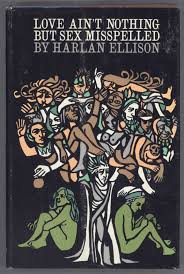
When his book Love Ain’t Nothing But Sex Misspelled came out in 1968, Harlan Ellison said that the title “reflects an attitude toward reality I would dearly love to see come to pass”. I disagreed — I still do — but it didn’t matter.  Ellison was out there kicking American culture in the shins, and that was good enough for me. He was an angry man in an angry era.

I never met the man and I stopped reading him after about 1970, so this is about early Ellison. He was a major part of my life through his short stories, still some of the best ever written, but I lost track of him about the time he went to Hollywood.

I read him through the time when I dumped God, watched blacks being fire-hosed in the deep South, escaped my parents, met up with the rest of the world, watched Americans on TV burning Viet Nam to the ground, and sat listening to the first draft lottery. My number was 41, by the way. Yikes! Everybody was angry on one side or the other of every issue (sound familiar?).

Through all this, Harlan Ellison was writing stories that kicked ass and took names. He was the perfect writer for the era.

He died yesterday (June 28th). I saw it this morning on a trailer sliding by under pictures of the latest atrocity on my morning news cast. I haven’t checked out the details yet. I don’t need to before writing this, because this is bibliography, not biography.

There were a lot of angry people writing things in the sixties. Most of them have been forgotten. Harlan is remembered because he made the things he wrote come real and resonate at a level beyond the moment. His short stories were the best I ever encountered, occasional clunker notwithstanding.

I went to my bookshelf and pulled out Paingod, I Have No Mouth & I Must Scream, The Beast that Shouted Love at the Heart of the World, From the Land of Fear, Earthman, Go Home, and Love Ain’t Nothing but Sex Misspelled. The first five are paperback. You can write them down when you finish reading and go to your neighborhood used book store, where the best in literature resides.

I say that because I just took a moment to check my local library’s online catalog. There are twelve entries on Ellison, all from late in his career, or things for which he wrote introductions. When he was hot, he was a newsstand sensation.

Newsstand: a place to buy newspapers, magazines, and paperback genre fiction. In other words, ephemera. You would never find War and Peace at a newsstand. You also wouldn’t find any of these books five months after they were published.

You will also find Ellison in a lot of anthologies beginning with the word Best . . .. He won a lot of Hugos and Nebulas, not always for his best work.

That’s it. The rest is a laundry list and the admonition to seek these out and read them. You’ll never find better.

Get Love Ain’t Nothing but Sex Misspelled and read it all, but pay particular attention to the Preface, and Pretty Maggie Moneyeyes. If you want to read the most honest writer’s autobiography ever submitted under the name of fiction, try Final Shtick.

Get as many of the others as you can still find. There will be some overlap since Love Ain’t . . . was mostly a self-chosen best-of. The gems awaiting you are not only the rest of the stories, but all of the highly personal introductions that never made it into Love Ain’t . . ..

I particularly recommend that you look at Earthman, Go Home to see what bad editing can do to a good writer. Not only was the original title Ellison Wonderland changed from something charming to something thumb-fingered dumb, but the cover contains every robot cliché that Ellison would never have used.

501. Preface to Robert Louis Stevenson

As anyone who has read even a few posts here knows, I started AWL to find readers for my novels, specifically for Cyan which had just been accepted by EDGE. I had no idea how many interesting people I would meet along the way. Some of them were fellow writers of science fiction, fantasy, and steampunk, some were fellow bloggers who wanted to be writers (this post is for you, as you’ll see at the end), and some of the ones I met indirectly had been dead for many years.

Of course, I had been discoursing with dead people all my life. Imaginary people, as well, starting with Victor Appleton II, “author” of books I was reading before I got my first library card. If you don’t recognize “him”, “he” was a house pseudonym belonging to the Stratemeyer group. “He” wrote the Tom Swift, Junior books which were my idea of science fiction when I was ten.

Come to think of it, many of the people in the Bible that my parents introduced me to were imaginary as well as dead, but a wise man doesn’t talk about to that in public.

One of my favorite friends-I-never-met is Robert Louis Stevenson. He has been a part of my life for decades, and I recently had cause to dig deeper into his personal story while putting together an upcoming series of posts.

Very early in his career (1878), long before anyone had heard of him, Stevenson wrote a travel book about his voyage by canoe on some European rivers, called Inland Voyage. I’m not recommending it to you, but it went into my massive pile of turn of the century — that’s nineteenth century — marine and canoe travel books, after I had skimmed it and found this in his preface:

To say truth, I had no sooner finished reading this little book in proof, than I was seized upon by a distressing apprehension.  It occurred to me that I might not only be the first to read these pages, but the last as well; that I might have pioneered this very smiling tract of country all in vain, and find not a soul to follow in my steps.  The more I thought, the more I disliked the notion; until the distaste grew into a sort of panic terror, and I rushed into this Preface, which is no more than an advertisement for readers.

A preface is only an advertisement for readers? Imagine that! If Stevenson had been writing 140 years later, he would have had a blog, and wouldn’t I love to read that. Also, consider the notion that one of the world’s most successful writers started out thinking that no one would ever read what he was writing.

Of course, there were thousands of other writers in 1878 who thought no one would ever read their writing, and no one ever did. We never knows in advance what will happen. We just have to keep putting one foot in front of the other, and hope.

500. Heinlein’s Harems

Heinlein did not invent group sex, but he tried to take out a patent on it.

               (Disclaimer: I made that up about the patent. It’s called hyperbole, the use of exaggerations and untrue statements for effect. The difference between hyperbole and lying is that in hyperbole, you don’t expect anyone to believe you.
               If you offer exaggerated or untrue statements with the style, cadence, and straight face of hyperbole, but you expect to be believed, that’s lying disguised as hyperbole. You may have seen this happen recently. At least one of our leaders makes it public policy.)

The world first became aware of Heinlein’s preoccupation with group sex in 1961 with his novel Stranger in a Strange Land. I didn’t buy in; I couldn’t accept the underlying idea. A successful family of multiple males and females didn’t seem likely. Most 1+1 marriages fail, and a lot of the ones which don’t fail, should fail. The idea of a whole passel of people living together in one big happy sexual family without exploding from the stresses generated strained my willing suspension of disbelief.

Hippies tried it a few years later. It was a lot of fun for the alpha personalities, but not so much for the shy ones who just went along with the idea. Communes tended to fall apart quickly.

Kings often have multiple women. In the orient, they called them harems. In the west, they called them mistresses. But any family of the 1+n style can’t be very successful. It will always result in one tired guy and a lot of women feeling blue and lonely.

Heinlein multiplied his multi-person families throughout the rest of his career, and to be fair, he did once portray such a family falling apart in the novel Friday.

Let me paint you a picture.  Start with a bunch of naked people. The men are okay looking and the women are beautiful. No exceptions on that issue. They are all young; that part is easy enough since they are all Howards and therefore semi-immortal. Put them in a luxurious lounge, with self-aware computers attending to their every whim. Now let the sex begin — but it doesn’t. Instead, we get endless, interminable, unquenchable talking about sex.

I read Stranger in high school. Three years later, in college, The Harrad Experiment was all the rage. It was about a school which encouraged its students to experiment with free love (as it was called in that era). My roommate read it and complained, “They don’t do it; they just talk about it.” I can’t verify that statement. It sounded so much like Stranger that I gave it a miss.

               (Disclaimer: Heinlein is one of my favorite authors. I re-read him more often than anyone but Zelazny. On the subject of sex, however, he sees the smiles and ignores the strains. For him, the cup is neither half-full nor half-empty. It is overflowing. It’s a nice idea, but it strains my credulity.)

When I wrote Cyan, two kinds of multi-person families showed up. Saloman Curran was the product of a ring family. That appears first in Chapter Six, Stranded on Earth [3] in the odd way that book is laid out. Ring families were a disaster for adults and children alike, and their structure goes a long way toward explaining why our villain was so villainous.

The ten explorers who set out on their multi-year journey to Procyon were a family of another kind, and one that worked out fairly well. They were young, healthy men and women, cut off from contact with any other humans, and stimulated by the excitement and danger of exploration. Sex was sure to happen anyway, so NASA made sure they were compatible during training. Read between the lines of that statement. I didn’t set the situation up for titillation; I was working out what I thought might actually happen. Once the explorers returned to Earth, the ten-some did not last. It had existed due to a particular situation, which was not likely to be repeated.

               (Disclaimer: Yes, I know this was supposed to be the future, yet the explorers are all apparently hetero. I started Cyan in the early eighties for that audience. If I were writing it today, I would have to change some things, but it’s really too late now.)

Heinlein was trying to shake up a moribund society, and make it look at what might happen. I was trying, a generation later, to figure out what probably would happen.

=======

Briefly, back to hyperbole as humor. Once in a meeting, I said with a straight face that, “Only stupid people exaggerate. Smart people use hyperbole.” Most of my friends just looked at me (that happened a lot). The one friend who got it, roared.

Yes, I know. It isn’t funny in cold print. It’s all a matter of timing.

499. Triple Tease

Thomas Anderson of Schlock Value has an ongoing love/hate (largely hate) relationship with blurbs. I mostly share his view, but things have changed since the era, mostly the 70s, which he reviews. When Cyan came out, I had the chance to write the blurbs myself. In fact, I was asked to write three blurbs of 10, 25, and 75 words, from which the publisher would choose.

Squeezing a whole novel into twenty-five-words-or-less is an interesting exercise. I decided to try it again on the novel I’m presently writing, Like Clockwork, but with a variation. 10, 25, and 75 is really hard. I’ll wait until the book is finished for that, but I did write short, shorter, and really short candidates.

Here are the results.

=========

The year is 1850. The year is always 1850. Now it is November and a year’s worth of progress toward understanding is in jeopardy. In a few weeks will come Midwinter Midnight, when the Clock that Ate Time will reset, it will be January first once again, and all that has been gained will be lost from memory.

Snap, who helped to build the Clock and regrets his actions; Balfour who was another man in another life; and Hemmings, formerly a computer, who now figures differently — these three, with Pilar, Eve, Lithbeth, Pakrat, and old man Crump are determined to set Time free again. And if they fail . . .

The year will be 1850. The year will be 1850 forever.

119 words

=========

The year is 1850 — again. A year’s worth of progress toward understanding is in jeopardy. In a few weeks it will be Midwinter Midnight, when the Clock that Ate Time will reset, it will be January first once again, and all that has been gained will be lost from memory.

50 words

=========

The year is 1850 in a this alternate London, where time has no hold. There are only a few weeks left to restart the future.

25 words

=========

How’s that for a tease?