Tag Archives: writing

396. Fire Again

It was nine o’clock at night upon the second of August — the most terrible August in the history of the world. One might have thought already that God’s curse hung heavy over a degenerate world, for there was an awesome hush and a feeling of vague expectancy in the sultry and stagnant air. The sun had long set, but one blood-red gash like an open wound lay low in the distant west.      ACD
Talk about atmosphere. I was copying those words from His Last Bow by Arthur Conan Doyle, a story about how Holmes and the opening days of World War I, when the helicopters started going over.

I was a teenager and then a draftee during the Viet Nam War, although I didn’t actually go there to serve. For many of my generation, helicopters are like the four horsemen. We don’t run out to smile and wave at the pilots when they go over because, for us, they represent death from above.

I’m about to change my mind about that. My new impression of helicopters is tied to the red and white Cal Fire ‘copters, with those huge steel buckets hanging down, which drop down to local lakes to carry water to fires. I’ve certainly seen plenty of them lately.

This decade, where I live, has been a decade of fire. I wrote a post on that subject less than a year ago, and here I go again.

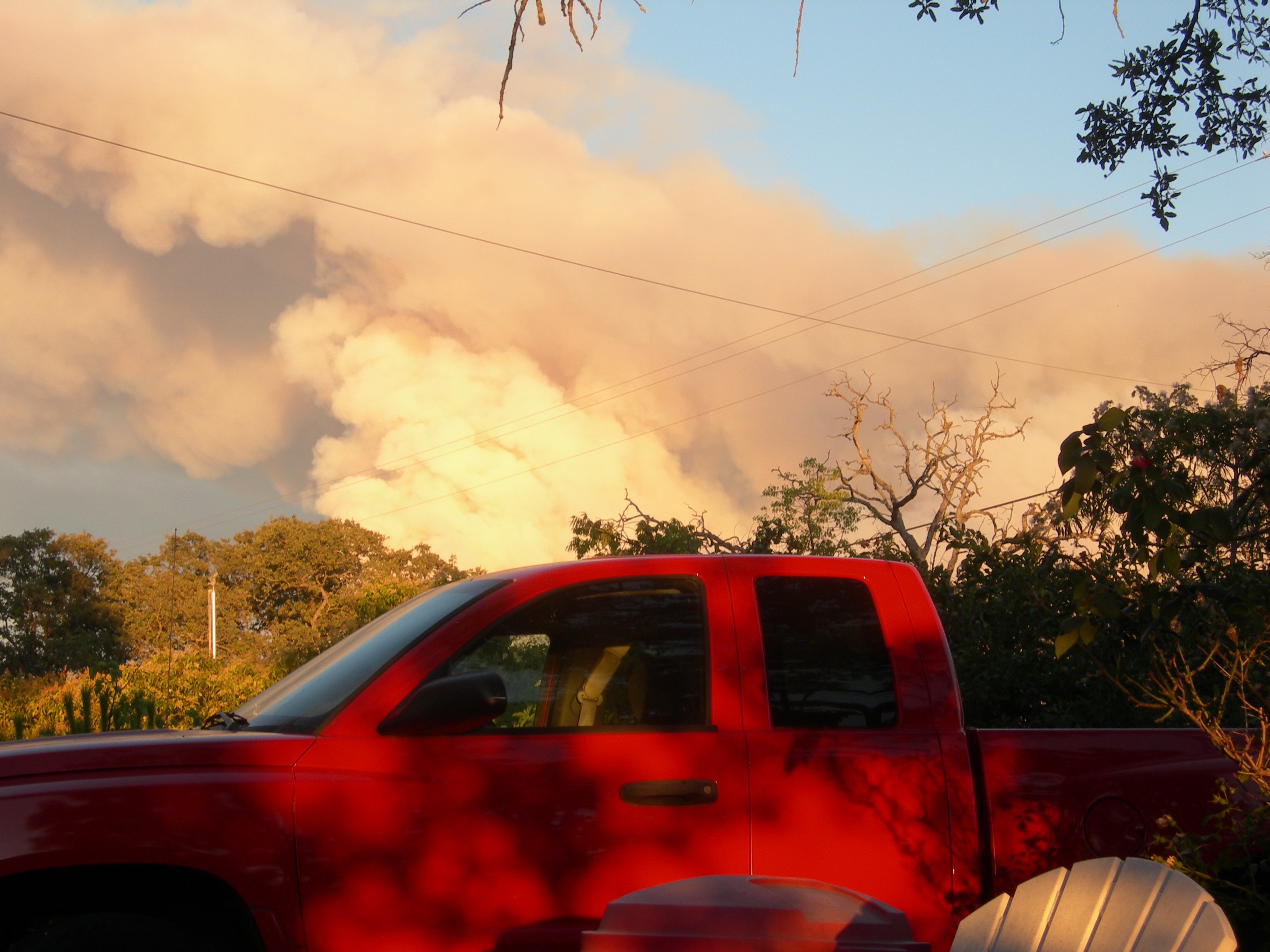
In the previous post, I opened with a picture taken from my front yard. I am opening this post with another, also from my front yard, taken a few weeks ago. In both cases, there is a lake between my house and the fire. The first fire burned 677 acres. This fire started in nearly the same place, but this time it burned 81,826 acres, so far, destroyed 63 homes, and threatened to destroy two nearby towns.

The day it started, my wife and I went down to watch the aerial ballet as DC 10s dropped fire retardant, spotter planes orbited high overhead, and Cal Fire helicopters carried tank after tank of water from the lake to douse the fire. This time they couldn’t stop it, and it eventually took thousands of firefighters to do the job. It still isn’t really over.

Then another fire broke out ten miles north of here and caused damage and confusion for two days. A day later, another fire broke out in the same area, and it is still burning.

Those helicopters I told you about? They weren’t part of any of those fires. They knocked down a fire less than a mile from my house. I heard them, closed my computer, and drove by back roads to a place I knew I could look without bothering the fire fighters. I needed to know if I should start loading the car to evacuate.

Nope. When I got to my overlook the helicopters had already knocked the fire down. To my eye, it looked like about twenty acres. When I turned around to come home, I saw a battalion of firetrucks arriving.

The helicopters got my attention at 4:55. I saw the knocked down fire at 5:05. It is now 5:45 and I am about ready to post this for tomorrow.

There aren’t enough words to thank firefighters, aerial and ground, but I do have two things to add:

I now keep my computer backup forty miles from here, and —

I’m thinking about moving to the rain forest.

Spirit Deer 35

He looked up into the eyes of an enormous black bear.

Fear took hold of him. The entire right side of the bear’s face was swollen to the size of an orange and his cheek was smeared with yellow pus. His nose was partially torn away. For a moment that seemed to last forever they faced each other; then the bear lumbered forward, growling deep in his chest.

Tim hooked spear to atlatl and stood his ground, poised over his kill like some prehistoric man.

The bear charged.

Tim hurled his spear, but it glanced off the bear’s heavily furred shoulder. Then Tim leaped sideways and the bear knocked him down as he charged by. His sweeping forepaw missed Tim by inches. Tim scrambled up instantly and ran. He heard the roar behind him and leaped into the lower branches of a small fir. Scrambling upward and tearing off his rough snowshoes as he climbed, he quickly reached a place where further climbing was impossible. The bear stood on his hind legs and stretched his mighty paws upward. The scars he left on the tree trunk were just below Tim’s feet.

The bear circled the tree several times, then went to the deer. Settling down where he could watch Tim, he began to feed.

Tim cursed the bear, but the bear did not listen. As his fear began to drain away, Tim pounded the tree trunk in frustration. To finally make a kill after all this time, only to have it snatched away! He needed that meat, but the humiliation was almost worse.

The bear continued to eat, keeping his one good eye on the tree where Tim seethed.

Across the mountain, a wall of white bore in, ripping the needles about him and tearing at the warmth of his body. In an instant, Tim could barely see the deer and bear. He had sweated during the chase; now he felt that moisture chilling his body. The wind carried snow in stinging, hail like particles that peppered his face and arms. His world was suddenly restricted to the few branches around him. He could see nothing and feel nothing but the cruel, cruel wind.

He had to have shelter, food, and fire. The bear stood between him and all three. He had lost his weapons, but he did not intend to freeze to death cowering in a tree.

There were some dead branches nearby that had partially dried since the last snow, and a squirrel’s nest that was dry on its underside  He had been carrying the remaining rifle cartridges since he was lost. Now he pulled the bullet out of one with his teeth and spread the gunpowder across the squirrel’s nest he had torn to pieces. With knife and firestone, he kindled a flame.

And the wind blew it out.

This was no time for further hoarding. He emptied the remaining cartridges across the nest, working the powder into the tangle so that some of it at least would be protected from the wind. Again he struck sparks and once again the nest took fire. This time it flamed up and scorched his eyebrows. He twisted the flaming nest into the tangle of dead branches and the wind fanned their flame higher until he held a formidable torch.

Tim slid to the ground and sidled toward the spear that lay closest to him. The bear made no move to charge, but growled deep in his throat. more tomorrow

395. The Sum of Fears

If you haven’t read today’s Serial post, go read it first.

We all have our fear-inducing creature, and for me, it is bears. Sharks? Nope. Wolves? I’d pet a wolf if it would hold still for it. But bears have my number.

It all started when I was a kid. The old black and white TV carried two stations, and one of them carried the program Cheyenne. I was eight years old when the series premiered, and big, quiet, gentle, soft spoken, confident Cheyenne Bodie became my picture of what a hero should be.

But there was this one episode . . .

Something was terrorizing the region. No one knew what it was, or even if it was human, animal, or supernatural. It came out of the dark night and killed, but there were never marks of claws on the crushed and mangled bodies. It scared the crap out of eight year old me.

Cheyenne set out to rid the ranchers of the curse. The thing hated campfires, and always attacked those it found around them, so Cheyenne went out alone, built a campfire, and took his place in a tree with rifle in hand. The night wore on — and wore on my nerves. The campfire burned down. Cheyenne left his rifle in a crotch of the tree and climbed down to put on more wood. As he was crouched over the fire, it appeared. Cheyenne reached for his six-shooter . . .

After the gun smoke cleared, we all found out that it was a giant grizzly, his claws burned off from a cubhood encounter with a campfire. Perfectly logical.

That bear still lives in my dreams. Be careful what you watch when you are eight years old.

And if that weren’t enough, there was the Bible. The old prophets who lived there were as real to me when I was a boy as the people who lived in my town. Every Sunday morning I avoided the boring sermon by looking attentive in the back pew, with downcast eyes and my bible open on my lap. There are a lot of exciting stories in that book, and one which was particularly troubling. I quote:

And he (Elisha) went up from thence unto Bethel: and as he was going up by the way, there came forth little children out of the city, and mocked him, and said unto him, Go up, thou bald head; go up, thou bald head.

And he turned back, and looked on them, and cursed them in the name of the LORD. And there came forth two she bears out of the wood, and tare forty and two children of them. (2 Kings 2:23-4 KJ Version)

Yikes! I was a fervent Christian back then and now I’m a card-carrying bald guy, but it seemed then, and seems now, a harsh fate for a bunch of kids who were just calling a bald guy bald.

Bears still scare Hell out of me, all out of proportion to their actual danger. So when I decided that Spirit Deer needed a demonic adversary to carry it through to the end, there was no question what it would be.

Two Hands and a Knife, which was always in my mind while I was writing Spirit Deer, was a boy’s vision of a long, adventurous vacation in the woods. Spirit Deer is more like what it would really be like if it happened. Two Hands and a Knife, was a perfect boys’ book; mine partakes of the realism I don’t ever seem to be able to shake.

So, a bear. I introduced him early, kept him simmering in the background until needed, and he will be there in a few more days for the climax, when . . .

No, that would be a spoiler.

Spirit Deer 34

Then it stumbled as something turned under his feet, and when it leaped to its feet again, Tim cast a spear. It fell short and Tim recovered it as he went by without breaking stride.

His breath came in tearing gasps. The deer was steadily pulling away. Only Tim’s crazed strength and the deep drift snow had kept him so close so long. The deer was running up what seemed to be a blind canyon. When he reached the end, Tim saw it leaping from rock to rock up the sheer side wall. As it neared the top, it slipped in the snow and plunged back, then recovered. It leaped up again and as it did, Tim cast his spear again. The range was extreme and the was angle great, but he connected. The deer went over the top with Tim’s spear protruding from the muscles of its hind leg.

Tim collapsed against a rock with his breath coming in hoarse wheezes. Then he started up.

He found the spear a hundred yards down the trail, lying in a patch of pink snow. The snow was dotted with pink as he trailed the deer.

* * *

The bear heard the noise of pursuit, rapid footfalls softened by the snow and harsh breathing. He plunged through the snow toward the sound and came across the pinkened furrow plowed by footsteps only minutes before. He smelled deer blood and man scent. The man scent set new fire to his smoldering rage. Rolling his shaggy head to one side, he studied the broken snow, but it told him nothing. Only his nearly useless nose told him anything worth knowing, and his ears that still heard the sounds of pursuit up ahead. He started quickly across the snow, following the trail of blood.

* * *

The sky was ominous. Black and gray clouds billowed above him, but Tim paid no attention. His entire world had shrunk to include only himself and the deer.

Then it burst from a thicket almost under his feet and leaped away. It did not seem that its strength had been reduced at all by the injury. The deer turned downslope in the direction from which they had come, and Tim cast his spear again. It furrowed the deer’s back muscles and stuck without slowing it. Tim ran after it, lifting his other spear.

Suddenly the deer fell forward in a shower of snow. He had plunged into a small ravine; there had been no break in the smooth white snow to mark its presence. The deer plunged and faltered, reddening the snow. Tim drew up and poised for a moment with his spear at the ready; then he threw with a long, clean motion. The spear plunged deep.

Still the deer struggled and regained its feet. Tim leaped into the snow choked ravine. The butt of his spear came around and smacked him in the ear. Then he had the deer in his hands. He wrapped his arms around its body and held it as it heaved and struggled, until it finally grew still.

Tim sat down in the snow beside the deer. Snow drifted down to settle on his clothing. He pulled out the spears and tried to think. He had to gut the deer, then build a fire. And a shelter. He had to skin the deer carefully so he could make a blanket of its skin.

No, first a shelter. And a fire. Then he would skin the deer and eat.

He heard a coarse grunt and heavy breathing.

He looked up into the eyes of an enormous black bear. more tomorrow

Spirit Deer 33

Chapter 13

The first storm of winter hung poised above the California mountains. It had paused, but now it was ready to descend once again.

A buck yearling deer struggled through the snow, searching out food. He moved downslope, breaking the drifts with his chest as he heaved through them. In the lee of a drift, he munched some frozen whitethorn, then moved on. Suddenly, he was startled and leaped sideways. There, half covered with snow, was a thing. He would have run, but the snow was too deep, so he froze with his eyes glued on this unknown object. A slight wind from his rear carried the unknown’s scent away from him.

The object did not move. The yearling came closer, carried by a curiosity that an older deer would not have indulged. He caught the scent of Man and prepared to run, but the wind drifted snow over the upturned face. The young buck moved closer, finally sniffing cautiously at the face.

* * *

Tim was brought back to consciousness by a soft caress. He opened his eyes and looked directly into the face of the young buck. It was already leaping back, startled by the flickering eyelids, when Tim lunged. His outstretched hand caught a forehoof, but the deer pulled free and plunged away through the drifts.

Tim staggered to his feet and searched about for his weapons. Plunging into the snow, he cast about desperately, finding one spear, then the other, and his atlatl. His bow was gone and his quiver was empty. Ignoring the pain in his ankle, he ran after the deer.

Neither Tim nor the deer could make much headway. Here in the hollow, the snow had drifted deep  Tim staggered over the snow, following the path the young deer had broken. Without his crude showshoes, he would have stood no chance at all. He was not quite running, but he was making the best speed he could. He would keep on until he caught the deer. He would not give up this time.

This deer would be his or he would die. He could not last through another night if he did not eat today. He knew this like he knew his own name. In the snow back there, he had been as near to death as anyone can ever get.

Tim ran on, throwing up snow in his wake. He fixed a spear to his atlatl  The deer was expending a tremendous amount of energy in tearing through the drifts. Tim shuffled alongside his trail, supported by his crude snowshoes. As the trail dropped down into another hollow, Tim caught sight of the deer ahead. He was gaining on it, but too slowly.

Tim and the deer crossed the second hollow and plowed up the other side. The deer plunged into a thicket of manzanita and turned left. Tim wheeled around the thicket, staying on the open snow, leaping along, trying to clear the worst of the drifts.

His ankle hurt with a white hot pain.

The deer turned into a copse of cedar and pulled up to look back. It was invisible against the dark background, but Tim saw the flicker of movement as it went to rest. Instead of turning toward the deer, Tim ran in the direction they had both been going until he was shielded by a fir, then wheeled toward the hidden deer. The deer bolted, but Tim had gained precious yards.

They stumbled upward, cutting diagonally across the rough slope. Here the drifts were lighter and the deer began to gain distance. Then it stumbled as something turned under his feet, and when it leaped to its feet again, Tim cast a spear. more tomorrow

Spirit Deer 32

In stalking the deer, Tim had followed Dog Creek to its source, had topped a minor divide, and had descended into a broad shallow depression. Here the firs grew more sparsely, giving him less cover, but allowing him to see the deer better. He snow was deeper here, so Tim had to carry his crutch and stumble along without its help. The activity seemed to do his ankle some good; it hurt, but some of the stiffness was going out of it.

He had given up following tracks; they were so plentiful now that they broke the snow everywhere and he had no way of knowing fresh from old. He was following a pair of antlerless deer, whether does or buck fawns he wasn’t sure. From time to time he would see them feeding, but they seemed to keep the same distance from him. It was as if they had become accustomed to his presence and considered him no threat at that distance. If so, they were right.

He slipped from cover to cover, trying to circle about and come at them from some unexpected angle. The wind stirred occasionally, but the gusts were mercifully short lived. Such cold! Soon he would have to build a fire. Desperate to finish this stalk before settling in for the night, he pushed down toward the pair of deer. They had been out of sight for several minutes, and he hoped that he was equally invisible to them. Moving quietly through a thicket of cedar, he broke into a clearing. The deer were gone. Following their tracks with his eyes, he found them a quarter of a mile away and higher up, looking back at him with more curiosity than fear.

* * *

The carrion he had feasted on was gone, but the festering sore, the blindness in one eye, and the damage to his nose remained. The rage, also, remained, and grew. Black bears are normally harmless, though unpredictable; this one was acting more like a grizzly. He rampaged through the forest, ripping everything that crossed his path, and headed up Dog Creek.

* * *

Now it was the eleventh day since Tim had left his house to go hunting. He woke before dawn in a tiny, crude shelter to find his fire nearly out. He built up the fire and began immediately to make his shelter better. Such cold! He worked on his shelter for several hours, staggering with weakness and stopping for long rests between each task. He was no longer thinking of survival. Survival had become too much to hope for. He was simply determined to never be so cold again.

Death was very near. He did not accept death. He would fight to the end, but he no longer had any real hope.

Finally, he rose from the fire and went out, leaving his useless crutch behind. He needed snowshoes, so he cut some cedar boughs and bound them to his feet with strips of bark. They were crude, but they would keep him from sinking into the snow.

It was a different kind of hunt this time. Tim did not think out his actions. He simply went through the motions, staggering half dazed through the snow and carrying his weapons carelessly at his side.

He topped a slight rise and started down into the hollow beyond. He tripped, rolled, and lay still.

The wind stirred the powered snow, and covered him. more next week

394. Today, everything changed

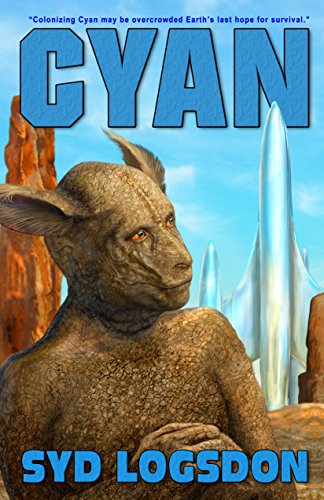
Today, everything changed. Those were Ramanda’s words when Viki picked up a chipped stone and the explorers of Cyan discovered that they were not alone.

Today, things will change in this blog, but perhaps more meaningfully for me than for you.

On the last day of August, 2015, I released the first post in A Writing Life and the first post in Serial. I immediately began a program of five posts of fiction and four mini-essays each week. It wasn’t long until I trimmed Serial to four posts a week to keep the two halves of the website in synch, and I have kept that schedule with very few breaks for nearly two years.

The early AWL posts were short, about 350 words, but they quickly grew and now they are typically about 700 words. Occasionally I repeated old posts, for various reasons, so my best estimate of how much I have written for A Writing Life (the blog) has reached over 200,000 words.

That’s the equivalent of a long novel or two short ones. I have never run out of material, but there have been times I have come close.

The content of Serial was already written, but even that takes a lot of time to convert into serial form. (see 245. Serializing)

I started preparing A Writing Life six months before its rollout. And yes, I know that it was dumb to name the overall website and one of the two posts with the same name. But I didn’t know it when I started, and it’s too late to fix it now. AWL (the website) came about when Cyan was accepted for publication, as a way to see that it didn’t die quick and quiet like A Fond Farewell to Dying had done. FFTD was a good novel. It deserved an audience, but it never found one.

It took a long time from acceptance to publication, but Cyan finally came out this April. In July, I went to Westercon to tell everybody who would listen that they ought to buy it. That’s how we do things these days. Hemingway would puke.

Where was I — oh yes, changes. I have spent so much time on this website that it has curtailed my actual writing. That can’t go on, but this site is how I met all of you, so I can’t quit it either. So here is the plan.

Starting today, I will no longer post on A Writing Life (the blog) to a schedule. When I have something to say, I will. For example, there will be a post August first about bears, and why they are in Spirit Deer.

If you haven’t followed me yet, this would be a good time to start, so you will get notification when I post. I will still have a lot to say, just not four days a week. This will get the schedule monkey off my back. I have a couple of sequels to Cyan that are calling me.

Serial will continue. Spirit Deer will be finished in early August. I will follow it with one of my favorite Harold Godwin novels from my childhood, now largely forgotten and in public domain. That will carry us most of the way to Christmas. Then we’ll see. There will be a post explaining all that on August 14, here in A Writing Life.

I’m not going away, I just won’t be around quite as often.

Download Cyan, or order it in paperback. If you like it, write reviews for Goodreads and Amazon. Tell your friends. Then in a year or so, you can tell them about the sequel.

In many ways, A Writing Life (the blog) has been less of a blog and more of a magazine. From now on it will be more like most blogs, with news, events, and updates of ongoing writing. But the magazine style mini-essays won’t disappear. They will simply stop dominating my life, so that I can get back to my novels.

Spirit Deer 31

Beneath him the hills fell away into what had to be the valley of the Tate River; beyond, etched against the clouds, were Mt. McCutcheon, Rampart Peak, and Mount Carter. Above and on either side of him towered Saddle Mountain and Davis Peak. He strained his memory; this would be the valley of Rube Creek – no, of Dog Creek. To get out he would have to follow Dog Creek to the Tate, then turn upstream and follow the river to the highway. He estimated the distance at between twenty and thirty miles.

He would never make it in his condition.

Then he realized that if he could see landmarks, a signal fire could also be seen. Looking around, he chose a dead cedar that stood alone. Dragging burning wood from his shelter, he built a fire against its base, cutting boughs and piling them high. Dense black smoke boiled up as the branches caught. Within minutes, the entire tree was blazing like a torch and Tim had to retreat from the heat. But the clouds were rapidly closing in and Tim knew that his fire had been started too late. He watched disheartened as the landmarks were eaten up one by one by the lowering clouds.

Tim continued to stand near the burning cedar. He was bitterly disappointed. If the clouds had held back for even ten minutes, the ranger station at Mt. McCutcheon would have seen his fire and would have sent someone to investigate. Instead, his fate was still in his own hands.

Food and a hide – he had to have both. And now, not later.

As he hunted, he found that he had plenty of deer to chose from. Muleys were out in record numbers scrounging among the drifts for food, and he heard the crash of antlers throughout the morning. Tim wasn’t sure if they were simply making up for lost meals, or because they sensed that this was only a lull in the storm.

He found a small set of tracks in the fresh snow. Keeping to the shadows of the trees, he advanced with arrow nocked, moving carefully from cover to cover. He carried the bow in his left hand with his fingers laced around the arrow while he gripped his crutch-club with his right hand. Tim floundered pitifully with that crutch, but he could not yet abandon it.

After a while he caught sight of his quarry and began to circle around upslope. It was a muley doe, feeding hurriedly but cautiously. He approached from above, keeping behind a stunted fir. She shied away but he remained perfectly still, and eventually she swung back to browse a manzanita below him. She was not aware of his presence or she would have run, but she stayed too far away for him to get a shot. She finished with the manzanita and moved closer. Tim sensed that he would get no better chance, so he drew and released. He saw the arrow arch true, but the deer had seen him move as he drew back his bow and she leaped away. The arrow brushed her flank as she bounded away, marking her with a harmless scratch.

* * *

The black bear was prowling. The slopes were alive with mule deer, but it was early in the season and they were not yet weak enough for him to run them down. Except in mid-winter, a black bear can usually only take fawns and carrion, and an an occasional lame, weak, or sick deer.

The black bear’s battered senses and infected face had combined with his stiffened leg to put him in a constant, killing rage. more tomorrow

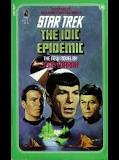
393. The IDIC Epidemic

I am always amazed when I find yet another novel which should have won awards and a place on every bookshelf, but has instead been forgotten. I don’t know why I should be amazed though, as it happens all too often. The IDIC Epidemic is such a book.

An additional oddity, which is actually a pattern, is that though the book is massively infused with future science, and contains more Star Trek lore and alien species that a Star Trek convention, the story succeeds because it mimics the same underlying moral stance as any human story about very different people thrown together in a crisis, and rising to the occasion.

The IDIC Epidemic is a novel that stands alone, but can equally be seen as the third in a trilogy that began with the original series Star Trek episode Journey to Babel, continued in The Vulcan Academy Murders, and concludes with The IDIC Epidemic. The TV episode was by D. C. Fontana and the two books are by Jean Lorrah. To quote:

the reunion (between Spock and  Sarek) that had begun on the perilous journey to Babel and continued when they had melded on Vulcan to save Amanda’s life only a few weeks ago, was finally complete.

That is a leitmotif floating through the three stories, but needs no spoiler alert since it isn’t the main story. Here is a spoiler free summary of The IDIC Epidemic.

Nisus is a Vulcan science colony dedicated to the idea of IDIC, Infinite Diversity in Infinite Combination. Members of most of the races known to the Federation work there in something like harmony. A plague breaks out which crosses species and brings the Enterprise on scene to help. Infinite Complications ensue. 

I suppose the next statement is a spoiler. Kirk does not single-handedly save the day. To be fair, he only does that about half the time, but this is one of those books where every character –and there are a horde of them — has his time on stage.

There are no space battles, either. Although there is a bit of skullduggery among some relatively minor villains, this is primarily a story of varied intelligent species striving against nature.

A little aside here: I bought Legacies: Captain to Captain a few months ago, but gave up reading it about a third of the way in. I have no criticism of book or author; it was simply that I had been on this roller coaster too many times before, and it couldn’t hold my interest. If you’ve read enough Star Trek novels (I must be well above fifty), the word rehash starts to crop up in your appraisal, and it really isn’t fair. Take any thirty Star Trek novels and read them one after another — the first will be wonderful and the last will be a rehash, no matter in which order you read them.

The IDIC Epidemic isn’t like that. Yes, there is a threat to be overcome, through great courage and high competence, but we also meet a dozen new characters and a couple of dozen who are back from The Vulcan Academy Murders. Their interactions matter as much as the action. We also learn a great deal more about about sex and love among Vulcans and between species. (Tastefully handled. This is Star Trek, not soft porn.) And we see courage exhibited by everybody.

Everyone is a hero, because it is that kind of situation. I was reminded, by contrast, of books by Philip Wylie from my youth, set in times of nuclear war. There were no real heroes in those books. The difference wasn’t in the  competing visions of mankind. It was structural to the kind of novels involved. IDIC is a hopeful book even through massive disasters.  A nuclear strike leaves no hope.

The IDIC Epidemic is one of the best Star Trek novels I have read. I recommend it highly. Both these Jean Lorrah books are available on Kindle. If you get them both, read The Vulcan Academy Murders first, although The IDIC Epidemic is the better book.

Spirit Deer 30

Replenishing his fire, he brushed great masses of snow from his clothing and sat huddled miserably. After a time, he became warmer again. The heat trapped within the shelter dried his clothing. Snow had built up on the roof of his shelter and had drifted against the walls, making what seemed to Tim a snug hideaway. The actual temperature in the shelter was only ten degrees above freezing, but Tim had grown used to hardship.

Outside, the snow fell ceaselessly, filling up the spaces between the trees and building long drifts in the meadows.

* * *

The black bear lay beneath a stunted hemlock. His various wounds ached and the festering shot beneath his eye had now robbed it of sight in one eye. He had eaten well of the deer carcass, but he needed more, much more, if he was to survive his winter hibernation.

* * *

Outside, the temperature had dropped to zero. Within the shelter, Tim huddled close to the fire. He slept little during the night, and his skin crawled at the thought of going out into the cold to search for more firewood. Throughout the mountains, this would be a time of withdrawal, when every creature stayed close to his den and dozed the storm away.

If the temperature stayed this low, he could not travel even when the storm broke. He would either freeze quickly, or starve slowly by the fire. It was not a matter of giving up – he would fight to the last – but now he realized that he had used up all his options. If he could kill a deer, he might make some rough clothing from its hide and live on its meat until he could fashion snowshoes and walk out. But how could he kill a deer when the cold had nailed him to his fire?

* * *

The black bear slept, wrapped in layers of fat and fur. The wind howled in the brush around him. From the Olympics in northern Washington to the Tehachapies east of Bakersfield, the western mountains were being buried by the first major storm of what would be an exceptionally harsh winter.

* * *

The storm was like a giant beast, crushing the land beneath it. When Tim stepped out of his shelter into the night, the wind whipsawed him and nearly drove him back inside. He forced himself to go out and burrow through the drifts for wood. Then he collapsed by the fire, almost crying out from the cold.

It would not be enough to get him through the night.

Again and again during the night, Tim had to go out to burrow through the drifts for down wood. Each time it was harder to force himself out, and each time it took longer to warm himself again. He got no sleep, just a few moments of dozing, and the strength the porcupine’s meat had given him drained steadily away.

Chapter 12

Tim was wakened by the sun. For a long time he lay in a stupor, unable to comprehend the meaning of that fact, then he leaped up and staggered out. He had to climb up out of his shelter onto the drift snow to see the world around him. Every tree and bush shone with a diamond light that hurt his eyes, and the sun hung suspended beyond a hole in the clouds.

The clouds had lifted during the night and the snow had stopped falling, but even as he watched the sun was obscured again. He could see for miles now, and for the first time he could make out familiar landmarks. more tomorrow