Monthly Archives: March 2017

317. SF in the Wild

Cyan is now available for pre-order through Amazon, with the eBook arriving April 17th. Meanwhile, I plan to repeat a few year old-posts that were designed to stir the blood of would-be readers just before an earlier release date that didn’t happen.

——————————-

This post was originally number 128.          If you are what you eat, I used to be beefsteak, fried okra, and hominy. That comes from growing up in Oklahoma. I also lived outdoors most of the hours of every spring, summer, and fall day, and way too many hours of every winter day. That comes from growing up on a working farm.

If you are what you read, then I used to be an Andre Norton protagonist, at least in my imagination. Although I never met or corresponded with her, Andre Norton was something of a long distance mentor.

Alice Mary Norton legally changed her name to Andre Norton early on, in an era when being a woman was no help to a science fiction writer. I didn’t know that when I first read her; I thought Andre Norton was a man. Not that I thought about it much, but she didn’t write like a girl. Looking back, I see that she actually wrote like a person, but I wasn’t that sophisticated then.

One reason Norton got away with writing gender neutral fiction was that her characters spent most of their time alone. Even in their relationships with others of their own kind, they were loners, if not complete outcasts.

Star Man’s Son was the first Norton I read. In it, Fors spent all but a few pages on a quest away from his people; that was a pattern to which Norton frequently returned. I could easily identify with the solo quest while I spent endless hours alone on a tractor. The only variations in my daily life were whether I was pulling a disk or a hay rake, and which Norton novel was replaying in my head.

Every time Shann Lantee on Warlock, or Naill Renfro on Janus, or any of a dozen other young men found himself stranded alone, or nearly alone, on an alien world, I could look up from my tractor seat at the Oklahoma prairie and say, “Yup, been there.”

The best thing about Norton’s characters was that they didn’t whine about being alone. They liked it. So did I.

I didn’t live in a city until I went to college. I spent my adult life living in the suburbs of a reasonably small city, and taught school in a very small town. As soon as I could retire, I moved to a few acres in the foothills. I would move further out if I could afford it.

I was born not liking cities, and my opinion never changed. It should be no surprise that my first novel was about a hunter surviving alone in the woods, or that my first science fiction novel Jandrax was about a hundred or so humans stranded on an alien world.. My three fantasy novels have a rural and medieval feel. David Singer, in A Fond Farewell to Dying, is a mountain boy who has to go urban to get his life’s work done. And Cyan, due out soon, begins with ten explorers on an empty world, then continues with the story of the peopling that world by hyper-urbanized refugees from an overcrowded Earth.

You write what you’ve lived.

Raven’s Run 111

Good old Harvey!

She was breathing heavily now and I could smell her readiness. “I used to come down here,” she said, “when Harvey was at work and look through these old files. I’d get myself so worked up I was like a steam engine. Then I’d ambush Harvey when he came in the door.”

Lucky Harvey!

“Look,” she said, and pulled out a file. The folder was dark from much handling. She spread half a dozen pictures out for my inspection. In the background was an open window with curtains blowing inward, with makeup on a bureau and a couple of stuffed animals on the floor beside the bed. A bedroom in somebody’s home, not a motel room. The woman on the bed was small, slim, and dark. The man was young and muscular. He had taken her in various positions. Some were imaginative, and some looked painful. One involved tying her hand and foot to the bed, spread eagled. Laura Jacks moved that picture to the top of the stack. The photography was good. I could clearly see the expression on the woman’s face. She was fighting the ropes, but she was having a wonderful time.

“When Harvey first got started, I used to help him with his business.”

“I can see that.” The woman in the picture was younger, but she was clearly Laura Jacks.

“I miss it, but Harvey made me quit. Funny, for a man who did what he did, and screwed around on me besides, he was really jealous. Possessive, I guess you’d say.”

“Possessive,” I repeated.

“I was afraid to screw around on Harvey. He would’ve killed me. So I would come down here and spend hours on a slow burn. Harvey got the benefit of that. He liked having me hot all the time. And I was!”

She paused, rubbing her hands over her thighs. “It’s been months since Harvey died,” she said. Her voice echoed in the basement and in my singing head.

She passed her hand lovingly over the photograph. “I really like this one,” she said. “I still have the same bed, upstairs, and some soft ropes I kept for Harvey to use. He liked it; he hurt me sometimes, but I didn’t mind.”

She pulled the Tee shirt over her head, turning it as she did so that it formed a twisted manacle around her wrists. Her breasts were small and her face shone with need. She extended her bound hands toward me. I shook my head. She stood up and pushed down her shorts, and stepped out of them. Naked, she pushed her bound hands toward me again, and said, “Please!” Again, I shook my head.   

She went to her knees at my feet and leaned forward, placing her bound hands on my feet in a gesture of final submission.

That was the way I left her, and it wasn’t easy.

*       *       *

I drove two miles north and parked overlooking the public beach off the end of Golden Gate Park. I had left my soot stained boots at the warehouse and changed into running shoes. It was a good thing; I needed to run. Badly. I slogged down to the water’s edge where the sand was hard in the retreating tide and ran southward. After a mile, I turned back. I just wouldn’t feel right running all the way back to her house.

Back at the car, I had worked up a sweat even in the chilly ocean wind, but it had barely taken the edge off my energies. more tomorrow

316. Cyan is Here

Finally, after a long wait, CYAN is available for pre-order at Amazon.

If you click here they will take your $2.99. That’s half price to those who pre-order. Pre-ordering puts you first in the queue and gives you the discount; the book itself will arrive in your Kindle on April 17.

Cyan will be available exclusively to Kindle customers at full price on April 17, and available to all eBook retailers on July 17.

Yea! (The dates I gave in an earlier post are now defunct.)

____________________________________________________

It think it would be fair to assume that, if you aren’t reading here for the very first time, you know that I started this blog to support Cyan. By now you know my writing style, and you’re still here, so it’s safe to assume you will like it. 

In the days before the internet, writers didn’t have to publicize their own work, unless they were a best seller and went on book signing tours. Writers also couldn’t publicize their own work, so the sword cut both ways. If you had a good book that didn’t find its audience, there was nothing you could do about it.

Now authors can and must be their own publicist. Hence this blog — even though writing it has become an ongoing pleasure.

Now its your turn. Brian at EDGE said to me:

One of our goals is to get 50 reviews posted on Amazon as quickly as possible.  Reviews can be posted any time after April 17th.  However, there is a catch. Only Amazon customers can post reviews.  A qualified Amazon customer does not have to have purchased CYAN to post a review, but they must have purchased something from Amazon in the past.

It would be good for you to contact as many of your supporters and ask if they would post a review. (That’s you.) If they are not currently an Amazon customer, they can become one by purchasing a copy of CYAN any time (and at the pre-order price of 2.99) and then post their review after the book becomes available on the 17th of April.

So that’s it. No hidden agenda. The agenda is in plain sight and always has been. However, I do have an additional inducement.

If you read Cyan, and like it, and review it, and it becomes successful enough to warrant publishers taking on other books of mine, then you will soon see:

Valley of the Menhir

Scourge of Heaven

Who Once Were Kin

All fantasy novels, already written. You might soon see two planned but not yet written sequels to Cyan. You might even see:

Raven’s Run (in Serial now)

Symphony in  a Minor Key (a teacher rebuilds his life after a false accusation of abuse)

Both are contemporary fiction. Your kids might even get to read the young adult Spirit Deer. (Either soon or later — I don’t know your life plans.)

Right now, I’m concentrating on Amazon, but if you also send a review to Goodreads, I wouldn’t mind at all.

There is a lot riding on electronic word of mouth.

Raven’s Run 110

Cyan is now ready for pre-order. Look at todays post on the AWL side of the blog.

_______________________

“Surely it can’t be that hard to find bank accounts.”

“Harvey never put anything in his own name. He always used dummy corporations to hide his earnings from the IRS.”

I said, “Hire an investigator.” But not me.

“Bill Bristol was going to help me, but never came through. I asked him for help the day he went through Harvey’s files.”

Now there was a bit of news. I asked, “When was this?”

“About a week after the day Harvey disappeared and the fire broke out in his office.”

“You mean those happened the same day?”

“Sure. Didn’t you know that? At first, we all thought they were going to find Harvey burned up in his office. And then they found him floating in the bay three days later.”

She shrugged and made a comic grimace. And she looked at me with slow, smiling eyes. Like she was a furnace, and she thought I was a sack of coal.

“So you asked Bristol to come over and help you sort things out?”

“No! I told you, those were old, dead files. He came by on his own. Said he had new information on something he and Harvey had been working on a couple of years ago. I took him down to the basement and he went through Harvey’s old files, but he didn’t find anything.” She shook her head in amusement. “Not anything he was looking for, anyway. Harvey’s files are always interesting.”

I said, “Would you take me down to the basement?” And I kept a straight face when I said it.

She said, “I thought you’d never ask.”

She was wearing a long Tee shirt and short shorts. Her legs were long and brown as she swivel hipped down the stairway. I was thinking that ten years older wasn’t that much older. There was something distasteful and much that was cliché about the situation, but hormones are hormones.

Harvey Jacks’ files consisted of a single cardboard box jammed with manilla file folders. Each one was labeled with a name or series of names. I pulled out Debra Tomlyn/Richard Deberg and flipped it open. It held a half dozen grainy black and white blowups of a chubby young blonde woman and a bald, middle aged man having sex. In the first shot, he was in the saddle. In the second, she was on top, head back, eyes closed, nipples erect, while he held her waist and drove his hips up to meet her. The other three shots were close variations on the same theme. The angle of the shots never changed, and the participants were not well centered. Obviously a hidden camera; probably near the ceiling.

I tried another file. Same story, new actors. A skinny black man and a pale Asian woman. Then two models of suburban ordinariness. Two young men. Two paunchy men in their forties and a girl-child who was probably fifteen but looked twelve.

I said, “Did your husband own a motel?” My voice came out hoarse.

Jacks’ wife was squatting beside me with her arm around my waist. She said, “Probably. I never knew, but most of these were shot in the same two or three rooms. Harvey was a whiz at his game. That one,” she pointed at the girl-child, “is one of my cousins. Several of the ones you see over and over in these shots were on salary to Harvey. He was a real businessman.”

Good old Harvey! more tomorrow

315. Apprentice in Science

fleming-schola-rs-1966For eight weeks in 1965, I was a Fleming Fellow (see yesterday’s post).

The gist of the program was that a Fellow was assigned to a research scientist as something like an apprentice. My personal research had been a hybrid of ecology and space science (see Tuesday’s post) Nothing like that was available in a medical research facility; instead, I was assigned to Dr. Gunnar Sevelius who was doing research on determining renal flow through use of radioisotopes. He had just finished editing Radioisotopes and Circulation the preceding year.

Dr. Sevelius gave me a small lab room and access to a supply of radioactive iodine, along with sensors for radioactivity and a strip chart recorder. He sat me down to talk about his work and tell me what he expected from me. He treated me as if I could figure things out for myself – which I could. I didn’t see him often after that, although I hung out with his young lab assistants.

I don’t need to give a lot of detail here. It has all been superseded.

Everything sophisticated in science was crude when it was being developed. Any kid in a high school metal shop today could reproduce one of Goddard’s original rockets — but only because Goddard taught them how. Any trained technician can slide you into a machine and look at images of the inside of your head — but only because to the work done by people like Dr. Sevelius. Everything at OMRF was cutting edge for 1965, and probably none of those machines are even stored in dusty basements any more. Science moves on, and quickly.

Computers? Video monitors? Forget it. A strip chart recorder had a moving roll of paper, a moving head with roll of typewriter ribbon and a striker that made a dash on the paper every time the sensor detected radioactivity. An image of a pair of kidneys looked something like this:

renal

You can see a strip chart recorder at the top of this post. That’s me in 1965, with a haircut that was already going out of fashion.

I learned a lot that summer, not least that I would never again spend eight weeks in a windowless room doing repetitive research. I love the results of science, but the doing of it can be damned boring. I also got to test myself against other smart kids, and be satisfied with the result. Every other Fleming fellow had done more sophisticated work than I had, but they were the products of sophisticated high school science programs, or the children of scientists.

There were lectures and activities for us. I met a scientist who had done research on the reaction of elephants to LSD — two years before I chose to avoid it when it became mind candy.

I learned about Michigan State, and was encouraged to apply there. I got a tour of the basement where research was being done using a sensory deprivation tank. Fifteen years later that became the basis for my second published novel.

I learned about the infamous Dr. Sexauer. From a former fellow, I got the names of two of my former incarnations, in a late night seance. Tidac and Javernan became characters in my three fantasy novels. I wrote about that incident, and it led to an odd occurrence. The OMRF was trying to find all its Fleming Fellows to prepare for the 60th anniversary of the program. I had mentioned the name of the girl who seemed to be running the ouija board. The OMRF had googled her name, found my post, and connected with me. It was good to hear from them again.

When I returned to my tiny high school that fall, I had touched the larger world and I would never turn back.

Raven’s Run 109

I made a detour back to my place for a shower and a change of clothes. I hoped none of the gang bangers were dead, but it wasn’t out of concern for the good of their souls, or mine. If they lived, they would probably murder their grandmothers before the month was out. But if a body was found in that burned out room, my fingerprints would be on every charcoal smudged surface in the place.

The more I thought about it, the more surprised I was that they had come after me. I had known that more than Davis, Susyn, and Allen/Alan were after Raven, but I had not expected an organization with enough resources to stake out Jacks’ burned out office.

I had Jacks’ home address from Joe Dias, so I went there next. It was a plain one-story brick house on Vicente. Most of the houses on the block seemed to have been built by the same builder, maybe fifty years ago. The lawn was small, brown and close cropped, like a Marine haircut. The front door was overdue for painting. There was a low chain link fence, but no dog or child to be kept back by it.

The woman who answered the door was small, dark, and wiry. There was a touch of gray in her black hair; her eyes were bright and suspicious. She would not remove the chain from the door until I passed her my card, left over from a previous life, that showed my name under the logo of Dias Investigations.

Once I got inside, she was friendly enough. Whatever grief she felt at losing her husband, she was showing no signs of it. She said her name was Laura Jacks. She sat me down on the couch, fed me coffee, and listened to an abbreviated version of my story.

“I don’t know much about Harvey’s current business,” she told me. “He kept that strictly to himself. He would occasionally mention a client, but that was about all. He did say that he was working for a big-wig’s daughter from Sacramento. He didn’t say who.”

“Did he say why she hired him?”

“No.”

“Did he tell you what he found out?”

“No. He never said nothing. I told you that.”

And so on. Eventually I ran out of things to ask, and “No” was the only answer she seemed to know.

“Did your husband keep any records at home?”

“Oh, sure.  Mostly on old cases that he was finished with. Nothing valuable, or he would have hidden them. Harvey hid everything, and he never told me where.”

She sighed deeply and shifted her weight on the chair. In the ten minutes of our conversation, he whole pose had changed. The initial stiffness had had gone out of her, as if she were melting. She had a small, muscular body; very trim for a woman of forty. As I watched, she slid deeper into the embrace of the chair and the lines of her face softened with interest. “Did you know,” she said, “that I am about to lose this house? Harvey made lots of money, but he always squirreled it away. He had bank accounts all over the city, and I can’t find any of them. All his bank books burned up with his office. Now I should be a rich woman, and I’m about to lose my house.” more tomorrow

314. Fleming Fellows

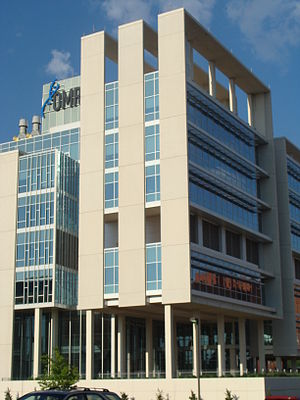
300px-oklahoma_medical_research_foundation_nimaphoto by Nima Kasraie

The Oklahoma Medical Research Foundation is a major research institution, but not a household word. Let me explain its importance in my life.

Everything that happens to a writer passes into his memory, sinks to the bottom, and grinds around there, knocking sparks off every other experience. Years later, it emerges, transmogrified, as stories or parts of stories.

My soul as a writer and as a human being was forged on a small farm, working essentially full time in addition to going to school. I was an only child. School and home were kept strictly separated. Except for one treasured cousin, none of my school friends ever entered my house.

I was a very smart child in a very small place. I worked hard, got strong, and loved the outdoor life, but my mind lived in other worlds, brought to me by books of science fiction. I decided to become a scientist. In that pursuit, I was torn between space science and ecology. When I was a high school junior, I put those two together (yesterday’s post).

That same year, among the many standardized tests we took, was the test to become a Fleming Fellow. There was also an application to be filled out in which I was to explain my aspirations and offer any personal projects to prove my capacity. I wrote up my ecosystem in space project.

I was notified that I was a finalist, and scheduled for an interview in Oklahoma City. At that time, I knew almost nothing about the fellowship or the OMRF.

Incorporated in 1946, the Oklahoma Medical Research Foundation was dedicated in 1949 by Nobel Laureate Sir Alexander Fleming. In 1957, OMRF started a summer program for students, which was quickly named the Fleming Scholar Program. It has evolved over the years, but in that era, from four to seven Oklahoma High School juniors were recruited, and spent eight weeks at the OMRF the following summer.

In the spring of 1965, I sat before a panel of scientists for my interview. I had expected questions on science. Instead, they asked questions on meaning and morality. What did I think of the bombing of Hiroshima? What did I think of capital punishment? Behind the questioning, they were clearly trying to find out my level of self-confidence, as the interview became quite adversarial at times. After I said that I was still uncertain about my stance on executions, one of the scientists asked, rather sharply, “Don’t you think it is our duty to think about such things?” I remember being irritated at his high-handedness. I snapped back, “I didn’t say I hadn’t thought about it. I said I hadn’t decided yet.”

I said to the panel that I intended to pursue a Ph.D. The whole panel tried to convince me that I should be getting an M.D. instead. I held my ground, and when the interview was over, one of the panelists admitted that most of them had Ph.D.s, not M.D.s.

Fortunately, self-confidence – or arrogance, if you prefer – is something I have never lacked. I received a Fellowship. I’ll tell you about it tomorrow.

Raven’s Run 108

Two hours later I heard footsteps in the hallway. The door jiggled and someone laughed. 

I prepared to bluff my way out. I needn’t have bothered.

The door swung back and a slick haired young hood slipped into the room, moving to his right. A second followed, moving left, then a third came through and straight ahead. They wore wide legged pants, slung low, earrings, and tattoos. Chicano gang bangers.

Five years ago, they would have been Asian. Ten years ago, they would have been Black. Fifty years ago, they would have been Italian. A hundred years ago, they would have been Irish. There are always gangs; only the nationalities change. And they are always for hire for the kind of head smashing, knee breaking enforcement that fits in with their limited self-image.

Their leader carried a baseball bat. The two outriders no doubt had knives, but they were still out of sight. Three-to-one gave them confidence. It was a good thing for me that it did.

Suddenly, I was pissed. The anger I had had bottled up since Raven left me had not come out in Venice. That had been too serious. Davis with a gun was as dangerous as ten of these street punks. Last night, in my apartment, the wheels had begun to come off of my restraint, and the sight of these three smug faces finished the job.

I came around from behind the desk and went to meet them, moving lightly through the debris. Nothing in the room retained enough structural integrity to make a weapon. The only implement of destruction in sight was the baseball bat, and I meant to have it.

The leader slapped it lightly against his palm and snarled an insult. There was such a roaring in my ears that I missed the actual words he said.

He read my eyes and brought the bat up. I kept coming. He swung.

I went under the swing and pivoted. I hit the kid to the leader’s right with an open palm to the chin, hard. His skinny neck snapped back and I could feel something important give way. Continuing to pivot, I put a hard heel in the batboy’s kidney. He went to his knees and the bat spun out of his suddenly lax grip. I caught it in mid air as I jumped for the door.

The third kid went for his knife – only it wasn’t a knife. It was a small automatic.

So much for running. I dropped forward in a shoulder roll that brought me back to my feet right in his face with both hands on the bat, high and low. I hit him, double handed, with the center of the bat, right across the nose. He hit the floor spraying blood.

Their leader was coming to his feet. I hit him full bore with the bat. It took him in the forehead and slammed him back into the room. Then I was gone. more tomorrow

313. Weightless Ecology

ecoopwegt-lessI’ve been putting off this post since I started the blog. It’s embarrassing. I’m proud of what I did, but telling it makes me feel a little like one of those old guys who never stops talking about the night his forward pass won the big game.

Still, if I hadn’t done what I’m going to tell you about today, I would never have done what I did the summer after (tomorrow’s post), and if not for that, I would still be driving a tractor in Oklahoma. So here goes.

1964-5 was my junior year in high school. That was the year I took both junior and senior English because I was running out of classes to take, and that was the year I discovered science fairs. We didn’t have one in our tiny school, but their was a regional competition one county over. I had recently discovered Shirley Moore’s Science Projects Handbook, which was the bible for the science nuts (nerd wasn’t a word yet) of my generation.

America was in space; the Mercury project was completed and Gemini was waiting in the wings. I was enthralled with space, but also with ecology. Rachel Carson’s Silent Spring was about to make ecology a household word, but no one in my world had heard of it yet. I decided to put the two together and build an “Ecosystem Operable in Weightlessness”.

Lets get real. Boy scientist builds spaceship and flies to Arcturus only happens in the very old pulp stories. I wasn’t going to build something that would actually fly in space. It was an exercise in design, with as much building as I could pull off with limited resources.

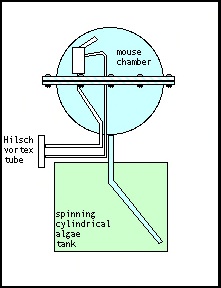
The idea was that at that time NASA needed to keep to keep some creature in weightlessness long enough to see what it would do to its body. Laika the Russian space dog hadn’t lasted long, and the longest Mercury flight had been 34 hours. I proposed a design that would put two mice in a closed ecosystem with algae. It was set up so that the algae tank would spin to provide just enough gravity to keep the water separate from the air, but the mice would be weightless in a separate chamber.

The fun was in the details. The mice would be housed in a two part plexiglas bubble, with a wire mesh floor at its equator. Waste would pass through he mesh, carried by the airstream and drop down into the algae tank.

That part actually got built. I made the algae tank of plexiglas, heated and formed around two round pieces of wood. I blew two half domes with a plywood form, an air compressor dragged up from shop class, and an oven borrowed from the home-ec teacher.

As I’ve said before, most of my education came outside of the classroom, thanks to indulgent teachers. They did the right thing, but it would get them fired if they did it today.

I bolted the half domes together through flanges formed during the blowing process. With two mice, Hing and Ho (named after the meerkats in Andre Norton’s Beast Master) in the upper chamber of the dome and a mass of Ankistrodesmus from a local stream in the algae chamber, connected by an aquarium pump, the ecosystem was as far finished as I could manage by the time of the science fair.

The physical result was limited by my resources, but the design went much further. To transfer the food to the mice, I had designed a pump, patterned after a Wankel engine (all the rage in Popular Mechanics that year). It was to send algae laden water up through a tube where it would be flushed over a fine mesh screen. The water would return to the tank on the airstream, leaving the algae for the mice to eat.

I did actually experiment with feeding them Ankistrodesmus. I strained it out of the water, dried it over a light bulb and passed the algae wafer into the mice’s cage. They went wild. You would have thought it was ice cream.

The design called for a small tube to carry a continuous airstream from above the algae water to strike the inside center of the upper dome, bringing the mice fresh air and carrying away waste as it returned. There a larger tube would carry the waste to the bottom of the algae tank.

To get water to the mice under weightlessness, the design called for the airstream from the algae tank to first pass through a Hilsch vortex tube, which split the airstream into hot and cold halves. The cold half was to pass between two thin metal plates. The warm (and moist) half of the air was to play onto the outside of these plates, leading to condensation and a continuous source of water for the mice to drink.

So why am I telling you this? Because this was the first step toward my future.

I didn’t know that at the time. I just did it because it was a challenge and more fun than I had ever had, but it led to a Fleming Fellowship, and that changed my life. more tomorrow.

Raven’s Run 107

I parked three blocks away. The ground level entrance to Jacks’ office was a door to a steep stairway. At the top was a long hall. No one was in sight. Down the hall I could hear the hum of voices and light from an open doorway laid a yellow rectangle against the grimy opposite wall. Jacks’ office was behind the first door, with windows on the street. The door itself was charred but sturdy, and the frosted glass window had been nailed up with plywood. The next door down was also boarded. Presumably the fire had spread that far before the fire department had put it out. The only other door in the hallway was the open one down and on the opposite side. I moved quietly down to see what it was. There was a hand lettered cardboard sign in the window advertising acupuncture. Hot needles off a sleazy hallway sounded about as appetizing as a back alley abortion, but the poor have pain as well as the rich.

The padlock on Jacks’ door was impressive, and so was the hasp. But whoever put it up hadn’t turned the screw plate back under the arm of the hasp. The screws holding it to the door frame were exposed.

I walked down to the hardware store and bought a screwdriver and a roll of masking tape. Five minutes later I had unscrewed the hasp. It was still attached to the door with the lock in place. I stuck the masking tape to the back of the screw plate to hold it in place and stepped inside, closing the door behind me. To a casual passer-by the door would look undisturbed.

Jacks office had been completely destroyed. The fire department must have come quickly to save the building, but this space was reduced to charred stubs of wall studding.  You could still tell that there had been two rooms. I was standing in a reception area and the far side of the burned out shell had been Jacks’ office, but the wall that had separated them was mostly gone. You could step through it any place.

Jacks had used a metal desk, the kind you buy as industrial surplus. It had survived the fire, barely. The ceiling was gone and the fire had cut through to daylight. There was a jagged, ten foot hole in the roof, which was fortunate since I hadn’t brought a flashlight and all the windows were boarded up.

I circled the room briefly, getting my bearings, then got down to business. I had to work quietly; beyond that, I was not worried about being disturbed. If my shadow enemy had an interest in this place, they would have searched it right after it burned. And if there had been anything worth finding, it was probably already gone.

On the floor behind the desk was a scattering of charred papers. I went through that first. The desk itself was empty, of course. I pulled the drawers and upended the carcass, looking for hideaways, and found nothing.

I was reasonably sure there was nothing to find, but I kept after it. Two hours later, I had turned over every spongy, black piece of debris twice, when I heard footsteps in the hallway. more tomorrow