Monthly Archives: June 2017

369. Fantasy World Building (2)

When you are ready to build your own fantasy world, you might consider these four things: tone, magic, language, and the concept of the archaic (found in posts today, yesterday, and tomorrow).

Continuing the concept of magic . . .

Christianity, in earlier centuries, saw witches as wielders of power which they obtained by pacts with Satan. Harmful as they were, witches had no power of their own. In many dark fantasies, the searcher after power obtains his heart’s desire from some greater being who is, in essence, a Satanic stand-in. Such Faustian bargains never end well.

Well, almost never. Martin does turn the tables on Satan in Robert Bloch’s That Hell-Bound Train.

Magic, in fantasy writing, often goes unexplained. The talisman in The Monkey’s Paw is understood by the reader without elaboration, just as a reader of westerns doesn’t need an explanation of how a six-gun works.

It is quite usual for a fantasy hero to have inborn power. Harry Potter was a wizard born of wizards. Ged is an unknown until his power is discovered by a mage. Corwin is a son of Amber.

It is equally usual to concentrate on the education of a wizard, or mage, or dziai. Ged went to Roke, Harry Potter went to Hogwarts, and my Tidac took two books to learn how to use his power because he had no mentor. His father never learned, and it destroyed him.

Can we have fantasy without magic? Probably not. Pavane is an alternate universe science fiction or an alternate history novel, but its tone makes it read like fantasy, except for the absence of magic. What seems to be magic in one chapter, may just be a dying dream; it isn’t made clear to the reader. For me, this places Pavane on the borderline between genres.

On the other hand, Randall Garrett’s Lord Darcy stories are all about magic, but their system of magic is so comprehensively worked out that they read like science fiction.

I know that my Menhir story, in its infancy, before I really knew what it was going to be about, read like a quasi-medieval world. Slowly I came to grips with how the powers of every soul are affixed to menhirs at death, making menhirs into gestalt beings which become repositories of power that can be tapped, at peril, by men of power. Only then did magic come into the world of the menhir. And only then did it begin to read as fantasy.

Language

“Up sword,” sayeth Sir Gallant, “lest I cleave thee where thou standest.”

Yeah, that’s pretty bad, and it has been a long time since I’ve seen that kind of fake-ancient language used in fantasy, except as a joke.

Language in fantasy is both a necessary tool, and a dangerous one. You can’t just throw in some thees and thous and -ests, but you also can’t speak in modern, colloquial English. Simple formality is the easiest way out. Even Zelazny, for all his smart-ass-with-a-sword characters, wrote with intelligence and a great deal of formality. If you want your characters to speak slang, you have to invent slang appropriate to their world, and that takes some effort.

Remember, whatever language your characters speak, even if you are setting your fantasy in early England, no one on Earth speaks that language today. In my fantasy world of the Menhir there are three languages in play, and a mid-sea island has a bastard language drawn from all three. It doesn’t matter. The book gets translated into English, whatever language the characters are speaking.

Whatever your genre, you are likely to have characters from different levels of society. Whether you are writing about nomads from the desert encountering the Pasha of Nevermore, or a Bostonian talking to a southern slave in 1845, you need to find a way to make your characters sound different from modern America, and from each other, but still be comprehensible. And it needs to sound natural. ‘Taint easy.

Languages – note the difference – are also dangerous, but at least you don’t have to invent one if you don’t want to. Tolkien did, to a degree far in excess of the needs of his stories. Almost no one else ever does. language continues tomorrow

Click here for next post.

Spirit Deer 6

He arranged this tender on a flat rock and worried the bullet out of a cartridge with his teeth. He spread the powder over his kindling, buried the mouth of the casing in the pile, and held it down with a rock.  Taking his knife, he tapped the primer.

Nothing!

He tapped it harder, and still nothing happened. Shivering and desperate, Tim dropped his knife and struck the casing with a rock. There was a sharp crack and the kindling scattered, but nothing took fire.

A spasm of shivering moved through him and he whimpered in the cold. Flint and steel. It was the only thing left to him, but he had no flint. He grabbed a broken off piece of granite and beat it viciously with his knife. It made no sparks. He tossed it aside and tried another. His breath was coming in sobs now. No sparks. 

He fell to his knees and rummaged among the pebbles and broken rocks, searching for something that was not granite. For a moment, the moon broke through, and he grabbed a rock that was shinier than the rest. He struck it with his knife.

A spark appeared. Tim struck it again and again until a shower of sparks fell on the damp tender. The gunpowder ignited, fizzling and snapping. Tim dropped the rock and knife and fell on his belly.

Blowing gently, he nursed the flame. A shred of bark shriveled and flared, then another. He held a fuzz stick above the tiny flame until it was fully burning, being careful not to smother it. Now he had a handful of flame and be began to feed it larger pieces of wood.

When finger thick pieces of wood were burning, Tim began to relax. He stretched his hands over the flame. Returning circulation almost made him cry out.

Tim gathered more wood and started another fire six feet from the first, then built a woodpile between them. He settled down there, warming himself and feeding them both. It was over an hour before the shivering stopped.

* * *

In the predawn light, Tim examined the rock he had used to start the fire. It glinted with metallic, golden flakes.  Pyrites – fool’s gold. The miners who had dug California’s hills for real gold had despised it, but to Tim it was a treasure.

The canvas case that had carried his emergency gear was basically undamaged. Only the snap had torn out. Tim bored holes in it and tied it shut with strings cut from his shirt cuff to make a secure case for his firestone.

He did not know how long it had been since he started his fire. He had watched the moon cross about a third of the sky before sunrise, peeking from time to time through the overcast. It was a glorious sunrise, but Tim hardly noticed.

Tim could not remember what had happened to him. He could only reason it out. He must have fallen into the stream, and it must have carried him downstream. Had he hit his head against one of those fang shaped rocks?

He explored his head with his fingers. There was a gash above and behind his left ear which had formed its own poultice of matted blood, dirt, and hair. Tim decided to leave it alone, since he could not see to tend it. It explained why he did not remember how he got where he was. It also explained his throbbing headache. more tomorrow

368. Fantasy World Building (1)

    Here we have an oddity. I am adding this paragraph after the original post date, but before Westercon. The title of this panel was changed from Fantasy World Building to Of Wizards, Dragons and Klingons: Fantasy and Sci-Fi World Buiiding. That is a bit ambitious; it pretty much includes everything writers do. I will leave these posts as they were, covering only fantasy worlds, but if you look at the rest of the panels on my Westercon page, you will find enough to justify the omnibus title.

I love fantasy, as long as you understand that I don’t include horror. Although all my publications so far have been science fiction, I have actually spent more time writing fantasy. You’ll see it, eventually.
     The first thing I wrote seriously, three years before I sat down to become a writer, was the first chapter of what became a three book fantasy series, Valley of the Menhir, Scourge of Heaven, and Who Once Were Kin.
     Since I began this blog, snippets of fantasy fiction and posts about the writing of fantasy have appeared here and there. Long term followers may recognize the following from posts 240 -243.

When you are ready to build your own fantasy world, you might consider these four things: tone and magic (today’s post), as well as language and the concept of the archaic (tomorrow).

Tone

The tone of the prolog to my novel Valley of the Menhir is intense and serious, but it can afford to be. It only lasts eight ms pages; if it were prolonged, such seriousness would quickly become pretentious. Books, like the characters in them, need to breathe. This is true whatever the genre.

J. R. R Tolkien set the tone for fantasy, and not necessarily in a positive way. The feel of Lord of the Rings is a combination of pretension and childishness, a tone that came from the uneasy mixing of hobbits with humans and elves. I liked LOTR well enough to read it twice, decades apart, but I don’t think I could make it through again. To be fair, the hobbits were the best thing in the books. When I tried to read the Silmarillion, the hobbits weren’t there to lighten the mood, so I finally bogged down and quit.

Tone at its best is found in A Wizard of Earthsea, which is, for my taste, and without equivocation, the best fantasy novel of them all. The overriding factor in the tone of Earthsea is humility. Ged is the son of peasants (or Earthsea’s equivalent) and he never loses touch with his humble beginnings. True, his arrogance leads to tragedy, but the bulk of the book is the story of Ged regaining the humility which is his natural state.

The language of the book is simple, matching the tone of the story. The image of a man in a tiny boat, pursuing his nemesis alone across Earthsea, has an almost Ghandiesque simplicity about it — if we remember that Ghandi had the simplicity and arrogance to bring down the British empire.

Tone can take many shades in fantasy, and still work. Fritz Leiber’s Fahfrd and the Grey Mouser stories on one hand and Keith Robert’s Pavane on the other are worlds apart in every way, but each strikes the tone necessary for its story. And yes, I know Pavane is an alternate worlds novel, but it reads like fantasy.

Roger Zelazny’s tone has one foot in science fiction and the other in fantasy. It doesn’t matter what he writes, his tone remains the same, and it works everywhere. Lord of Light is certainly science fiction and Creatures of Light and Darkness is certainly fantasy. Amber, in all its volumes, transcends categorization, but all these works belong in the genre called everything-Zelazny-wrote. I’ve read all his work repeatedly, and will continue to do so, because I get lost in the sound of his voice. And that is what tone is, after all.

Magic

Any sufficiently advanced technology is indistinguishable from magic.
                Clarke’s third law.

The universe is full of forces; some of those forces are personalities.
                reference lost

I believe that the second quotation above is from a piece by James Blish, which I read many years ago and no longer have available to me. If anyone recognizes the source, let me know. In that same piece, as I recall, he spoke of Black Easter as an experiment in which he treated the Book of Revelation as simple fact. Roger Zelazny made a career out of treating non-Western religions as if they were simple fact.

Like stardrives, magic can be highly structured or haphazardly thrown in when the story needs it. Both styles work, depending on the skill of the author. The most organized magic I recall is Randall Garrett’s Lord Darcy stories. For disorganization, see any new author.

A primary, underlying question in any presentation of a fantasy world is, “Where does the magic come from?” Is it a dispersed, readily available natural resource like The Force in Star Wars? Does it reside within its wielder, as a natural consequence of his being? Or is it owned by other powerful beings, who must be supplicated or bargained with to obtain a portion of their power? This choice has a huge effect on how dark the story is likely to become. we continue magic tomorrow

Click here for next post.

Spirit Deer 5

The stream roared in its bed, and towhees darted about, showing him their red sides as the flitted by. Tim was watching them, when he saw his deer. The stream took a sharp bend here, so he saw the muley through a double screen of willows and across the open space above the stream. Its forequarters were matted with dried blood.

“Finally,” Tim thought. He brought up his rifle. Walking at a half crouch, he worked out to the lip of the stream. The wind was upstream and the deer was not looking his way, so he waited, hoping it would move. A tree trunk lay between Tim and a prefect shot. But the muley didn’t move, so Tim carefully shifted sideways.

A rock turned under his foot, the rifle went off into the air, and Tim fell through space into a pit of blackness.

Chapter 2

Tim was caught up and swept away. For an eternity, he fell through frigid space, beaten by unseen fists.

Then there was a time of drifting and slow surrender.

There was an endless slope where he chased his quarry. Then the quarry turned on him and he was running downhill in frenzied panic.

There was the cold. The numbing, all consuming cold.

Finally there was ultimate blackness.

* * *

It was the cold that woke him.

His consciousness did not return all at once. First he was aware of the crumbled granite beneath his cheek. Then he became aware that his clothes were wet and that the world was dark.

Tim rolled over onto his back, tearing his ice encrusted jeans loose from the rock. The moon was up and for a time Tim had no idea where he was.

Fire! He had to have a fire. His clothes were soaked, where they had not crusted with ice. He reached for his match case, but it was not there. The survival pack was torn open and empty.

He sat for a minute, holding his head and shivering.

He was beginning to remember his plunge into the stream. Somewhere along the line, he must have hit his head. His fingers explored his scalp and came away damp and sticky. He had probably smashed into one of the boulders that studded the stream.

He raised his head and looked around. He was nowhere near the stream. He was high on a slope in broken granite country; the boulders and stunted trees around him made fantastic shapes in the night.

And he was freezing!

The cold was intense. As he became more fully awake and aware, Tim’s discomfort changed to pain. His fingers ached deep in the joints and he shivered so that he could hardly move.

His rifle was gone. His watch was gone. He had an empty canteen and a hunting knife at his belt, but the canvas case that held his survival kit had torn open. The snake bite kit, salt tablets, coil of snare wire, coil of fish line, hooks, sinkers, compass and plastic poncho – all the things his dad had helped him put together, all were gone. He still had the clothes he was wearing, a handkerchief, and four cartridges for his missing rifle.

Those cartridges seemed his best hope of a fire. He knew how to start a fire with them if he had a rifle. But without one . . . ?

He gathered firewood as best he could in the near darkness, where the moon only showed occasionally through the clouds. Using his knife, he shredded bark from the driest wood and cut fuzz sticks. He arranged this tender on a flat rock and worried the bullet out of a cartridge with his teeth. more tomorrow

367. Alien Autopsy (5)

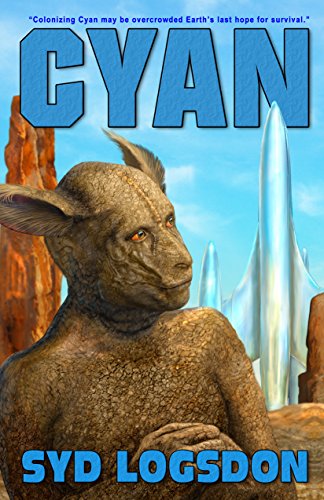
The other four Alien Autopsy posts were in Serial last week. After they were finished, I realized that I needed to give you a better picture of the Cyl. They are kind-of my favorites.

On Cyan, the dominant alien species of the torrid zone are the Cyl.  Viki Johansen, the scout specializing in Anthropology.—

. . . began a campaign of attrition and, after eight months, managed finally to enter the Cyl camp without disturbing them. They had become so used to her presence that they largely ignored her, and first-hand she confirmed her suspicions that the Cyl were of Australopithecine level intelligence

Their ears, she discovered, conveyed a complex emotive language that no one could hope to translate. Every position, every nuance of stance, was replete with meaning, and immense complexities of feeling could be portrayed by counterpoising irreconcilable emotions against one another. Yet there was no communication of ideas.

The Cyl are physiologically incapable of speech. After some changes you’ll have to read the book to find out about, “they” are taught to sign. Much later, Keir Delacroix meets up with a Cyl leader, and describes her —

The leader was an old female. Her scale filaments were sparse and shaggy, and her gel glands were puckered and no longer functioning. It was the first close up look Keir had had of a living Cyl. When she squatted at rest, her powerful hind legs jutted forward at a sharp angle and she rested her tiny forearms across her huge, scarred knees. Her mouth was broad and toothy, her bare facial skin stretched taut over massive bones and utterly impassive. She had no need of facial expression while her ears played symphonies of feeling.

Still later, Viki and her Cyl come to Beryl, Debra, and Tasmeen, needing help, and there is a dangerous moment of interspecies distrust.

The Cyl heads swiveled back toward Beryl and Debra again. There was no change of expression. There never would be, never could be, any change of expression on those bony faces. That fact alone would always keep humans and Cyl from completely trusting each other, for the humans, with their immobile, underdeveloped ears were as expressionless to the Cyl as the Cyl were to humans.

It comes near to a bloodletting as Beryl stands, armed, between the Cyl she has never seen, and her child. But then . . .

The Cyl ears moved in a symphony of sudden understanding, and of appreciation for the humanity of these strange creatures who would die — just as a Cyl would die — to protect their young.

The lead Cyl leaned forward and placed her darts, crossed, on the floor in front of Beryl and Debra. Her two companions quickly copied the motion, then all three shuffled backward. They were awkward inside the dome where the furnishings of the place made a maze for them to negotiate. As bounders, they were creatures of the unobstructed open plain. This human habitation was utterly foreign to them, not because of the steel from which it was made, or the interlocking triangles of its geodesic construction, but because it was cluttered. How could one hope to move about in it?

Beryl just stared at the Cyl. Their huge heads, their stone faces, and the heavy teeth showing through the thin slash of their lips, were too much for her to trust.

Cooler heads prevail, and Viki explains their need. Tasmeen is quick to come to their defense.

Viki was signing to her Cyl as Tasmeen spoke. It was not a translation. Cyl thought was too different for that. What she signed were a string of independent concepts. Had she been Cyl, the positions of her ears would have placed the concepts in an emotional context and tied them together into a rich and complex whole. When the Cyl spoke to Viki, that was what she received, the great subtlety of hands and ears in concert, but when she spoke, it was, to the Cyl, as if she were a halting child. She said:

WOMAN. LEADER. POWER. (my) PRIDE. TRUST (her).

The lead Cyl signed that Viki’s trust in Tasmeen was like the trust of the entire Cyl race for Viki; that in trusting Viki, they therefore trusted Tasmeen; that they too recognized the power in this woman; and that it was a lovely irony (the Cyl live for irony) that the sister of the mother of the race of Cyl was of an age to be the daughter of the mother of the race of Cyl, and therefore this woman of power who was their mother’s-sister was also their agemate-sister, so that the emotions of love and respect that they must necessarily have for her as the savior of their race were also the emotions they would choose to have for one who was both mother and sister to them all.

This she said in a three-second flurry of ear and hand motions.

Beryl watched, wondering if this hulking, stupid-looking creature was really of human intelligence, or if Viki was merely fooling herself.

A little irony never hurts.

The best aliens not only look different, but think differently as well.

Spirit Deer 4

Tim started up the slope and the muley broke from cover.  With surprising speed, it went up the slope on three legs. Tim sighted quickly and squeezed the trigger – but nothing happened! He had forgotten to work the lever after his first shot. He jacked a shell angrily into the chamber and fired, but the deer kept right on going, and he knew he had missed.

Tim topped the skyline fifteen minutes later. Below him was a broad, shallow valley, now lost in shadow, and behind him the sun was setting. The deer was nowhere in sight.

* * *

Tim was in trouble, and he knew it. It was too late to find his way back to the campground before full dark, and he was growing cold, so he built a fire near a circle of junipers. He had slept out many times with his father, but never without a sleeping bag or jacket, and never without food. “Serves you right,” he told himself, bitterly. He fed the fire and squeezed close to it.

Tim could imagine his mother coming home from work, past midnight, and moving about the silent, empty house. She would see his note. If he was really lucky, she would assume that he had decided to spend the night at his grandfather’s house. It would be late, so she probably wouldn’t call. It would probably be morning before she knew he was missing.

If he just had his cell phone he could have told her what happened, although he cringed at how lame the story would sound.

It was a miserable night. Tim dozed in snatches on a bed of dry ferns and needles. Before is was fully light, Tim had already stamped out his fire and started off, but even exercise did little to warm him.

He had a decision to make. Within an hour, his mother would be calling his grandfather, and would find out that he wasn’t there. He didn’t want to worry her, but there was no way to avoid it now. The question was, should he go back immediately and face her, or should he spend a little more time to bring the muley in. He decided to spend one hour looking for the injured muley, then he would have to go back.

The ground was too rocky to take tracks, so he headed for the stream he could see at the base of the valley. It was rocky with only a few patches of dirt, and he found no tracks there, so he worked his way downstream, looking for anything to indicate that the deer had passed that way.

Just when he was about to give up and turn back, he found three-legged deer tracks.

Now Tim was really in a dilemma. He didn’t want his mother to worry, but he didn’t want to leave his wounded deer either. And he certainly didn’t want to have to tell his dad that he had left a wounded animal.

“Just a little longer,” he decided.

Tim followed the tracks down the valley. It was slow work; the tracks only appeared at scattered intervals where the ground was soft enough to hold them. Several times he lost them altogether, but always managed to pick them up again.

The sunny morning was turning into a very cloudy day. Up here snow would be dangerous, and even rain would be a first class misery. At least he had the survival pack his father had helped him put together. It held matches and a plastic poncho, and he never went into the woods without it.

The stream roared in its bed, and towhees darted about, showing him their red sides as the flitted by. Tim was watching them, when he saw his deer. more next week

366. Three comments on Spirit Deer

[1]  When I was a very young writer, I read everything in the library under Dewey Decimal 808. It’s called Rhetoric & collections of literature, but really, it’s where they stick all the how-to-write books. In one book of articles, there was a piece titled Multiply by Two. The author’s thesis was that it is always better when starting a book to have two people in front of the reader, to allow for conversation while setting the scene. That’s probably reasonable advice, but I disregarded it in Spirit Deer. Tim is completely alone by page six, and remains that way until the last page.

At the time I wrote Spirit Deer, it just seemed right for Tim to be alone. I had spent half my childhood alone, walking to round up cattle twice a day or on a tractor, endlessly circling innumerable fields. Nothing could seem more normal for Tim the adult, and that didn’t change when he became Tim the youngster. And it wasn’t just me. In the outdoor adventures I read as a child, boys were always out in the woods, and often alone.

I read those books in the fifties and I wrote Spirit Deer originally in the seventies. In 2017, I wonder if the cell phone generation has ever been alone, or ever will be again.

[2] Speaking of cell phones, the cell phone bit in Spirit Deer Post 2 was introduced because no modern kid would be without one. I didn’t want it in the story, so I used one sentence to both establish Tim as responsible and get rid of the damned thing. This scene also introduces a girl, who has no part in the story, but would be missed if absent in 2017. Her absence would have been taken for granted back in the seventies. Or the fifties. Or the thirties, or the nineteenth century. Actually, I see the automatic inclusion of females as progress, but I still wanted Tim to be alone in this story.

[3] Until Tim fires his rifle in Spirit Deer Post 3, he could always just go back to the campground and bike on the his grandfather’s place. There would have been no story. I wanted Tim to have some responsibility for getting himself into trouble. This book is about choices, so it would have been inappropriate for him to get dumped into the wilderness due to forces beyond his control.

This is very different from the original version of Spirit Deer where the hunt had been the legitimate act of an adult.

I also give Tim an out in Post 4 and he doesn’t take it. He could just walk away from his responsibility. But Tim is a moral being, as all my main characters tend to be. I like a stalwart hero. I don’t like the weaselly, vacillating type who finally talks himself into doing the right thing — in real life, or in the characters I write about.

Spirit Deer 3

He hid his bike in the manzanita a hundred yards from the campground and took his rifle with him. Then he slipped a few cartridges into the magazine, just in case.

He walked into the woods. It was late October and the Sierra Nevada mountains of California were beautiful. The aspens were gold against the deep green of the firs and the air was clear and cool. As the morning slipped by he occasionally heard the shots of other hunters, but he didn’t see any deer.

By mid-afternoon, Tim reached a high valley, cut through by a small, swift brook. There he lay back with the sound of water in his ears. The rifle was across his stomach as his eyes searched the edges of the trees.

Five deer came out of the woods on an eyebrow of trail fifty feet higher up the slope and a long hundred yards away. A four point buck led the way, followed by three does and a yearling. Tim sat up and brought up his rifle. He took up slack on the trigger and squeezed gently, just as his father had taught him.

In the moment that Tim fired, the lead muley caught sight of him and pulled up short, then stumbled. His forequarters failed him and his chest hit the trail as his back legs struggled for balance. Then he was up again and running up the trail.

The other deer were gone. Tim’s attention had been all on the leader and he had not even seen where they went after they disappeared into the forest.

Now he was in a panic. Until he had fired that shot, he had not really admitted to himself that he was out hunting alone. He had just been “taking a walk”. If he turned away and went back down to the campground now, his parents would never know the truth. But Tim would know, and in the hunter’s code his father had taught him, leaving a wounded animal was unthinkable.

Tim plunged into the stream where it ran shallow across a bar of harder rock, holding his rifle high. He scrambled up the talus slope, using rocks and juniper as handholds. When he reached the point where the deer had been, he found the manzanita covered with a fine spray of blood.

Tim turned up the narrow, winding trail in pursuit of the wounded deer. Near the stream there were vines and underbrush, but as the trail climbed, it became more open. The muley was nowhere in sight.

There were a number of tracks on the trail, but only one set going in the right direction. Tim studied them for a moment, looking for some distinctive feature, but he found none. The deer held a grueling pace for more than a quarter of a mile before his tracks showed that he had slowed and begun to limp.

The situation didn’t look promising. The deer had run into an area of broken granite and stunted firs. It was not a place for an inexperienced tracker.

The sun was low, filling the land with shadows and strange suggestions of shapes. It was beginning to get cold, and Tim’s jacket was back at the campground, tied to his bike.

Tim sat down on a rock to scan the slope ahead of him. Finally, almost lost in the tangle of roots at the base of an uprooted ponderosa pine, he thought he saw a set of antlers.

Tim started up the slope and the muley broke from cover. With surprising speed, it went up the slope on three legs. more tomorrow

365. You wanna write?

“You stupid-looking sons of bitches wanna write? Well, gwan home and write!”
Sinclair Lewis

This is the entire text of a lecture by Sinclair Lewis. It is quoted by John Masters, best selling author from the fifties and sixties, in his autobiography Pilgrim Son. Masters had just summed up his prospects as a beginning writer this way:

I could invest about two and a half years in making myself a self-supporting writer. I did not hesitate a moment in deciding it was a reasonable investment.

This was mid-1947. His evaluation was based on having severance pay after leaving the British Army in mid-career. Today’s equivalent would be a good day job.

In some ways, Masters is my touchstone for intelligent planning of a writing life. I read his autobiography early on, shortly after I had made a similar summing up, and had decided I could afford most of a year to see if I could write.

I’ve told my story before in the first three posts of this blog, and I repeated it a year later. I apologize to those few who were with me that early, but it needs telling yet again because it explains Spirit Deer, which is now appearing over in Serial. You will also hear more about Masters, both next week and later.

#                #                #

I started my college career at Michigan State in Biology, and later switched to Anthropology. The draft put me into the Navy, and then I returned to the University of Chicago for a masters degree. I intended to continue with my Ph.D., but didn’t work out that way.

I had lost my chops. Learning how to study, learning how to learn (not the same thing), and learning how to play the game (definitely not the same thing) are a college student’s chops. After four years in the Navy, it took me some time to get my chops back, and by then the next year’s quota for Ph.D. candidates had been filled. My would-be career was in hiatus.

However, all was not lost. When my major professor read my Master’s thesis, he told me to reapply the following year and they would find a place for me.

I had an unexpected year off. What to do? I knew I could write, but didn’t know if I could sit down day after day and write hundreds of pages. This was my chance to find out. The day after Labor Day, September 2, 1975, I sat down in front of my typewriter to find out.

Writing a science fiction novel or a fantasy novel would have called for a lot of time spent in world building. That wouldn’t tell me what I needed to know. A historical novel would have called for even more research, and a detective novel would have called for crafting a complex puzzle. I wasn’t worried about any of those skills. I just wanted to know — could I write word after word after word, day after day, week after week? And would it be fun?

I needed a minimal research story, so I decided to send my protagonist on a deer hunt, where he would get lost. I would set it in autumn, in a part of the Sierras I could drive to in a day if I needed to be on the scene. I would roll in a storm, with low hanging clouds so he couldn’t find north and couldn’t send up smoke. I intended to let him get out on his own. Over the weeks I piled misery after misery on the poor guy’s head.

Within two weeks, I was hooked. I was having a ball. Getting lost in the woods and finding my own way out was infinitely exciting, since every night I could go to my comfortable bed while poor Tim Carson (he had a last name then) tried to sleep on the frozen ground.

I never reapplied to Chicago, but I did go on to write many other novels.

Spirit Deer 2

Last year, Tim had been allowed for the first time to go with his father on his yearly deer hunt. Then his father had given him a rifle for Christmas, and this year they would have hunted together for the first time. There had never been any open agreement between them – that would have spoiled the whole thing – and his father would never have admitted that these were rewards for good behavior. Good behavior was simply expected. But if Tim hadn’t gotten control of his temper, the rifle and the hunt would not have been his.

Tim picked up an axe and took his anger out on the wood.

* * *

Tim was standing beside the pickup when his parents left the next morning. His dad tossed a worn leather satchel into the back and squeezed his shoulder. “Your mother is going to drop me off on her way to work,” he said. “Maybe I’ll be able to get a day between runs before deer season is over.”

“Now don’t you go driving crazy!” Tim’s mother said.

“You know me, Helen.”

“Yes, I do.” She turned and kissed Tim, and said, “There are leftovers in the refrigerator. You’ll have to make your own supper. I’m taking another double shift while Susan is having her baby. Maybe you ought to bike over to see your Granddad.”

“All right, Mom,” Tim said, but inside he was shouting, Not you too! He knew he shouldn’t be angry at either of them, but he was. After the pickup pulled out of sight, he wandered around the yard, feeling abandoned and feeling sorry for himself.

Eventually, he went to his bedroom and sat down on the bed with his new rifle across his knees. It had never been fired, except on the practice range. He took the shells from the box on his desk and loaded it, then unloaded it again. Finally he dropped a half dozen cartridges into his pocket and picked up his pack. As long as both parents were gone for the night, he figured he might as well spend the time with his grandfather. Maybe he could get in some target practice, or maybe he could get his grandfather to tell some of the family tales about the old Miwuk Indian days.

He left a note for his mother and strapped his rifle across the handlebars of his bike. He turned up the main highway into the mountains, standing on his pedals to make the initial grade. When he got to the turnoff to his grandfather’s place, he hesitated. Up the road, only seven miles further into the mountains, was the campground where he and his father had parked last year when they went hunting. At least he could go there. He had all day.

The road rose sharply for those seven miles, and Tim was thoroughly winded when he arrived at the campground. Half a dozen empty campers were parked there, but there was no one in the campground. Everyone was out hunting.

Tim stood astraddle of his bike for a long time, running his hands across the smooth steel and wood of his rifle. He was sorely tempted to have his hunt anyway, alone. Finally he decided to just walk in the woods for an hour before he went down to his grandfather’s place. He reached for his cell phone to tell his grandfather, then remembered that it was at home.  The one girl he liked least had begun to call him twice a day, so he had stopped carrying it. more tomorrow