Monthly Archives: June 2017

364. The Core Story

photo by David Mayer

For the last month, these posts have been coming later in the day, in hopes of finding new readership in other time zones. I haven’t been happy with the results, so today I am reverting to the old posting schedule.

Over in Serial today, I begin presenting the novel Spirit Deer. I had some hesitation about this.

As it stands, Spirit Deer is a juvenile, not a YA. It would be suitable for most of the kids I taught in middle school, but too young for teenagers. It would stand with Island of the Blue Dolphins, not with Twilight.

It didn’t start out that way. When I originally wrote it, as an experiment to see if I could I write a complete novel, Spirit Deer was a book for adults. Tim had a last name, a wife, a job, a backstory, and other adult considerations. When he got lost in the woods and had to find his own way out, it was a catalyst for changing his life.

It was only 45,000 words however. That was too short for a western or a science fiction novel, even in the seventies, and way too short for a regular novel. And while the lost-and-found part of the story was fine, the relationships part wasn’t ready for prime time. It didn’t deserve to be published, and it wasn’t.

I moved on and my second novel,  Jandrax, and it was published. Fair trade; Spirit Deer had done its job by teaching me to write. It could be put away with no regrets.

But it wouldn’t die. The problem was, once you strip away the wife and the job and the friend and the adult concerns, the core story of how to keep alive when nature is trying to kill you was still powerful.

After a lot of years, and several other novels, I went back to Spirit Deer and stripped it down to it’s essence. At that level, Spirit Deer could have been about any male above the age of thirteen, all the way up to senility. To be fair, a woman could have endured what Tim endured, but I don’t think a woman would want to read a book about it. At least not in the eighties and nineties when the core story was tapping me on the shoulder and saying, “Don’t give up on me.”

Spirit Deer became a juvenile because of its length. When the wife and friend and backstory went away, there were only about 25,000 words left.

Consider this:

Man against nature, other men, or himself, is a story.
Man against nature, other men, or himself, plus gunfights, is a western.
Man against nature, other men, or himself, plus thugs, is a thriller.
Man against nature, other men, or himself, plus spies, is James Bond.
Man against nature, other men, or himself, plus sweet sex, is a romance.
Man against nature, other men, or himself, plus rough sex, is men’s action — a genre which has all but disappeared.
Man against nature, other men, or himself, plus sex, catching a big fish, and death on the last page, is Hemingway.

I didn’t want to add any of those plusses, and I didn’t want to make Spirit Deer artificially longer, so it became a juvenile. It’s still a good story, it taught me a lot, and it provides a lot for us to talk about as writers.

That is, I assume you are or want to be a writer, or I would have lost you in the second paragraph.

Spirit Deer will be presented in forty posts over in Serial, and there will be posts over here on A Writing Life expanding on the story, on being a beginning writer, and on how many ways a writer can present a core story.

Spirit Deer 1

Spirit Deer
by Syd Logsdon

Chapter 1

Tim was packing for their hunting trip when his father came to his room. When he hesitated in the doorway, Tim knew that something was up, and that it wasn’t something good. He shoved another pair of jeans into the pack and said, “What’s the matter, Dad?”

“I just got a call from Mike Conway,” Tim’s father replied.  “He’s come down with the flu.”

Tim stood still with his hands resting quietly on the half filled pack, waiting for the rest.

“I have to drive his rig for him.”

“How far?” Tim asked.

Tim’s father came up and put his hand on Tim’s shoulder. “All the way to Chicago. I’m sorry, Tim”

Tim wished he was twelve years old again, so he could throw a screaming fit. He had been working on his temper these last two years, trying to be fair to his family, trying to be responsible – trying to be more like his dad. If he acted childish now, if he even whined, his father would be terribly disappointed in him. He didn’t want that, so he gritted his teeth and asked, “How soon will you be back?”

“That’s the rest of the bad news. I can’t pick up his load until tomorrow morning. Figure two days each way, and at least a day to unload and load at the other end. Five days; I’ll barely be back in time to make my own next run.”

Tim couldn’t believe it. It wasn’t fair. He had waited all year for this hunting trip and now it was going to be snatched away from him. He said, “I wish we had left two hours ago.”

Tim’s father shook his shoulder in a friendly way. “Then Mike would have driven sick. I’m glad I was here for him. He has been a good friend to all of us.”

It was true. Tim knew that; but inside, the selfish twelve year old he had been was screaming, “I hate it, I hate it, I hate it!” Tim was tired of being fair. His fingers tightened on the pack. He wanted to grab it up and throw it – preferably through a window, or at his dad.

But Tim saw his father’s eyes on him. He knew the look of disappointment that would come into those eyes if he gave in to childishness, and he never wanted to see that look again. His dad said, “Tim, I’m proud of you for taking this like a man.”

Tim couldn’t reply, and he couldn’t stand those eyes on him any longer. He nodded with set lips and left the room. He headed for the woodpile.

Two years ago, the last time he had thrown a tantrum, his father had taken him out to that woodpile. He had given the axe to Tim and had told him to chop wood. After ten minutes, when some of his anger had been drained away by smashing the heavy logs into firewood, his father had said, “Everyone gets angry. Everyone wants to have things go just right, and things never do. Now you’ve got a choice to make. You can cry like a baby when you don’t get your way, or you can act like a man. The next time you find yourself losing control, I want you to get up from whatever you are doing and come out here. Work it out, then come back.”

Tim had spent a lot of time at the woodpile that year. Gradually he had gained control of himself, and as his father grew proud of him, he had grown proud of himself.

It had been nearly a year since he had gone to the woodpile to take out his frustrations, but this was no ordinary disappointment. more tomorrow

363. Masters: Coming to America

What sort of country would (the United States) have now if the Indians had had an Immigration Service when the Pilgrims set out in 1620?
John Masters

When I first read John Masters, something he said stuck with me. Before going to Westercon this year, I wanted to run down that quotation, and in doing so I found much more worth sharing. What he said about writing will appear here later, but today I want to give his insights on immigration, or, as he called it, his Seven Year’s War with the U. S. Immigration authorities.

For reasons detailed in his book, John Masters decided that, though he was an Englishman, there was no life for him in England, and that America should become his home. He applied for an immigrant visa, knowing that the British yearly quota of 65,000 was never filled. His reactions to the questions asked on the application form were humorous, but too long to place here. Apparently the questions were as inane then as they are now. (see 329. Green Card Blues and 361. Take This Test)

A week or so later, he was told that he would have to wait about four and a half years. He had been placed on the Indian quota. He went back to inquire and was told that American law only recognized the place of his birth, not his actual citizenship. Never mind that he was born in a British military hospital. Never mind that he was born of a British mother and a British father, stationed in the British army in a British controlled area. Never mind that a child born of an American parent (and it only takes one) anywhere in the world is an American citizen. Never mind that he was born in 1914, and India didn’t become a country until 1947. He was born in India, so he was on the India quota.

It was a good thing he hadn’t been born while his father was stationed in Greece. The Greek quota was eighty-one years. (Yes, that is not a misprint. 81 years.)

Masters decided to withdraw his application for an Immigrant visa, get a visitor’s visa, and work things out later. That was not allowed. Since he had applied for an immigrant visa, he was no longer eligible for a visitor’s visa. Too many others when facing impossible waits had made that same move, then disappeared once they were in America.

As you might guess, as a British Army officer with plenty of friends, he was eventually allowed a visitor’s visa, came to America, and managed to stay permanently, although with many additional bureaucratic battles.

Good thing he wasn’t actually Indian.

More to the point in 2017, good thing he wasn’t Mexican, or poor, or not a native English speaker.

Master’s comments on writing will come in later posts.

Alien Autopsy (4)

In Jandrax, I was happy to use modified mammals and birds. That was all the story needed. When I wrote Cyan, I faced a different situation. My crew was set down on an alien planet for one year, with the task of coming to understand its weather, geology, and ecology in order to prepare for colonization. They were all scientists, so their actions and conversations called for a deeper understanding of their new world than any other kind of science fiction novel would have required. That challenge was half the fun.

When I began Cyan, I had been studying ecology for about twenty years, starting back when I had to explain what the word meant. I later came to understand the essence of Earth’s taxonomy in the most rigorous possible way — I had had to condense it to a level which middle school students could understand without dying of boredom.

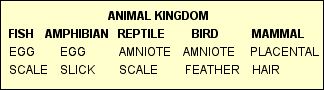
Terrestrial taxonomy looks something like this:taxon

Drop a salmon egg on the gunwale of your canoe and it will dry out in minutes. A chicken or turtle egg would survive the same treatment. This is the meaning of amniote egg (although there are other, competing meanings). Creatures who lack them, must lay their eggs in water. The rest of the chart should be clear, although simplified. For example, birds have scales on their legs as well as feathers elsewhere, and I skipped Dinosauria altogether.

I built up Cyan from the taxonomic level. If I had hadn’t been showing the planet through the eyes of a team of scientists, I would never have started out there.

It had to be weird but recognizable — that’s the key to all science fiction invention. It also required restraint. You can only explain so much to your reader without losing them, and beyond a certain point, your backstory is wasted effort.

I took grasses and weeds for granted. I gave my trees multiple trunks bound together, like a strangler fig without its victim. For something like insects, I made Chitropods – chitro sounds like chitin, and pod means foot, so the reader can be expected to infer an exoskeleton. Continuing the idea of inference, if we call the flying creatures who eat the chitropods pouchbats, the reader will draw a better picture in his mind that we could on paper.

The number of legs is important to Terrestrial arthropods, but I bypassed that by giving all chitropods many legs, but with only one joint each where each meets the body. This gave them a rolling gait “like caterpillars on crutches”.

These are throw-away inventions. They could have been applied to any ecosystem and they are not systemically related to each other. They alone would be good enough for most science fiction novels, but not for one about scientists teasing out the essence of their planet.

Here we need a key differentiation, from early in evolution, from which a thousand lesser differences can be derived. I decided that on Cyan, early in the development of chordate life, the vertebral column doubled at the posterior, giving Cyanian sea life twin tails. That changed everything. Earth fishes evolved legs from their fins. Cyanian “fishes” evolved legs from their split tails, so every Cyanian land creature is a tail-less hopper, fundamentally different from anything on Earth.

On Cyan, the classes are Pseudo-pisces, Amphibia, and Inturbia. No reptiles, no birds, no mammals, no dinosaurs. The Amphibia are cold blooded. Inturbia are inefficiently warm blooded. The term Inturbia should imply “internal body temperature un-perturbed by external changes”. Not every reader will get that, but writers should reward their best readers by not spelling everything out.

There are a thousand other details, but for that, you will just have to download Cyan.

All this is not to say that I didn’t invent interesting alien creatures. Kavines are incredibly fierce. Dropels, especially after they became domesticated, are cute and tasty. In the southern part of the upper continent, the Cyl developed something close to sapience, leading Viki to . . . nope, sorry, that’s a spoiler. I just started with taxonomy so they would all fit together.

Of course, too much consistency without outliers would be boring, so I added the globe wombs. The explorers see them shining in the treetops from their first minutes on the planet, and it takes a while for them to figure out what they mean.

Inturbia have live birth. Cyanian amphibs have to return to water to lay their eggs, except for one group, the Sphaeralvids, who produce globewombs. When a Sphaeralvid mother comes to term, she moves to a sunny spot in the treetops and exudes a transparent, leathery sac filled with a clear fluid like seawater. Into this she deposits fertile ova, then defecates. Algae from the Sphaeralvid mother’s bowels convert the feces into biomass and the Sphaeralvid nymphs fed off the algae.  When the feces are gone, the globewomb walls break down, leaving the now sizable nymphs free to face Cyan on their own.

Neat, huh? That is entirely too much detail for most books, but Cyan was written to show, realistically, what exploration of a new world might be like. This is just the kind of detail a crew of scientists would be recording.

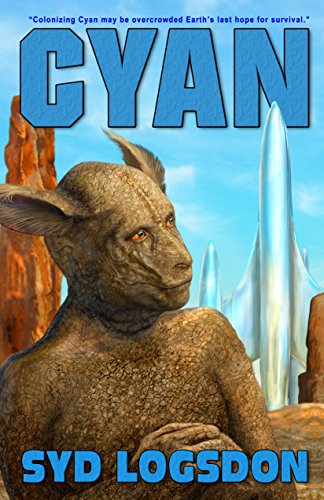
Aside:      Shortly after posting this, I received a digital copy of the print-on-demand version of Cyan to proof. I spent May 29 and 30 in close reading of all 315 pages. The taxonomy and ecology of Cyan are backstory, dribbled out in bits here and there, but what the reader sees up front and in their faces are the individual alien beings. I realized that I need a fifth Alien Autopsy post to devote to the Cyl (the cover critter), but there is no space for it here. You will find it next Thursday over on the A Writing Life side of this website.

#               #               #

I began Cyan a few years after I wrote Jandrax, and set it in the same universe but hundreds of years earlier.

I also have in mind a third novel set in the same universe, but very different. It will take place on Stormking, a prison planet with a Uranian inclination to the ecliptic. The people who make up its population are not scientists, but outcasts. They have no interest in taxonomy. They meet the creatures native to their world one by one, and all they care about are which ones can they eat and which ones want to eat them. This time I’ll stop worrying about how these alien creatures make up a logical system, and just weird them up big time. That ought to be fun, too.