As usual, there will be no post this Friday. There will also be no post on Monday, Dec 21, so that my four posts for Christmas week can include Christmas Eve and Christmas Day.
Filler
Leave a reply

As usual, there will be no post this Friday. There will also be no post on Monday, Dec 21, so that my four posts for Christmas week can include Christmas Eve and Christmas Day.
Because I intend to publish the novel from which this excerpt comes, Symphony Christmas will not be placed in Backfile.
The class couldn’t decide whether to be upset at having to wait to read their papers, or happy at the thought of getting music instead of work. The last few students put down their pencils and Neil started the tape. Garfunkle sang with sweet melancholy about Mary, born in a trailer, who shone like a gem in a five-and-dime store. Without the music, the words would have meant little. With the music, it became a lament for loneliness and abandonment that even eleven year olds could understand.
After the last chord had died away, Neil shut off the machine and began to rewind. Laura Diaz said in a small voice, “Mr. McCrae, can we hear it again?” A dozen of the students added their appeals to hers.
“Sure,” Neil agreed. “First let me give you these. I typed up the words and ran them off so you could understand them better.”
This time through about half of the children followed the printed sheets as the music played.
“That was neat!”
“Yeah, but sad.”
“Neat but sad is exactly what I think of it,” Neil agreed. “Does anybody want to hear it one more time?”
They did, and it carried them to the break.
*****
When they came back, Oscar Teixeira accused him of deception by announcing, “Mr. McCrae, this wasn’t a real party and I never did get my candy!”
“You’re right. It wasn’t and you didn’t. This was something I cooked up to teach you something. We will have a real party on the twenty-third, and you will get your share of the candy in about five more minutes.
“Meanwhile, I want you all to think back to how you felt when you got your candy.”
Their faces told him that they remembered, and he could plot who had and hadn’t gotten candy by their smiles and frowns.
“All right, who can tell me why I gave more candy to some than to others?”
“‘Cause you wanted to,” Tony replied.
Neil ignored him. Finally Sean Kelly said, “You gave lots of candy to the good kids and not much to the ones who aren’t good.”
“How much did you get, Sean?”
Those who sat near him and had seen his single piece of candy, laughed. Sean held up one finger.
“Sean, do you think you are a bad kid?”
“Well, I have been getting in trouble with Duarte.”
“Yes, you have, but that doesn’t make you a bad kid. And that wasn’t why I distributed the candy the way I did. I had another reason in mind.”
Duarte said in sudden disbelief, “You gave the Mexican kids more than you did the white kids!”
“Did I? If I did it was an accident. Or rather, it was because my reason has something to do with how your parents live.”
Suddenly Elanor had a realization She shouted out, “You gave the poor kids more than you did the rich kids!” Then she raised her hand, because she had forgotten to do so in her excitement at understanding something the “smart” kids had missed.
“Elanor, you are absolutely right.” continued
 Yesterday, I left you shivering, but I don’t want you to get the wrong impression. I didn’t hate my childhood on the farm – I loved it.
But I wouldn’t do it again for a billion dollars.
Our Christmas was not typical because we worked every day, and because my parents were committed Southern Baptists. So was I, except at the end, and even then I was a closet unbeliever. They never asked, and I never told, so even during my last two years at home I went to church three times a week, sang the hymns, prayed aloud when called upon (that was particularly hard) and lived a Godly life.
My parents appreciated Christmas, but not as the secular holiday it has become. They saw it as a celebration of the birth of Christ.
There was no Santa in our house, although no one was offended when someone sent a Christmas card with the old fellow flying his sleigh. From my first memory, I knew Santa was only a myth that other parents told their children about. It was fun to hear about Rudolph in the song on the radio, but at home we sang Silent Night and O Little Town of Bethlehem.
We had a tree, decorations, Chiristmas cookies, presents, lights, ornaments, and all the rest. But nobody came down the chimney, and the presents were labeled from Mom and Dad, or from Grandpa, but never from Santa.
We didn’t do Christmas morning anyway. We opened our presents on Christmas Eve after the evening milking and supper were over. That was a matter of practicality. Christmas morning, like every morning, began with three hours in the dairy barn.
It was still fun. One year Hallmark came out with lick and stick ribbon, and taught classes in how to use them. My mother took the class and taught me. That year all the presents I wrapped were decorated with ribbon snails and ribbon roses.
It was fun, but it wasn’t jolly. My parents were quiet people, and since I had no brothers or sisters to bounce off of, I never learned to be boisterous. Even today, when I see people cheering on their favorite sports team, I have no real understanding of why they act that way.
There was no Christmas service at church unless Christmas happened to fall on a Sunday. The business of the church, we were reminded often, was not fun and games or helping our neighbors with their troubles. A good Christian might help a neighbor in need, but the church did not. The church was in the business of saving souls, and nothing else.
If Christmas fell on Sunday, the sermon would begin with the story of Christ’s birth, but somewhere around the middle it would morph into hellfire. The only reason the birth of Jesus means anything, we were told, is because of the crucifixion and resurrection at the other end of his life.
Still, I enjoyed my life and I enjoyed Christmas. If it looks a bit grim in hindsight, at the time it just seemed normal.
Recently, PBS did a special on the Pilgrims. They were the no-fun champions of the world, ranking right up there with jehadis. As I watched, I was amused by the knowledge that it only took a couple of generations for their offspring to kick over the traces and become Baptists, because even that seemed like more fun.
Eventually, I left home for college in Michigan. The first year I was there we got the snowstorm of the century, 24 inches in 24 hours. The campus was snowed in for a week and I loved every minute of it.
The summer after, I met the girl who would become my wife. She was filled with a massive and infectious sense of joy. We were married in 1969 (post 27. That Was My Childhood) and that first Christmas was wonderful beyond anything I could have imagined. So were the next forty-four. Likewise the forty-sixth, when it comes next week.
Because I intend to publish the novel from which this excerpt comes, Symphony Christmas will not be placed in Backfile.
Neil has distributed Christmas candy unevenly around his class of sixth graders.
“Mr. McCrae,” Stephanie Hagstrom demanded, standing bolt upright beside her seat in surprise and dismay, “what are you doing? You can’t give some people more candy than others. You just can’t.”
All the children were looking at him now. He nodded sagely and said, “Why can’t I?”
“It’s not fair.”
“Why do I have to be fair?”
Tony Caraveli was probably the only one enjoying the exercise. He had a pile of candy and he liked confusion. He shouted out, “Because the school board will get you for it.”
Neil had to grin. “Tony, you have a beautiful sense of how things really work. You are right. The school board would get mad at me. But what if I chose to ignore them?”
“You won’t.”
That part of the conversation wasn’t going where Neil wanted it to go, so he turned back to Stephanie who was still standing in the aisle looking like Liberty Leading the People. He asked, “Why do I have to be fair? Is life fair?”
“Yes,” she said defiantly.
He raised his eyebrows and invited the rest of the class to comment. They all but shouted Stephanie down, and the essence of their opinion was that life was not fair. “All right,” he said, “I want you to think of one time when life was not fair to you.”
Almost every hand went up. Neil waved his arms and said, “Wait! Just wait. I want you to take three minutes to think of the very worst way life has been unfair to you. Now think!”
They couldn’t wait. They couldn’t stand it. They twitched; they seethed; they bubbled. It was like watching a pressure cooker. Finally Neil said, “Okay.”
This time, every hand went up, but Neil simply got to his feet and began distributing paper. “I want you to write down what you just thought of,” he said, and a collective sigh rolled through the room.
“Mr. McCrae,” Bob Thorkelson whined, “can’t we just tell you? Please.”
Neil shook his head.
“Please!”
“Write it.”
They knew from long experience that there was no appeal to the command to write. They took up their pencils and within seconds the room was silent except for the scratching of graphite on paper.
Meanwhile, Neil got his tape deck out from under the desk and put the Garfunkle tape in it. He had already cued it to the second cut on the back side. When most of the students had laid their pencils aside and raised their hands again, Neil said, “Since it’s a party, I thought we’d have some music.”
“Mr. McCrae,” Tanya wanted to know, “don’t we get to read our papers?”
“Later.” continued
 A white Christmas – it’s a cultural heritage, even for those who never share it directly. Hawaii and Florida get their snow on TV and Christmas cards. Californians go to the mountains where the snow is cold and deep, then return home and string Christmas lights on their palm trees.
During my childhood, Oklahoma was on the border of the snowfall. We had snow, but it was rare and sparce; never fluffy, but hard and small like buckshot. We occassionally had no-school days because of snow, but not for reasons you could anticipate. An inch would fall during the night, accompanied by monster winds. Come morning, the fields would be blown brown and bare, and all that snow would be deposited in the roadways, trapped between the barbed wire fences on either side, three feet deep and impassible.
I do remember that the front yard was once covered with snow, an inch deep held up by the brown, dead grass. It was a chance to make my first snowman. I rolled snow for what seemed like hours and finally had stacked him up three feet high – a lumpy, anorexic figure with stick arms and nose, rock eyes, and a borrowed hat. Unfortunately, the whole yard was rolled bare to make my snowman.
Oklahoma in winter was brown everywhere – except where it was green. There were fallow fields, winter stripped trees, prairie grass pastures cropped close and brown by cattle, but there were also field of winter wheat. Planted in the fall and harvested in the spring, those fields were as green as Ireland throughout the winter. Our dairy cattle were grazed on winter wheat. It was a major boost to our income, but what green wheat did to their digestive output I won’t detail in a family friendly post.
For two thousand years, Christmas has been part of the agricultural cycle of the seasons. Even in the sixties, the seasons ruled our activities. In spring, we harvested winter planted crops and planted for the fall harvest. In summer, we bailed hay both commercially and for ourselves. The cattle were bred to drop calves in autumn. Through the summer they were mostly dry and needed little care, but they came into milk production just as the last fall harvest was over, and kept us working – and earning a living – through the long months of winter.
And it was work; and it was cold. The coldest I remember was five below, but zero was not uncommon. That might not seem like much, but come along for the ride.
Each day began about 4:30 when my dad opened the bedroom door and growled, “Get up!” in a voice you wouldn’t even consider not obeying. I would spend the next half hour crouched in the living room in front of the space heater putting on three layers of clothing, warming each piece individually. I don’t know why I bothered; the wind pierced to the skin within the first five seconds of leaving the house.
Morning milking took about three hours. Unlike the other seasons, I didn’t have to go get the cattle; they were waiting impatiently for the grain they would get while they were being milked. I won’t describe the process again (see post 47). The floor was concrete, deep frozen overnight, and the cold telegraphed up through thin boot soles all the way to your knees. At least when I had to walk outside, I didn’t sink; the mud-manure mixture was frozen to brown cement. When the milking was finished, my dad would drive out into the pasture to distribute hay while I stayed behind and washed up all the milking machines, strainers, and milk cans. Then it was a mad rush through breakfast and a bath (twice a day, every day, you can figure out why) in order to dress and catch the bus for school.
I loved school, and not just because I was scholarly by nature. It was warm inside.
Home in the afternoon, with an hour to do my homework, then out to the barn to do it all over again.
Every day, seven days a week, all winter. Including Christmas. More tomorrow.
Because I intend to publish the novel from which this excerpt comes, Symphony Christmas will not be placed in Backfile.
Rosa desperately needed for someone to hold her, and tell her she was good and pure and valuable.
Neil could not. He could not touch Rosa, or any of his girls. Carmen could and did, Fiona did when she was so inclined, Pearl mothered them all, and students came from everywhere to be hugged by Donna Clementi. But no student ventured near Glen Ulrich; and Tom Wright, young and friendly as he was, kept them at arm’s length.
Women teachers can hug and touch. It is expected of them. It is “motherly”. But let a man teacher touch his girls and he is a lecher; let him touch his boys and he is a pervert.
It isn’t fair, but it is the way of the world.
After a while, Neil went to his tape collection and put on Art Garfunkle’s first solo album. He juggled the fast forward until he found the cut he wanted, then listened to it twice through. Then he took pencil and paper and ran it through until he had the words copied down, then typed them onto a ditto master.
*****
On his way to school the next morning, Neil stopped to buy a bag of Christmas candies. The first hour, the students read, and when they returned from their break to start the second period, Neil announced that they were going to have an early Christmas party.
That met with uniform approval, and none of it was silent. He added, “Just stay in your seats. Rafael, please give everyone a paper towel to use as a plate. I have some Christmas candy I’ll distribute as soon as Rafael has finished.”
Rafael worked quickly and a festive atmosphere filled the room. Neil waited until the boy had taken his seat again, then went around giving out candy.
He gave Duarte one piece, Sean one piece, Rafael five pieces, Laura Diaz eight pieces, Raul Fuentes six pieces, Stephanie one piece, and Oscar no candy at all; and so on, around the room.
As soon as they noticed, the fireworks began.
“Hey, you got more than I did.”
“Mr. McCrae, I only got one piece!” (This Neil ignored.)
“Get your hand out of my pile.” – “But you got more than I did.” – “So what? Its mine now.”
“Mr. McCrae . . .?”
“Hey, what’s going on?”
“That’s no fair!”
“That’s cheap!” continued
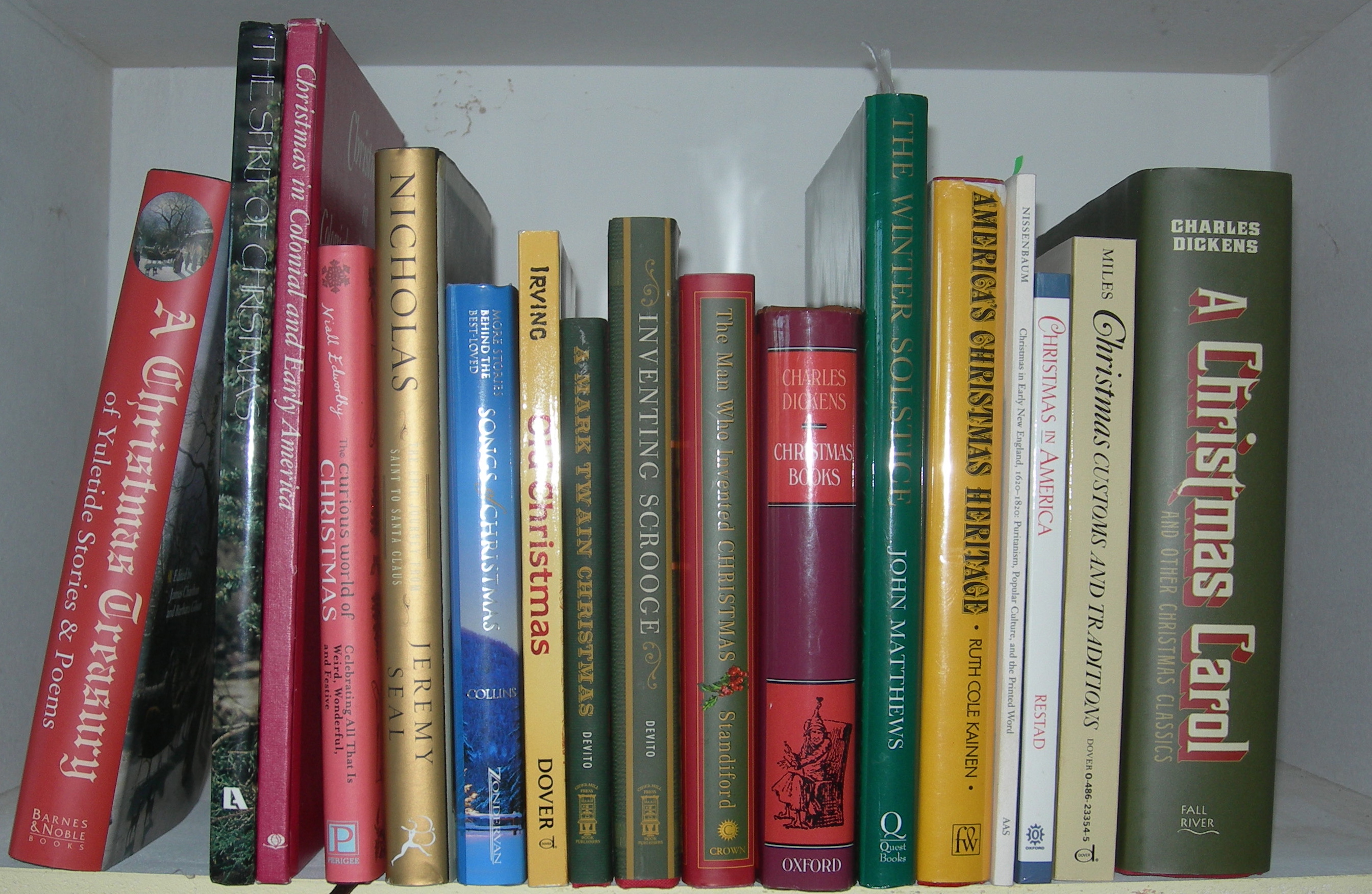 Here is the annotated booklist I promised you yesterday. You could also Google Christmas or old Christmas, or search either of those subjects on Amazon. I suggest you do. This is not a best list because there are too many books on Christmas for anyone to have read them all. This is simply a list of what I’ve discovered over the years, minus the clinkers. Some of these are easy to find, others will lead you through the back stacks of used bookstores, but there’s no harm in that.
A Christmas Carol by Dickens has to head any list. He also wrote many other Christmas works and gets his own post next Wednesday, the 23rd.
Washington Irving had a powerful influence on Christmas, which is largely forgotten today. Among his followers was Clement Moore of Night Before Christmas fame. They also get their own post, on Christmas Eve.
The rest of this list is in order from decorator froth to historical complexity.
Go to any bookstore and you will find dozens of Christmas cookbooks and books on Christmas decor, sometimes with historical tidbits. You’re on you own here, with one exception. The Spirit of Christmas series by Leisure Arts is classy, has been around since about 1990, and fills up ten pages of Amazon with choices.
Christmas in Colonial and Early America, 1975, by World Book, is an early, sepia toned version of this kind of book with a little more meat in it’s history.
For almost two decades, Ace Collins has been writing books titled Stories Behind . . . , beginning with Stories Behind the Best-loved Songs of Christmas. The title tells the tale; the individual stories are interesting and heart felt.
The Curious World of Christmas is lightweight and breezy, a book of short entries which can be digested one little bite at a time.
The only recent Christmas book I can’t recommend is Nicholas, by Jeremy Seal. I found it dark and tedious, and couldn’t get past page 42, but if you want a detailed look at how St. Nicholas became Santa, it’s the only work I know completely devoted to that subject.
The Man Who Invented Christmas by Les Standiford and Inventing Scrooge by Carlo De Vito each tell the story of the genesis of Charles Dickens’ most famous story. As a writer and a lover of Christmas, I couldn’t choose between them. Read the one that is easier for you to find. Then read the other one next Christmas.
A Mark Twain Christmas has been sitting on my next shelf for a couple of weeks. I will give it a tentative approval based on a thumb-through, and the fact that it is also by Carlo De Vito.
A Christmas Treasury of Yuletide Stories and Poems by Charlton and Gilson has works by every famous author you’ve ever heard of, from St. Matthew through The Adventure of the Blue Carbuncle.
Ruth Kainen’s America’s Christmas Heritage contains well written regional histories of Christmas at a level of detail that is satisfying without being overwhelming.
John Matthews’ The Winter Solstice has a look similar to the decorator/cookbook works above, but with a unique twist. It concentrates on the Roman, Celtic, and Germanic contribution to Christmas. It feels like the Middle Ages, without falling into the trap of New Age Gaia worship.
Christmas Customs and Traditions by Clement Miles is a Dover reprint of a 1912 work. It is an old fashioned history of the evolution of Christmas from Roman times to what was then the present.
Christmas in America by Penne Restad is a scholarly telling of the history of American Christmas. 172 pages of text, 36 pages of notes. You get the picture; a book for the overeducated Christmas nerd, but it is still a good read.
The remaining “recommendations” are probably over the top.
I have in front of me Christmas in Early New England, 1620-1820: Puritanism, Popular Culture, and the Printed Word by Stephen Nissenbaum, published by the American Antiquarian Society. I have already confessed to having two masters degrees, one in Social Science and one in History. This is the kind of thing I used to read for a living. I still read them, but only if they are on a subject that really interests me. Nissenbaum taught at Amhurst; you will find his original research referenced in many of the less scholarly books above. His book The Battle for Christmas was a Pulitzer Prize finalist, but a scholarly work of 400 pages is not something to take on casually. I confess to not owning it; I read it on interlibrary loan years ago. If, however, you are a Christmas nerd and a history buff, it is available in paperback. Go for it; what have you got to lose?
Now it’s your turn. Since blog posts hang around forever, any reply you make to add your Christmas recommendations will remain attached, even if I repost this next Christmas.
Because I intend to publish the novel from which this excerpt comes, Symphony Christmas will not be placed in Backfile.
Neil is reading papers written by his sixth grade class.
Lauren Turner wrote:
Every year we go to my granmas house for christmas. she has a great big living room where we all put our presents. I get presents from my mom and dad but nobody else gives them to me. I mean I get presents, but my brother always gets twice as many and they are always neater than mine and i don’t think its fair ! ! ! !
Oscar Teixeira wrote:
My Dad gets me chemistry sets and sport shirts and ties and last year he got me a calculator. What I really want is a baseball mitt and a football.
Stephanie Hagstrom’s paper was well written, in beautiful handwriting, and decorated with candy canes in all four corners. She detailed what presents she got last year, told how happy she was to have Christmas with her parents, and told what she expected to get this year.
Rosa Alvarez’s paper was not so well written, although it showed great progress for her. It said:
This year I don’t think we will have much of a Christmas because my Daddy has lost his job and Mommy’s job at the bank doesn’t give us much money. My Oldest brother has gone back to Mexico, but Daddy said that what money we have will go to buy toys fo the little kids. That’s OK, I don’t mind.
Neil lay back on his couch and wiped his eyes.
He remembered fellow teacher Carmen’s voice the first day they had looked at his students’ folders. Carmen had told him about Rosa. Then she had passed him Stephanie’s folder, and had said, “This is Rosa’s competition. She will take all your time if you let yourself be seduced by success. Stephanie will sound smart because she had mastered English; Rosa will sound stupid because she has not.
“The Stephanies of this world always get more than their fair share.”
He thought about them for a long time. He loved both girls, not merely in a vague way as he did all his students, but intensely and personally because they had both come early to his attention and he knew them well. Stephanie knew her own worth; her parents had taught it to her early. But Rosa was one of the meek ones. She desperately needed for someone to hold her, and tell her she was good and pure and valuable. continued

Welcome to my favorite season.
But first, a word from our sponsor. My upcoming novel Cyan has been delayed. It will be out in April or May, not in January as originally announced. Because of this, about a dozen Cyan related posts had to be replaced with new, season appropriate material. All that is done now, and things are back to calm.
*****
When I was a child, I enjoyed Christmas without having the full joy of it. That came later, with marriage to the right person. On our first Christmas together, we decorated the tree on my early December birthday, and that tradition has continued unbroken since.
The season of our second Christmas the musical Scrooge came to theaters. Even though I had no VCR, I bought the tape while I had the chance. Who knew it would be around forever.
Seeing Scrooge led to reading A Christmas Carol, and that led to reading the four other Christmas stories Dickens wrote in subsequent years.
I was vaguely aware that our Christmas was an amalgam of Christian and pagan practices and, being historically minded, I sought out the details. That led me through a forest of books, which I will share tomorrow.
*****
One of the difficulties of being an underpubished writer is all the novels bubbling in your head that you fear will never come to be written. One of these is a novel of lives lost and reclaimed in and around Philadelphia in 1789, set during the Christmas season and giving a picture of Christmas before Santa was invented. As an early Christmas present this year I gave myself permission to write the Christmas Eve chapter of that unwritten novel and present it here. Unfortunately, time came too short. Maybe next year.
Instead I am presenting the Christmas section of a completed novel Symphony in a Minor Key. It tells the story of Neil McCrae, a teacher, during the Christmas season of 1989. Symphony in a complex novel, and the excerpt given only touches on surface events. Nevertheless, Neil and his girlfriend Carmen are nice people, and I think you will enjoy spending the holidays with them. Pop on over to Serial where the story starts today and runs through Christmas day.
This is from the novel Symphony in a Minor Key, a complex book with a number of intertwined story strands. This excerpt describes the experiences of Neil McCrae, a teacher, during Christmas 1989, leaving out a good deal of material you would have to read the whole novel to follow. I particularly like this piece because it is not a story. It doesn’t have a beginning, middle, and end, and everything is not wrapped up in a shiny Christmas bow at finis.
Symphony Christmas
Because I intend to publish the novel from which this excerpt comes, Symphony Christmas will not be placed in Backfile.
On the day appointed for Neil’s evaluation, the principal came earlier than Neil had expected and sat down before the tardy bell had rung. The more mature students tried to look at him without seeming to do so. The others just stared. Neil rapped the desk for attention and took roll. Then he said, “I had intended to tell you today that Mr. Campbell would be coming by for evaluations, but he has gotten here sooner than I had expected. How many of you have been through these teacher evaluations before?”
Probably all of them had; a third of them remembered it well enough to raise their hands.
“Who can tell me what their previous teacher told them at evaluation time?”
Tony Caraveli thought he could remember. Neil distrusted the devilish look in his eye, but told him to go ahead.
“Make me look good!” Tony said.
The children all laughed, but it had a nervous and restrained sound. Bill Campbell did not react, which made them more nervous. Neil said, “Whoever told you that was probably joking. Who else can tell me?”
Sabrina said, “Ms. Thompson told us to just be ourselves and act like there wasn’t anyone in the room.”
“Good. That is just what I want you to do. Ignore Mr. Campbell; it won’t hurt his feelings.”
This time the children’s laughter was more relaxed, and Bill acknowledged it with a wave of his hand.
Neil read to his class for twenty minutes from The House Without a Christmas Tree. He led a discussion about the story, and from that drew the children into talking about how their families celebrated the season. Neil made notes from their discussion on the chalkboard, then told them to write a paper on Christmas in their homes.
Neil’s lesson plan had been worthwhile but unexceptional. He had not intended for it to be earth shaking, but when he sat at home that night reading the papers, he found that he had cut close to the bone.
Casey Kruger wrote:
We don’t hav Christmas at our house. My parents say that it is a peagan rittul. Jesus was born in a stabul and din’t have any presents, so we don’t have any present either. I wish we did.
I would really like to have a real Christmas this year. continued
 A Writing Life