Author Archives: sydlogsdon

70. The War is Over

240px-Wildfire_near_Cedar_Fort,_Utah Every era has its terrors. Throughout my childhood in the fifties I was deeply aware of the likelihood of nuclear war. I was fifteen during the Cuban missle crisis. When I went to college, Viet Nam was well underway.

As I mention today in Serial, I tried my hand at folk music. I even wrote a song, which no one has heard for the last 45 years. I wish I could call it the melancholy thoughts of youth but, sadly, it’s still spot on.

The War is Over
Syd Logsdon

Now that the last war is over
Now that the violence is done
Search through the rubble for mourners
You will find — not a one.

Now that the green grass is dying
Now that the trees are stripped bare
The sounds of the forest are silent
The brooks have no laughter to spare.

The moon still hangs sad and silent
The stars fill the heavens with light
The sea rolls so dark and so lonely
Over cities where ruins now lie.

Look for your friends in the mountains
Or your enemy’s spoor on the plain
Run through the corridor shelters
Seek a companion in vain.

Cry out your soul for a songbird
But none will answer your call
Search for your friends and your loved ones
But they’re gone — one and all.

Search for the one called the victor
Through the still smoking rubble and ruin
Now that the violence is over
Now that the war has been won.

Innisfree

hiatusYeats is one of the great poets of the English language and The Lake Isle of Innisfree is among his best known poems. I was introduced to it through folk music.

I arrived at college just at the end of the folk era. It had basically passed me by in my country-western Oklahoma life, and I was hooked as soon as I discovered it. One of my roommates had been in a high school folk group in Minnesota. He quickly found a girlfriend who could sing (beautifully) and a fellow guitarist, and started playing in the local coffee houses. I borrowed his tenor guitar to learn on, then got a six string, and I was just getting reasonably good when folk music disappeared overnight and psychedelic rock became the rage. Timing was never my strong suit.

My roommates and I were always short on cash, so we shared our stash of records. One of my favorites was Hamilton Camp’s Paths of Victory, but it went with my roommate when college was over. Camp took Yeat’s Innisfree and wrote music for it, and a sweeter song was never sung – at least until Judy Collins sang it a cappella to his music a year later.

This is one of the two or three songs I catch myself singing whenever I am alone and can harm no one. Chances are you already know the poem, but I suggest that you Google judy collins innisfree and hear it sung on U-tube. Or, if you are old enough to enjoy an early Dylan sound-alike, Google hamilton camp innisfree.

  It isn’t hard to find. Clearly, I’m not the only one who loves it.

The Lake Isle of Innisfree – William Butler Yeats – 1892

I will arise and go now, and go to Innisfree,
And a small cabin build there, of clay and wattles made;
Nine bean-rows will I have there, a hive for the honey-bee,
And live alone in the bee-loud glade.

And I shall have some peace there, for peace comes dropping slow,
Dropping from the veils of the morning to where the cricket sings;
There midnight’s all a glimmer, and noon a purple glow,
And evening full of the linnet’s wings.

I will arise and go now, for always night and day
I hear lake water lapping with low sounds by the shore;
While I stand on the roadway, or on the pavements grey,
I hear it in the deep heart’s core.

*****

During this last week of the year, I’m taking a hiatus, sort of, by placing some of my favorite poems instead of things I have written. My fantasy short story Prince of Exile will begin here the first full week of next year.

69. Site Tour

IF YOU HAVE ONLY BEEN DIPPING INTO THIS WEBSITE, THIS WILL SHOW YOU HOW TO ACCESS SOME THINGS YOU MIGHT HAVE MISSED

But first, an announcement. My upcoming novel Cyan has been delayed. It will be out in April or May, not in January as originally promised.

This has left me scrambling. About a dozen Cyan related posts which were scheduled for December and January had to be replaced with new, seasonally appropriate material. All that is done now, and things have calmed down.

So now —– welcome to the five cent tour.

This is post sixty-nine in the blog A Writing Life. The site is also called A Writing Life, which may cause some confusion. Since this is my first website, I learned as I went and not all my early decisions were the best.

This site has been up since August 31, with an arrival page called Welcome to my Worlds and two separate but related blogs. That was an early choice I have never regretted, although I’m sure some should-have-been followers have clicked in at the arrival page and never found either blog. No plan is perfect.

I had a backlog of material which I wanted to present in serial form, so my second blog was called Serial. There is another blogger’s rule: simple and straight forward is good; cute, clever, and confusing is bad.

As of today, there have been eighty-eight posts under Serial. So far I have presented a previously published science fiction novella (To Go Not Gently), a science fiction short story (Into the Storm), a vignette (Koan), two fantasy short stories (Blondel of Arden and The Best of Lies), a non-fiction piece (How to Build a Culture) and an excerpt from a contemporary novel (Symphony Christmas).

All of the above have been removed from Serial; otherwise, the slide from latest post to earliest post would take endless minutes. There will be one more fantasy short story, Prince of Exile, beginning next week, then Serial will morph into something different. Check it out in mid-January.

Except for Symphony Christmas, all the pieces removed from Serial have been moved to Backfile. They can be found on the Backfile drop-down menu, along with two other pieces that were never placed in Serial. They have all been returned to first-to-last order, but the original blog divisions have been retained as virtual chapters to make navigation easier.

If you actually click on Backfile, you will find a page with an annotated list of its final contents, divided into Fiction, Non-fiction, and Poetry. Clicking on a live poem will take you to the A Writing Life blog where it appeared. The other poems entries will be made live as they appear in posts. Five will be activated during December.

Library is an annotated list of my novels. About and Contact are just what you would expect them to be.

Wander around and enjoy yourself.

Channel Firing

hiatusThis poem by Thomas Hardy was written in April of 1914,
fourteen years after Tagore, which I will give you in two days.
Two months later, World War I began.

         Channel Firing

That night your great guns, unawares,
Shook all our coffins as we lay,
And broke the chancel window-squares,
We thought it was the Judgment-day

And sat upright.  While drearisome
Arose the howl of wakened hounds:
The mouse let fall the altar-crumb,
The worms drew back into the mounds,

The glebe cow drooled.  Till God called, “No;
It’s gunnery practice out at sea
Just as before you went below;
The world is as it used to be:

“All nations striving strong to make
Red war yet redder.  Mad as hatters
They do no more for Christés sake
Than you who are helpless in such matters.

“That this is not the judgment-hour
For some of them’s a blessed thing,
For if it were they’d have to scour
Hell’s floor for so much threatening . . .

“Ha, ha.  It will be warmer when
I blow the trumpet (if indeed
I ever do; for you are men,
And rest eternal sorely need).”

So down we lay again.  “I wonder,
Will the world ever saner be,”
Said one, “than when He sent us under
In our indifferent century!”

And many a skeleton shook his head.
“Instead of preaching forty year,”
My neighbour Parson Thirdly said,
“I wish I had stuck to pipes and beer.”

Again the guns disturbed the hour,
Roaring their readiness to avenge,
As far inland as Stourton Tower,
And Camelot, and starlit Stonehenge.

During this last week of the year, I’m taking a hiatus, sort of, by placing some of my favorite poems instead of thing I have written. The fantasy short story Prince of Exile will begin here the first full week of next year.

Filler

This week there will be posts Tuesday through Friday, to allow me to post on New Year’s Eve and Day.

Today, and during the rest of this last week of the year, I’m taking a hiatus, sort of, on the companion blog Serial by placing some of my favorite works by others. My fantasy short story Prince of Exile will begin there on Monday, Jan. 4th.

The First Surveyor

hiatusDuring this last week of the year, I’m taking a hiatus, sort of, by placing some of my favorite poems instead of things I have written. My fantasy short story Prince of Exile will begin here the first full week of next year.

A. B. Paterson, Australian poet, is often called Banjo Paterson because he signed his poetry with a picture of a banjo during his early days as a newspaper writer. Australian egalitarianism carries with it overtones of hidden conflict, between urban and outback, between privileged and unprivileged, and between pioneers and the late comers who often, as in this poem, had no understanding of the ones who came before them.

The First Surveyor

“The opening of the railway line! — the Governor and all!
With flags and banners down the street, a banquet and a ball.
Hark to ’em at the station now! They’re raising cheer on cheer!
‘The man who brought the railway through — our friend the engineer.’
They cheer his pluck and enterprise and engineering skill!
‘Twas my old husband found the pass behind that big red hill.
Before the engineer was born we’d settled with our stock
Behind that great big mountain chain, a line of range and rock —
A line that kept us starving there in weary weeks of drought,
With ne’er a track across the range to let the cattle out.

“‘Twas then, with horses starved and weak and scarcely fit to crawl,
My husband went to find a way across the rocky wall.
He vanished in the wilderness — God knows where he was gone —
He hunted till his food gave out, but still he battled on.
His horses strayed (’twas well they did), they made towards the grass,
And down behind that big red hill they found an easy pass.

He followed up and blazed the trees, to show the safest track,
Then drew his belt another hole and turned and started back.
His horses died — just one pulled through with nothing much to spare;
God bless the beast that brought him home, the old white Arab mare!
We drove the cattle through the hills, along the new-found way,
And this was our first camping-ground — just where I live today.

“Then others came across the range and built the township here,
And then there came the railway line and this young engineer;
He drove about with tents and traps, a cook to cook his meals,
A bath to wash himself at night, a chain-man at his heels.
And that was all the pluck and skill for which he’s cheered and praised,
For after all he took the track, the same my husband blazed!

“My poor old husband, dead and gone with never a feast nor cheer;
He’s buried by the railway line! — I wonder can he hear
When by the very track he marked, and close to where he’s laid,
The cattle trains go roaring down the one-in-thirty grade.
I wonder does he hear them pass, and can he see the sight
When, whistling shrill, the fast express goes flaming by at night.

“I think ‘twould comfort him to know there’s someone left to care;
I’ll take some things this very night and hold a banquet there —
The hard old fare we’ve often shared together, him and me,
Some damper and a bite of beef, a pannikin of tea:
We’ll do without the bands and flags, the speeches and the fuss,
We know who ought to get the cheers — and that’s enough for us.

“What’s that? They wish that I’d come down — the oldest settler here!
Present me to the Governor and that young engineer!
Well, just you tell his Excellence, and put the thing polite,
I’m sorry, but I can’t come down — I’m dining out tonight!”

68. Nostalgia

Dec 25thAs a sort of disclaimer, let me assure you that Christmas Day, and the season that precedes it, is my favorite time of the year. I love everything about it, but that doesn’t keep me from also seeing it slantwise.

“It’s coming on Christmas, they’re cutting down trees . . .” It seems to be a sad and bitter beginning, but Joni Mitchell’s River is all about nostalgia, and so is American Christmas in the twenty-first century.

This goes deeper than surface appearances. The obvious nostalgia is for rural life and all its simplicities – clean snow, red barns, white farmhouses and a one horse open sleigh. In reality, there is nothing nostalgic about walking to the barn in the pre-dawn darkness to face three hours of chores at five below zero. Never mind; when I see that perfect scene on a Christmas card, I want to be there. Childhood memories of frozen feet don’t stand in the way.

Christmas literature today has come to mean movies. I know that there are new Christmas books every year, but they all seem to fall into a soupy genre I can’t bring myself to read.

Among movies, the original is A Christmas Carol, in all its iterations. It stands alone, a whole genre all by itself, and there is no nostalgia in it. No one wants to go back to the age of “prisons, and Union workhouses”, cold, hunger, and early death. Instead, the story is about the change in Scrooge as he considers the horrors faced by those around him, many of which are his own fault. The horrors don’t go away, except for the few people Scrooge can help, but Scrooge himself is redeemed.

Recently, there have been a spate of TV movies all asking, “will the girl get the guy by Christmas”? I leave them with that soupy genre of books, readily available for those who can stomach them, after pointing out that they have nothing to do with Christmas.

The rest of Christmas movies fall into one category, with one masterplot. They range from silly to profound, but they all have this in common: Santa is accused of assault, or loses his memory, or decides that he doen’t want to be Santa any more, or Santa Jr. doesn’t want to take over for Santa Sr..

Santa, and/or those around him, are on the verge of losing faith, but they are saved at the last minute by _______. Choose a crisis and a salvation, and write you own screenplay.

Don’t get me wrong. I love these films; I watch them all season. They have to be really bad for me to turn one off. But what is the one thing are all these movies nostalgic about? Faith, of course, which so many people today are clinging to by their fingernails.

If Santa stands in for Jesus – and even those who wish he didn’t, know that he does – then every time Santa once again proves himself to be real, that version of Christianity which proposes a warm, loving, all seeing, yet forgiving God is reaffirmed.

Those who are afraid to doubt out loud can sit back and let Santa, acting as a stand-in, reaffirm their faith.

I’ll buy in. For another Christmas season I will set aside my unbelief and bask in the feeling that someone out there will make all things come right.

Now get out from in front of the television; Miracle on 34th Street will be on in twenty minutes.

Symphony Christmas, 10 of 10

Because I intend to publish the novel from which this excerpt comes, Symphony Christmas will not be placed in Backfile.

Neil and Carmen are delivering a present to Rosa at her apartment.

Rosa’s little sisters were staring at Neil, wide eyed and unabashed. He shifted nervously from one foot to the other, painfully aware of the brightly wrapped package under his arm. The Alvarez’s were nice people; he could deal with them in a school setting where formality gave a pattern for their interaction. Here, he did not know what to do.

Language was not the problem; Carmen could translate. The problem was culture. Should he sit down? Should he expect a cup of coffee? If they offered him one, would they expect him to take it or to refuse? Would they be insulted if he refused? Should he treat Carmen as an equal, or take charge of the conversation? Should he come right to the heart of the business and give the gift, or would it be more proper to talk a while first? If he were in the home of any of his Anglo kids, no matter how rich or poor, he would not have been so much at a loss.

Carmen sensed his discomfort and took charge. She spoke to Mrs. Alvarez in Spanish. Although Rosa’s mother spoke fair English, she was more comfortable in Spanish, and it let Jose share in the conversation. Then Carmen said, “Give her the package.”

Neil held out the package to Rosa and said, “Merry Christmas.” For the first time, Rosa and her parents allowed themselves to become aware of its existence. Before that moment, only the younger children had stared at it.

Rosa held it in her hands for a long time, admiring the paper. “Its really pretty,” she said.  Neil wondered if she would open it now or at Christmas, but he had no way of asking without appearing pushy.

Then Carmen said, “Go on, Rosa. Open it.” Rosa tore off the paper, pulled open the box, and extracted the jacket. Her face was full of hesitation. She loved it, but she wasn’t quite sure it was really hers until Neil said, “Go ahead, see if it fits.”

Rosa spoke to her mother – asking permission? – before she slipped it on. Her face lit up as she smoothed the fabric around her. Then she had to ask; she had to be sure. She said, “Is it for me?”

“It’s yours,” Neil assured her. He started to add that Carmen had picked it out, but his good sense stopped him. It would detract from the moment, so he remained silent while she showed it to her parents. Rosa’s father crossed to Neil and shook his hand again, mumbling something in Spanish of which Neil only caught, “Gracias.”

Rosa’s mother said, “It is really nice, but you shouldn’t have.”

Neil looked at Rosa’s beaming face and said, “I wanted to.”

Things had gone well so far; it was time to retreat before he said something clumsy to ruin everything. Neil made a tiny motion toward the door and Carmen spoke to the Alvarez’s in Spanish one more time, then took Neil’s elbow and eased him toward the door as the conversation bounced back and forth between her and Rosa’s mother.

Rosa and her mother followed them out onto the stoop, then Rosa made a quick, shy motion forward and threw her arms around Neil’s waist for a moment. She said, “Thank you, Mr. McCrae.”

Her heart was in every word and her voice made it a song.

Neil and Carmen drove away in silence. Neil was not a man to accept gratitude easily; it made him uncomfortable, and out of his discomfort he said, “Giving her a jacket won’t change her life.”

Carmen was beginning to understand him. She recognized the source of his uneasiness. She replied, “Giving her a jacket won’t change her life, but knowing that you cared for her might.”    finis

67. ‘Twas the Night . . .

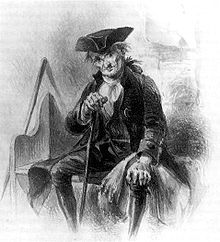
220px-Diedrich_Knickerbocker

Everybody reads Washington Irving in college because he is IMPORTANT. Almost nobody reads him afterward for pleasure. Sleepy Hollow and Rip Van Winkle live in our racial memory, but nobody actually reads the stories.

I tried to read Knickerbocker’s History of New York and liked it as far as I got. However it was a satire disguised as a history, so I couldn’t enjoy it as fiction and I couldn’t trust it as history. My pleasure died of whiplash.

What does this have to do with Christmas? A great deal, actually. In his “history”, Irving included a dream in which

St. Nicholas came riding over the tops of the trees, in that self-same wagon wherein he brings his yearly presents to children

This is apparently the first introduction into American society of Sinterklass, the Dutch version of St. Nicholas from which our Santa comes. Others took up the banner. We will look at them below, but first let’s see what else Washington Irving did for Christmas.

In 1815, Irving moved to England, and five years later published his Sketch Book. Five of the chapters from that work, frequently published separately today as Old Christmas, extolled the nostalgic joys of the old, rural Christmas traditions of England. Widely read in the United States, it was instrumental in giving Christmas respectability at a time when it was reviled by the religious establishment and degenerating into drunken rowdyism among the working classes. 

Irving was a prominent member of the Knickerbockers, a conservative group opposed to the rise of the mob – that which most of us call democracy. They were particularly horrified by the excesses and vandalism of Christmas as it was practiced at that time. They worked to move the center of celebration from the street to the home.

In 1809, Irving published his History on St. Nicholas’ day. In 1810, the Knickerbockers released a broadside extolling St. Nicholas for his bringing of presents to good little girls and boys – and punishment to the rest. A poem about him appeared that same year. I won’t inflict all of it on you, but the last two lines tell you enough.

From naughty behavior we’ll always refrain,
In hope that you’ll come and reward us again.

Twelve years later another poem called the Children’s Friend was published, with “Santeclaus driving his reindeer o’er chimneytops” and giving gifts to the good little children, but still leaving a switch for the parents to use on the rest.

There is little question that Clement Moore, a Knickerbocker since 1813, knew Knickerbocker’s History, Old Christmas, and both poems when he wrote a poem of his own combining all the happy elements and leaving out the preaching and punishment.

A Visit from St. Nicholas, which we usually call ‘Twas the Night Before Christmas, was the result. Ironically, a group of grumpy, nostalgic elitists who loved order and discipline and hated democracy, eventually gave us a poem which would enthrall children for the next two hundred years.

*     *     *

The poem Children’s Friend is just good enough to be amusing rather than repulsive. You can see a facsimile of an original copy at http://pastispresent.org/2009/good-sources/christmas-treasures-flip-through-the-pages-of-the-children%E2%80%99s-friend/ .

Here it is in plain type. I would be surprised if you like it, but it may give you a greater appreciation of what Clement Moore made of the same materials.

Children’s Friend

Old Santeclaus with much delight
His reindeer drives this frosty night.
O’er chimneytops, and tracks of snow,
To bring his yearly gifts to you.

A steady friend of virtuous youth,
The friend of duty, and of truth,
Each Christmas eve he joys to come
Where love and peace have made their home.

Through many houses he had been,
And various beds and stockings seen,
Some, white as snow, and neatly mended,
Others, that seem’d for pigs intended.

Where e’er I found good girls or boys,
That hated quarrels, strife and noise,
I left an apple, or a tart,
Or wooden gun, or painted cart;

To some I gave a pretty doll,
To some a peg-top, or a ball;
No crackers, cannons, squibs, or rockets,
To blow their eyes up, or their pockets.

No drums to stun their Mother’s ear,
Nor swords to make their sisters fear;
But pretty books to store their mind
With knowledge of each various kind.

But where I found the children naughty,
In manners rude, in temper haughty,
Thankless to parents, liars, swearers,
Boxers, or cheats, or base tale-bearers,

I left a long, black, birchen rod,
Such as the dread command of God
Directs a Parent’s hand to use
When virtue’s path his sons refuse.

Yeah, me too! Same as you, I’ll stick with The Night Before Christmas.

 

Symphony Christmas, 9 of 10

Because I intend to publish the novel from which this excerpt comes, Symphony Christmas will not be placed in Backfile.

Carmen has asked Neil why he hesitates to give the jacket he has purchased directly to Rosa.

He shrugged.

“Have you been out at the apartments?”

“I drive by them every day, but I’ve never been in one of them.”

“Why not?”

“I’ve never had reason to go. I’ve never been in one of my rich kids’ homes, either.”

“Don’t you want to see how they live?”

“Yes,” Neil admitted, “I really do, but I don’t want to look like big bwana coming in to look at the native village.”

Carmen shook her head in mild dismay. “Neil,” she said, “I think you’re more ashamed of their poverty than they are.”

*****

Christmas inched closer. The children were ready for vacation and their attention wandered at any excuse. Juan Rogers went back to Mexico for the winter, and Joaquin Velasquez followed three days later. Attendance had never been great at Kiernan; by the week before Christmas, it was not uncommon for one fourth of the students to be gone on any given day. Neil preached the values of school attendance and all but tore his hair out in frustration; it did no good.

The children’s minds went on vacation a week before their bodies were allowed to follow.

*****

Carmen drove by to pick Neil up at six. His own car was packed to drive to Oregon in the morning, so he tossed the colorfully wrapped present into her back seat and they went out to dinner. Afterward, she drove him out to the Oaks Apartments.

The scene was forlorn. Neil had seen this place twice each day as he drove to and from work, but he had never turned in. Two sycamores, a giant and its still considerable smaller brother, grew in the courtyard between facing rows of small apartments. The structures were of concrete block, two stories high with an open walkway at the upper level. There were four apartments on each side in each level; sixteen in all. It looked as if it had been a motel some time in its early history. The grass was still green and trimmed, even at Christmas time. The ragged palms out front were immune to the changing seasons, but the sycamores were bare.

Someone had wrapped the swing set in tinsel garland, and there were decorations in some of the windows. No children played outside so late on a winter evening.

When Neil got out of the car, he could see his breath. It was in the forties, which was about as cold as Modesto got. It would seem mild to an easterner, but to a little girl without a jacket, it would be just plain cold. Neil reached into the back seat and picked up the package. Carmen led the way without hesitation; she knew most of the families here.

The door opened to her knock, and Maria Alvarez appeared. She spoke with Carmen in fluid, rapid Spanish, then drew the door open and motioned them in. Neil stepped into the living room and looked around. Jose Alvarez was a slim, dark man in jeans and an undershirt. He got up swiftly and shyly from his place in front of the television and looked at his wife, who said something to him in Spanish. Neil could only understand a few words. Jose offered a brief, limp handshake, yelled, “Rosa!”, and spoke sharply to his younger daughter, who quickly turned down the volume on the TV.

Rosa came out of the kitchen dressed in ragged jeans and a faded sweat shirt. Her face lighted at the sight of Neil and Carmen, then fell instantly. Was she embarrassed by her house or her parents? Neil could not read her. Wherever it came from, the expression was chased away a moment later by shy happiness. Rosa took her mother by the elbow and spoke rapidly, gesturing toward Neil. Her mother nodded vigorously and smiled at Neil again. She took his hand in a longer handshake and said, “Gracias. Thank you. Rosa says you are helping her get better every day with her English. We know how important that is.”    continued