Author Archives: sydlogsdon

Symphony 71

Neil ended up having a great time. Mrs. de la Vega was past the worst of her illness and her zest for life had returned. She waited until Carmen had gone out, then got up and cooked Neil a delicious Mexican meal, ignoring his protests, and carrying on a one sided conversation in Spanish. Only their gestures and laughter were bilingual.

Carmen chewed him out royally for letting her mother out of bed. Neil said, “How was I to stop her?” Carmen had to admit that it would have been impossible.

Several days later, Carmen came in to see his can tree. She had only just heard of it from Delores. She said, “Why didn’t you tell me what you were doing? I would have been glad to help.”

“I really didn’t do that much,” Neil explained. “Stephanie Hagstrom and her mother were the force behind it, and Delores agreed to do the distribution for us.”

“How did you ever get it started? I’ve tried to get my seventh graders to have some social conscience all year, and I’ve gotten nowhere.”

Neil explained about the candy trick. She said, “Good. Good. We need more of that kind of thing.” Then she gave him a dazzling smile, looked around to see that no students were near, and gave him a quick kiss.

“”What was that for? Not that I’m complaining.”

“That, Neil McCrae, is because you are a nice guy.”

“It took you long enough to notice.”

Her gaiety went away. Neil said, “What’s wrong?”

“Nothing. I don’t want to talk about it.”

“Are you sure?”

She nodded. “Someday I will,” she promised, “but not just now.”

They left together in Carmen’s car because they had a date to do some Christmas shopping at the mall. Neil had to get gifts for his mother and grandfather because this year school was running all the way to the twenty-third. He would have a day to drive to Oregon and no time to shop once he got there.

While they were walking through J. C. Penney’s, Neil said, “You know Rosa Alvarez?”

“Sure.”

“If you had to, could you pick out clothes that would fit her?”

“I guess so. Why?”

“She’s kind of chubby.”

“I know what she looks like. Why did you ask if I could pick out clothes for her?”

“Do you think her parents would mind if I bought her a jacket? She has been coming to school without one and it is really getting cold in the mornings.”

“I’m sure they wouldn’t mind, Neil. I could let them know so they won’t buy her one for Christmas, if they had planned to. When did you decide to do this?”

Neil shrugged, feeling embarrassed for no good reason. “I don’t know, she just looks so miserable every morning. She always heads for my room to warm up.”

Carmen smiled. “She doesn’t come there just to warm up. You have a fan club.”

That embarrassed Neil even more and Carmen laughed again.

Carmen bought the jacket for him. It was nothing Neil would have chosen, but she assured him it was stylish as well as warm.  He bought lesser presents for a dozen of his other students whose parents were poor. Carmen said, “Can you afford all this?”

“The only other people I have to buy for are my mother and grandfather.”

“And me!”

“Well, that goes without saying.”

“Say it anyway.”

He faced her suddenly and drew her back between some racks of clothing. His face was serious as he said, “Carmen, you are very precious to me. If I haven’t said it before, I’m saying it now.”

“Wow!” She put her hand on his chest and kissed him quickly. Then she pulled away and said, “People are looking. I don’t want the kids to catch us necking behind the lingerie.” more Monday
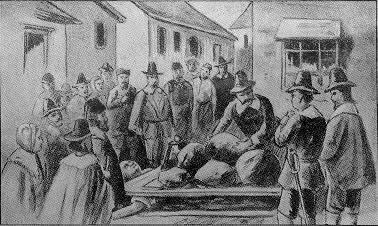
453. More Weight: Arthur Miller’s Crucible

About a month ago in a post I mentioned Arthur Miller’s The Crucible. Sometimes a passing reference like that can bring old thoughts and feelings to the surface, and send me back for a closer look.

I encountered The Crucible in the winter of 1966. Yes, they had printed books that far back. I was in my first quarter at college, writing what was probably my first college paper, “The Evil of Innocence.” My take was that evil came from the girls’ testimonies despite their essential innocence. I offer no apologies for lack of sophistication; everybody has to start somewhere.

For Arthur Miller, The Crucible was about the McCarthy hearings before the House Committee on Unamerican Activities. I remember those days only vaguely, since I was less than ten years old. What I actually remember is going to a public meeting with my parents at my grade school where our principal read from J. Edgar Hoover’s Masters of Deceit: The Story of Communism in America and How to Fight It, and gave a talk on how communism was a danger, even in our little town of 121 people.

The adults in my life were author to many nightmares.

I met Arthur Miller’s The Crucible about a decade later than I met J. Edgar, and I didn’t react to the McCarthyism allegory. I didn’t respond strongly to the characters either, except for Giles Corey calling for “More weight!” as they crushed him under stones. John Proctor left me unmoved and the various girls were merely victims. I cut them a lot of slack, for reasons you’ll understand in a moment.

In short, I didn’t react to the words on the page, but to the implications that exploded in my mind as I read them. That happens sometimes.

I had turned atheist just before my sixteenth birthday, and had told no one. I was enmeshed in a Baptist family in a Baptist town in the Baptist State of Oklahoma in the middle of the Bible Belt. I kept my head down and my mouth shut and told no one until I reached college two and a half years later.

So, when I read The Crucible I was a recent escapee from my own personal Salem. For me the main protagonist was not a man, woman, or girl, but Salem itself, seen as a massive, encircling, inescapable miasma of religious intolerance, hovering ready to strike down any who disagreed with its particular version of Christianity.

That isn’t good history. It isn’t even a full reading of The Crucible, but it was the story as I read it. No surprise, really.

Today, being a reasonably honest scholar, I went to Goodreads to see how others had reacted to The Crucible and got an earful. About half reacted to the McCarthyism allegory and gave high marks. About half gave three stars for skillful writing, then trashed The Crucible for its sexism. To be more precise, they trashed Arthur Miller for making his males into characters and his females into cyphers.

It kind of makes you wonder: did Miller write a sexist Crucible to reflect the era of the actual witchcraft trials, or because he was a grown man in the fifties and it seemed normal?

Perhaps there is one thing we can learn about great literature, which The Crucible is no matter how unpalatable it may seem to some of today’s readers. It has many messages, for many people, in many ages, and not all of them were necessarily clear in the mind of the writer. Miller saw McCarthyism. I saw the danger of being different in a small community. Goodreads is full of reviews from readers who can’t get past its sexism.

Maybe we can all agree that Giles Corey was a hero and John Proctor was a weasel?

Symphony 70

“Anne Marie Chang has been teaching and researching reading for twenty-five years. She knows what she is talking about.”

“Maybe for some kids. Maybe for some schools, but not this one. Half of my kids can’t read, and that has to take priority over some half-baked ideas about cultural literacy. When I first started here I had all the kids at one level and half of them were miserable, frustrated, and unable to succeed. I gave them materials at their level, and they started reading. That’s the bottom line.”

“That’s your bottom line. The state’s bottom line is that leveling labels children, and those labels become so embedded in their thinking that they can never succeed.”

“Anne Marie Chang was labeled and it didn’t stop her from succeeding. Kids know what they are. If you put non-readers with readers, they just get their noses rubbed in their own inabilities.”

It was an old argument, and they didn’t resolve it; but when reason cannot solve a problem, force does. Bill told Neil he had to change his methods.

“Fine,” Neil replied. “Show me something that works and I will change to it.”

They parted on that unsatisfactory note, and two days later Neil found another note in his mailbox. This one said, “I have enrolled you in a cooperative learning seminar being put on by the county board of education on Monday. It is the only alternative to leveling anyone has been able to find. Go to the seminar, and then make it work in your classroom. I will evaluate you again in two weeks.”

Neil discussed the matter with Carmen, but neither of them could see any way out of the impasse. There were things to be said for both sides of the argument. And frankly, it did not interest them much. They both had experience enough to know that any theory is only a partial solution at best. This one was being forced upon them, so they would ride with the tide until it reversed, as tides and theories always do.

Neil continued teaching in leveled groups, hoping to get in a few more weeks of effective instruction. Meanwhile, he had more interesting and valuable things on his mind. The morning after his candy trick, Stephanie had come to him with a proposition. Her church collected cans for the needy every Christmas. She thought their class should do the same thing.

Neil thought it was a wonderful idea. He called Mrs. Hagstrom and discussed it with her to make sure that the parents would not have any objection. The biggest problem Stephanie’s project presented was identifying the needy in the community and getting food to them without putting them in the spotlight. Fortunately, Delores Zavala had lived in the district all her life and knew every adult, child, car, cat, dog, and everyone’s financial condition. She proved invaluable and Stephanie turned out to be an eleven year old dynamo. Within three days she had organized all her friends, and their friends, and their friends.  That meant every child in the sixth grade. Two weeks after the idea was born, there was a seven foot stack of canned goods in the corner of Neil’s classroom.

# # #

December was a busy month for them all, but particularly for Carmen whose mother became ill and began to take all her spare time. After two weeks Carmen was looking tired and complaining that she wasn’t getting any Christmas shopping done. Neil offered to sit with her mother to give her an evening off. Carmen accepted and Neil found, to his surprise, that Maria de la Vega spoke no English. Carmen had been so much at ease in her job, and so confident in the world she shared with him, that he had assumed her family was educated and English speaking. more tomorrow

Symphony 69

(Continuing Stephanie’s response.)

But sometimes I guess they don’t have much choice. Like if they have lost their jobs and they don’t have much money. I think it would be sad to live like that and I am glad my Daddy has a good job so we can live in a nice house and have nice things.

Your class made me see what it would be like to not have anything and to see other people get things. I wouldn’t like that, but I guess I needed to see it, so thank you Mr. McCrae for showing me.

Rosa had written:

We used to have a lot at Christmas until my daddy lost his job, but we are still luky I guess cause we have more than some other poeple have  We hav plenty to eat even if it is beans alot of the time. I like beans anyway  and if I don’t get nothing for chirismas this year thats alright because I got a lot last year.

It would be easy, Neil thought, to see Stephanie as spoiled and Rosa as some kind of angel, but that wasn’t so. They were both just sweet eleven year old girls who hadn’t had much experience in the world. Giving them some of that experience was Neil’s job.

# # #

Bill Campbell showed up for a surprise evaluation on Monday the fifth. He came in as the tardy bell was ringing and said, “I want to see the children read. If this isn’t the hour you have it scheduled, tell me and I will come back, but I want to see it today.”

Neil said, “I normally read to them for about ten minutes and then they read.”

Campbell sat down at the back of the class and waited, clipboard in hand.

Neil went ahead with the morning’s work. He read to them for ten minutes, then told them to get out their reading books. They took them and moved with no further command to separate areas of the room.

Bill Campbell sat up and frowned. He caught Neil’s eye, but Neil only shrugged.

Neil worked with each reading group in turn. Bill Campbell sat silently, making occasional notes on his clipboard, and twice he moved over to sit close beside a reading group. When the period was almost over, he left as silently as he had come.

Neil watched his departing back and sighed. Olivia said, “What’s the matter, Mr. McCrae?”

“Nothing,” he said. “Lauren, its your turn to read.”

# # #

When Neil went to the teachers’ lounge for coffee at recess, there was a note in his mailbox that said: Meet with me after school about your evaluation. He handed the note to Carmen and Pearl and said, “I’m screwed now. Bill came in unexpectedly this morning and found me teaching reading in leveled groups.”

Pearl reached over and solemnly shook his hand. She said, “It has been really nice knowing you, Neil. I’m sure you will enjoy teaching in Alaska next year, or maybe Timbuktu.”

“You told me to do it!”

With the solemnity of Colonel North testifying before Congress, she said, “I’m sorry. I don’t remember that conversation ever taking place.”

Carmen laughed. “Face up to it like a man,” she said. “I’m sure he will provide a blindfold and a last cigar.”

Bill Campbell was less amused. At their meeting he said, “I didn’t send you to that conference so you could go against everything they taught you.”

“What they taught didn’t make sense.”

“Anne Marie Chang has been teaching and researching reading for twenty-five years. She knows what she is talking about.” more tomorrow

452. Male Teachers

This is a follow up to the post 446. Until Proven Innocent. As I said then, my interest in guilt as a first assumption long predates current concerns about sexual harassment and abuse. Current events cause me to place this post at this time. It is an awkward coincidence that the long quotation appeared in Serial only last Thursday.

================

Where were you when the world ended?

That is the opening line from Symphony in a Minor Key, which is now appearing over in Serial. The hero of that novel, high school teacher Neil McCrae, is falsely accused of sexual misconduct with a student and his world as he has known it comes to an end. He moves to another school in another state to rebuild his life. This provides an underlying structure for a novel that takes him through one year of teaching sixth grade, mirroring what I was doing that year in the real world.

In my twenty-seven years of teaching, I saw all kinds of teachers. The vast majority were fine people. A few should never have become teachers. At least one male teacher had questionable behavior. He didn’t last long in our school, but small schools tend to be self-policing. I’ve also seen several absolute goons who came for interviews but were not hired.

No matter how good and kind and honorable most teachers are, not all teachers should be teachers, and every parent knows that. In my experience, no matter what kind of people teachers are, the first thing parents see is their gender. If you are male, life as a teacher holds a different set of expectations for you.

In this scene from Symphony in a Minor Key, Neil McCrae has been reading a paper in which a student tells about her life. He feels a deep emotional bond with her, but . . .

Rosa was one of the meek ones. She desperately needed for someone to hold her, and tell her she was good and pure and valuable.

He could not.

Even if the shadow of Alice Hamilton’s accusation had not hung over him, he still could not have touched Rosa, or any of his girls. Carmen could and did, Fiona did when she was so inclined, Pearl mothered them all, and students came from everywhere to be hugged by Donna Clementi. But no student ventured near Glen Ulrich; and Tom Wright, young and friendly as he was, kept them at arm’s length.

Women teachers can hug and touch. It is expected of them. It is “motherly”. But let a man teacher touch his girls and he is a lecher; let him touch his boys and he is a homosexual.

It isn’t fair, but it is the way of the world.

That is how Neil sees the world, and since he is a kind of alter ego of mine, of course he is right. I don’t think things are going to change in that regard any time soon. And if I may make a prejudiced statement, they probably shouldn’t.

Being a male teacher of young people a strange profession. We tend toward carefulness that borders on paranoia. And since I am a writer first, with teaching as a life-long day job, I wrote a novel about it.

Symphony 68

When they came back, Oscar Teixeira accused him of deception by announcing, “Mr. McCrae, this wasn’t a real party and I never did get my candy!”

“You’re right. It isn’t and you didn’t. This was something I cooked up to teach you something. We will have a real party on the twenty-third, and you will get your share of the candy in about five more minutes.

“Meanwhile, I want you all to think back to how you felt when you got your candy.”

Their faces told him that they remembered, and he could plot who had and hadn’t gotten candy by their smiles and frowns.

“All right, who can tell me why I gave more candy to some than to others?”

” ‘Cause you wanted to,” Tony replied.

Neil ignored him. Finally Sean Kelly said, “You gave lots of candy to the good kids and not much to the ones who aren’t good.”

“How much did you get, Sean?”

Those who sat near him and had seen his single piece of candy, laughed. Sean held up one finger.

“Sean, do you think you are a bad kid?”

“Well, I have been getting in trouble with Duarte.”

“Yes, you have, but that doesn’t make you a bad kid. And that wasn’t why I distributed the candy the way I did. I had another reason in mind.”

Duarte said in sudden disbelief, “You gave the Mexican kids more than you did the white kids!”

“Did I? If I did it was an accident. Or rather, it was because my reason has something to do with how your parents live.”

Suddenly Elanor had a realization. She shouted out, “You gave the poor kids more than you did the rich kids!” Then she raised her hand, because she had forgotten to do so in her excitement at understanding something the “smart” kids had missed.

“Elanor, you are absolutely right.”

Elanor beamed.

Stephanie half raised her hand, withdrew it, then raised it again. Neil was pleased at this crack in her normal self-confidence. He nodded, and she said, “I guess it was fair that you gave the poor kids more candy. But now you said you are going to make it all even.”

“That’s right, I am. I do like to be fair.”

Stephanie squirmed in a perplexity of near understanding. Every atom of her body was involved in the moment. She said, “But then — why did you do it?”

“I didn’t do it for the poor kids.”

She just shook her head. She still didn’t get it.

“I did it for the rich kids.”

She was still blank, but trying so hard to understand.

“I did it so the kids who always get everything could just once, in one tiny way, know what it feels like to see others get something they want while they get nothing.”

# # #

Neil instructed his class to evaluate the lesson. If they wanted, they could look at it like Mr. Campbell would, or they could tell how it had affected them personally. Most of them wrote willingly; kids always do when they have something they really want to say.

That night he read their papers.  Stephanie had said:

I always get a lot for Christmas and for birthdays. I always say thank you to my parents. I really do appreciate them. They are very good to me and I know it. 

Sometimes I see other kids parents being mean to them. They won’t let them play baseball or buy them things and I think how sad it would be to be like that.

more tomorrow

Symphony 67

“It’s not fair.”

“Why do I have to be fair?”

Tony Caraveli was probably the only one enjoying the exercise. He had a pile of candy and he liked confusion. He shouted out, “Because the school board will get you for it.”

Neil had to grin. “Tony, you have a beautiful sense of how things really work. You are right. The school board would get mad at me. But what if I chose to ignore them?”

“You won’t.”

That part of the conversation wasn’t going where Neil wanted it to go, so he turned back to Stephanie who was still standing in the aisle looking like Liberty Leading the People. He asked, “Why do I have to be fair? Is life fair?”

“Yes,” she said defiantly.

He raised his eyebrows and invited the rest of the class to comment. They all but shouted Stephanie down, and the essence of their opinion was that life was not fair. “All right,” he said, “I want you to think of one time when life was not fair to you.”

Almost every hand went up. Neil waved his arms and said, “Wait! Just wait. I want you to take three minutes to think of the very worst way life has been unfair to you. Now think!”

They couldn’t wait. They couldn’t stand it. They twitched; they seethed; they bubbled. It was like watching a pressure cooker. Finally Neil said, “Okay.”

This time, every hand went up, but Neil simply got to his feet and began distributing paper. “I want you to write down what you just thought of,” he said, and a collective sigh rolled through the room. 

“Mr. McCrae,” Bob Thorkelson whined, “can’t we just tell you? Please.”

Neil shook his head.

“Please!”

“Write it.”

They knew from long experience that there was no appeal to the command to write. They took up their pencils and within seconds the room was silent except for the scratching of graphite on paper.

Meanwhile, Neil got his tape deck out from under the desk and put the Garfunkle tape in it. He had already cued it to the second cut on the back side. When most of the students had laid their pencils aside and raised their hands again, Neil said, “Since it’s a party, I thought we’d have some music.”

“Mr. McCrae,” Tanya wanted to know, “don’t we get to read our papers?”

“Later.”

The class couldn’t decide whether to be upset at having to wait or happy at the thought of getting music instead of work. The last few students put down their pencils and Neil started the tape. Garfunkle sang with sweet melancholy.  Without the music, the words would have meant little. With the music, it became a lament for loneliness and abandonment that even eleven year olds could understand.

Mary was an only child,
Nobody held her, nobody smiled . . .

After the last chord had died away, Neil shut off the machine and began to rewind. Laura Diaz said in a small voice, “Mr. McCrae, can we hear it again?”

A dozen of the students added their appeals to hers.

“Sure,” Neil agreed. “First let me give you these. I typed up the words and ran them off so you could understand them better.”

This time through about half of the children followed the printed sheets as the music played.

“That was neat!”

“Yeah, but sad.”

“Neat but sad is exactly what I think of it,” Neil agreed. “Does anybody want to hear it one more time?”

They did, and it carried them to the break. more Monday

================

ASIDE: I have too much respect for other writers to print the lyrics of Mary Was an Only Child without permission, but you can find them on line. Better still, you can hear it on YouTube.

451. The Blurb

Every writer hates blurbs. If the term blurb is unfamiliar to you, it refers to the written material on the outside of a paperback novel that ostensibly tells the reader what the story inside is  about. It is supposed to be a way for the reader to judge quickly whether or not to make a purchase.

However publishers have no intention of telling you why you shouldn’t buy one of their books, so looking for an accurate blurb is a bit like Diogenes looking for an honest man. Thomas Anderson of Schlock Value, whose quirky reviews I never miss, wages an ongoing war against dishonest blurbs.

Yesterday I ran across Robert Bloch’s The Opener of the Way in a used bookstore. I’m not a fan of Bloch, nor of horror, but I bought it because I had to have a copy of the back blurb. I’ve reproduced the top half of it in the scan above. The bottom half, in extreme fine print, says:

(Actually, the Opener of the Way is a first-rate collection of ten terrifying tales of horror and the macabre, including some of the finest ever written about Ancient Egyptian curses, vampires, pacts with the Devil and others. We hope you ‘enjoy’ them . . .)

The fine print was more honest than most and the top part was downright clever. It isn’t usually that way. For example, the blurb on the back of my first novel Jandrax says:

As a scout he’d tamed four planets — and more women than most men ever see . . .

Now in truth, there is only one sentence in the novel that mentions, in passing, that first-in scouts are famous for being rowdy when between assignments.

The back blurb on Jandrax is in three parts, each flamboyant in the style you would find on old westerns. Setting aside the gosh-wow tone, the first and third section are accurate enough in content, but that middle section makes Jandrax sound like astro-porn.

There are two problems with this. Anyone who buys the book expecting a sexy, racy delight, will be terribly disappointed. And anyone who wants a serious portrayal of how space exploration might actually look will probably turn away. Based on the phrase more women than most men ever see, I wouldn’t buy the book myself.

True cliché: You only get one chance to make a first impression. The blurb is where authors make their first impression, and if the publisher blows it, authors are the ones who suffer. 

My second novel A Fond Farewell to Dying has a front blurb that says (in all caps):

WHAT PRICE LIFE? SURRENDER YOUR BODY! GIVE UP YOUR SOUL!

Yech! Sorry folks, that also has nothing to do with the story inside. Neither does the angel blowing the last trump over four zombies in boxes, but bad cover art is a subject for another post. FFTD is about an atheist who tries to come up with a mechanical version of immortality, and succeeds without the universe taking revenge on him for hubris. The front cover, both art and blurb, gives a very different impression. In fact, I saw FFTD for sale on a spinner rack of Christian paperbacks in a supermarket. Someone there certainly got a surprise.

The back blurb was lengthy, given in three paragraphs. The first two were reasonably accurate, but the third was wildly misleading. That inaccuracy irritated me no end, but most blurbs are much worse. They often look like they were mixed up and placed on the wrong book.

I challenge you to take a handful of science fiction paperback novels which you have already read, look at the blurbs, and decide if they have anything to do with the novel as you remember it. If you get one match out of five tries you’ve probably won the jackpot.

Still, the opening statement in this post may be an overstatement. Perhaps every long-time writer used to hate blurbs would be more accurate. When Cyan was being prepared for publication, the folks at EDGE asked me to write my own blurb, and I have to admit that compressing a novel into a sentence or two is hard. I appreciated the chance, but now I have no one to blame.

Symphony 66

Daddy said that what money we have will go to buy toys for the little kids. That’s OK, I don’t mind.

Neil lay back on his couch and wiped his eyes.

He remembered Carmen’s voice the first day they had looked at his students’ folders. Carmen had told him about Rosa. Then she had passed him Stephanie’s folder, and had said, “This is Rosa’s competition. She will take all your time if you let yourself be seduced by success. Stephanie will sound smart because she had mastered English; Rosa will sound stupid because she has not.

“The Stephanies of this world always get more than their fair share.”

He thought about them for a long time. He loved them both, not merely in a vague way as he did all his students, but intensely and personally because they had both come early to his attention and he knew them well. Stephanie knew her own worth; her parents had taught it to her early. But Rosa was one of the meek ones. She desperately needed for someone to hold her, and tell her she was good and pure and valuable.

He could not.

Even if the shadow of Alice Hamilton’s accusation had not hung over him, he still could not have touched Rosa, or any of his girls. Carmen could and did, Fiona did when she was so inclined, Pearl mothered them all, and students came from everywhere to be hugged by Donna Clementi. But no student ventured near Glen Ulrich; and Tom Wright, young and friendly as he was, kept them at arm’s length.

Women teachers can hug and touch. It is expected of them. It is “motherly”. But let a man teacher touch his girls and he is a lecher; let him touch his boys and he is a homosexual.

It isn’t fair, but it is the way of the world.

After a while, Neil went to his tape collection and put on Art Garfunkle’s first solo album. He juggled the fast forward until he found the cut he wanted, then listened to it twice through. Then he took pencil and paper and ran it through until he had the words copied down, then typed them on a ditto master. 

# # #

On his way to school the next morning, Neil stopped to buy a bag of Christmas candies. The first hour, the students read, and when they returned from their break to start the second period, Neil announced that they were going to have an early Christmas party.

That met with uniform approval, and none of it was silent. He added, “Just stay in your seats. Rafael, please give everyone a paper towel to use as a plate. I have some Christmas candy I’ll distribute as soon as Rafael has finished.”

Rafael worked quickly and a festive atmosphere filled the room. Neil waited until the boy had taken his seat again, then went around giving out candy.

He gave Duarte one piece, Sean one piece, Rafael five pieces, Laura Diaz eight pieces, Raul Fuentes six pieces, Stephanie one piece, and Oscar no candy at all; and so on, around the room.

As soon as they noticed, the fireworks began.

“Hey, you got more than I did.”

“Mr. McCrae, I only got one piece!” (This Neil ignored.)

“Get your hand out of my pile.” — “But you got more than I did.” — “So what? Its mine now.”

“Mr. McCrae . . .?”

“Hey, what’s going on?”

“That’s no fair!”

“That’s cheap!”

“Mr. McCrae,” Stephanie Hagstrom demanded, standing bolt upright beside her seat in surprise and dismay, “what are you doing? You can’t give some people more candy than others. You just can’t.”

All the children were looking at him now. He nodded sagely and said, “Why can’t I?”

“It’s not fair.” more tomorrow

Symphony 65

Probably all of them had; a third of them remembered it well enough to raise their hands.

“Who can tell me what their previous teacher told them at evaluation time?”

Tony Caraveli thought he could remember. Neil distrusted the devilish look in his eye, but told him to go ahead.

“Make me look good!” Tony said.

The children all laughed, but it had a nervous and restrained sound. Bill Campbell did not react, which made them more nervous. Neil said, “Whoever told you that was probably joking. Who else can tell me?”

Sabrina said, “Ms. Thompson told us to just be ourselves and act like there wasn’t anyone in the room.”

“Good. That is just what I want you to do. Ignore Mr. Campbell; it won’t hurt his feelings.”

This time the children’s laughter was more relaxed, and Bill acknowledged it with a wave of his hand.

Neil read to his class for twenty minutes from The House Without a Christmas Tree. He led a discussion about the story, and from that drew the children into talking about how their families celebrated the season. Neil made notes from their discussion on the chalkboard, then told them to write a paper on Christmas in their homes.

Bill left at the end of the hour. The instant he was gone, Greg Ellis’ hand shot up. “Mr. McCrae,” he demanded in honest concern, “how can you stand that?”

Neil had to grin. “Greg, I stand that for exactly the same reason you take math tests. Because I have to. But, believe me, it’s no fun!”

When he checked his mailbox at noon, there was a neatly hand written summary of Bill Campbell’s evaluation. At the bottom, he had written, “Generally a good lesson. Next time, I want to hear the children read!”

Neil thought, You just think you do!

# # #

Neil’s lesson plan had been worthwhile but unexceptional. He had not intended for it to be earth shaking, but when he sat at home that night reading the papers, he found that he had cut close to the bone.

Casey Kruger wrote:

We don’t hav Christmas at our house.  My parents say that it is a peagan rittul.  Jesus was born in a stabul and din’t have any presents, so we don’t have any present either.  I wish we did.

I would really like to have a real Christmas this year.

Lauren Turner wrote:

Every year we go to my granmas house for christmas.  she has a great big living room where we all put our presents.  I get presents from my mom and dad but nobody else gives them to me.  I mean I get presents, but my brother always gets twice as many and they are always neater than mine and i don’t think its fair ! ! ! !

Oscar Teixeira wrote:

My Dad gets me chemistry sets and sport shirts and ties and last year he got me a calculator.  What I really want is a baseball mitt and a football.

Stephanie Hagstrom’s paper was well written, in beautiful handwriting, and decorated with candy canes in all four corners.  She detailed what presents she got last year, told how happy she was to have Christmas with her parents, and told what she expected to get this year.

Rosa Alvarez’s paper was not so well written, although it showed great progress for her. It said:

This year I don’t think we will have much of a Chirstmas because my Daddy has lost his job and Mommy’s job at the bank doesn’t give us much money. My Oldest brother has gone back to Mexico, but Daddy said that what money we have will go to buy toys for the little kids. That’s OK, I don’t mind.

more tomorrow