Category Archives: A Writing Life

Ursula K. Le Guin

January 23, 7 PM.    The post I promised you, regarding how I organize my writing, is postponed until tomorrow.

I just learned that Ursula K. Le Guin died yesterday. It occurs to me, given how young the people who read this blog tend to be, that you may not know her. That would be a shame.

My years teaching middle school also leads me to a suspicion, that she may have passed into that limbo of forced reading. If a teacher makes you read it, it must be dull, right?

I have no power to tell you what to read, but I can make two suggestions.

Ursula Le Guin was the greatest fantasy writer in the history of fantasy. No exceptions.
and
A Wizard of Earthsea is her masterpiece.

Of all the writers who moved me, inspired me, and taught me how to write by example, Le Guin is the one I most would have loved to bump into at a convention just to say hello, and thank you. That it didn’t happen, is one of my regrets.

456. A Map is Not a Journey

I’m offering a look at the nuts and bolts of how I organize my writing, in four posts. 456 explains the system I used for years. 457 tells how I keep order while writing today. 458 gives the gory details on why this system works and 459 shows you how to keep track of your research. Take what you can use and ignore the rest.

I don’t outline, and failure to do so has gotten me into a world of trouble over the years. If you don’t know where you are going, you are likely to drive off a cliff.

When I do outline, that gets me into a different kind of trouble. All the fun goes out of the writing. I can stare at blankness for hours, unable to force myself to begin something that, in my heart, is already done.

Someone, Vonnegut I think, wrote about a character that read novels just “to see what happens next.” That makes sense to me. I write novels to see what happens next. If I know too much, too soon, I lose interest.

On the other hand, starting on page one without a fair idea of what you plan to write will result in a lot of uncompleted novels.

All this is very vague and has been said a thousand times before. What a new writer need is nuts and bolts, so let me give you some, first from Phyllis A. Whitney.

Whitney died in 2008 at the age of 104, having written over a hundred novels. She wan’t someone I read, except for one article, A Map is Not a Journey, which appeared in the magazine The Writer and was reprinted in the 1972 Writer’s Handbook. That book was fresh and new in 1975 when I started writing and it is still a good source for learning writing as a humane art. You wouldn’t want to go to it for marketing advice.

Whitney’s article provided the organizational backbone of my first half dozen novels, all written before home computers. It still works. She used a notebook and I used a card file, but the structure was the same. I will give you a tastes of the categories of information she used, then send you to Whitney for detail.

Work Calendar: deadlines and daily progress.

Title Ideas: self explanatory.

Situation and Theme: what is going on and why.

Problem: what is the hero(ine) trying to solve.

Development: a catch-all to write down miscellaneous bits as they are thought of.

Outline: Whitney makes the point that she can’t outline too far ahead. She starts with a rough outline, and refines it all through the writing process. The full outline, in all its detail, can’t be written before the book is finished.

To Be Checked: things Whitney needs to know.

Additional: things Whitney needs to change. Remember, this was pre-computer, when making changes in a paper ms. was no small chore. The idea is, make a note as as you think of the change, then deal with it later.

Bibliography: self explanatory.

Research: self explanatory.

Diary: here Whitney lets recalcitrant characters make diary style entries to help her come to understand them.

Of course, I modified this scheme to meet my own needs. Cyan had sections on Cyan’s solar system, Cyan’s fauna, the Cyl before and after, Terrestrial politics, and Lassiter drive/core ships. It had a biography section with mini-biographies of the ten original explorers. There were also categories that fit Whitney’s personality and genre (mysteries) which I didn’t need and didn’t use.

Stripped to a summary, Whitney’s system doesn’t look like much. My recounting misses the charm of her writing and the details which won’t fit into a short post. You should go to the original.

I tried to find a copy of Whitney’s article online to link for you. No luck. I did find that its title is now one of the great and widely appreciated quotes.

If you want to know more, I do have a source for you. Whitney wrote a Guide to Fiction Writing in 1988. I just found it today. I haven’t actually seen a copy, but Amazon has a LOOK INSIDE which showed me that the article is there in the form of a couple of early chapters. You can get it used for under two bucks, and I’m sure it is worth a lot more than that.

Next post, how I work today.

455. Voices in the Walls

Annotated Links to
Voices in the Walls

Voices in the Walls is a fragment of a novel. It is still available in archives, but it would be impossible to navigate because it is entwined with A Writing Life posts and you would have to read long columns from bottom to top. Instead, I am going to provide a set of annotated links to make life easier.

Voices in the Walls was presented in Serial, parallel to the posts in A Writing Life that explored my position on race. You might want to read yesterday’s post for a quick summary of the novel’s genesis.

I wrote Voices in the Walls in the eighties, as a fictional way of presenting a young man who has to rethink his entire life when faced with with the fact that all his previous understanding of race is wrong. I used the opening days of Lincoln’s presidency, as the nation slid into war, as a vehicle for the story.

I never finished the novel, for reasons I explained yesterday, but it still means a lot to me. I also decided that, as an example of a writer’s struggle with a hard-headed idea, it might form a sort of how-to for writers. Enjoy.

Voices in the Walls 1  Setting the stage for the story.

Voices in the Walls 2  Setting the stage for the story.

Voices in the Walls 3  Prolog, and a discussion of bracketing.

Voices in the Walls 4  Why this novel and why 1861?

Voices in the Walls 5  Chap. 1 begins

Voices in the Walls 6  Chap. 1 continued

Voices in the Walls 7  Chap. 1 continued

Voices in the Walls 8  Chap. 1 continued

Voices in the Walls 9  Chap. 1 continued

Voices in the Walls 10  Chap. 1 continued

Voices in the Walls 11  Discussion inserted between chapters

Voices in the Walls 12  Chap.2 begins

Voices in the Walls 13  Chap. 2 continued

Voices in the Walls 14  Chap. 2 continued

Voices in the Walls 15  Chap. 2 continued

Voices in the Walls 16  Chap. 2 continued

Voices in the Walls 17  Chap. 3 begins

Voices in the Walls 18  Chap. 3 continued

Voices in the Walls 19  Chap. 3 continued

Voices in the Walls 20  Chap. 3 continued

Voices in the Walls 21  Chap. 4 begins

Voices in the Walls 22  Chap. 4 continued

Voices in the Walls 23    Chap. 4 continued

Voices in the Walls 24  Chap. 4 continued

Voices in the Walls 25  Chap. 5 begins

Voices in the Walls 26  Chap. 5 continued

Voices in the Walls 27  Chap. 5 continued

Voices in the Walls 28  Chap. 5 continued

Voices in the Walls 29  Chap. 5 ends, outline of the rest begins

Voices in the Walls 30  2 of 6, outline

Voices in the Walls 31  3 of 6, outline

Voices in the Walls 32  4 of 6, outline

Voices in the Walls 33  5 of 6, outline

Voices in the Walls 34  6 of 6, outline

454. Another Man’s Shoes

Another Martin Luther King day has rolled around. They always pose a problem for me.

What? You don’t care about my problems? Well, there is really no reason you should, except that this one is about trying to write honestly, which makes it a problem many of us share.

I grew up white in a conservative Oklahoma where blacks were not favored. That puts it gently. I watched the civil rights marches of the fifties and sixties on TV and decided I was on the wrong side of history. And humanity.

Then I became a writer, and that all needed to be explored. I did so in posts. Look at any post in A Writing Life from mid-January through the end of February of 2016 if you are curious.

I also tried to explore that story in a novel called Voices in the Walls. I began it in the eighties and made it through about seventy pages before I ran up against the essential issue — there was no way I could write about slavery from the inside, yet I had to in order to make the book work.

Matt Williams is a young southerner who is torn both ways at the outset of the Civil War. I put him through a series of events which sends him south to rescue a free black woman who has been recently captured. I pulled that part off without straining credulity, but once he is there I need for him to interact with escaping slaves and to see slavery from their perspective.

I had no problem with Matt’s perspective, and the overall novel is from a white viewpoint. However, he has to come to see the south from a slave’s viewpoint and when I reached that point in the book, a voice in the back of my head began screaming, “What right do you have to write that?”

Intellectually, the voice is bogus. It is the job of a fiction writer to crawl inside other people’s heads and speak through their mouths. I’ve done it innumerable times.

Emotionally, this particular voice is too loud to ignore.

Matt and his slave counterpart (I never got far enough to name him) each has to experience the other’s understanding of the world. That is what the novel is about. If a black writer can’t take the white position, and a white writer can’t take the black position, the story can never be told. I don’t accept that, and since I am a sympathetic white, I should be able to proceed.

I can’t. The voice in my head won’t shut up. It has been yammering at me for decades. It may just be one of those things that I am too locked into my own generation to ever get straight.

No problem. One of you will write it, sooner or later. Maybe one of you already has.

#                 #                 #

Voices in the Walls is still available in archives, but it would be impossible to navigate. Someday I will present it in another form, but for now, I am going to give you a set of annotated links in Wednesday’s post.

453. More Weight: Arthur Miller’s Crucible

About a month ago in a post I mentioned Arthur Miller’s The Crucible. Sometimes a passing reference like that can bring old thoughts and feelings to the surface, and send me back for a closer look.

I encountered The Crucible in the winter of 1966. Yes, they had printed books that far back. I was in my first quarter at college, writing what was probably my first college paper, “The Evil of Innocence.” My take was that evil came from the girls’ testimonies despite their essential innocence. I offer no apologies for lack of sophistication; everybody has to start somewhere.

For Arthur Miller, The Crucible was about the McCarthy hearings before the House Committee on Unamerican Activities. I remember those days only vaguely, since I was less than ten years old. What I actually remember is going to a public meeting with my parents at my grade school where our principal read from J. Edgar Hoover’s Masters of Deceit: The Story of Communism in America and How to Fight It, and gave a talk on how communism was a danger, even in our little town of 121 people.

The adults in my life were author to many nightmares.

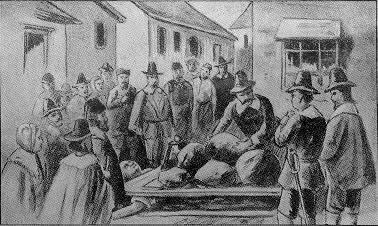
I met Arthur Miller’s The Crucible about a decade later than I met J. Edgar, and I didn’t react to the McCarthyism allegory. I didn’t respond strongly to the characters either, except for Giles Corey calling for “More weight!” as they crushed him under stones. John Proctor left me unmoved and the various girls were merely victims. I cut them a lot of slack, for reasons you’ll understand in a moment.

In short, I didn’t react to the words on the page, but to the implications that exploded in my mind as I read them. That happens sometimes.

I had turned atheist just before my sixteenth birthday, and had told no one. I was enmeshed in a Baptist family in a Baptist town in the Baptist State of Oklahoma in the middle of the Bible Belt. I kept my head down and my mouth shut and told no one until I reached college two and a half years later.

So, when I read The Crucible I was a recent escapee from my own personal Salem. For me the main protagonist was not a man, woman, or girl, but Salem itself, seen as a massive, encircling, inescapable miasma of religious intolerance, hovering ready to strike down any who disagreed with its particular version of Christianity.

That isn’t good history. It isn’t even a full reading of The Crucible, but it was the story as I read it. No surprise, really.

Today, being a reasonably honest scholar, I went to Goodreads to see how others had reacted to The Crucible and got an earful. About half reacted to the McCarthyism allegory and gave high marks. About half gave three stars for skillful writing, then trashed The Crucible for its sexism. To be more precise, they trashed Arthur Miller for making his males into characters and his females into cyphers.

It kind of makes you wonder: did Miller write a sexist Crucible to reflect the era of the actual witchcraft trials, or because he was a grown man in the fifties and it seemed normal?

Perhaps there is one thing we can learn about great literature, which The Crucible is no matter how unpalatable it may seem to some of today’s readers. It has many messages, for many people, in many ages, and not all of them were necessarily clear in the mind of the writer. Miller saw McCarthyism. I saw the danger of being different in a small community. Goodreads is full of reviews from readers who can’t get past its sexism.

Maybe we can all agree that Giles Corey was a hero and John Proctor was a weasel?

452. Male Teachers

This is a follow up to the post 446. Until Proven Innocent. As I said then, my interest in guilt as a first assumption long predates current concerns about sexual harassment and abuse. Current events cause me to place this post at this time. It is an awkward coincidence that the long quotation appeared in Serial only last Thursday.

================

Where were you when the world ended?

That is the opening line from Symphony in a Minor Key, which is now appearing over in Serial. The hero of that novel, high school teacher Neil McCrae, is falsely accused of sexual misconduct with a student and his world as he has known it comes to an end. He moves to another school in another state to rebuild his life. This provides an underlying structure for a novel that takes him through one year of teaching sixth grade, mirroring what I was doing that year in the real world.

In my twenty-seven years of teaching, I saw all kinds of teachers. The vast majority were fine people. A few should never have become teachers. At least one male teacher had questionable behavior. He didn’t last long in our school, but small schools tend to be self-policing. I’ve also seen several absolute goons who came for interviews but were not hired.

No matter how good and kind and honorable most teachers are, not all teachers should be teachers, and every parent knows that. In my experience, no matter what kind of people teachers are, the first thing parents see is their gender. If you are male, life as a teacher holds a different set of expectations for you.

In this scene from Symphony in a Minor Key, Neil McCrae has been reading a paper in which a student tells about her life. He feels a deep emotional bond with her, but . . .

Rosa was one of the meek ones. She desperately needed for someone to hold her, and tell her she was good and pure and valuable.

He could not.

Even if the shadow of Alice Hamilton’s accusation had not hung over him, he still could not have touched Rosa, or any of his girls. Carmen could and did, Fiona did when she was so inclined, Pearl mothered them all, and students came from everywhere to be hugged by Donna Clementi. But no student ventured near Glen Ulrich; and Tom Wright, young and friendly as he was, kept them at arm’s length.

Women teachers can hug and touch. It is expected of them. It is “motherly”. But let a man teacher touch his girls and he is a lecher; let him touch his boys and he is a homosexual.

It isn’t fair, but it is the way of the world.

That is how Neil sees the world, and since he is a kind of alter ego of mine, of course he is right. I don’t think things are going to change in that regard any time soon. And if I may make a prejudiced statement, they probably shouldn’t.

Being a male teacher of young people a strange profession. We tend toward carefulness that borders on paranoia. And since I am a writer first, with teaching as a life-long day job, I wrote a novel about it.

451. The Blurb

Every writer hates blurbs. If the term blurb is unfamiliar to you, it refers to the written material on the outside of a paperback novel that ostensibly tells the reader what the story inside is  about. It is supposed to be a way for the reader to judge quickly whether or not to make a purchase.

However publishers have no intention of telling you why you shouldn’t buy one of their books, so looking for an accurate blurb is a bit like Diogenes looking for an honest man. Thomas Anderson of Schlock Value, whose quirky reviews I never miss, wages an ongoing war against dishonest blurbs.

Yesterday I ran across Robert Bloch’s The Opener of the Way in a used bookstore. I’m not a fan of Bloch, nor of horror, but I bought it because I had to have a copy of the back blurb. I’ve reproduced the top half of it in the scan above. The bottom half, in extreme fine print, says:

(Actually, the Opener of the Way is a first-rate collection of ten terrifying tales of horror and the macabre, including some of the finest ever written about Ancient Egyptian curses, vampires, pacts with the Devil and others. We hope you ‘enjoy’ them . . .)

The fine print was more honest than most and the top part was downright clever. It isn’t usually that way. For example, the blurb on the back of my first novel Jandrax says:

As a scout he’d tamed four planets — and more women than most men ever see . . .

Now in truth, there is only one sentence in the novel that mentions, in passing, that first-in scouts are famous for being rowdy when between assignments.

The back blurb on Jandrax is in three parts, each flamboyant in the style you would find on old westerns. Setting aside the gosh-wow tone, the first and third section are accurate enough in content, but that middle section makes Jandrax sound like astro-porn.

There are two problems with this. Anyone who buys the book expecting a sexy, racy delight, will be terribly disappointed. And anyone who wants a serious portrayal of how space exploration might actually look will probably turn away. Based on the phrase more women than most men ever see, I wouldn’t buy the book myself.

True cliché: You only get one chance to make a first impression. The blurb is where authors make their first impression, and if the publisher blows it, authors are the ones who suffer. 

My second novel A Fond Farewell to Dying has a front blurb that says (in all caps):

WHAT PRICE LIFE? SURRENDER YOUR BODY! GIVE UP YOUR SOUL!

Yech! Sorry folks, that also has nothing to do with the story inside. Neither does the angel blowing the last trump over four zombies in boxes, but bad cover art is a subject for another post. FFTD is about an atheist who tries to come up with a mechanical version of immortality, and succeeds without the universe taking revenge on him for hubris. The front cover, both art and blurb, gives a very different impression. In fact, I saw FFTD for sale on a spinner rack of Christian paperbacks in a supermarket. Someone there certainly got a surprise.

The back blurb was lengthy, given in three paragraphs. The first two were reasonably accurate, but the third was wildly misleading. That inaccuracy irritated me no end, but most blurbs are much worse. They often look like they were mixed up and placed on the wrong book.

I challenge you to take a handful of science fiction paperback novels which you have already read, look at the blurbs, and decide if they have anything to do with the novel as you remember it. If you get one match out of five tries you’ve probably won the jackpot.

Still, the opening statement in this post may be an overstatement. Perhaps every long-time writer used to hate blurbs would be more accurate. When Cyan was being prepared for publication, the folks at EDGE asked me to write my own blurb, and I have to admit that compressing a novel into a sentence or two is hard. I appreciated the chance, but now I have no one to blame.

450. Centuries Are Nothing to India

It is a new year, and once again I find myself in India. Metaphorically that is, in my latest novel.

I went to college as a biology major and quickly switched to Anthropology. Everyone in the Biology department wanted to study DNA and I wanted to study ecology. It was 1966 and I was about ten years too early.

Once in the Anthropology department, I quickly found myself drawn to Indian studies. That is, South Asian studies, not the study of American Indians, as they were called before the days of political correctness.

I also found that common terminology doesn’t fit the larger world. What Americans call the Middle East is neither middle nor eastern. It is West Asia. East Asia is China and Japan. South Asia is Pakistan, India, Nepal, Bangladesh and Sri Lanka I fell in love with all the parts of South Asia, and never made it to any of them in the flesh. The Viet Nam war got in the way, and then novel writing got in the way.

I have visited variant Indias three times now in novels. A Fond Farewell to Dying (Pocket/Timescape, 1981) was set in a future following nuclear war and rising of the waters, in which India is the last nation having a modern, scientific culture. America is reduced to backwardness while Europe and northern Asia are blasted by nuclear fallout. David Singer, having renamed himself Ram David Singh, has left America to become a scientist in India, where he perfects a type of mechanically derived immortality which gets him into no end of trouble.

During my years of Indian studies, I ran across Rabindranath Tagore’s poem Sunset of the Century. I was so taken by it that I quoted part of it when I wrote A Fond Farewell to Dying, and quoted a shorter piece of it as the sub-title of this website.

Here is what I quoted in Fond Farewell:

Be not ashamed, my brothers, to stand before the proud and the powerful.
With your white robes of simpleness.
Let your crown be of humility, your freedom the freedom of the soul.
Build God’s throne daily on the ample bareness of your poverty.
And know that what is huge is not great and pride is not everlasting.

That last line is probably my favorite quotation of all time. I posted the complete poem two years ago. Tagore wrote it on the last day of the nineteenth century, looking back at centuries of oppression and forward to a new century of freedom.

India showed up again in Cyan but I won’t give out any spoilers on that.

My latest novel The Cost of Empire is a look at an India just beginning to push for independence in a steampunk flavored alternate universe. Rabindranath Tagore is an off-camera character, as the cousin of one of the main characters who has a habit of quoting him. I’ll let you know when it is finished.

449. Go Google Yourself

Cover by artist E. Rachael Hardcastle

This is mostly for and about writers; but then, most of you are or want to be writers.
There are two kinds of people in this world: those who Google themselves and those who don’t.
There are two kinds of people who Google themselves: those who admit it and those who don’t.
Me, I just do it for business reasons. That’s my story and I’m sticking to it.

All this came up because of a young author I occasionally converse with through post replies. J. M. Williams just published his first book The Adventures of Iric (a flash fiction collection). On the cover, his name appeared as JM Williams and he asked his followers about which worked better — J. M. or JM.

Actually, he has bigger problems than that. J. M. Williams, written either way, is not sufficiently unique in our internet world. When I went to Amazon to buy his book, he was nowhere to be found. Instead, the J. M. Williams who wrote A Legacy of Magi: A Mystic’s Path popped up. Different book, different author.

This is the second time I have had this problem. I met Thomas Watson, author of the War of the Second Iteration series at Westercon, picked up his book Chance Encounters, and found him a pleasant person to talk to. When I wanted to see what a short story sold separately as an e-publication looked like, I went to Amazon and bought one by Thomas Watson. Bad idea; it was a mess, full of blood, guts, and bad writing, because it was by a different Thomas Watson.

If J. M. Williams and Thomas Watson have this problem, what would it be like for John Smith?

If these seem like shameless plugs, so be it. I liked Chance Encounters. I have just begun Adventures of Iric and am enjoying it already.

Personally, I have the childhood misfortune of being Sydney Franklin Logsdon. The first name is from my father, who was named after a great aunt. The middle name is from my grandfather. Logsdon is unspellable and unpronouncable. That triple consonant — gsd — does not roll off the tongue. Even shortened to Syd, my name is a little girlie, which was a big deal growing up in an Oklahoma cow town. In high school I went by Log, except for a few of the smart alecks in math class who called me Logarithm.

An odd name turned out to be a godsend on the internet. The first time I googled my name, it was mostly me, not a thousand strangers using my name. When I bought the URL for my website (sydlogsdon.com), no one else had snatched it up.

J. M. Williams’ announcement of his first novel reminded me that I hadn’t googled myself recently, so I did it again.

I found a few posts by or about Sydney Logsdon, a young girl who is heavily into sports and into posting pictures of herself. The last time I did a self-google, about a year ago, she was all over the internet, but not so much this time. Perhaps she moved on, or maybe she got married and is still out there under her new name.

I found one obituary of my father — different middle name — with misspellings and no mention of children. The internet has a lot of accuracy problems.

I found a Myspace music mix by Sydney Logsdon aka dumbgirl98. She is probably a namesake I don’t want to meet.

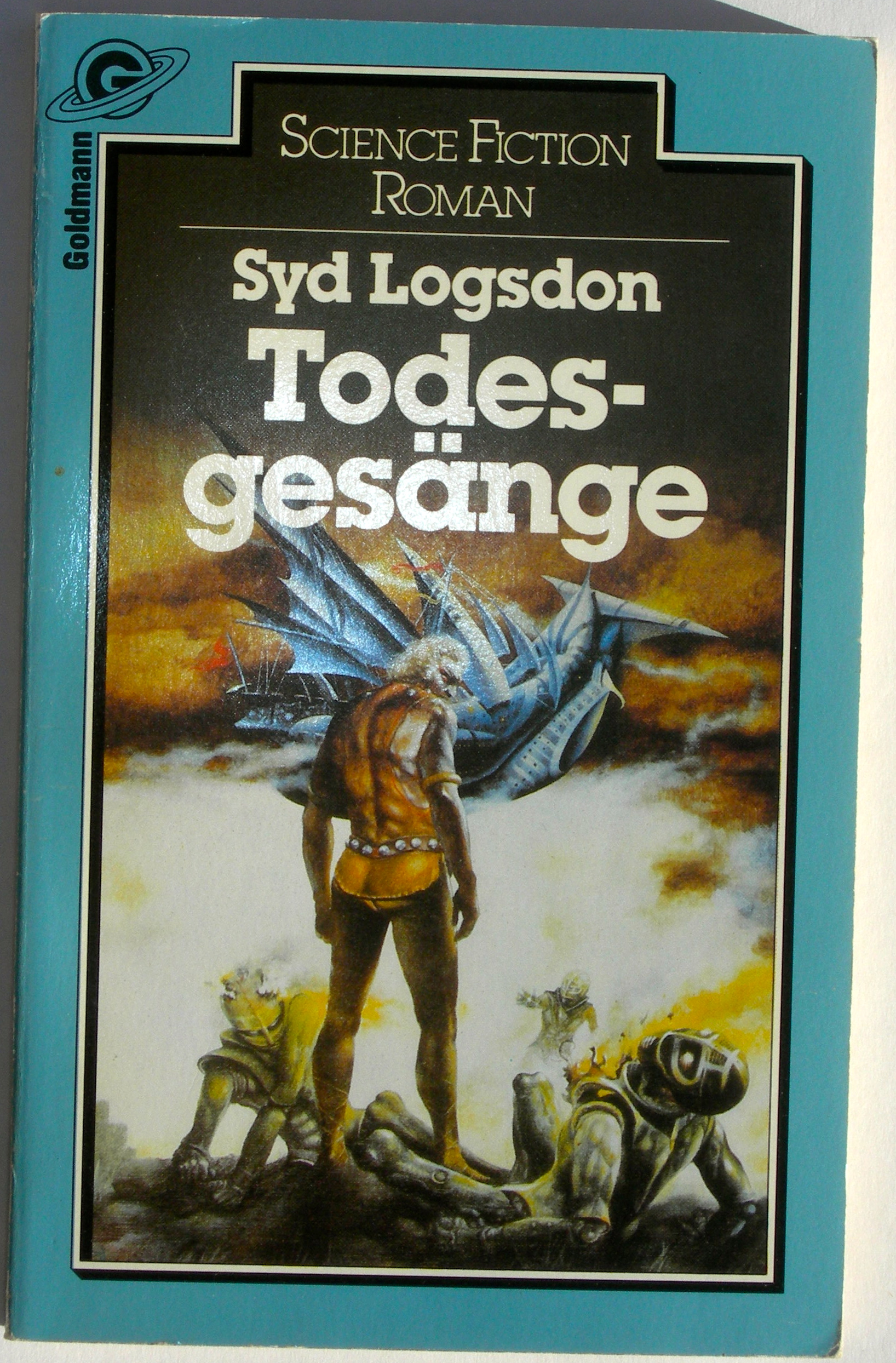
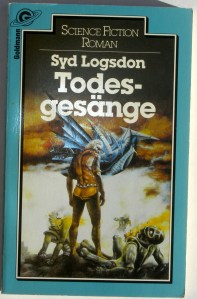
I found quite a few references to my newest novel Cyan. I found a ton of advertisements from used bookstores selling Jandrax or A Fond Farewell to Dying. One of them was in French. I even saw one in German, touting Todesgesänge, the translation of FFTD. It had a review I couldn’t read.

I found a review I hadn’t seen before for FFTD. In English, this time. That also gave me a new old-SF review site to follow.

I found somebody with my name telling how to make slime.

I found a number of sites selling illegal copies of my novels as ebooks. You won’t be surprised to see that I am not including a link to any of them.

What I didn’t see, was a hundred other people using my name. I dodged that bullet.

If you are a writer, or want to be, and your name is Avant B. Jones, don’t use A. B. Jones as the name on your novel. If your name is Bill Smith, you might consider a pseudonym. It’s a matter of branding, and it gives you something to think about while you are waiting for your first book to hit the internet.

448. The Good King

Merry Christmas and why are you on the internet when you should be sitting by the Christmas tree?

Christmas is my favorite holiday. Of all the masses of Biblical knowledge I accumulated in my religious childhood and youth, the story of the Nativity is the only part that still moves me to joy.

I particularly enjoy Christmas carols, even the unsingable ones. However, I never understood the appeal of Good King Wenceslas until I saw and heard it in the movie Miracle Down Under, where it is sung by a poor family and some swagmen to the accompaniment of a washboard. Then I understood the bump-bump-bump-bump-bump-bump-bump non-melody as something that could be handled even by coarse voices without instruments.

I also paid attention to the lyrics for the first time. The King is watching over his people, and when a poor man is spotted gathering wood for his fire, the King goes to his hut with food. The final few lines are particularly moving, despite their awkwardness as they are tacked on as a sort of “moral of the story”.

Therefore, Christian men, be sure,
    wealth or rank possessing,
Ye who now will bless the poor,
    shall yourselves find blessing.

Not bad. Even today, we could use a President who understands that simple message.