Category Archives: A Writing Life

447. Lupe Revisited

Last Christmas, I told the story of Lupe in a world where Donald Trump was going to be President. Now he is President, and things have not gotten better. Here is Lupe’s story again.

Ramon came in, stamping the snow from his feet, and shook the snow from his jacket before closing the door. The sun was low in the eastern sky behind him as Lupe moved up and hugged his leg. He smelled of sweat and manure and soured milk, but she didn’t mind. She had hugged him this way every morning for as long as she could remember, and he always smelled the same. For Lupe, the smell was as familiar and welcome as his cold fingers on the top of her head.

Every morning Ramon rose before the sun was up, and left the house. His daughter greeted him when he returned hours later, and saw him off again in the afternoon. She was usually asleep when he came home at night.

It is hard work milking cattle twice a day, and the pay is low. The cattle march in from the muddy lots to take their turns in the stalls, where fast moving men attach the milking machines. The cattle resent the process and the workers have to move quickly to avoid having their hands caught against he stanchions. It goes on for hours, in heat or cold, beginning every morning before daylight, and continuing again every evening until long after dark.

Lupe stepped aside to make room for her mother. Today she seemed worried; her voice was unusually sharp as she asked, “What did he say?”

Ramon said, “I didn’t tell him.”

I translate, of course. Every word was in Spanish.

“You got your money for the week?”

Lupe’s father nodded, “I told him I needed it today, to buy things for Christmas. I was afraid to tell him the truth. He is a good man, but it seemed best that he should not know.”

Lupe’s sister came out of the single bedroom with a cardboard box in her arms, tied up with twine. Lupe looked up with interest. It was not wrapped in paper, but any box is interesting so close to Christmas. Carmella put the box down on the floor and returned a moment later with blankets and bedding, also rolled up and also tied up with twine. Lupe asked what she was doing, but Carmella ignored her.

Her father carried the box and roll outside. Her mother came out of kitchen with a box of food, and that began a procession of boxes, coming from various parts of the house and out to the car. Lupe’s mother and sister had gathered their possessions during the pre-dawn, while Lupe slept.

Now Lupe dragged at her mothers leg asking questions, but she was ignored until Carmella pulled her aside and said, “We are going away.”

“Where?”

“I wish I knew Lupita. I wish I knew.”

“But why?”

“It’s only a month until he becomes President. Everyone here knows who we are. We have to go away, somewhere where people don’t know us.”

“But why? I was born here. This is home.”

“So was I, Lupe, but mother and father were not.”

When they pulled out an hour later, Lupe stared back at the little house where she had spent her whole, short life, until it disappeared around a bend. Then she looked out the windshield, past her mother and father’s silent heads. It was a long road, wet with melted snow. Her father would not leave the house tonight before the sun went down and go to the cows. There would be no more money, no more warmth, no more little house. It would be again as it had been, before the job at the cows, before she was born. Lupe knew what that was like from hearing her parents talk. Now it would be like that again.

*          *          *

Is Lupe real? She was born from the hundreds of little Mexican-American girls I taught over twenty-seven years. How many were undocumented? I never knew. I never asked. I didn’t need to know.

Is she real? She is as real as heartache. She is as real as fear. She is as real as dislocation, cold, hunger, and injustice.

446. Until Proven Innocent

When I started this post, my queue was full into the second week of January. News in the world outside my writing space has moved so quickly, however, that I am squeezing it in today. I’ll leave the four parts date-stamped and unchanged from what I originally wrote.

========

I am writing this on December sixth, 2017. Right now President Trump is announcing his decision to recognize Jerusalem as the capital of Israel, but that isn’t the only news story of the day. It just increases the chance that we will all be dead before I get around to posting this.

The other news story of the day is the Time magazine person (people, actually) of the year, The Silence Breakers. I have been bothered by this movement since it began, but until now it seemed too early to say so.

I don’t disagree with the women coming out with accusations. I applaud them. But there is a problem with bandwagons, and every news story I’ve seen so far falls into the same trap. They all say, “The women must be believed.”

No. This is false. Completely and utterly false.

The truth is, “The women must be listened to. Their accusations must be considered valid, and subjected to the same scrutiny as any other accusations.”

In shorter terms, “The women must not be automatically disbelieved.” That is a very different statement from, “The women must be believed.”

There are two problems here. The first is conflation. A pat on the butt isn’t the same as rape. The accusations against Weinstein are not of the same level as the accusations against Franken.  There is a mass of absolutely disgusting behavior coming to light, but it is not all of the same weight. Some of it, if proven, deserves life in prison. Some deserves a powerful slap across the face, by the victim, at the time, and nothing more. Most of it falls between those two extremes.

The second problem is guilt and innocence. Even if every accusation so far is valid (and that wouldn’t surprise me), I guarantee that by the time you read this, some innocent guy is going to be on trial in the court of public opinion for something he didn’t do. Women also lie.

“Not likely,” you say? Perhaps not so far, but give it time.

Let’s take a little trip, mentally, one hundred years back and to certain parts of America. I didn’t say the South, because it wasn’t just the South. At that time and in those places, if a white man said something, it was taken for the truth. If a black man said something contrary, he was lying.

It’s rather like the reaction a woman would have received if she had made an accusation ten years ago. I don’t want to go back to that situation, not even with the roles reversed.

I am in favor of this shift in public sentiment. I applaud and support the Silence Breakers. But while we are all reading today’s Time magazine, let’s also pull out that dog-eared copy of Arthur Miller’s The Crucible and give it another glance.

It’s very simple, and damned unsatisfying, that not every accusation is false (even if we like the guy) and not every accusation is true (even if we hate the guy).

Bandwagons are fun to ride on, but you wouldn’t want to get run over by one.

========

Time flies when you are making predictions. This morning (December 14) Senate Minority Leader Chuck Schumer reported to the FBI that forged sexual harassment claim was sent to news media. The supposed author of the documents denies having written it.

So it begins.

========

And now it is Saturday, December 17. Next Monday morning, Tavis Smiley will present on GMA his statement of innocence about charges leveled in the last few days. Is he actually innocent? Is he guilty?

I don’t know. And that is the point.

At any rate, if I don’t shoehorn this into the post queue now, it will be too late to bother.

========

And now, December 18, I have heard Smiley’s response. I need to say more, since I wrote an entire novel based around false accusations (Symphony in a Minor Key, over in Serial) but my posting schedule and my life schedule will push that into January. No problem; I don’t think this issue is going away any time soon. more later

445. Bait the Crazies

This post will be bitter, so I will also make it short.

Much of Symphony in a Minor Key is based closely on personal experience. The conference that Neil and Carmen attended is of that species. I attended the real conference on which this fictional one was based. Call it a close paraphrase, complete with the same opening exercise, although they used an excerpt from A Clockwork Orange instead of a Burns poem.

I have endured hundreds of these meetings. Some were after school, on our own campus. Some were away and multi-day. All of them cost the district money which was not well spent, and cost me time that could have been better spent shooting pool. Or sleeping. Or — I often thought at the end of a long day — shooting myself.

Some of the presenters were prophets of some new panacea. Some were just trying to do something they thought was useful. Some were shysters, plain and simple. Some were just trying to make a living. Some — I am convinced — had no training for anything but education, but had discovered they couldn’t stand kids, and had to do something else to make a living that justified the years they spent in college.

A few were competent. Very, very few.

A friend and fellow teacher told me, when I was just beginning, that the only job in education worth doing is teaching in the classroom. If you are thinking, “What else is there?”, you clearly have not experienced the phalanx of bureaucrats who make up a large part of the education community.

I thought she was right at the time, and thirty-plus years later, I am convinced of it.

Teaching, like any other profession, has its moments. Sometimes it is wonderful. Sometimes it is terrible, and never more so than at conferences where those who know little try to teach those who know better.

And yes, like Neil, when I couldn’t take it any more, I would raise my hand, smile innocently, and bait the crazies.

Truth be told, I did that a lot.

444. Last Men on the Moon

left to right: Schmitt, Cernan (seated), and Evens

The last Apollo mission occurred forty-five years ago this week, with final departure from the moon on December 14th..

The three men who went to the moon on Apollo 17 were not the original choice. Astronaut crews during Apollo were selected well in advance, with primary and backup crews for each mission. The backup crew, as a unit, was supposed to fly on a subsequent mission, but not the very next one. That plan was frequently disrupted by events. Everyone probably remembers from the movie Apollo 13 that Mattingly was originally part of the Apollo 13 crew, but was bumped at the last minute in favor of Swigert because Mattingly had been exposed to rubella. The actual shuffling that took place was far more complicated than that.

As Apollo wound down and missions 18, 19, and 20 were cancelled, (see 441. The Last Apollo) nine astronauts were going to lose their chance at the moon. One of these men was Harrison Schmitt who had been slated for Apollo 18. He was one of the scientist astronauts recruited by NASA. Given the schedule at the time Apollo 18 was cancelled, none of these scientists would have flown. This was unacceptable to the scientific community; they lobbied for and got Schmitt moved up to Apollo 17, which cost Joe Engle his mission.

What happened to the men who got the Apollo axe? Obviously that is worth at least one post, possibly more, but my rotation pushes that into January or later.

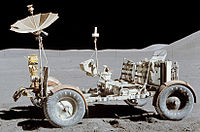
Eugene Cernan and Harrison Schmitt landed on the moon December 11. Their mission was J type, as were Apollo 15 and 16, which meant these missions were designed for a three day stay and included a Lunar Rover. This dune buggy looking vehicle allowed one or two astronauts to move further away from the Lunar Lander and greatly increased the usefulness of the mission.

Apollo 17 landed in the Taurus-Littrow region of the moon. This site allowed sampling a wide range of types of rock, as it consisted of an ancient lava flow, with surface broken by subsequent meteor strikes, and included secondary strikes. This means that ejecta from the nearby Tycho crater came to earth (came to Moon?) causing secondary, smaller craters at the Taurus-Littrow site. This allowed Schmitt to sample Tycho material even though an Apollo landing at Tycho never happened.

A few minutes before eleven PM, Greenwich Time, December 14, 1972, the last manned mission to the moon lifted off, to later rendezvous with the CSM and return to Earth. Gene Cernan was the last to enter the lunar Lander before take off. We’ll give him the final words:

“Too many years have passed for me to still be the last man to have left his footprints on the Moon. I believe with all my heart that somewhere out there is a young boy or girl with indomitable will and courage who will lift that dubious distinction from my shoulders and take us back where we belong. Let us give that dream a chance.”

==========

I’ve read a large number of memoirs by astronauts and others involved in space exploration. The Last Man on the Moon by Eugene Cernan and Don Davis is one of the best. If you want more of this story, that is the place to go for it.

443. Booklist Reboot

On December 15, 2015 I posted this list of Christmas books. 

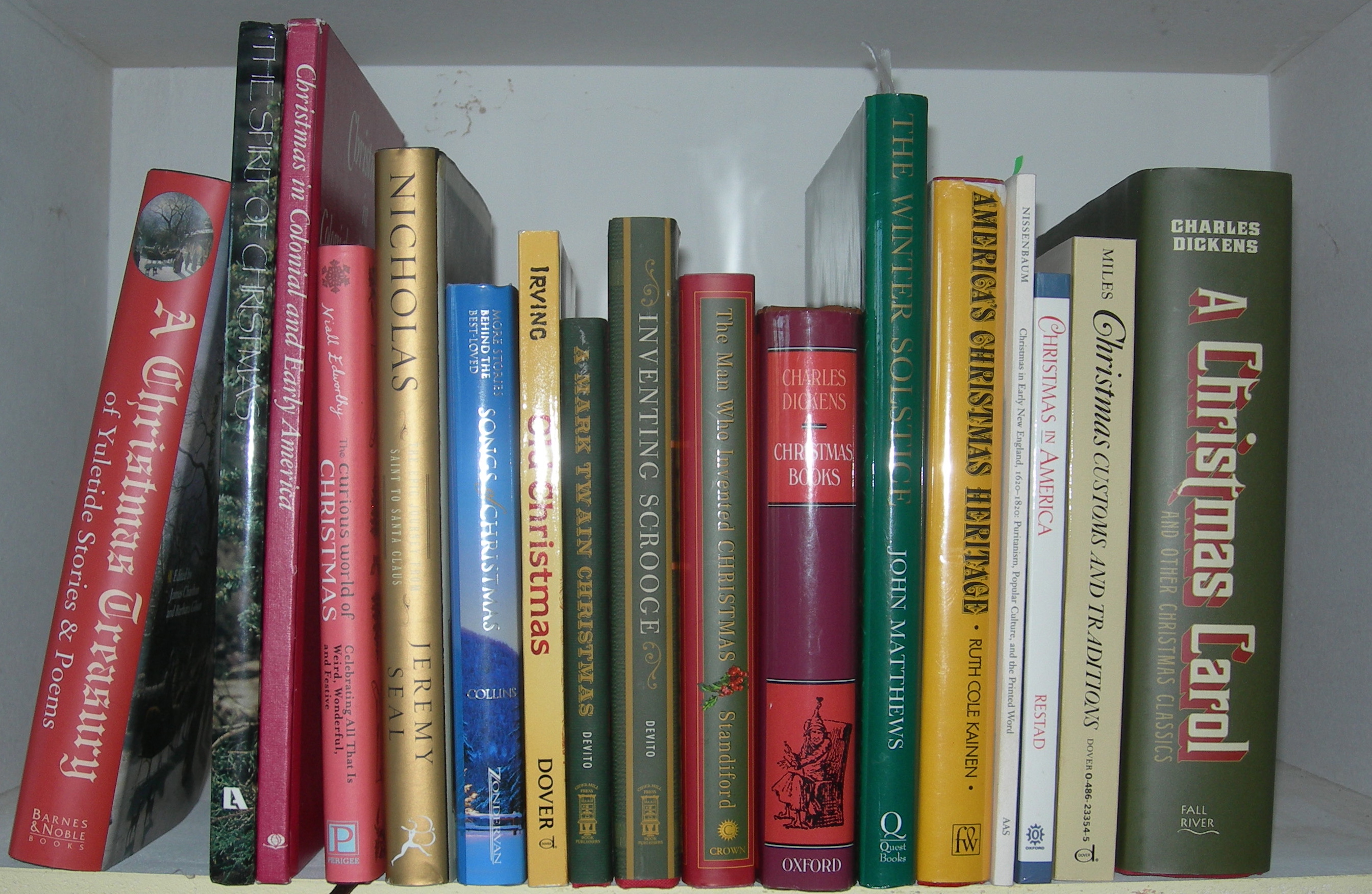
Here is the annotated booklist I promised you yesterday. You could also Google Christmas or old Christmas, or search either of those subjects on Amazon. I suggest you do. This is not a best list because there are too many books on Christmas for anyone to have read them all. This is simply a list of what I’ve discovered over the years, minus the clinkers. Some of these are easy to find, others will lead you through the back stacks of used bookstores, but there’s no harm in that.

A Christmas Carol by Dickens has to head any list. He also wrote many other Christmas works and gets his own post next Wednesday, the 23rd.

Washington Irving had a powerful influence on Christmas, which is largely forgotten today. Among his followers was Clement Moore of Night Before Christmas fame. They also get their own post, on Christmas Eve.

The rest of this list is in order from decorator froth to historical complexity.

Go to any bookstore and you will find dozens of Christmas cookbooks and books on Christmas decor, sometimes with historical tidbits. You’re on you own here, with one exception. The Spirit of Christmas series by Leisure Arts is classy, has been around since about 1990, and fills up ten pages of Amazon with choices.

Christmas in Colonial and Early America, 1975, by World Book, is an early, sepia toned version of this kind of book with a little more meat in it’s history.

For almost two decades, Ace Collins has been writing books titled Stories Behind . . . , beginning with Stories Behind the Best-loved Songs of Christmas. The title tells the tale; the individual stories are interesting and heart felt.

The Curious World of Christmas is lightweight and breezy, a book of short entries which can be digested one little bite at a time.

The only recent Christmas book I can’t recommend is Nicholas, by Jeremy Seal. I found it dark and tedious, and couldn’t get past page 42, but if you want a detailed look at how St. Nicholas became Santa, it’s the only work I know completely devoted to that subject.

The Man Who Invented Christmas by Les Standiford and Inventing Scrooge by Carlo De Vito each tell the story of the genesis of Charles Dickens’ most famous story. As a writer and a lover of Christmas, I couldn’t choose between them. Read the one that is easier for you to find. Then read the other one next Christmas.

A Mark Twain Christmas has been sitting on my next shelf for a couple of weeks. I will give it a tentative approval based on a thumb-through, and the fact that it is also by Carlo De Vito.

A Christmas Treasury of Yuletide Stories and Poems by Charlton and Gilson has works by every famous author you’ve ever heard of, from St. Matthew through The Adventure of the Blue Carbuncle.

Ruth Kainen’s America’s Christmas Heritage contains well written regional histories of Christmas at a level of detail that is satisfying without being overwhelming.

John Matthews’ The Winter Solstice has a look similar to the decorator/cookbook works above, but with a unique twist. It concentrates on the Roman, Celtic, and Germanic contribution to Christmas. It feels like the Middle Ages, without falling into the trap of New Age Gaia worship.

Christmas Customs and Traditions by Clement Miles is a Dover reprint of a 1912 work. It is an old fashioned history of the evolution of Christmas from Roman times to what was then the present.

Christmas in America by Penne Restad is a scholarly telling of the history of American Christmas. 172 pages of text, 36 pages of notes. You get the picture; a book for the overeducated Christmas nerd, but it is still a good read.

The remaining “recommendations” are probably over the top.

I have in front of me Christmas in Early New England, 1620-1820: Puritanism, Popular Culture, and the Printed Word by Stephen Nissenbaum, published by the American Antiquarian Society. I have already confessed to having two masters degrees, one in Social Science and one in History. This is the kind of thing I used to read for a living. I still read them, but only if they are on a subject that really interests me. Nissenbaum taught at Amhurst; you will find his original research referenced in many of the less scholarly books above. His book The Battle for Christmas was a Pulitzer Prize finalist, but a scholarly work of 400 pages is not something to take on casually. I confess to not owning it; I read it on interlibrary loan years ago. If, however, you are a Christmas nerd and a history buff, it is available in paperback. Go for it; what have you got to lose?

===================

BY THE FOLLOWING YEAR I had purchased and re-read Nissenbaum, and wrote three posts summarizing The Battle for Christmas. If, like me, you are a complete Christmas nerd, click here to read them.

442. Life is a Tunnel

Every once in a while, a phrase appears, demanding to be used. Sometimes it fits into whatever is being written at the time. Sometimes it hangs around for years before it fits. Sometimes, it just hangs around.

The phrase at the top came to me when I was considering a sequel to Raven’s Run. There were several stories on audition, and none were chosen. I don’t even remember which sequel this was supposed to go with. I do remember the scene it was to be part of.

Iain Gunn was looking out a second story window at an urban street. South San Francisco, I think. It was just beginning to rain. A girl with long black hair had just gotten out of a car. She was wearing a tight, short dress, and she was, of course, lovely. Gunn was waiting for someone to come along who was connected with the business he was just getting involved in, and this girl certainly was not that person, but she caught his attention.

She hunched her shoulders when the rain first hit her, but then she straightened her back and looked up. She raised her hands to the rain and smiled. No dancing around — she was a serious and sophisticated person — but she accepted the rain and appreciated the moment. She stood for a few more moments, facing Gunn but unaware of his presence. Her hair began to flatten against her head and Gunn could see beads of moisture trickling down her face. Then she turned and walked purposefully away. For her the moment was over, but it would remain with Gunn.

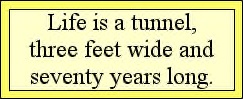
Life is a tunnel, three feet wide and seventy years long. The phrase hits Gunn (as it had hit me). She is just another of the million people he will nearly meet, nearly have some kind of relation with, one whom he could perhaps come to hate, or perhaps fall in love with. But he will never know.

If this were cliche #472 in the detective story handbook, he would meet her again and this would just be a foreshadowing of things to come. Meeting her again would be expected by the reader.

It is not meeting her that will make the incident meaningful. She will now become a symbol for all the things we miss as we live our random lives.

It’s not a new idea, and not the first time I’ve used it. These words in the opening paragraphs of Valley of the Menhir set the stage for what is to come:

Out there in the night that stretches away from us all — there where consciousness ends; where experience missed sets an iron boundary on our lives — there is a land of red sky and green sea, Poinaith, and another land where the gray sky leans down to lock hands with the sliver elfin forest.

Experience missed sets an iron boundary on our lives. Another phrase that jumped into my head, but in this case, just as I needed it.

We all live lives of found and missed opportunities. Our lives are a path from birth to death, as wide as our shoulders and as long as we last. We see so much, but if we were to turn three feet to either side, there are a thousand other lives we could live instead.

I’m satisfied with my life so far and I’m glad I was wrong about its length. I have more things to do, and more books to write. These last seventy years have been great, but I‘m not done.

441. The Last Apollo

“We leave as we came, and, God willing, we shall return, with peace and hope for all mankind.”        Cernan’s closing words on leaving the moon at the end of Apollo 17

Forty-five years ago, at 12:33 AM Eastern Time, the last manned moon flight took off from Cape Canaveral.

It was a stunt from the get-go. Kennedy’s speech, setting a goal of landing a man on the moon and returning him safely to the Earth, was a Trump-worthy brag. If we had failed, it would be laughed at today as just another empty promise made by a politician.

One man laid down the challenge and thousands of men and women carried out the promise.

But it was still a stunt. When Kennedy made his speech on May 25, 1961, Russian had put a man into orbit. We had not, although we had managed a sub-orbital flight. Atlas boosters were still blowing up on launch, so a smaller Redstone was used for Alan Shepard’s flight on May fifth.

NASA had only been in existence for three years. By any real or imagined yardstick, the Russians were far ahead in space.

By herculean efforts, NASA forged ahead through Mercury and Gemini. The fire aboard “Apollo One” set American efforts back significantly, and when launches began again, it looked like the Russians were going to land on the moon first.

There were Soviet problems however, particularly the repeated failure of their N-1 rocket. These doomed their attempt to reach the moon first, but NASA was not aware at the time.

NASA had problems of its own. The lunar lander was not ready when Apollo 7, the first actual manned Apollo flight, left for low Earth orbit in October of 1968. Only a year remained on Kennedy’s timeline, and the Soviets — we thought — were poised to land on the moon ahead of us. Something had to be done.

That something was the Apollo 8 journey to and around the moon, without a lander, for the Christmas season of 1968. We had been to the moon first (by an ad-man’s stretch of the truth), even if the Soviets became the first to land.

Apollo 9 tested the lunar lander in low Earth orbit. Apollo 10 (the most frustrating almost in human history) returned to the moon, deployed the lunar lander, and flew it to within wishing distance of the moon without landing.

Apollo 11 landed a man safely on the moon, and returned him safely to the Earth.

Now what?

For the Soviets, the answer was to turn away from the moon. Their N-1 mega-rocket had failed, and their manned modules and lander were stored away. The Soviets began a series of long flights and space stations, studying space from low Earth orbit.

For NASA there were nine more Saturn V rockets waiting to launch Apollo 12 through 20. It didn’t turn out that way. Apollo 12 landed in a different part of the moon, Apollo 13 suffered and explosion, didn’t land, and barely made it home.

Even before Apollo 13, Apollo 20 was cancelled so its Saturn V could be used to launch Skylab. Even before Apollo 14 landed, Apollo 18 and 19 were cancelled. Why? Because it was a stunt from the get-go. Apollo 11 met the deadline. To coin-counting bureaucrats, that was enough.

For those of us who see space exploration as the future of humanity, Apollo 11 was only the  beginning. Lunar exploration, a moon base, Mars. Venus — there should have been no end.

Bureaucrats did not agree. On Thursday, 1972, at 12:33 AM Eastern Time, the last manned moon flight took off from Cape Canaveral.

more next Thursday, the anniversary of the last liftoff from the Moon

440. Pearl Harbor Day is Tomorrow

Pearl Harbor Day is tomorrow and for the third time, I am not going to write about it directly.

In 2015, I used Pearl Harbor Day as a jumping off place to discuss the decision to go to war in Iraq.

In 2016, I used Pearl Harbor Day as a jumping off place to discuss Japanese Internment.

In 2017, I am even less able to salute and shout hallelujah than I was on the last two times Pearl Harbor Day rolled around. Things are even worse than they were then.

Do I think we were shouldn’t have retaliated to the Pearl Harbor attack? Don’t be absurd.

Do I support disarmament? I wish I could, but it would be national suicide.

Am I a veteran? Yes; and I would love to be the last veteran.

Am I a pacifist? Don’t I wish. I would love to live long enough to be able to say yes to that, but I won’t. Neither will you, and you are younger than I am.

There are times when we have to fight and Pearl Harbor signaled one of those times, but our national default setting should not be attack. We should fight rarely, and only when necessary. For many years now, we have been doing a terrible job of deciding when to fight, so I find it hard to wave the flag. Someone might think that means I’m ready to start shooting.

Tomorrow is Pearl Harbor Day. It is also the forty-fifth anniversary of the last manned moon launch. I think I’ll write about that.

439. Jose, Maria, y Jesus in Trumpland

[Don’t expect even handedness here.]

In English we call him Joseph, in Italian he is Giuseppe, in Basque he is Joseba, in Spanish he is just plain Jose.

In English we call her Mary, in Hebrew she is Miryam, in German she is Maria, and also in Spanish.

In English he is Jesus, in Cornish he is Jesu, in Italian he is Gesu, and in Spanish he is Jesus again, but pronounced Hey-sous.

We are going to walk with these three in this sermon for the Christmas season.

And it came to pass in those days, that there went out a decree from Caesar Augustus, that all the world should be taxed. And all went, every on into his own city. And Jose also went up from Galilee, out of the city of Nazareth, into Judaea, unto the city of David, which is called Bethlehem, to be taxed with Maria his espoused wife, being great with child.

Of course that could be written as Joseph and Mary, but surely they are the same couple, in any language. Jose was a carpenter. He built things out of wood to feed his family, and he paid his taxes like everybody else. All the world was to be taxed, and he had to go back to the place from which his people came.

Where would that be? Perhaps a land with cities named Sacramento for the Holy Sacrament, or maybe Atascadero, Alameda, Camarillo, El Segundo, or Escondido. Perhaps cities like Fresno, La Mesa, Madera, or Mariposa show where his people once lived. Certainly they must have lived in cities like Los Angeles, Merced, Paso Robles, Salinas, or San Francisco. Even if his people no longer own the land, certainly the city named after him, San Jose, must once have belonged to his people.

And so it was, that, while they were there, the days were accomplished that she should be delivered. And she brought forth her firstborn son, and wrapped him in swaddling clothes, and laid him in a manger, because there was no room for them in the inn.

I think Luke shortened this a bit. Was there only one inn in Bethlehem? We can see the young couple, going from place to place, Jose leading, Maria on a burro since she cannot walk so late in her pregnancy. Everywhere they are turned away. Are all the sleeping places truly full? It may be. Or perhaps something about the two of them, perhaps the color of their skin, makes the innkeepers turn them away. Luke does not tell us.

I see migrant housing everywhere I go in California and I think, perhaps, a manger was preferable.

Now they are in a place where their people once lived, but to which they are no longer welcome. And here, their son is born.

Donald Trump would call Him an anchor baby. I wonder what He will call Trump, when they finally meet.

And there were in the same country shepherds abiding in the field, keeping watch over their flock by night. And, lo, the angel of the Lord came upon them, and the glory of the Lord shone round about them: and they were sore afraid. And the angel said unto them, Fear not: for, behold, I bring you good tidings of great joy, which shall be to all people.

To all people. ALL people. Imagine that!

=============

Luke’s story is complete, but ours is not. It is up to every one of us to see that it turns out right.

438. Machine P

               Friends, I am amending this post as of June 1, 2018. I am changing it’s title from Machine P o r n. I have had more hits on this post than on anything I have written, but I have obviously just been generating frustration among those who clicked on purely because of the word P o r n. You will notice that I have also hidden the word itself from the view of crawlers.
              I like hits as much as the next blogger, but I’m not into misrepresentation. I am leaving the post otherwise intact, since it does have something non- p o r n ographic to say.

================================================

On Monday, we started talking about steampunk, then wandered into changes in science fiction and in real world technology. Picking up where we left off . . .

I always watch the PBS program A Craftsman’s Legacy. It is very steampunk, although that may not be obvious until later in this post. The most recent episode was a jeans maker. If I weren’t already hooked on the program, that’s something I would never have watched. In actual fact, the making of jeans was boring, but the program turned out to be twenty-five minutes of pure Machine P o r n. Through the whole show, every scene was an orgy of early twentieth century sewing machines of every specialized type, all whirring and clunking with their working parts in naked sight.

The only thing moving on a modern sewing machine is the needle, but there is a computer screen where you can tell it what to do. One modern machine will do more than a warehouse full of old ones, but but everything is hidden. It is a classic black box. It does stuff, but you don’t get to see how.

You can see the procession from hands-on to hands-off, and from visible to hidden in boy’s fiction. Tom Swift (later called Senior) could build anything with his own hands back in the twenties. Tom Swift Junior in the fifties and sixties could design anything, but he usually turned it over to his chief engineer to build the prototype. In the first Rick Brant book (1947), work on their moon rocket was delayed when they couldn’t get a certain type of tube (that’s valve in the British half of the world). By book number nine (1952), Rick was learning how to make printed circuits and was introduced to transistors. We watched him build a control unit, but once it was finished, it was sealed and no one else would ever see its guts.

Real science has followed the same progression. Galileo did his experiments by rolling lead balls down ramps. Today science requires a Large Hadron Collider.

Do I miss the good old days? Not at all. I’ve been living in the future since I was eight years old. I am pointing out that one byproduct of the Good New Days is that the working parts of everything are hidden, and that has consequences.

I spent the majority of my teaching career trying to make up for this loss. When I taught pulleys, I used homebuilt equipment with heavy weights so the kids could actually feel the difference when they changed the mechanical advantage. Every year, students were divided into teams of three or four and they all built gizmos, which were devices of their own design that carried out an assigned task. It was a different task every year and they were not allowed to take their work home, so Dad or older brother couldn’t cheat. All they had to work with was a shop full of tools, a pile of donated materials, and what they had learned. They had to see their gizmos in their heads and build them with their hands. No black boxes here.

Steampunk fits in here, as well. Steampunk is the meeting of the past and the future. As part of the past, it is familiar and understandable. It is also full of all the nineteenth, twentieth, and twenty-first centuries’ hopes and fears. Retrofuturistic is one word used to describe it, and it fits. Of course, as a word, retrofuturistic is as strange as the thing it points toward.

The clockwork aspect of steampunk is certainly one of its charms, especially in steampunk DIY and illustrations. We look at the pictures on the page, or the pictures in our mind while we read, and think, “I understand that. I could build that.”

And we could. Or at least the better, smarter self we all become when we sit down to read science fiction could.

In clockwork, once you take the back off the watch, everything is visible. If you look long enough, you can figure our what makes it tick.