Category Archives: A Writing Life

404. Various Anniversaries

I was really busy two years ago, and forty-two years ago.

On September 2, 1975 – the day after Labor Day that year – I sat down to see if I could write a novel. By Christmas, the first iteration of Spirit Deer was a reality, and I had become a writer.

Two years ago, six months after learning that Cyan had been accepted for publication, after several months of learning about blogging, after learning how to use Word Press, after pre-writing a few dozen posts — on August 29, 2015 I posted the first introduction to A Writing Life and Serial.

I seems like yesterday, and also like a lifetime ago.

403. Steampunk Dirigibles

Warning: this post gets nerdy.

If it has dirigibles, it’s steampunk. No, that doesn’t quite work.

If it doesn’t have dirigibles, it isn’t steampunk. No, that doesn’t work, either.

If it is steampunk, then chances are, there’s a dirigible in it somewhere. OK, now there’s a pronouncement I feel comfortable with. Even Brisco County, Jr. had a dirigible eventually.

The variety of airships (a more generic term) in steampunk is huge, especially if you look at the vast number of illustrations on line. The Aurora in Oppel’s Airborn is entirely realistic. The Predator in Butcher’s Aeronaut’s Windlass if essentially an air-floating wooden sailing ship. Some are essentially floating cities. Some run on diesels. Some run on magic, or crystal power.

Back here on Earth, everybody knows at least one dirigible, the Hindenburg, just like everybody knows at least one steam ship, the Titanic, and for essentially the same reasons. Beyond that, real knowledge of actual airships is spotty.

It might be helpful, before embracing the infinite variety of steampunk airships, to have a go at definitions for those which actually existed.

First up, why dirigible instead of Zeppelin? Answer: for the same reason that we use the word automobile instead of calling all automobiles, Fords. Ferdinand von Zeppelin meant more to the development of dirigibles than Henry Ford did to the development of autos, so if you want to say Zeppelin instead of dirigible, I won’t argue with you. After all, I used to say, “Gimme a Coke,” when I really wanted a Pepsi.

However, in the world of my upcoming steampunk novel, you wouldn’t dare say Zeppelin. It would be unpatriotic. A Brit with more ambition than morals stole Zeppelin’s plans, sabotaged his work, and built a British fleet of airships before the German war, while Zeppelin’s war efforts came to nothing. The result was a sweeping British victory, an overwhelmingly powerful Britain, and a very interesting world to write about. But no one calls dirigibles Zeppelins.

In our (real) world, airships are often divided into three classes, blimps, semi-rigids, and dirigibles. Blimps are bags of lifting gas which hold their shape entirely due to internal pressure. Pull the plug, and they collapse. Semi-rigids have a keel structure which helps to keep them from distorting due to localized weights, such as engines, but they still don’t have a solid skin. Dirigibles have a skeleton and a skin, and individual gas bags for the lifting gas. Dirigibles are sometimes called rigids; that is the most accurate term, but it is rarely used.

You will find this three part division in dozens of books on airships, and it fits pretty well. But the word dirigible was used far earlier, and at that time it meant “capable of self-movement and control”. There were dirigible torpedoes in the water, long before Zeppelin put dirigible airships into the air.

Which drags us back to another recycling of an old word — torpedo. During the American Civil War there were two types of torpedoes, stationary and spar. A stationary torpedo was a mine. When Admiral Farragut sailed into Mobile Bay, shouting, “Damn the torpedoes, full speed ahead,” that would translate into modern English as, “Damn the mines, full speed ahead.” A spar torpedo, on the other hand, was an explosive device attached to a long wooden pole and rammed into an enemy ship by a steam boat, often sinking both. Neither kind of torpedo had self propulsion or self steering.

Torpedoes with that capability were initially called dirigible torpedoes. The adjective dirigible was later dropped. E. E. Smith, in Triplanetary, recycled that old term for use in galactic warfare:

In furious haste the Secret Service men had been altering the controls of the radio-dirigible torpedoes, so that they would respond to ultra-wave control; and, few in number though they were, each was highly effective.

The original hot air balloons were (and still are) unable to steer or move on their own. The quest for dirigibilty (controlled self- movement) led to blimps, semi-rigids, and “dirigibles”.

So, there is plenty of confusion even before we get to the use of airships in steampunk. Call them dirigibles, if you want. Call them Zeppelins, if you want. I don’t see how anyone has a right to complain about your choice.

402. Nuclear Spacecraft

I taught middle school science for twenty-seven years, and always, whether I was supposed to or not, I taught the space program.

I grew up with space travel, first in fiction, then in fact. I loved it, and the kids I taught loved it, too. How much of that rubbed off from me, I’ll never know.

By the time I started teaching, the big show was over. When Gene Cernan stepped back into his LEM in 1972, it was the high water mark of manned space exploration. It’s been downhill since.

In the classic science fiction novel I had planned to serialize, Rip Foster is heading out toward the asteroid belt on the nuclear powered spacecraft Scorpius. That’s how we all thought the future would look. That’s how the future should have looked. Chemically powered rockets are simply not sufficient for exploring the solar system.

We have have nuclear power plants for electricity, nuclear submarines, nuclear aircraft carriers, even a nuclear cargo ship. Why not nuclear spacecraft? Weight? Do you really think we couldn’t have overcome that problem? Maybe it was the danger, but . . .

Here is a quiz for you. How many nuclear submarines are lying on the bottom of the ocean, tombs for sailors and ecological time bombs for the rest of us? Two from America and six from Russia. An additional Russian nuclear sub sank twice, but was raised both times.

How many nuclear and thermonuclear bombs have gone missing? The U.S. admits to eight. How many more are hidden under the umbrella of security? Your guess is as good as mine. How many have the Soviet’s lost? You ask them, I’m keeping my head down.

Did I mention Chernobyl and Fukushima?

Let me put it another way. When the Soviets launched Sputnik and initiated the space race, then followed up with a man in orbit before we could even launch a sub-orbital flight, we did an end-around and went to the moon.

If the Soviets had launched a nuclear powered space craft, we would have launched a nuclear powered space craft. Technology would not have stopped us. Fear of radiation would not have stopped us.

That was then, this is now. The best thing for manned space exploration today – though not for American interests or world peace – would be for the Chinese to launch a nuclear powered space craft. It wouldn’t even have to be a good one. Just the threat would be enough, and in a few decades ships like the Scorpius would be filling the solar system.

401. Harold Goodwin

Harold Goodwin was a diver, worked for Civil Defense, NASA, NOAA and other agencies, and said that his books “were often a spinoff from my technical work.” He wrote forty-three books in all. His popular science books were written under his own name, and included Space: Frontier Unlimited and Challenge of the Seven Seas. I have not been able to find a full list, but it hardly matters. They would be hopelessly out of date.

If you plan to look in Goodreads, look up his pseudonyms. The Harold Goodwin they feature isn’t our guy.

Try this: look up The Rocket’s Shadow on Goodreads. You will find three authors on the by-line — John Blaine, Harold Leland Goodwin, Peter J. Harkins. Harkins co-wrote the first three Rick Brants with Goodwin. Clicking on H. L. G will take you nowhere useful, but clicking on John Blaine will take you to his Washington Post obituary. For a man who is hard to track down, this is the most accessible mini-biography. Or just click here.

Goodwin’s twenty-four volume Rick Brant series of science adventures for young people were written under the name John Blaine. His only true science fiction novel, also for the young, was Rip Foster’s story, written under the pseudonym Blake Savage.

Goodwin served as a combat correspondent in the Marine Corps in the Pacific during World Was II. By no coincidence, Scotty, Rick Brant’s companion, was an ex-marine who also served in the Pacific. And Rip Foster’s Planeteers from the Rip Foster book are basically space marines.

Goodwin served as a State Department official in Manila after the war; Rick and Scotty end up in the Pacific and islands of the East Indies in several stories.

Goodwin wrote on the cutting edge of science, but he started writing in the late forties, so most of what he wrote seems dated today. He was generally accurate, with a couple of goofs. In his first Rick Brant The Rocket’s Shadow, he fouled up the calculations and got his rocket to the moon in hours instead of days. He later expressed embarrassment at his error. In the Rip Foster book, he has Rip conversing freely with Earth from a point near the Sun — he forgot that pesky speed-of-light communications delay.

When the Rip Foster book came out, we all expected to see nuclear spacecraft and a rapid expansion of the manned exploration of our solar system. Heinlein made an early career out of the same assumption, but it never happened. in that sense, the sixty-plus year old Rip Foster book is still out ahead of us.

400. A Forgotten Classic

This is a shortened version of the post introducing what I call the Rip Foster book, which I had considered serializing. See the previous post for why I changed my mind.

This book is one of the best of the “this is what might actually happen” style of science fiction. I wrote Cyan in the same style. Unlike the Rick Brant books, the science in this book stands up to modern scrutiny, except for the fact that Rip’s solar system has alien life on several planets and moons.

Even though I decided to continue presenting my own work in Serial, this classic deserves to be read, even today. I recommend it to adults and boys alike. Girls, I apologize. No girls were allowed in juvenile science fiction in the fifties. Sorry. Don’t blame me; I was just a kid back then.

#                     #                    #

Today, in Serial, I (had planned to begin) the presentation of a mostly forgotten classic.

The author was Harold Goodwin. I’ve talked about him before. (see 60. Thank You Harold Goodwin and 195 Boys at Work: Rick Brant) and I have suggested downloading this particular book from Project Gutenberg.

This novel was written under the pseudonym Blake Savage. It first appeared in 1952, published by Whitman, titled Rip Foster Rides the Gray Planet. This is the edition which Gutenberg has available, with illustrations by E. Dean Cate. The same year, the novel was released in England as Rip Foster Rides the Grey Planet (note the British spelling).

The novel was again published by Whitman in 1958 as Assignment in Space with Rip Foster. That was the version that lit up my childhood. Denny McMains’ illustrations were superb. Golden released a paperback reverting to the original title in 1969.

If you want a copy today, a Gutenberg download will come free. An ebook version of Assignment in Space with Rip Foster is available through Amazon, with the wonderful Denny McMains illustrations, for under a buck. The novel also appears at the end of the Tom Corbett Space Patrol Megapack, without illustrations.

Original copies show up from time to time, more often in antique stores than in used book stores, for prices ranging from pennies to “you gotta be kidding”.

By the way, Rip is the nickname of Richard Ingalls Peter Foster. It was a clever way to get a cool first name without going over the top. Donald Wollheim used the same acronymical schtick a few years later when he called the character Michael Albert Richard Sampson, Mike Mars. (see 357. Mike Mars and Project Quicksilver)

Most of the authors from my youth are still in print, or in libraries. Of the books that I loved then, which have since been forgotten, Rip Foster stands out as the best by far, as well as being the only one which was not part of a series. It deserves to be revived, and this seem(ed) the right time for me to do that.

And, yes, it is in public domain. I don’t steal from other authors.

399. I Changed My Mind

No, I did not change my mind about cutting back on posts in the A Writing Life blog. Since I made that decision, I have outlined most of, and written the first six chapters, rough draft only, of a new novel. The title is still in limbo so I won’t say more until I can name it properly. The decision to cut back was a good one.

I am actually making a change in Serial. I had planned to run a guest novel. I had written two posts explaining why and giving a bio of the author, Harold Goodwin. I had also reduced the first several chapters of that novel to serial posts, enough to carry through mid-September, and positioned them in the queue, ready to publish.

So, why? First, why a guest novel — then why did I change my mind?

Since 2015, Serial has been a place for me to present short stories, a novella, presentations from Westercon, long and short excerpts from novels, and complete novels.

Christmas week of 2015 I presented five classic poems that have inspired me. Otherwise, everything in Serial has been something I have written.

The cupboard isn’t empty; four novels remain. Valley of the Menhir, Scourge of Heaven, and Who Once Were Kin, are complete fantasy novels. They deserve to be held back to be presented in a more traditional way. Symphony in a Minor Key is a complete novel about teaching. I’m quite proud of it, but it didn’t seem right for this blog, which has been largely aimed at science fiction readers.

I argued with myself through the month of June. Should I run a classic SF novel that is unknown to today’s audience, or should I run a novel of my own about teaching. It was a big decision, since once committed, it would be six months before I could change course. I opted for the SF novel.

One the decision was made, I placed the first 20 posts in the Serial queue. Then I went on with my life, still mulling over the decision. Spirit Deer began appearing, and you all kept reading. I found no reduction in reader’s responses. Hmmm. You had stayed with me through Raven’s Run and through Voices in the Walls as well. Hmmm, again.

I started this blog to reach two audiences. First, I was looking for lovers of science fiction and fantasy who might want to read my novels, if I could make them aware of them. Second, I expected the blog to be read by new and would-be writers.

I found both but, clearly, in reverse order. Ok, I hear you. I never was comfortable with a guest novel, anyway.

New plan — I will post Symphony in a Minor Key. But first, I need to buy time. It takes many hours to turn a novel into a serial (see 245. Serializing), and my guest novel was due to start today.

No problem. I have several pieces that were published in Serial before anyone was reading this blog. I’ll recycle one or two — no one now reading has seen them, anyway — while I am preparing the next novel.

And so, PRESENTING—

Blondel of Arden, beginning in Serial today.

398. Summing Up Spirit Deer

Today Spirit Deer ends with a short post. Tim is home and all is well.

Here’s a short summing up for those who missed the start. Spirit Deer has appeared in two major forms. It was first a book for adults, with a thirty-something Tim Carson, who had a wife, a job, friends, and included various events which have since been excised. It was a carefully chosen story that offered me no research difficulties. The entire purpose of the original Spirit Deer was to see if I could write day after day until a novel length manuscript emerged. I could. It did. And I never stopped writing.

Years later I pared it back to its core story and recast it as a juvenile, which is what I have presented here.

Writing Spirit Deer was so enjoyable that I did not reapply for a Ph.D. program in Anthropology, as I had intended. Also, in full disclosure, I had come to the realization that, although Anthropology as an intellectual endeavor fascinated me, the idea of sitting in an Indian (South Asian, not Native American) village and taking down daily gossip as field work did not appeal. Not even a little bit.

So I kept writing, had some success, had a long dry spell for sales during which I still kept on writing, and now my new book Cyan is available. On the basis of that publication, I just came back from Westercon where I served on panels, met a batch of young authors, and was struck by the kernel of a new steampunk novel that I am working on as you read this. My second published novel was set in India, and made use of all those years studying Anthropology. My next one is built around an obscure event in the history of British India, turned inside out and backwards in an alternate steampunk universe.

Its been a good ride, and a rough ride, but I wouldn’t have had it it any other way.

397. University of Steampunk

Here I am, quoting myself, from Golden Age of Science Fiction:

Recently I have been reading Neil and Neal, Gaiman and Stephenson, but I know I must have missed a feast of others. I have probably missed more than one feast. Is there a Golden Age of Steampunk? Probably, but I don’t know the sub-genre well enough to talk about it.

Since I wrote that, I have interacted with a bunch of steampunk authors, done a lot of research, and concluded that, “Yes, I was right. There is a golden age of steampunk and it is now about a century and a half deep.”

I love steampunk. i already knew that. But now I have a better handle on what steampunk is, and I am continuing to pursue my education. Let’s call it University of Steampunk (self-inflicted) and I am inviting you to come along. And don’t hesitate to use reply to tell me when you think I’m wrong.

Not only am I immersing myself in steampunk research, I am also writing my first steampunk novel. Since Westercon, it has tumbled out onto the screen. I have it fully outlined, with initial drafts of the introduction and first two chapters.

The rest of this post is drawn from the draft introduction.

#           #            #

This novel, as yet unnamed, working title Durbar, is steampunk, pure and simple, and designed to be so. It differs from other steampunk novels only in that it emphasizes strong scientific and historical excuses for the prevalence of steam power and pseudo-Victorian culture.

My literary introduction to that age on our own planet did not come from Austen, the Brontes and their ilk. My literary Victorian/Edwardians were Holmes and Watson, Hannay and all his friends, and Davies and Carruthers; in other words, the stories of Arthur Conan Doyle, John Buchan, and Erskine Childers’ Riddle of the Sands.

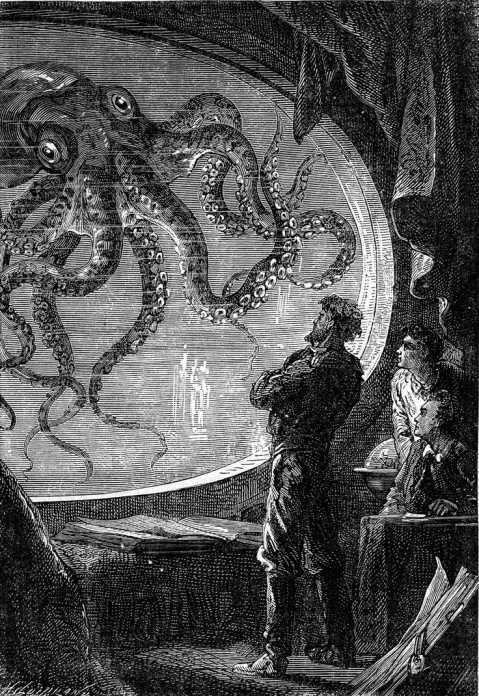
I can tell you the exact hour the new novel was born. I had gone looking for understanding of the steampunk phenomenon. I was aware of the movement; it seemed to always be in the periphery of my vision, but it wouldn’t come clear. Certainly Jules Verne, especially Twenty Thousand League Under the Sea, was steampunk before steampunk. So was the Wild Wild West, and both were staples of my childhood. I had stumbled onto Kenneth Oppel’s Airborn while teaching middle school. It was a fine novel which seemed on the verge of steampunk without completely fitting the mold.

Add a few inspiring steampunk short stories off the internet and childhood memories of reading my grandfather’s copy of Tom Swift and his Electric Rifle — also steampunk before steampunk — and I was ready to write something of my own. Still, it is foolish to write in somebody else’s genre without understanding the boundaries.

I visited a series to panels on steampunk while I was at Westercon 70. I found an inviting openness and nobody seemed interested in defending boundaries. I also came to appreciate the culture of steampunk (their term) and the joys of cosplay. Appreciate, not join in; I’m the guy in the corner, not the dressed up dude on the stage.

The panel which saw the birth of my new novel was called The Science of Steampunk: What Makes the Gears Go Round? As it turned out, there are steampunk authors who are perfectly happy to write their novels without caring what makes the gears go round, and there are also hard-science types who just can’t live that way. This panel had about an equal mix of those two.

They all had fun with the question, but the only scientific underpinning for some kinds of steampunk is magic. I enjoyed the interchange, and I want to thank Ashley Carlson, Bruce Davis, Steve Howe (not the guitarist), Susan Lazear and David Lee Summers — and Ryan Dalton who moderated — for the education.

As I was listening to the science types trying to find an equation for magic, it occurred to me that is would be great fun to write a novel which did tie up all the scientific and historical underpinnings of a steampunk world, neatly and realistically.

That was when two bombs went off in my head. I’m not ready to go public with what they were, but In the course of an hour, the new novel had gone from nonexistent to a full blown embryo. My thanks to the panel, but don’t expect any royalties.

396. Fire Again

It was nine o’clock at night upon the second of August — the most terrible August in the history of the world. One might have thought already that God’s curse hung heavy over a degenerate world, for there was an awesome hush and a feeling of vague expectancy in the sultry and stagnant air. The sun had long set, but one blood-red gash like an open wound lay low in the distant west.      ACD

Talk about atmosphere. I was copying those words from His Last Bow by Arthur Conan Doyle, a story about how Holmes and the opening days of World War I, when the helicopters started going over.

I was a teenager and then a draftee during the Viet Nam War, although I didn’t actually go there to serve. For many of my generation, helicopters are like the four horsemen. We don’t run out to smile and wave at the pilots when they go over because, for us, they represent death from above.

I’m about to change my mind about that. My new impression of helicopters is tied to the red and white Cal Fire ‘copters, with those huge steel buckets hanging down, which drop down to local lakes to carry water to fires. I’ve certainly seen plenty of them lately.

This decade, where I live, has been a decade of fire. I wrote a post on that subject less than a year ago, and here I go again.

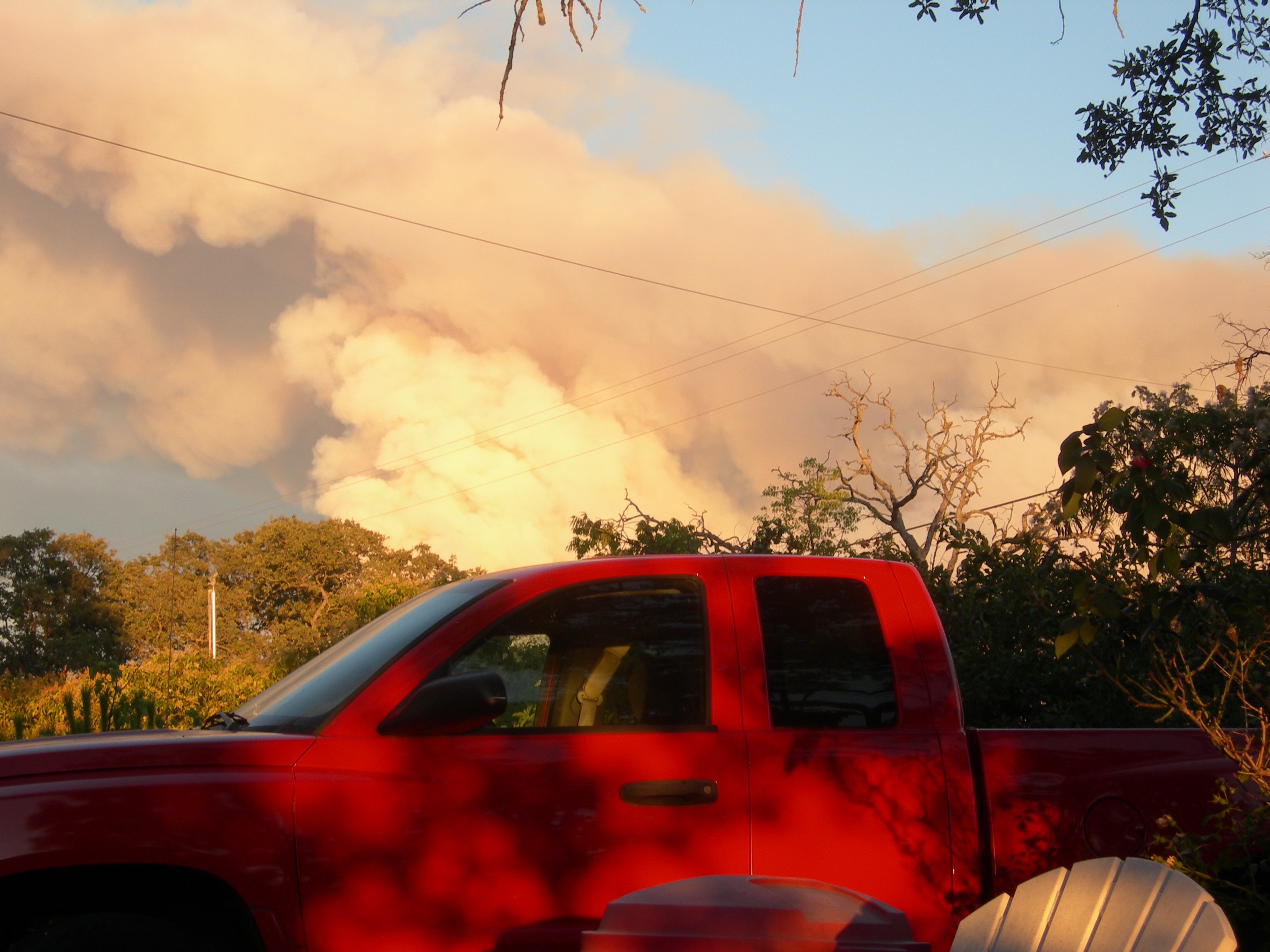
In the previous post, I opened with a picture taken from my front yard. I am opening this post with another, also from my front yard, taken a few weeks ago. In both cases, there is a lake between my house and the fire. The first fire burned 677 acres. This fire started in nearly the same place, but this time it burned 81,826 acres, so far, destroyed 63 homes, and threatened to destroy two nearby towns.

The day it started, my wife and I went down to watch the aerial ballet as DC 10s dropped fire retardant, spotter planes orbited high overhead, and Cal Fire helicopters carried tank after tank of water from the lake to douse the fire. This time they couldn’t stop it, and it eventually took thousands of firefighters to do the job. It still isn’t really over.

Then another fire broke out ten miles north of here and caused damage and confusion for two days. A day later, another fire broke out in the same area, and it is still burning.

Those helicopters I told you about? They weren’t part of any of those fires. They knocked down a fire less than a mile from my house. I heard them, closed my computer, and drove by back roads to a place I knew I could look without bothering the fire fighters. I needed to know if I should start loading the car to evacuate.

Nope. When I got to my overlook the helicopters had already knocked the fire down. To my eye, it looked like about twenty acres. When I turned around to come home, I saw a battalion of firetrucks arriving.

The helicopters got my attention at 4:55. I saw the knocked down fire at 5:05. It is now 5:45 and I am about ready to post this for tomorrow.

There aren’t enough words to thank firefighters, aerial and ground, but I do have two things to add:

I now keep my computer backup forty miles from here, and —

I’m thinking about moving to the rain forest.

395. The Sum of Fears

If you haven’t read today’s Serial post, go read it first.

We all have our fear-inducing creature, and for me, it is bears. Sharks? Nope. Wolves? I’d pet a wolf if it would hold still for it. But bears have my number.

It all started when I was a kid. The old black and white TV carried two stations, and one of them carried the program Cheyenne. I was eight years old when the series premiered, and big, quiet, gentle, soft spoken, confident Cheyenne Bodie became my picture of what a hero should be.

But there was this one episode . . .

Something was terrorizing the region. No one knew what it was, or even if it was human, animal, or supernatural. It came out of the dark night and killed, but there were never marks of claws on the crushed and mangled bodies. It scared the crap out of eight year old me.

Cheyenne set out to rid the ranchers of the curse. The thing hated campfires, and always attacked those it found around them, so Cheyenne went out alone, built a campfire, and took his place in a tree with rifle in hand. The night wore on — and wore on my nerves. The campfire burned down. Cheyenne left his rifle in a crotch of the tree and climbed down to put on more wood. As he was crouched over the fire, it appeared. Cheyenne reached for his six-shooter . . .

After the gun smoke cleared, we all found out that it was a giant grizzly, his claws burned off from a cubhood encounter with a campfire. Perfectly logical.

That bear still lives in my dreams. Be careful what you watch when you are eight years old.

And if that weren’t enough, there was the Bible. The old prophets who lived there were as real to me when I was a boy as the people who lived in my town. Every Sunday morning I avoided the boring sermon by looking attentive in the back pew, with downcast eyes and my bible open on my lap. There are a lot of exciting stories in that book, and one which was particularly troubling. I quote:

And he (Elisha) went up from thence unto Bethel: and as he was going up by the way, there came forth little children out of the city, and mocked him, and said unto him, Go up, thou bald head; go up, thou bald head.

And he turned back, and looked on them, and cursed them in the name of the LORD. And there came forth two she bears out of the wood, and tare forty and two children of them. (2 Kings 2:23-4 KJ Version)

Yikes! I was a fervent Christian back then and now I’m a card-carrying bald guy, but it seemed then, and seems now, a harsh fate for a bunch of kids who were just calling a bald guy bald.

Bears still scare Hell out of me, all out of proportion to their actual danger. So when I decided that Spirit Deer needed a demonic adversary to carry it through to the end, there was no question what it would be.

Two Hands and a Knife, which was always in my mind while I was writing Spirit Deer, was a boy’s vision of a long, adventurous vacation in the woods. Spirit Deer is more like what it would really be like if it happened. Two Hands and a Knife, was a perfect boys’ book; mine partakes of the realism I don’t ever seem to be able to shake.

So, a bear. I introduced him early, kept him simmering in the background until needed, and he will be there in a few more days for the climax, when . . .

No, that would be a spoiler.