Category Archives: A Writing Life

69. Site Tour

IF YOU HAVE ONLY BEEN DIPPING INTO THIS WEBSITE, THIS WILL SHOW YOU HOW TO ACCESS SOME THINGS YOU MIGHT HAVE MISSED

But first, an announcement. My upcoming novel Cyan has been delayed. It will be out in April or May, not in January as originally promised.

This has left me scrambling. About a dozen Cyan related posts which were scheduled for December and January had to be replaced with new, seasonally appropriate material. All that is done now, and things have calmed down.

So now —– welcome to the five cent tour.

This is post sixty-nine in the blog A Writing Life. The site is also called A Writing Life, which may cause some confusion. Since this is my first website, I learned as I went and not all my early decisions were the best.

This site has been up since August 31, with an arrival page called Welcome to my Worlds and two separate but related blogs. That was an early choice I have never regretted, although I’m sure some should-have-been followers have clicked in at the arrival page and never found either blog. No plan is perfect.

I had a backlog of material which I wanted to present in serial form, so my second blog was called Serial. There is another blogger’s rule: simple and straight forward is good; cute, clever, and confusing is bad.

As of today, there have been eighty-eight posts under Serial. So far I have presented a previously published science fiction novella (To Go Not Gently), a science fiction short story (Into the Storm), a vignette (Koan), two fantasy short stories (Blondel of Arden and The Best of Lies), a non-fiction piece (How to Build a Culture) and an excerpt from a contemporary novel (Symphony Christmas).

All of the above have been removed from Serial; otherwise, the slide from latest post to earliest post would take endless minutes. There will be one more fantasy short story, Prince of Exile, beginning next week, then Serial will morph into something different. Check it out in mid-January.

Except for Symphony Christmas, all the pieces removed from Serial have been moved to Backfile. They can be found on the Backfile drop-down menu, along with two other pieces that were never placed in Serial. They have all been returned to first-to-last order, but the original blog divisions have been retained as virtual chapters to make navigation easier.

If you actually click on Backfile, you will find a page with an annotated list of its final contents, divided into Fiction, Non-fiction, and Poetry. Clicking on a live poem will take you to the A Writing Life blog where it appeared. The other poems entries will be made live as they appear in posts. Five will be activated during December.

Library is an annotated list of my novels. About and Contact are just what you would expect them to be.

Wander around and enjoy yourself.

Filler

This week there will be posts Tuesday through Friday, to allow me to post on New Year’s Eve and Day.

Today, and during the rest of this last week of the year, I’m taking a hiatus, sort of, on the companion blog Serial by placing some of my favorite works by others. My fantasy short story Prince of Exile will begin there on Monday, Jan. 4th.

68. Nostalgia

Dec 25thAs a sort of disclaimer, let me assure you that Christmas Day, and the season that precedes it, is my favorite time of the year. I love everything about it, but that doesn’t keep me from also seeing it slantwise.

“It’s coming on Christmas, they’re cutting down trees . . .” It seems to be a sad and bitter beginning, but Joni Mitchell’s River is all about nostalgia, and so is American Christmas in the twenty-first century.

This goes deeper than surface appearances. The obvious nostalgia is for rural life and all its simplicities – clean snow, red barns, white farmhouses and a one horse open sleigh. In reality, there is nothing nostalgic about walking to the barn in the pre-dawn darkness to face three hours of chores at five below zero. Never mind; when I see that perfect scene on a Christmas card, I want to be there. Childhood memories of frozen feet don’t stand in the way.

Christmas literature today has come to mean movies. I know that there are new Christmas books every year, but they all seem to fall into a soupy genre I can’t bring myself to read.

Among movies, the original is A Christmas Carol, in all its iterations. It stands alone, a whole genre all by itself, and there is no nostalgia in it. No one wants to go back to the age of “prisons, and Union workhouses”, cold, hunger, and early death. Instead, the story is about the change in Scrooge as he considers the horrors faced by those around him, many of which are his own fault. The horrors don’t go away, except for the few people Scrooge can help, but Scrooge himself is redeemed.

Recently, there have been a spate of TV movies all asking, “will the girl get the guy by Christmas”? I leave them with that soupy genre of books, readily available for those who can stomach them, after pointing out that they have nothing to do with Christmas.

The rest of Christmas movies fall into one category, with one masterplot. They range from silly to profound, but they all have this in common: Santa is accused of assault, or loses his memory, or decides that he doen’t want to be Santa any more, or Santa Jr. doesn’t want to take over for Santa Sr..

Santa, and/or those around him, are on the verge of losing faith, but they are saved at the last minute by _______. Choose a crisis and a salvation, and write you own screenplay.

Don’t get me wrong. I love these films; I watch them all season. They have to be really bad for me to turn one off. But what is the one thing are all these movies nostalgic about? Faith, of course, which so many people today are clinging to by their fingernails.

If Santa stands in for Jesus – and even those who wish he didn’t, know that he does – then every time Santa once again proves himself to be real, that version of Christianity which proposes a warm, loving, all seeing, yet forgiving God is reaffirmed.

Those who are afraid to doubt out loud can sit back and let Santa, acting as a stand-in, reaffirm their faith.

I’ll buy in. For another Christmas season I will set aside my unbelief and bask in the feeling that someone out there will make all things come right.

Now get out from in front of the television; Miracle on 34th Street will be on in twenty minutes.

67. ‘Twas the Night . . .

220px-Diedrich_Knickerbocker

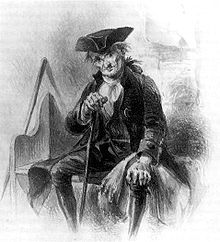
Everybody reads Washington Irving in college because he is IMPORTANT. Almost nobody reads him afterward for pleasure. Sleepy Hollow and Rip Van Winkle live in our racial memory, but nobody actually reads the stories.

I tried to read Knickerbocker’s History of New York and liked it as far as I got. However it was a satire disguised as a history, so I couldn’t enjoy it as fiction and I couldn’t trust it as history. My pleasure died of whiplash.

What does this have to do with Christmas? A great deal, actually. In his “history”, Irving included a dream in which

St. Nicholas came riding over the tops of the trees, in that self-same wagon wherein he brings his yearly presents to children

This is apparently the first introduction into American society of Sinterklass, the Dutch version of St. Nicholas from which our Santa comes. Others took up the banner. We will look at them below, but first let’s see what else Washington Irving did for Christmas.

In 1815, Irving moved to England, and five years later published his Sketch Book. Five of the chapters from that work, frequently published separately today as Old Christmas, extolled the nostalgic joys of the old, rural Christmas traditions of England. Widely read in the United States, it was instrumental in giving Christmas respectability at a time when it was reviled by the religious establishment and degenerating into drunken rowdyism among the working classes. 

Irving was a prominent member of the Knickerbockers, a conservative group opposed to the rise of the mob – that which most of us call democracy. They were particularly horrified by the excesses and vandalism of Christmas as it was practiced at that time. They worked to move the center of celebration from the street to the home.

In 1809, Irving published his History on St. Nicholas’ day. In 1810, the Knickerbockers released a broadside extolling St. Nicholas for his bringing of presents to good little girls and boys – and punishment to the rest. A poem about him appeared that same year. I won’t inflict all of it on you, but the last two lines tell you enough.

From naughty behavior we’ll always refrain,
In hope that you’ll come and reward us again.

Twelve years later another poem called the Children’s Friend was published, with “Santeclaus driving his reindeer o’er chimneytops” and giving gifts to the good little children, but still leaving a switch for the parents to use on the rest.

There is little question that Clement Moore, a Knickerbocker since 1813, knew Knickerbocker’s History, Old Christmas, and both poems when he wrote a poem of his own combining all the happy elements and leaving out the preaching and punishment.

A Visit from St. Nicholas, which we usually call ‘Twas the Night Before Christmas, was the result. Ironically, a group of grumpy, nostalgic elitists who loved order and discipline and hated democracy, eventually gave us a poem which would enthrall children for the next two hundred years.

*     *     *

The poem Children’s Friend is just good enough to be amusing rather than repulsive. You can see a facsimile of an original copy at http://pastispresent.org/2009/good-sources/christmas-treasures-flip-through-the-pages-of-the-children%E2%80%99s-friend/ .

Here it is in plain type. I would be surprised if you like it, but it may give you a greater appreciation of what Clement Moore made of the same materials.

Children’s Friend

Old Santeclaus with much delight
His reindeer drives this frosty night.
O’er chimneytops, and tracks of snow,
To bring his yearly gifts to you.

A steady friend of virtuous youth,
The friend of duty, and of truth,
Each Christmas eve he joys to come
Where love and peace have made their home.

Through many houses he had been,
And various beds and stockings seen,
Some, white as snow, and neatly mended,
Others, that seem’d for pigs intended.

Where e’er I found good girls or boys,
That hated quarrels, strife and noise,
I left an apple, or a tart,
Or wooden gun, or painted cart;

To some I gave a pretty doll,
To some a peg-top, or a ball;
No crackers, cannons, squibs, or rockets,
To blow their eyes up, or their pockets.

No drums to stun their Mother’s ear,
Nor swords to make their sisters fear;
But pretty books to store their mind
With knowledge of each various kind.

But where I found the children naughty,
In manners rude, in temper haughty,
Thankless to parents, liars, swearers,
Boxers, or cheats, or base tale-bearers,

I left a long, black, birchen rod,
Such as the dread command of God
Directs a Parent’s hand to use
When virtue’s path his sons refuse.

Yeah, me too! Same as you, I’ll stick with The Night Before Christmas.


66. Five by Dickens

DSCN3975 Everybody knows the story of Scrooge. Everybody from Alistair Sim to the Muppets to his namesake duck has played him. I won’t waste your time talking about the story, but have you read him?

Everybody knows Dickens, but did you like him when you met him? I didn’t, in high school. Great Expectations was the most boring, pointless, excruciatingly unending experience of my reading life. My only expectation was that it had to end eventually, and my only hope was never to have to read Dickens again.

A Christmas Carol isn’t like that at all. It is a joy to read.

Marley was dead, to begin with. There is no doubt whatever about that. The register of his burial was signed by the clergyman, the clerk, the undertaker, and the chief mourner. Scrooge signed it. And Scrooge’s name was good upon ‘Change for anything he chose to put his hand to.

You can’t beat writing like that. And it’s short; it makes its point and shuts up.

There seems to be something magical, or at least natural, about novella length. A Christmas Carol and The Old Man and the Sea were both novellas, and either would have been destroyed if it had been stretched out to novel length.

(TOM&TS a novel? Forfend! You’d need the heart of a bookseller to make that claim.)

Dickens was in financial and artistic trouble when he wrote A Christmas Carol and it was the making of the rest of his career. You can get the whole story of its origin from either The Man Who Invented Christmas by Les Standiford or Inventing Scrooge by Carlo De Vito.

A Christmas Carol was prefigured by the story of Gabriel Grub, chapter 29 of The Pickwick Papers, a story within a story which is often reprinted separately today under the title “The Story of the Goblins Who Stole a Sexton.” Old Grubb was so miserable that he chose to spend Chrismas night in a graveyard to avoid human contact. Goblins caught him there and put him through miseries which led to his redemption. The parallel is obvious.

After the ringing success of A Christmas Carol, Dickens wrote another Christmas novella during each of the succeeding four years. These five little books were published together during Dickens lifetime as Christmas Books. That version, with original illustrations, is avaliable from the series The Oxford Illustrated Dickens.

That volume often appears in bookstores seasonally, but you don’t have to seek it out. There will be some kind of Dickens Christmas collection every year. I have in front of me A Christmas Carol and other Christmas Classics, 2012, Fall River Press, which has the five novellas and seventeen other Dickens seasonal stories. Again, however, there is nothing special about any particular version. The stories have been around a hundred and seventy years and they don’t change.

Yesterday, I saw this year’s version in Barnes and Noble, leather bound, red, with gold and white pen style illustrated cover. This version is called A Christmas Carol and other Christmas Stories. It looks like the kind of book you would put in the living room to impress your snooty guests, but the stories inside don’t care about the cover.

As a point of honesty, I slipped into the B&N website just now to confirm my memory. This version was the 300th book that came up when I searched Dickens Christmas. Obviously more people buy Dickens than read him.

A few years ago I decided to read one of the other stories each year at Christmas time. That isn’t as logical as it seems, since Christmas is not a time of leisure. I eventually got through three and a half of the other four. I read The Chimes first and enjoyed it. It was something of a Christmas Carol reprise, and not as good as the original, but worth reading. A Cricket on the Hearth was once the most popular of these books. I didn’t get through it, not because I wasn’t enjoying it, but because that was the year time did me in. I still plan to read it someday. Maybe June would be better. The other two were worthwhile but not earth shaking.

For the sake of completeness, the Dickens Christmas books, in order, are:
     A Christmas Carol
     The Chimes
     A Cricket on the Hearth
     The Battle of Life
     The Haunted Man

65. Winter Solstice

DSCN1841The calendar says “first day of winter”. The astronomically inclined say “winter solstice”. Since this is the day that the sun appears to be as far south as it ever gets, it bothers me sometimes that the first day of winter (speaking with a northern hemispheric bias) comes when, by the sun, winter should be half over. That feeling comes of having a certain kind of over-picky mind; pure experience, of the shivering kind, recognizes that there is a delay effect in seasonal changes. Meterologically speaking, the phrase “first day of winter” fits pretty well. It’s going to get a lot colder before it gets warmer again.

What if it didn’t get colder, or warmer? What if we had no seasons? What would that do to your heating and cooling bills? What would it do to your wardrobe? Would you even wear clothing?

It’s easy enough to arrange; just choose a planet with no axial tilt. Like Cyan.

Late in the novel Cyan, while some of the scouts are on a rescue mission to save a group of Cyl (non-human natives) by transferring them to the southern hemisphere, we get a detailed picture of what Cyan looks like.

In the cockpit, Debra was alone with her thoughts while Tasmeen attended to piloting the landing craft.  The sky outside was black with stars. She had never expected to see the stars from space again. Beneath them, Cyan spun lazily. Clouds blanketed various portions of the temperate zone where humans lived, and only a bit of the torrid zone which was the domain of the Cyl. Further north than that, where Keir and the children were, clouds massed high and storms raged.

The lower latitudes passed beneath them. This was the band of eternal desert, where every island and fragment of a continent was dry lifeless rock studding a lifeless sea. There were few clouds here, but ahead of them now was the equatorial cloud band. The heart of the great heat engine that was Cyan, where the water steamed in the relentless light of Procyon A, pumping moisture into the atmosphere and sending it northward and southward, over the lifeless bands too hot for coalescence and on up toward the dry Cyl lands and the wet human lands and the great snowcapped poles.

They passed the clouded equator, the southern dead zone, spiraling down toward the southern torrid, the zone where neither Cyl nor man had ever set foot, and where the Cyl could live secure from the depredations of man.

Aside: Cyan was originally scheduled for publication in January, but has been pushed back to April or May.

64. ‘Twas the Season (post 2)

DSCN1839 Yesterday, I left you shivering, but I don’t want you to get the wrong impression. I didn’t hate my childhood on the farm – I loved it.

But I wouldn’t do it again for a billion dollars.

Our Christmas was not typical because we worked every day, and because my parents were committed Southern Baptists. So was I, except at the end, and even then I was a closet unbeliever. They never asked, and I never told, so even during my last two years at home I went to church three times a week, sang the hymns, prayed aloud when called upon (that was particularly hard) and lived a Godly life.

My parents appreciated Christmas, but not as the secular holiday it has become. They saw it as a celebration of the birth of Christ.

There was no Santa in our house, although no one was offended when someone sent a Christmas card with the old fellow flying his sleigh. From my first memory, I knew Santa was only a myth that other parents told their children about. It was fun to hear about Rudolph in the song on the radio, but at home we sang Silent Night and O Little Town of Bethlehem.

We had a tree, decorations, Chiristmas cookies, presents, lights, ornaments, and all the rest. But nobody came down the chimney, and the presents were labeled from Mom and Dad, or from Grandpa, but never from Santa.

We didn’t do Christmas morning anyway. We opened our presents on Christmas Eve after the evening milking and supper were over. That was a matter of practicality. Christmas morning, like every morning, began with three hours in the dairy barn.

It was still fun. One year Hallmark came out with lick and stick ribbon, and taught classes in how to use them. My mother took the class and taught me. That year all the presents I wrapped were decorated with ribbon snails and ribbon roses.

It was fun, but it wasn’t jolly. My parents were quiet people, and since I had no brothers or sisters to bounce off of, I never learned to be boisterous. Even today, when I see people cheering on their favorite sports team, I have no real understanding of why they act that way.

There was no Christmas service at church unless Christmas happened to fall on a Sunday. The business of the church, we were reminded often, was not fun and games or helping our neighbors with their troubles. A good Christian might help a neighbor in need, but the church did not. The church was in the business of saving souls, and nothing else.

If Christmas fell on Sunday, the sermon would begin with the story of Christ’s birth, but somewhere around the middle it would morph into hellfire. The only reason the birth of Jesus means anything, we were told, is because of the crucifixion and resurrection at the other end of his life.

Still, I enjoyed my life and I enjoyed Christmas. If it looks a bit grim in hindsight, at the time it just seemed normal.

Recently, PBS did a special on the Pilgrims. They were the no-fun champions of the world, ranking right up there with jehadis. As I watched, I was amused by the knowledge that it only took a couple of generations for their offspring to kick over the traces and become Baptists, because even that seemed like more fun.

Eventually, I left home for college in Michigan. The first year I was there we got the snowstorm of the century, 24 inches in 24 hours. The campus was snowed in for a week and I loved every minute of it.

The summer after, I met the girl who would become my wife. She was filled with a massive and infectious sense of joy. We were married in 1969 (post 27.  That Was My Childhood) and that first Christmas was wonderful beyond anything I could have imagined. So were the next forty-four. Likewise the forty-sixth, when it comes next week.

63. ‘Twas the Season (post 1)

DSCN1795A white Christmas – it’s a cultural heritage, even for those who never share it directly. Hawaii and Florida get their snow on TV and Christmas cards. Californians go to the mountains where the snow is cold and deep, then return home and string Christmas lights on their palm trees.

During my childhood, Oklahoma was on the border of the snowfall. We had snow, but it was rare and sparce; never fluffy, but hard and small like buckshot. We occassionally had no-school days because of snow, but not for reasons you could anticipate. An inch would fall during the night, accompanied by monster winds. Come morning, the fields would be blown brown and bare, and all that snow would be deposited in the roadways, trapped between the barbed wire fences on either side, three feet deep and impassible.

I do remember that the front yard was once covered with snow, an inch deep held up by the brown, dead grass. It was a chance to make my first snowman. I rolled snow for what seemed like hours and finally had stacked him up three feet high – a lumpy, anorexic figure with stick arms and nose, rock eyes, and a borrowed hat. Unfortunately, the whole yard was rolled bare to make my snowman.

Oklahoma in winter was brown everywhere – except where it was green. There were fallow fields, winter stripped trees, prairie grass pastures cropped close and brown by cattle, but there were also field of winter wheat. Planted in the fall and harvested in the spring, those fields were as green as Ireland throughout the winter. Our dairy cattle were grazed on winter wheat. It was a major boost to our income, but what green wheat did to their digestive output I won’t detail in a family friendly post.

For two thousand years, Christmas has been part of the agricultural cycle of the seasons. Even in the sixties, the seasons ruled our activities. In spring, we harvested winter planted crops and planted for the fall harvest. In summer, we bailed hay both commercially and for ourselves. The cattle were bred to drop calves in autumn. Through the summer they were mostly dry and needed little care, but they came into milk production just as the last fall harvest was over, and kept us working – and earning a living – through the long months of winter.

And it was work; and it was cold. The coldest I remember was five below, but zero was not uncommon. That might not seem like much, but come along for the ride.

Each day began about 4:30 when my dad opened the bedroom door and growled, “Get up!” in a voice you wouldn’t even consider not obeying. I would spend the next half hour crouched in the living room in front of the space heater putting on three layers of clothing, warming each piece individually. I don’t know why I bothered; the wind pierced to the skin within the first five seconds of leaving the house.

Morning milking took about three hours. Unlike the other seasons, I didn’t have to go get the cattle; they were waiting impatiently for the grain they would get while they were being milked. I won’t describe the process again (see post 47). The floor was concrete, deep frozen overnight, and the cold telegraphed up through thin boot soles all the way to your knees. At least when I had to walk outside, I didn’t sink; the mud-manure mixture was frozen to brown cement. When the milking was finished, my dad would drive out into the pasture to distribute hay while I stayed behind and washed up all the milking machines, strainers, and milk cans. Then it was a mad rush through breakfast and a bath (twice a day, every day, you can figure out why) in order to dress and catch the bus for school.

I loved school, and not just because I was scholarly by nature. It was warm inside.

Home in the afternoon, with an hour to do my homework, then out to the barn to do it all over again.

Every day, seven days a week, all winter. Including Christmas.   More tomorrow.

62. A Christmas Booklist

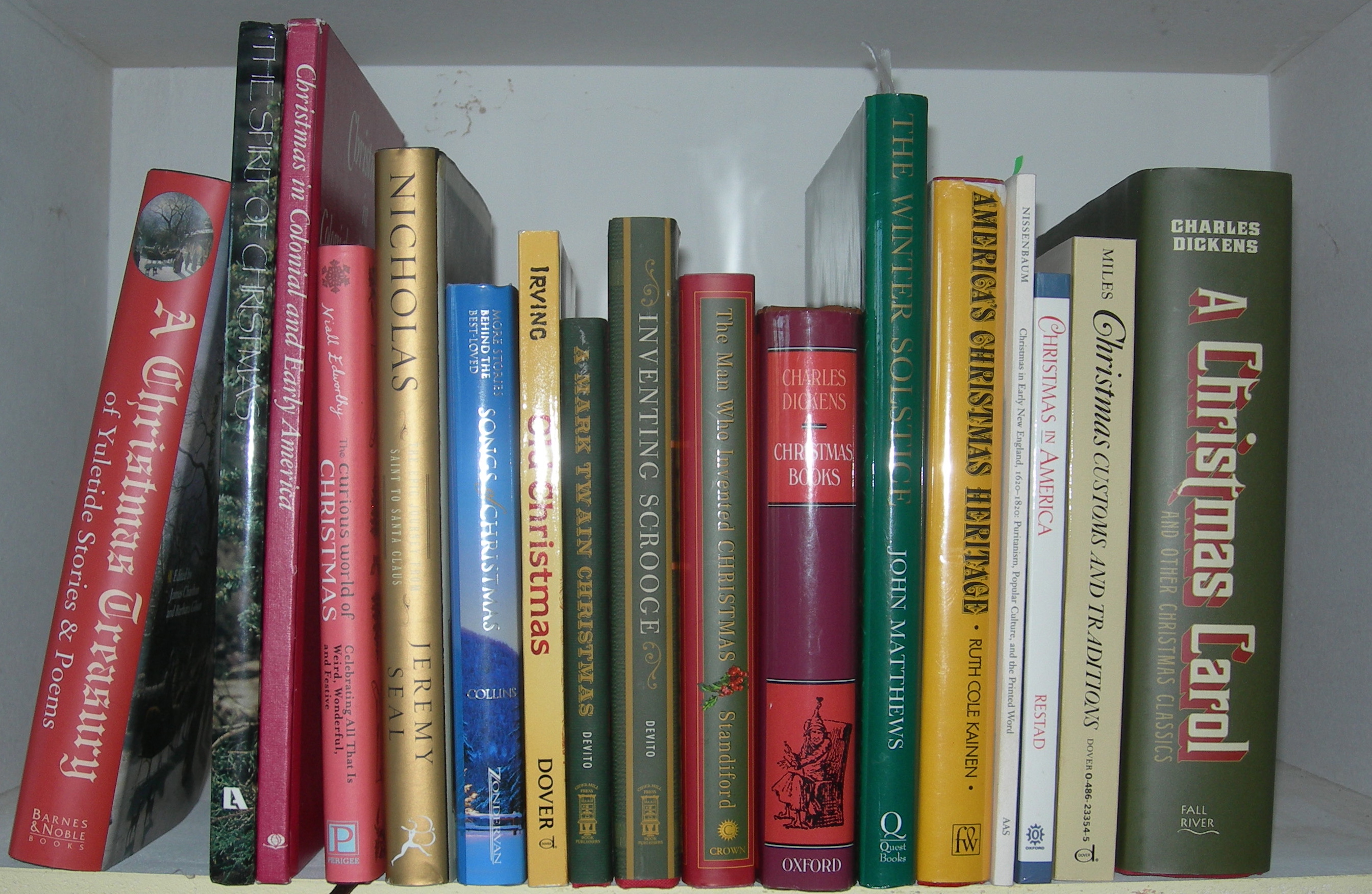
DSCN3974 Here is the annotated booklist I promised you yesterday. You could also Google Christmas or old Christmas, or search either of those subjects on Amazon. I suggest you do. This is not a best list because there are too many books on Christmas for anyone to have read them all. This is simply a list of what I’ve discovered over the years, minus the clinkers. Some of these are easy to find, others will lead you through the back stacks of used bookstores, but there’s no harm in that.

A Christmas Carol by Dickens has to head any list. He also wrote many other Christmas works and gets his own post next Wednesday, the 23rd.

Washington Irving had a powerful influence on Christmas, which is largely forgotten today. Among his followers was Clement Moore of Night Before Christmas fame. They also get their own post, on Christmas Eve.

The rest of this list is in order from decorator froth to historical complexity.

Go to any bookstore and you will find dozens of Christmas cookbooks and books on Christmas decor, sometimes with historical tidbits. You’re on you own here, with one exception. The Spirit of Christmas series by Leisure Arts is classy, has been around since about 1990, and fills up ten pages of Amazon with choices.

Christmas in Colonial and Early America, 1975, by World Book, is an early, sepia toned version of this kind of book with a little more meat in it’s history.

For almost two decades, Ace Collins has been writing books titled Stories Behind . . . , beginning with Stories Behind the Best-loved Songs of Christmas. The title tells the tale; the individual stories are interesting and heart felt.

The Curious World of Christmas is lightweight and breezy, a book of short entries which can be digested one little bite at a time.

The only recent Christmas book I can’t recommend is Nicholas, by Jeremy Seal. I found it dark and tedious, and couldn’t get past page 42, but if you want a detailed look at how St. Nicholas became Santa, it’s the only work I know completely devoted to that subject.

The Man Who Invented Christmas by Les Standiford and Inventing Scrooge by Carlo De Vito each tell the story of the genesis of Charles Dickens’ most famous story. As a writer and a lover of Christmas, I couldn’t choose between them. Read the one that is easier for you to find. Then read the other one next Christmas.

A Mark Twain Christmas has been sitting on my next shelf for a couple of weeks. I will give it a tentative approval based on a thumb-through, and the fact that it is also by Carlo De Vito.

A Christmas Treasury of Yuletide Stories and Poems by Charlton and Gilson has works by every famous author you’ve ever heard of, from St. Matthew through The Adventure of the Blue Carbuncle.

Ruth Kainen’s America’s Christmas Heritage contains well written regional histories of Christmas at a level of detail that is satisfying without being overwhelming.

John Matthews’ The Winter Solstice has a look similar to the decorator/cookbook works above, but with a unique twist. It concentrates on the Roman, Celtic, and Germanic contribution to Christmas. It feels like the Middle Ages, without falling into the trap of New Age Gaia worship.

Christmas Customs and Traditions by Clement Miles is a Dover reprint of a 1912 work. It is an old fashioned history of the evolution of Christmas from Roman times to what was then the present.

Christmas in America by Penne Restad is a scholarly telling of the history of American Christmas. 172 pages of text, 36 pages of notes. You get the picture; a book for the overeducated Christmas nerd, but it is still a good read.

The remaining “recommendations” are probably over the top.

I have in front of me Christmas in Early New England, 1620-1820: Puritanism, Popular Culture, and the Printed Word by Stephen Nissenbaum, published by the American Antiquarian Society. I have already confessed to having two masters degrees, one in Social Science and one in History. This is the kind of thing I used to read for a living. I still read them, but only if they are on a subject that really interests me. Nissenbaum taught at Amhurst; you will find his original research referenced in many of the less scholarly books above. His book The Battle for Christmas was a Pulitzer Prize finalist, but a scholarly work of 400 pages is not something to take on casually. I confess to not owning it; I read it on interlibrary loan years ago. If, however, you are a Christmas nerd and a history buff, it is available in paperback. Go for it; what have you got to lose?

Now it’s your turn. Since blog posts hang around forever, any reply you make to add your Christmas recommendations will remain attached, even if I repost this next Christmas.