Tag Archives: fantasy fiction

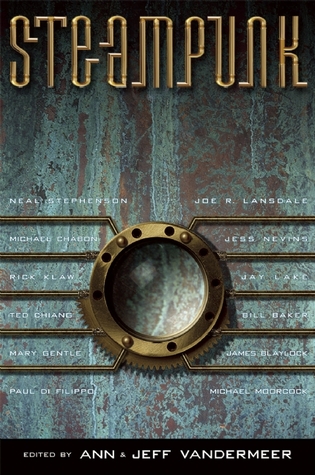
413. Wherefore Art Thou Steampunk

As they teach us in high school, when Juliet says, “Wherefore art thou Romeo?”, she means why are you called Romeo, and then goes into a long bit about identity. This post will do the same thing.

I have been writing a steampunk novel since July, and it is going quite well. I am roughly half way through the first draft, and doing my world building as I write. I am also researching what it means to be steampunk.

My justification for writing in an unknown genre is that it really isn’t all that unknown. It is a first cousin to science fiction, to fantasy, to horror, to the novels of Verne, to alternate history when limited to the near-Victorian, to Edisonade (a new name to me for a sub-genre I’ve been reading all my life — think Tom Swift), and to the old west with neo-mechanical devices (a genre that existed long before the Wild Wild West). I’ve been reading all of these, all my life.

The name steampunk was proposed by K. W. Jeter in a letter to Locus. Jetter, James P. Blaylock, and Tim Powers are three big names in early steampunk, but the genre has come a long way since then.

You would be surprised how much research into obscure subjects lies untapped in college libraries in the form of Ph.D. dissertations. I have learned to use the internet to seek them out, since so many of the things I am interested in are quite obscure.

Mike Perschon’s 2012 dissertation The Steampunk Aesthetic can be accessed at https://era.library.ualberta.ca/files/m039k6078#.WbA9kcdllBw. On that page, click Download the full-sized PDF if you want to follow me down that rabbit hole. If not, you could just try Perschon’s website http://steampunkscholar.blogspot.com.

No? Neither? I don’t blame you. Not many people have that much itch, so hang on and I will quote a few of Perschon’s conclusions.

Accordingly, this is not a study of Victorians or Victorianism, but rather a study of steampunk’s hodge-podge appropriation of elements from the Victorian period.

Non-speculative neo-Victorian writing is characterized by an adherence to realism that steampunk rarely cleaves to.

Steampunk (is) not . . . historical fiction per se, but . . .  speculative fiction— science fiction, fantasy, and horror, all mixed into one—that uses history as its playground, not classroom.

The most useful thing Perschon said, from my perspective, is that steampunk is not a genre, but an aesthetic. I had largely come to the same conclusion. The question for me has become not, “is it steampunk,” but rather, “does it taste like steampunk”.

I found that the more carefully I researched the Victorian past, both historically and technologically, the more I was attempting to make my novel fit a set of limitations. I was approaching it the same way I approached Cyan, where I first created a world with certain characteristics, then worked my story around it.

Steampunk doesn’t seem to work that way. In steampunk, an author has an idea of what his world looks like, then comes up with some quasi-magical dingus to make it work. Do you want your airship to be able to lift more and go faster? Invent a gas that never existed. In science fiction terms, it’s more Star Wars than Heinlein. There is nothing wrong with that, but I’m having a hard time wrapping my head around it.

In addition to academia. I am also half-way through a half-dozen recent steampunk novels. I would be further along, but I’ve been a bit busy writing my own. I’ll clue you in on those novels as I finish them.

409. Man Stuff

I wrote this last Thursday. The post, not the quotation.

          Marquart and Dael took a bench in a completed corner. “Tell me how you have things arranged,” he said.
          “None of the wardens will leave their houses until late in the morning. The first will arrive here about midday. We will have roast krytes ready by then . . .” Marquart waved away her recitation. He didn’t care about preparations for food and drink; he was satisfied that there would be plenty of both.
          “Who will sleep where? Who will arrive first, who will stay latest, who will want to get me alone to talk to, who will get drunk quickest, who is likely to pick a fight, and with whom?”
          “Oh, man stuff.”
                                          from Valley of the Menhir

Today, I was writing chapter eleven of my latest steampunk novel. So far my hero (I don’t do wimpy protagonists) has served aboard four dirigibles and has risen in rank from Sub Lieutenant to Lieutenant Commander, brevet, in the British air service. These craft are the result of an unscrupulous Brit who, through theft, intimidation, and assassination has crippled the German airship effort and stolen all their ideas.

Earlier this morning (as I wrote) Lieutenant Commander David James and I settled thirty passengers into their berths on the Henry V, a dirigible of war acting as a passenger vessel carrying diplomats the the Grand Durbar in Delhi. If you don’t know what a durbar is, you’ll find out in coming months. David hated every minute of it.

Then we got a break of several hours as he got to go back to his real job as the lowest member of the group of senior officers, seeing to details as the dirigible, nicknamed Harry in reference to Shakespeare, leaves London for Paris. We have been following David’s career for eleven chapters now, and he has done a little bit of everything as he worked his way up. He will do even more in the future, and we will (metaphorically) stand at his shoulder and give him our moral support.

Man stuff.

The year is 1887, Victoria is on the throne, and our Britain is even stronger than the real one was since they just won the German War, largely through a squad of spies and assassins that remains Britain’s guilty secret. David is one of the few Brits who knows this.

Now its time for me to take David by the shoulders and march him down to the lounge to preside, as a stand-in for the massively scarred Commander VanHoek, over the first evening meal of the cruise. He hates the idea. Actually, so do I. In writing, as in life, sometimes if you want to go to a certain place, the path to get there passes through places you would rather avoid.

I’ve been researching Victorian aristocratic gossip in order to build a world like yet unlike our own. It’s not my cup of Earl Grey, but it is the job I’ve taken on, and I will do it well. Well enough, in fact, to move my readers through the event without arousing their distaste. That’s the writer’s equivalent of “never let them see you sweat”.

Still, I’ll be glad when the dinner is over so David and I can get back down to the engineroom where we can try to get another horsepower out of those damned, recalcitrant McFarland engines.

Man stuff.

405. Blondel’s Future

You really should go to Serial and finish Blondel of Arden before you read this post.

#                    #                    #

I enjoyed writing Blondel of Arden. I like formal language, and I don’t get to use it often. I also rarely get the chance to write something completely light.

Blondel was pure fun, with every possible cliché in place. Quite sexist, actually. Somewhat like John Wayne and Maureen O’Hara in McClintock or in The Quiet Man. She gives him hell in both movies, and he paddles her at the end. (Pun unintended, but noted.) That is actually more than I can tolerate and I usually turn the TV off somewhere short of the end.

I understand the bondage symbolism in this kind of fiction. The climax of McClintock when O’Hara is running from her husband with all the town cheering him on is too much like a rape scene with spectators for my taste. I stopped well short of that in Blondel of Arden.

Blondel is a cynic, Grat is an innocent, and Sylvia is a twit. That’s thin characterization, but adequate for a short semi-comic piece. I enjoyed this brief encounter with more-or-less cardboard characters.

However, I’m a sucker for people, even people on paper. I thought Sylvia had some quality hidden beneath her flirtatious exterior. I liked her. I thought she had potential.

You have to understand that I wrote this many years ago. I thought of turning it into a novel, but I never will. I have four or five novels waiting in the wings now, and by the time I finish them, I’ll have a half-dozen more tugging at my sleeve.

But when I was considering a novel, this is what I had in mind —

#                    #                    #

Sylvia returns home, sans broach, to a pointless round of “women stuff”. She hates it. She misses the one great adventure of her life. She also reviews he own behavior, and finds it wanting. Grat and Blondel served her well and she served them with contempt. She broods about her behavior, and works to make herself better in her everyday round.

This is not enough. She owes a debt. (See, I told you she had quality.) If she can’t pay it, she can at least acknowledge it.

Something – I don’t know what – happens which frees her from her obligations at home. She sets out to find Blondel and Grat, to do something for them if she can, or at least to say thank you and I’m sorry I was such a twit.

Blondel and Grat have become companions. Grat is beginning to lose his innocence. Blondel fears that it is from associating too closely with him. Grat is also lovesick; Sylvia was his first romance and he can’t forget her. Blondel finds this alternatively endearing and irritating.

Blondel’s crust is thinning, and that is dangerous. He is a smart, little guy in a world of ignorant, thundering clods. His ability to “do unto them” quietly and unnoticed is his only defense. Every time he does something self-serving – which is basically how he survives – Grat looks on, once again disappointed in his friend.

Sylvia eventually finds them and joins them. Nobody is really happy with the arrangement. Any pair of the three could find a way to coexist, but the three-way relationship cuts too close to each of their hidden weaknesses.

Each person finds him/herself in peril and escapes that peril only through the aid of the other two. Grat and Sylvia grow in romantic love, while Grat has to wrestle with the understanding that Sylvia is no longer a damsel in distress. Blondel, to his external disgust and his disguised satisfaction, find himself in an avuncular relationship with these two innocents.

What perils? How do they overcome them? Beats me. Writing peril and escape are the easiest parts of writing a novel. They will present themselves as needed, if you know your characters and where they are going to end up.

I was also planning to use this as an excuse to build a story around a fantasy version of the Field of the Cloth of Gold, a real event in 1520 when Henry VIII of England and Francis I of France held an extravagant series of jousts in the fading days of classical knighthood. Think kings in golden plate armor whacking each other for sport and bragging rights, in a world where cannon balls could blow fist sized holes through either of them if the battle were real.

This gives us three real and relatable people trying to survive on the fringes of empty magnificence. Now the kings are cardboard — which is their normal state of being.

I don’t have time to take six months to write this novel, but I would love to spend two days reading it.
Blondel 13

“Now, Grat,” Blondel comforted, “not so dramatic, please. Tell me what happened.”

“The brooch is missing and she accused me of stealing it.”

She, then; not Sylvia, any more. Blondel fought hard not to lose his look of concern and asked blandly, “But when would you get the chance to steal it? It hung between her breasts, beneath her bodice.”

Grat flushed and said, “Well, this afternoon . . . by the river, uh . . . Well, dammit, she was willing!“

Now Blondel grinned outright. “At least your day wasn’t a total waste.”

That was no comfort. Grat caught Blondel’s arm and said, “Her father does business with Duke Corrin and his men are after me. What am I to do?”

“I have a fast horse. It is saddled, and it is yours.”

Grat wrung his hand in gratitude and cried out his thanks.

Blondel said, “It is the least that I can do. I held the illusion as long as I could.”

Grat’s mouth dropped and he shouted, “You left the real brooch on the trail?”

“I told you I couldn‘t hold the illusion at a distance. They would have had us otherwise.”

“But why didn‘t you tell me?”

“When, Grat? When could I have gotten you alone? She was on you like lice all the last two days.” Then he chuckled. “Besides, if I had told you, you would have missed this afternoon by the riverbank.”

A broad grin creased Grat’s face. “Aye. That‘s right.” Then he cocked his head, hearing voices beyond the tents, and bolted for the horse Blondel had tethered nearby. Leaning down from the saddle, he thrust out his hand and said, “If we ever meet again, I am your man. You‘ve saved me from a terrible fate.”

Blondel took his hand. “Yes,” he said, thinking of Sylvia. “I think I did.”  finis

Blondel 12

Blondel looked up at Grat, quietly pleading for understanding. “I had to do it, he said. “We will need a fast horse, and soon.”

Sylvia rode, and Grat strode along beside her, smiling at her jokes as she chattered away the morning. From time to time she reached out to touch Grat’s hair or beard, but she never offered to let Blondel ride. He trudged wearily along behind them, still holding the spell of illusion. Grat had asked last night if he could hold it at a distance, and he had replied, “Not far. Not far at all.”

#                  #                  #

Between the Andis and the Raipiar rivers, above their confluence, there was a meadow spotted with trees. Now it had been converted into a tent town with twice a thousand inhabitants. There were wares and entertainments of every description in a moving mosaic of colors and flesh, with rushing children and dogs, and pigs roaming the littered streets, occasionally toppling a tent as they rooted out its pegs in search of garbage.

Blondel took his leave and his horse at the edge of the crowd. “I‘ve some friends to meet, and some business to attend to,” he told Grat, “but if you find yourself in need, come to Chiana‘s tent.”

Grat took his leave hurriedly. By her carriage, Sylvia was making it clear that she was through with Blondel and that if Grat wanted her favors he had better be quick. Blondel watched the crowd swallow them up, following Grat’s unkempt head as it sailed unworried above the mass of smaller men. Then, smiling with world weary understanding, he let go of illusion.

#                  #                  #

Something less than three hours later, Grat staggered through the back flap of Chiana’s tent looking as if the hounds of Hell itself were at his heels. The shallow parallel scratches that decorated his cheek were Sylvia‘s brand, and he stood panting like a stag at bay. Blondel came quickly up from the narrow patch of shade where he had been dozing and offered Grat the dregs of his winehorn. Grat emptied it at a draught and hurled it to the ground, shouting, “I am undone!” final post on Monday

Blondel 11

They reached the road as the sun was rising. There had been no pursuit, and Grat asked, “Do you think they found the brooch you left?”

“I have no doubt of it.”

Grat looked uneasily over his shoulder, for the road was no haven of safety and they would be two days afoot before they reached the Faire. “How long before they find out what you have done?”

“I will keep the illusion up as long as I am able,” Blondel said, but he looked uneasy.

They made good time despite Sylvia. She walked at Grat’s side, leaning on him perhaps a bit more than was strictly necessary, and Blondel plodded wearily along behind. At first Grat wondered at his loss of vigor; then he decided that Blondel was still trying to hold the spell of illusion. He tried clumsily to express his gratitude, but Blondel only shrugged it off.

Grat left Sylvia to walk with Blondel for awhile. She did not drop back to join them, but continued doggedly ahead, looking back from time to time toward Grat. He seemed oblivious to the invitation, but Blondel was not so sure.

Throughout the afternoon they talked, and Blondel found Grat a boon companion, and a strange one. His years as a guard had not made him cynical and his rough demeanor had sloughed off now that he considered Blondel a friend.

Grat had been on his own since he was very young and even now his stature was belied by the youth in his eyes and the wonder in his speech. He was the stuff knights should be made of, but rarely were, and Blondel stopped regretting the efforts he had made. Grat, at least, was worth rescuing.

Blondel tried to warn him of what lay ahead, saying, “Not all things are as they seem.”

Grat mistook the meaning of his words and replied, “I know that Sylvia has been harsh, but she is alone and frightened.” When Blondel would have spoken more plainly, Sylvia dropped back to lead Grat’s thoughts astray with gay chatter and a hidden, cutting glance for Blondel.

Blondel fell back again, chewing on the future, for Grat’s open friendliness had touched him deeply.

They spent the night at an inn. The innkeeper’s wife took pity on Sylvia‘s condition, helped her to bathe and provided her with simple but untattered clothing. Grat dozed in the corner, giving his wounds a rest, and Blondel played bones with the innkeeper and hostler. When they left the following morning, Grat found that Blondel had won a small purse and a saddled horse.

“Blondel,” Grat said, “you are shot through with luck.“

Blondel scowled. “I augmented my luck last night.”

Grat was shocked. “You spelled the bones! After the innkeeper took us in from pity!” more tomorrow

Blondel 10

“They say it is magical,” Sylvia added.

“They lie.”

Blondel handed the piece to Grat, who turned it in his big hands, not really knowing what to make of it. “The centerpiece is sapphire,” Blondel said, “but of very inferior quality. The surrounding gems are emeralds of some value, though small. It would bring perhaps a hundred crowns on the black market; maybe thrice that if one could establish unencumbered ownership.”

Grat weighed the piece in his hand. “A hundred crowns? I doubt if I’ve made that in the last ten years. “

Blondel reached out for the brooch and Grat hesitated before returning it. Sylvia was beginning to look worried. “Aye,” Blondel said, “those outlaws would chase us to Hell for it.”

He continued to stare at the brooch, and Sylvia reached out saying, “Give it back.”

He shook his head and said, “Bide a moment. I have an idea. If this were left on the trail for the outlaws to find, all pursuit would cease.”

“Now just a minute!” Sylvia said, reaching for the brooch again. Blondel drew it back and Grat moved menacingly toward him.

Stop!

Sylvia froze, looking foolish, and Grat eased back on his haunches again. When Blondel chose to stop playing and project his will, his voice became a weapon of no small value. Even the crickets in the grass beyond the fire had fallen silent.

“It would not be necessary to leave the brooch, of course,” Blondel continued. “Only to make them think that we had.”

“How?“

“By creating a doppelganger of it.”

“You can‘t do that,” Sylvia snapped.

“No? I can‘t talk to foxes either, can I?”

She subsided. Blondel closed his hands about the brooch, bent forward and began to croon in a language strange to his companions. Grat felt the hairs on his neck begin to rise and reached for Sylvia‘s hand. She let him take it.

Ten minutes later, Blondel’s voice died away and he raised his head, stretched the muscles of his neck and opened his hands. Two identical brooches lay there. He handed one back to Sylvia and placed the other prominently near the fire. She turned the brooch in her fingers, examining it minutely. Blondel only smiled and said, “Let‘s go.” more tomorrow

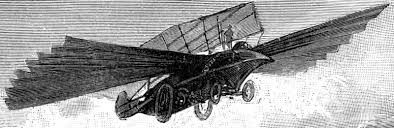
403. Steampunk Dirigibles

Warning: this post gets nerdy.

If it has dirigibles, it’s steampunk. No, that doesn’t quite work.

If it doesn’t have dirigibles, it isn’t steampunk. No, that doesn’t work, either.

If it is steampunk, then chances are, there’s a dirigible in it somewhere. OK, now there’s a pronouncement I feel comfortable with. Even Brisco County, Jr. had a dirigible eventually.

The variety of airships (a more generic term) in steampunk is huge, especially if you look at the vast number of illustrations on line. The Aurora in Oppel’s Airborn is entirely realistic. The Predator in Butcher’s Aeronaut’s Windlass if essentially an air-floating wooden sailing ship. Some are essentially floating cities. Some run on diesels. Some run on magic, or crystal power.

Back here on Earth, everybody knows at least one dirigible, the Hindenburg, just like everybody knows at least one steam ship, the Titanic, and for essentially the same reasons. Beyond that, real knowledge of actual airships is spotty.

It might be helpful, before embracing the infinite variety of steampunk airships, to have a go at definitions for those which actually existed.

First up, why dirigible instead of Zeppelin? Answer: for the same reason that we use the word automobile instead of calling all automobiles, Fords. Ferdinand von Zeppelin meant more to the development of dirigibles than Henry Ford did to the development of autos, so if you want to say Zeppelin instead of dirigible, I won’t argue with you. After all, I used to say, “Gimme a Coke,” when I really wanted a Pepsi.

However, in the world of my upcoming steampunk novel, you wouldn’t dare say Zeppelin. It would be unpatriotic. A Brit with more ambition than morals stole Zeppelin’s plans, sabotaged his work, and built a British fleet of airships before the German war, while Zeppelin’s war efforts came to nothing. The result was a sweeping British victory, an overwhelmingly powerful Britain, and a very interesting world to write about. But no one calls dirigibles Zeppelins.

In our (real) world, airships are often divided into three classes, blimps, semi-rigids, and dirigibles. Blimps are bags of lifting gas which hold their shape entirely due to internal pressure. Pull the plug, and they collapse. Semi-rigids have a keel structure which helps to keep them from distorting due to localized weights, such as engines, but they still don’t have a solid skin. Dirigibles have a skeleton and a skin, and individual gas bags for the lifting gas. Dirigibles are sometimes called rigids; that is the most accurate term, but it is rarely used.

You will find this three part division in dozens of books on airships, and it fits pretty well. But the word dirigible was used far earlier, and at that time it meant “capable of self-movement and control”. There were dirigible torpedoes in the water, long before Zeppelin put dirigible airships into the air.

Which drags us back to another recycling of an old word — torpedo. During the American Civil War there were two types of torpedoes, stationary and spar. A stationary torpedo was a mine. When Admiral Farragut sailed into Mobile Bay, shouting, “Damn the torpedoes, full speed ahead,” that would translate into modern English as, “Damn the mines, full speed ahead.” A spar torpedo, on the other hand, was an explosive device attached to a long wooden pole and rammed into an enemy ship by a steam boat, often sinking both. Neither kind of torpedo had self propulsion or self steering.

Torpedoes with that capability were initially called dirigible torpedoes. The adjective dirigible was later dropped. E. E. Smith, in Triplanetary, recycled that old term for use in galactic warfare:

In furious haste the Secret Service men had been altering the controls of the radio-dirigible torpedoes, so that they would respond to ultra-wave control; and, few in number though they were, each was highly effective.

The original hot air balloons were (and still are) unable to steer or move on their own. The quest for dirigibilty (controlled self- movement) led to blimps, semi-rigids, and “dirigibles”.

So, there is plenty of confusion even before we get to the use of airships in steampunk. Call them dirigibles, if you want. Call them Zeppelins, if you want. I don’t see how anyone has a right to complain about your choice.

Blondel 9

“I did find out that the main road passes within a half day‘s journey of here.”

“Then we can reach it before them?”

“Perhaps, if we move out now and skip sleeping.” Turning to Sylvia, Blondel asked, “Can you do that?”

“I can do any thing you can!”

“See that you do!” he snapped, and Grat bristled. Clearly, he was taking a personal interest in his charge. Well, he could have her; Blondel wished she had never crossed his path.

“What I don‘t understand,” Blondel went on, “is why they are chasing you at all.”

“I should think that‘s obvious,” Sylvia replied icily, stung again by Blondel’s disregard.

He said, “Have you taken a good look at yourself lately?”

She flushed beet red and moved her hands as if to smooth out her skirts, but they were mud clotted. Her hair had come undone and hung in a matted tangle around her ash smudged face.

Grat had been prepared to make an issue of Blondel’s cavalier attitude, but his good sense got in the way. He opened his mouth, then closed it again and scratched his head. Finally he said, “You‘re right. Why work so hard to get something they could — begging your pardon, Sylvia — buy cheaper in any, uh, tavern?”

They both turned to Sylvia and her defiance melted. “I guess it could be for the brooch,” she said in a small voice.

“What brooch?” Grat asked.

“The Tataelian Brooch, of course. It has been in our family for centuries.”

“And they think you have it? How stupid.”

“But I do have it.”

Blondel asked, “Where?” and she flushed again. “How would they know that you are carrying it?”

“They might know. Father did brag it about town that I would look lovely with it at my throat at the Faire.”

“God deliver me from mortals,” Blondel groaned. “Well, you might as well show it to us.”

“I will not. How do I know you won‘t try to steal it yourself?”

“If that were my intention,” Blondel snapped, “you would have no say in the matter. Show us.”

Blondel expected Grat to react to that, but the burly guard was silent. Clearly, he felt demeaned to discover that, rather than guarding Sylvia‘s honor, he had been risking his life for a bit of gold and stone. She turned her back and fumbled with her bodice, then handed Blondel the brooch. He held it up to the light of the fire and examined it with an occasional, “Hmm.” more tomorrow

Blondel 8

He turned back to Grat. “I am no warrior, but I do have some unusual talents. Before we go down and smite our enemies, to our own possible dismay, let me use them.” Grat agreed and the girl pointedly ignored him, so Blondel moved to the edge of the firelight and called softly. At first nothing came, then a hare hopped up shyly to investigate. He gave a sharp command and it disappeared. He did not want the aid of a fluff brain and besides a rabbit was likely to be stoned for food. Also, Blondel did not like to become too friendly with rabbits; he still had to eat them occasionally. An old bullsnake he also sent away, though it smacked its hard gums and cocked its head in readiness to serve. He needed more than stealth; he needed intelligence.

It was a fox that he chose. It is always hard to call a fox. They like to linger on the edge of things and snap up any appetizing creature that responds. This one had missed the hare Blondel had sent away, but the scent remained and it took all of Blondel‘s concentration to get his mind off dinner and onto war.

“What was that all about?” Sylvia asked when he returned.

“I sent a spy to check things out.”

“A spy?”

“A fox.”

She stared at him angrily. “Don‘t take me for a fool!”

“I wouldn‘t dare.”

“You can‘t talk to animals. No one can.”

“I can; you see, my grandmother was a fairy.”

“There are no such things.”

Blondel smiled. He had long since learned patience In dealing with rabbits, birds, humans and other less intelligent creatures. “Have it your own way. I must be a figment of your imagination.” He went out to the edge of the light again, so that the fox would not be afraid to come to him, and went to sleep.

An hour later, he came off the ground with a bound and a curse. Just like a fox to wake him by biting his earlobe! He choked back what he was thinking so as not to offend his temporary ally and leaned down, speaking strange and slow in the language of foxes. When he finally barked his thanks and looked up, Grat was looking at him with a new respect and Sylvia looked like she had just found something warm and squirmy in the toe of her boot.

“Well?” Grat wanted to know.

“I didn‘t find out much. There are nine of them now, and they have set up camp. They seem to have no intention of moving before daylight.”

“Didn‘t your friend overhear what they were saying?“

Blondel looked pained. “Foxes don‘t understand human speech. Do you have any idea how long it took me to learn foxtalk?”

“How was I to know?“ more on Monday