Tag Archives: fantasy fiction

488. The Cost of Empire 3

This is the third of four posts from The Cost of Empire. Click here for post 1.

Another repeater above their heads spun, giving the tillerman a new bearing. He released the stop and heaved the chest high lever to his right. A linked lever in front of Daniel moved with it and he grabbed hold to add his strength. The tillerman could move the great ship’s rudder alone, but in time of need the Eye officer’s added power made things move faster.

Of course, faster is a relative term. Old Ugly never maneuvered with anything like speed. Now her bow swung slowly to starboard. Daniel could feel the increased trembling in the platform underfoot as her engines quickened far below and behind him.

Daniel’s arms felt the jolt as Jons locked the lever. Following the course was Jons’s duty; taking bearings was Daniel’s. Now he said, “Commander, the shark is moving parallel to the convoy, at high speed. Specification follows.”

David’s hands went to the sides of the cage surrounding his helmet, playing the levers there. He focused on the shark’s fin, set a lever, waited a slow five count, focused again and reset. Then he reported, “Twenty-nine knots, Sir.”

He heard the Commander acknowledge, then add, “Farragut class. We are honored by their newest.”

That didn’t require a response, so Daniel kept his mouth shut. They were moving to cut the sub off. Fat chance! The new diesel engines in that sub were much more powerful than the naphtha vapor engines in the Anne of Cleves, but also much too heavy for an airship to use.

Now the shark’s fin turned toward the convoy. Daniel had been waiting for any change in velocity. He took a bearing as it turned, counted a slow five, took another, and said through the speaking tube, “Changing course toward the convoy. New bearing coming on repeater. New speed — twenty-seven knots, but accelerating.” Daniel was taking readings continuously now. “New speed — twenty-nine knots. New speed — thirty-one knots. New speed — thirty-one knots. He seems to have maxed out.”

Daniel gritted his teeth at having added that unnecessary interpretation. The Commander didn’t need him to state the obvious.

“Thank you, Mr. James.” There was a judiciously measured touch of ice in Commander Dane’s voice and Daniel felt a flush in his cheeks.

He swallowed his embarrassment and continued taking bearings. The dirigible had made two more course changes; he had not aided Jons because all his attention was on the oncoming shark’s fin. The Anne of Cleves was small and slow, but she had an advantageous position.

Far below, Lieutenant Ennis and a crew of men had dragged up a spherical object, and now crouched around an open hatch. Commander Dane was calculating and estimating, based on Daniel’s continuous barrage of information. He ordered the drop.

Daniel saw a small black object fall into his field of vision, locked his monocular on it, and followed it down. It hit the water a dozen feet behind and to the left of the fin. He reported, then grabbed the linked lever. The sub has passed out of sight and the new bearings meant turning Old Ugly almost completely around. He and Jons fought the massive force of the rudder, and the dirigible slowed perceptibly as it swung onto its new course.

Through the strain on his body and the pounding of his heart, Daniel heard the Commander’s voice:

“A good try boys. When we bombed the Germans we usually hit our targets, but a stationary target is different from a moving one. It would have felt good to see a bladder of seawater burst on that American’s control deck. Still, we can console ourselves with the idea that they’ll wonder what we actually dropped.”

Jons snorted, and said, “Seawater, my ass, Sir. Brinley has been collecting urine all week. Now I know why.” more tomorrow Click here to jump directly to the final post.

487. The Cost of Empire 2

This is the second of four posts from The Cost of Empire. Click here for post 1.

Submarine wasn’t entirely a proper term for the American craft. It had started as an improvement on their Hunley types, using the new engine devised by Rudolph Diesel, but because the engine had a hunger for air, they rarely submerged. The British called them sharks, because the only part anyone ever saw was the narrow fin that stuck above the water. The whole British Navy knew from direct experience was that they were fast while on the surface — faster than any ship in the British fleet.

Her Majesty’s Navy hated that.

America was not an enemy nation — technically. They had taken neither side in the German War. British-Americans and German-Americans had each lobbied Washington, but America had opted for neutrality. Actually, they acted more than a little holy about that.

That didn’t stop American sharks from harrying British convoys. There was no reason for it. It was just another game in which America flaunted her independence and self-righteousness. And any game that the British enter, they have to win. For Queen and Country. And just to prove that they are the best — especially Sub-Lieutenants.

Daniel tossed his canary to David and went down the starboard ladder in the unapproved manner, hands and feet outside the rungs, using friction to keep his descent just short of free fall. He hit the lower catwalk at a run and sprinted forward, past the last gas bag and up a sharply slanting ladder to the Eye of the ship. That was his battle station in this week’s rotation.

The tillerman was already there, of course. When not at battle stations, he stood his watch alone, translating the Commander’s orders into vertical and horizontal movements of the control surfaces. It was no easy task, and the ratings who qualified for the duty were uniformly big men, with bulging thighs and massive deltoids. Daniel slapped the tillerman on the shoulder to squeeze past him. He was a rating whom Daniel knew only as Jons, since his Welsh first name was unpronounceable. Jons nodded and eased aside. There was barely room for the two of them.

The Eye was in the foremost part of the ship, a tiny platform studded with ratcheted levers designed to allow one man’s unassisted strength to move the great rudders and elevators back at the rear of the craft.

Daniel struggled into the half-helmet and fastened the strap beneath his chin. Now his left eye was covered by a powerful monocular and his right eye was free. He could shift from detail to panorama by changing eyes. It took some getting used to, since opening both eyes at once caused a visual blackout. An hour in the half-helmet meant a headache that would last the rest of the day.

“Sub-Lieutenant James reporting, Sir,” he said into the speaking tube at his chin.

Commander Dane’s voice echoed in his ears, calm as always, “Daniel or David?”

“Daniel, Sir. Sorry.”

Jons pointed off the starboard bow, keeping him from a second embarrassment. Daniel managed to focus on the shark by the time the Commander asked, and was able to answer instantly, “I have it in sight, Sir. Bearings follow.”

He reached overhead and pulled down a head cage of silver, brass and mirrors. He slipped his half-helmet into the cavity and magnets snapped it into place. David looked at the ten foot red band on the flagmast of the nearest cargo vessel, set his verniers, chose another ship further back and to his left and repeated, then focused on the moving fin and pressed a button to finalize. The cage had monitored his head movements with great accuracy. Now the hundreds of gears in the babbage spun and sent the result down to the repeater in the control car. more next Tuesday. To jump straight there click here.

486. The Cost of Empire 1

These next two weeks I am devoting four posts to an excerpt from my new steampunk novel The Cost of Empire.

Chapter One — Tick, tick 

There was a light haze over the sky above. The sea five hundred feet below sparkled, but the glare was easy on the eyes. It was typical North Atlantic weather for May, in the Year of Our Lord 18—, and of the Reign of Queen Victoria, year forty-seven, aboard Her Majesty’s Consort Class Dirigible, Anne of Cleves.

Daniel and David James saw none of this. They were busy clambering over, under, and about the two McFarland engines, looking for cracks or pinholes, and sniffing for the distinctive smell of leaking fuel. It was a bit of tricky business, since the engines continued to snort and whirl all the while. They were a maze of polished brass and shining gears, with shafts of oiled steel feeding power to massive cranks that sent power to the air screws. You could lose a finger — or a head — if you put it in the wrong place while crawling about.

The inspection never took less than twenty-five minutes, and they repeated it every three hours. There was no slacking of discipline as Her Majesty’s airships, filled with hydrogen and fueled by naphtha, were floating bombs.

Daniel climbed the short ladder to the catwalk as David did the same from the other side. Their first words were scripted by discipline. Daniel, who was senior by one week, asked, “Starboard engine report?”

David replied, “Starboard engine clean and tight. Port engine report?”

Daniel said, “Port engine clean and tight.” And he added, “Tick.”

David grinned and mimicked, “Tick.”

The ratings below glanced up from their work. Two smiled and one shook his head. The two cousins moved forward to a pair or racks and picked up canaries to continue their inspection. Canaries were not birds, although canaries in mines had carried out the same function fifty years previously. These canaries were thirty foot long poles of hex bamboo, with heavy glass syringes capped with valves, on one end. Daniel and David ascended the port and starboard ladders, with one hand for the rungs and the other for the canary, and managed to turn their ascent into an entirely unnecessary race.

Sub-Lieutenants are more than a little like puppies when no higher rank is watching. When they rejoined at the upper catwalk, David, who had arrived half a rung sooner, said, “Tick,” and Daniel responded in kind. They separated, Daniel going forward and David aft, then worked back toward each other.

The ring ribs divided the dirigible into many small coffers, any one of which might accumulate hydrogen leaking from a gas bag. The upper catwalk was high enough that the canaries would just reach the upper arch of the ship. Daniel dropped the lower half of his canary over the handrail so that it rotated to vertical, then shoved it up to within an inch of the outer skin. He pulled the lanyard connected to the syringe and it sucked in whatever gas was at that high arch. He then lowered it to his level and triggered the sparker inside the syringe.

Ratings called this making the canary fart. If there was leaked hydrogen in the heavy glass syringe there would be a brief, contained explosion; then everyone would be on instant alert until the leak was found and fixed.

No explosion occurred. It almost never did, but vigilance never let up. Daniel moved to the next coffer to repeat, and shouted down the catwalk to David, “Tick.”

The reply he got was unexpected. Full Lieutenant Ennis, all of twenty-seven years old and called Grandpa behind his back by the Sub-Lieutenants, stuck his head above the upper catwalk and shouted in his quarterdeck voice, “Damn your ticks, Mr. James. We all know we are on a vessel full of hydrogen and naphtha. We don’t need your infernal tick, tick, tick to remind us that we live inside a bomb. Now get below, stow those canaries, and man your stations. We’ve sighted a sub.” more Thursday. To jump straight there click here.

482. Where’d Ya Get That Name?

I was writing a short story yesterday, called The Gods of Wind and Air. I knew the main character well enough, had an idea of who he was and what motivated him, and had a fair idea of what he was about to do. I had written the first paragraph and the last paragraph, so I knew where he and I were going together, but I didn’t know his name.

It needed to be reasonably short — five or six letter would be ideal. He was a peasant, with only one name and it didn’t need to be fancy, but it also didn’t need to look like he was an American. No Bill nor Tom nor even Andre need apply.

Usually by this stage in something I’m writing, I know all the main characters’ names, and minor characters are forgettable enough that their names don’t count. I didn’t want to stop the flow of things, so I went postal on the keyboard, firing off a hundred finger strokes at random while moving my hands in twin circles around the keyboard. Three seconds, four at the outside, and I had produced:

;dknclm,v mqrt09gyoweuhb sd; vkjqroifgowduh jnsdp;ogui48o uyecxvKsmvkrpifgvdwslhj merpiogiyfvcoldsjkjvm qp9fgvweujk mpf9gewqsiojksvbpo9irhgbcv anop;s’dkv90q8reudvbq][giu193reuojvbn fe][guy38ewyiush sjnf][5206yu08tr peldgjshdkv[w40efuy 2ieuochn we[]pgf0uhisdujvnmaw]p-0uyhgfovl;d klfop3yion[pqofgijeqhj

Somewhere in that mess would be letter clusters that would fire a spark in the old brain. Sure enough, there was a pel and an an which gave me Pellan, and my troubled peasant had a name.

If you plan to write a normal novel, you will need from dozens to hundreds of names. Sometimes that is easy. When I wrote Jandrax, the stranded colonists were French, three colonies removed from Earth, but still with French names. I went to Homo Hierarchicus, by Louis Dumont. It is a study of Indian caste by a French anthropologist which I had from my college days. Half of the scientists in the bibliography are French. I copied a long list of first names, a long list of last names, and chose at random from each. Then I cross-checked to see that I had not accidentally recreated some famous name — say, Marcel Proust. I did have a Marcel, but I made sure he had a different last name.

When I wrote Symphony in a Minor Key I needed a lot of Anglo and Mexican names. Where I live, that is no problem. I just went to the phone book to get twin, paired lists of first and last names.

Sometimes a reader has no trouble guessing where a writer got a name. In the western novel Flint, the villain is Porter Baldwin. Since Porter and Baldwin were two of the major locomotive manufacturers in that era, and the action revolves around frontier railroads, we have no problem figuring out where Louis L’Amour got PB’s name.

It’s not that easy when you are writing fantasy. I’ve never met anyone named Pellan, for instance. When I wrote my first fantasy novel, I needed names for five sub-lords (as I called them then). I happened to be listening to an early record (stereo, LP, 12 inch vinyl — it was a long time ago) by Ravi Shankar. In the liner notes, he explained the five parts of a raga, giving the Indian names for the movements.

Yes, you guessed it. I later modified them so that it was not so obvious. Just a piece of advice; if you are writing a fantasy about a pair of twins, and you happen to be listening to classical music — don’t name your twins Allegro and Adagio. Someone will notice.

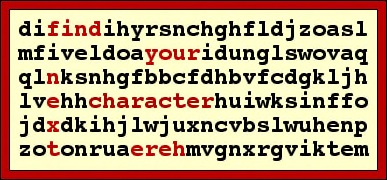
Eventually, I needed so many odd ball names that I had a brainstorm. I bought a Find-a-word. They aren’t so popular anymore, so I will describe — a Find-a-word is a book of full page puzzles where each page is filled with letters in a grid. Your job is to find the words that are listed at the bottom of the page.

I used the Find-a-word to look for letter groupings that weren’t words, but could be in my fantasy world. Brilliant, I thought. In reality, I never found anything useful. Maybe you will have more luck. I offer the notion to you free of charge.

It’s no secret that most of the people who read A Writing Life are, or want to be, writers. If you will please look up and to the left, you will find a button that says Leave a reply.

I know you guys (and gals — and whatever) are out there. I can hear your breathing in the dark. Take five minutes and tell me what you do to find character names. I’m honestly curious.

479. Snap at his Bench

Here is a peek at Like Clockwork, the steampunk novel I’m working on now.

Snap worked every day in his shop, sometimes on maintenance, sometimes on new toys. Day after day, the children cleaned and polished and wound the mainsprings on the toys that he had already built. It would have been cacophony if all the toys had all run all the time of course. Even a good thing can be overdone. Still, every day at least ten of the clockwork toys whirred, clanked and blatted (if it was a clown) or sang (if it was a doll).

The ships whose sails shifted with the wind were entirely Snap’s. So were the several kinds of self-bouncing balls, and the elfin forest of trees that waved their branches to an unfelt, fairy wind. The toys which had faces were his and hers — the mechanism was by Snap and the wood or porcelain flesh came from Pilar’s hands. The dolls which cooed and snuggled in a child’s arms had hands and faces of of clay that Pilar had moulded, fired, and glazed.

Every iteration of the year, a dozen new creations were added. Hundreds of toys lined the shelves and a few each day clanked, chirped, crawled, waltzed, rolled with laughter, and bounced in acrobatic arabesques. Their motion came from Snap; their expressive faces came from Pilar.

Rarely did anyone buy them. Once a year, perhaps — almost never twice in one twelvemonth — someone from the other London made his way to the street outside, saw the sign that said Like Clockwork, looked through the window at the wonders inside, and entered. Then one of Snap’s and Pillar’s clockwork offspring would reach the outer world, and for a time there would be meat in the pot, and new brass, paint, clay and springs for future creations.

Their daily bread came from Pilar, who worked alone in a back room with a spring pole lathe and carving tools, making nutcrackers, jester’s heads and crudely carved puppets. She had no more than six or seven patterns, and she produced them quickly in the time she could spare from other work. They sold for a shilling, but they sold. There were thousands of children in Luddie London without toys, and a few parents who would set aside a penny here and a penny there until they could buy one of the toys Pilar made.

Eve, Lispbeth, and Pakrat were an integral part of the enterprise. Snap called them his sweepers and dusters and winders. They kept the place spotless. The delicate machinery of the toys demanded it, and Pilar demanded it. The children worked continuously, but joyfully. No one made them come each morning.

Outside the toy shop lay hunger and cold, fog and soot, bullying and torments. In the streets and alleys and tenements life was lived by the law of strength, augmented by the rule of want.

Inside was warmth and kindness. Even Pilar’s stony look seemed a mask over a beating heart — but it was such a good mask that the children were afraid to take chances with her wrath. Snap was a massive presence at the workbench, short and thick with muscle, with fingers that were always bleeding a little from scrapes and punctures given to him by slivers of brass or steel or wood, but ignored in his fierce concentration. From time to time he would look up and smile, at Pilar or one of the children, but his eyes always turned quickly back to his task.

Inside there was food, simple and not plentiful, but always there, always to be counted on.  And work, unending, undemanding, unpaid. In the mind of each child there arose a formula, as sure and unrelenting as algebra — work equals warmth, work equals food, work equals safety from the world outside the shop, work equals acceptance.

Work equals self-worth.

471. Sunshine Blogger Award (2)

JM Williams nominated AWL for the Sunshine Blogger Award, which he and I both consider a chance to give a shout out to bloggers we follow. I started on Monday, and ran long, so here is the rest of the story.

There are four rules to the SBA. I took care of two of them on Monday. The remaining are:

Answer the 11 questions sent by the person who nominated you.
Nominate 11 new blogs to receive the award and write them 11 new questions.

I only nominated four blogs, and only wrote three questions. Michael, Thomas, Joaquin and James, the questions are at the bottom, should you chose to accept. (There is no penalty if you don’t. This post will not self destruct.)

 JM Williams’ questions to me were:

1. When did you start writing?   In the early seventies I started by writing a few articles for magazines. I started writing fiction in 1975. not counting the answer to question five.

2. Which genre do you prefer to write? To read?  Fantasy for both.

3. Which genre do you actually write most often? It is about equal between fantasy and science fiction, with a few contemporary novels as well, but only SF seems to sell.

4. What is your favorite piece of work and why? By other writers, A Wizard of Earthsea by Ursula Le Guin. From my own work, a short story The Prince of Exile. Of everything I’ve written, that was the only story in which I had no idea where it came from, nor where it was going while I was writing it. On the inspiration-perspiration continuum, it was way to the left.

5. Where is the most interesting place you came up with a story idea? This is not so much a where as a how.

A couple of years before I started writing fiction, I was with my wife in the stacks of a library. I had finished for the night and she was still working, so I took down something to read. The only tolerable book in the area was Beowulf. I flipped it open to a random page and read, “All that lonely winter . . .”

A vision exploded in my head, of a young boy, at an open wind hole in a castle, looking out over a snowy scene. He was living with relatives who had taken him in after his father was killed. They expected him to grow up and avenge his father’s death, but he had no interest in revenge. He just wanted to be left alone.

I saw him and his situation with instant and absolute clarity.

The next day I wrote the first chapter of the novel the incident called out, then put it away. Four years later, it became my third novel, but it remained unfinished for decades. Now it has grown into a three book series, and if I ever find a publisher, I’ll announce it here.

6. If you could win any writing award, which would it be? The Nebula, of course. A Hugo wouldn’t be bad either. I can’t hope for a Nobel Prize since I can’t sing, play guitar, and blow harmonica at the same time.

7. Do you associate with other writers? Are they at the same level as you? My level  is totally weird. I have been published since 1978, but I went unpublished (and unknown) for a long time after, and now am published again. I work strictly alone. I loved meeting writers at Westercon this year, and I love meeting them on the internet, but there is a huge generational gap.

8. What’s one of your writing goals for 2018? I have two actually. I want to see my recently finished steampunk novel find a publisher, and finish the second steampunk novel I am working on now.

9. Are you a plodder or a plotter? 100% plod. I outline very little. When I was a teacher, I was always in trouble because I refused to write lesson plans. I carried everything in my head, and that scared the principal half to death.

10. Where do you currently live, where are you originally from, and have you ever lived in a foreign country? I live in the foothills of central California, on three acres with wild turkeys and bobcats. I grew up on a farm in Oklahoma. In between, I lived in cities and hated it. When I became a teacher, and finally had a dollar in my pocket and summers off, my wife and I spent six summers living in a tent and subsisting on bread and apples, four in Europe and two in Australia. You can go far on little, if you want to badly enough.

11. If you could travel anywhere in the Universe, where would it be and why?   If?  What do you mean if?  I travel everywhere in the Universe I want to. Why else would I be a writer?

#                #                #

Now the questions for my nominees. Three instead of eleven, and loosely organized at that.

1. List your favorite authors. Length of list is your choice. A reason for the choices would be nice as well.
2. List your favorite books (That’s not the same question, since it it quite possible to have a favorite book by someone with only one great book.) Again, reasons would be nice.
3. List your favorite genres (or sub-genres, if you that works better for you) and tell what you look for as a sign of quality in that particular genre.

#                #                #

I had a great time doing this exercise, but my nominees may not feel the same way. If they don’t respond, no problem. The reviewers in particular have a tightly formatted product that might not work well with the Sunshine Blogger Award.

The main idea is to send them some new customers.

470. Sunshine Blogger Award (1)

The logo above is for the Sunshine Blogger Award, for which JM Williams just nominated A Writing Life. It’s not a HUGO, but a way for bloggers to give a shout out to other bloggers. Thanks JM. I appreciate it.

The rules of the contest (if that’s the right word for it) are:

1.) Thank the person who nominated you in a blog post and link back to their blog.
2.) Answer the 11 questions sent by the person who nominated you.
3.) Nominate 11 new blogs to receive the award and write them 11 new questions.
4.) List the rules and display the Sunshine Blogger Award logo in your post and/or on your blog.

Okay, I’ve done 4 and I’ll do 2 and part of 3 on Thursday. Here come 1 and the rest of 3, all mangled together.

JM Williams who nominated AWL, is a writer with a long list of stories, mostly published electronically, and one anthology of flash fiction, The Adventures of Iric. I mentioned Iric recently in a post about author’s names, and reviewed it positively on Amazon. JW Williams has a new website, and an old one that you might still fall into if you are using a search engine, along with an author page on Amazon.

Our connection came when he liked one of my posts, some time ago. I don’t formally follow any blogs, since my time is limited, but every time someone likes one of my posts, I drop in to their site and look them over. I get a lot of newbies, and a lot of people who are working out problems in the semi-public sphere of the internet.  I like that. I hope this doesn’t sound smart-ass, but it seems to me that baring your soul to the universe, without telling anyone your home address, is a safe way to both vent and find support. I also get likes from a lot of new and would-be authors, and every time I post a poem, I snare a lot of poets.

I end up reading a lot of poetry and fiction and occasionally something really grabs my attention. JM Williams and Iric did that. I have also found a lot of useful information on the world of e-publishing on his site. I’ve been in this game a long time, but the “e” side of publishing is something I’m just learning about. So thanks for shared interests and information. I’m glad we’ve met. I liked Iric and I’m anxious to read your novel when it comes out.

#                #                #

I’m only going to nominate four new blogs, one by an author and three by reviewers.

Michael Tierney was another whom I discovered when he liked one of my posts and I backtracked him. His blog, Airship Flamel, is largely devoted to steampunk and victoriana, and to publicizing his writing. That makes him a man after my own heart. I enjoy his blog, but this is primarily a shout out for his novel. I bought, read, and reviewed To Rule the Skies. I recommend it as a very British romp.

The remaining nominees are reviewers of novels that they consider really old — but which I read when they first came out.

Thomas Anderson is the voice of Schlock Value, which is the only blog I read without fail every week. His subtitle, Reading cheap literature so you don’t have to, is probably all you need to know in order to understand his perspective.

I found him in an odd way. About the time I was starting my blog, I googled myself. Strictly business, you understand, and I found a review of Jandrax, my first novel. It had been out of print for forty years, and here was a review dated 2014. Did I read it? Does Donald comb his hair funny?

Thomas didn’t love Jandrax, but his review was fair. More important, compared to the reviews it got when it came out, he had obviously read it closely.  I went to the contact me section and sent him a letter, saying something like, “Since you review books that came out forty years ago, you probably never expected one of the authors to respond, but here I am.” We’ve been going back and forth ever since.

Thomas likes to review schlocky books, and he has a talent for finding them, skewering them, and still finding something worthwhile in most of them. It’s an odd approach, but I really like it.

I discovered Joachim Boaz (actual name unknown to me) and his site Science Fiction and Other Suspect Ruminations via Schlock Value. He reviews book of the same era, but takes them all on, the good, the bad, and the weird, and with a more serious demeanor. If you check out one of his many indexes you will be amazed at the breadth of his coverage. If you are curious about an old SF book, this should be your go-to site.

James Nicholl  of James Nicholl Reviews also came to my attention when he reviewed one of my old novels. His site covers publications over a wider time scale, and anybody who has review categories like 50 Nortons in 50 Weeks and The Great Heinlein Juveniles (Plus The Other Two) has something worthwhile going on. I have read a dozen or so reviews so far, which means I have just scratched the surface. This is going to be fun.

Okay, I’m up to a thousand words and I haven’t started answering questions yet. It looks like this post is going to roll over into Thursday.

Ursula K. Le Guin

January 23, 7 PM.    The post I promised you, regarding how I organize my writing, is postponed until tomorrow.

I just learned that Ursula K. Le Guin died yesterday. It occurs to me, given how young the people who read this blog tend to be, that you may not know her. That would be a shame.

My years teaching middle school also leads me to a suspicion, that she may have passed into that limbo of forced reading. If a teacher makes you read it, it must be dull, right?

I have no power to tell you what to read, but I can make two suggestions.

Ursula Le Guin was the greatest fantasy writer in the history of fantasy. No exceptions.
and
A Wizard of Earthsea is her masterpiece.

Of all the writers who moved me, inspired me, and taught me how to write by example, Le Guin is the one I most would have loved to bump into at a convention just to say hello, and thank you. That it didn’t happen, is one of my regrets.

451. The Blurb

Every writer hates blurbs. If the term blurb is unfamiliar to you, it refers to the written material on the outside of a paperback novel that ostensibly tells the reader what the story inside is  about. It is supposed to be a way for the reader to judge quickly whether or not to make a purchase.

However publishers have no intention of telling you why you shouldn’t buy one of their books, so looking for an accurate blurb is a bit like Diogenes looking for an honest man. Thomas Anderson of Schlock Value, whose quirky reviews I never miss, wages an ongoing war against dishonest blurbs.

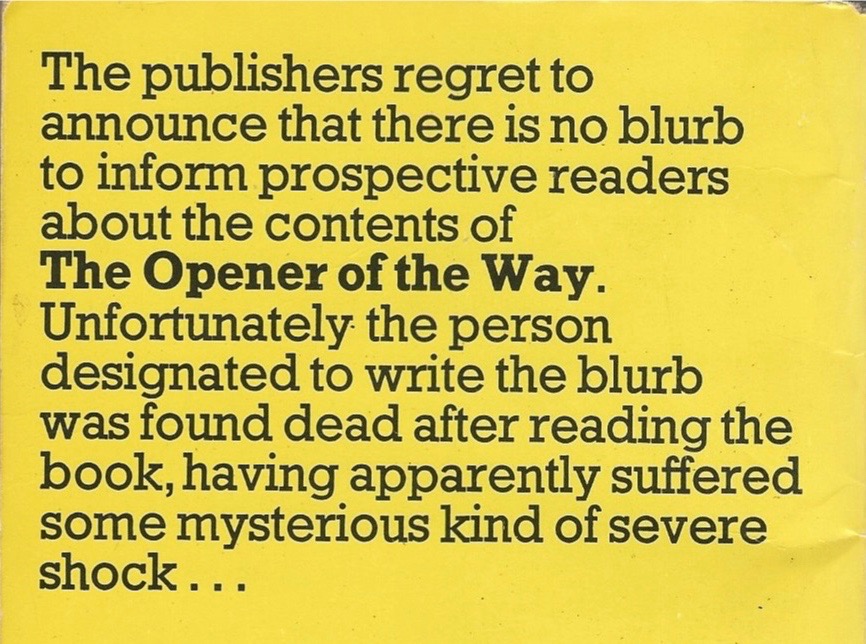
Yesterday I ran across Robert Bloch’s The Opener of the Way in a used bookstore. I’m not a fan of Bloch, nor of horror, but I bought it because I had to have a copy of the back blurb. I’ve reproduced the top half of it in the scan above. The bottom half, in extreme fine print, says:

(Actually, the Opener of the Way is a first-rate collection of ten terrifying tales of horror and the macabre, including some of the finest ever written about Ancient Egyptian curses, vampires, pacts with the Devil and others. We hope you ‘enjoy’ them . . .)

The fine print was more honest than most and the top part was downright clever. It isn’t usually that way. For example, the blurb on the back of my first novel Jandrax says:

As a scout he’d tamed four planets — and more women than most men ever see . . .

Now in truth, there is only one sentence in the novel that mentions, in passing, that first-in scouts are famous for being rowdy when between assignments.

The back blurb on Jandrax is in three parts, each flamboyant in the style you would find on old westerns. Setting aside the gosh-wow tone, the first and third section are accurate enough in content, but that middle section makes Jandrax sound like astro-porn.

There are two problems with this. Anyone who buys the book expecting a sexy, racy delight, will be terribly disappointed. And anyone who wants a serious portrayal of how space exploration might actually look will probably turn away. Based on the phrase more women than most men ever see, I wouldn’t buy the book myself.

True cliché: You only get one chance to make a first impression. The blurb is where authors make their first impression, and if the publisher blows it, authors are the ones who suffer. 

My second novel A Fond Farewell to Dying has a front blurb that says (in all caps):

WHAT PRICE LIFE? SURRENDER YOUR BODY! GIVE UP YOUR SOUL!

Yech! Sorry folks, that also has nothing to do with the story inside. Neither does the angel blowing the last trump over four zombies in boxes, but bad cover art is a subject for another post. FFTD is about an atheist who tries to come up with a mechanical version of immortality, and succeeds without the universe taking revenge on him for hubris. The front cover, both art and blurb, gives a very different impression. In fact, I saw FFTD for sale on a spinner rack of Christian paperbacks in a supermarket. Someone there certainly got a surprise.

The back blurb was lengthy, given in three paragraphs. The first two were reasonably accurate, but the third was wildly misleading. That inaccuracy irritated me no end, but most blurbs are much worse. They often look like they were mixed up and placed on the wrong book.

I challenge you to take a handful of science fiction paperback novels which you have already read, look at the blurbs, and decide if they have anything to do with the novel as you remember it. If you get one match out of five tries you’ve probably won the jackpot.

Still, the opening statement in this post may be an overstatement. Perhaps every long-time writer used to hate blurbs would be more accurate. When Cyan was being prepared for publication, the folks at EDGE asked me to write my own blurb, and I have to admit that compressing a novel into a sentence or two is hard. I appreciated the chance, but now I have no one to blame.

442. Life is a Tunnel

Every once in a while, a phrase appears, demanding to be used. Sometimes it fits into whatever is being written at the time. Sometimes it hangs around for years before it fits. Sometimes, it just hangs around.

The phrase at the top came to me when I was considering a sequel to Raven’s Run. There were several stories on audition, and none were chosen. I don’t even remember which sequel this was supposed to go with. I do remember the scene it was to be part of.

Iain Gunn was looking out a second story window at an urban street. South San Francisco, I think. It was just beginning to rain. A girl with long black hair had just gotten out of a car. She was wearing a tight, short dress, and she was, of course, lovely. Gunn was waiting for someone to come along who was connected with the business he was just getting involved in, and this girl certainly was not that person, but she caught his attention.

She hunched her shoulders when the rain first hit her, but then she straightened her back and looked up. She raised her hands to the rain and smiled. No dancing around — she was a serious and sophisticated person — but she accepted the rain and appreciated the moment. She stood for a few more moments, facing Gunn but unaware of his presence. Her hair began to flatten against her head and Gunn could see beads of moisture trickling down her face. Then she turned and walked purposefully away. For her the moment was over, but it would remain with Gunn.

Life is a tunnel, three feet wide and seventy years long. The phrase hits Gunn (as it had hit me). She is just another of the million people he will nearly meet, nearly have some kind of relation with, one whom he could perhaps come to hate, or perhaps fall in love with. But he will never know.

If this were cliche #472 in the detective story handbook, he would meet her again and this would just be a foreshadowing of things to come. Meeting her again would be expected by the reader.

It is not meeting her that will make the incident meaningful. She will now become a symbol for all the things we miss as we live our random lives.

It’s not a new idea, and not the first time I’ve used it. These words in the opening paragraphs of Valley of the Menhir set the stage for what is to come:

Out there in the night that stretches away from us all — there where consciousness ends; where experience missed sets an iron boundary on our lives — there is a land of red sky and green sea, Poinaith, and another land where the gray sky leans down to lock hands with the sliver elfin forest.

Experience missed sets an iron boundary on our lives. Another phrase that jumped into my head, but in this case, just as I needed it.

We all live lives of found and missed opportunities. Our lives are a path from birth to death, as wide as our shoulders and as long as we last. We see so much, but if we were to turn three feet to either side, there are a thousand other lives we could live instead.

I’m satisfied with my life so far and I’m glad I was wrong about its length. I have more things to do, and more books to write. These last seventy years have been great, but I‘m not done.