Tag Archives: fantasy fiction

531. I Knew!

I suppose there are writers who finish a first draft and move on to the next book. Louis L’amour was like that; you can tell from his goofs. There will be a statement in chapter three that is flatly contradicted by another statement a few chapters later. It’s the kind of thing that even a cursory second reading would have caught.

For the rest of us, there are always bits left on the cutting room floor. In my case, whole novels worth, but I’m probably extreme.

One thing I like about computers is that when inspiration strikes, you can write down an unrelated paragraph or two right in the middle of the chapter you are working on, and then go back to what you were doing before. Maybe put it in bold to catch the eye. Later, at leisure, you can retrieve it. I do that all the time, and with every rereading the bit catches my eye and reminds me to make room for it.

Sometimes, no matter how good a bit is, it never gets used. That offends the little voice in my head that says waste not, but there is no help for it.

I was revising Like Clockwork today when one of those bits shamed me that I couldn’t find a place to use it. For context, one of my characters, called Balfour, is a kind of ghost of Robert Louis Stevenson. In the bit that will never be used, someone says to Balfour . . .

“You wrote a boy’s book about pirates. Who knew that there was anything more than that in you?”

. . .  and Balfour replies . . .

“I knew.”

Anyone who writes genre fiction will understand Balfour’s pique at the assumption that he was only a writer of books for children.

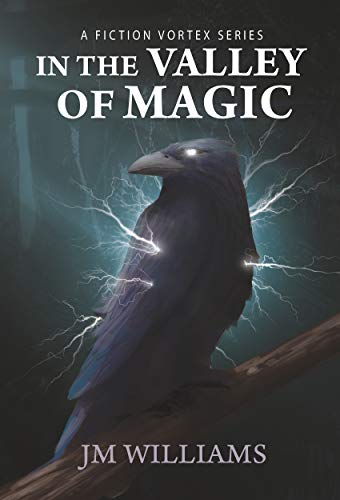
530. In the Valley of Magic

I recently finished JM Williams’s novel In the Valley of Magic, and I’m here to tell you about it.

Over the three years of this blog, I have been liked by quite a few people and most of them are bloggers. I always drop in to see their sites, with mixed results. If they are also writers, I try to sample what they have written. Usually the results belongs in a blog, not a bookstore. That’s not criticism; everybody has to start somewhere. Once in a while they are good, but not my type, so I have to give them a pass. One author wrote an amusing and entertaining first novel, which I reviewed positively, and a second novel I couldn’t get through.

JM Williams is the positive exception. I have read three of his works now, and they have all been excellent. Be careful if you go looking for him, though. An Amazon search will offer more than one JM Williams, and you won’t know which is which. You might try his website to keep things straight.

If you have read Iric, you have already been introduced to Marudal, the scene of the action. Iric’s appearance in the new novel is sadly brief.

JM Williams calls this a short-story-novel. There is no single, main hero. For most of the book, each chapter introduces a new viewpoint character. That may sound challenging, but the characters are cunningly drawn and are mostly people you will want to spend time with. It all works well, although I don’t care for his term short-story-novel. That suggests a fix-up novel, which this definitely is not.

If you don’t know the term, a fix-up novel is a novel made up of often tenuously linked short stories. They were popular in the early days of paperbacks, when writers would mine their short stories from SF magazines and shoehorn them together to make novels. Sometimes it worked; sometimes it didn’t.

In the Valley of Magic is nothing like that. It is a single, unified novel, very tightly organized and plot driven. It just has lots of characters, and each one has a piece of the story to tell. By the end of the book, those characters begin to reappear and to interact in ways that bring the whole to a satisfying conclusion.

The characters were varied and interesting, and the ones who should have been appealing, were. Many were flawed, sometimes deeply, and in need of a little redemption. There were plenty of villains, too, but most were self-serving or driven by ignorance and indifference. Some were simply on the wrong side of a developing war.

The plot was complex, and made to seem even more so by the way it was presented by one character at a time. It wasn’t a whodunnit, but more of a a what-the-hell-did-they-just-do? Since we couldn’t ask ourselves, “What will happen next to our hero?” given that our “hero” changed with every chapter, we were left asking, “What was that all about, and what is it going to lead to next?” The plot propelled the story forward and the payoff was well worth the read.

JM Williams also recently published a retelling of a Hans Christian Andersen tale titled The Nightingale. It has a few characters always on stage and the rest in the background, so we see the action through just a few viewpoints. That’s normal, and I wouldn’t mention it except to point out that Williams also excels in traditional storytelling.

529. Dystopia Lost

A few days ago, as I was working on Like Clockwork, a matter came up that calls for sharing a thought. Many dystopian stories end in a catastrophe. This is particularly true in movies, where special effects are always a temptation. Walls fall, the city burns, people flee or die, and the old order is disrupted or brought down. End of story.

Things haven’t quite worked out that way in Like Clockwork, although some of that is certainly on the horizon in my pocket London. I know this because I have already written the bulk of the first half and the bulk of the second half, and now I’m trying to stitch up the middle.

Hemmings — who used to be called Helmsman, and before that was called Bartleby after the scrivener, and who may still have another new name before I’m finished — has just destroyed the God he worships, metaphorically speaking. No problem, it happens all the time, but now he has destroyer’s remorse.

I didn’t expect that, as I sent him out to (deleted to avoid spoiler). It is a peculiarity of the way I think, that every time one of my characters does something I ask myself, “What would happen now in the real world?” Not what would Heinlein do, or what would Zelazny do, or what would Neal or Neil do, but what would Life do?

I can’t imagine Hemmings doing what he just did and getting away clean. He would certainly have to wring his hands and cry, “What have I done?”

When you burn down the church, metaphorically, there is no way to avoid ending up hip deep in ashes. To quote yesterday’s draft, “God had hurled Lucifer out of heaven; Hemmings had hurled himself out.” Hemmings didn’t expect that, nor the regrets which followed. Neither did I.

Writing is certainly an interesting way to spend your time.

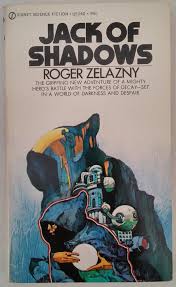
527. Jack of Shadows

This is one of the fifteen that hit the sweet spot. Actually, almost anything by Zelazny belongs on somebody’s best-of list.

If you haven’t read Roger Zelazny, it’s time to start. The border between science fiction and fantasy is his domain, and nobody explores in better than he does.

Zelazny’s magnum opus is the Amber series, ten books detailing the story of Prince Corwin and his family and enemies — frequently the same people. You might start with Nine Princes in Amber, but then you will find yourself hooked, with nine more books to read before you can rest.

He also has a number of stand-alone novels, any one of which would be a proper place to begin to experience Zelazny. To name a few, in publication order:

This Immortal
The Dream Master
Isle of the Dead
Jack of Shadows
To Die in Italbar
Doorways in the Sand
Bridge of Ashes
Eye of Cat

There are also a half dozen between Bridge of Ashes and Eye of Cat which, in my opinion, don’t stack up to the rest. I’ve read and reread all of the above and a few more, along with numerous of his short stories. They always seem to be lurking in the Best Of . . . anthologies.

Isle of the Dead is probably my favorite among the stand-alones, followed closely by Eye of Cat, but as a recommendation for a Zelazny newbie I give you Jack of Shadows. It is close on the heels of the previous two in quality, and it is a more typical Zelazny. If you like Jack of Shadows as well as I do, you’re probably ready to take the big leap into the seemingly endless Amber books. Just make sure you don’t start out of order or it will drive you nuts. Check out the bottom of this post for details.

Jack, our (anti) hero begins his tale at his execution.

His planet is tidally locked with it’s sun like scientists used to think Mercury was. One side is constantly in day and the other constantly in night. Ah, you say, science fiction. Don’t jump to any conclusions. The daysiders are quite scientific, but the nightsiders are denizens of magic. Jack derives his power from shadow, so he is a creature of both and of neither, which is a very Zelaznyesque thing to be.

Nightsiders are immortal, but can be killed. Upon death, they are reborn in the Dung Pits of Glyve, which is at the middle of the nightside of the planet. That is where Jack finds himself shortly after the story begins, and the novel is basically the tale if Jack working his way back past innumerable enemies, to freedom, revenge, questionable redemption, and a cliffhanger ending.

Almost every review, and there are many of them, tells the whole story in brief. But why would you want to know if you plan to read it yourself? I won’t be party to cheating you like that.

If you decide to take the big leap into the Amber series, here is a list to keep you in proper order. There are two sets of five novels, the first being the story of Corwin:

Nine Princes in Amber
The Guns of Avalon
Sign of the Unicorn
The Hand of Oberon
The Courts of Chaos

The second set is the story of his son Merlin.

Trumps of Doom
Blood of Amber
Sign of Chaos
Knight of Shadows
Prince of Chaos

Neither set of novels comes to a proper conclusion. Zelazny was still writing them when he passed. We can imagine that he is somewhere in a luxurious room in Castle Amber, close enough to hear Random’s drumming, writing the ninety-second installment for the amusement of the immortals.

Aside for those old enough to have read Amber when it was being written: Did anybody else out there think the title of book one was a mashup of Nine Princes Waiting and Forever Amber and the second book title a spin on The Guns of Navarone, three best sellers of that era? Considering Zelazny’s sense of humor, it could be.

521. The Eve of Battle

I was cleaning my computer of half started blog posts when I came across this quotation. It comes from the last pages of Scourge of Heaven, the sequel to Valley of the Menhir. This excerpt comes from a time when most of the action is over, when the godly battles have been won and lost, and the only task left for Tidac is stopping the human armies that have gathered in the Mariatrien Plains to do battle.

By this time Tidac is in full possession of his power. He lets his ai move from mind to mind, considering those who will stand on the verge of death when the morning comes and the armies move against each other.

============

Limiakos was king. He strode where others walked. He kept his head high, while those around him bowed. He looked at the men before him and knew that they would do what he told them to do. He walked with armed men at the left of him and armed men at the right of him, and all men feared him.

Limiakos and his kind are rare among men. If they seem common, it is only because they always make themselves so visible. Tidac had no use for them.

Such men are the leavening; they are not the loaf. Tidac set them aside and touched the others, those common men who make up the bulk of armies, and the bulk of mankind. Men neither overpoweringly good nor overpoweringly evil; men with mild ambitions and small accomplishments. Men herded to battle and taught to hate a faceless enemy. Men who die without any real understanding of the issues they decide.

For such men, the movement of nations has no reality beyond the slogans they are taught. The rise and fall of dynasties has only dim and distant meaning for them. To such men, this is reality — a woman in the night, a meal when they are hungry, a warm fire, a dry place away from the rain and perhaps, if they are among the lucky ones, a child to protect and teach.

To such men, death is the reality. The last reality they ever confront and its lessons live through eternity. If such men knew while still living, that which they learn in the moment of their deaths, there would be no wars.

Hiatus

Back in 2015 I started serializing things I had written. There have been novels, short stories, novellas, fragments, essays, and how-tos. First they came five days a week and later four days a week. All in all, I estimate that there have been between 700 and 800 posts in Serial, but I’m not going to count them. That would be too much trouble.

It has been three years, almost to the day, and I’m out of stuff.

I considered serializing Harold Goodwin’s Rip Foster novel. It is in public domain and I would love to introduce it to a new generation, but I decided against it, at least for now. Serial has been almost entirely mine, and I don’t want to screw that up. I could see serializing a series of public domain classics, but I doubt that I will.

I have two old novels, recently updated, which are out looking for a home. I have a new novel doing the same, and I see the completion of another new novel on the close horizon. None of those will appear in Serial since I am committed to seeing them published in the normal fashion.

There will be others, as well. I plan to keep writing until they nail the lid down.

I am not closing Serial. I can see several possibilities that would place more writing here at some time in the future, but none of them are likely to occur soon. So I am declaring a hiatus, not an end.

I’ll leave you with a picture of Snap working at his bench, in the shop called Like Clockwork. That’s the same as the title of the novel that is nearing completion.

Snap is still working, and so am I.

520. Beta Readers

This isn’t really a rant. Honest. If you had ever heard me rant, you would recognize the difference.

I find myself out of step with the modern world most of the time. I’m comfortable with that, but once in a while it catches me by surprise.

This comes of being an only child, raised on a farm, miles from the nearest small town. That is to say, alone. I also grew up in the era of the movie cowboy, the lone hero standing against the world. We’re talking John Wayne here; Clint Eastwood came much later.

In other words, I grew up in a place and time that preached individualism.

Today, we all cooperate.

That is, if we believe songs and movies and television and books, everything has changed. But has it really? I doubt it. We always cooperated on many things, and we still treasure the individual’s take on some things, although the balance between the two seems to be shifting. Even John Wayne always had some gang of scraggly misfits following along behind him.

I taught middle school as if cooperative learning hadn’t been invented yet. I could get away with that in the eighties and nineties, and a lot of other teachers had that same attitude. If I had to teach where “every child is equally and specially brilliant” — I’m quoting a TV ad for a private school — I’d rather drive a truck.

===============

So, what brought this to mind? Beta readers. The word is new, but the idea isn’t. Robert Louis Stevenson’s wife is rumored to have burned the first draft of Dr. Jekyll and Mr. Hyde, and didn’t like the rewrite all that much. We also hear that Mrs. Mark Twain often wasn’t too keen on what Sam Clements wrote.

Of course beta readers are more than censors. Ginny Heinlein always read RAH’s first drafts. She was agonizing about telling RAH that the first draft of Number of the Beast was not up to his standards, when an operation cured his mental fogginess and he saw it for himself. (It’s in the biography; I’m not claiming any special knowledge here.)

Since I always visit the websites of anyone who clicks a like button on one of my posts, I have been looking over the shoulders of a lot of young writers. I see people seeking beta readers and thanking their beta readers. They clearly think that beta readers strengthen the work.

Maybe. Even probably. Still . . .

It is certainly true that the editors who once filled that function are no longer as easy to reach. I also see the self-publishing advice that hiring an editor out of pocket before going to press is money well spent. Again, probably. It’s hard to spot your hundred and fifth grammatical error, after you have fixed a hundred and four.

Beta readers are all very twenty-first century, and I certainly have great respect for those writers who have the nerve to bypass traditional publishing. But for me . . .

Nobody reads a word I have written until it is checked and rechecked, read and reread, and then reread again a few dozen more times. By me, and only by me. It’s mine. I don’t share until I’m ready to publish. The first person to read my blog is you, and the first person to see one of my novels is an editor at some publishing house.

It’s all very much old school.

So beta readers need not apply to the old curmudgeon. But that’s just me. You’ll follow your own style. Writers always do.

511. Novel or Novella

If you don’t know about <tor.com>, it is a high quality on-line magazine of science fiction. For years they were one of the few places which would take unagented submissions for short stories, although they have recently changed that policy. They have been mostly closed to novellas as well, but they still have occasional open periods, and one has just begun.

Since most submissions end in, “Try again elsewhere,” I have not previously mentioned any of my own submissions in this blog. However this opening for novellas has brought up some things I want to talk about. Again (see also 146. Novella 1).

Before we begin, here is a piece of information. SFWA (Science Fiction Writers of America), the professional organization which awards the Nebulas, breaks stories into these categories:

short story    under 7,500 words
novelette       7,500 – 17,500 words
novella         17,500 – 40,000 words
novel            40,000 words and up

In the last few years, most people would add very short, or flash fiction, to this list.

I have been working since January on a novel called Like Clockwork, but it has been fighting back. It wants to be 65,000 words long. That would be just right for a submission in the 1970s or ’80s, but is too short to sell in today’s market, unless you are self-publishing.

I’m not. I have considered it seriously, but it calls for a skill set that I don’t have, and don’t want. So I continued soldiering on, hoping for inspiration. Then I became aware of the novella opening at Tor (dot) com, which left me with a choice — try to make Like Clockwork longer than it wanted to be, self-publish it at its natural length, or cut it drastically to create a novella.

My own first publication was a novella, To Go Not Gently in Galaxy in 1978. It was roughly the first third of the novel A Fond Farewell to Dying which I was then in the process of writing.

Cutting TGNG out of FFTD was easy. There was a natural break in the action that allowed me to end the story without leaving the reader feeling cheated.

Cutting Like Clockwork down to size would be another matter; I would have to remove about a third of the book. That would be painful, but would not be a new situation. The floor under my computer is already metaphorically knee deep with good writing that didn’t fit into various novels.

First I had to cut out a long section that took place before the main story. That was easy enough, except that it meant dribbling the necessary backstory into the rest of the book a sentence here and a paragraph there. Smoothly, you understand, and without letting the seams show.

There were four main characters and four lesser characters in Like Clockwork, all paired off. One pair had to be dropped. Some of the things that they did for the plot had to be shoehorned into the lives of the remaining pairs. Smoothly; without letting the seams show.

Much was lost. The Great Babbage, companion to the Great Clock, simply went away. It was reduced to a couple of off-hand references, and that really hurt.  Altogether, it took me a month to chew 65,000 words down to 39,000 words. I submitted it earlier this week, retitled The Clock That Ate Time.

Will you be reading it soon? The writer’s psychotic optimism says yes, but I didn’t destroy any of the files that I cut, and everything that was removed can always be restored if necessary.

That’s my recent history, but it is only worth telling because it points out a larger problem.

Only certain lengths of story can find a market in today’s world. There are homes for flash fiction and for short stories, and novellas can occasionally find their place, but the lengths between 40,000 words and about 90,000 words reside in a wasteland. That is really unfortunate, since most of the best novels in the history of science fiction were in that range.

It’s all a matter of fashion. The best of today’s science fiction would have been rejected unread as too long to publish just a few decades ago.

To put it bluntly, then and now both stink if you have a good story that is the wrong length.

All this is somewhat malleable but there are stories that need to be a certain length. If you are a young writer, this profiling by story length is one more reason self publishing may be your future.

507. Sita as Symbol

Be warned: this post is about symbols, double entendre, hidden meanings, fecundity, and has a few references to the religions of India.

Over in Serial today, Marquart is engaged in a symbolic exchange. He gives three gifts, and a young man and his wife give a pledge of lifelong loyalty. When the ceremony is over . . .

. . . the boy, who as son of a serf had been nobody, gained status and lost freedom. And the girl, who had been of the village, lost freedom and gained a husband.

That insert is the first sentence in tomorrow’s post. Things don’t always come out even when you serialize something that was written as a whole.

All this is nothing new to fiction, or life. It closely resembles a young man becoming a squire, or a successful warrior being knighted. There is an exchange — fealty for security in the master’s service — and there is both a gain and a loss as someone passes from one status to another.

The thing that makes Marquart’s exchange a bit different is that the young actors in the drama are lowly. You might call them peasants or serfs, which are technically not the same thing, but which share being low on the scale of status.

I go low all the time. I grew up on a farm, wading through cow manure. At school I used a slide rule (google it) but at home I used a shovel. I feel comfortable with lowly folks; with working folks. Even though Tidac is a god, he doesn’t know it and ends up being raised . . . Oops, I nearly let a spoiler slip there!

The girl receives an iron pot, and Marquart says:

May your hearth be always warm, and the pot and your belly always full.

The audience laughs. Marquart could have said that differently — more coarsely — but that would have been offensive. As it is, “the girl blushed and the villagers giggled”. Unmarried, in a culture like this one, the girl was a danger and was in danger. Once married, pregnancy becomes appropriate, and even desired. The “full belly” refers to hunger satisfied and pregnancy.

Marquart says the right words at the right time. The moment is ritualized, and ritual makes the unsayable, sayable.

The iron post was given to the wife from the hands of a female servant. No man touches it.

The plow shear is given to the man. The girl touches the package, but the man opens it. More symbolism. Later, when the man receives the axe, she does not touch it at all.

After giving the plow shear, Marquart says:

Urel, plow deep and often, so that your seed may be sewn, and your harvest may be bountiful.

“The villagers and serf alike howled with laughter.” Double entendre rears its lovely head. Yes, Marquart is telling the serf to be a farmer, but he is also commending him to the marriage bed. And everyone present knows it.

If he had said the same thing baldly, everyone would have been offended at his lack of tact. They would also have missed a chance to be in on this great joke that they all got to share.

It resembles the rules of cussing. Every time I hear someone casually saying f**k, I think, “What a waste.” A good cuss word has to be saved for the appropriate occasion, and delivered with perfect timing. Throwing it around like an ordinary word wastes it. If you say f**k every time you bump your knee, what is left to say when you drop an anvil on your foot?

Double entendre is fun. Sometimes kids don’t get that. They think their elders are afraid to use plain language, but it’s all a game. If you don’t follow the rules, the game is no fun.

By the way, I didn’t think up that bit with the plow shear. In some South Asian languages, the word for the act of plowing is the same word used for the act of intercourse. A professor in one of my anthropology classes told us that, but then he added, “Just because the word is the same, doesn’t mean that when a farmer says, ‘I’m going out to plow my field,’ he is really saying ‘I’m going out to commit ritual intercourse with the earth’. He just means that he is going out to plow.”

I don’t think my prof was being entirely honest. I think he was wanting to keep a class full of post-adolescents under control. In fact, that farmer would be saying both, simultaneously, and enjoying the double entendre.

One last note. In the Ramayana, the god Ram’s wife is the goddess Sita, and the word sita also means furrow.

506. The Great American Read

The Great American Read or
What is that book doing on the list,
and where is my favorite?

If you want to start a fight, make a list of great books, then step back while every reader on Earth disagrees with you.

When the Great American Read was announced, I couldn’t wait to see the list. I love lists of great books. It turned out, however, that these weren’t great books, but favorite books. That is a major distinction. Great books or influential books would include the Koran, The Wealth of Nations, Das Kapital, and a raft of works everybody has heard of, but few have read. That list would not include Fifty Shades of Grey or The Martian.

It reminded me of a collection called Best Remembered Poems which included a selection of Purple Cow poems but did not contain Andrew Marvell’s To His Coy Mistress. Popularity and quality are different categories.

As I worked my way deeper into the GAR, I found that the original list of 100 came from a group of readers carefully selected for diversity. That’s all very twenty-first century, but it is likely to find oddball books as well as good ones.

Not that I am complaining. If I made a list of my 100 favorite books, no one would else like all of them either. That’s just the nature of the game.

The GAR people ask, “Which book is your favorite?” I read the list and didn’t find my favorites. A Wizard of Earthsea wasn’t there, which was criminal, but not surprising. Kidnapped wasn’t there, nor was anything else by Robert Louis Stevenson. That was surprising. What about Treasure Island and The Strange Case of Dr. Jekyll and Mr. Hyde?

As a side note, in 2014 The Guardian did a list of the 100 best novels and Kidnapped came in number 24.

So I looked at the list and started to make notes.

There were 8 books I had read and liked — Tom Sawyer, The Call of the Wild, The Count of Monte Cristo, Dune, The Hunt for Red October, The Lord of the Rings, Siddhartha, and The Sun Also Rises. None of these were my favorites, and only Tom Sawyer and Siddhartha would be runners-up for that title.

I won’t identify those I didn’t read or didn’t like, but . . .

There were 4 I read but didn’t like.
There were 4 I read part way through and tossed.
There were 3 I knew enough about to avoid.
There were 2 I read, but found them to be nothing special.
There were 8 I had not read, but I had read other books by the same author. This included authors I had liked and ones I had disliked.
There were 3 which were on my to-read list. I subsequently read one of these and demoted it to nothing special.

There was also one book — Moby Dick — that I read as a child in an abridged version, and plan to read in its entirety when I have a spare decade.

Looking at my tally, you might think I’m picky. That’s probably true, but there are a thousand books in my read-and-liked category that weren’t on this list. I just don’t seem to read what everybody else reads.

How about you? There is a reply button at the top of the post.

———:::———

The original question was, what is your favorite. For me, out of this list, it would be The Adventures of Tom SawyerThe Lord of the Rings beats it for scope, The Sun Also Rises beats it for gravitas, but it seems to me the only way to choose from such a varied list is to judge a book on how well it does what it sets out to do. For that, TS beats them all.

If I didn’t have to choose from their hundred, I think I would choose The Old Man and the Sea.