Tag Archives: history

310. Boys at Work: Howard Pease

By at Wk atwOn August 2 through 4, 2016, I wrote posts on what I called apprenticeship literature. Here are two more in that series.

More than any other writer, apprenticeship literature is the domain of Howard Pease.

Pease’s fame was world wide and his stories spanned the globe as well, but where I live he is a local author. Not many people remember him, since his best known books were written in the 20s and 30s. Those who read him, tend to love his work. A glance at Goodreads will find few but uniformly high ratings.

Pease was born in Stockton, California. He wanted to be a writer from grade six. He spent his professional life as an English teacher near San Francisco. Between school years, he shipped out on freighters, and based most of his novels on what he learned there.

He is best known for his Tod Moran books, in which Tod begins at the bottom of the hierarchy of shipboard life and works his way up to first mate over thirteen novels. His friend and mentor through most of those novels is Captain Jarvis.

The Tod Moran books are not politically correct by today’s standards. The anti-bullying squad would burn them if they ever got close enough to read them. Although Jarvis is a mentor, his shipmates are the dregs of the harbors. Tod has to fight – literally – to maintain his place on board. Hazing is a constant theme in all Pease’s books, but the message is not “hazing is bad.” The message is that you have to fight every day to survive in a man’s world.

Try writing that in a children’s book today.

Tod comes on board his first ship having devoured his favorite book, The Lookout: a romance of the sea. What he learns in that book does not serve him well. He discusses with Jarvis how different his world is from his expectations.

Tod smiled ruefully. “But everything is so different from what I was taught to expect.”

“It always is, Joe Macaroni. Before a boy grows up, he has to unlearn all those pretty myths about life and death which have been taught him by tender-minded ladies of both sexes. I feel sorry for the poor kids. They have to go through hell. … Most of them don’t, though. Instead, they commit intellectual suicide; they remain simply children.” Jarvis fixed his keen eye on Tod and his face softened. “Somehow, I feel you won’t do that. You’ll kick off those swaddling clothes. … But I pity you in the process – I pity you.” The Tattooed Man, p. 90

This sounds like the address Pease made to an ALA conference in 1939, where he called children’s literature “wholly and solely a woman’s world . . . (under) tender-minded feminine control.” That address reminds me of Heinlein’s ongoing argument with his editor at Scribner’s, which eventually caused him to stop writing juveniles.

One final note for anyone who is already a fan of Howard Pease: the Summer 2000 issue of the San Joaquin Historian was entirely devoted to him. You will find it on line at www.sanjoaquinhistory.org/documents/HistorianNS14-2.pdf
306. White Men Only

Mostly, A Writing Life is a look at science fiction and writing in general. However, I am an American, and my country did something seventy-five years ago that needs to be remembered. See also Monday’s and Tuesday’s posts.

The Naturalization Act of 1790 stated that citizenship was available to “any alien, being a free white person”. That set the tone for the future. When the law was amended after the Civil War, it’s new iteration was taken to mean that Chinese were not eligible for citizenship.

Economic reality brought them to America anyway, where their children became citizens by birth, even though their parents could not be naturalized. The Chinese importance to the transcontinental railroad is well known. When the golden spike was driven, Chinese by the thousand were thrown out of work, and in the years that followed, downturns in the American economy were blamed on cheap Chinese labor. By 1882, Chinese were forbidden entry into the United States, a condition that continued until the 1940s.

In 1880, only 148 Japanese were living in the United States. Between 1885 and 1894, the need for cheap labor in Hawaii coupled with economic difficulties in Japan led 25,000 Japanese to emigrate to Hawaii. Many of those later moved on to the mainland.

During the last quarter of the nineteenth century, particularly during the Alaskan gold rush, there was a need for cheap labor all over the American west. Chinese were prohibited from entering the US, but Japanese were not. The result was predictable; between 1901 and 1908, 127,000 Japanese entered the United States. Many entered the fishing industry. Many were skilled in a kind of small scale, intensive agriculture that was new to the United States. All came from a culture that emphasized the entrepreneurial spirit.

Like the Chinese before them, the Japanese immigrants were denied citizenship, but their children became citizens at birth.

Most of these Japanese settled in California, where they formed a tiny minority. By 1941, only a small minority of that minority were both native born and of voting age, leaving the Japanese politically voiceless.

Throughout the half century before Pearl Harbor, the Japanese, especially in California, were subject to virulent racism. Repeatedly, the California legislature made it illegal for Japanese to lease or own land, but these were poorly conceived laws that were universally evaded. Japanese children were segregated out of public education.

It is a familiar pattern. Most ethnic groups endured it when they first came to America – then used the same tactics against whoever came after them. Like hazing at West Point, it is a long-standing American tradition.

Then came Pearl Harbor. Unfounded fears of the Japanese led to Executive Order 9066, and in 1942 the American military moved 120,000 Americans from their homes and incarcerated them thousands of miles away in “relocation centers”. I call them Americans because they were either actual citizens or long time residents who intended to live out their lives in their new country, but were prevented from receiving citizenship because of their race.

Much is made of the harshness of the centers, but that is not the point. Tens of thousands of GIs lived in barracks identical to those that made up the relocation centers. There was one difference, however, that does matter. The GI barracks were not surrounded by barbed wire fences, with guard towers manned by soldiers with guns.

And those GIs who made it back from the war, returned to their homes. The homes, farms and businesses of the Japanese were largely taken by the neighbors who had sent them away.

* * * * * * * *

I said in the beginning that I would not shove conclusions down your throat. I will, however, leave you with this quotation from Personal Justice Denied, p. 28:

(Japanese relocation) is the bitter history of an original mistake, a failure of America’s faith in its citizens’ devotion to their country’s cause and their right to liberty, when there was no evidence or proof of wrongdoing.

For me, 2017 is beginning to look a lot like 1942. Decide for yourself.

305. Relocation – or not

Mostly, A Writing Life is a look at science fiction and writing in general. However, I am an American, and my country did something seventy-five years ago that needs to be remembered.

I have been aware of the relocation of the Japanese for a very long time, but in preparing these posts, I put on my historian’s hat and did my research. The final word (or as close to a final word as ever exists in history) comes from the government commission empaneled to investigate the matter in 1980. Their report, Personal Justice Denied, is available on line at https://www.archives.gov/research/japanese-americans/justice-denied

*************

Executive Order 9066 began with these words:

Whereas the successful prosecution of the war requires every possible protection against espionage and against sabotage to national-defense material, national-defense premises, and national-defense utilities . . .

Certainly, no one could argue with that. The devil was in the details of how Executive Order 9066 was carried out.

There were four groups of American residents who were affected by this order, in two categories – Japanese, German, Italian, and Aleut. The Aleuts were living in a war zone on distant Alaskan islands and had to be removed for their own safety. Their story is not a happy one, but their removal was necessary.

Our concern is with the other three groups, residents and citizen descendants from the three countries against which America was at war.

Italians were dismissed by the government and military as of no danger. They were so little regarded, that it almost seems embarrassing in retrospect. FDR called them “a lot of opera singers” and they were quickly removed from the category of “aliens of enemy nationality.” Whatever distrust individual citizens may have had, the government did not move against them, even though Executive Order 9066 allowed it to do so.

Germans were also treated differently than the Japanese in spite of the powerful pro-Nazi movement among German Americans before the war. The Bund rally for Hitler in New York in 1939 drew 20,00 people, and Bund membership nationwide was more than 200,000.

Of course, mass exclusion of Germans and Italians would have required dealing with a million detainees. And they were white, which Japanese were not, by the standards of the day.

Nevertheless, German and Italian individuals were at risk. Military commanders used their powers to exclude many individual citizens of German or Italian ancestry from the areas under their command. Many non-citizens were arrested and brought before INS hearings, where they were not allowed lawyers and could not object to the questions put to them. Any issues of loyalty were decided in favor of the government. By three months after Pearl Harbor, 1393 Germans and 264 Italians had been incarcerated by this system

Everyone knows that Japanese were relocated en masse, but there is a twist to the story. Not all Japanese were treated equally, either. Japanese from the west coast were the ones relocated. That means mostly California, Oregon, and Washington – Hawaii was only a territory at that time.

The Japanese in Hawaii were not relocated. Why? There is no single, simple answer. At least part of the reason lies in the fact that Hawaii was tightly under martial law. Part of the reason lies in the personalities of the regional generals, Emmons in Hawaii and DeWitt on the west coast. Part of the answer lies in sheer numbers. In 1942, 35% of the population of Hawaii was of Japanese ancestry.

However, most of the reason lies in years of racism in the western part of America. We will look at that tomorrow.

304. Another Day In Infamy

Seventy-five years ago yesterday, FDR signed Executive Order 9066 which allowed the Army to remove tens of thousands of American citizens from their homes and place them in relocation camps. America has long recognized the error of this action. Now, more than ever, we need to look at how it came about – not only because of the anniversary, but because of what is happening in our country today.

First, however, an aside. This is not a reaction to Donald Trump and his travel ban or his planned expulsion of undocumented residents. I’ve been planning this series of posts for over a year. I announced them in early December (See 266. The Other War), and I would be writing the same series of posts if Donald Trump had never existed.

Nevertheless, these posts do shine a sidelight on his policies.  You can make the comparisons for yourself.

* * * * * * * *

Executive orders are neither good nor bad, as a class of action. They are just the way legislation gets fine tuned and enforced. There are times when a president oversteps his authority and gets slapped down by the courts. There are times when a president should act, but does not. It would be easy to find citizens who applauded Obama’s executive orders and hate Trump’s – and just as easy to find the reverse.

Every executive order has to be seen on its own merits, even executive orders by the same president. Although Roosevelt’s Executive Order 9066 will receive harsh criticism here, we should also remember his Executive Order 8802, which prohibited racial discrimination in the defense industry. There are very few full time villains, and probably no full time heroes. That’s why, in a democracy, we choose our leaders carefully, and watch them just as carefully after they are in office – no matter who they are.

* * * * * * * *

The Japanese attacked Pearl Harbor on December 7, 1941. On December 8, America declared war. On December 12, FDR issued Executive Order 8972 which ordered military guards and patrols within the US to protect national defense areas. The justification was protection of America from domestic sabotage by internal enemies. That would also be the justification for Japanese removal.

On February 19, 1942, FDR issued an additional executive order, number 9066, toward the same end, but this time he called on the military to exclude “any or all persons” from areas of military importance, with wide discretion to decide who this meant and what constituted an area of military importance.

I have placed links to full versions of both orders at the bottom of this post. Here is a cut-down version of EO 9066, for those who don’t care to see the full text:

. . . by virtue of the authority vested in me as President of the United States, and Commander in Chief of the Army and Navy, I hereby authorize and direct the Secretary of War . . . to prescribe military areas . . . to which, the right of any person to enter, remain in, or leave shall be subject to whatever restrictions the Secretary of War . . . may impose in his discretion (and) to provide for residents of any such area who are excluded therefrom, such transportation, food, shelter, and other accommodations as may be necessary . . . I hereby further authorize and direct the Secretary of War . . . to take such other steps as he . . . may deem advisable to enforce compliance with the restrictions applicable . . .

As you begin reading the full text, at first it seems to be an order to do things like keep spies off Navy bases. But then you come to the part which says that “such transportation, food, shelter, and other accommodations as may be necessary” will be provided, and it becomes clear what is really intended.

They called it exclusion, as in being excluded from a Navy base. Today it is called removal, because it was not a Navy base from which these unnamed people were being excluded. It was the entire west coast of the United States. And the people excluded from their homes, farms, and businesses were Japanese Americans.

I know people who have no problem with this, who say we were at war with Japan and who see all Japanese as one. I know some whose hatred of Japan has never died.

Facts don’t support them. The Japanese, who were not a threat, were incarcerated. The Germans, with whose Fatherland we were also at war, had shown massive support for Hitler, but they were not incarcerated. Why? The details of all this will come in the next two posts.

Executive order 8972 https://fas.org/irp/offdocs/eo/eo-8972.htm

Executive order 9066 https://www.ourdocuments.gov/doc.php?doc=74&page=transcript

299. I Survived Skylab

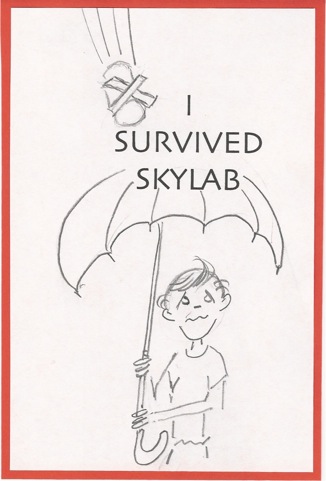
skylabAt the top of this post is a drawing, done with deliberate crudeness. I wish I could have used the original, but it existed before digital cameras and Pinterest. I have searched the internet without success for the image I remember. There are dozens of modern Skylab T-shirts. but none like what you see here.

In 1979, Skylab came crashing back to Earth. NASA knew it was going to happen, but could not prevent the event; it even predicted the date, July 11. The world partied in the face of danger – especially since the chances of being at ground zero were billions to one – and I Survived Skylab T-shirts were worn everywhere. The one I remember had a silly looking cartoon schmuck holding an umbrella over his head while Skylab was flashing down behind him.

If anyone still has a picture of one of those original T-shirts, post it on Pinterest and I’ll provide a link.

No one had intended Skylab to come to such an end. It was in reasonably high orbit, about 275 miles when he last crew came back to Earth. It still contained plenty of air and water, although the gyros were failing. It could have been remanned, and there were tentative plans to shift it to to a still higher orbit. No one took it too seriously, though; the vessel was old and battered, and NASA had turned its attention to the Space Shuttle.

In fact, most people at NASA thought the next Skylab crew would be ferried up by the Space Shuttle.

Nature had other plans.

By 1973, it was predicted that Skylab would deorbit years earlier than NASA was predicting, but NASA failed to listen. Increased solar activity had heated the atmosphere, causing it to expand. Low Earth orbits are still within the tenuous ranges of the outer atmosphere. Although the life of such orbits is measured in years, all things within a few hundred kilometers of Earth eventually come down. Now NASA was facing the fact that the Space Shuttle would not fly before Skylab’s orbit became critical. Not only could Skylab not be saved, it could no longer be equipped for a controlled deorbit.

A Russian Cosmos had crashed into northern Canada only a year before. The second stage of the Saturn which had launched Skylab had remained in orbit two years, then crashed into the North Atlantic in 1975. NASA was aware that the potential for disaster was great. It was predicted that up to 25 tons of debris might survive reentry, and there was no way to determine where it might land.

If Skylab had landed on Omaha – or Paris – we would be living in a very different world, with a very different attitude toward space exploration. In point of fact, Skylab struck the Earth in the desert of western Australia. No one was injured. Property damage was minimal.

The Shire of Esperance sent NASA a fine for littering.

*  *  *  *  *  *  *

Everybody has to carve out his own niche. In my science fiction, I concentrate on the next couple of centuries. In these posts I concentrate on the early space program. I have not yet written about the space shuttle, which always seemed to be like Grandpa’s pickup truck that he bought after he was no longer young and had sold his hot rod. Sorry, my prejudice, which I am sure I will someday reverse without apology.

I am even less interested in the ISS. I remember too well that, during its planning – before the feds told them to shut-their-mouths and not bite the hand that was feeding them – the scientific community complained loudly about all the research that would go unfunded to feed the ISS.

The ISS, symbol of American-Russian friendship, boldly going where everyone has already gone before. Sorry, my prejudice again.

If you are interested in the ISS, there is a plethora of available writing. If you want to know more about early space stations, try to find Living in Space by Giovanni Capara in your local library. Published in 1998, it is a detailed study of all the space stations before ISS.

298. Skylab (2)

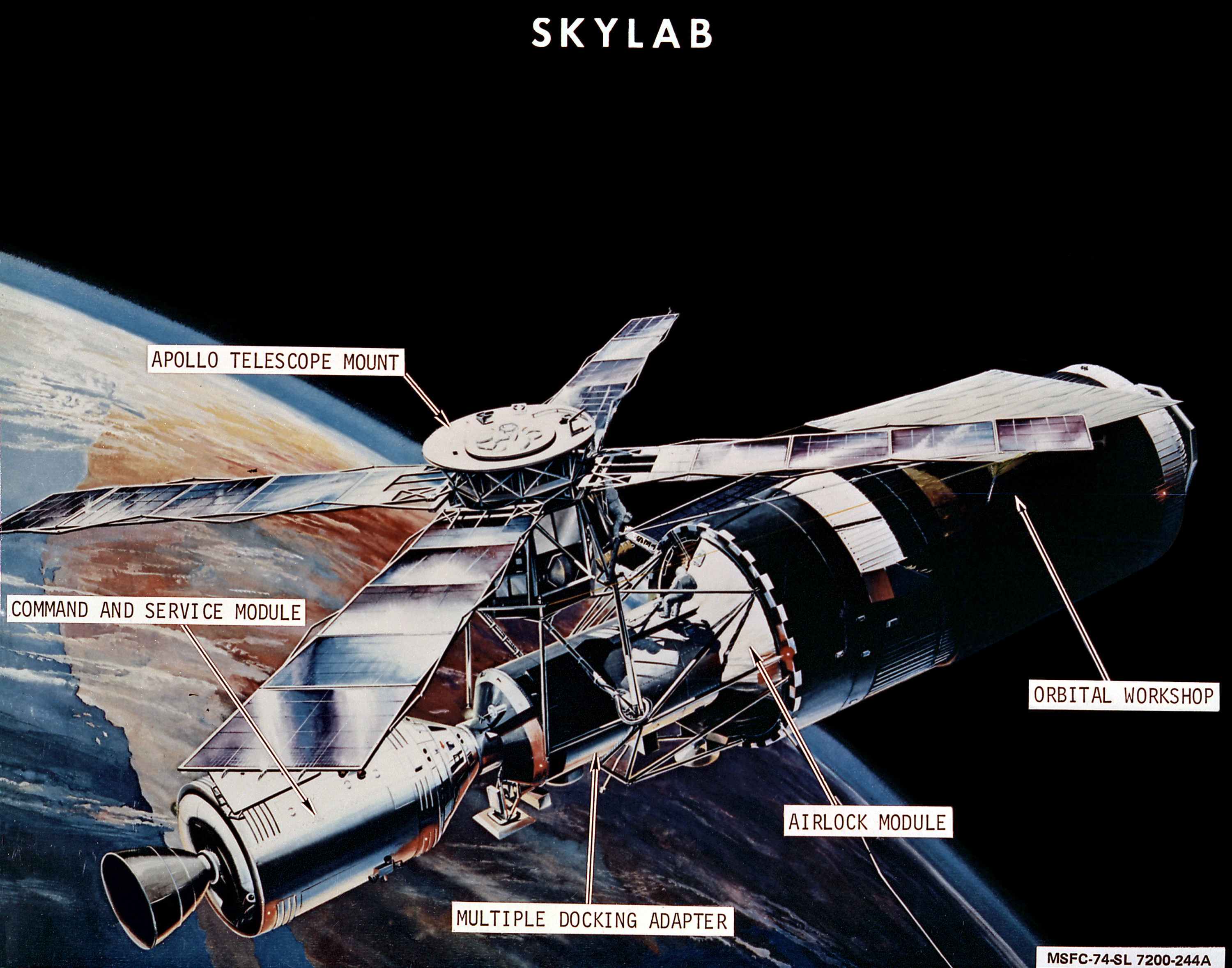
skylab_labeledTwo days after Armstrong and Aldrin stepped onto the moon, NASA announced that it would launch an orbital laboratory with space telescope, using a Saturn V rocket. Because of its great power, the Saturn V could place a large payload in low earth orbit, using only its first and second stages. The entire third stage was converted into the orbiting laboratory, and launched intact and ready for occupation. This was Skylab.

The astronauts who would man Skylab would arrive later in CSMs – NASA speak for Command Module and Service Module, considered as a package deal – launched on smaller Saturn I-B rockets.

This cylindrical third stage was divided by a floor grating into an upper work area and lower living quarters,with eating, sleeping, and bathroom areas. It was, of course, a weightless environment. At the end of the vehicle, an airlock and docking adapter allowed egress for extravehicular activities and connected Skylab to the CSM which brought the astronauts up, and remained docked to return them to Earth. A solar panel array provided power. In pictures of Skylab, this array is what looks like helicopter blades above the vehicle. The telescope mount is in the center of the solar power array.

Skylab was launched on May 14, 1973, with disastrous results. The meteorite shield, which was supposed to stay snugly against the outside of Skylab during the flight up, and deploy once in space, deployed prematurely. Once in orbit, only part of the solar panel array deployed. The rest had been trapped by the damaged meteorite shield. The result was too much heat and not enough power. Skylab was uninhabitable.

The astronaut launch was temporarily cancelled and NASA went into salvage mode. Within eleven days they had proposed, built, and tested a set of repairs, and the crew of Conrad, Kerwin, and Weitz launched on May 25th. It proved to be no easy task.

The first day, working from the hatch of the CSM, Weitz tried using a forked stick to remove some of the debris remaining from the meteorite shield in order to deploy the solar array. No luck. Then the astronauts tried to dock, only to find that part of their capsule was non-functional. They had to externally repair their docking probe before connecting with Skylab and finally getting to sleep, no closer to repair. The next day, they attacked repairs from inside Skylab. Weitz wore a gas mask as he tested the air inside the structure. Scientists had feared that the high temperature environment would release poisonous gasses from the insulation. It had not, but the temperature inside was 130 degrees. The astronauts then set up a parasol they had brought, inside the second airlock near the telescope, and slowly extended it outside Skylab. It opened successfully, providing relief from the sun. The temperature dropped, although only to 95 degrees. The second night, the astronauts slept in the docking adapter area where the temperature was reasonable.

Several days later, Conrad and Kerwin performed another EVA, used large scissors to cut away part of the meteorites shield, and finally freed the remaining solar array.

The work of the first Skylab crew not only saved the station for the work it was designed to do, but also proved the necessity of manned missions to rescue projects in danger. Twenty years later, when the Hubble needed repair to perform its functions, the precedent had long since been established.

The first Skylab crew stayed aboard a month, conducting astronomy and medical research. The second crew, Bean, Lousma, and Garriott, remained aboard for two months, continuing repairs and research.. The third crew, Carr, Pogue, and Gibson, remained in space 84 days, observed and photographed comet Kohoutek and continued other experiments.

By the time the third crew returned to Earth, Skylab was nearing the end of its service life. Beyond the damage done on launch day, many other systems were failing. There were plans to use it further, but nature had plans of her own. conclusion tomorrow

296. Space Walks (2)

gemini_spacecraftWe left Gene Cernan hanging onto to the side of Gemini 9, part way thorough a disastrous space walk. I’ve provided a drawing of the Gemini to orient you to what comes next.

Cernan left the hatch and began to move back to the base of the Gemini, utilizing undersized hand holds. He was weightless, which makes this sound easy, but remember that bending your arm is like “bending and inflated life raft”. As he worked his way back, he had to thread his umbilical through undersized stand-offs to keep it from tangling. When he reached the base of the Gemini, he found it surrounded by a ring of torn metal, like razor wire, that was the result of separation from the Titan rocket that had put him into orbit. Just the thing a space suit does not need to make contact with.

Once Cernan made it past the turn to the very base of the Gemini, he faced new problems. He was exhausted and overheated; the inside of his visor was so fogged that he was nearly blind. Making visibility even worse, the light NASA had provided over the MMU was a dim bulb, completely inadequate to his needs. He began to attempt to fire up the MMU, a procedure that required about thirty switches to be thrown in sequence, but he could hardly see the switches, and every time he tried to turn a dial, his untethered body spun the opposite way.

Once the MMU powered up, he had to release and position the arms and get it strapped on. By now he was far overbudget for time, and out of contact with Stafford in the Gemini. His heart was beating at three times its normal speed, he couldn’t see for sweat and fog, and the Gemini was twenty minutes away from orbital night when the impossible becomes the unthinkable. Stafford terminated the mission. The MMU was abandoned, untested. Cernan made his painful way forward and returned, not without a final struggle, to the safety of the Gemini.

Let’s let Cernan speak for himself.

Why is floating in space and turning a few dials so difficult? Let me give you a couple of tests. Connect two garden hoses and turn on the water. Now, using only one hand, try to unscrew them. Or, hold a bottle of soda or beer at arm’s length, and using a single hand, remove the twist off top. For extra reality, run a mile before you start so you’re nice and tired, do it while wearing two pairs of extra-thick gloves and close your eyes to simulate being unable to see. Stand on your head while doing some of these things to resemble tumbling in space. You get the idea. 

* * * * * *

There is one kind of space walk that always works, called a stand-up EVA. If an astronaut simply stands up on his seat, with the hatch open, he has none of the problems Cernan had.

Gemini 10 began with a stand-up EVA. Later Michael Collins performed an umbilical EVA, successfully although not easily, using a hand held maneuvering unit similar to the one used by Ed White.

In Gemini 11, Richard Gordon performed an umbilical EVA to attach a tether to an Agena target vehicle. Like Cernan, he overheated, lost vision to a fogged visor, and had his EVA cut short.

In Gemini 12, Buzz Aldrin performed two stand-up EVAs, sandwiched around an umbilical EVA. For the first time, everything went right. Aldrin had use of larger hand and foot holds, a reduced workload, and tools designed to overcome the problems of weightlessness. The lesson learned by White, Cernan, Collins, and Gordon had finally made spacewalks practical.

295. Space Walks (1)

260px-ed_white_first_american_spacewalker_-_gpn-2000-001180EVAs (extravehicular activities) or space walks are commonplace today. It wasn’t always that way. In the early days of space exploration, every space walk was a brush with death. The Russians denied that reality and the American’s downplayed it. But the fact was, in the words of Gene Cernan (see also 293. the Last Man on the Moon), “. . . we didn’t know diddly-squat about walking in space when I popped my hatch open on Gemini 9. . . It’s a sobering reflection when I think about it now, and I thank God that I lived through the experience.”

It was life threatening from the beginning. Alexey Leonov nearly died on man’s first spacewalk (see 116. Spacecraft Threatened by Bears). Three months later, Ed White’s space walk was exhilarating until it came time to reenter his Gemini craft. Then he found getting back in to be nearly impossible. Nothing is as easy as it looks in space.

There are basically three problems with spacewalks – vacuum, vacuum, and weightlessness. Vacuum outside and pressure inside makes space suits incredibly difficult to bend. Reaching over to flip a switch, which a bedfast child could do on Earth, takes great strength when suited up and in vacuum. Vacuum also provides insulation. When a spacewalking astronaut is working hard to bend in his pressure suit, the vacuum of space is keeping his body heat from dissipating. Finally, weightlessness makes it impossible to get purchase to exert one’s strength.

Both Leonov and White floated happily, but when it came time to reenter their vehicles, they found it hard to maneuver, hard to bend, and they both overheated.

Cernan’s spacewalk, the third ever attempted, was worse. He was given an impossible series of tasks to perform. Nevertheless, he was determined to perform them. People who fail, don’t remain in the astronaut corps, and trying to do the impossible nearly killed him.

First, the two astronauts fully suited up and opened the hatch. This meant that not only Cernan was suddenly encased in a “garment made of hardened plaster of paris”, but so was Stafford, reducing his ability to help. They released the “snake”, their term for the umbilical cord that carried electricity, oxygen, and communications. Ed White had also been on the end of an umbilical, but he had had a hand powered jet that he used for mobility. Cernan’s first experiment was to see if he could move around space, simply tugging on the umbilical.

He couldn’t.

The snake uncoiled and recoiled, subject to internal stresses. Any time Cernan tried to move by tugging on it, he ended up being spun out of control. This went on for half an hour until it was clear that no astronaut would ever be able to use his umbilical to maneuver.

Cernan clung to the hatch to catch his breath, then began the second experiment. The MMU was a backpack style manned maneuvering unit designed for an astronaut to fly freely at the end of  a safety line. It was a great idea, but there was no place in the Gemini to store it, so it had been fastened into a recess in the very base of the vehicle.

Now he just had to get there. concluded tomorrow

293. The Last Man on the Moon

600px-nasa_apollo_17_lunar_roving_vehicleOn one side is cynicism.

On the other, political correctness, a stiff upper lip, wearing your game face, or whatever is the most current version of refusing to acknowledge defeat or failure even while it is kicking your ass.

Somewhere in between is the truth.

I’ve been reading astronaut biographies for the last decade. You don’t really understand the American space program that made my youth so exciting until you have seen the same events through many different – sometimes sharply disagreeing – viewpoints. All of the biographies have been in that truthful middle ground, but some suffered from too much emotional distance and some from too much optimism. They all share bitterness at some contractors whose spacecraft were substandard, and ultimately deadly.

Of all these biographies, two stand out, Grissom’s Gemini (see 87. Gemini) and Cernan’s The Last Man on the Moon. I have long planned a post on Cernan’s book, but the timing of his death caught me tangled up in other matters and delayed it these last two weeks.

Cernan flew on Gemini 9, Apollo 10, and Apollo 17. He flew within 10 miles of the lunar surface, without landing on May 22, 1969. He landed the Apollo 17 craft three and a half years later, on December 11, 1972. When he stepped back aboard for the final time, he became the last man to walk on the moon, making the title of his memoir inevitable.

Unlike Glenn, Shepard, and Armstrong, Cernan didn’t become a household name, but he should have.

Cernan’s first flight was Gemini 9. Their first task was rendezvous and docking, which had been a pain in NASA’s side. Gemini 6 had been scrubbed when it docking target failed, and had flown later, using Gemini 7 as a rendezvous target, but without docking. Then Gemini 8 achieved rendezvous and docking with a subsequent Agena, only to be nearly torn apart by a thruster failure in the Gemini. Only Neil Armstrong’s skill saved the day.

When Cernan and Stafford on Gemini 9 rendezvoused with their Agena target vehicle they found that the shroud covering the docking target had only partially retracted. Docking was once again impossible. They succeeded in making three separate rendezvouses then set out to perform an ambitious EVA, or, as Cernan titled chapter 13 of his book, “The Spacewalk From Hell”.

I’ll save that story for later, when I give a full post of the trials of early spacewalks.

Three years later Stafford and Cernan were together again, along with John Young, on Apollo 10. When I taught the space program to eighth graders, I called this the most frustrating mission in the history of exploration. Leaving Young in the Command Module, Stafford and Cernan took their Lunar Lander down to about ten miles above the moon’s surface, did not land, and returned to lunar orbit to rendezvous with Young and return to Earth. Aside from de Sade level cruelty, it all seems so pointless from our perspective.

Of course, it was neither cruel nor pointless. It was necessary to calibrate the instruments which would calculate the vectors necessary to land accurately. It would be impossible to overemphasize how crude instruments were in 1969. Even with the help of Apollo 10, Apollo 11 did not land exactly where it was supposed to and nearly crashed in a rubble field.

By one number Stafford and Cernan missed being first on the moon. Stafford did not fly another mission until the Apollo-Soyusz mission of 1975. Cernan became commander of Apollo 17 which, because of funding cuts, became the last Apollo flight to land on the moon.

Back in Indiana, Purdue University holds bragging rights to having produced the first (Armstrong) and last (Cernan) astronauts to land on the moon.

276. Wild Parties Never End

154px-uphellyaa7anneburgess30jan1973Wild parties never end, they just get organized. And maybe slightly domesticated. Consider Mardi Gras. Better still, consider Up Helly Aa.

It is said that fishermen can never get far enough north. Fishermen from Indiana go to Michigan. Fishermen from Michigan go to Ontario. Fishermen from Ontario head for the Arctic.

I found the same thing to be true when I visited Scotland. The first trip I made it north to Caithness. The second trip I made it to the Orkneys. Eventually I made it to Shetland, and once there I worked my way up to the northernmost point on the British Isles.

I didn’t see Up Helly Aa. It comes the last Tuesday in January, and in January I will always be in California, not standing in the wind off the pack ice. But I wouldn’t mind beaming in, watching the festivities, then beaming back before my liver froze.

Up Helly Aa is a relatively new celebration of the end of the Christmas season, mixed with a revival of old Viking themes. As early as 1824, on Christmas eve, a diarist recorded:

the whole town (of Lerwick, Shetland’s capital) was in an uproar; from twelve o clock last night until late this night blowing of horns, beating of drums, tinkling of old tin kettles, firing of guns, shouting, bawling, fiddling, fifeing, drinking, fighting.

If you followed the posts on The Battle for Christmas, this will sound very familiar. Christmas has been domesticated since this report, but the spirit of riot is well represented in Up Helly Aa.

It began as “tar-barreling”. Mobs of masked young men dragged barrels of burning tar through the streets of Lerwick, often colliding with other mobs, and clogging the narrow streets of the town as they made their way toward the harbor. Sober citizens were not amused. The Town Council appointed constables to keep things in check.

About 1870, the participants themselves began to change the proceedings. They invented the name Up Helly Aa, began a torchlight procession, and introduced ‘guizing – going in disguise. Soon Viking themes became common. By the 1880, Viking longships were being dragged through the streets instead of flaming tar barrels, and the ‘guizer Jarl (Jarl is the Viking equivalent of Earl) had become master of ceremonies.

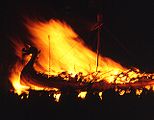
Is there anyone who doesn’t know that dead Viking chiefs were put on their longships, and the ships burned? That’s what happens in modern Up Helly Aa. The purpose-built longship is dragged by torchlight, by masses of young men in Viking costume, down through he narrow streets to the harbor where the torches are all tossed aboard for the fiery finale.

Then the drinking starts in earnest. Who wouldn’t love that?

The day after Up Helly Aa is an official holiday so everyone can recover.