Tag Archives: literature

502. Harlan Ellison

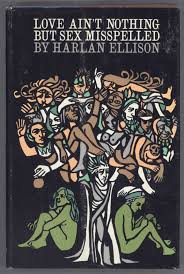
When his book Love Ain’t Nothing But Sex Misspelled came out in 1968, Harlan Ellison said that the title “reflects an attitude toward reality I would dearly love to see come to pass”. I disagreed — I still do — but it didn’t matter.  Ellison was out there kicking American culture in the shins, and that was good enough for me. He was an angry man in an angry era.

I never met the man and I stopped reading him after about 1970, so this is about early Ellison. He was a major part of my life through his short stories, still some of the best ever written, but I lost track of him about the time he went to Hollywood.

I read him through the time when I dumped God, watched blacks being fire-hosed in the deep South, escaped my parents, met up with the rest of the world, watched Americans on TV burning Viet Nam to the ground, and sat listening to the first draft lottery. My number was 41, by the way. Yikes! Everybody was angry on one side or the other of every issue (sound familiar?).

Through all this, Harlan Ellison was writing stories that kicked ass and took names. He was the perfect writer for the era.

He died yesterday (June 28th). I saw it this morning on a trailer sliding by under pictures of the latest atrocity on my morning news cast. I haven’t checked out the details yet. I don’t need to before writing this, because this is bibliography, not biography.

There were a lot of angry people writing things in the sixties. Most of them have been forgotten. Harlan is remembered because he made the things he wrote come real and resonate at a level beyond the moment. His short stories were the best I ever encountered, occasional clunker notwithstanding.

I went to my bookshelf and pulled out Paingod, I Have No Mouth & I Must Scream, The Beast that Shouted Love at the Heart of the World, From the Land of Fear, Earthman, Go Home, and Love Ain’t Nothing but Sex Misspelled. The first five are paperback. You can write them down when you finish reading and go to your neighborhood used book store, where the best in literature resides.

I say that because I just took a moment to check my local library’s online catalog. There are twelve entries on Ellison, all from late in his career, or things for which he wrote introductions. When he was hot, he was a newsstand sensation.

Newsstand: a place to buy newspapers, magazines, and paperback genre fiction. In other words, ephemera. You would never find War and Peace at a newsstand. You also wouldn’t find any of these books five months after they were published.

You will also find Ellison in a lot of anthologies beginning with the word Best . . .. He won a lot of Hugos and Nebulas, not always for his best work.

That’s it. The rest is a laundry list and the admonition to seek these out and read them. You’ll never find better.

Get Love Ain’t Nothing but Sex Misspelled and read it all, but pay particular attention to the Preface, and Pretty Maggie Moneyeyes. If you want to read the most honest writer’s autobiography ever submitted under the name of fiction, try Final Shtick.

Get as many of the others as you can still find. There will be some overlap since Love Ain’t . . . was mostly a self-chosen best-of. The gems awaiting you are not only the rest of the stories, but all of the highly personal introductions that never made it into Love Ain’t . . ..

I particularly recommend that you look at Earthman, Go Home to see what bad editing can do to a good writer. Not only was the original title Ellison Wonderland changed from something charming to something thumb-fingered dumb, but the cover contains every robot cliché that Ellison would never have used.

501. Preface to Robert Louis Stevenson

As anyone who has read even a few posts here knows, I started AWL to find readers for my novels, specifically for Cyan which had just been accepted by EDGE. I had no idea how many interesting people I would meet along the way. Some of them were fellow writers of science fiction, fantasy, and steampunk, some were fellow bloggers who wanted to be writers (this post is for you, as you’ll see at the end), and some of the ones I met indirectly had been dead for many years.

Of course, I had been discoursing with dead people all my life. Imaginary people, as well, starting with Victor Appleton II, “author” of books I was reading before I got my first library card. If you don’t recognize “him”, “he” was a house pseudonym belonging to the Stratemeyer group. “He” wrote the Tom Swift, Junior books which were my idea of science fiction when I was ten.

Come to think of it, many of the people in the Bible that my parents introduced me to were imaginary as well as dead, but a wise man doesn’t talk about to that in public.

One of my favorite friends-I-never-met is Robert Louis Stevenson. He has been a part of my life for decades, and I recently had cause to dig deeper into his personal story while putting together an upcoming series of posts.

Very early in his career (1878), long before anyone had heard of him, Stevenson wrote a travel book about his voyage by canoe on some European rivers, called Inland Voyage. I’m not recommending it to you, but it went into my massive pile of turn of the century — that’s nineteenth century — marine and canoe travel books, after I had skimmed it and found this in his preface:

To say truth, I had no sooner finished reading this little book in proof, than I was seized upon by a distressing apprehension.  It occurred to me that I might not only be the first to read these pages, but the last as well; that I might have pioneered this very smiling tract of country all in vain, and find not a soul to follow in my steps.  The more I thought, the more I disliked the notion; until the distaste grew into a sort of panic terror, and I rushed into this Preface, which is no more than an advertisement for readers.

A preface is only an advertisement for readers? Imagine that! If Stevenson had been writing 140 years later, he would have had a blog, and wouldn’t I love to read that. Also, consider the notion that one of the world’s most successful writers started out thinking that no one would ever read what he was writing.

Of course, there were thousands of other writers in 1878 who thought no one would ever read their writing, and no one ever did. We never knows in advance what will happen. We just have to keep putting one foot in front of the other, and hope.

500. Heinlein’s Harems

Heinlein did not invent group sex, but he tried to take out a patent on it.

               (Disclaimer: I made that up about the patent. It’s called hyperbole, the use of exaggerations and untrue statements for effect. The difference between hyperbole and lying is that in hyperbole, you don’t expect anyone to believe you.
               If you offer exaggerated or untrue statements with the style, cadence, and straight face of hyperbole, but you expect to be believed, that’s lying disguised as hyperbole. You may have seen this happen recently. At least one of our leaders makes it public policy.)

The world first became aware of Heinlein’s preoccupation with group sex in 1961 with his novel Stranger in a Strange Land. I didn’t buy in; I couldn’t accept the underlying idea. A successful family of multiple males and females didn’t seem likely. Most 1+1 marriages fail, and a lot of the ones which don’t fail, should fail. The idea of a whole passel of people living together in one big happy sexual family without exploding from the stresses generated strained my willing suspension of disbelief.

Hippies tried it a few years later. It was a lot of fun for the alpha personalities, but not so much for the shy ones who just went along with the idea. Communes tended to fall apart quickly.

Kings often have multiple women. In the orient, they called them harems. In the west, they called them mistresses. But any family of the 1+n style can’t be very successful. It will always result in one tired guy and a lot of women feeling blue and lonely.

Heinlein multiplied his multi-person families throughout the rest of his career, and to be fair, he did once portray such a family falling apart in the novel Friday.

Let me paint you a picture.  Start with a bunch of naked people. The men are okay looking and the women are beautiful. No exceptions on that issue. They are all young; that part is easy enough since they are all Howards and therefore semi-immortal. Put them in a luxurious lounge, with self-aware computers attending to their every whim. Now let the sex begin — but it doesn’t. Instead, we get endless, interminable, unquenchable talking about sex.

I read Stranger in high school. Three years later, in college, The Harrad Experiment was all the rage. It was about a school which encouraged its students to experiment with free love (as it was called in that era). My roommate read it and complained, “They don’t do it; they just talk about it.” I can’t verify that statement. It sounded so much like Stranger that I gave it a miss.

               (Disclaimer: Heinlein is one of my favorite authors. I re-read him more often than anyone but Zelazny. On the subject of sex, however, he sees the smiles and ignores the strains. For him, the cup is neither half-full nor half-empty. It is overflowing. It’s a nice idea, but it strains my credulity.)

When I wrote Cyan, two kinds of multi-person families showed up. Saloman Curran was the product of a ring family. That appears first in Chapter Six, Stranded on Earth [3] in the odd way that book is laid out. Ring families were a disaster for adults and children alike, and their structure goes a long way toward explaining why our villain was so villainous.

The ten explorers who set out on their multi-year journey to Procyon were a family of another kind, and one that worked out fairly well. They were young, healthy men and women, cut off from contact with any other humans, and stimulated by the excitement and danger of exploration. Sex was sure to happen anyway, so NASA made sure they were compatible during training. Read between the lines of that statement. I didn’t set the situation up for titillation; I was working out what I thought might actually happen. Once the explorers returned to Earth, the ten-some did not last. It had existed due to a particular situation, which was not likely to be repeated.

               (Disclaimer: Yes, I know this was supposed to be the future, yet the explorers are all apparently hetero. I started Cyan in the early eighties for that audience. If I were writing it today, I would have to change some things, but it’s really too late now.)

Heinlein was trying to shake up a moribund society, and make it look at what might happen. I was trying, a generation later, to figure out what probably would happen.

=======

Briefly, back to hyperbole as humor. Once in a meeting, I said with a straight face that, “Only stupid people exaggerate. Smart people use hyperbole.” Most of my friends just looked at me (that happened a lot). The one friend who got it, roared.

Yes, I know. It isn’t funny in cold print. It’s all a matter of timing.

Thankfully Deleted

Snap shook his head. “Let’s look from here, and think about what we see. The Clock is a machine. It has gears that mesh together. 16,384 gears in the outer layer alone, although you can’t see them now. They are cleverly built, with fine bearings, but the still they generate heat. Look at the snow, falling on the shell of the Clock, but not melting.”

The paragraph above was written for chapter 36 of Like Clockwork, and then deleted. It was too detailed. It told an accurate bit about an important part of the world of Like Clockwork, but it also slowed the story down.

For those who follow this blog looking for hints about writing, here is a koan, or a parable, or a rule of thumb, depending on how fancy you like in your language:

Think up a thousand nifty things for your novel, hold them firmly in your memory, but write down only ten of them. If you use them all, you will never get to the end of your novel, and neither will your reader.

496. Bob Dylan, Nobel Laureate

There is something about blogging that I didn’t expect when I started. Since these posts are opinionated, but not totally opinion, I find myself doing research from time to time to keep my facts straight. That means I occasionally learn things I would never otherwise have known.

It’s a major bonus.

I was aware of Bob Dylan’s selection by the Nobel committee, and his reticence regarding the event, but I didn’t know the full outcome. I wanted to make an off-hand comment about it in another post, but didn’t want to make a fool of myself, so I checked out the facts.

The Nobel committee awarded Dylan the prize for literature last October “for having created new poetic expressions within the great American song tradition.”

Can a song be true literature? I would say yes, although rarely; about as often as a poem is or a novel is. Does Dylan’s work rise to that level of gravitas. Again, my answer is yes; the only other songwriter who comes to mind who worked at that level was Leonard Cohen. Paul Simon just misses the cut.

Dylan took a very long time replying to the committee, fueling speculation that he would refuse the honor, but he finally complied, and eventually provided his Nobel lecture, which is the only requirement attached to the prize.

His lecture was also my prize for checking out the facts. It is superb. I’ve provided a link below.

The lecture, actually more of a biographical essay, is written in the same intelligent but not over-educated voice that we hear in his songs. This is entirely appropriate; it is pure Dylan. He tells of the early impact of Buddy Holly, and then of American folk, then shifts to a personal analysis of three classic books, Moby Dick, All Quiet on the Western Front, and the Odyssey. He presents their complexity, their unflinching view of the rough truths of life, and the manner in which each makes statements which require the readers engagement. Much in these books is not spelled out and nailed down, just as much in his songs is not. These three books are offered for their influence on Dylan’s work.

I found the essay intelligent and moving, and instead of providing a blow by blow, I recommend that you use the link below to read it for yourselves.

I will only quote one short passage, from near the end:

Our songs are alive in the land of the living. But songs are unlike literature. They’re meant to be sung, not read. The words in Shakespeare’s plays were meant to be acted on the stage. Just as lyrics in songs are meant to be sung, not read on a page. And I hope some of you get the chance to listen to these lyrics the way they were intended to be heard.

I hope you will take the time to read the whole essay. Meanwhile, I think I’ll go dig up some of those old LPs I bought while I was in college during the sixties. He has a rough voice and I don’t like his harmonica playing, but oh, those words!

Update

Last Friday, I added this to the post Machine Porn, and to the post How to Get Readers for your Blog.      Just so you know . . .

Friends, I am amending this post as of June 1, 2018. I am changing it’s title from Machine P o r n. I have had more hits on this post than on anything I have written, but I have obviously just been generating frustration among those who clicked on purely because of  the word P o r n. You will notice that I have also hidden the word itself from the view of search engines.
I like hits as much as the next blogger, but I’m not into misrepresentation. I am leaving the post otherwise intact, since it does have something non- p or n ographic to say.

If I had made a list of “Things I expect to happen now that I am a blogger,” this would not have been on the list.

494. We Can Have Archaic and Eat it Too

Marquart rode into my life on horseback. The day after my epiphany, I had a couple of hours off. I was in the Navy at that time, working as a dental technician in an oral surgery, and we had back-to-back cancellations. I wasn’t a writer yet, just an over-committed reader, but I had written the first chapters of a dozen novels. That was usually as far as I got before the impulse ran out.

I took that two hours to write Marquart and his companion’s entry into the Valley of the Menhir. You can see what it eventually became over in Serial today, but it took a long time to reach that level of sophistication.

When Marquart first rode into the valley, forty-six years ago, he was riding a horse. It was all very medieval because I hadn’t done any world building. All of the religious aspects aspects of the story, enreithment, the relation of souls to bodies, and both to ai — even the existence of ai — were nowhere in my mind. It was just a bunch of soldiers in armor riding horses into a valley populated by deer and dotted with oaks. The only fantasy element was a werewolf. I didn’t even know then that shapeshifters were not native to the world of the menhir, having been brought in through the Weirwood menhir from the world of Lorric by the Shambler. I didn’t even know there was a Shambler, nor any of the other gods that you met during the last two weeks.

After two hours I had a short chapter, and the next customer knocked on the door, ready to have his wisdom teeth extracted. I put the chapter in a drawer. I wasn’t a writer then, and had no intention of becoming one.

Three years later, I decided to give writing a try and got hooked. Two years after that I pulled out that chapter, dusted it off, and started world building.

All this was about the time of the fantasy revival led by Ballantine, and there was no lack of books on how to create fantasy worlds. Purists were arguing that a simply medieval world hardly qualified as fantasy. I could see their point. Although it never kept me from enjoying fantasies that did not rise to that standard, I decided that horses just weren’t going to work for me.

During those Navy years I had lived near the San Diego Zoo Safari Park. On one trip there I had seen okapi, had fallen in love with them, and now added them to the book. That lasted about a week before I realized that I needed a true fantasy creature, not just a real one most people had never heard of, so I created kakais in okapi’s much jazzed-up image. Their heavily sloped backs — much sharper than okapis —  gave me the need and opportunity to design strange saddles which would require unusual practices for troops in the field. They also gave me reason to design a harsh culture for the riders of the plains, the Dzikakai (literally, men of the kakai) who were going to be the perennial enemies of the people of the Inner Kingdom.

Okapi.

Eventually, I populated the world of the menhir with a mix of “normal” and created critters. Besides kakais, I brought in tichan as bovine substitutes, added krytes (described and used for plot purposes)  and jaungifowl to my list of birds, made my bears red, and kept ordinary squirrels and deer.

Plot building, world building, and language building all took place as I wrote successive drafts. I don’t recommend the technique. Not only did it take me decades to finish the project, but I ended up with at least a hundred thousand words of text that had to be cut out as the project grew out of hand. Maybe a few chunks of that will end up in Serial late this year, but most of it will never be read by anyone but me.

Still, I doubt if this particular fantasy could have been written any other way, so I guess I shouldn’t complain. At least that’s what I tell myself.

During all this, I went to Westercon 33 in Los Angeles in 1980. I sat in the audience of a lugubrious discussion of what the magic horses in Lord of the Rings ate, and whether it was Tolkien’s responsibility to tell us. (My answer, unspoken as I gritted my teeth, was, “No, you damned fools, it wasn’t!”)

This was followed by a spirited but deeply nerdy debate on the use of language in fantasy. The language of the Inner Kingdom in VOTM was just beginning to come together for me, so I perked up my ears. The idea of archaic language was floated, and someone said that it should only be used as a spice in regular English. The concept spice morphed into general food terms, and the metaphor had become almost embarrassingly labored when one member of the audience stood up and said:

“Are you trying to tell us that we can have archaic and eat it too?”

I wish I had said that. Maybe sometimes we do try too hard.

493. Lost Classics

I have been cleaning out a house where I used to live. It’s a little like archaeology. This was the house where I wrote some of my early novels, and it is the place I have been keeping the older and less often accessed half of my books. Every place I go in the house, a good memory looks back, and every box of books I open brings a forgotten smile.

I found an old A Common Reader catalog. I wish I had kept all the ones I received in those days, but who knew that A Common Reader would go out of business and make them irreplaceable. I’ll tell you about it in a future post.

One of the odd books I ordered from that odd catalog also turned up, Lost Classics by Michael Ondaatje, Michael Redhill, Esta Spalding, and Linda Spalding. You only need the first name to find it on Amazon, but fair is fair. I quote from the introduction:

A book that we love haunts us forever . . . it is in the act of reading, for many of us, that forged out first link to the world. And so, lost books . . . gnaw at us.

I know the feeling. Although, to be honest, I try not to lose my favorites, which is why it takes two houses to hold my library.

Lost Classics comes from Brick: a literary journal. In 1998, the editors ran a Lost Classics issue, and thereafter they were inundated with additional material from their readers. This was collated into the volume on the desk in front of me. You can still get it from Amazon, even though it came out in 2000.

Seventy-four writers provide short essays on somewhat more than that many lost books. They range from slightly forgotten to seriously obscure, but they all fascinate. Searching the index, I find that when I first read Lost Classics nearly two decades ago, I had already read two, The Highwayman by Phillip Noyes (one of only two which really weren’t lost) and N by E by Rockwell Kent. A couple were on my to-read list, and I made a point of finding and purchasing Islandia by Austin Tappan Wright. On full disclosure, it was too dense to penetrate.

That leaves nearly eighty unaccounted for, and that is the point. These are books you will probably never see, but the joy here is reading what they meant to those who did read them.

These are strange people, but I think they will be familiar to you. I will give you just one example:

I cannot find the book and the two or three people to whom I might have lent it have no memory of it, have never heard of it. But I have a clear memory of a Saturday in the summer of 1990, during the year when I tried to live one month in Dublin followed by one month in Barcelona and managed not to live much at all . . . the book hit me hard. I started reading . . . and I am still recovering, in certain ways, from what I learned.

Which reader was that? Which book? I won’t tell you. You will have to find a copy and seek it out for yourself. If you like old things, or odd things, or obscure things, you owe it to yourself.

492. Runeboards

If you are wondering what a runeboard is, look at the top of all the menhir posts. It is a stars-within-stars tool of divination used all over the world of the menhir. Dymal and Taipai were using one in the opening last Wednesday’s Serial and Hea Santala herself has one incised on a truncated stalagmite in her island fortress Whitethorn.

Normal folks, like Taipai, have runeboards incised on wood with counters of brass. There are seventy-one spaces on the runeboard, and seventy-one counters. Each counter bears a rune, but I’m no Tolkien. I didn’t design seventy-one unique runes. That is left for your imagination.

Each rune has several different possible meanings, so simply spilling counters on wood doesn’t mean much. There is a role for intuition in reading which meaning is appropriate to the moment. Also, in a typical spilling of counters about half of the counters just bounce off and lie mute around the board. The ai (personal power) of the caster is involved in a proper scrying.

Really exceptional runecasters, like Lyré, conjure up three dimensional runeboards out of their own personal ai, but normal people, including the rest of the gods, stick to wood and brass.

The inverted star in the center of the board is called the Heartstar. The pentagon that forms its center is called the Heart of the Heartstar. In a true reading, the rune carrying the personal symbol of the caster, or the subject of the casting, falls on the Heart of the Heartstar. If it does not, the scrying is suspect.

By the way, there is no diabolical reason for the inversion. It just lines up better that way with the small stars on either side. Aesthetics rule, in this case.

On very rare occasions, when the caster is a dziai or dziain (man or woman of power) a full mandala emerges. This means that all the counters fall on the board, one per space, with the kladak (personal symbol) in the Heart of the Heartstar. From such a casting, much can be learned about its subject, so achieving a full mandala gives the possessor power over the subject of the mandala. You will see that occur late in Banner of the Hawk.

Incidentally, if you want to pronounce dziai properly, the d is nearly silent, just a whisper of air over the tip of the tongue, as if you were saying “tisk“. Pronounced properly, dziai sounds almost like tziai. But not exactly. A native speaker would hear the difference.

I suppose there are writers who work all this kind of thing out in advance. I further suppose that those people are good at video games. Not me. I played video games with my nephew one time and found it supremely boring. In my case, I discovered (rather than invented) the rules of the runeboard as I wrote the first draft of the menhir books, and refined them while I refined the rest of the work.

That’s also how the language of the Inner Kingdom crept in, one word at a time. Grammar came later.

Also, Lyré is pronounced lee-ray.

Serial Novels

Continued from earlier this week, when I discussed the Serial posts that were also writing how-tos.

I’ve been writing a long time, with some publishing success, and long years of drought. I’m not going to say, “But the things that didn’t get published are still good!” If you have been reading Serial, you already know that.

Here is the full list of my novels, not counting fragments.

Contemporary novels: Spirit Deer, Symphony in a Minor Key, and Raven’s Run.

Science fiction: Jandrax, published 1979,  A Fond Farewell to Dying, published 1981,  (and the novella To Go Not Gently which was extracted from it in 1978) and Cyan which is presently available

Fantasy: Valley of the Menhir, Scourge of Heaven, and Who Once Were Kin.

Steampunk: The Cost of Empire and Like Clockwork.

The Cost of Empire is freshly finished and looking for a publisher. Like Clockwork is in progress as we speak, and a little more than half done. You won’t be seeing either of them in Serial, but I’ll tell you when to start looking at your local book seller.

Valley of the Menhir and Scourge of Heaven are a single story, long enough for two novels, with a natural break in the middle. You won’t be seeing them here.