Tag Archives: literature

Symphony 5

“I began to tutor her after school. We were reading Julius Caesar at the time. She could read the words plainly, and she could work through the antique phrasing to get at the literal meaning. But it didn’t mean anything to her. She didn’t grasp the story behind the story, and when I would point some of it out to her, she just looked at me like I was speaking another language.

“Four weeks later, I gave an essay test on Julius Caesar. She took it carefully, wrote neatly, and filled her blue book. But when I read it, it contained nothing except bare facts and a few of the things I had told her. There was no evidence of her own thoughts.

“I gave her a C, and she accused me of seducing her.”

# # #

It was quiet in Campbell’s office. The voices of children playing in the yard outside filtered through the windows. Neil continued, “I don’t think she ever meant to make the accusation. I think she rehearsed saying it, playing with the idea, but she had never intended to carry out her fantasy. Once it slipped out, she was trapped. There was no turning back.

“She told her father that I had offer to give her an A if she came across. She wouldn’t file charges with the police, but she couldn’t keep him from taking it before the school board. It was a circus. Her father called me a perverted vulture preying on innocent young girls and I called his daughter a liar. It was like being on trial, but without the safeguards. The chairman of the school board did his best, but it got rowdy.

“Alice said I had been coming on to her all year. She said she finally gave in, and we had sex behind closed doors in the classroom, every Tuesday after school.”

Neil had to stop long enough to swallow back his bitterness.

“I never laid a hand on her, and I always left my door open. I told the board that. I said she was lying. She said the same about me. We both said it loud and ugly.

“It was the door that settled the matter. Alice claimed that it was always closed; I said it was always open. One of the board members went to get the janitor in charge of that wing. He told the school board that the door had been open every afternoon. He even remembered hearing Alice and me talking about Julius Caesar.”

Campbell shifted in his chair, and said, “So the board didn’t act?”

“Between her lie about the door and her refusal to talk to the police, it was pretty clear that she was making it up. The board tabled the matter. Hamilton circulated a petition to have me fired, and several hundred signed it. Then some members of the board came to me quietly and asked me to resign for the good of the community.”

“But you didn’t?” Campbell said.

“How could I? It would have been the same as admitting guilt. Besides, I was getting mad.

“The school board rejected Hamilton’s petition. The story ran in the newspaper the next day, with my picture on the front page. One of the board members said that their hands were tied by tenure. There was nothing they could do.” 

That was when his troubles really started. Every day for the next three weeks, there was a parent in the back of each of Neil’s classes, taking notes and watching every move he made.

“I could take all that,” Neil said, “but when April came and it was time to sign up for fall classes, parents started coming to Dr. Watkins quietly, one by one, asking that their children not be put in with me.

“Until then, I had been dealing with a vocal minority. Now I was forced to realize that for every parent who was convinced of my guilt, there were ten more who weren’t sure of my innocence. It was the last straw.” more tomorrow

409. Man Stuff

I wrote this last Thursday. The post, not the quotation.

          Marquart and Dael took a bench in a completed corner. “Tell me how you have things arranged,” he said.
          “None of the wardens will leave their houses until late in the morning. The first will arrive here about midday. We will have roast krytes ready by then . . .” Marquart waved away her recitation. He didn’t care about preparations for food and drink; he was satisfied that there would be plenty of both.
          “Who will sleep where? Who will arrive first, who will stay latest, who will want to get me alone to talk to, who will get drunk quickest, who is likely to pick a fight, and with whom?”
          “Oh, man stuff.”
                                          from Valley of the Menhir

Today, I was writing chapter eleven of my latest steampunk novel. So far my hero (I don’t do wimpy protagonists) has served aboard four dirigibles and has risen in rank from Sub Lieutenant to Lieutenant Commander, brevet, in the British air service. These craft are the result of an unscrupulous Brit who, through theft, intimidation, and assassination has crippled the German airship effort and stolen all their ideas.

Earlier this morning (as I wrote) Lieutenant Commander David James and I settled thirty passengers into their berths on the Henry V, a dirigible of war acting as a passenger vessel carrying diplomats the the Grand Durbar in Delhi. If you don’t know what a durbar is, you’ll find out in coming months. David hated every minute of it.

Then we got a break of several hours as he got to go back to his real job as the lowest member of the group of senior officers, seeing to details as the dirigible, nicknamed Harry in reference to Shakespeare, leaves London for Paris. We have been following David’s career for eleven chapters now, and he has done a little bit of everything as he worked his way up. He will do even more in the future, and we will (metaphorically) stand at his shoulder and give him our moral support.

Man stuff.

The year is 1887, Victoria is on the throne, and our Britain is even stronger than the real one was since they just won the German War, largely through a squad of spies and assassins that remains Britain’s guilty secret. David is one of the few Brits who knows this.

Now its time for me to take David by the shoulders and march him down to the lounge to preside, as a stand-in for the massively scarred Commander VanHoek, over the first evening meal of the cruise. He hates the idea. Actually, so do I. In writing, as in life, sometimes if you want to go to a certain place, the path to get there passes through places you would rather avoid.

I’ve been researching Victorian aristocratic gossip in order to build a world like yet unlike our own. It’s not my cup of Earl Grey, but it is the job I’ve taken on, and I will do it well. Well enough, in fact, to move my readers through the event without arousing their distaste. That’s the writer’s equivalent of “never let them see you sweat”.

Still, I’ll be glad when the dinner is over so David and I can get back down to the engineroom where we can try to get another horsepower out of those damned, recalcitrant McFarland engines.

Man stuff.

Blatant Commercialism

Greetings, new friends.

Recently, a number of new people have found their way to my website, and I am glad to see you. All my old friends have already heard this.

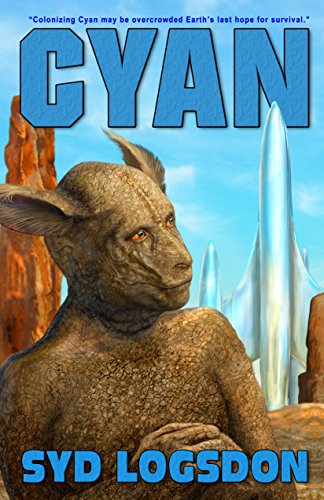
I began this website two years ago, shortly after finding out that my novel Cyan had been picked up by EDGE publishers of Canada. The original idea was to make myself and my writing known in order to find new readers for my novel. The website has grown well beyond that since.

Cyan came out in April as an ebook, and later became available in paperback as well. If you just found this website, you missed all the build up.

Cyan is a realistic, near-future science fiction novel about the exploration and colonization of a planet around a nearby star. With complications, of course.

If you click here, it will take you to the Amazon page where you can read reviews, see the blurb, and even use the Look Inside function to read a chapter or two. You can also click and buy.

If you do buy and like what you read, please take time to write a review. That way publishers will buy my next book. And then so can you.

End of commercial. Thanks for listening. SL

Symphony 3

May 1988

The heat of summer had already settled into the Central Valley of California by May. Coming down from Oregon, Neil McCrae felt it as soon as he dropped down out of the mountains, even though it was still early morning. By the time he reached Redding, sweat was collecting between his back and the car seat. The wind coming in through the window made the heat bearable, but the air was viscid.

Rolling southward, he passed the sentinel towers of Sutter Buttes. On his right, the coast range lay dry and golden; on his left and further away, the Sierras were lost in heat haze. All around him the valley was tabletop flat and impossibly green. Sacramento drew up, became a brief nightmare of traffic, noise, and ozone, then receded behind him. He changed freeways and the quality of the land changed as well. It was still green and alive, but the coast range had receded into the distance. The flatness seemed to go on forever, and now the valley was heavily peopled. The land along the highway was dotted with houses and farms, small towns and wineries. There was a used-up look to the land near the freeway. Neil could see hardscrabble apartment houses with dirt lawns and abandoned cars, a blown down drive-in theater, and a canal bridge made from an old railroad flatcar. Out beyond the highway fringe, the land was deeply green; dull and uninteresting to the long view, but vital and alive close up. Everywhere there were flowers. The oleanders which had been planted in a continuous hedgerow down the center of the divided highway were in full pink, red, and white bloom.

Neil McCrae drove southward through the hot, thick air, through a tunnel of flowers, into a new and hostile country, leaving behind him all he had known.

At Salida, he took an exit onto Kiernan Road. Now he was surrounded by orchards. Orderly, man made forests stretched away on both sides of the road, narrowing his view and hiding the flatness of the valley. The dust beneath the orchards was dappled heavily with sunlight and shade.

Three miles further east, Neil tuned into the parking lot of Kiernan School. He stood beside his car, letting the wind dry his back, then slipped on his sport coat and crossed the tarmac. The surface had been renewed recently; it stuck to his feet as he crossed and sent waves of heat all the way to his knees. He entered the blessed coolness of an air conditioned office

Two children were waiting for the secretary’s attention. Neil watched them as he waited his turn. They were both about ten. One was a dark girl who stood quietly, gripping the edge of the countertop with tense fingers. She spoke a few words too softly for Neil to hear, received a scrawled note, and slipped outside, walking wide around Neil as she went out the door. The other child was a boy with dirty blonde hair, skinny and pale, with heavy glasses too large for his face. He stood twisting his hands together and squirming in place until the secretary got time to talk to him.  He wanted to call his mother. The secretary asked his reasons, refused him, then had to argue with him sharply before he left. He slammed the door as he went out. There had been a rehearsed quality about the exchange, as if the boy had known that he would be refused.

When it was Neil’s turn, he said, “I’m Neil McCrae. I have an appointment with Mr. Campbell about a teaching position.”

# # #

William Campbell was a short, spare man with graying hair. When he rose from behind his desk to shake hands, there was no welcome in his face. more next week

Symphony 2

Here is the table of contents for Symphony in a Minor Key

The Ides of March
May 1988
August 1988
Day One
September 1988
Parents
Reading
Theory
Interlude
Halloween 1988
Evaluation
Discipline
Cooperation
Terror
Losses
Rumors
English
Sex Ed
Confrontation
Home

The Ides of March, a prolog which sets up the situation, occurs late in the previous school year in another state. In May, Neil applies for work at Keirnan school. During August he prepares for the coming school year.

Day One is very early September. Now it would be early August. Halloween announces itself, and Christmas occurs during the chapters Evaluation and Discipline.

Terror happens on Martin Luther King Day. That is not a political statement. That is the day in my real world that a school shooting happened in a nearby city. I had made an agreement with myself to match my fictional world with the real one, so this day took me places I would never have gone on my own.

Home happens at Cinco de Mayo (the fifth of May) as the school year is winding down.

I wrote an honest story. Everything that happened, could have happened in my real world. Many of these things were close analogs to things that did happen.

I never faced false accusation, but I was aware every day that I might. That is what it means to be a male teacher in America today.

Symphony 1

The Ides of March

Where were you when the world ended?

For Neil McCrea, the world he had built for himself ended on a gray Friday afternoon in March, at eleven minutes after two, among familiar surroundings. 

Neil was teaching his sixth period class, literature for high school seniors — feeling end of the week weariness, counting the minutes until the end of the day, and passing back student papers he had spent far too many hours correcting. He stepped carelessly between the backpacks, purses, and spills of schoolbooks that littered the aisles between the rows of desks. With Shakespeare and Lincoln and Martin Luther King watching from posters on the wall while the day faded outside, he called his students’ names and handed back their essays.

Alice Hamilton sat at the back of the third row. She was blonde, spoiled, and at least half as pretty as she thought she was. Neil dropped a bluebook on her desk and moved on to the next student. Then he heard the hissing intake of her breath. 

She slammed the bluebook down and screamed, “How could you! How could you give me a C after all I did for you!”

Neil just stared, too astonished to respond.

A slow flush rose up Alice’s neck and spread across her face; then she leaped to her feet and fled the room. Neil watched her go, carrying his hopes and dreams with her.

Innocence is no shield, when the world ends.

=========================================

So begins Symphony in a Minor Key, a novel written in real time, before the concept of real time was ever heard of.

Briefly, I started teaching when it became apparent that I could not make a living by writing. It was a day job at first, but it was a very satisfying day job that I eventually held for twenty-seven years, and from which I eventually retired.

About five years in, I decided to write a novel about teaching. I also decided to write of a fictional school year while a real school year was progressing. Rainy day in my world; rainy day in the book. Opening day on opening day, Christmas on Christmas, and so on. If you look at the table of contents (tomorrow’s post) you will see how that worked out.

Despite what Alice Hamilton implies, Neil is a good guy. Take my word for it. He’ll explain it all to you over the next several posts.

Today is August 12. I’ll be telling the tale as a serial, beginning September 12 to give myself time to get organized, and carrying on to something close to May 11. That is fairly close to a school year but, although I wrote this in real time, their Christmas and Halloween probably won’t fall exactly on our Christmas and Halloween.

Stick around. I think you’ll like it.

407. Where Life Is

This is a repost from very early in the history of this blog.  SL

I was in the shower getting ready for a day at school when my wife called to me. A plane had hit the World Trade Center. By the time I dried and dressed, the second plane had hit.

Twenty minutes later, driving to work, I listened to the radio as the towers fell.

All day long I taught science, keeping to the lesson plan. I didn’t want to teach, and no one wanted to listen, but it was necessary to keep a semblance of normalcy. Every break we teachers watched the television, but we didn’t take any news back to the classroom. Our students needed to be in their own homes, with their parents, before they began to deal with the details of America’s disaster.

At the end of the day, I drove home. I had upon me the need to write, but not of the tragedy. Others wrote that day of what had happened, and wrote well. I needed to write of love and joy and beauty – and of my wife who is all those things to me.

Poems come slowly to me; usually they take years to complete. This one rolled freely about in my head as I drove, and when I arrived at home, I only had to write it down.

                    There Am I

Where there is water, there am I.
In sweet, soft rain and in hard rain,
driving and howling,
or filling the air with luminescent mist.
Water is life, and there am I.

Where there is sun, there am I.
In the soft heat of morning or in the harsh afternoon,
or heavy with moisture, forcing its way through clouds,
or dry as a lizard’s back.
Where the Sun is, is life, and there am I.

Where Earth is, there am I.
Whether dark loam, freshly plowed
or webbed with fissures, hard as stone,
or sandy, or soft as moss.
Where Earth is, is life, and there am I.

Where life is, there am I.
rainforest or desert,
broad plains of grass, or brooding jungle,
Where life is, there am I.

Where She is, there is life,
and sun and rain and earth, and all good things.
Where She is, is life,
And there am I.

The “I” was supposed to be me, of course, speaking of my own love for wilderness, and “She” was, of course, my wife.

However, when it was done it felt more like a religious poem. Strike the last verse, let the “I” be God and it sounds like something written by someone with a great deal more faith than I have. Odd.

After the Storm

Postscript to Into the Storm
Not to be read by romantic types

You would have to be numb from the waist down not to feel the sexual tension in Lydia and Michael’s common flight.

How did you react to it; what did you think of their respective personalities? Is Lydia the perfect victim-heroine from romance literature, who will be the making of Michael – eventually? Is Michael the wounded warrior whose soul Lydia will save?

If you read Into the Storm that way,
you might want to avert your eyes
from the rest of this postscript.

For me, Lydia is a wimp and Michael is a jackass with a mommy-take-care-of-me complex. I couldn’t imagine spending further time with them if they were not going to change. In the original concept for a novel, Lydia was going to change a lot, as Michael’s true character was revealed.

First a bit of backstory. Their communion is not telepathy; it is technologically enabled transmission of thought and feelings, an offshoot of the memory taping technology of A Fond Farewell to Dying (short version, To Go Not Gently). Each person has to choose to be implanted. Michael has browbeaten Lydia into doing so, working on her guilt that she can walk while he can’t. She is kind and naive; he is ruthless. Living in each other’s heads, she has fallen completely under his domination.

He wants to go to live in the Martian colony where the lower gravity will allow him greater freedom. Lydia does not want to go, but shortly after Into the Storm she gives in. Her futile resistance to the move and her resentment begin to grow her a backbone. On Mars she works to support them both, and begins to find independence as Michael turns his attention elsewhere. She is fascinated by her work and he is bored with it, which gives her respite from his continual prying.

As she grows apart from Michael, she wants to have the transponder removed, but the surgical techniques that were readily available on Earth are not available on Mars. She literally can’t get Michael out of her head.

Time passes. Lydia’s importance grows and Michael’s childish need for thrills does not abate. He is exploring Phobos in a powered spacesuit, the celestial equivalent of the powered wings,  when he crashes. Lydia, in her new executive position, is coordinating the response to a Mars-wide crisis. She has access to ships which could rescue him, but she cannot spare them.

She has to save Mars with Michael’s dying voice crying in her head. Then she has to face the honest fact that his loss is less tragedy than relief.

Not quite a romantic ending.

#              #              #

I still think it was a good story, but it would have been no fun to write, and no fun for any reader who didn’t have her own hated Michael to make it meaningful. If you have a Michael of your own (or a Michelle, it works both ways), you have no doubt already fleshed out this outline in your own head, and are voicing an evil laugh under your breath.

For the rest of us, all that is left is Michael and Lydia’s flight, which is physically exciting, sexually arousing, and more than a little creepy.

Into the Storm 3

DSCN3989100 klicks, 200 klicks; speeds not to be measured on instruments; not for an artist; a master. Not for a man who had only fallen – once. He sensed their speed in the groaning of her titanium pinions and the growing strain on her arms.

She closed her eyes against the pain to come.

He arched their back and spread wings against their fall, arcing them upward and sideways through the turbulence of the interface and into a rising cell. The servos took the strain, but they communicated a portion of it to her. Pain, the instructor, the feedback; the pain would become unbearable before the fabric of her wings failed. Just before.

They shared the pain, but pain had become his world and this was his rising above it. His exultation. And it was her gift to him that she lent her body to this, for to her the pain was only pain, and she cried out against it.

Then they were climbing faster than ever, from the momentum gained in their plummet. She drew her pain in and made it a private thing that Michael could not feel. Later another, softer Michael would feel remorse for her pain. With hands and mouth, for his lower body was paralyzed, and with full knowledge that his own burning could never be satisfied, he would ravish her, putting all of his frustrations into her ecstasy. That he gave her freely, as she gave him this.

That was the Michael of endless nights and bitter days; but now, for one long moment of exultation, he was the Michael that had been, before misjudgment and arrogance had hurled his body to the ground.

Now, he soared.

Through the roof he called it. Augmented by the momentum gained in falling, propelled by the even beating of mechanical wings and buoyed by the rising cell of air, he took her through the rains and the lightnings and the pit-cold region where hail is born, upward through the thinning edges of the storm to where the air is still and the sun still shines. Through the roof.

With the last erg of upward force expended, Michael rolled over to float above the storm. From here the thunderheads were pearly white; billowing fields and valleys of cloud as peaceful as the sleep of childhood. They looked as if a man could walk across them to the end of the world. The sky was the dark blue of high altitude and the gray ring around the sun was itself encircled by a rainbow.

Hovering like some great eagle, above the tumult of the storm, with their height disguised by the carpet of clouds, her fear left her and her joy began.

For long minutes they glided, and she felt Michael slipping away. His ecstasy had ended. To dive again into the storm would be foolhardy; whatever Michael’s vitality, it was Lydia’s body they rode and she had reached her limit.

She felt his hesitation and knew his temptation. Just one more thrust into the clouds; just one more plunge into ecstasy and death.

She knew this and said nothing; and in her calm he found the courage to turn away from the storm and glide downward, carrying with him his tired and precious burden.

Come back Monday for a postscript to this story.