Tag Archives: memoir

47. Working

DSCN5109I think I was eleven. I remember the incident with complete clarity, but not the date. I was sitting at the kitchen table; it was five in the afternoon and my dad was heading out to the dairy barn for the evening milking. As he passed my mother, he said, “I’m taking the boy with me,” and jerked his head at me. I got up and followed him out the door.

From that moment, I was a working man. I still am; retirement didn’t change anything. I’ll still be writing something, or building something, or fixing something while they’re nailing down the lid on my coffin.

This story isn’t about going back to cave life. We didn’t milk the cows by hand. There were mechanical milkers, two of them, which my dad shifted manually from cow to cow. That was exciting, because the cows were half wild and he never knew when one of them would try to kick his head off.

As each cow finished, my dad would pour the milk into a bucket, then move on to the next cow. It was my job to carry the milk into the next room and pour it into the strainer on top of a milk can – and not spill any on penalty of “the look”. Since the bucket weighted about half as much as I did, and the strainer was chin high, I got strong fast.

Work on the farm was very physical, not because we were poor, but because it was a long time ago and there weren’t many labor saving devices around. Before we got our first grain auger, I scooped tons of grain by hand. We counted it a major innovation when we switched from heavy steel scoops to light aluminum ones.

There were lazy times, too. At harvest, I drove the truck. That meant moving up next to the combine every fifteen minutes for offloading. Three minutes of driving followed by twelve minutes of waiting for the combine to go around the field again, repeated hour after hour for several weeks. I had a straw hat, a ice cooler of water, a truck seat to lounge on, and a  stack of library books. It was heaven.

We were frequently broke, but never poor. My dad never balanced a checkbook in his life. During bad years, we borrowed from the bank when we ran out of money; during good years, we paid them back. As long as the good years outnumbered the bad, it all worked out in the end.

I didn’t leave the farm to get away from work. I liked the work. I left the farm so I could find a job that would utilize my brain as well as my body. I planned to be a scientist; I ended up a writer and a teacher, but I never stopped working.

So what lessons did I learn from all this? Work is its own reward, and it had better be, because its likely to be all the reward you get. There is no relationship between work and money. You work hard and carefully because you are supposed to; it’s what a man does. It doesn’t assure success.

You can see how useful all this had been for a writer.
46. Three Men Gone (2)

Last post, I told you about a man of faith. The other two men on my list are different.

The first was a profane man. He smoked and drank and chewed tobacco, and his speech was punctuated with oaths. He was the owner and operator of the local gas station. That’s what we called it, although no one ever bought gasoline there. Every farmer had a 500 gallon tank at his farm. You filled your tractor there, filled the out-of-service milk cans you used to carry gasoline to the fields, and filled your pickup.

You went to the gas station to get a tire repaired or buy a fan belt from the hundreds hanging high on the walls. The station operator would retrieve one of them using a ten foot pole with a hook on the end, which he manipulated one handed.

You see, he only had one arm, and that was a bigger deal in the fifties than it is today.

If you are young, you may never have seen a tire removed from its rim. If you are under fifty, chances you have never seen it done without a pneumatic breaker. This station operator had only a tire vice, a heavy rubber-faced hammer, and two or three levers shaped like blunt, curved chisels. When a tire needed repair, it was the signal for the start of a violent ballet with all the farmers gathering around to watch. He would drive the tire away from the rim with a dozen powerful blows from his overdeveloped right arm, drop the hammer and insert a lever, haul it back and brace it against the center stem of the tire vice, grab the hammer and drive it deeper, grab the free end of the lever and haul it mightily sideways clear around the perimeter until the tire popped free of the rim so he could reach the tube inside. It was fast and loud as he did with one arm what the onlooking farmers could not have done with two.

Today, because of helicopters and advances in medicine, fewer soldiers die within the first hour of being wounded. As an unintended consequence, limbless persons have become common. Add to that the generation old shame for the way returning Viet Nam vets were sometimes treated, and you end up with a culture which embraces its amputees.

This was not true in the fifties. The station owner’s lost limb could have been a war wound. He was of the right age to have lost it in WWII, but I never knew. No one talked about things like that back then. And no one provided special hospitals, advanced prosthetics, or support groups. A man made it on his own, or he didn’t, with very little help.

I was impressed. I still am.

*****

I never met the third man in this trio. His name was Nigger Eddie. I won’t clean that up. It would be as wrong as changing Injun Joe’s name to clean up Tom Sawyer.

There were no black people in my little town, but Nigger Eddie lived somewhere in the county. That was the name everybody called him by; I never knew his real one. We would see him driving down the main street, which was also a state highway, face forward in his pickup, never making eye contact. People would look up as he passed by and say, “There goes Nigger Eddie.” They never waved; he never looked up.

Nigger Eddie was respected by everybody because he kept to himself and never made trouble. He drove through our lives, but he was never a part of them. Apartheid was new in the fifties, even in South Africa, but my people fully understood its basic principles.

That’s all I know. Even as a child I wondered where he lived; was he married; did he have kids; what was that family’s life like? I will never know.

Within a decade, the civil rights movement opened my eyes and began to open the eyes of the nation. Here was a black man too old to reap the benefits of that change. I hope that his children and grandchildren did.

45. Three Men Gone (1)

There are three men from my childhood I would like to see again.

The first was the preacher at our church for about ten years. I can see him before me in memory, but I can’t remember his name.

Over the years I have known a lot of preachers. Some were weak men trying to do good; some weren’t worth much, no matter how hard you looked for goodness in them. The man I remember was what a preacher should be.

Our church was as tiny as our town, so we couldn’t afford a full time minister. This gentleman worked as a switchman on the railroad, in a yard in Tulsa, thirty-five miles away. He lived near his work and drove to our town every Sunday, come rain, sleet, snow, hail, or tornado. He preached the morning sermon, spent the day visiting church members, then preached again on Sunday night. Some church family invited him to dinner every Sunday after church, and that was about all the pay he got. The salary we gave him would barely cover his gasoline. Midweek, he drove up after work for prayer meeting.

Fifty years later, I still remember his sermons. They were hard, but they weren’t cold. He told of fire and Hell and the coming Armageddon in tones that would set your hair on fire, but his face was always full of kindness, sorrow, and forgiveness. When he said Christ would forgive, you could believe it when you looked into this man’s eyes.

One morning, he did not show up for Sunday service and word went around that there had been an accident. He worked between the cars, opening the couplers, and America’s rail yards have always been slaughterhouses. His hand had been caught between moving cars.

I was too young to visit him in the hospital, so I didn’t see him again until he returned weeks later. He had lost the outer half of his right hand, but he could still hold the Bible in it, and slap it down in emphasis on the pulpit. I was ten; I couldn’t take my eyes off it. I can still feel the bony oddness of it as we shook hands at the end of every service.

He preached a thousand sermons in that church, with one theme: surrender to the love of God or burn in Hell. I eventually surrendered, went down the aisle to where we sat side by side on the front pew with his arm around my shoulders while he prayed for my soul. It didn’t take, but if there were anything today that would make me change my mind about God, it would be that man’s unfaltering faith.

44. S. L. in Occupation

220px-Polish_kid_in_the_ruins_of_Warsaw_September_1939Last post was about my father in the closing days of WWII. After his wounds had healed, he was returned to his unit, now in occupied Bavaria.

How he felt about the German soldiers he fought, he never did say. In his stories, he never shot them – just scared them a bit. Somewhere along the line he had ditched his M1 Garand for a Thompson sub-machine gun with a broken stock. He carried it (he said) one handed by the pistol grip; in combat he pulled the trigger and recoil sent the muzzle swinging up and to the left, with a spray of bullets that sent the enemy sprinting for cover.

It was a good, clean story for the wife and kid, but once he almost slipped in the middle of telling it. Comfort and humor almost got swamped by blood and truth. He changed the subject. There is no doubt in my mind that, like a million other WWII veterans, he only told what his audience could bear to hear.

His feelings about German civilians were quite clear; these were his kind of people. Bavaria was a long way from the seats of power, and these were farmers and poor shopkeepers. He hated Nazis, and German generals, and politicians, but he liked the local people and they liked him. So did their daughters.

My father was handsome young man, full of life, full of fun, and he had money. The young German men were gone. They had gone to war and were now dead or in Allied POW camps. The German civilians were hungry. As I read between the lines of his stories, my father kept several families fed, in exactly the same way my grandfather kept several families of out of work townsmen fed with produce from his farm during the depression.

My father’s feelings for his Bavarian Germans were conditioned by his childhood. These were working people, like his own family and friends, and like the German settlers that lived around Owasso, Oklahoma where he was raised.

He fell in love with a German girl and they planned marriage, but he discovered that to marry her, he would have to reenlist and remain in Germany two more years. He was a homesick farm boy, ready to feel the Oklahoma dirt beneath his feet again, so he left his German girlfriend and came home. A year later he married. A year after that, I was born.

43. S. L. Goes to War

150px-US_1st_Infantry_Division_SSI.svgAs I said in the last post, I served but did not see combat. The Syd Logsdon in this title is my father.

World War Two was a presence in our home when I was young. My dad served, was wounded, and returned. It was the biggest and most concentrated experience of his life.

My dad was a storyteller, but all his war stores were humorous tales of incidents along the way, or descriptions of enduring exhaustion and cold, or brief, dry, cool descriptions of the techniques used to clear a town or take a pillbox. He went through some of the worst fighting in the war, but his stories were essentially bloodless.

These were not the kind of gung-ho stories that would lead to hero worship. He didn’t consider himself a hero, anyway. He was just one of millions who went where he was sent and did what he was given to do; that was enough.

I can see him in memory, telling his stories. Even as a child, I could see the pain in his face. He had to tell the stories – he couldn’t keep them in – but he kept the horrors shut up behind his eyes. I don’t know how much he told my mother when they were alone, but I do know how often her nights were disrupted by the terrors that came to my father in his dreams.

He joined the First Infantry Division as a replacement after D-day and fought his way across northern France. His view was a soldier’s view – a road here, a village there, this particular house, that particular pillbox. I don’t think he ever had a global picture of where he was. He left combat in an ambulance before the assault on the Rhine. He always said that wound kept him alive. He had an almost superstitious belief that he would have died on the Rhine.

He was there for the entire Battle of the Bulge. Roughly two hundred thousand American and German troops died in a small corner of the Ardennes forest. You can see windrows of the dead, in history books, in grainy black and white photographs. He never talked about that, although he was eloquent about the cold and the exhaustion.

The wound that sent him out of combat came under incongruous circumstances. After the Battle of the Bulge was over, his group had captured a stash of German weapons. The lieutenant in charge wanted to try them, so he, my father, and some other privates took a panzerfaust – a German antitank weapon – out to an open field. My father put it on his shoulder and pulled the trigger.

My father always speculated that some Jewish prisoner in a munitions factory had sabotaged the weapon, in hopes of taking out a German soldier. No one will ever know. The weapon exploded an inch from his head, and he spent the remaining months of the war in a hospital in Paris.

More next post.

42. The Other Veterans

300px-USMA_Color_Guard_on_ParadeVeteran’s Day is tomorrow, but I have three more posts on the subject, so this is coming early.

I am an American; I vote. During my nearly thirty year career as a school teacher, I always went to the polls early and wore my ”I have voted, have you?” sticker throughout the day. Children would ask me, “Who did you vote for?” I never told them. Sometimes they would ask me, “Are you a Democrat or a Republican?” I never told them.

Teachers have a responsibility to be involved and have political opinions, because they are citizens. But they also have a responsibility to avoid shoving those opinions down the throats of their captive audience.

I am one of the other veterans, the ones who went, did their job, and moved on. I don’t march in parades. I love America, but I still have a love/hate relationship with the flag. It stands for aspirations toward universal freedom, and when I think of it like that, I love it. But it also stands for the darkest of horrors.

I went into service in 1971 because my draft number was 41.

Heinlein said slavery is not made more appealing by calling it Selective Service. I agree, mostly; however conscription levels the field. Without conscription, the white and the rich would not have protested so loudly as they (we) did, and the Viet Nam war would have gone on much longer.

During my last year in college I signed up for a term in the Peace Corps. My wife and I were going to Mysore (a state in India, since renamed Karnataka) to teach horticulture. It was a good fit, since I was an anthropology major specializing in South Asia, and a farmer’s kid. It was also a chance to learn an Indian language beyond my college Hindi, and get a taste of fieldwork before I committed myself to a Ph D. program.

Then Nixon did away with the Peace Corps deferment. The Marines were drafting, so I joined the Navy. I wasn’t trying to avoid death; I was young enough to foolishly assume I wouldn’t get killed. I just didn’t want to shoot anyone who was defending his homeland in a war that never should have started.

Four years later I was a civilian again, the Viet Nam war was over, and the general opinion had shifted. Most Americans had come to realize that the war was a mistake.

Thirty years later Bush Two sent troops in to find weapons of mass destruction that never existed, as if we had learned nothing.

I am a veteran; I believe in defending my country against real enemies. But when I see starry eyed children who can’t wait for their chance to plunge into battle – well, pardon my lack of enthusiasm.

40. Names From the Past

Original_ouija_board

The boy in the tower, remember? From the last two posts? His name? I’ll take you there by way of a side trip.

In 1965 I was a Fleming Fellow. I can be reasonably sure you’ve never heard of that, but it is a wonderful program. Every year from four to seven juniors from Oklahoma high schools are chosen to spend the summer teamed up with doctors from the Oklahoma Medical Research Foundation, essentially as research interns.

We were housed boarding house style with a local family, where one of my young colleagues promptly found a girlfriend, Dixie Margaret Peacock-Van Tyle. I wouldn’t share her name after all these years, but it’s just too good to resist. She was pretty, vivacious, and a lot more worldly than we nerds were.

One night as we were all sitting around the living room, she brought out a ouija board and we had a seance. All our hands were on the planchette, but Dixie was the one who interpreted the results. The board told us of past lives, and when it came to my past, the board spelled out TIDAC. Tidac, Dixie said, was a fourteenth century prince of Normandy. Then it spelled out JAVERNAN. Javernan was a sixteenth century French sorcerer.

I was a kid from nowhere. At home, I had to keep my opinions ruthlessly suppressed. I worked constantly, on the farm and on science projects. I had no real interests except for getting-the-hell-out, and getting on with my life. I had no girlfriend, not because girls didn’t like me, but because I refused to let any entanglement interfere with my escape.

Considering my real life, being a prince and a sorcerer in previous lives was a big deal. I went to bed that night with a smile on my face that has really never faded.

Thank you, Dixie, wherever you are. You brought some romance and whimsy into my life.

The boy in the tower became Tidac, and when he grew to be a man, the first friend he made was named Javernan.

39. Into the Valley

220px-Langaa_egeskov_rimfrostIn 1972, I was working as head surgical technician in the dental service of a naval hospital. We did quite a bit of exciting work, but the day to day routine consisted of assisting in the extraction of impacted wisdom teeth.

The next day after the vision of the young boy in the tower (yesterday’s post), some unfilled appointments left me with a couple of hours to kill. I sat down and wrote the first chapter of what would become a fantasy series.

I typed the last period on the last polishing of that story in June of 2013.

Mark Twain said of a writer starting a novel, “. . . in the beginning he is only proposing to tell a little tale; a very little tale; a six-page tale.”

In 1972 I had no intention of writing a novel, much less becoming a novelist, but the boy’s story already had me by the throat.

In that first chapter, which I wrote there in the dental office, Marquart, the boy’s father, comes in on horseback (kakais came later), in midwinter, to take up his new lands in the Valley of the Menhir. His new wife is with him, pregnant with the boy. They are seen by Harthka, wife of a free forester and, as they pass on, we follow her to her crude, hidden dwelling. She is followed by a ‘shifter (only a simple werewolf in this first iteration) who attacks her. She is saved by her husband Amon (later Amyn, to avoid confusion with Amon Ra).

A simple story, and very medieval at first. Everything would grow, deepen, and morph as the fantasy elements crystalized, but I did not know that in 1972. I did realize, as I wrote that first chapter, that when Marquart was killed, the boy would flee to the hills, would be found and raised by the forester Amyn, and that those years would be the making of him.

I also knew the boy’s name, which I will share next post.

A young marine knocked on the door. I put the papers aside, called the oral surgeon, and went back to work. That night I took the chapter home and filed it away, where it would lie fallow for the next five years, then re-emerge to blow a hole in my career.

More next post.

38. Sidetracked by Mark Twain

200px-Beowulf.firstpageMark Twain said:     (see posts 18, 19, and 20)     “(In the beginning a writer) has no clear idea of his story; in fact he has no story. He . . . can only find out what it is by listening as it goes along telling itself . . .”      

Been there; done that. Spirit Deer and Jandrax presented themselves to my typewriter with reasonable speed and ease. My third work, Valley of the Menhir, was a kakai of a different color.

          (Kakai – the native riding beast of the World of the Menhir.)

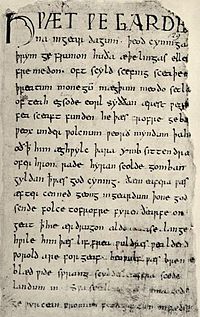
VOTM actually came to me about three years before I had any idea of becoming a novelist. I was stationed at a California naval base and my wife was with me. She was working at the base library and taking a reference librarian class at a local junior college. I took it with her, for company. One night in the college library, waiting for her to finish her work, bored, I took down a copy of Beowulf. I opened the book and the words “all that lonely winter . . .” jumped out at me.

I slammed the book shut and put it away. I didn’t know what part of the story I was in, or what the actual context was, and I didn’t care.

I had had a vision of a young boy in the open window of a stone tower, looking out across a leafless, snow bound landscape. He was newly an orphan. The master of the tower had saved him, but in doing so, the boy had become captive to his world’s expectations. He would now have to spend his childhood in preparation for gaining revenge on the slayer of his father. But he wanted no revenge. His only feelings for his cold and distant father was a vague fear, even now that he was dead.

I wasn’t a novelist yet, but I knew a story when I saw one. I didn’t know I would still be haunted by it forty-some years later.

More next post.

34. A Very Young Teacher

101One sultry afternoon in late spring the principal came running into my ninth grade classroom and shouted, “Boys, get on the bus. There’s a prairie fire.” All the boys from all four grades – about fifty of us – piled into the school bus and roared off west of town. Local farmers with milk cans of water in their pickups and bales of gunny sacks were already there. We grabbed wet sacks and went to work, and during the next three hours we fought the fire to a standstill.

Not one boy hesitated and not one parent complained. Small town Oklahoma in 1962 was a very different place than anywhere in America today. It was a good place to grow up if you wanted to become a man, and the sooner the better.

Two years later, I was one of two students in second year German when the English and German teacher was severely injured in a car accident. He was out for six weeks. The only substitute teacher in the area was a million years old, and she didn’t speak German. She got the job.

About the second day, the principal pulled me aside and said, “I want you to teach the first year German class.” I said yes. Then or now, I can’t imagine giving any other answer.

He put the substitute into the library during the hour German was taught and pulled me out of the class I was supposed to be in. It was tough. My German wasn’t as strong as it should have been, but it got better fast. Every night I typed up worksheets on my old manual typewriter, and every morning the school secretary made copies. I worked the kids hard and put up with a lot of silliness. A class full of sophomores is never going to really listen to a junior, even when the principal comes in regularly.

Can you imagine the lawsuits if that were to happen today? After about a week, the principal asked me how I was doing. I said, “It’s working. I’m studying at night, staying one chapter ahead of them, and trying to seem like I know more than I do.”

He patted me on the shoulder and said, “Son, that’s how we all do it.”