Tag Archives: military

165. Hopping Across the Atlantic

In False Fame on June 7, I gave Lindbergh a bit of a hard time. That was fair, but there is more to the story.  Lindbergh left New York, flew to Newfoundland, then crossed the Atlantic and landed in Paris, all in one unbroken flight and solo. No one had done that before and he deserved credit for his achievement.

During the New York to Newfoundland part of the flight, and crossing France at the other end, Lindbergh could have tried to set his plane down in a cow pasture if it had faltered. He would probably have lived to tell the tale. It is the over water part of his flight that scared those who followed his exploits and made him a hero.

However, eight other men had already crossed the Atlantic by air and two of them were on a non-stop flight.

***

A great deal of progress in aviation had taken place between the Wright brothers first flight and the end of WW I. By 1919, the U. S. Navy was ready to attempt a flight across the Atlantic, using Curtiss flying boats.

There was a generation of world wide flight, now largely forgotten, between world wars one and two, that used flying boats. The reason was simple – there were few airfields. If you wanted to fly to Cuba, for example, your only choice was to land in the water at Havana harbor. All that changed in the 40s when warring nations, especially the US and Britain, built military airfields across the globe. When peace returned, the day of the flying boat was over.

300px-Curtiss_NC-4_four_engine_configuration-detailIn 1919, that generation of flight was just beginning. The U. S. Navy had commissioned Glenn Curtis to build four flying boats before the end of WW I, and now planned to use them in an attempt to cross the Atlantic by air.

On May 8, the NC (Navy Curtiss) 1, 3, and 4 left New York on a three jump flight to Newfoundland, where they were repaired and readied for the longest over water part of the journey. They left Newfoundland on May 16, heading toward the Azores. A string of naval ships were set out along the way for navigation or rescue. The NC-4 arrived at the Azores after a 15 plus hour flight. The NC-1 and -3 didn’t make it. The NC-1 landed in the open ocean; it crew was rescued but the craft later sank. The NC-3 also landed in open water, then taxied the last 200 miles to the Azores.

The NC-4, now alone, left for Portugal on May 20, but didn’t get far. After repairs, it again departed on May 27 and arrived at Lisbon harbor ten hours later. From North America to Europe, the trip took just under 27 hours – or just under 11 days, depending on how you spin your figures. Subsequently, the NC-4 flew on to Portsmouth, England, making it the first flight from the United States to Great Britain.

All in all, three aircraft with six-man crews and 53 Naval support ships were involved in the journey. The crew of the NC-4 were Albert Cushing Read, Walter Hinton, Elmer Fowler Stone, James Breese, Eugene Rhodes, and Herbert Rodd.

Two weeks later two British aviators made the Atlantic crossing non-stop. We’ll look at their flight tomorrow.

163. X-craft

Jay Miller wrote a book called The X-planes: X-1 through X-31, and later revised it to include craft through X-45. (Presently, the number is up to X-56.) If you are any kind of a space aficionado, you need to look it up in your local library. The only thing wrong with the book is its title; not all X-craft were planes.

When I was growing up, I was in love with the F-104 Starfighter and the X-15 rocket plane, two aircraft with markedly similar outlines. The F-104 was designed, a few prototypes were built and tested, then it went on to become one of the most successful fighter jets in history. The X-15 was designed, three were built (and rebuilt after various incidents), and tested. There were never any more X-15s, nor had there ever been a plan to build more. The X-15 was never a prototype, because a prototype is a first iteration, built to be tested, perfected and turned into a series. That is true whether you are talking about fighter jets or can openers, but not true of X-craft.

X-craft were something different. They were flying laboratories – a much overused term, but still accurate, although technology demonstrator is preferred.

After World War II, advances in flight by Germans, British, and Americans, along with nascent cold war tensions, put us on the edge of an unknown frontier. The “sound barrier” loomed as the best known obstacle to further advances in aviation, but there were a hundred other unknowns that never made it into the popular press. Wind tunnels could only tell so much, computer modeling was decades in the future, and it made no sense to build a squadron of high-performance aircraft that might or might not fly.

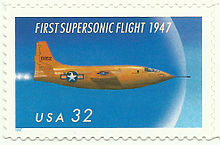
First_Supersonic_Flight_1997_Issue-32c

A glance at the first X-plane, the Bell X-1, gives clues to what was known and what was not known. We already knew that turbulence off the wing would foul up the tail controls at high speed, so the horizontal stabilizer was attached high up on the vertical stabilizer, not on the body. It was not known what negative effect the cockpit bubble would have, so the windscreen was faired into the shape of the fuselage. It was shaped like a 50 caliber bullet – everybody says that without explaining. It is a reference to the machine guns carried on fighter planes. Fired from a ground rest, those bullets would have been sub-sonic. The planes they were mounted on flew at subsonic speeds, but bullets fired from a plane in flight had been going supersonic for a long time.

An aside here for the non-nerd. Planes flying slower than the speed of sound are subsonic. That includes all commercial aviation except the Concorde. Planes flying faster than the speed of sound are supersonic. The X-1 and its follow-ons proved that supersonic flight is not problem. The problem is the transition zone, the trans-sonic region. Slower than sound, the accumulated shock wave is out in front of you. Faster than sound, it is behind you. At the speed of sound, it is right in your lap, trying to tear your plane apart. No modern, supersonic plane lingers at that speed.

The X-1 broke the sound barrier (i.e., passed through the transonic region into the supersonic region) on October 14, 1947, with Chuck Yeager at the controls.

Since this is A Writing Life, I’ll add that I was born about two months after the sound barrier was broken. I was present on the planet for almost all of the early X-craft explorations, although far too young to notice. When I became aware of the X-craft, I fell gloriously in love with them and the infatuation never passed.

The X-2 was a more normal looking aircraft, with swept wings and a pilot’s bubble. It carried supersonic speeds to new heights, but killed its pilot in the process. I will tell that story next Wednesday.

The X-3 was an extreme aircraft, stretched out and incredibly streamlined right down to the tip of its needle nose. It looked faster than any plane before or since, but it wasn’t. All that streamlining couldn’t make up for the fact that the engine slated for the plane wouldn’t fit, and the one that did fit was underpowered. The fastest (looking) plane in the sky flew slowly.

The X-4 was tailless and not successful. The X-5 tested variable sweep wing technology. The X-6 was an aborted project testing out the possibility of a nuclear powered aircraft. The X-8 was a small, unmanned rocket designed for upper atmospheric research. The X-7, and X-9 through X-12 were test beds for missile research. X-13 and X-14 were early attempts at Vertical TakeOff and Landing (VTOL).

Then came the coolest aircraft/spacecraft in the history of mankind, the X-15, which will be the subject of tomorrow’s post.

150. Old Enemies

There are times when a man has to stand up and defend his country. That is the flip side to yesterday’s post criticizing boot camps.

Today we face Islamic extremists who would destroy us. We can bemoan the our mistakes in Iraq, but we have to move forward from where we are. Wishful thinking is of no value in this issue. We call them fanatics. That’s an accurate description, but it is not useful. It’s just another word like evil, enemy, or barbarian – just another word that means THEM, as opposed to US.

If we are going to understand Islamic terrorists in order to defeat them, we have to find the inner fanatic in our own culture, so we can start to see the world through their eyes. Today we will revisit a time when Christians were killing each other over doctrine. Tomorrow, we’ll compare that to Islam.

*****

Trying to compress two thousand years of Christian history into a few hundred words borders on the burlesque, but let’s try. Christianity began with Jesus, who did not write the Bible. Fundamentalists like my people believe that it was written by his immediate followers under the infallible inspiration of God, but textual evidence suggests that it was actually written hundreds of years later.

In any case, by the third century there were hundreds of “books” to chose from. The Church chose some and discarded many in order to create the Bible. This gives some validity to the Catholic notion that the word of the Church is more important than the Bible, or at least others’ interpretations of the Bible.

Within the Roman empire, Christianity went from persecuted, to allowed, to the official religion of the state. Then along came Martin Luther. He was not the first to question the Church, but he was the first one to live through the encounter, because of changes in world politics which pitted proto-German rulers against Rome and provided him with a sanctuary.

The dam broke and here came a vast flood of new denominations, each anti-Catholic and each disputing with its fellow Protestants. For protection, many of these denominations sought the protection of secular leaders. Protection from outside enemies soon moved toward forced conversions within an area. The Dutch and Swiss became largely Calvinist, many Germanic states became Lutheran, Ireland remained Catholic at the core, although under increasing pressure from their English conquerors, France and Spain remained Catholic, England became the realm of the Church of England, and Scotland fell under a particularly Knox-ious form of Calvinism.

From 1618 through 1648 the Thirty Years War decimated Europe as country after country fought to see which form of Christianity would prevail, cementing the notion of one realm, one ruler, one religion. The notion of individual choice in religion was crushed under the boots of Kings and generals. This era provided every denomination with myths of how THEY were trying to destroy OUR beliefs. That WE were also trying to destroy THEIR beliefs tends to be forgotten.

The English Civil War, also called the War of the Three Kingdoms, came hard on the heels of the Thirty Years War. American notions of religious freedom were born out of the horrors of a conflict where various interpretations of God’s Truth were enforced at sword point, and partisan armies swept the land. The American answer to all this was the separation of church and state, found in the First Amendment:

Congress shall make no law respecting an establishment of religion, or prohibiting the free exercise thereof . . .

There is a bit of cynicism in this. Instead of insisting that God’s will be done, Americans have learned that the man in power rarely understands God’s will.

149. Boot Camp

It’s Armed Forces Week again, that time of year when any questioning of the military is taken as a slap at servicemen or veterans. Citizens who have the temerity to say, “Wait a minute, let’s talk this over,” are seen as unpatriotic. When I was in the military, those people were called commie-pinko wimps. I was one of them, but they drafted me anyway. I’ve told that story in 42. The Other Veterans. I also told the flip side of the story in 43. S. L. goes to War and 44. S. L. in Occupation, which detail my father’s WW II experiences. There are times when a man has to stand up and defend his country. There are also times when a man has to stand up and tell his country to back off.

The military has no use for patriots, because patriots think for themselves. In combat, a soldier who shouts, “We must not do this,” is likely to get himself and his teammates killed. He has to go on, following orders.

So how do we turn patriots into yes-men? Boot camp. That’s what it’s there for.

Boot camp is not seen as something important, or morally debilitating. And, I suppose, compared the things that happen later in the field, it isn’t that important. But . . . without boot camp to turn patriots into soldiers, those later events could never happen.

This isn’t about me. I went through boot camp in neutral mode, observing, remembering, and trying not to feel. I wan’t always successful, but I was successful enough to survive intact. I was changed, of course, but by my own experiences, not by pre-programmed manipulations.

This also isn’t about the eighteen year old children who made up most of the recruits, who were eager to follow the path their elders had set, and ready to go over and kick some commie ass. This is about one young man, and those he represents. He came into boot camp a patriot, ready to serve his country, full of love and compassion, but ready to do his duty. They broke him. I can still see him standing in the barracks before lights out, talking to his friends, saying, “This isn’t right. I joined up to fight for my country. Why are they treating us like this?” His friends laughed at him and told him that this was nothing, it was just getting him ready for what was to come.

It wasn’t nothing, but it was getting ready for his life to come. That was the point.

I never talked to him. There was nothing I could say. He was learning in front of my eyes what I had learned years before, at other hands, under other circumstances. But I never forgot him.

Boot camp is what in Anthropology we call a liminal experience, one that tears down an old identity in order to build a new one. The folks at boot camp are really good at this, even in mild boot camps like the one I experienced at the San Diego Naval Training Center. We could see the real thing across the fence at the Marine boot camp, and we thanked God every day that we weren’t Marines. While I was there, a Marine recruit who could no longer take the daily abuse ran off and stowed away on a jet liner at the civilian airport just over the fence. Hours later the jet landed at his home town on the east coast and he fell out of the wheel well, frozen, asphyxiated and dead. The Marines said good riddance. We worms (as Navy recruits are called) laughed. Learning to laugh at the death of others is part of the boot camp experience.

It was all choreographed indignation, play-acting inflicted onto a captive audience. They said that if we didn’t keep our barracks clean enough or our socks rolled tightly enough, the Trouble Shooters would come.

“You worms have been given socks to roll! That’s all we trust you with now! How can we trust you with nuclear bombs once you’re on an aircraft carrier if you can’t roll socks now!”  Every word was delivered at a shout.

Of course, the Trouble Shooters came. They always do. They came in the night, screaming in manufactured rage and tearing the barracks apart while we stood at attention in our shorts at the foot of each bed.

Near-naked, helpless, frightened into immobility, knowing that the only way to survive was to  let the insanity happen. Civilian identities dying; new, military identities growing.

The making of a Navyman. You could put it on a poster.