Tag Archives: poetry

32. Roses, out of the dry ground

220px-Queen_Mary's_Gardens_P6110014

I like poetry a lot, but my personal taste pretty much stops with Frost and Yeats.

I like to pepper my novels with quotations from the Rubyiat, Masters, Tagore, and poetic scriptures from various religions. When an appropriate quotation is not available, I never hesitate to write a bit of poetry to develop a character or move a story along. Poetry written to purpose is not real poetry, but I will be including some of it in later posts as illustrations of the writing process.

Roses, out of the dry ground is a real poem, and the first I wrote as an adult.

Novels come over time, with a few flashes of inspiration and a lot of grinding work. I have enough novels waiting to keep me writing for the next three hundred years.

Poems only come when they come. For me that means rarely, but they are a treasured gift when they do come.

Roses, Out of the Dry Ground

The child fled
From harsh words and rough hands
And the uncaring glance that kills the soul,
To hide among the weeds and brambles,
The lizards and the hard cased beetles,
Where no voice comforts,
And no voice condemns.

There he found a rose, growing
          out of the dry ground.

Out of dirt, caked and broken,
Webbed down by spiders;
With dusty leaves,
          yet blooming.

The child reached out and touched a thorn
So gently that his finger did not bleed.
(For the child knew thorns)
Reached further, and touched the blossom, so gently
That its fragrance filled the desert air.

He sat long among the weeds
And gazed in wonder, that the rose,
So ragged, could still be sweet.

Never knowing,
          it was a mirror that he saw.

31. Discovering Khyyam

412px-033-Earth-could-not-answer-nor-the-Seas-that-mourn-q75-829x1159My novel A Fond Farewell to Dying opens with a quatrain from the Rubyiat of Omar Khyyam.

Oh, threats of Hell and Hopes of Paradise!
One thing is certain – This life flies;
        One Thing is certain and the rest is Lies;
The Flower that once has bloomed forever dies.
Khyyam/FitzGerald quatrain LXIII

It was the perfect setup for a book about people deeply aware of the fleetingness of life and trying to find their own kind of immortality.

Edward FitzGerald is the scholar whose translation of Khyyam is most widely known. He took a mass of unrelated quatrains, translated and arranged them, and gave them a unified voice. Although called a translator, he might better be called the co-author.

Khyyam was a Persian, but not a Muslim. He was one of the leaders of the old order, recently deposed by Muslim conquest. This accounts for the wine bibbing and the questioning attitude toward God, which otherwise would seem odd, even dangerous, among the Sultans, camels, turbans, and oases which fill the poems.

I first encountered Khyyam on a high school field trip to visit nearby University of Tulsa. I managed to sneak a moment in the university bookstore, and bought the most interesting paperback I could lay hands on quickly. It was the Rubiyat. I read it on the bus ride home and was immediately hooked.

The Rubiyat is the perfect book for a questioning young man just beginning to find his own voice and his own mind. Khyyam questions authority; in fact, he questions the ultimate authority, God himself. It is not a book for atheists though, unless they are simply looking for literary support for their opinions. Khyyam was no atheist. You can’t call God to task as he does, unless you believe in Him.

Oh, Thou who Man of baser Earth didst make,
And ev’n with Paradise devise the Snake:
For all the Sin wherewith the Face of Man
Is blacken’d – Man’s forgiveness give – and take!
Khyyam/FitzGerald quatrain LXXXI

A book full of rebelliousness will catch a young man’s eye, but it is the beauty and wisdom in every line which makes it remain a treasure in later life.

30. You Have Spent Your Life

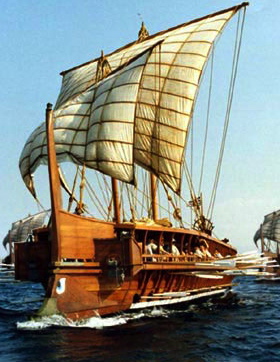
Greek_GalleysWhen I began teaching, I found companionship among fine people. It was the best part of the job, especially after of the solitude of writing full time. I learned from them all, although I never became like any of them. Teaching, more than any other job, except perhaps writing, is all about personal style.

Many of my friends said they envied my knowledge. Fair enough; I envied their strengths as well. Adrianna could keep fifty kids in order on the athletic field. Crystal gave her kids the love they needed, and was patient beyond when patience was reasonable. Dan arranged the math department so the strong were challenged and the weak were not overwhelmed.

I give thanks for the companionship of these colleagues and friends, particularly for Barbara, who took me under her wing when I had just begun to teach. We taught different students from the same stories, which I referred to when I wrote a poem for her on her retirement.

For Barbara

You have spent your life
     growing barley beside the Tigris;
          building pyramids along the Nile.

Rowing beside Odysseus
     going home to Ithaca.
Walking the night
     with Harriet Tubman.
          And dreaming with Dr. King.

A thousand children
     you have taken with you
          on your journey,
     as they struggled toward
          maturity and grace.

You have spent your life well.

I never planned to be a teacher. I called it my day job until it became apparent that I was going to teach all the way to retirement. I would have preferred to be a full time writer; or a professor, as I would have been if writing had not seduced me. But I would have missed much.

By my best estimate, nearly 4000 children moved through my classroom. Sometimes I can still hear their laughter.