Tag Archives: review

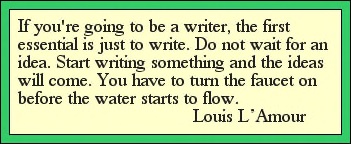
435. Looking for Louis L’Amour

To revise or not to revise, that is the question. Actually, the question is how much to revise.

There are legendary writers who write rapidly, never revise, and turn out books like Hershey’s turns out chocolate bars. I recently read a third hand account of a writer who churned out a (very bad) science fiction novel over a long weekend. It was published, although probably it should not have been.

And then there’s Walt Whitman who was still changing parts of Leaves of Grass long after it was published. I guess I must be in the latter camp, since I’ve written three paragraphs of this post so far, and I have already changed three dozen words.

All this makes me remember the words of Luther Perkins, guitarist for Johnny Cash. He was famous for playing essentially the same riff on every song, and it always sounded great. Other guitarist were flying all over the fretboard at blinding speed, and being as quickly forgotten. Perkins said, “They’re looking for it. I’ve found it.”

I guess once you’ve found it, it gets easier. After four decades, I’m still searching. And rewriting. And revising, And polishing. It’s actually very soothing, but it is slow.

Louis L’Amour found it relatively early in his career. I became something of an expert on him during the seventies and eighties by reading and rereading his novels while taking breaks from my own writing. As a young writer, I could write a few paragraphs or even a half page, then I had to look at the ceiling for a while, waiting for the next thought to come.

Take heart, new writers; after four decades, things come a lot faster.

There were times, lots of times, when I had to do something to get my conscious mind off what I was writing so my subconscious could do its work. And not science fiction or fantasy; that is what I was trying to get away from. I needed something soothing and predictable, but written with a professional touch.

That’s a definition of the works of Louis L’Amour.

If my taste for L’Amour seems out of character for a science fiction and fantasy writer, remember I grew up on an Oklahoma farm in the fifties when every hero on TV rode a horse. I worked cattle every day, myself — but they were dairy cows and I was on foot. Everybody wore Stetsons and cowboy boots, and every farmer out on his John Deere tractor was a cowboy on a horse in his secret heart.

Go listen to some country western music; you’ll get the idea.

A single word description of L’Amour’s westerns would be consistent. A few were weak, a few were superb, most were strong examples of a type. His excellence was within a limited canvas. His historicals were weak and his one fantasy was a total dog.

Over a couple of decades, I read all his novels multiple times while waiting to find out what I was going to say next. (Except for The Haunted Mesa (1987); I could never get through that one a second time.) The same characteristic phrases appear at frequent intervals.

If you have written a long chunk of text, novel or not, finished or not, try this test. Choose a phrase that seems characteristic of you. Use the find function. If that phrase shows up fifty-seven times, you might want to think about that.

L’Amour’s moral and political positions are simple, firm, and unvarying — much like Heinlein, actually. An unsympathetic critic would say he wrote the same book fifty times. I think that pushes criticism of consistency too far. It would be better to say that he had a consistent moral position that channeled him into a certain type of story.

Personally, I tend to see both sides of every argument, whether in life or in my writing. Given a certain fictional situation, L’Amour would solve it in a certain characteristic way. I would see a hundred ways to solve it, and then go searching for solution number one hundred and one. It makes for slow writing.

L’Amour did not revise. I discovered that the first time I read Reilly’s Luck (1970). Early in the book the hero meets Wild Bill Hickok; when they part, L’Amour says that he never saw Hickok again. Forty pages later, Hickok and the hero meet up a second time, and Hickok loans him a gun.

You couldn’t make that kind of an error if you did even the most cursory revising. But that isn’t really surprising, considering how many books L’Amour’ wrote. He knocked them out like a chicken laying eggs. He couldn’t have done that if he had agonized over every book.

The two different styles of writing lead to two different approaches to revising. As writers, I don’t think we get to choose which camp we fall into. It’s a blessing or curse you are just born with.

425. Goodreads as Textbook

I bought The Key of Time several years ago from E. R. Hamilton’s, my favorite purveyor of remaindered books. It looked and sounded good, but so did the half dozen others that came in the same order. I put Key aside and it stayed in my to-read pile until I became immersed in Steampunk. It seemed to ooze Steampunk, so I dove in.

I planned to review it in this blog. You saw the results on Monday in post 423. 85 Pages: a review, so named because I couldn’t get past page 85.

That got me thinking about Goodreads. I’ve only been involved with Goodreads for about a year and a half, but I am impressed by the intelligence of most of the reviews. Since I discovered it, I have treated Goodreads almost like a textbook on what intelligent readers want.

Here are Goodreads’ stats on The Key of Time by Felix J. Palma, translated by Nick Caisto:

10289 ratings                2127 reviews                rating 3.37 out of  5

That’s a lot of ratings and reviews. Many Goodreads books have almost none. The 3.37 rating is fairly normal. It’s hard to find a book on Goodreads that doesn’t garner mixed reactions.

I decided to pick a few Goodreads reviewers who agreed and disagreed with my take. Here are some examples — or rather excerpts, for the sake of space and so I don’t step on anybody’s copyright.

Traci said, It was amazing.

. . . Do you enjoy magic tricks even though it’s all sleight of hand? . . . I loved every moment I spent with this new and talented author.  . . . one of my favorites, of the year. Beautifully written.

Did Palma get his act together after page 86? Were the last 524 pages better than what I read?Did I miss something?

Frances seemed to think so, with some reservations.

Frances said, (I) really liked it.

. . . I was beginning to wonder if I wanted to continue. At times I groaned (but it). . . . soon became compelling enough to finish. When I finally read the last page . . . I (was) . . .  pleased to have read such a creative and unique book.

I have to admit that I also felt compelled to continue as well, despite the insipid “hero” and glacial pace. It reminded me of all the times I’ve tried to read Dickens’ longer books. But this isn’t Dickens. It’s more like pretend-Dickens. For me it was finally more irritating than intriguing.

Velma said, (I) did not like it. and recommended the book for “someone willing to edit it, heavily.”

Time travel! Jack the Ripper! Automatons! What’s not to love?!? Well, as it turns out, almost everything. . . . it took every ounce of stick-to-it-iveness I could muster to get through this convoluted, interminable literary maze. WHERE, I ask you, was the EDITOR in this hot mess? . . . (Palma is) a decent, if grandiose, storyteller and he mimics to perfection the florid style of the period he set this novel in . . . But come on, Félix, enough with the meandering, the inconsistencies, the convenient last-minute reprieves . . . I was all set to love this book, what with it being about the re-writing of the history of the earliest science fiction and all, but it wasn’t to be . . .

Velma pretty much sums up my reaction. If you look at her whole review on Goodreads, she is even angrier than this excerpt shows.

What is the takeaway? About Goodreads, that is. I’ve had my say on Palma.

Goodreads won’t tell you if a book is good. It will tell you all the different things readers think about it. And that is its value — many looks from many directions. I will continue to check it out, after I read something. Whether I love a book or hate it, I always learn something from Goodreads reviews, even it is is just public taste.

424. Arthur C. Clarke and Russia

(Written last Thursday) This morning’s news brings new revelations about what Russia is doing to America through the internet. Or are they new? Didn’t Arthur C. Clarke warn us all that this was coming back in 1960 in his short story I Remember Babylon? Of course he did; Arthur has always been ahead of the curve.

I Remember Babylon? is actually dated and struck me as a bit naive when I first read it, but you might want to check out Arthur’s prescience as he gives you today’s headlines 57 years before they happened. After its original appearance in Playboy, the story was reprinted in Tales of Ten Worlds, available in your local used bookstore or on Amazon.

423. 85 Pages: a review

This was supposed to be a review of The Map of Time, by Felix J.  Palma, a book of 609 pages. Instead, it is a review of the first 85 pages because I am going to bail, give up, leave; because life is short and Time is precious.

Mind you, there is some quality in this book. If it were irremediably terrible, I wouldn’t waste a post on it.

Heinlein did time travel, often and occasionally well. Let me retrodict (retrodict: neologism, the opposite of predict) how Heinlein would have written the first 85 pages of this story in, say, 1955.

A___ stood over the torn body of his lover, heartbroken, feeling that his life was over. Then C___, his cousin said, “You can fix this. Just go back in time and kill her killer before he can kill her.

That, folks, is the entire thrust of the fist 85 pages of The Map of Time.

And that’s not all. We already knew exactly what was going to happen by the second or third page. How? Because Palma spends most of his pages foreshadowing events. And, since he calls in every cliché known to Victorian England — Jack the Ripper, ruthless rich father, cowardly wimp of an heir, H. G . Wells and his Time Machine, a hero who thinks he is sensitive but is actually just a clod chasing whores in Whitechapel — we know from the start where this story is going.

The only surprise along the way is that there wasn’t one single surprise along the way.

The writing style is Victorian appropriate. The “hero” never becomes quite so bad that we don’t think he might be salvaged. The “Dear Reader” asides are cleverly handled. The description of London carries the story well. These are all the reasons I stayed around as long as I did. I thought it might get better. I thought something would eventually reward me for my perseverance.

No luck. I’m out of here.

Did I leave just before the story got good? I’ll never know.

If you stuck with The Map of Time all the way through, and you think I’m wrong, tell me. But, spoiler alert, I’ll be hard to convince.

422. Little Bitty White Hunters

When he got back to his apartment, Neil dug around in his still packed boxes to find the few books he had kept as personal treasures from his childhood. The formula books had not worn well; they held little that the adult Neil McCrae could find worthwhile. But there were others that had kept their value, and he spent the next four hours accompanying the young Hunt brothers as they continued the expedition their father had had to abandon, collecting zoo animals while floating downriver on their Amazon Adventure.

That is a quote from Symphony In a Minor Key. It was the opening paragraph of Symphony 13, over in Serial.

Neil McCrae and I have a lot in common — duh — but I also kept him as a separate person. He has more patience than I do, for example. Another thing I did was give him an English class, while I was teaching science. This lets him read to kids and read their papers, and that gives me — through him — the chance to tease out what is going on in their minds.

More than any other subject, literature is about involvement and about demonstrating that involvement by writing. But please! Sixth grade papers are awful. You’ll see when you have to read some of them with Neil. I’ll be over here with my bunsen burner; call me when you are through.

I’ve done my share of teaching reading and literature, which aren’t quite the same thing. Neil encounters a ton of difficulties, and solves them, more or less. I encountered all the same problems in my first fifteen years of teaching, and the same good, bad, and ugly solutions, before science largely pushed reading out of my curriculum.

Teaching reading is tough in a school where the children have widely ranging skill levels. Teaching literature is relatively easy, if you have good literature to teach. Accepted literature is not the same as good literature. I don’t have the guts to teach Where The Red Fern Grows. If you had that piece of pornography of violence foisted on you as a child, you’ll get the pun. On the other hand, I loved teaching Fog Magic.

Truthfully, most of the children’s literature I know, I read as a teacher. There were no bookstores which featured children’s books where I grew up, and besides, most of the children’s books I read when I was a teacher hadn’t been written yet when I was a child.

Like most children who are given the choice, I read books for children, books for young adults, and books for adults, indiscriminately. I still do. Just a couple of years ago I made it half way through my childhood set of Rick Brant books before I ran out of time and steam. Any time I see a Howard Pease juvenile, I snatch it up. His popularity has waned and they are getting scarce.

So Neil looks back at his childhood (which was my childhood — Neil was born full grown on the Ides of March) and remembers the books he read. Willard Price wrote the “___ Adventure” books starting with Amazon Adventure in 1949, and continuing for an additional thirteen books, ending in 1980. I only read the first four; by the time he wrote the rest, I had outgrown them. They all followed the pattern Neil later recounts, someone young went somewhere interesting and did something exciting, without adult supervision. That isn’t much, but that is all it takes.

In some cursory research today, I ran across an interesting phenomenon. I don’t want to make too much stew out of one oyster, but the critics in the day when the “___ Adventure” books were written, said that they were full of cruelty to non-Western people and animals. That is a problem in anything written before books were sanitized in the name of political correctness. If I were a cynic, I could say that this makes the eligible to join the rest of Western literature. Fortunately, I’m not a cynic, but I did note that comments written recently by men who grew up reading the “___ Adventure” books, then became adult writers of today, praised those books. Hmmm.

The truth is, when I wrote Symphony originally, I wasn’t thinking of Amazon Adventure at all. I was thinking of Zane Grey’s Ken Ward in the Jungle, but I didn’t have a copy, and had no way to get one to cross-check my memory. Amazon Adventure was in the local library, so it was the one to be immortalized.

Today things are different. I went to the other Amazon and ordered an eBook containing all three Ken Ward stories. Kindle is my new favorite word beginning with a K. It lets me romp through my out-of-print childhood at a buck a pop, without ever leaving the chair in front of my computer.

The world has changed, and my tastes have changed as well, so I don’t have much hope, but I’m going to give Ken Ward another try.

419. Airship Flamel

As I mentioned previously, I found To Rule the Skies: An Airship Flamel Adventure when its author, Michael Tierney, liked one of my posts and I went to visit his website. I bought it as an eBook, which is an adventure in itself. I read eBooks on my desktop Mac. Things that come through iBooks work fine, but the Kindle download is a piece of crap. As you read, it jumps to a new page every few seconds without any input from the user. The only way to successfully read is with your finger lightly on the mouse, and that only works part of the time. This is particularly irritating since the old Kindle download worked fine.

Let me say at the outset that I loved this book. It was a hoot. However, I’m not sure how many of you will feel the same. It probably depends on your vision of what steampunk should be.

To Rule the Skies reminded me of the books I read when I was a kid back in the fifties. Then books were straightforward, violence was muted, and nobody had any literary pretensions. Irony was unknown.

You couldn’t write a book like that if it were set in today’s world, or in the past as seen from today. You can do it in steampunk. As Perschon said of Oppel’s Airborne, it was a time “before the cynicism and doubt the Great War produced. This is the Gilded Age; this is the time of Victorian Optimism.”

That attitude may not be realistic, but it is a breath of fresh air.

The plot resembled an episode of The Wild Wild West, but the crew of the airship Flamel was pure Victorian British. Stiff, long winded, formal, but that was its charm. The tone was somewhere between innocent naiveté and tongue in cheek.

After all, True Grit isn’t Louis L’Amour, and that is its charm. The same thing works here.

I think its time for an example.

Sparks flew at every connection and disconnection. Montgomery was worried that the chamber was imbalanced and he made ready to pull the switch that would break the connection to the umbilical.  “She canna take it any more!” he cried, and just as he did, the shaking stopped suddenly, and the plasma inside the chamber settled down to a slowly pulsing orange glow.  He spun in his chair and checked the gauges.  “All normal, Mr. MacIver!  The luminous matter reaction has started!”  Montgomery slumped in his chair relieved.

MacIver? Say that one out loud. And engineer Montgomery shouting, “She canna take it any more!” as he performs a miraculous repair on a dying piece of high tech machinery. The pop culture references come thick and fast.

I hope Michael Tierney isn’t insulted if I say it isn’t literature, but, man, is it fun.

417. Sturgeon and Steampunk

If I’ve learned anything in my ongoing study of steampunk, it is that Sturgeon’s Law does not apply. [Sturgeon’s Law: Ninety percent of everything is shit.]

Sturgeon’s rule applies to science fiction, fantasy, literature approved for the college curriculum, and the work of prominent philosophers. It applies to fields where there is some objective means of determining quality.

Steampunk, on the other hand, is so wide ranging that it would be hard to find any two fans who agree on precisely what it is, far less what constitutes good steampunk.

After I read and reviewed Steampunk by the Vandermeers (see 411. Steampunk I II III), I checked out how it fared in Goodreads. The reviews were all over the map. More notably, when reviewers told what stories they liked or hated, no one liked or hated the same stories.

So if Sturgeon is not useful, let’s try this: [Logsdon’s addendum: I don’t like ninety percent of what I try to read.] That is why I’ve read so many first-twenty-pages-of-novels, without finishing them. I’m referring to all novels, not just steampunk.

The Addendum is not just a matter of putting my name beside Sturgeon’s. You could call it Wilkes Addendum, if your name were Wilkes, or Jones Addendum if your name were Jones. I suspect it would still hold. Quality and liking are not the same thing. I frequently read works that are marvelously written, but I simply can’t find any interest in them. That often happens when I dip into the Classics. It happened in some of the stories in the Vandermeer anthology.

On the flip side, some stories are pure fun, even though I can’t claim that they are intrinsically good.

This like/dislike issue comes up all the time when people “like” one of my posts. I always visit their websites. A lot of them are very young or deeply wounded, and are baring their souls. Occasionally I say hello, but mostly I withdraw silently, just happy that the internet is there for them.

Frequently I find a writer who is displaying his work. I always read, but rarely comment, because, “Who am I to judge?” It was under those circumstances that I recently read the first chapter of Echo by Kent Wayne (very much not steampunk). It is a fine piece of fiction, powerfully written, and it will clearly have much to say in coming chapters. It is also quite violent, and the character at the center is not someone I could like — yet, although there are hints of coming change. I short, I rank it high for quality, but I won’t read it further because it takes me places I don’t want to go. My shortest honest response would be, fine work, but not for me.

On the other hand, I also found Michael Tierney through a “like”, bought his purely steampunk ebook To Rule the Skies, and am presently 77% of the way through it. That’s an ebook workaround for the lack of pagination. The novel reads like Tom Swift, the Steampunk Professor and I love it for that very reason. I’ll devote a post to it shortly.

Another thing I have tentatively concluded is that lots of steampunk fans must also love Downton Abbey and Fear of Flying. I’ve lost track of how many heroes and heroines are members of the Victorian upper crust, the heroines also being spunky and liberated.

Oh well, it’s a big tent, with room for everybody. Most of the people inside seem to be wearing top hats with gears on them, but it isn’t required.

411. WordCamp Sacramento

Saturday, September 16th, I attended WordCamp, Sacramento, and it was a disaster. I left when there were still hours remaining in the first day of a two day conference.

Don’t get me wrong. I was impressed; the conference was well organized and the presenters were knowledgable. The problem was in the advertising. There should have been a disclaimer to warn people like me to stay away. I’ll explain further, below.

About three years ago I decided to blog and set about learning how. It took a while and there were lots of wrong turns along the way. I began by studying HTML and CSS. (see 408. Behind the Curtain) I’m glad I did. That study gave me some deep background knowledge, and some specific skills as well.

Do you check out the comments when you read someone’s blog? I always do. There is a lot of back patting but also some interesting insights. J. M. Williams, in a comment on the post above, said that HTML served him better than algebra. That sounds entirely reasonable. I don’t use it often, but I couldn’t do without it when I need it.

Well into learning HTML and CSS, i stumbled on WordPress and found a way of blogging without coding. There are others who provide the same kind of service. Blogster comes to mind. I have seen blogs done on Blogster that looked great. I’ve never used it, so I don’t know how seamless the user experience is. That’s all I can say about Blogster.

On the other hand, I have worked with WordPress for about two and a half years. It comes in two flavors, WordPress.org and WordPress.com. From the user’s viewpoint, they are quite different.

WordPress.org is the master organization, largely staffed by volunteers, which provides the basic code that underpins everything else. They do not provide themes, plugins, hosting service, and so forth, but they are quite willing to help you find those things for yourself. They are the people who put on WordCamp and more power to them, even though it didn’t work for me.

WordPress.com is a one stop shop. The provide WordPress software (via the dot org people), hosting, themes, a plugin master pack, and they will sell you a URL or let you use one of theirs for free.

Big hint: if you plan to blog, buy your URL as soon as possible, before someone else gets it. The name you call your blog is much less important. If you google sydlogsdon.com, you’ll get me every time. If you google A Writing Life, you’ll get me and a hundred other bloggers who call their sites the same thing.

If all you want to do it write a blog, go WordPress.com. If you love the tech stuff, or if you have sophisticated tastes in aesthetics, or if you plan to run a business, dot org gives you much more flexibility. You pay for that by working harder at the tech side of your craft

WordCamp Sacramento was by and for the dot org side of WordPress. Three-quarters of what they presented had no application in my dot com world. The other quarter, I already knew.

Bottom line: If you are a dot organism there are WordCamps all over and you will probably find them useful. Most of the readers of my blog are dot commies, and don’t need what WordCamp provides. more Wednesday

401. Harold Goodwin

Harold Goodwin was a diver, worked for Civil Defense, NASA, NOAA and other agencies, and said that his books “were often a spinoff from my technical work.” He wrote forty-three books in all. His popular science books were written under his own name, and included Space: Frontier Unlimited and Challenge of the Seven Seas. I have not been able to find a full list, but it hardly matters. They would be hopelessly out of date.

If you plan to look in Goodreads, look up his pseudonyms. The Harold Goodwin they feature isn’t our guy.

Try this: look up The Rocket’s Shadow on Goodreads. You will find three authors on the by-line — John Blaine, Harold Leland Goodwin, Peter J. Harkins. Harkins co-wrote the first three Rick Brants with Goodwin. Clicking on H. L. G will take you nowhere useful, but clicking on John Blaine will take you to his Washington Post obituary. For a man who is hard to track down, this is the most accessible mini-biography. Or just click here.

Goodwin’s twenty-four volume Rick Brant series of science adventures for young people were written under the name John Blaine. His only true science fiction novel, also for the young, was Rip Foster’s story, written under the pseudonym Blake Savage.

Goodwin served as a combat correspondent in the Marine Corps in the Pacific during World Was II. By no coincidence, Scotty, Rick Brant’s companion, was an ex-marine who also served in the Pacific. And Rip Foster’s Planeteers from the Rip Foster book are basically space marines.

Goodwin served as a State Department official in Manila after the war; Rick and Scotty end up in the Pacific and islands of the East Indies in several stories.

Goodwin wrote on the cutting edge of science, but he started writing in the late forties, so most of what he wrote seems dated today. He was generally accurate, with a couple of goofs. In his first Rick Brant The Rocket’s Shadow, he fouled up the calculations and got his rocket to the moon in hours instead of days. He later expressed embarrassment at his error. In the Rip Foster book, he has Rip conversing freely with Earth from a point near the Sun — he forgot that pesky speed-of-light communications delay.

When the Rip Foster book came out, we all expected to see nuclear spacecraft and a rapid expansion of the manned exploration of our solar system. Heinlein made an early career out of the same assumption, but it never happened. in that sense, the sixty-plus year old Rip Foster book is still out ahead of us.

393. The IDIC Epidemic

I am always amazed when I find yet another novel which should have won awards and a place on every bookshelf, but has instead been forgotten. I don’t know why I should be amazed though, as it happens all too often. The IDIC Epidemic is such a book.

An additional oddity, which is actually a pattern, is that though the book is massively infused with future science, and contains more Star Trek lore and alien species that a Star Trek convention, the story succeeds because it mimics the same underlying moral stance as any human story about very different people thrown together in a crisis, and rising to the occasion.

The IDIC Epidemic is a novel that stands alone, but can equally be seen as the third in a trilogy that began with the original series Star Trek episode Journey to Babel, continued in The Vulcan Academy Murders, and concludes with The IDIC Epidemic. The TV episode was by D. C. Fontana and the two books are by Jean Lorrah. To quote:

the reunion (between Spock and  Sarek) that had begun on the perilous journey to Babel and continued when they had melded on Vulcan to save Amanda’s life only a few weeks ago, was finally complete.

That is a leitmotif floating through the three stories, but needs no spoiler alert since it isn’t the main story. Here is a spoiler free summary of The IDIC Epidemic.

Nisus is a Vulcan science colony dedicated to the idea of IDIC, Infinite Diversity in Infinite Combination. Members of most of the races known to the Federation work there in something like harmony. A plague breaks out which crosses species and brings the Enterprise on scene to help. Infinite Complications ensue. 

I suppose the next statement is a spoiler. Kirk does not single-handedly save the day. To be fair, he only does that about half the time, but this is one of those books where every character –and there are a horde of them — has his time on stage.

There are no space battles, either. Although there is a bit of skullduggery among some relatively minor villains, this is primarily a story of varied intelligent species striving against nature.

A little aside here: I bought Legacies: Captain to Captain a few months ago, but gave up reading it about a third of the way in. I have no criticism of book or author; it was simply that I had been on this roller coaster too many times before, and it couldn’t hold my interest. If you’ve read enough Star Trek novels (I must be well above fifty), the word rehash starts to crop up in your appraisal, and it really isn’t fair. Take any thirty Star Trek novels and read them one after another — the first will be wonderful and the last will be a rehash, no matter in which order you read them.

The IDIC Epidemic isn’t like that. Yes, there is a threat to be overcome, through great courage and high competence, but we also meet a dozen new characters and a couple of dozen who are back from The Vulcan Academy Murders. Their interactions matter as much as the action. We also learn a great deal more about about sex and love among Vulcans and between species. (Tastefully handled. This is Star Trek, not soft porn.) And we see courage exhibited by everybody.

Everyone is a hero, because it is that kind of situation. I was reminded, by contrast, of books by Philip Wylie from my youth, set in times of nuclear war. There were no real heroes in those books. The difference wasn’t in the  competing visions of mankind. It was structural to the kind of novels involved. IDIC is a hopeful book even through massive disasters.  A nuclear strike leaves no hope.

The IDIC Epidemic is one of the best Star Trek novels I have read. I recommend it highly. Both these Jean Lorrah books are available on Kindle. If you get them both, read The Vulcan Academy Murders first, although The IDIC Epidemic is the better book.