Tag Archives: science fiction

350. Master Basho’s Dojo (2)

Regular readers will notice that these posts are coming later in the day.

Keir, back from Cyan, has found Uke Tomiki after his disappearance. You really should read yesterday’s post first, if you missed it.

They ate supper with the master of the dojo as the evening fog rolled in to mask the hillside and hide the view of the slum. The old man introduced himself as Basho. At Keir’s puzzled expression, he explained, “The name is familiar, perhaps? Basho was a seventeenth century poet, famed for his haiku. I took his name when I opened this dojo. I was born under another name.”

They sat on tatami and ate rice with scraps of vegetables and fish. It was not fancy, but there was plenty of it. Keir suspected Uke’s back salary assured that.

Keir had wanted privacy to talk to Uke, but the master of the dojo was soon engrossed in his meal, and ignored them so completely that it was as if they were alone.

Keir said, “Uke, I need you.”

“For what, Keir?”

“Will you come with us to Cyan?”

“Of course,” Uke smiled. “I was only waiting for you to ask.”

“Why did you wait? You knew that you would be welcome.”

Uke looked serene, but it was apparent that it was a hard won serenity. Much pain lay beneath it. He said, “Keir, my arrogance almost cost you your life. Or made your life a thing not worth living.”

“How so.”

“My testimony.”

“You were in pain, and you only told what you knew.”

Uke shook his head. “No. If I had acknowledged my pain, I would have never put you in danger. I hid my pain, hid my uncertainty, and attacked the court-martial board. Their whole lives were dedicated to the acquisition of power, and I threw in their faces the fact that they had no power over me. If I had gone in meekly, they would have treated me gently, and I would never have been badgered into giving them the testimony they used against you.”

“You can’t blame yourself for what they did. I don’t.”

“Blame is not the issue, Keir. I cannot control what they were and what they did. But I should be able to control what I am and what I do – and I didn’t. I attacked when I should have been silent. I would never jump a kavine with my bare hands, because I recognize its danger. I did not recognize the danger that panel represented. Worse, I did not realize that my attack would put you in danger. And I should have.”

“And so . . .?”

“And so, I compounded my failure. I went from stupidity to stupidity. For a while, after the trial, I spent my time drinking, taking drugs, and walking dark streets alone, as if I were searching for death so that I would not have to face my failure. Eventually, I came to my senses and returned here, to regain my balance.”

“Returned?”

Uke nodded. Keir pushed his empty rice bowl aside and said, “When Stephan told me you had come here, we agreed that it was unlike you. You never seemed to have much feeling for your Japanese heritage.”

“That is largely true. My father was a fifth generation citizen of USA. He and his elder brother were most unlike one another. His brother embraced zen, became a black belt in several disciplines and spent much of his adult life in Japan. My father, on the other hand, loved football, beer, and everything American. What he knew about Japan, he learned in college. When he became ambassador, he went to Japan as much a foreigner as if his name had been John Smith. And I am my father’s son.”

“But . . .?”

“But even as a boy, I loved my uncle and, odd as his ways seemed to me, I spent time with him when he returned to San Francisco to found a dojo.”

They were silent for a moment, and the old man raised his chopsticks in a kind of salute. Keir said, “How old are you, Uncle?”

With mock formality, Uke’s uncle replied, “I have had the privilege of seeing the year ’06 once before, although I was too young to remember it.”

“Uke, are you ready to take on the world again?” Keir asked.

Uke looked toward his uncle, who nodded and said, “It is time.”

This is your last freebie. What are you waiting for – go download Cyan.

349. Master Basho’s Dojo (1)

What! You haven’t downloaded Cyan yet? It’s been available for weeks.

OK, I understand. You want one last tease. Since you insist, here is Keir, on Earth, looking for his friend and crew mate Uke Tomiki after he has disappeared.

Keir took the jumper to the San Jose airport, and the Rapitrans to within ten blocks of Uke’s dojo. It was not actually in San Francisco, but south fifty kilometers in the hills overlooking Santa Cruz. Until fifty years ago, the hills had been covered with redwoods, but not even the most stringent conservation measures could stand against the urban guerrillas who slipped in at night to chop away at their half meter thick bark. In twenty years of nightly battering, the trees had died one by one, and as each one fell, shacks took its place. Now the forest of giants had given way to a forest of slum housing, growing like mushrooms on the bones of the ancient trees.

Keir found his way through the roadless maze of polyfoam, packing crates, cardboard, and stucco, with starving children staring like beasts from the darkened holes that passed for doorways.

The dojo was built of grey wood, laboriously split and sawed from the bodies of the downed giants. Three living redwoods remained, towering above the rubble, protecting the dojo from the sun, and in turn being protected by the ones who lived there. The dojo was a low, open building. Some of the inner parts were protected from sight by moveable screens. A stern young woman with a staff stood in the doorway, and made him wait while she sent word of his coming to those inside.

A young boy led him inside. Keir wondered if he was there to seek enlightenment, or food.

He was met by a wizened old man with sparse black hair and a wispy goatee, who was not quite the cliché Keir had expected, but close. They bowed slightly to each other, and Keir said, “I have come to see Uke Tomiki.”

“I have been expecting you.”

Keir raised an eyebrow and the old man’s face broke into a smile. “No,” he said, “it is not mysticism. I had not been expecting you, personally, but it was clear that eventually one of Uke’s friends would come for him. He is not the kind of man the world leaves in peace for long. A dojo such as this could never be his home; only a brief resting place. I will take you to him.”

The little man led Keir beyond the screens. There, a dozen men and women of various ages sat zazen, in two rows, facing an altar covered with flowers. Uke was third from the left in the back row, and he did not notice them when they came in. Keir looked at the old man, but got no help. He was simply waiting to see what Keir would do.

Uke had taught them all the pose of zen meditation, so Keir knelt quietly at the side of the room, mimicking their stance, but he did not attempt to meditate. He simply waited, watching the ones who were meditating. The old man considered him for a moment longer, then left quietly.

An hour passed. These people did not chant, so the only sound was the buzzing of flies and the distant, indecipherable sound of voices in the slum beyond the dojo. At first Keir considered Uke in his new surroundings, then he reviewed the work he had to do for the remainder of the week. It would take months of perseverance to achieve the no-mind state these people were searching for. You couldn’t just step in off the street and meditate successfully, so Keir did not attempt it.

Eventually, the old man came back and struck a gong. The meditators opened their eyes, shook their heads and began to swim back up to the world they had temporarily left. Keir was watching Uke when he stood and became aware of Keir. At first he seemed still off in that dreamy place, but suddenly his eyes cleared and a smile came to his face. He crossed the room, hand outstretched, and at the last moment, changed his mind and embraced Keir, saying, “My God, how I have missed you.”

To be completed in tomorrow’s post.

348. Spring

        Friday was Cinco de Mayo. Since I don’t post on Friday, I have placed this note here.
        Cinco de Mayo and St. Patrick’s Day are opposite sides of the same coin, as I explained in 115. St. Patrick’s Day with Juan O’Malley, last year. I also had something to say about racial identity in 144. Who Said You Were Mexican?, on Cinco de Mayo, a year ago today. I don’t want to repeat those posts, but you are welcome to click and visit.

Now, today’s post, beginning with a quote from Cyan:

For the colonists, the world that loomed beyond the perimeter fence was a fearsome enemy. Cyan’s climate aggravated the problem. The colony was situated in the region of spring — or autumn, depending on your psychological makeup. But it was neither spring nor autumn, and as the year wore on there grew up an unhealthy expectancy. Minds and bodies geared to seasonal change had a gene deep awareness that spring had been prolonged past its time — an awareness that slowly changed to a deep, unarticulated dread.

In Cyan, I made a great deal out of the lack of seasons, because seasons are so overwhelmingly important on Earth. Of course, people who were born and lived all their lives in Hawaii or Tahiti probably look at that claim and say, “What the heck is he talking about?” But most of us know.

Here in the foothills of the Sierras, half the year is harsh, brown and dry. The other half is green, and during that rainy seasons wild flowers not only come in profusion, but they also come in order.

First comes miner’s lettuce, with tiny flowers in the center of large, circular leaves. Not impressive as flowers, really, but a life saver for the the vitamin starved miners during the gold rush. Then comes Blue Dick. Now don’t blame me; I didn’t name it, and it is lovely despite its name.

The lupine come early middle and late, in a variety of colors. When my wife and I first came to the foothills, we learned most of the names, but now we mostly just look and enjoy.

What has this to do with writing? It’s the way I choose to live, and the places my characters go are mostly places I wouldn’t mind accompanying them.

Today (April 24) my wife and I drove to one of our many favorite spots. It’s late in the sequence of things, but the white lupine haven’t quite reached their peak.

In New York City today, there are writers inhabiting dim, smoky bars, gathering material for their next novel. More power to them. I couldn’t take it.

For me, I spend my green winter going out twice a week to see how the wildflowers are coming along, and gathering material for my next novel. That’s my story, and I’m sticking to it.

341. Air Force in Space, Almost

Regular readers will note that posts now come later in the day.

See if you can find anything wrong with this sentence:

Throughout 1943, U. S. Air Force  B-17 bombers carried out raids over Germany.

Give up? The place is right, the time is right, the B-17s are right, but the United States Air Force did not exist yet. The service in question was the United States Army Air Force, previously called the United States Army Air Corps. From the beginning of American military aviation, planes flying from ships belonged to the Navy and planes flying from air fields belonged to the Army.

That changed with post-war reorganization. The War Department became the Department of the Army, which then joined the Department of the Navy and the newly created Department of the Air Force to become the Department of Defense.

The Air Force was new and hungry, and it soon found plenty to feed on.

By dropping atomic bombs on Japan, the United States had changed the face of warfare. A bombs, and soon H bombs, became our first line of defense against expected Soviet aggression, and it was the Air Force’s job to deliver them if needed. Within a decade, missiles were ousting planes as the primary means of delivery, and the Air Force became the proprietor of such missiles as the Atlas, Titan, and Minuteman.

But not of all missiles. The United States Army developed the Redstone IRBM which launched the first two American astronauts into space, if not orbit. The Redstone was later succeeded by the Pershing which was a cornerstone of the defense of Europe until the eighties. The Navy developed the Polaris and then the Poseidon submarine launched missiles, which were probably, due to their stealthy deployment, a greater deterrent than the missiles developed by the Air Force.

Meanwhile, the Army continued to maintain some aircraft for support missions, and with the onset of war in Korea and later Viet Nam, Army helicopters became a major force in the air. Naval jets launched form aircraft carriers were the equal of Air Force planes. Soon the Marine Corps came to maintain what amounts to a mini-air force all its own.

It looked like everybody has aircraft and everybody had missiles.

The Air Force had additional, more ambitious plans. They intended to launch manned Air Force vehicles into space, first on top of a Thor, then atop an Atlas. The project was called MISS, Man in Space Soonest. The Air Force announced its nine astronauts on June 25, 1958. They included X-15 pilots Scott Crossfield, Joe Walker, John McKay, Robert Rushworth, Robert White — and Neil Armstrong.

A month later, MISS was cancelled.

Two months later a new government organization called NASA was formed and took up the concepts pioneered by the Air Force. MISS became Project Mercury.

The Air Force, however, was not through trying for space. More on that tomorrow.

340. Federated Space Service

Regular readers will note that posts now come later in the day.

A week ago today, Cyan was delivered to those who preordered from Amazon, and went on regular sale. If you’ve read past the opening segment, you know that the explorers who returned to Earth found it greatly changed.

From Cyan: All seemed well, on the surface, but something profound was happening to the people of Earth. They were waking up to reality. When interstellar exploration had begun, few had taken it seriously. Now the process was flushed with success, and that success carried the seeds of its own downfall.

Suddenly, all over Earth, people who had been indifferent to space travel, except to mutter about a waste of resources, became truly aware of what was happening. And they didn’t like it. In the vague common mind of the beast, numbers began to move in slow, painful calculations.

A few thousand colonists; billions of the rest of us.

They — the rich, the powerful, the smart, the educated, the lucky — they will go to the stars and walk the green valleys of paradise. We — the downtrodden, the ordinary, the workers, the plodders, the ones who really make things happen, the ones who always get screwed — in short, you and me. We will stay behind.

In the general elections of 2103, and in a hundred scattered elections and revolutions in 2104, the people of Earth turned on their leaders and said with a loud voice that the spacers who brought in the ore from the belt, and the workers of L-5, and especially those who were finding new worlds, were no longer heroic friends but dangerous enemies. They would no longer be given freedom to do as they pleased, but would be harnessed to the common good.

This was the Earth Darwin returned to in 2105. When Tasmeen signaled Ganymede Station, she received a taped reply.

“Welcome home, Darwin. You will find the language of this year somewhat different from when you left. When the Dog Star returned in 2088, we found that it would be best to train comtechs in the jargon of your departure year, and that is the reason for this tape.

“The biggest change you will have to be ready for is that NASA no longer exists … because after the general elections of 2103 the people of North America decided to combine all space efforts into one military organization. You are all now members of the Federated Space Service.”

Tasmeen said, “I have a bad feeling about this.”

– – – – – – – – – – –

In point of fact, on our world, the war between NASA and the Air Force began on October 1. 1958, the day NASA came into existence and began to encroach on Air Force prerogatives. We’ll look at some of those early battles this week.

334. Making Videos for Cyan

I know from visiting your websites, that a lot, maybe most, of you either are or want to be writers. I’ve talked about some of the mechanics of that, especially in posts 133 and 134. During the last month, I’ve learned some more about how books are marketed in the age of the internet. I’ve had to make videos.

That proved harder than I thought it would, partly because of technology. Don’t think I’m a Luddite – I’ve been a computer nut since 1986 – but I don’t own a video camera. i don’t have kids to record as they grow, and I have no interest is seeing myself moving about on the computer screen.

Most of those who make videos to promote their books do so on their smart phones. I don’t have a smart phone. It is my firm belief that Alexander Graham Bell was an emissary of the Devil. I communicate the way God intended, by email, where I can correct my mistakes before I push send.

I finally used the camera built into my Mac. It makes a shaky, Skype-like picture, but that works well enough if you hold still and go into talking-head mode.

I didn’t want to ramble, so I wrote a script and tried out some videos. They stank (that’s the grammatically correct word that morphed into stunk about twenty years ago). It turns out that a glib, casual, conversational tone takes a hell of a lot of rewrites. I should have remembered that. I had to learn it two years ago when I wrote my first posts. I don’t mean numbers 1, 2, 3 . . .. I mean the ones you never saw because I trash-canned them.

Writing two masters theses and a bunch of novels did not prepare me to write posts. I had to learn a whole new, casual style. This month I learned that written-casual is not the same as spoken-casual — even if it is written as a script before it is spoken. It took quite a few tries to make the transition.

Eventually I made three videos for Brian at EDGE and he will put them on Youtube. They are an introduction to Cyan, the story of why I wrote Cyan, and a reading from Cyan. The first is already up; click here.

I’ve also tacked on the script I used in the Introduction to Cyan.

____________________

Hi. Welcome to my world, or at least to one of them. I’ve always been a fan of near future novels of exploration. There are so many things about traveling at sub-light speed that make for a great story.

Besides, it won’t be long until scientists have charted the actual planets around all the nearby stars. Then we won’t be able to make up our own planets.

Put those ideas together and you have Cyan, which is the name of me newest novel and the name of the planet that it takes place on.

In the year 2080 a crew of five men and five women, scientists all, set out for Procyon where they find a planet that stands straight up in orbit, with bands of unvarying climates. About 45 degrees north, is paradise.

But paradise with teeth — virgin, wild, beautiful, but very dangerous. Keir, our crewleader’s task is to keep his fellow explorers alive. He’s good at his job, but on a planet crowded with predators, that may not be enough.

For these scientists from vastly overcrowded earth, after years confined within the starship, the beauty and emptiness of Cyan is intoxicating.

They have one year to decide if Cyan is suitable for colonists, and it turns out to be perfect. But then one of the scientists picks up a flaked stone. This is not a natural occurrence. Someone, or some thing, has made it.

The explorers have discovered the Cyl.

The Cyl are a stone age group. They look nothing like man and their intelligence is low, but they are about to become much more. Evolution moves quickly under Procyon’s intense radiation, and the Cyl are poised to make the leap to full intelligence.

Earth needs Cyan to ease its massive population, and the Cyl need to be left alone to find their own destiny. Lines are drawn among the explorers and the resolution of the problem threatens to tear them apart.

____________________

When you get your copy of Cyan, you will see that this introduction actually only covers the first fifth of the novel. Giving a full summary would have made the video far too long.

333. Arthur C. Clarke: The Big Re-write

This is a follow-on to yesterday’s post.

There is an intellectual challenge in comparing Clarke’s Against the Fall of Night to his The City and the Stars. I could easily see someone writing a thesis in an English Literature program comparing the two in great detail. That would certainly make more sense that a thousandth thesis on Joyce’s Ulysses.

Clarke’s first version of the work, written, published, and praised, just wouldn’t let go of his mind. I get that; it happen to me twice. (The won’t let go part, not the published and praised part.) My second serious novel, Valley of the Menhir, came to me as a fragment and grew piecemeal over four decades. Cyan rolled along smoothly, and was almost finished (at about half it’s present length) when I ran into a problem I couldn’t solve without destroying the basic structure of the book. It sat in manuscript for years before I realized a way out of my dilemma.

Of course Against the Fall of Night was already out there, but the idea that a book could nag at a writer for years and finally cause a rewrite — even after it was published — makes perfect sense to me.

Truthfully, however, these two novels are the same story. Clarke would not agree, but I think he stood too close to both his works to judge. There are differences between the two, of course, and Clarke considered them significant. They don’t seem so to me.

In the introduction to Against the Fall of Night, Clarke said:

Between 1937 and 1946, at least five versions, of ever increasing length, were developed.

He also said this, which we already noted yesterday:

. . . undoubtedly, much of the emotional basis came from my transplantation from the country (Somerset) to the city (London), when I joined the British Civil Service in 1936. The conflict between a pastoral and an urban way of life has haunted me ever since.

Many people before Clarke had written to that theme without creating anything as lasting as the city Diaspar. Many people after Clarke recycled Diaspar, under many names in many novels. The movie Logan’s Run comes to mind. Yesterday I spent an hour in a local used bookstore and saw several forgettable (and actually forgotten) novels where the hero escapes from or is exiled from a sealed city and finds himself in a sylvan, or at least archaic, world.

I am glad to have reread The City and the Stars, and to have read Against the Fall of Night for the first time, but I don’t think I could recommend either to a modern audience. The writing style is not stilted, but it doesn’t sing. The premise is good, but a modern reader will have seen it already in a hundred novels published since mid-last-century. Finally, Clarke fails in his stated prime intention. He does not give a sense of deep time. When he says that some aspect of Diaspar has lasted a billion years, he could have said a thousand years instead, and the feeling would have been the same. I don’t fault him for this; I think the task was an impossible one. A thousand years or a billion years are both the same size when measured against the only yardstick that matters — “Longer than I will live.”

Diaspar, glorious as it is in Clarke’s description, had stood for billions of years and then was utterly changed by one young man is what appears to be about a year. Such an effortless transition has neither resonance nor believability. What Alvin does is powerful and meaningful, and Clarke’s creation of Diaspar, Lys, the Seven Suns, and Vanamonde is worthy of praise. But the changes that happen come too easily for full satisfaction as a novel.

Both versions of the story of Diaspar were great books for their time. Nevertheless, a modern reader encountering them today might shrug and say, “This is all old stuff. I’ve seen all this before.” He would not realize that these two novels, through their many imitators, are the reason the ideas seem familiar.

This all reminds me of Jekyll and Hyde. Almost no one has read the original, unless forced to in a literature class, but everyone knows the story. So which is great — the imitators everyone has seen, or the original everyone has forgotten?

332. Arthur C. Clarke: The Two Diaspars

In 1949, Arthur C. Clarke wrote his first novel Against the Fall of Night. Four years later, he rewrote it, and gave it a new title, The City and the Stars. Clarke himself said that only about 25% of the first novel resided in the second. My arithmetic doesn’t add up with his. I see them as much closer to each other than that; in some ways, barely different.

If you want details, go to the Wikipedia article on the latter novel. There is a section of comparison between the two books where the differences are laid out, but I find them superficial.

I read Against the Fall of Night for the first time this month. The City and the Stars, on the other hand, was one of the first proper science fiction novels of my childhood, and a major influence on me.

I read it soon after I found the local public library. Clarke, Asimov, Heinlein, Norton and dozens of lesser science fiction writers were suddenly available, where I had previously only had Tom Swift Jr. to read. About then I was probably reading three books a week, and at least half were extremely forgettable.

This would have been about 1960 or 1961, when I was thirteen or fourteen. Clarke was my main man then. That seems entirely appropriate; I was just really learning to think, and Clarke was all head. By the seventies, I couldn’t read him any more. His prose doesn’t sing and his characters have neither heart nor cojones. They weren’t quite wooden, but they were at least cloistered.

Actually, most of all, they were extremely British. And so are these two novels. Here is a quote:

Since that far-off day, Man had explored the Universe and returned again to Earth — had won an empire, and had it wrestled from his grasp. p. 97

That’s from The City and the Stars, the one I read as a child. At that time my understanding of the twentieth century was shallow indeed. Reading it again fifty-some years later, it is clear that the novel is largely a product of its time and place. Clarke had just moved from Somerset to London and found the transition difficult. Hence the contrast between Diaspar the uber-city and Lys the sylvan paradise. Both books revolve around the elegiac feeling of a time when mankind had forged a stellar empire and then withdrawn to Earth when (as his main character believes) they were driven back from what they had conquered.

World War II had just concluded. It had driven a stake through the heart of the British Empire. India won its independence in 1947, and the fifties saw one after another of the old colonies become new countries. At home in Britain, it was a time of deep austerities as the British tried do rebuild their nation out of the ruins of war. 

America suffered during the war; I do not disparage her losses, but no one bombed our cities to rubble, nor destroyed our economy. The fifties in Britain were not like the happy days of hot rods, tract housing, TV, freeways, and kitchen appliances.

Reading Against the Fall of Night or The City and the Stars today, as an adult aware of twentieth century history, that background informs my reading much as it surely informed Clarke’s writing. In both novels, the closed city of Diaspar is the last bastion of mankind in an Earth gone to desert, in a universe on which man has turned his back. Alvin, the hero, is mankind’s last hope of recovery from those great losses. more tomorrow

331. Solitaire for Ten

Cyan is now available for pre-order through Amazon, with the eBook arriving April 17th. Meanwhile, I plan to repeat a few year old-posts that were designed to stir the blood of would-be readers just before an earlier release date that didn’t happen. This is one of them.

————————————-

In the novel Cyan, the starship Darwin carries ten explorers at relativistic speeds to explore the Procyon system.

Ten explorers, eleven light years from Earth. As the only humans on the entire planet Cyan, the death of any one is sure to send shock waves reverberating through the group.

Keir Delacroix, groundside leader of the explorers tried to put this into perspective upon the death of one of his colleagues. You will note a deleted name, to avoid a spoiler.

It seems to me that funerals are for the living, for saying things that we already know, to put life and death in perspective and find some comfort.

“We are alone here. We are more alone than any other humans have ever been. When one of us hurts, we all hurt. When one of us dies, a piece of the whole dies. We must be very careful with one another, because we are all we have.

“We come from an Earth that is overflowing with people. One death there is nothing. Had **** stayed behind, and died, no one would have noticed. Here, that death puts our whole world out of balance. And that is why we are on Cyan — to find a world where individual lives can be valuable again. At least, that is why I am here. Not as a scientist; not even as an explorer; but as a man searching for a place where humanity can find its soul again.

Death is a hungry beast, seldom satisfied with just one victim. And exploring a new planet is no safe endeavor.

—————————————

When pioneers arrived on the east coast of North America, the forest they faced was vast. It was later said that a squirrel could travel from the Atlantic to the Mississippi without ever having to touch the ground. That forest is no more.

When Heinlein’s pioneers reached the stars, flaming laser axes in hand, they wrought similar destruction. Today’s reader would not accept that.

I wrote Cyan as an exercise in seeing, not what could happen, but what probably would happen, in near-term stellar exploration. That includes both the pressures for colonization from an overcrowded Earth, and a knowledge of the ecological disasters which need to be avoided.

The explorers on Cyan are careful in their daily actions and in planning for future colonization, but they are not prepared to find a truly half-human species. Viki Johanssen, crew anthropologist, demands that Cyan be placed off limits to colonization, for their sake. Keir disagrees, and colonization plans go forward.

Viki is faced with a decision. What if she stayed behind when the Darwin returned, to study these creatures while they were still pristine, before human colonists come in? What would you do, if you knew that mankind’s only chance to study this half-human species was now, even at the expense of becoming the only person on an entire planet, certainly for decades, perhaps forever?

Would you choose to stay behind?

328. Still not a Frog or a Kangaroo

220px-Litoria_tyleri    220px-RedRoo

Cyan is now available for pre-order through Amazon, with the eBook arriving April 17th. Meanwhile, I plan to repeat a few year old-posts that were designed to stir the blood of would-be readers just before an earlier release date that didn’t happen. This is one of them.

——————————————-

Flashback: 1963, riding in a car, reading an article, probably by Arthur C. Clarke, on why humans should go into space. A little fish, swimming in shallow water, said to his father, “Why don’t we go up on the land and see what we can find?” The father fish responded, “Why would you want to do that?”

I read the passage out loud, but no one was interested, so I relapsed into nerdy silence.

Years later I found that the now accepted theory is that fish in shallow waters, accustomed to using their fins against the sea bottom, began to use them to navigate mud flats at low tide as mud skippers still do in mangrove swamps today. Legs evolved from fins.

It didn’t happen this way on Cyan. (This is a follow-on to posts 320 and 321. If you missed them, we’ll wait for you to read them. Done? Good.)

On the planet Cyan, hundreds of millions of years ago, primitive chordates developed a split vertebral column, which resulted in twin tails. When they moved onto land, their tiny front steering fins were never used for locomotion and their twin tails (they had no back fins) became legs.

As Gus Lienhoff said when he dissected the first one Cyanian creature the explorers had collected:

Look, no pelvis. Look at this complex of bones. Some are fused, some flex, and these four are cantilevered. And look up here; no scapulae, just three extra thick, specialized vertebrae. Tiny front legs, powerful back legs with twice as many joints as you would expect, and absolutely no hint of a tail. Not even anything like a coccyx. A truly tailless, truly hopping biped. I wouldn’t have believed such a thing was possible.

Not a frog, not a kangaroo.

Frogs are quadrupeds with overdeveloped hind legs, like rabbits. They have a vestigial tail, like a human coccyx. If you look at a frog’s skeleton, it looks a bit like a massively deformed human. They can leap, but they also walk.

Kangaroos have a five-legged gait when walking. They lift up on a tripod made of small front legs and a powerful tail to shift their massive hind legs forward. Then they stand balanced on their hind legs while moving their forelegs and tail forward. 3 – 2 – 3 – 2, etc. When they run, they depend on their tail for balance, just as some dinosaurs used a massive tail to keep their foreparts from tipping forward.

Cyanian bipeds, from the simplest to the most complex are hoppers. They all have short, grasping forelimbs; not quite T-rex hands, perhaps, but too weak to knuckle walk, as apes do. They can move miles with grace and speed, but moving inches puts them into a condition of stumbling clumsiness. There are tree dwelling tailless bipeds on Cyan; how they navigate is a mystery I didn’t get around to investigating.

When a trio of Cyl (intelligent Cyanian creatures created through recombinant DNA – its a long story) first enter a human habitat . . .

They were awkward inside the dome where the furnishings of the place made a maze for them to negotiate. As bounders, they were creatures of the unobstructed open plain. This human habitation was utterly foreign to them, not because of the steel from which it was made, or the interlocking triangles of its geodesic construction, but because it was cluttered. How could one hope to move about in it?

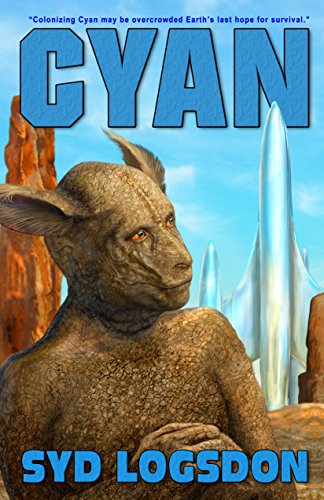
I explained all this to the artist who did the cover for Cyan. I also sent a crude sketch of what I had in mind, with many disclaimers about my (non)skills as an artist. The resulting cover shows a Cyl slightly different from my vision, but better. That’s what good SF cover artists do. However, it is an upper body portrait, so the secret of bipedal tailless hopping remains unresolved.

If I really want to know how it works – and I do – I would have to construct a skeletal robot and see how he moves. But there is no way I’m going to have that much free time anywhere in my near future. I have too many other books to write.