Tag Archives: science fiction

331. Solitaire for Ten

Cyan is now available for pre-order through Amazon, with the eBook arriving April 17th. Meanwhile, I plan to repeat a few year old-posts that were designed to stir the blood of would-be readers just before an earlier release date that didn’t happen. This is one of them.

————————————-

In the novel Cyan, the starship Darwin carries ten explorers at relativistic speeds to explore the Procyon system.

Ten explorers, eleven light years from Earth. As the only humans on the entire planet Cyan, the death of any one is sure to send shock waves reverberating through the group.

Keir Delacroix, groundside leader of the explorers tried to put this into perspective upon the death of one of his colleagues. You will note a deleted name, to avoid a spoiler.

It seems to me that funerals are for the living, for saying things that we already know, to put life and death in perspective and find some comfort.

“We are alone here. We are more alone than any other humans have ever been. When one of us hurts, we all hurt. When one of us dies, a piece of the whole dies. We must be very careful with one another, because we are all we have.

“We come from an Earth that is overflowing with people. One death there is nothing. Had **** stayed behind, and died, no one would have noticed. Here, that death puts our whole world out of balance. And that is why we are on Cyan — to find a world where individual lives can be valuable again. At least, that is why I am here. Not as a scientist; not even as an explorer; but as a man searching for a place where humanity can find its soul again.

Death is a hungry beast, seldom satisfied with just one victim. And exploring a new planet is no safe endeavor.

—————————————

When pioneers arrived on the east coast of North America, the forest they faced was vast. It was later said that a squirrel could travel from the Atlantic to the Mississippi without ever having to touch the ground. That forest is no more.

When Heinlein’s pioneers reached the stars, flaming laser axes in hand, they wrought similar destruction. Today’s reader would not accept that.

I wrote Cyan as an exercise in seeing, not what could happen, but what probably would happen, in near-term stellar exploration. That includes both the pressures for colonization from an overcrowded Earth, and a knowledge of the ecological disasters which need to be avoided.

The explorers on Cyan are careful in their daily actions and in planning for future colonization, but they are not prepared to find a truly half-human species. Viki Johanssen, crew anthropologist, demands that Cyan be placed off limits to colonization, for their sake. Keir disagrees, and colonization plans go forward.

Viki is faced with a decision. What if she stayed behind when the Darwin returned, to study these creatures while they were still pristine, before human colonists come in? What would you do, if you knew that mankind’s only chance to study this half-human species was now, even at the expense of becoming the only person on an entire planet, certainly for decades, perhaps forever?

Would you choose to stay behind?

328. Still not a Frog or a Kangaroo

220px-Litoria_tyleri    220px-RedRoo

Cyan is now available for pre-order through Amazon, with the eBook arriving April 17th. Meanwhile, I plan to repeat a few year old-posts that were designed to stir the blood of would-be readers just before an earlier release date that didn’t happen. This is one of them.

——————————————-

Flashback: 1963, riding in a car, reading an article, probably by Arthur C. Clarke, on why humans should go into space. A little fish, swimming in shallow water, said to his father, “Why don’t we go up on the land and see what we can find?” The father fish responded, “Why would you want to do that?”

I read the passage out loud, but no one was interested, so I relapsed into nerdy silence.

Years later I found that the now accepted theory is that fish in shallow waters, accustomed to using their fins against the sea bottom, began to use them to navigate mud flats at low tide as mud skippers still do in mangrove swamps today. Legs evolved from fins.

It didn’t happen this way on Cyan. (This is a follow-on to posts 320 and 321. If you missed them, we’ll wait for you to read them. Done? Good.)

On the planet Cyan, hundreds of millions of years ago, primitive chordates developed a split vertebral column, which resulted in twin tails. When they moved onto land, their tiny front steering fins were never used for locomotion and their twin tails (they had no back fins) became legs.

As Gus Lienhoff said when he dissected the first one Cyanian creature the explorers had collected:

Look, no pelvis. Look at this complex of bones. Some are fused, some flex, and these four are cantilevered. And look up here; no scapulae, just three extra thick, specialized vertebrae. Tiny front legs, powerful back legs with twice as many joints as you would expect, and absolutely no hint of a tail. Not even anything like a coccyx. A truly tailless, truly hopping biped. I wouldn’t have believed such a thing was possible.

Not a frog, not a kangaroo.

Frogs are quadrupeds with overdeveloped hind legs, like rabbits. They have a vestigial tail, like a human coccyx. If you look at a frog’s skeleton, it looks a bit like a massively deformed human. They can leap, but they also walk.

Kangaroos have a five-legged gait when walking. They lift up on a tripod made of small front legs and a powerful tail to shift their massive hind legs forward. Then they stand balanced on their hind legs while moving their forelegs and tail forward. 3 – 2 – 3 – 2, etc. When they run, they depend on their tail for balance, just as some dinosaurs used a massive tail to keep their foreparts from tipping forward.

Cyanian bipeds, from the simplest to the most complex are hoppers. They all have short, grasping forelimbs; not quite T-rex hands, perhaps, but too weak to knuckle walk, as apes do. They can move miles with grace and speed, but moving inches puts them into a condition of stumbling clumsiness. There are tree dwelling tailless bipeds on Cyan; how they navigate is a mystery I didn’t get around to investigating.

When a trio of Cyl (intelligent Cyanian creatures created through recombinant DNA – its a long story) first enter a human habitat . . .

They were awkward inside the dome where the furnishings of the place made a maze for them to negotiate. As bounders, they were creatures of the unobstructed open plain. This human habitation was utterly foreign to them, not because of the steel from which it was made, or the interlocking triangles of its geodesic construction, but because it was cluttered. How could one hope to move about in it?

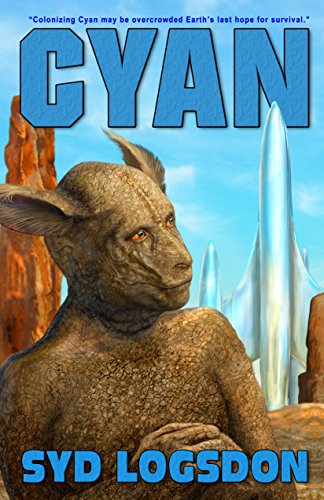
I explained all this to the artist who did the cover for Cyan. I also sent a crude sketch of what I had in mind, with many disclaimers about my (non)skills as an artist. The resulting cover shows a Cyl slightly different from my vision, but better. That’s what good SF cover artists do. However, it is an upper body portrait, so the secret of bipedal tailless hopping remains unresolved.

If I really want to know how it works – and I do – I would have to construct a skeletal robot and see how he moves. But there is no way I’m going to have that much free time anywhere in my near future. I have too many other books to write.

324. Scientific Entrepreneurs

ksc-20160408-ph_kls0001_0005_25704320894In Heinlein’s original stories, a visionary entrepreneur named D. D. Harriman put the first man on the moon. In our world, NASA did it.

Recently, NASA has been in one of its periodic slow periods and entrepreneurs like Elon Musk have been taking center stage. Just this week (I’m writing this on March second) both groups were in the news. Musk announced that two unnamed underwriters had put down sizable deposits for a trip around the moon in the near future, riding in a Dragon spacecraft on top of one of his Falcon rockets. And NASA has announced that the first launch of its Space Launch System booster might carry astronauts around the moon again, for the first time since 1972.

Both are big news, if they happen. Of course, if you follow the space program, you know that there are always more big stories of upcoming events than there are actual events. We’ll have to wait and see.

There are many space enthusiasts who feel that private enterprise should lead in the exploration of space. “Boy genius builds rocket in basement and travels to Alpha Centauri” has a long history in science fiction. I don’t see it.

American industry built all the components of the Apollo missions, and the government paid the bill. Elon Musk has built the Falcon rocket (see photo) on his own, but a NASA contract to supply the ISS pays at least part of the bill. Different, yes, but how different? Privately owned trucks carry goods to your town every day, but on government built roads. Private enterprise is always entangled with government support.

Perhaps it all comes down to a case of, “Who do you trust?” Do you trust private enterprise? Or do you trust the government? Personally, I don’t trust either one of them, so I don’t care who carries the torch for space exploration, as long as it happens.

All this brings us to the anniversary of the day.

Since innumerable interesting things have happened throughout history, and there are only 365 days in a year, you can find something worth celebrating almost any day.

On March 26 (yesterday) or March 25 — depending on which side of the international date line you’re sitting on as you read this — in 2012, James Cameron made a solo descent to the deepest point in the ocean.

The Challenger Deep, in the Marianas Trench, had not been visited by humans since 1960. That expedition was sponsored by the government, specifically the U. S. Navy. Cameron’s visit was self-financed.

Rich men spending their money on their passions, without regard for profit, is not just a twenty-first century phenomenon. Rockefeller made his money in oil, then set up the Rockefeller Foundation. Alfred Nobel made his fortune in armaments, then set up a Peace Prize. Andrew Carnegie made his money in railroads, then set up a chain of libraries across America, including one which illuminated my youth.

Cameron became rich through such films as Titanic and Avatar. His passion for undersea exploration is of long standing. Like Musk with manned space flight, Cameron is continuing an exploration that the government began, then partially abandoned.

Tomorrow we will look at earlier explorers of Challenger Deep.

323. Five by Heinlein

Most of the reviews of science fiction novels are primarily plot summaries, with personal comments. When they are good, it is usually as much from the voice of the reviewer as for the novel in question. A case in point is Schlock Value, my inevitable Sunday night guilty pleasure, which cracks me up weekly with reviews of novels you couldn’t pay me to read.

I don’t write that kind of review myself. I only review favorite books, so I am usually saying, “Here is something great you may have missed. You should consider finding a copy, because it’s worth reading.” That being the case, I prefer giving an appreciation with a bare minimum of summary.

All this makes for short reviews, so I am able to offer you five of Heinlein’s pre-Stranger, non-juvenile, short and polished novels in one post. They are in order of book publication, although two were serialized in magazines years before they were published independently.

Beyond This Horizon, 1948, original serial 1942, is interesting in part because it doesn’t exactly sound like Heinlein. Future society is gun-toting and very polite, rather slow moving and just a little bit prissy. Beyond This Horizon’s tone reminded me a little of Bellamy’s Looking Backward, which I read because it was mentioned as an early influence on Heinlein.

Hamilton Felix (everybody’s name reads like an alphabetical list with the commas dropped, which is actually a pretty neat bit) is looking for the meaning of life, and finds it, more or less. If you’ve read a dozen Heinleins and are curious about what he sounded like before he was fully formed, I recommend this one.

The Puppet Masters, 1951, is probably familiar to everybody, if only from movie versions. This is not one of my favorites. It’s too much of an alien possession horror story for my taste, although, to be fair, it’s a pretty good alien possession horror story. There is one thing about the novel I don’t understand. Heinlein always complained about Star Trek’s tribbles being a rip-off of his flat cats (from The Rolling Stones), so why didn’t he complain about the Star Trek episode Operation: Annihilate!, which is a full blown rip-off of The Puppet Masters?

Double Star, Hugo winner, 1956, has as a main character an out of work actor who is hired to stand in for a prominent politician who has gone missing. He starts out very much unlike a typical Heinlein hero, but grows into one as the story progresses. Heinlein had several of what he called “the man who learned better” stories, and this is probably the best of them.

Door Into Summer, 1957, is my favorite of the early, short, polished Heinlein novels. Daniel Davis, inventor, is duped out of his work and exiled, only to return for revenge and more. He is a bit of a sap at the beginning, but gets over it. The opening page alone, which sets up the title, it worth the price of admission.

Methuselah’s Children, 1958, original serial 1941, is the first appearance of Lazarus Long who later appeared prominently in just about everything Heinlein wrote during the last third of his career. That alone is reason enough to read the book, but if Heinlein had stopped writing after completing this novel, Methuselah’s Children would still rank as a classic of science fiction.

For those who remember the seventies – or lived through them and therefore don’t remember them – this is the novel that launched the Jefferson Starship album Blows Against the Empire.

(No, not that empire! The Viet Nam bashing American empire.)

322. Time Enough for Love

tefljpg

Heinlein gets mentioned in this blog fairly often. I can’t really say he is my favorite, although I probably read him more often than any other science fiction writer. He isn’t the smartest writer, or the most thoughtful, certainly his longer novels drag, and his writing style doesn’t sing. But he’s the most fun.

I’ve heard several reviewers bemoan the lumbering style of the novels from the late part of his career, then admit that they still read them all the time. I get that.

It recently occurred to me that I have said I don’t much like his two most famous works, Starship Troopers and Stranger in a Strange Land, but I’ve never named my favorites.

Favorites. Plural. There have to be two, because books from the first half of his career are utterly different than books from the second half. In the beginning, Heinlein novels were short, tightly plotted, and polished to a high shine. Most of them are very good, but the pinnacle of that era for me is The Door into Summer. It and four others will be presented in tomorrow’s post.

Stranger . . .  was the watershed in Heinlein’s career. It was long, disjointed, and sloppy. He attempted to shake up the status quo after the rest of the culture had already moved on. Worst of all, it was boring.

He wrote other short, polished works in his middle period, but the long novels gradually prevailed. Twelve years later, Time Enough for Love was published and quickly became my favorite among the new type.

(My near favorite is The Number of the Beast. I read the opening to that novel a couple of times a year, but when they all set of for Mars, I close the book. It goes down hill into useless, irritating bickering, then wanders out of science fiction altogether into fairy land. Sorry, that’s not a place I care to go, but that first hundred-plus pages are perfect.)

If you like tightly plotted novels, don’t waste your time on Time Enough for Love. If you like long winded, rambling stories like your Grandpa used to tell, that is closer, but not fully accurate either. Lazarus Long, the grumpy, selfish, charming oldest man alive is at the center of the novel, but there is also a large cast of (mostly interchangeable) characters to break up the storytelling with current events. Oddly, the most compelling character other than Long is a computer.

One of the stories buried in the middle of the book is of novella length. It isn’t named, but I call it the Happy Valley interlude. If you’ve read the book, you know which part I mean. When I wrote my novel Cyan, it was largely because I had never found a novel that told the story of a planet from exploration through colonization, without getting sidetracked by ray guns and space battles, or some lame bit about lost Earth colonies, parsecs from home. The Happy Valley interlude was the sole exception to that lack, although it was way too short to satisfy me.

After Happy Valley, the story wanders on, stumbling from one interesting bit to another, with lots of throwaway philosophy, and sex about as exciting as seeing your dad pat your mom on the butt as they wander off to bed.

Sounds like I hated it. No, I loved it. i can’t explain it, and I don’t plan to try.

Heinlein is a storyteller with a voice that many find charming – and many dislike intensely. I can’t argue with those who hate him, but he’s got my number. I could sit and listen to him ramble on for hours and, metaphorically, I often do.

321. Home Grown Ecosystems (2)

Cyan is now available for pre-order through Amazon, with the eBook arriving April 17th. Meanwhile, I plan to repeat a few year old-posts that were designed to stir the blood of would-be readers just before an earlier release date that didn’t happen.

 —————————————-

Continuing our look at the creation of an ecology for Cyan. If you missed yesterday’s post, you might want to go there first.

We can take grasses and weeds for granted. Let’s give our trees multiple trunks bound together, like a strangler fig without its victim, and that should be enough. We need something like insects. We’ll call them Chitropods – chitro sounds like chitin, and pod means foot, so our reader will infer an exoskeleton without any further work on our part. Continuing the idea of inference, if we call the flying creatures who eat the chitropods pouchbats, the reader will draw a better picture in his mind that we could on paper.

The number of legs is important to Terrestrial arthropods, but lets bypass that by giving all our chitropods many legs, but with only one joint each where it meets the body. Now they have a rolling gait “like caterpillars on crutches”. Humor helps keep description from limping along. (Sorry, couldn’t resist!)

These are throw-away inventions. They could have been applied to any ecosystem and they are not systemically related to each other. They alone would be good enough for almost any SF novel, but not for one about scientists teasing out the essence of their planet.

Here we need a key differentiation, from early in evolution, from which a thousand lesser differences can be derived. Here it is for Cyan. Early in the development of chordate life, the vertebral column doubled at the posterior, giving the Cyanian version of fish twin tails. That changed everything. I’ll explain more fully later in a separate post.

On Cyan, the classes are Pseudo-pisces, Amphibia, and Inturbia. No reptiles, no birds, no mammals, no dinosaurs. The Amphibia are cold blooded. Inturbia are inefficiently warm blooded. The term Inturbia should imply “internal body temperature un-perturbed by external changes”. Not every reader will get that, but we need to reward our best readers by not spelling out everything.

There are a thousand other details, but for that, you will just have to download the book when it comes out July 5th.

***

I do have one more thing to share. I wouldn’t bother you, but since you’re reading a post about the backstage secrets of writing science fiction, I can assume that we are all nerds together here .

Inturbia have live birth. Cyanian amphibs have to return to water to lay their eggs, except for one group, the Sphaeralvids, who produce globewombs.

(Globewombs were) the closest thing to an amniote egg that Cyan’s fauna had developed – a transparent, leathery sac extruded by a Sphaeralvid mother and filled with a clear fluid like seawater. Into this she deposited fertile ova, then defecated. Then she separated from the globewomb and left it cached in the crotch of a tree, high up where it would receive full sunlight. On a bright day millions of these globewombs glinted in the treetops.

Algae from the Sphaeralvid mother’s bowels converted the feces into biomass and the Sphaeralvid nymphs fed off the algae.  When the feces were gone, the globewomb walls would break down, leaving the now sizeable nymphs free to face Cyan on their own.

Neat, huh? The globewombs are glinting in the treetops from the first day planetside. By the time the explorers understand what they are, the reader will have been wondering for some time. Globewombs don’t contribute anything to the plot, but since these are scientists trying to tease out the ecology of Cyan, we need some concrete examples of their work. Globewombs provide that.

They make me want to be there when they make the discovery – but that’s why I wrote the book.

320. Home Grown Ecosystems (1)

Cyan is now available for pre-order through Amazon, with the eBook arriving April 17th. Meanwhile, I plan to repeat a few year old-posts that were designed to stir the blood of would-be readers just before an earlier release date that didn’t happen.

——————————-

Over in Backfile, you will find an eleven part document called How to Build a Culture, inspired by Poul Anderson’s How to Build a Planet.

I could also write a paper called How to Build an Ecosystem, but who needs to read all that. A couple of posts here should cover the subject, without boredom or overload.

The fact is, simply peppering your planet with a few well chosen and deeply odd critters is enough in most cases. Andre Norton did it all the time, and it worked for her. The frawns and yoris on Arzor are simply transmogrified bighorn sheep and alligators, but so what? They provide plot points and local color, and that is all that is asked of them. Marion Zimmer Bradley gave us a mammalian snake, a hyper-weasel, and an intelligent dinosaur who sent out pheromone soaked calling cards in Hunters of the Red Moon. What more could you want?

When I wrote Cyan, I faced a different situation. My crew was set down on an alien planet for one year, with the task of coming to understand its weather, geology, and ecology in order to prepare for colonization. They were all scientists, so their actions and conversations called for a deeper understanding of their new world than any other kind of science fiction novel would have required. That challenge was half the fun.

When I began Cyan, I had been studying ecology for about twenty years, starting back when I had to explain what the word meant. I later came to understand the essence of Earth’s taxonomy in the most rigorous possible way – I had had to condense it to a level which middle school students could understand without dying of boredom.

Scientists should forgive the following chart and paragraph.taxon

Drop a salmon egg on the gunwale of your canoe and it will dry out in minutes. A chicken or turtle egg would survive the same treatment. This is the meaning of amniote egg (although there are other, competing meanings). Creatures who lack them, must lay their eggs in water. The rest of the chart should be clear, although simplified. For example, birds have scales on their legs as well as feathers elsewhere, and I skipped Dinosauria altogether.

Now pull up a chair and lets build Cyanian ecology. It needs to be wierd but recognizable – that’s the key to all science fiction invention. We also need restraint. You can only explain so much to your reader without losing them, and beyond a certain point, your backstory is wasted effort.

Come back tomorrow and we’ll dive more deeply into Cyanian ecology.

319. What’s in a Name

nam-pgIt is said that Louis L’amour wrote the same novel a hundred times. It has been said that Robert Heinlein wrote the same character a thousand times.

Do you remember All You Zombies? No? Well, that’s not surprising. It was first published in 1959 and it isn’t about zombies, but about a man(sic) who is every character in the short story, by means of time travel and a sex change operation.

Even Lawrence Smythe, the lead character in Double Star, who starts out an anti-Heinlein character, becomes a true Heinlein character by the end of the novel.

Before we decide that this is a fault, lets look at the names Heinlein uses.

Valentine Michael Smith
Woodrow Wilson Smith
Maureen Smith
Johan Sebastian Bach Smith
Lawrence Smythe
Max Jones
Oscar Gordon
Wyoming Knot (All right, that one was a bad pun that doesn’t fit the pattern, but I had to include it.)
Thomas Paine Bartlett
Patrick Henry Bartlett
Daniel Boone Davis
Andrew Jackson Libby
D. D. Harriman (Think E. H. Harriman, tyrant of American railroads.)

Good God, what bigger clue do you need? Do you think Heinlein couldn’t think of interesting or unusual last names? Or that he couldn’t think of names not already used by famous Americans? These are American everymen. (Or women. Or both, in alternation.) No wonder they all look alike.

They’re also Bob Heinlein clones. And that’s okay by me.

318. Too Many Exoplanets

trappppIt’s official. The good old days are gone.

About a year ago, I said:

(T)he party is nearly over. We now have the capacity to discover extrasolar planets, and new ones are found every year. Fortunately for latecomers to the planet builders guild, megaplanets are easier to find that Earth sized ones, and NASA keeps cutting funding. Still, it won’t be too many years before you can’t decide for yourself where, within the limits of orbital mechanics, you want the planets of Alpha Centauri or Procyon to be.

Science has a way of getting somewhere a lot faster than you would expect. Manned space exploration doesn’t fit that statement, because it runs on politics, not science.

On February 22, in Nature, it was announced that seven Earth size planets had been discovered circling a single star only thirty-nine light years from Earth. Far more important, all seven orbit within the band of temperature where liquid water is a possibility. By contrast, our system has one such planet, Earth, and maybe Mars for a few minutes on a hot afternoon near the equator in mid-summer – if the ice doesn’t sublimate instead. Seven; its unheard of.

The star is TRAPPIST-1, an M dwarf. 

In fact there has been a mini-revolution in the search for exoplanets. NASA’s Kepler space telescope has found more that 4700 potential planets. Many of these will no doubt turn out to be false positives, since the techniques of the search are not perfected, but it is still a staggering number. Most of these were found around stars similar to our sun – where else would you look first? Very few of them are both Earth sized and at the right distance from their star to have the possibility of liquid water.

As I said in Cyan, “planets of no use as real estate.”

Since a mechanical failure in 2013 compromised its ability to orient itself, Kepler has concentrated on observing red dwarfs. To eveyone’s surprise, the planet candidates found around these small, dim stars tend to be more Earth sized. And there are a lot of them.

The TRAPPIST-1 discovery, however, was not by NASA but by the TRAnsiting Planets and Planetesimals Small Telescope group operating out of the University of Liège, Belgium. That explains the use of caps; TRAPPIST is an acronym.

If you want details – and of course you do – the best source is here. This page from the University of Liège is in French, but the video which will self-start is in English, and gives enough details to stir the blood of any space or science fiction fan.

It took me about three seconds to start speculating about what kinds of novels could be written about the exploration of the TRAPPIST-1 system. Suppose most or all of the seven planets had some form of life, all evolving independently. Suppose we write about a paleontological mission on a planet which had vertebral life, then lost it; these dwarfs have a solar wind that operates heavily on planets so close in. Suppose at some time in the deep past, a spacefaring civilization arose on one of these planets, colonized the others, and then died out. Or didn’t die. Or seems to have died until our intrepid explorers begin to poke around.

Okay, I was wrong. The golden age is still here.

317. SF in the Wild

Cyan is now available for pre-order through Amazon, with the eBook arriving April 17th. Meanwhile, I plan to repeat a few year old-posts that were designed to stir the blood of would-be readers just before an earlier release date that didn’t happen.

——————————-

This post was originally number 128.          If you are what you eat, I used to be beefsteak, fried okra, and hominy. That comes from growing up in Oklahoma. I also lived outdoors most of the hours of every spring, summer, and fall day, and way too many hours of every winter day. That comes from growing up on a working farm.

If you are what you read, then I used to be an Andre Norton protagonist, at least in my imagination. Although I never met or corresponded with her, Andre Norton was something of a long distance mentor.

Alice Mary Norton legally changed her name to Andre Norton early on, in an era when being a woman was no help to a science fiction writer. I didn’t know that when I first read her; I thought Andre Norton was a man. Not that I thought about it much, but she didn’t write like a girl. Looking back, I see that she actually wrote like a person, but I wasn’t that sophisticated then.

One reason Norton got away with writing gender neutral fiction was that her characters spent most of their time alone. Even in their relationships with others of their own kind, they were loners, if not complete outcasts.

Star Man’s Son was the first Norton I read. In it, Fors spent all but a few pages on a quest away from his people; that was a pattern to which Norton frequently returned. I could easily identify with the solo quest while I spent endless hours alone on a tractor. The only variations in my daily life were whether I was pulling a disk or a hay rake, and which Norton novel was replaying in my head.

Every time Shann Lantee on Warlock, or Naill Renfro on Janus, or any of a dozen other young men found himself stranded alone, or nearly alone, on an alien world, I could look up from my tractor seat at the Oklahoma prairie and say, “Yup, been there.”

The best thing about Norton’s characters was that they didn’t whine about being alone. They liked it. So did I.

I didn’t live in a city until I went to college. I spent my adult life living in the suburbs of a reasonably small city, and taught school in a very small town. As soon as I could retire, I moved to a few acres in the foothills. I would move further out if I could afford it.

I was born not liking cities, and my opinion never changed. It should be no surprise that my first novel was about a hunter surviving alone in the woods, or that my first science fiction novel Jandrax was about a hundred or so humans stranded on an alien world.. My three fantasy novels have a rural and medieval feel. David Singer, in A Fond Farewell to Dying, is a mountain boy who has to go urban to get his life’s work done. And Cyan, due out soon, begins with ten explorers on an empty world, then continues with the story of the peopling that world by hyper-urbanized refugees from an overcrowded Earth.

You write what you’ve lived.