
Tag Archives: science fiction

257. Who Knows?

Who knows? Probably the internet.

The internet is science fiction at its best. Back in 1986, when I bought my first Mac, it came with a program called HyperCard. It was a crude, early version of what has now grown to be the internet. It allowed you to create mini-documents called cards and connect them via buttons so you could jump freely from one to another. I dreamed of creating a database of everything I wanted to keep at my fingertips. Then Newton came out – Newton was a proto-tablet that didn’t work very well – and I saw the pair of them as my own personal Tricorder.

Just dreams. Both hardware and software were too crude to be more than a tease, and even a tiny database takes a vast amount of time to create.

Today, the internet does what I dreamed of doing in the days of HyperCard and Newton. I use it to do research for this website. Sometimes I’m looking for things I don’t know, and it works fine for that. Primarily, however, I use it to check details on things I already know.

Here is an example. Years ago I wanted to look again at the Sherlock Holmes quote about furnishing your brain. If you don’t know what I’m talking about, here it is:

“You see,” (Holmes) explained, “I consider that a man’s brain originally is like a little empty attic, and you have to stock it with such furniture as you choose. A fool takes in all the lumber of every sort that he comes across, so that the knowledge which might be useful to him gets crowded out, or at best is jumbled up with a lot of other things, so that he has difficulty laying his hands upon it. Now the skillful workman is very careful indeed as to what he takes into his brain-attic. He will have nothing but the tools which may help him in doing his work, but of these he has a large assortment, and all in the most perfect order. It is a mistake to think that that little room has elastic walls and can distend to any extent. Depend upon it there comes a time when for every addition of knowledge you forget something that you knew before. It is of the highest importance, therefore, not to have useless facts elbowing out the useful ones.”

I thought this was in one of his middle stories. It wasn’t; it was in the first, A Study in Scarlet. To find it, I pulled down my complete Holmes in two volumes and spent an hour looking, but I couldn’t find it. I stumbled across it by accident months later.

So today I did an experiment. I went to my search engine and typed in “brain attic”. It returned a page with ten responses. Six of them referred to the Holmes quote. I opened one, copied and pasted into this post, and you just read it.

Here is another example of finding things I already knew. In my post on The Monkey’s Paw, I wanted to use a quatrain from the Rubaiyat. I knew it well, but not well enough to quote for publication. I didn’t want to spend time getting out my copy and reading through its pages, so I typed a fragment – “dId the hand of the potter shake” – into the search engine and up popped:

After a momentary silence spake
Some Vessel of a more ungainly Make;
“They sneer at me for leaning all awry:
What! did the Hand then of the Potter shake?

Notice that I scored a hit even though I had left out “then”.

Earlier today, I was writing about the Lord Darcy stories. I didn’t want to misspell Randall Garrett’s name (How many Ls, how many Rs, how many Ts?) so I typed it into the search engine and got my correct spelling along with a great deal of additional material that I didn’t need.

That I didn’t need at the moment, that is, but information that will be there when I do need it. Like I said at the top, the internet is science fiction at its best.

255. Fire

dscn2539For writers – or anyone who is leading a thoughtful life – every day brings experiences that add to our understanding of the world around us. For the last half decade, my tutor has been fire.

I took the photo at the top of this post a few years ago, while standing in my front yard. The smoke was only about three miles away and my first thought was, this is finally it. Fortunately, it was on the other side of a lake that lies in the valley between my house and its location. We drove to a vantage point and spent an hour watching a scoop-equipped helicopter dropping down to the lake for loads of water, and dropping them on the fire. It took several days to put it out, so for a week we could not open any windows because of the smell of burning.

There have been weeks in late summer almost every year recently, when the smell of burning kept us indoors. You could blame our long-running drought, but that isn’t it. When there is little winter rain, things become unnaturally dry, and there is fire. When there is abundant winter rain, the grass and weeds grow tall and lush, and there is more fuel for the fires that still come.

Arthur Clarke wrote a story called Report on Planet Three, in which Martians, observing Earth through telescopes, concluded that life could not survive here because the atmosphere was so rich in oxygen that Earth might have open fires as a natural phenomenon! When I first read the story as a youth in Oklahoma, I found it humorous. Now that I live in the foothills of California, I say, “Yep, Arthur, you got another one dead right.”

A few years ago, a target shooter started a fire that burned into Yosemite. Three years ago, north of here, an illegal campfire was the spark. Two years ago, east of a foothill town I visit frequently, it was untrimmed trees rubbing against a power line. This year, someone pulled off the road into dry grass and his hot muffler started a thousand acre burn just a few miles from my home. That was the fire that caused me to write this post.

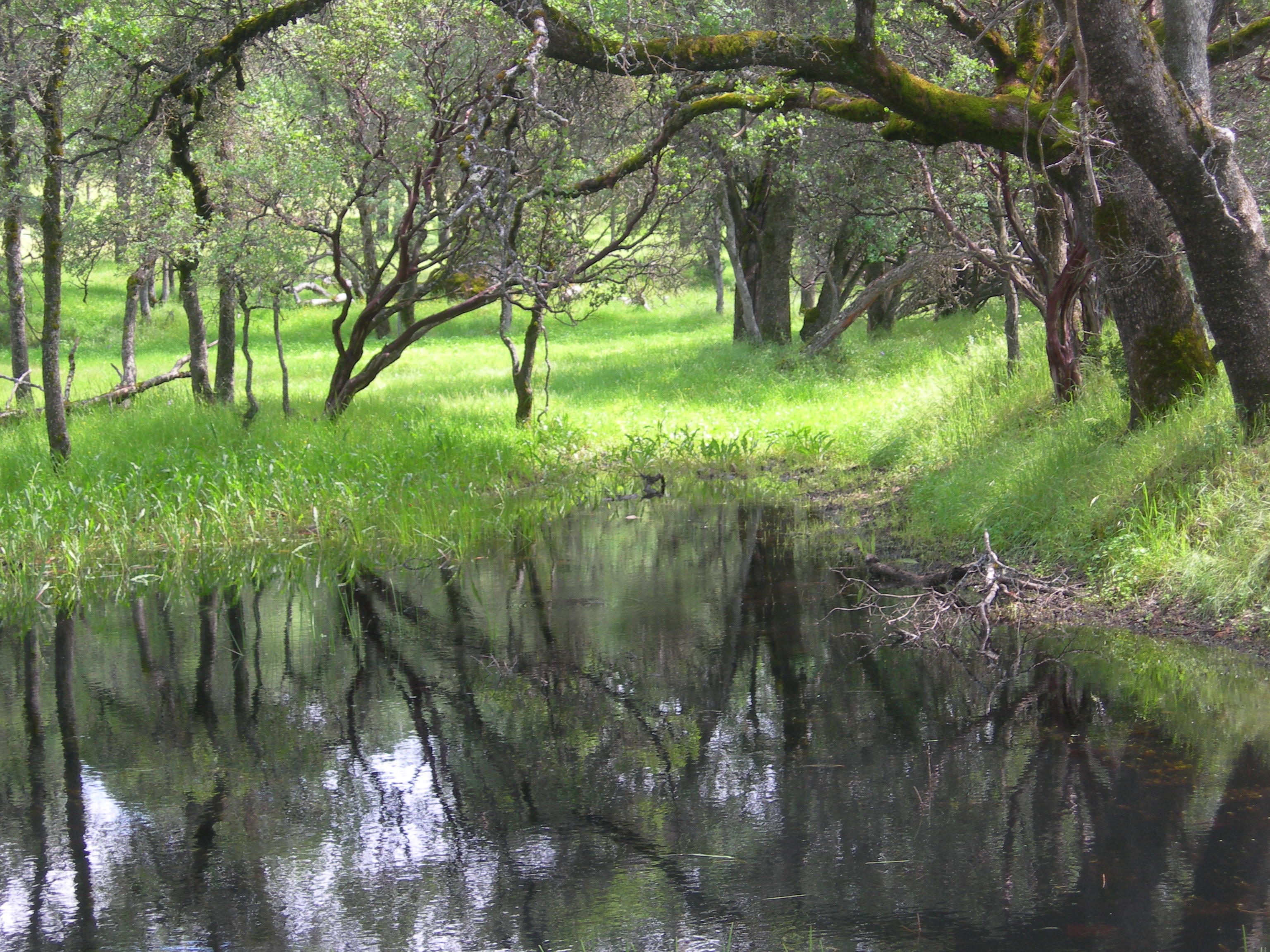
dscn4753Here is one of my favorite places. It is a vernal pond; man made, but fleeting. Right now it is probably filling with water, as it does every fall. It will look this beautiful until spring – maybe.

In the coverage of the fire this year, a newscast showed a reporter standing on a black top road. One side was untouched; the other was fire blackened. It was the point at which the fire had started, and I recognized it as the place I park when I go to the pond. I couldn’t tell whether the reporter was facing north or south, so I don’t know if my favorite place was saved, or destroyed. I haven’t yet had the heart to drive up and find out.

In my writing, I have brought nuclear war to Earth in two different fictional universes. It’s easy. I don’t see many movies, but everyone sees their trailers on TV. Massive, ubiquitous destruction prevails. A kid with his own camera and computer could illegally produce his own apocalyptic vision, using FX stolen from Blue-ray. Washington and New York have each gone up a dozen times in the last few years. He would have an abundance of destruction to call upon.

Bringing massive destruction over there is easy and cathartic. Dealing with even small destructions right here is another matter. I had no problem blowing up the Earth, twice, but I dread driving up to see if my favorite pond is still there.

253. Handgun Accuracy

2-gunsOver in Serial, the chapter Raven’s Run 42 came out yesterday. This post was supposed to stand across from it, but Leonard Cohen’s death caused me to push Handgun Accuracy back a day to make room for an appreciation of what he meant to me.

Everything in the night drive through Martigues and the Barre Lagoon in yesterday’s post is from research. I was never there. But I was in Marseille and everything there is from experience. You have to have some first hand knowledge, mixed with research, if you want to look like you know everything.

The bit with the .45 automatic is also accurate, and from experience. I only fired an M1911A1 once in the Navy, in boot camp, but years later I acquainted myself with it and a large variety of other handguns at a firing range near my home. I spent an hour a week there, every Tuesday for a year, and became proficient with the two dozen styles and calibers they had for rent. That was partly for writing research, and partly because we live in a dangerous world.

You have to be able to describe handgun usage accurately for the kind of fiction I write. And yes, this post title has that double meaning, like the NRA bumper sticker that says Gun Control Means Using Both Hands. I could never resist a bad joke.

Accuracy is important in science fiction weaponry as well. In Jandrax, Jan’s “express pistol” was a technologically advanced weapon that was fairly fully explained, while the other weapons were nineteenth century technology because they were meant to be repairable on a frontier world.

In Cyan, due out soon, the explorers are operating in the near future. I decided to give them handguns only slightly advanced over the present day for their initial exploration, as in:

“Gus carried a comped 12mm magnum semi-automatic in a cross draw holster.“

This led the proofreader at EDGE to highlight comped and write “?”. (See 134. The Long Road to Cyan (2) for details on proofreading in the modern era.)

Comped actually refers to mid-twentieth century technology. I replied:

Comped, pronounced compt, not comp-ed, is a standard term. It comes from compensated, and refers to a series of slits on either side of the front sight of a heavy handgun, which redirects some of the expanding gasses upward, counteracting muzzle flip. Gun nerds will know the term; others will just be puzzled.

The cross draw holster is reasonable, but it is mentioned early because it sets up a plot point I would need about forty pages later.  And 12mm magnum will certainly ruffle the hackles of purists, but again, it is so named for a reason. The largest caliber presently designated in millimeters is 10mm and magnum is applied to a new, more powerful version of an old caliber. This means the 12mm magnum is two generations away – which is what I was looking for, a near-future version of present day technology.

I made these automatics obsolete during the colonization phase by introducing a handgun called a fletcher which was, in essence, a hand held rocket launcher. If you need a powerful, hand held weapon with little recoil, replacing bullets with mini-rockets is the simplest way forward.

You can only use phasers in Star Trek novels and no self respecting science fiction author will ever say “ray gun” again, but fletchers – certainly under a different name – will probably be available within a decade or so. High caliber handguns have just about reached the limits of human hand strength, even though all of them are comped today.

Keep your eye on future issues of Field and Stream for new developments.

249. The Presidency That Wasn’t

Greetings, my fellow Americans. This is the first time in my life that America has gone to the polls with so little to hope for and so much to fear.

On February 29 of this year I wrote a silly story about a child born on Leap Day. I repeated it, in longer form, on July 6. As the Presidential campaign degenerated, the story haunted me with a view of a lighter and better version of things. I had written the end of the story first; now I felt impelled to go back and fill in the beginning and the middle over a number of posts spaced out through the summer and autumn. If you want to see them, check out the tag cloud for Leap.

Today is the big day, the day of Leap’s fate and unwanted triumph. I can’t leave him hanging. I have to tell the ending again, somewhat abbreviated, this time. I owe him that much, after all I’ve put him through in his alternate America.

********

In 1952 a boy was born on Leap Day. His Dad was named Alan Hed, and he wanted to give his son the same name, but his wife had a quirky sense of humor. She named him Leap Alan Hed, and all his childhood acquaintances called him Leap A. Hed.

The teasing drove him to a foolish act. Leap began to count his age by Leap-day-birthdays. When he was sixteen, he started putting his age down as four. He spent a lot of time talking to the principal about that, until the school finally got tired of the whole business.

The draft board wasn’t amused when he turned eighteen and still claimed to be four, but when the 1969 draft lottery gave him draft number 285, they stopped worrying.

Leap never married (he claimed he was too young) and the IRS was indulgent. They figured he would regret his claims when he wasn’t eligible for Social Security until he was 260 years old.

Leap eventually put that nonsense behind him, but not soon enough. Billy Joe Barker, a newspaper columnist, heard about him and touted him as a write-in candidate for President in 2016. It started as a joke, but it caught fire. If you’ve read any recent posts, you know the details.

Donald Trump denounced him. Nothing new there. Donald denounces everybody.

********

Unfortunately, some jokes get out of hand.

When the polls opened, well over a hundred million people wrote in Leap Alan Hed, each thinking he was the only person in America who would do so. It brought a landslide in both the popular vote and the electoral college.

Weren’t the voters surprised? And wasn’t Leap terrified? He headed for Canada – he had camped near the border the night before just in case – and sought asylum. The Canadians didn’t want any part of the controversy. They wouldn’t let him in.

Leap thought about moving to another country, but there wasn’t anywhere else he wanted to live. And there probably wasn’t any country that would take him. Except Russia, and he was no Snowden. Or Manafort.

He decided to just disappear, and he did. I don’t know where he went; he didn’t tell me. Geraldo claimed to know, but that turned out to be a bluff. Somebody said that he crossed the Canadian border and was heading north, following a compass, but everybody knows you can’t walk to the North Pole now that the ice caps have melted. Probably looking for a Fortress of Solitude, and you can’t blame him.

All those people who voted for Leap are now wringing their hands and wondering what is going to happen next. They never thought he would win. They never thought he would run to Canada like a modern day Draft Dodger. Which, essentially, is what he is — drafted to be President, and scared out of his wits.

Hillary has been very quiet about it all. She hopes to win in the House if they can find Leap, and get him to resign. But it’s problematical. Only fourteen Democrats and eleven Republicans were elected to the new Congress. Aside from a few Libs and Greenies, the rest are all newly elected Independents, sent by a disgusted America.

Bernie is smiling.

Donald claims he will still win, and when he does, he plans to invade Canada.

Hillary is biding her time.

********

Okay, folks, it’s been a long time since February, and Leap’s story is now over. But wouldn’t the wait for tonight’s election results be less dreary if you had written him in?

245. Serializing

I’ve been doing a lot of serializing lately. In fact, I’ve been at it for over a year, but lately it has become intense.

Publishing novels serially in periodicals is a very old idea. Most of Charles Dickens work came out that way. What I’m doing is a bit different though, because Dickens wrote his novels to be serialized. The size of each chunk was known to him when he wrote. And the chunks were bigger.

David Copperfield was a novel of 358,551 words. I know this by downloading it from Project Gutenberg, transferring it to my word processor, and using the word count function. You might make note of that; it is a useful technique. David Copperfield was published in twenty monthly installments. That makes each installment was about 18,000 words. In SFWA (Science Fiction Writers of America) terms, each installment was of novella length.

My typical serial post is about 600 words.

Dickens serialized in order to sell to those who could not afford his books, and at the same time, to boost sales of those books when they came out after they appeared in periodicals. Most successful nineteenth century authors followed the same pattern. So did the big names in twentieth century science fiction, although they wrote smaller novels and presented them in fewer, but longer installments. Often they didn’t sell their books for serialization until they were already completed.

That is also my situation. Nothing I have presented in Serial was in progress at the time it was serialized. I’m too slow and picky a writer for that. Some of the things presented had been published, some had not, one was presented as a excerpt from a completed novel, and one was a fragment from a novel I’ll probably never finish. Jandrax was annotated to such a degree that it almost forms a writing primer, and How to Build a Culture was entirely a how-to.

Everything I have presented in Serial has been to assure continued readership of the website. It’s a trick. Leave ‘em hanging, and they’ll come back. And the whole website is to assure a readership for my upcoming novel Cyan, and for others that will follow.

But man, it has been fun.

I’ve enjoyed revisiting old friends. I’ve learned a lot from a close re-reading of old material, especially regarding pacing. Since I post four days a week, each post has to be relatively short, both to keep from running out of material too soon and to keep each reading experience brief for the sake of the daily reader. I didn’t originally choose 600 words; that just evolved.

The actual process of taking a novel and breaking it into pieces has been fascinating, frustrating, and a rewarding learning experience. It begins with a completed novel, which may be decades old, and which will already have been polished to a high shine. Still, I find errors from time to time.

First, using a word processor version, I have to re-read the novel, looking for natural breaks in the action every two and a half to three manuscript pages. I type a nonsense word at each break. I use breakbreak, as one word, which has meaning to me but would never appear in the actual text. This will allow me to use the find function to jump from break to break if I should need to. After typing breakbreak, I highlight what I have chosen, use the word count function, then type in the number of words. If it seems too short or too long, I adjust.

That takes care of post #1. Now to repeat. Jandrax required 92 posts. Raven’s Run will require 150. Some posts make sense on their own, but some require that I start with a sentence or two from the previous day’s post. I use bold-italic to denote this repeat.

All this takes place on a single word processor document. I then make individual documents of each post-to-be. This is a backup to what will actually appear on the website. At this point, I run the spell checker one last time and face the two-space conundrum.

I learned touch typing in high school in the mid-sixties on a mechanical (not even electric) typewriter. This was overseen by Mrs. Worden (AKA the warden) who pounded (pun intended) the rules into our heads. One rule was that you put two spaces between sentences.

Over the years I went from mechanical typewriters, to electric typewriters, to computers, but the rule stuck with me – even after everyone else had stopped using it. Raven’s Run was written before I kicked the two space habit, so now I have to go through each document removing the second space.

The last step is copying from word processor file to website.

Tedious? Yes. Fun? Absolutely. If you write, and you don’t enjoy reading your own work, why bother?

243. On Fantasy: Archaism

Marion Zimmer Bradley is well known for her fantasies, but she cut her teeth on science fiction. Her Darkover series was a massive best seller in its day. Darkover is a planet in our universe, populated by humans from a stranded starship, whose powers of the mind come (quite scientifically) from the pollen of psychotropic plants and from interbreeding with non-human natives. Lost and out of contact with their technological roots, they evolve a feudal society. They create an archaic world from a purely science fiction starting point.

Of course this is a reductionist view of a complex and massive series of novels and short stories. But it makes the point that archaism in fantasy is easy to achieve. You could almost write a formula:

HORSES + SWORDS + MAGIC = FANTASY

Of course it takes more than that to achieve good fantasy.

The time before known time is an ancient idea. Atlantis and Mu fit into it. Tolkien’s Middle Earth came before recorded history. So did the world of Conan. The worlds of Michael Moorcock seem to be of this nature, but a closer reading will have to follow them sideways in time. Alternate histories allow access to archaic worlds coexisting with our modern world. We can go to other 2016s, where the Native Americans are the only Americans, or Rome still rules, or Muhammed became an atheist. Take your pick, and if you can’t find what you like, you can write your own.

Remnant stories also let the past live on. Professor Challenger found dinosaurs still living deep in the Amazon. Hilton’s characters found Shangri-La. Even Rick Brant, in the favorite series from my childhood, found a lost remnant of an earlier age hidden in the Himalayas in The Lost City.

You could go sideways in time, or backward, or to some lost valley and find dystopian, crowded cities, but that almost never happens. Archaism is about escaping modernity, crowding, complication, and life in cities. Back to simpler times. Back to the good old days. Back to the land of childhood. Back to the middle ages where knights in shiny armor rode pretty horses and rescued damsels with big bosoms and pearly teeth from dastardly villains – or dragons.

Does anybody believe this? Of course not. Does anybody want to believe? Of course. And in the friction generated when those two truths rub together, the fire of archaism is born.

So our hero goes back (or sideways) and he/she finds the land of her/his heart’s desire and it isn’t what she/he expected at all. But it isn’t bad. There are problems to overcome, heartaches to endure, and villainy to face, but so what? That’s true in Portland, and Austin, and New York City as well. In the new/old world  there are beauties and wonders, in addition to troubles. And it’s probably green, with trees and meadows, even if it also has rain and snow instead of eternal sunshine.

Above all, there aren’t any traffic jams. And the cell phone never rings.

Wait a minute. I’ll get my backpack, and we can go.

242. On Fantasy: Language

Up sword, sayeth Sir Gallant, lest I cleave thee where thou standest.

Yeah, that’s pretty bad, and it has been a long time since I’ve seen that kind of fake-ancient language used in fantasy, except as a joke.

Language in fantasy is both a necessary tool, and a dangerous one. You can’t just throw in some thees and thous and -ests, but you also can’t speak in modern, colloquial English. Simple formality is the easiest way out. Even Zelazny, for all his smart-ass-with-a-sword characters, wrote with intelligence and a great deal of formality. If you want your characters to speak slang, you have to invent slang appropriate to their world, and that takes some effort.

Remember, whatever language your characters speak, even if you are setting your fantasy in early England, no one on Earth speaks that language today. In my fantasy world of the Menhir there are three languages in play, and a mid-sea island has a bastard language drawn from all three. It doesn’t matter. The book gets translated into English, whatever language the characters are speaking.

Whatever your genre, you are likely to have characters from different levels of society. Whether you are writing about nomads from the desert encountering the Pasha of Nevermore, or a Bostonian talking to a southern slave in 1845, you need to find a way to make your characters sound different from modern America, and from each other, but still be comprehensible. And it needs to sound natural. ‘Taint easy.

Languages – note the difference – are also dangerous, but at least you don’t have to invent one if you don’t want to. Tolkien did, to a degree far in excess of the needs of his stories. Almost no one else ever does.

I did, in a manner of speaking. The Menhir stories grew from a single image, and I had no idea for years where they were going. Things got invented, and the world of the Menhir grew by accretion. I invented a style of fighting, which required invention of a sword/lance, which required invention of a name, and lancette entered my story’s vocabulary. A thousand place names and personal names got invented. Gradually, the world grew a religious background which became the underpinning for what passes for magic on the world. This morphed into an entire system for the handling of life and death, and words like ai, enreithment, and abahara entered the vocabulary of the story. I invented a kind of peasant dwelling and now we had hartwa. My people started out with oxen and horses but that wasn’t satisfactory so they were soon riding kakais and using tichan to pull their wagons.

Words begat words, morphographically. Since ai means power and dzi– means man of, then a dziai is a man of power, and the men of the plains whose entire lives revolve around their mounts are, of course, the dzikakai.

As if that weren’t enough, my people started quoting words and phrases from the language of a nearby kingdom; just like the English quote the French, n’est-ce pas. I eventually made myself a glossary, but don’t take that as a requirement. I’ve been living on the world of the Menhir, part time at least, for four decades, but even I get confused sometimes.

**      **       **

I’ve told this story before, but I can’t leave the subject of language in fantasy without repeating it. The scene, as I recall, was Westercon 33, Los Angeles, in 1980. A panel of writers and editors was discussing fantasy, and things had gotten out of hand. After a grueling discussion of what some magical breed of horses in Lord of the Rings ate, they had moved on to the subject of archaic language. Somebody said it was okay, but don’t overdo it. Somebody said archaisms should be used sparingly, like spice in food. That went back and forth for several minutes until some wag in the audience stood up and asked, “Are you saying we can have archaic, and eat it too?”

I wish I had thought of that.

241. On Fantasy: Magic

Any sufficiently advanced technology is indistinguishable from magic.
Clarke’s third law.

The universe is full of forces; some of those forces are personalities.
reference lost

I believe that the second quotation above is from a piece by James Blish, which I read many years ago and no longer have available to me. If anyone recognizes the source, let me know. In that same piece, I believe, he spoke of Black Easter as an experiment in which he treated the Book of Revelation as simple fact. Roger Zelazny made a career out of treating non-Western religions as if they were simple fact.

Like stardrives, magic can be highly structured or haphazardly thrown in when the story needs it. Both styles work, depending on the skill of the author. The most organized magic I recall is Randall Garrett’s Lord Darcy stories. For disorganization, see any new author.

A primary, underlying question in any presentation of a fantasy world is, “Where does the magic come from?” Is it a dispersed, readily available natural resource like The Force in Star Wars? Does it reside within its wielder, and a natural consequence of his being? Or is it owned by other powerful beings, who must be supplicated or bargained with to obtain a portion of their power? This choice has a huge effect on how dark the story is likely to become.

Christianity, in earlier centuries, saw witches as wielders of power which they obtained by pacts with Satan. Harmful as they were, they had no power of their own. In many dark fantasies, the searcher after power obtains his heart’s desire from some greater being who is, in essence, a Satanic stand-in. Such Faustian bargains never end well.

Magic, in fantasy writing, often goes unexplained. The talisman in The Monkey’s Paw is understood by the reader without elaboration, just as a reader of westerns doesn’t need an explanation of how a six gun works.

It is quite usual for a fantasy hero to have inborn power. Harry Potter was a wizard born of wizards. Ged is an unknown until his power is discovered by a mage. Corwin is a son of Amber.

It is equally usual to concentrate on the education of a wizard, or mage, or dziai. Ged went to Roke; Harry Potter went to Hogwarts, and my Tidac took two books to learn how to use his power because he had no mentor. His father never learned, and it destroyed him.

Can we have fantasy without magic? Pavane is an alternate universe science fiction or an alternate history novel, but its tone makes it read like fantasy, except for the absence of magic. What seems to be magic in one chapter, may just be a dying dream; it isn’t made clear to the reader. For me, this places Pavane on the borderline between genres.

On the other hand, Randall Garrett’s Lord Darcy stories are all about magic, but their system of magic is so comprehensively worked out that they read like science fiction.

I know that my Menhir story, in its infancy, read like a quasi-medieval world. Slowly I came to grips with how the powers of every soul are affixed to menhirs at death, making menhirs into gestalt sentient beings which become repositories of power that can be tapped, at peril, by men of power. Only then did magic come into the world of the menhir. And only then did it begin to read as fantasy.

240. On Fantasy: Tone

Menhir, introduced last Thursday, is presented in two novel length chunks – Valley of the Menhir and Scourge of Heaven – but it is one story just as the three parts of Lord of the Rings are one story. The Morning of the Gods is a short prolog featuring characters who set things in motion, but are not before us throughout the work. One, although central to the plot, stays in the background through most of the books, and the other dies early.

The tone of this prolog is intense and serious, but it can afford to be. It only lasts eight ms pages; if it were prolonged, such seriousness would quickly become pretentious. Books, like the characters in them, need to breathe. This is true whatever the genre.

J. R. R Tolkien set the tone for tone in fantasy, and not necessarily for the best. The combination of pretension and childishness that came from mixing hobbits with humans and elves was, for me, an uneasy mix. I liked Lord of the Rings well enough to read it twice, decades apart, but I don’t think I could make it through again. To be fair, the hobbits were the best thing in the books. When I tried to read the Silmarillion, the less the hobbits were there to lighten the mood, the harder I found it to read, until I finally bogged down and quit.

Tone at its best is found in A Wizard of Earthsea, which is, for my taste, and without equivocation, the best fantasy novel of them all. The overriding factor in the tone of Earthsea is humility. Ged is the son of peasants (or Earthsea’s equivalent) and he never loses touch with his humble beginnings. True, his arrogance leads to tragedy, but the bulk of the book is the story of Ged regaining the humility which is his natural state.

The language of the book is simple, matching the tone of the story. The image of a man in a tiny boat, pursuing his nemesis alone across Earthsea, has an almost Ghandiesque simplicity about it – if we remember that Ghandi had the simplicity and arrogance to bring down the British empire.

Tone can take many shades in fantasy, and still work. Fritz Leiber’s Fahfrd and the Grey Mouser stories on one hand and Keith Robert’s Pavane on the other are worlds apart in every way, but each strikes the tone necessary for its story. And yes, I know Pavane is an alternate worlds novel, but it reads as a fantasy.

Roger Zelazny’s tone has one foot in science fiction and the other in fantasy. It doesn’t matter what he writes, his tone remains the same, and it works everywhere. Lord of Light is certainly science fiction and Creatures of Light and Darkness is certainly fantasy. Amber, in all its volumes, transcends categorization, but all these works belong in the genre called everything-Zelazny-wrote. I’ve read all his work repeatedly, and will continue to do so, because I get lost in the sound of his voice. And that is what tone is, after all.

239. Morning of the Gods

Not counting fragments, dead ends, and works in progress, I have written nine novels. Three were science fiction; two were published and one is in the process of being published, so this blog had concentrated most heavily on that genre. Three others were more or less contemporary, a survival novel, a mystery adventure (now on display over in Serial), and a novel on teaching, a bit of which appeared in Serial last Christmas time.

You wouldn’t know it from this blog, but I have spent more time and effort, and more of my soul, on three novels of fantasy than on all my other efforts combined. It’s time to give them a moment in the sun. Here is the opening of Valley of the Menhir, a prolog called Morning of the Gods.

**       **       **

Other lands; other skies.  Not of earth. Lands of red sky and green sea; or gray sky and silver forests. Lands and peoples as endless as the sand, and as nameless. Realities shifting into one another, slipping by like images glimpsed in a nightride through chaos.

Out there in the night that stretches away from us all – there where consciousness ends; where experience missed sets an iron boundary on our lives – there is a land of red sky and green sea, Poinaith, and another land where the gray sky leans down to lock hands with the sliver elfin forest. 

And there is a land that has no name. We will call it the World of the Menhir. Although menhirs are found on many worlds – they are, in fact, the gateways between worlds – on no other world are the fates of its people so intertwined with their menhirs.

The World of the Menhir was temporarily Godless. Certainly, there were plenty of ways to worship. Piety was great among the people, but the last real Gods had departed a thousand years ago. All that was about to change.

In the land of red sky, two riders came, the one skirting the water’s edge and throwing up a spray of spindrift, the other riding some paces inland and throwing up a spray of creamy sand.

The foremost rider, Rem Ossilo, drew rein and his mount Margyr shook its head in rebellion at ending its run. Hea Santala’s mount closed the distance between them and they cantered inland to the cliff base and the path that wound upward. Switchbacking single file, Rem Ossilo in the lead, they ascended the cliff to a rounded, grassy hill. The sea was green beneath them, hurling itself against the headland beneath a rusty sky.

At the top Rem dismounted to look back. There was no pursuit – yet. Hea Santala’s gaze followed his. Though her face was lined with sadness and his with anger, there was no mistaking the commonality of that gaze. It was a last looking, drawing in memories for an uncertain future, hoarding a moment out of time to nourish them in exile.

Rem Ossilo gazed long at the distance, first assuring himself of their temporary safety, then taking in the panorama of his homeland. That was his way. Hea Santala took in all things at once, loving the land and fearing her enemies in the same unwavering gaze. Even hating her enemies somewhat, not for their animosity, but because she must leave this land. That was her way.

Rem looked then at his wife; that there was still some affection in his glance was a tribute to her, not to him. In the distance there was a hint of dust. She raised a finger to point, saying, “Our children are coming.”

For a moment every light emotion left his face, and it was as if someone had opened the gates of hell. Then hell turned icy and he turned away from the sea, remounting and urging Margyr toward the jumble of menhirs that surmounted the hillock. Hea Santala followed without comment. All her life she had followed without comment, and that had been her undoing.

**       **       **

That’s the last you’ll see of Poinaith as Rem and Hea pass into exile in another world, the world of the Menhir, where Valley of the Menhir will properly begin five generations later.