Tag Archives: science fiction

243. On Fantasy: Archaism

Marion Zimmer Bradley is well known for her fantasies, but she cut her teeth on science fiction. Her Darkover series was a massive best seller in its day. Darkover is a planet in our universe, populated by humans from a stranded starship, whose powers of the mind come (quite scientifically) from the pollen of psychotropic plants and from interbreeding with non-human natives. Lost and out of contact with their technological roots, they evolve a feudal society. They create an archaic world from a purely science fiction starting point.

Of course this is a reductionist view of a complex and massive series of novels and short stories. But it makes the point that archaism in fantasy is easy to achieve. You could almost write a formula:

HORSES + SWORDS + MAGIC = FANTASY

Of course it takes more than that to achieve good fantasy.

The time before known time is an ancient idea. Atlantis and Mu fit into it. Tolkien’s Middle Earth came before recorded history. So did the world of Conan. The worlds of Michael Moorcock seem to be of this nature, but a closer reading will have to follow them sideways in time. Alternate histories allow access to archaic worlds coexisting with our modern world. We can go to other 2016s, where the Native Americans are the only Americans, or Rome still rules, or Muhammed became an atheist. Take your pick, and if you can’t find what you like, you can write your own.

Remnant stories also let the past live on. Professor Challenger found dinosaurs still living deep in the Amazon. Hilton’s characters found Shangri-La. Even Rick Brant, in the favorite series from my childhood, found a lost remnant of an earlier age hidden in the Himalayas in The Lost City.

You could go sideways in time, or backward, or to some lost valley and find dystopian, crowded cities, but that almost never happens. Archaism is about escaping modernity, crowding, complication, and life in cities. Back to simpler times. Back to the good old days. Back to the land of childhood. Back to the middle ages where knights in shiny armor rode pretty horses and rescued damsels with big bosoms and pearly teeth from dastardly villains – or dragons.

Does anybody believe this? Of course not. Does anybody want to believe? Of course. And in the friction generated when those two truths rub together, the fire of archaism is born.

So our hero goes back (or sideways) and he/she finds the land of her/his heart’s desire and it isn’t what she/he expected at all. But it isn’t bad. There are problems to overcome, heartaches to endure, and villainy to face, but so what? That’s true in Portland, and Austin, and New York City as well. In the new/old world  there are beauties and wonders, in addition to troubles. And it’s probably green, with trees and meadows, even if it also has rain and snow instead of eternal sunshine.

Above all, there aren’t any traffic jams. And the cell phone never rings.

Wait a minute. I’ll get my backpack, and we can go.

242. On Fantasy: Language

Up sword, sayeth Sir Gallant, lest I cleave thee where thou standest.

Yeah, that’s pretty bad, and it has been a long time since I’ve seen that kind of fake-ancient language used in fantasy, except as a joke.

Language in fantasy is both a necessary tool, and a dangerous one. You can’t just throw in some thees and thous and -ests, but you also can’t speak in modern, colloquial English. Simple formality is the easiest way out. Even Zelazny, for all his smart-ass-with-a-sword characters, wrote with intelligence and a great deal of formality. If you want your characters to speak slang, you have to invent slang appropriate to their world, and that takes some effort.

Remember, whatever language your characters speak, even if you are setting your fantasy in early England, no one on Earth speaks that language today. In my fantasy world of the Menhir there are three languages in play, and a mid-sea island has a bastard language drawn from all three. It doesn’t matter. The book gets translated into English, whatever language the characters are speaking.

Whatever your genre, you are likely to have characters from different levels of society. Whether you are writing about nomads from the desert encountering the Pasha of Nevermore, or a Bostonian talking to a southern slave in 1845, you need to find a way to make your characters sound different from modern America, and from each other, but still be comprehensible. And it needs to sound natural. ‘Taint easy.

Languages – note the difference – are also dangerous, but at least you don’t have to invent one if you don’t want to. Tolkien did, to a degree far in excess of the needs of his stories. Almost no one else ever does.

I did, in a manner of speaking. The Menhir stories grew from a single image, and I had no idea for years where they were going. Things got invented, and the world of the Menhir grew by accretion. I invented a style of fighting, which required invention of a sword/lance, which required invention of a name, and lancette entered my story’s vocabulary. A thousand place names and personal names got invented. Gradually, the world grew a religious background which became the underpinning for what passes for magic on the world. This morphed into an entire system for the handling of life and death, and words like ai, enreithment, and abahara entered the vocabulary of the story. I invented a kind of peasant dwelling and now we had hartwa. My people started out with oxen and horses but that wasn’t satisfactory so they were soon riding kakais and using tichan to pull their wagons.

Words begat words, morphographically. Since ai means power and dzi– means man of, then a dziai is a man of power, and the men of the plains whose entire lives revolve around their mounts are, of course, the dzikakai.

As if that weren’t enough, my people started quoting words and phrases from the language of a nearby kingdom; just like the English quote the French, n’est-ce pas. I eventually made myself a glossary, but don’t take that as a requirement. I’ve been living on the world of the Menhir, part time at least, for four decades, but even I get confused sometimes.

**      **       **

I’ve told this story before, but I can’t leave the subject of language in fantasy without repeating it. The scene, as I recall, was Westercon 33, Los Angeles, in 1980. A panel of writers and editors was discussing fantasy, and things had gotten out of hand. After a grueling discussion of what some magical breed of horses in Lord of the Rings ate, they had moved on to the subject of archaic language. Somebody said it was okay, but don’t overdo it. Somebody said archaisms should be used sparingly, like spice in food. That went back and forth for several minutes until some wag in the audience stood up and asked, “Are you saying we can have archaic, and eat it too?”

I wish I had thought of that.

241. On Fantasy: Magic

Any sufficiently advanced technology is indistinguishable from magic.
Clarke’s third law.

The universe is full of forces; some of those forces are personalities.
reference lost

I believe that the second quotation above is from a piece by James Blish, which I read many years ago and no longer have available to me. If anyone recognizes the source, let me know. In that same piece, I believe, he spoke of Black Easter as an experiment in which he treated the Book of Revelation as simple fact. Roger Zelazny made a career out of treating non-Western religions as if they were simple fact.

Like stardrives, magic can be highly structured or haphazardly thrown in when the story needs it. Both styles work, depending on the skill of the author. The most organized magic I recall is Randall Garrett’s Lord Darcy stories. For disorganization, see any new author.

A primary, underlying question in any presentation of a fantasy world is, “Where does the magic come from?” Is it a dispersed, readily available natural resource like The Force in Star Wars? Does it reside within its wielder, and a natural consequence of his being? Or is it owned by other powerful beings, who must be supplicated or bargained with to obtain a portion of their power? This choice has a huge effect on how dark the story is likely to become.

Christianity, in earlier centuries, saw witches as wielders of power which they obtained by pacts with Satan. Harmful as they were, they had no power of their own. In many dark fantasies, the searcher after power obtains his heart’s desire from some greater being who is, in essence, a Satanic stand-in. Such Faustian bargains never end well.

Magic, in fantasy writing, often goes unexplained. The talisman in The Monkey’s Paw is understood by the reader without elaboration, just as a reader of westerns doesn’t need an explanation of how a six gun works.

It is quite usual for a fantasy hero to have inborn power. Harry Potter was a wizard born of wizards. Ged is an unknown until his power is discovered by a mage. Corwin is a son of Amber.

It is equally usual to concentrate on the education of a wizard, or mage, or dziai. Ged went to Roke; Harry Potter went to Hogwarts, and my Tidac took two books to learn how to use his power because he had no mentor. His father never learned, and it destroyed him.

Can we have fantasy without magic? Pavane is an alternate universe science fiction or an alternate history novel, but its tone makes it read like fantasy, except for the absence of magic. What seems to be magic in one chapter, may just be a dying dream; it isn’t made clear to the reader. For me, this places Pavane on the borderline between genres.

On the other hand, Randall Garrett’s Lord Darcy stories are all about magic, but their system of magic is so comprehensively worked out that they read like science fiction.

I know that my Menhir story, in its infancy, read like a quasi-medieval world. Slowly I came to grips with how the powers of every soul are affixed to menhirs at death, making menhirs into gestalt sentient beings which become repositories of power that can be tapped, at peril, by men of power. Only then did magic come into the world of the menhir. And only then did it begin to read as fantasy.

240. On Fantasy: Tone

Menhir, introduced last Thursday, is presented in two novel length chunks – Valley of the Menhir and Scourge of Heaven – but it is one story just as the three parts of Lord of the Rings are one story. The Morning of the Gods is a short prolog featuring characters who set things in motion, but are not before us throughout the work. One, although central to the plot, stays in the background through most of the books, and the other dies early.

The tone of this prolog is intense and serious, but it can afford to be. It only lasts eight ms pages; if it were prolonged, such seriousness would quickly become pretentious. Books, like the characters in them, need to breathe. This is true whatever the genre.

J. R. R Tolkien set the tone for tone in fantasy, and not necessarily for the best. The combination of pretension and childishness that came from mixing hobbits with humans and elves was, for me, an uneasy mix. I liked Lord of the Rings well enough to read it twice, decades apart, but I don’t think I could make it through again. To be fair, the hobbits were the best thing in the books. When I tried to read the Silmarillion, the less the hobbits were there to lighten the mood, the harder I found it to read, until I finally bogged down and quit.

Tone at its best is found in A Wizard of Earthsea, which is, for my taste, and without equivocation, the best fantasy novel of them all. The overriding factor in the tone of Earthsea is humility. Ged is the son of peasants (or Earthsea’s equivalent) and he never loses touch with his humble beginnings. True, his arrogance leads to tragedy, but the bulk of the book is the story of Ged regaining the humility which is his natural state.

The language of the book is simple, matching the tone of the story. The image of a man in a tiny boat, pursuing his nemesis alone across Earthsea, has an almost Ghandiesque simplicity about it – if we remember that Ghandi had the simplicity and arrogance to bring down the British empire.

Tone can take many shades in fantasy, and still work. Fritz Leiber’s Fahfrd and the Grey Mouser stories on one hand and Keith Robert’s Pavane on the other are worlds apart in every way, but each strikes the tone necessary for its story. And yes, I know Pavane is an alternate worlds novel, but it reads as a fantasy.

Roger Zelazny’s tone has one foot in science fiction and the other in fantasy. It doesn’t matter what he writes, his tone remains the same, and it works everywhere. Lord of Light is certainly science fiction and Creatures of Light and Darkness is certainly fantasy. Amber, in all its volumes, transcends categorization, but all these works belong in the genre called everything-Zelazny-wrote. I’ve read all his work repeatedly, and will continue to do so, because I get lost in the sound of his voice. And that is what tone is, after all.

239. Morning of the Gods

Not counting fragments, dead ends, and works in progress, I have written nine novels. Three were science fiction; two were published and one is in the process of being published, so this blog had concentrated most heavily on that genre. Three others were more or less contemporary, a survival novel, a mystery adventure (now on display over in Serial), and a novel on teaching, a bit of which appeared in Serial last Christmas time.

You wouldn’t know it from this blog, but I have spent more time and effort, and more of my soul, on three novels of fantasy than on all my other efforts combined. It’s time to give them a moment in the sun. Here is the opening of Valley of the Menhir, a prolog called Morning of the Gods.

**       **       **

Other lands; other skies.  Not of earth. Lands of red sky and green sea; or gray sky and silver forests. Lands and peoples as endless as the sand, and as nameless. Realities shifting into one another, slipping by like images glimpsed in a nightride through chaos.

Out there in the night that stretches away from us all – there where consciousness ends; where experience missed sets an iron boundary on our lives – there is a land of red sky and green sea, Poinaith, and another land where the gray sky leans down to lock hands with the sliver elfin forest. 

And there is a land that has no name. We will call it the World of the Menhir. Although menhirs are found on many worlds – they are, in fact, the gateways between worlds – on no other world are the fates of its people so intertwined with their menhirs.

The World of the Menhir was temporarily Godless. Certainly, there were plenty of ways to worship. Piety was great among the people, but the last real Gods had departed a thousand years ago. All that was about to change.

In the land of red sky, two riders came, the one skirting the water’s edge and throwing up a spray of spindrift, the other riding some paces inland and throwing up a spray of creamy sand.

The foremost rider, Rem Ossilo, drew rein and his mount Margyr shook its head in rebellion at ending its run. Hea Santala’s mount closed the distance between them and they cantered inland to the cliff base and the path that wound upward. Switchbacking single file, Rem Ossilo in the lead, they ascended the cliff to a rounded, grassy hill. The sea was green beneath them, hurling itself against the headland beneath a rusty sky.

At the top Rem dismounted to look back. There was no pursuit – yet. Hea Santala’s gaze followed his. Though her face was lined with sadness and his with anger, there was no mistaking the commonality of that gaze. It was a last looking, drawing in memories for an uncertain future, hoarding a moment out of time to nourish them in exile.

Rem Ossilo gazed long at the distance, first assuring himself of their temporary safety, then taking in the panorama of his homeland. That was his way. Hea Santala took in all things at once, loving the land and fearing her enemies in the same unwavering gaze. Even hating her enemies somewhat, not for their animosity, but because she must leave this land. That was her way.

Rem looked then at his wife; that there was still some affection in his glance was a tribute to her, not to him. In the distance there was a hint of dust. She raised a finger to point, saying, “Our children are coming.”

For a moment every light emotion left his face, and it was as if someone had opened the gates of hell. Then hell turned icy and he turned away from the sea, remounting and urging Margyr toward the jumble of menhirs that surmounted the hillock. Hea Santala followed without comment. All her life she had followed without comment, and that had been her undoing.

**       **       **

That’s the last you’ll see of Poinaith as Rem and Hea pass into exile in another world, the world of the Menhir, where Valley of the Menhir will properly begin five generations later.

238. The Worst Story

The Worst Story Ever Told

The rest of this week and all of next are devoted to fantasy. It’s a fluid category. In one sense, everything is fantasy. Science fiction almost always has some outré element, and it usually deals with science or engineering which hasn’t been invented yet, and probably never will be in the “real” world. The Iliad and the Odyssey are predicated on believing that the Gods are real. So is Pilgrim’s Progress, The Scarlet Letter, and most American fiction written before 1950.

We just need is a simple definition which separates science fiction from fantasy, so we can compare apples with apples. It probably doesn’t exist, but I’m going to throw something into the pond just to stir up the water.

Science fiction stories tell us to ask for the stars.
Fantasy stories tell us to be careful what we ask for.

**       **       **

The Gods have always told us to be careful what we ask for, and most men, frightened, have complied. A few have had the courage to complain, at least in poetry and song. Leonard Cohen, in Bird on a Wire, said:

I saw a beggar leaning on his wooden crutch,
He said to me, “You must not ask for so much.”
And a pretty woman leaning in her darkened door,
She cried to me, “Hey, why not ask for more?”

Khayyam in the Rubiyat, using pots as metaphors for human beings, said:

After a momentary silence spake
Some vessel of a more ungainly make:
  “They sneer at me for leaning all awry;
What! did the hand, then, of the Potter shake?”

**       **       **

Of those who knuckled under and said, “Be careful what you ask for,” no one has written a more damnable story than W.W. Jacobs’ The Monkey’s Paw. Morally, that is. As a piece of fiction, it is superb. As an apology for the status quo, no one has done better. That is to say, no one has done worse.

Without, the night was cold and wet.” So the story begins. Mr. White and his son are playing chess when Sergeant-Major Morris, back from India, comes visiting and tells the tale of a talisman, enspelled by a fakir, which grants three wishes to three men. The holy man “wanted to show that fate ruled people’s lives, and those who interfered with it did so to their sorrow.”

The first man had his three wishes. Morris does not know what the first two were, but the third was for death. Morris then had his three wishes, but he won’t discuss them. He hurls the talisman into the fire, but Mr. White recovers it and . . .

No, I can’t tell you any more. It’s all too horrible.

(But you can click the link above and read for yourself.)

Of course not all fantasy fits my baiting definition, and much that is not fantasy, does. I’m just poking the beast with a stick, because every time I read something that says, “Be careful what you ask for,” I am once again infuriated by the propaganda of surrender.

237. Rain

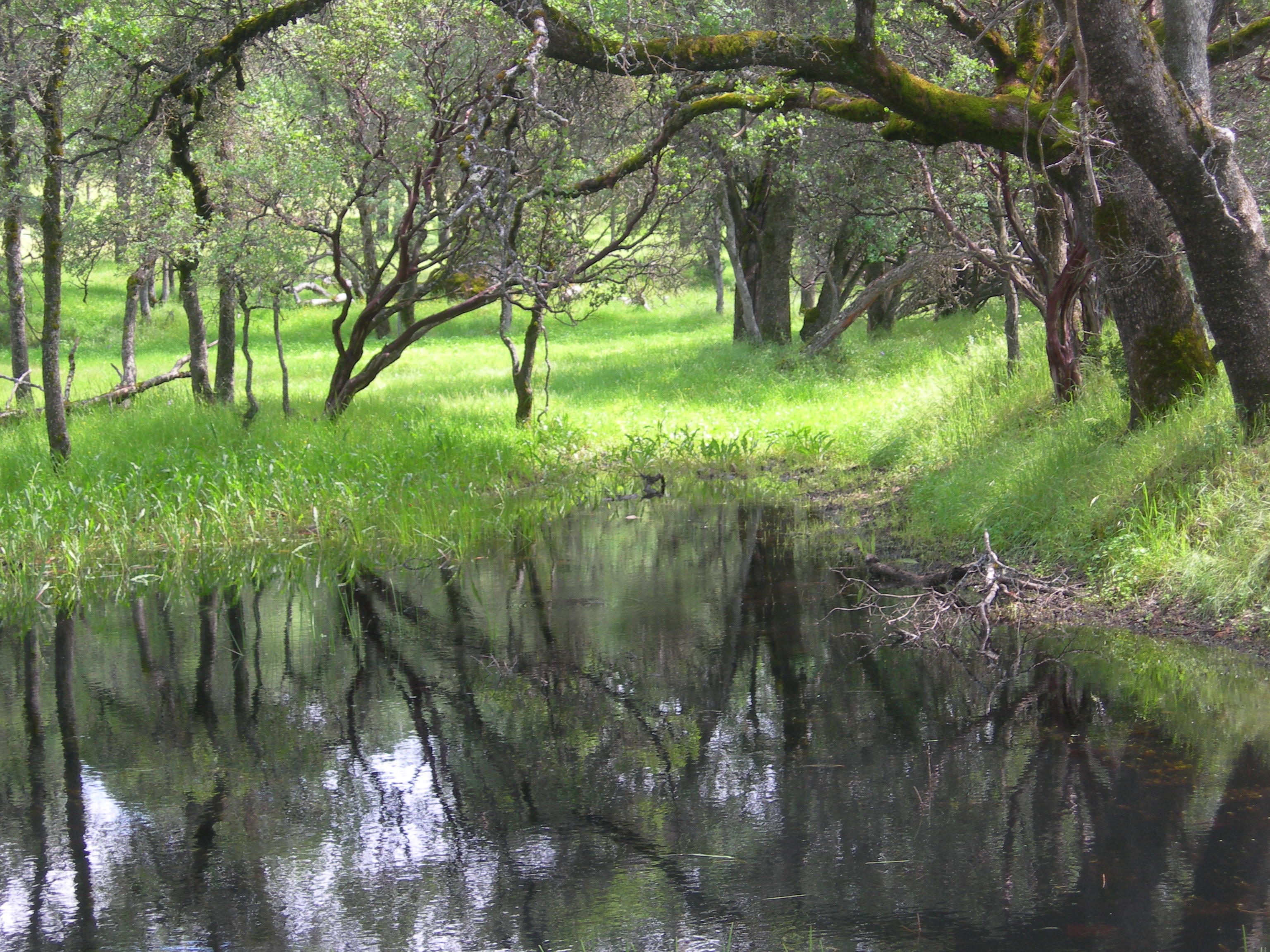
dscn4753This is a vernal pond, a few miles from my home. It will fill with water by Christmas and be dry again by Easter.

Let’s take a break from the world of politics and check into the latest meteorological phenomenon.

It rained last night.

That may not be a big deal to you, but here in the foothills of the Sierras it represents the change from one season to another in a climate that only has two seasons – dry and wet.

Our last rain came in mid-April. Six months without a drop. You may have heard that we are in a drought, but this is a different phenomenon. It is normal here for the last rain to come in mid-April, and normal for the first rain of the rainy (if that is the word) season to come in mid-October. Our drought is because we haven’t been getting enough rain between October and April.

So what does that have to do with my world of writing science fiction? Everything, really.

When I was young, my three favorite SF authors were Clarke, Heinlein, and Norton. Clarke’s stories always took place in artificial environments. Heinlein’s characters inhabited space ships, orbiting habitats, or frontier worlds; it didn’t matter, as long as they could talk incessantly, they were happy. Andre Norton characters, whether they were explorers, soldiers, spies, or interstellar traders, always spent their time outdoors, in wilderness or something like wilderness. The only cities you were likely to see in a Norton novel were in ruins, or the slums of the Dipple which any one of several young men were quick to flee from, usually into more trouble than they could imagine.

That suited me just fine. Her worlds were my world. In rural Oklahoma, I spent from May to September every year outside, usually driving a tractor, through rain, wind, dust, and heat. There were years when I watched the crops dry up and die under the relentless sun – and watched my Dad see six months work disappear before his eyes. There were other years when the rains came on time, the crops were good, and the pastures grew up heavy with grass; when the nights were a symphony of insect whirrings and the days were filled with bird songs and butterflies. Cliché? Paradise always sounds like a cliché.

It was the only life I knew, and I loved it, good years and bad, but I had to leave it, first for college, then to make a living. When I wrote my first book, I sent my protagonist into the mountains and lost him there, then let him find his way out. For my second book, Jandrax, I marooned a shipload of colonists on a barren, unexplored world, and watched them find a way to survive. In Cyan, coming out in a few months, I send a crew of ten to explore a rich new planet, then send them back to colonize.

I lived in a small city for most of my life. I could write about cities, but I don’t want to. My world is the world of nature –  even if it is nature on another planet.

So— it rained last night. About an inch, which isn’t much, even by Oklahoma standards, but the foothills only get thirteen inches in an average year. All the creekbeds remain empty and the hills remain covered with tall, dead grass in shades of brown, but within the soil, the change has begun. Seeds that have lain dormant since spring will be sprouting now, out of sight, and within a week there will be a faint haze of green, invisible beneath the long grass, but showing in the road ditches. This year’s grass will begin to flex its vegetive muscles, forcing its way upward through last year’s dead roots. Unnoticed, those roots will begin to loosen and be shoved aside until one day, a month from now, seemingly all at once, the old year’s grasses will tilt and fall, to disappear beneath the new green.

Suddenly all the brown will be gone and the new year’s grass will clothe every hillside. While the snows of winter cover the midwest, these Sierra foothills will be spring green, and the wildflowers will return.

234. Revisiting Columbus

A year ago today, I was anticipating a January 2016 release for my novel Cyan. Since Columbus had a brief appearance there, I published an excerpt on Columbus Day as a teaser. The novel’s release has been delayed, and very few people were reading that early in the blog’s history, so here is a reprise

*             *             *

Poor Columbus; he has taken a beating over the years. We don’t see him for what he was, with all his strengths and weaknesses, but through the lens of our own times. Here is a picture of how we might view him a century from now, when we have had to change our calendar to meet the demands of the rest of the world.

Anno Domini
A Latin phrase meaning the Year of our Lord.

Before sunrise on October 12, 1492, Anno Domini, a lookout for Columbus’ expedition sighted land. Columbus had found two new continents (although he did not know it), following his own powerful vision of how the Earth was constructed (a vision that was wrong), and began a five hundred year reign as king of explorers.

Half a millennium later, Columbus was dethroned. Even school children were now being taught that Columbus was not the only one who knew the world was round. Sailors and scholars had known that for hundreds of years before him.  Columbus’ great vision was that the Earth was small, and in that he was wrong. By the late twentieth century, it was certain that the Vikings got to America first, likely that St. Brendan beat Columbus there, and there were a dozen other putative explorers who had their champions.

Besides, American popular thought was in one of its Noble Savage stages, and it was politically correct to echo the Native Americans who complained that Columbus was a destroyer of races and cultures.

But even at the height of Columbus bashing, it was apparent that his voyage had differed in one significant detail from the other explorers who had preceded him. After Columbus, America was never lost again. After Columbus, and those other explorers who sailed close on his heels, the Earth became entirely known and entirely interconnected for the first time.

*****

In the year A. D. 2037 (as Christians measure time), at the Conclave of Mecca, the Islamic world announced that they would no longer recognize, speak with, acknowledge, or deal with any person, nation, or document which forced them to use a calendar based on Christianity.

At the International Bureau of Weights and Measures Convention in Buenos Aires two months later, a new calendar was established, based on a sidereal year. It would have neither weeks nor months since Islam and the rest of the world could not compromise on the issue of lunar months. It could not start at Jesus’ putative birth, nor at Mohammed’s, and it quickly became apparent that the new Standard Year should date from the midnight preceding the day the Earth became one planet for the first time.

This whole Standard Year business came about by accident. When I wrote Jandrax thirty plus years ago, I had no idea that I would write other stories in the same universe. After all, I stranded all those poor people so far out that no one would ever find them.

However, I began wondering what circumstances, beyond what I had already written, might cause Dumezil to invent his pan-Earth religion, and I wondered what Jan Andrax’s ancestors were like. That led me to make Stephan Andrax, Jan’s multi-great grandfather, spaceside commander of the Cyan expedition.

In Jandrax, I had pulled the date Standard Year 873 out of thin air. Now I had to backtrack and make it work for Cyan, which I did my making Standard Year Zero start with Columbus’ discovery of America.

233. Yearbooks Farewell

In an early science fiction novel/novella (A Fond Farewell to Dying/To Go Not Gently), I gave my protagonist a twenty year gap in his memory. To fill himself in on the events he missed, a friend of his suggests reading encyclopedia yearbooks, one by one.

It was a bad idea on two fronts. Shortly after I wrote that suggestion, Wikipedia drove paper encyclopedias out of business, and yearbooks were no more. My story was set a couple of centuries in the future, and long before we could get there, the immediate future had bit me where it hurts.

Even if that had not happened, it was a bad idea to trust yearbooks, as I found out when I tried it myself. I was planning to plot out a novel set in the sixties, so I accumulated yearbooks as a starting point for research. They were useless, and I kicked myself for not having realized in advance that they would be.

Almost everything the editors of the 1966 yearbook thought was important, turned out to be forgettable by the eighties. The important trends of that era only became obvious in retrospect.

1989 was like that, too. It was a pivotal year, but I missed it while I was living it.

I was alive, awake, and alert in 1989. I had recently returned from spending two summers in Europe. I was writing a teacher novel, and planning the novel Raven’s Run (now being posted in Serial), but I missed 1989’s significance. I didn’t really come to appreciate it until decades later when I was preparing to bring Raven’s Run up to date.

Basically, the cold war ended and the modern era began in 1989. When I realized that, I nudged Raven’s Run into that year so I could add a few events that I had missed when they happened, and set myself up for sequels.

I wrote a bracketing event, a meeting between Ian Gunn and a friend in Luisanne, Switzerland in 2012, where they are revealed as spies, or something like. (Raven’s Run 1) This leads to reminiscence and Ian begins to tell his friend of events that took place in 1989 – which becomes the novel.

I dropped these words into chapter 2:

It was April.  Ayatollah Kohmeni had a few months left to live, and no one had yet heard of Osama ben Ladin.  There were still two Germanies, two Berlins, and a wall; I had had my dealings with that wall a few years earlier, in uniform, when the cold war was even colder.

When I wrote chapter 2 in the mid-nineties, there were “two Germanies, two Berlins, and a wall”. I didn’t have to tell anyone. Not then – but posting Raven’s Run today, it has become necessary to remind my readers.

1989 was a pivotal year. If you don’t remember, or you weren’t born yet, take a look at Thursday’s post.

227. Mentors in Detection

“We are like dwarfs sitting on the shoulders of giants.”
             John of Salisbury, Issac Newton, and a million lesser lights attempting false humility.

What pen name? What market? What can we steal? . . . Correction. Not ‘steal.’ If you copy from three or more authors, it’s ‘research.’”
               Robert Heinlein, Time Enough For Love, and in a half dozen other novels in almost identical words.

There is very little in this world that is new and unique. We all borrow from those who went before. Some people borrow from giants, some borrow from pygmies.

Some people borrow from Shakespeare and screw it up royally. Some people borrow from third rate writers and turn the result into something memorable. But we all borrow.

I have made no secret of my mentors in science fiction, first Andre Norton, then Robert Heinlein. I write only a little like Norton and nothing like Heinlein (I would pay real money for his touch with humor.) Nevertheless, they both live in my head, all the time.

There are a thousand other authors whose work has moved me, but Norton and Heinlein got there early. Only Harold Goodwin (John Blaine) and the Bible got there sooner.

Over in Serial, my novel Raven’s Run is being serialized. It is a “men’s adventure”, a genre that is no longer recognized. In modern parlance, it would probably be classed as a thriller, although the tension level is really too low for that. It is also something like a detective novel, but not much. Genres today are so small and tightly defined, that RR crosses several of them. It resembles the Travis McGee books in that way.

In connection with mentors and influences, I will be covering three detective series next week along with one spy novel. McGee was a real influence on my writing. The two Fathers taught me a few things, but they are basically just stories I like. I’ll explain the Shrike when I get there, next Thursday.

Detective literature started with Holmes, both in the world at large and in my reading. I read him when I was in high school, and I still do, occasionally, although it is harder now that I can lip synch all the stories. I didn’t read other detective stories – or Westerns for that matter – until I was writing science fiction and fantasy full time and needed something to cleanse my mental palate between writing sessions.

McGee was by far the best and most influential. I’ll talk about him next Tuesday. Dashiell Hammet never appealed to me, but Raymond Chandler was superb. Robert Parker’s Spencer was great for the first ten books while he was imitating Chandler; after he started imitating himself, they went down hill fast. I enjoyed Chesterton and Greeley enough to give each his own post next week.

Quite a few of the authors who come to mind were actually writing spy stories, like the gritty early James Bonds before they degenerated into farce.

There were authors with a few books whose work stuck with me. E. C. Bentley’s Trent’s Last Case was worth reading. So were the few Bertram Lynch mysteries by John Vandercook. That particular series was a recent discovery, in ancient, battered copies at my favorite underfunded library – you know, the one that never throws away a book. Rex Stout’s Nero Wolfe is the series I am working my way through now, since I have read the covers off all my previous favorites.

To be certain that I didn’t forget any old friends, I went through several “best detective authors” lists on line. There I found Alistair MacLean (author – under a pen name – of The Black Shrike) and John Buchan. I would not have called them detective novelists, but they are among my favorites.

Not every detective lives in contemporary England or America. I fully enjoyed the five or six Cadfael novels I read before the spell wore off. I own and frequently reread every Judge Dee book, and Bony (Napoleon Bonaparte), the half aborigine Australian detective is very nearly my all time favorite.