Tag Archives: science fiction

60. Thank You, Harold Goodwin

BOOKSI have a December birthday, which worked out well as a kid since books were my favorite gifts, and winter is a prime time for reading. The gifts I got were locally sourced and cheap, mostly published by Grosset and Dunlap, Whitman, or Golden. For anything by a normal publisher, I depended on libraries.

Heinlein’s juveniles were legendary, but he wasn’t the only writer of juvenile science fiction. Norton made a carreer of it before she branched into fantasy. Donald Wohlheim wrote a eight book series about a secret project of young astronauts called Quicksilver which shadowed the accomplishments of Project Mercury. Joseph Green wrote a six book series built around the character Dig Allen. All of them kept me entertained through long Oklahoma winters.

Nobody, not even Heinlein, did it better than Harold Lee Goodwin, although the comparison is apples to oranges. Heinlein’s juveniles were set in space and used future science reasonably  extrapolated from the present. Goodwin’s stories, with one exception, were set in the present and built on extant science.

If you’ve never heard of Goodwin, its largely because he worked under the pseudonyms Blake Savage and John Blaine. If he gets no respect, it’s largely because he was published by Grosset and Dunlap. That meant Goodwin’s Rick Brant books shared bookstore space with Tom Swift, Jr and the Hardy Boys – series that were written to outline by anonymous hack authors.

I read all three G & D lines as a kid, and enjoyed them because they were all I had. They taught me to read and to love reading. But when I try to reread Hardy Boys books today, they come off dull and dumb. Tom Swift, Jr. – well, I can’t force myself through them, although I still try from time to time.

Rick Brant holds up. A few years ago I reread the whole series from start to finish and they were as good as I remembered them. The same was true of Goodwin’s single outer space adventure, sometimes titled Rip Foster Rides the Gray Planet and sometimes Assignment in Space with Rip Foster.

Rick Brant lived the perfect life. I would have traded with him in a heartbeat. He had adventures, twenty-six eventually, which he shared with Scotty (Don Scott) who was the ideal older brother figure. They appeared to be seventeen and eighteen in the first book and were still the same age forty-three years later. That’s good work if you can get it.

Rick lived with his family on Spindrift Island where his father was the head of a diverse group of scientists. Each had a different specialty, allowing for a wide range of stories, and they formed a dozen of the best uncle figures any boy could imagine.

Rick was bright and a bit precocious, but he wasn’t a wunderkind. Elsewhere he might have seemed nerdy, but on Spindrift he simply seemed a bright young scientist among brilliant experienced older scientists. He was always learning. He often saved the day, but he never had to save the world.

In short, he seemed real.

I wish I could recommend Rick Brant to today’s audience. Certainly it would be hard to match the series’ quality, but the same timeliness that made it work on publication, makes it dated today. A kid with a smart phone is not likely to be impressed when Rick invents a miniature walkie talkie, and that’s just too bad.

Harold Goodwin was a diver, worked for Civil Defense, NASA, NOAA and other agencies, and said that his books “were often a spinoff from my technical work.” His lengthy obit is reprinted in Goodreads at https://www.goodreads.com/author/show/3487756.Harold_Leland_Goodwin?from_search=true

 

54. Bind Not, Be Not Bound

In Blondel of Arden, now in Backfile, and in post 56, coming Thursday, I produced song lyrics to give my characters a chance to show their attitudes. In the novel Cyan, due out in spring, I went a step further by having the characters themselves write poetry. I’ll cover that in a future post.

Keir Delacroix is the groundside leader of the explorers on Cyan. Because of events in his childhood, he has an aversion to forcing others to his will – especially women. He spells this out in a poem.

Bind Not, Be Not Bound

Speak softly, draw near,
Touch but do not cling,
Bind not!

Share with me your love and laughter,
Smiles and frowns, days and nights.
As a lover, as a friend,
Mine, but free.
(As I am free.)

Remain as you wish,
Depart when you will.
Be not bound.

This attitude leads him to questionable decisions late in his year of exploration. Those decisions come back to haunt him when the explorers return to Earth, massively change the early days of colonization, and ultimately lead Keir to a broader view of human relationships.

52. Anthropology 101

220px-Nehru_gandhiFirst I wanted to be a scientist, an inventor, and a spaceman. The word astronaut hadn’t been invented yet. By the time I reached high school John Storer, Peter Mathiessen, and Marston Bates had converted me to ecology. I entered college majoring in biology; following their rules, I took chemistry and math the first year and enrolled in Biology 201 at the beginning of year two. I lasted less than a week, because the whole department was DNA crazy. In the words of Marston Bates, they were only interested in “skin-in” biology, while I was only interested in “skin-out” biology. They were wearing white lab coats; I wanted to wear khaki.

rolling sched...Ten years later, everyone would have been studying ecology. My timing was a fortunate misfortune, because twenty years later the study of ecology had degenerated into fighting with government bureaucracy to save what little of the wild remained. Diplomacy is a skill I never had and never wanted, so it’s a good thing my life didn’t lead me down that path.

Anthropology was the closest thing to behavioral biology that MSU offered. I switched majors and it served me well. I spent two summers on archaeological digs which taught me I didn’t want to be an archaeologist. I did want to look like one. My roommate and I took our first archaeology class in 1967. Professor Cleland was tall and lean, with close cropped hair and a full red beard. We went back to the dorm and threw away our razors. I never went back to bareface, which came in handy a year later when the Summer of Love occurred and suddenly there were hippies everywhere.

All this, you understand, was years before Indiana Jones put on his hat and picked up his whip.

My interests within anthropology soon narrowed down to South Asia, that is from Pakistan, through India to Bhutan and from Nepal to Sri Lanka, including overseas populations in places like Trinidad and Fiji. I mined that knowledge heavily in A Fond Farewell to Dying and made two of the main characters in Cyan Dravidian Indians from Trinidad.

Although I spent a lot of energy studying Hinduism, Islam, and Buddhism, the religion around which I built Jandrax came from a more personal source – from growing up a fundamentalist and then bailing out.

The core concept of Anthropology is culture.

Putting it as simply as possible, we do not see with our eyes or hear with our ears, but every sensory perception is filtered through our cultural upbringing. We have an internalized vision of what the world is like, and every perception is censored by that view.

That is a quote from a paper I gave at Westercon 34 in Sacramento, California in 1981, in which I summarized what the study of anthropology and the writing of novels had taught me about creating alien cultures. Thirty-five years later, it stands up well to the test of time, so I am presenting it on this website. It starts today in Serial.

It’s called How to Build a Culture. Pop over and give it a look.

37. Fantasy, Whatever That Is

220px-Mårten_Eskil_Winge_-_Tor's_Fight_with_the_Giants_-_Google_Art_ProjectIt has been a grand ride.

Since I started reading science fiction in the late fifties, I have seen the rise of Amber, Witch World, the Dorsai, the Lensmen, LeGuin, Zelazny, Ellison, Varley, Ballard, and hundred of others. I was there for the Tolkien revival and the revival of other fantasy writers under Ballantine.

Through the years, avid readers waged war on one another over the most trivial of notions, just like any other family. If you called science fiction “sci fi” (never mind SyFy) you were beyond the pale. You had to call the genre science fiction, or maybe SF; but then you had to argue whether that stood for science fiction of speculative fiction or . . . I’ve forgotten what the lesser contenders were.

Mimeograph and USPS were the internet of the early sixties. Whole forests went to the pulp mills to make paper to support arguments about what was or was not science fiction, whether fantasy was worth considering, and where one ended and the other began. Then Heinlein published Glory Road and sent shock waves through the SF community by landing with one foot squarely in each camp.

I mention all this because, although my publications so far have been science fiction, I have spent more time and taken more satisfaction writing fantasy. I’ll spell that out in the next few posts. Most of those works remain unpublished, but you can see some short stories in Serials.

Today, everything goes, but you still have to declare your allegiance. I recently dealt with a publisher who required that you shoehorn your submission into one of about forty SF/fantasy sub-categories.

All of this is probably subsumed under Clarke’s Third Law, “any sufficiently advanced technology is indistinguishable from magic.” Put another way, the Creation as given in Genesis is fact, allegory, or fantasy depending on whether you are a fundamentalist, a religious liberal, or an atheist.

Put still another way, if it tastes like fantasy, it is (for you) and if it tastes like science fiction, it is (for you).

25. Columbus, King of Explorers

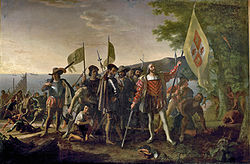
250px-Landing_of_Columbus_(2)Poor Columbus; he has taken a beating over the years. We don’t see him for what he was, with all his strengths and weaknesses, but through the lens of our own times.

This excerpt from my upcoming novel Cyan gives a picture of how we might view him a century from now, when we have to change our calendar to meet the demands of the rest of the world.

Anno Domini
A Latin phrase meaning the Year of our Lord.

Before sunrise on October 12, 1492, Anno Domini, a lookout for Columbus’ expedition sighted land. Columbus had found two new continents (although he did not know it), following his own powerful vision of how the Earth was constructed (a vision that was wrong), and began a five hundred year reign as king of explorers.

Half a millennium later, Columbus was dethroned. Even school children were now being taught that Columbus was not the only one who knew the world was round. Sailors and scholars had known that for hundreds of years before him.  Columbus’ great vision was that the Earth was small, and in that he was wrong. By the late twentieth century, it was certain that the Vikings got to America first, likely that St. Brendan beat Columbus there, and there were a dozen other putative explorers who had their champions.

Besides, American popular thought was in one of its Noble Savage stages, and it was politically correct to echo the Native Americans who complained that Columbus was a destroyer of races and cultures.

But even at the height of Columbus bashing, it was apparent that his voyage had differed in one significant detail from the other explorers who had preceded him. After Columbus, America was never lost again. After Columbus, and those other explorers who sailed close on his heels, the Earth became entirely known and entirely interconnected for the first time.

*****

In the year A. D. 2037 (as Christians measure time), at the Conclave of Mecca, the Islamic world announced that they would no longer recognize, speak with, acknowledge, or deal with any person, nation, or document which forced them to use a calendar based on Christianity.

At the International Bureau of Weights and Measures Convention in Buenos Aires two months later, a new calendar was established, based on a sidereal year. It would have neither weeks nor months since Islam and the rest of the world could not compromise on the issue of lunar months. It could not start at Jesus’ putative birth, nor at Mohammed’s, and it quickly became apparent that the new Standard Year should date from the midnight preceding the day the Earth became one planet for the first time.

This whole Standard Year business came about by accident. When I wrote Jandrax thirty plus years ago, I had no idea that I would write other stories in the same universe. After all, I stranded all those poor people so far out that no one would ever find them.

However, I began wondering what circumstances, beyond what I had already written, might cause Dumezil to invent his pan-Earth religion, and I wondered what Jan Andrax’s ancestors were like. That led me to make Stephan Andrax, Jan’s multi-great grandfather, spaceside commander of the Cyan expedition.

In Jandrax, I had pulled the date Standard Year 873 out of thin air. Now I had to backtrack and make it work for Cyan, which I did my making Standard Year Zero start with Columbus’ discovery of America.