Tag Archives: science fiction

109. Our Stellar Neighborhood (post 1)

FTL is the break point of science fiction. Without a faster than light drive, exploration is restricted to the local area, and that’s fine with me. I take satisfaction in building planets within the constraints of known stars. But beware, the party is nearly over. We now have the capacity to discover extrasolar planets, and new ones are found every year. Fortunately for latecomers to the planet builders guild, megaplanets are easier to find that Earth sized ones, and NASA keeps cutting funding. Still, it won’t be too many years before you can’t decide for yourself where, within the limits of orbital mechanics, you want the planets of Alpha Centauri or Procyon to be.

When I began world building, the prime reference was How to Build a Planet by Poul Anderson. I also had an article from Sky and Telescope titled Stars Nearer than Five Parsecs. Today the internet provides an embarrassment of riches, including planet building apps. Apps? Where’s the fun in that?

What I am about to present will be old knowledge to some of you, so forgive me. Not everybody can be a nerd on everything. There are plenty of people, including would-be science fiction writers, who only want a primer on the local neighborhood, because their passions lie elsewhere.

What is the star closest to Earth? The sun. That’s a gotcha riddle among middle school students. The sun’s luminosity is generally given as 1.0, which makes the luminosities of other stars easy to understand by simple comparison.

Okay, what star is next closest, Alpha Centauri or Proxima Centauri? The P- word gives it away, but it isn’t really that simple.

Alpha Centauri isn’t a star, it only seems to be one to the naked eye. A moderate telescope resolves that dot in the sky into three dots. Alpha Centauri is a triple star, or maybe  a double star with a third star wandering through the area. Astronomers haven’t decided yet.

Alpha Centauri is the largest “star” in the constellation Centaurus. Centaurus has moved southward since the ancients named it, so that Alpha Centauri is no longer visible from the northern hemisphere. I had to wait decades to see it, on my first trip to Australia. There you don’t look for Centaurus, you look for the Southern Cross, a kite shaped constellation within Centaurus.

Alpha Centauri is just a dot in the sky, but I was thrilled to finally see the star which was the setting for so many science fiction stories from my youth.

The two stars of the binary pair are named Alpha Centauri A and Alpha Centauri B. The third star is sometimes called Alpha Centauri C, but more often Proxima Centauri because it it slightly closer to Earth. Beta Centauri is something entirely different. The second brightest dot in Centaurus, Beta Centauri is a star system 525 light years from Earth – not in the local neighborhood at all. Beginners sometimes say Beta Centauri when they should be saying Alpha Centauri B.

The naming convention is widespread, but not universal. Many stars have names given to them by the ancients. Many more are simply alpha-numeric designations, following the conventions of published star charts or inventories by observatories.

*****

Click here for a Wikipedia article that will list 56 of the nearest stars, followed by maps. The first map will give you some idea of where these stars lie in relation to each other.

Tomorrow we can look at some of the rest of the nearby stars, concentrating on those which might have planets useful for human real estate.

107. Codger’s Law

There are laws which govern human behavior. No matter how chaotic things become, somebody will take what he sees and codify it. Science fiction is no different.

Asimov gave us the three laws of robotics:

1. A robot may not injure a human being or, through inaction, allow a human being to come to harm.
2. A robot must obey the orders given it by human beings except where such orders would conflict with the First Law.
3. A robot must protect its own existence as long as such protection does not conflict with the First or Second Laws.

Asimov himself worked those laws to death, and provided countless plot ideas for other authors.

Since so many science fiction authors are scientists or engineers, laws from the “real” world permeate writings in the field. We frequently see references to the three laws of thermodynamics, the three laws of motion, and the three laws of planetary motion. Three is a happy number for codifiers, but sometimes it just isn’t enough. Both robotics and and thermodynamics needed to add a zeroth (but not a fourth) law.

Arthur C. Clarke also committed three laws:

1. When a distinguished but elderly scientist states that something is possible, he is almost certainly right. When he states that something is impossible, he is very probably wrong.
2. The only way of discovering the limits of the possible is to venture a little way past them into the impossible.
3. Any sufficiently advanced technology is indistinguishable from magic.

Asimov’s laws were for fictional robots; Clarke’s laws are more about how the real world works.

Everybody knows Murphy’s Law, “Anything that can go wrong, will go wrong”. It is a favorite of engineers, but it works equally well in almost any human situation. It has variants and corollaries. Sod’s and Finagle’s variants add, “. . . at the worst possible time” or “. . . with the worst possible outcome.” Some even say that “Murphy was an optimist,” but that may be stretching things a bit.

Related, and not a law but a test, is the matter of the half-glass. Optimists say the glass is half full; pessimists say the glass is half empty. At my house, given a 50% glass, my wife will say it’s nearly full and I’ll say it’s almost empty, but that could be an extreme case.

Of all the “laws”, Sturgeon’s is my favorite. Wearying of critics of science fiction who claimed that ninety percent of science fiction is crap, Sturgeon replied, “Ninety percent of everything is crap.” I’ve never heard anyone disagree, expect those who would have a higher percentage, or who substitute an even more disreputable excremental material.

Finally, not to be outdone, I want to add my own bit of codification. I came to this idea when comparing Dorsai! and The Final Encyclopedia, two of my favorite science fictions novels. They come from early and late in Gordon Dickson’s career and are so different in style that, brilliant as they both are, they could have been written by two different authors. I have seen the same phenomenon in the work of other writers. Possibly even in my own.

Codger’s Law: “The older the writer, the longer the manuscript.”

87. Gemini

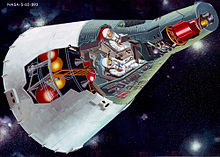
220px-Gemini_spacecraftToday I want to share with you a book you are unlikely to see. Few libraries have it and it commands unreasonable prices in used books stores. It’s writing style is not artistic. Yet it is a moving book, because of its subject, its author, and its timing. The book is Gemini, by Virgil “Gus” Grissom.

Every American knows something about Apollo. Most have at least heard of Mercury, but the Gemini program has been largely forgotten. That is reasonable enough; youth looks forward. At the time, however, Gemini saved America’s faith in the space program at a time when Soviet advances had made us look foolish and hopelessly outclassed.

Here is a brief summary for the terminally young: the Mercury program, consisting of two sub-orbital flights followed by four orbital flights, put America into space, but the one man capsules – not yet called spacecraft, for good reason – were largely occupied rather than flown. Gemini was a two man spacecraft which could change orbits, meet up with other orbiting objects, and was fully under control of its pilots.

If Mercury was a Volkswagen and Apollo was a Winnebago, Gemini was a sports car.

Mercury capsules had windows in the hatch, only placed there at astronaut insistance. Astronauts could look out, but not forward. Gemini’s viewports were moved to a front facing orientation, like the eyes of a predator. It’s pilots had to see where they were going, because they were actually flying their space craft.

For Apollo to do its job, NASA had to learn to rendezvous, dock, and perform EVAs (extra vehicular activities – space walks) and provide a cadre of astronauts who had proven their ability to do these things. That was the purpose of Gemini.

Grissom was the second American in space and the command pilot of the first manned Gemini mission. He provides a first hand look at the program through it’s brief five year span. The book was written just after the last Gemini flight.

Speaking of 1965, Grissom says: ”We had put ten men and five spacecraft into space and returned them safely, performed EVA, and achieved rendezvous. It was a pretty good record for a program that only two years before had appeared to be foundering.” Eventually sixteen astronauts flew on ten manned Gemini missions.

Grissom’s book is an excellent summary. His style charmingly represents a working astronaut who is not a writer. Nevertheless, the book is haunted. We know that, in the words of Grissom’s editor and friend Jacob Hay, “Within weeks after completing the first draft manuscript of this book, Lieutenant Colonel Virgil Ivan Grissom was dead, killed with his colleagues Lieutenant Colonel Edward M. White, and Lieutenant Commander Roger B. Chaffee, in a flash fire aboard the Apollo spacecraft they were scheduled to take aloft in its first manned flight on Feburary 21, 1967.”

The launchpad fire occurred on January 27, 1967, forty-nine years ago today. For details, see Jay Barbree’s Live from Cape Canaveral (2007), especially chapter nine, ”I’ve got a fire in the cockpit!” Also see post 27, That Was My Childhood.

The book Gemini would have been hard to read when it came out shortly after the fire. It is even harder to read today, given our understanding of the incompetence that led to the disaster. Knowing that the primary cause was flammable materials in an all oxygen atmosphere, it is hard to hear Gus admit that, “For their part, the medical people weren’t really entirely happy over out 100 per cent oxygen supply.”

Still – the book is joyful, and clearly written my a man who loved what he was doing. Gus says he was writing the book for his sons, and the sons and daughters of the other astronauts, and for other sons and daughters throughout America. He meant me (I was senior in high school when the book was published), and he meant you, whatever your age.

Grissom’s book Gemini is largely forgotten, but what he and his fellow astronauts did will not fade from our memories.

80. And Don’t Begin With And

yol 8This is the last of eight how-to posts on writing. I haven’t exhausted the subject, but I want to quit before I exhaust my readers.

Your Own Language:
And don’t begin with and

Here is a rule that was strictly enforced in the antediluvian days of my youth. I think today’s teachers have largely given up, and thank goodness. The rule is: Don’t begin a sentence with a conjunction.

This sentence is acceptable:     “Every morning he saddled his horse carefully, and every evening he wiped him down with equal care.”

According to the rule, this construction is not acceptable:     “Every morning he saddled his horse carefully. And every evening he wiped him down with equal care.”

And yet, this third version is “correct” again.     “Every morning he saddled his horse carefully. Every evening he wiped him down with equal care.”

What? This makes no sense – unless you first accept the fallacy that each sentence should be complete in itself. This is the same completeness fallacy that leads teachers to teach paragraphs in isolation (see yesterday’s post).

In any story, essay, letter, email, or post, the writing flows from the first word to the last. How we break up that writing – where we put periods, commas, paragraphs, dashes, colons, and semicolons – is entirely a matter of pacing.

Whether you prefer eighteenth century novels with sentences a hundred words long and a paragraph break every other page, or something modern with rapid fire, disjointed chattering, every story has to engage the reader at its beginning, then carry through to some reasonable level of closure.

It’s that simple.

Children have no problem with closure in their stories. At the end, the hero wakes up. Hemingway usually had no problem either; at the end of a typical Hemingway novel, the hero dies. But even that isn’t complete closure. When Robert Jordan is lying on the hillside at the end of For Whom the Bell Tolls, the enemy is closing in and there is no doubt he’s about to die. But what will happen to Maria? Will his coming sacrifice save his comrades? We don’t know.

As the holy men told the Prince of Exile, “Every true story ends in death, but no true story ever ends.” Closure is necessary, but never complete.

How much closure do you need? Thomas Anderson has said twice in reviews that the endings of my novels leave him feeling unsatisfied. Fair enough, yet they satisfy me. It is entirely a matter of taste.

Of course, there are limits. I once read a novel by an otherwise reputable author who ended it in mid-sentence because, just as his character has come to understand the meaning of life, he gets hit by a bus. That’s cheating.

There are more novels and blogs yet to write, and that’s closure enough for now.

79. Death to the Five Part Paragraph

yol 7 If you are a writer, a teacher, a parent, or a student, don’t back off because the title seems beneath your interest. This is Basic BS 101.

Your Own Language, 7:
Death to the five part paragraph!

Here is your zen koan for the day – how do you teach that which cannot be taught?

Answer: you make up arbitrary rules which seem to cover the situation, then teach the rules instead of the unteachable thing.

I speak, of course, of the five sentence paragraph, a structure found in every middle school classroom, but which exists nowhere in nature.

At one point in my teaching career I was preparing a program which was to teach writing by analyzing the writing in students’ science and history textbooks. I performed an experiment to confirm a suspicion. I went to my bookshelf, chose five non-fiction books at random, chose a page and a paragraph in each at random, and analyzed the result.

The only book that followed the format taught in middle school was How to Hang Drywall. It was written by a drywall contractor and was probably the only book he ever wrote. I could visualize him digging out his old textbooks for guidance before beginning to write. To be fair, it was full of accurate information. I had followed his instructions (that’s why the book was in my library)  and my drywall stayed up; but it was excruciatingly dull, and it didn’t need to be.

There is another related old chestnut: tell them what you are going to tell them, tell them, then tell them what you just told them. This is the five part paragraph with pontoons on both sides to keep it from sinking.

I don’t see this in print too often: if you do, maybe you’re reading the wrong kind of book. I do see it every Saturday morning on PBS in the show Woodsmith Shop. Like the drywall book, this is the product of intelligent men – professionals who are not professional writers – presenting what they know, but following rules that are not serving them well..

The wonder is that the book and the TV program work as well as they do, given the teacher generated chestnuts they had to work with.

Here is a five sentence paragraph following a format popular in middle schools:

  • topic sentence
  • supporting sentence
  • supporting sentence
  • supporting sentence
  • recapitulation or close

I got ready for school this morning. I brushed my teeth. Then I took a shower. Finally I put on my school clothes. Then I was ready for my day.

Wow, exciting! Actually, that wasn’t a paragraph at all. It was a mini-essay, and an exceedingly boring one at that.

A paragraph is a piece of a larger work. It tells part of the story. It should have some internal consistency, but it is not independent. It introduces a thought or carries on the thought begun in earlier paragraphs.

That’s it. There are no other rules.

You can’t teach a student to write a paragraph. A paragraph does not and cannot exist. When teacher’s try to teach a paragraph, they are actually teaching mini-essays, and doing a poor job of that.

Take a two page essay, sans indentation. Break it into four paragraphs. Now take the same essay and break it into ten paragraphs. The former will sound formal, the latter will sound breezy.

Paragraphs can determine tone, can help keep our thoughts and understandings organized, and give us places to breathe. Where we break essays and stories into paragraphs is determined by the tone we want to achieve, and by the content of the work.

There are no other rules. Teachers who create artificial formulas to give themselves something to teach strangle the minds of their students.

78. Who Decides?

yol 6Your Own Language: Who Decides?

Who decides which version of English we speak? The list is long, but English teachers are not on it.

Everyone has a mental picture of teachers, good or bad, loving or fearful, and as small children we usually think of them as powerful beings. Teachers know better. They are the functionaries of a massive bureaucracy. They are told what to teach and what not to teach, out of textbooks they have no power to change. The only thing that keeps them from being serfs is that the same incompetence that characterizes the entire educational establishment extends to an incompetence at commanding obedience.

Teachers are told what to do, and then, sometimes for good and sometimes for ill, they do what they can get away with.

Preachers used to have a powerful influence on language. You couldn’t say damn or hell in school. You still can’t say shit, although, merde, the Aussies say it all the time. Today preachers have been replaced by the purveyors of political correctness. Even thirty years ago, when I first began teaching, one of our textbooks had modified Tom Sawyer by changing Injun Joe’s name to Outlaw Joe. Need I say that it has gotten worse since then?

We have to decide for ourselves what to accept and what to reject out of what the world hands us. To a large extent, we all have to be self-educated.

I learned that early. I spent my first eight years in a tiny school where there were two grades per teacher. Half of each school day was under instruction; the other half was spent doing independent work while the teacher taught the other grade. By the time I reached high school I had developed self-reliance, and I had come to the conclusion that none of my teachers knew enough to teach me all I wanted to know. That was particularly true in English.

I didn’t want to talk like an Okie. More importantly, I couldn’t afford to if I was going to escape to the intellectual life I wanted. My salvation was Strunk and White’s Elements of Style, which I read as a counterbalance to the simple mindedness of my textbooks. S and W was dated, even then, and is in considerable disrepute today. A glance at Wiki finds it to have a “toxic mix of purism, atavism, and personal eccentricity” and to be “the best book available on writing good English”. Strong opinions do tend to polarize, but at least they were the prissy opinions of learned men. There weren’t too many leaned men in Talala, Oklahoma. Besides, I was already arrogant enough to ignore anything I didn’t find palatable.

Writers have always been arbiters of English, but which writers? We would all like to sound like Shakespeare but, zounds and forsooth, who would listen if we actually did? If you want to write romances (God forgive you) you will need to master the rippling muscles and heaving bosoms style. If you want to sound like Hemingway, you will have to take a magic marker and scratch out all the adjectives in your dictionary. Even hard boiled writers eventually get tired of terseness. Robert Parker put these words into tough guy Spencer’s mouth, “I felt like I was trapped in a Hemingway short story. If I got any more cryptic I wouldn’t be able to talk at all.”

There are no infallible rules, grammatical or otherwise. That doesn’t mean anything goes. Somewhere in between rigidity and chaos, you will have to find your particular brand of English. And you had better choose well, because that (among many other things) will determine who is willing to listen to you.

77. Adverbially Farewell

yol 5Your Own Language, 5: Adverbially Farewell

I am here to present a eulogy to an old and treasured friend, the suffix -ly.

As adversity separates the men from the boys, the suffix -ly separates the adverbs from the adjectives. At least, it used to.

As a matter of full disclosure, I am not a linguist. I am fascinated by languages, but I haven’t taken the time to learn them. I once spoke two semesters worth of Hindi and I can still embarrass myself in German, but my studies have mostly been as an onlooker. I have read several dozen books purporting to explain linguistics, but books by real linguists make tensor calculus look easy.

Still, I can expound on the really low level stuff.

Two factors are at work in language, position and word endings. Latin was not positional. Veni, vidi, vici (I came, I saw, I conquered) could be stated in any word order without losing meaning because the form of each word defines its function.

English can be positional. If we say the boy ate the dog, we assume it was a hot dog because word order tells us who was the eater and who was the eaten. If we said the flic ate the flak, we don’t need a dictionary to know who did the eating; word order tells us.

But I also said eater and eaten. These are constructions which depend on endings, not word order. English swings both ways. If I say the eater ate the eaten, we all say, “So what?” But if I say the eaten ate the eater, I am speaking nonsense. Or maybe I meant that the one who is usually the eaten ate the one who is usually the eater, in which case we know we have witnessed an ironic reversal of circumstances.

It can be complicated, but let’s keep it simple. Adverbs typically end in -ly; adjectives don’t. (Ugly is the exception).

Here are three quick nonsense examples, quickly presented. (Okay, four.)

  • “The rapid river flowed rapidly through the canyon.”
  • “The beautiful sunset reflected beautifully off the cathedral.”
  • “The angry citizen spoke angrily to his Congressman.”

Once upon a time and place, say Oklahoma in 1962, teachers taught this distinction and expected student to know it. Even then, however, only word nerds like me continued to make the distinction after the ink had dried on the final exam.

Apparently anchormen never got the word. Ad men say whatever they want, truth and grammar notwithstanding, so they don’t count.

In 2016, if I hear someone making the distinction between adjective and adverb, my ears perk up, it is so unexpected.

I think it is fair to say that Steve Jobs drove the final nail in the coffin. When he urged us all to “Think different”, he made it official that even smart guys don’t need grammar. Now anyone who puts up a sign reading “Shop local” can say, “If it is good enough for Jobs . . .“

Okay, true confession. This isn’t actually the rant it appears to be. I will continue to fight the battle of the adverb personally, but the war is over, and I know it.

Actually, it probably doesn’t matter. I know what Jobs means from context and word order. Losing the -ly ending probably won’t make any difference in the English language. It is just one of the natural ongoing changes that occur in all languages.

Once, in post 53, I said that, as users of the English language facing change, we have only one obligation. If the change is stupid, don’t use it. The loss of -ly isn’t stupid. It just hurts my ears.

76. What is Language?

yol 4Your Own Language, 4: What is Language

The last thing I said in post 73 was that if you want to write, you have to create your own version of English. That seems insane on the face of it. Create your own version of English? Why not just use the real thing?

Because there is no such thing as the real thing. I pity the teachers who have to teach “proper” English because that beast does not exist in the wild, and attempts to create it in the laboratory have all failed.

Language, like history, is a product of the winners. You people in New England; why do you think you don’t eat grits, and say ain’t and y’all? It is entirely because Pickett’s charge failed at the Battle of Gettysburg.

No one does linguistic imperialism as well as the English. I didn’t say British. Great Britain consists of England and three other historic countries which were conquered and welded onto England against their will, and whose languages were crushed by the conquerors.

America gained its independence late in this process. English was already the dominant language and its dialects were dispersed throughout America to morph into the dialects we still have. (see post 12) Conquered languages like Gaelic and Scots survived in the backcountry of Britain to see a resurgence in the last fifty years, but died quickly in America.

After American independence, the languages of the two countries diverged until George Bernard Shaw was able to quip, “England and America are two countries separated by a common language.” Part of the divergence was due to American adoption of Amerindian, African, and Spanish vocabulary, part was natural drift, and part of it was the rise of industrialism in both countries before rapid international communication was common. To put it another way, American cars have hoods and trunks instead of bonnets and boots because cars were invented after 1776 and before the internet.

The French have a government agency designed to regulate proper French. It doesn’t work. Ordinary Frenchmen disregard it, but the bureaucrats still try. Britain attempts to unify and codify it’s many dialects and languages through its public schools. At many times in Britain’s history, in-school use of dialects that deviated from governmentally supported norms was severely punished.

That wouldn’t work in America. If a teacher from London had had the misfortune of landing in the Oklahoma of my childhood, the local farmers would have taken him aside to say, “You’re from England, why the Hell can’t you speak English.” This line would have been delivered in an Okie accent that the Londoner probably would not have understood.

All of this leads to the question, “Who is in charge of our language?”, but that requires a post of its own, next Tuesday, after we attend a funeral on Monday.

75. Parts of Speech, Oh, No!

yol 3The next posts are tagged teaching, as well as the usual SF, fantasy and writing. I taught school for twenty-seven years, mostly science, along with a little of everything else, including reading and writing. So pardon me while I rant a little.

My idea of Hell is being an English teacher, working all day with textbooks written by Satan’s emissaries, then going home and spending all night correcting horrible writing. My idea of an angel is someone who does that out of duty, or love of writing, or love of children.

The problem with English textbooks is that they are written by people who can’t write. Or rather, have only written for other English teachers, who learned their trade by writing for other English teachers, who learned their trade . . .

If textbook writers had to sell their wares at Barnes and Noble, they would starve. But people don’t buy textbooks, bureaucrats do.

Let’s start with the most basic lie textbooks tell.

Your Own Language, 3: Parts of Speech, Oh, No!

The next time someone asks you if (insert word of your choice) is a noun, the correct answer is:

  • Yes
  • No
  • Sometimes, but not always
  • It all depends.

That seems evasive, but it is actually the correct answer.

Parts of speech exist and are critically important in understanding and mastering English, but they are not things, they are functions. I am tempted to say verbs not nouns, but partially accurate analogies confuse more than they help.

Wait! I saw you reaching for that off switch.

Of course you are an adult, and far from grammar school (an interesting concept, “grammar school”) but some of you are teachers and most of you are parents, or will be. I want to show you a fallacy. It won’t take long.

Parts of speech morph. Verbs turn into nouns, which turn into verbs again, sometimes with odd results. When I was a boy, if a salesman had said he had to service his customers, he would have been making an off-color sexual reference. Service meant sex, in absence of emotion; bulls serviced cows. Or it meant the carrying out of a mechanical act. The serviceman (noun) at the service (adjective) station serviced (verb) your car.

A salesman served (verb) his customers, and that act was the service (noun) he provided for them. Over my lifetime I have seen the noun service become a verb again with results that still sound wrong to my ear.

Nail. It is a word, but it is not a part of speech. It can act as a part of speech, that is, it can take on a function, but which function it takes on can’t be guessed by seeing the word in isolation.

“He hung his shirt on a nail.” Clearly nail is a noun here because of its function in a sentence.

“Nail that board back up on the fence where the dog knocked it down.” Clearly nail is a verb here because of its function.

“His new nail gun increased his productivity.” Here nail is an adjective.

Most of the time, as children in school, or as adults learning a foreign language, we get our parts of speech as lists to be memorized in isolation. If a child is told to memorize a list of nouns – bat, ball, dog, horse, house – we have already begun a lifelong pattern of generating ignorance. The brightest students will learn in spite of the handicaps thrown in their way; the rest will decide they are too stupid to learn. And all because we taught them things that aren’t true.

74. Writing vs. Storytelling

yol 2Your Own Language, 2: Writing vs. Storytelling

Here is a confession. I’ve never read Harry Potter. I’ve tried, but I could never get through the first book; the writing was too dull for me. It would have been fine for a romance, or a modern slice-of-life, or even a western, but fantasies need to sing. At least in my universe.

A Potterfanatic friend of mine tells me that the movies follow the books extremely well, and I find the movies superb. Whatever I think of Rowling’s writing style, she is a first-class storyteller.

We have to judge Homer entirely on his storytelling, since no one has ever heard his original delivery.

Shakespeare is noted for both language and storytelling, and I don’t dispute it. But just between us, if you took one of his comedies with its misunderstandings and cross-dressing disguises, and stripped it of its beautiful language, wouldn’t it look at home on I Love Lucy?

Pavane, by Keith Roberts, is one of my favorites for beauty of writing. If you read the reviews on Goodreads, you will find a strong division between those who praise the beauty of his writing and those who find him confusing, disorganized, and sometimes lacking in believability. I can’t buy that, because his writing trumps any weaknesses in storytelling – for me.

In my own writing, if I had to choose I would take beauty of writing over storytelling. But we don’t choose; we strive for both.

Of course, it’s all artificial. Analysis always is, but analysis is a useful tool if you don’t let it get in the way of creativity. Critics use analysis to tell us how we screwed up, and rarely, what we did right. We use analysis to try to catch our faults before they can.

What about you? This series of posts are meant for would-be writers, not casual onlookers. Which side of the writing vs. storytelling dichotomy do you come down on?

Try this experiment. Choose a favorite novel, then look it up in Goodreads and read at least thirty reviews. You might want to beware of the respondents who are young readers just getting their wings, but you will probably find most of them to be mature and intelligent. It can be eye opening to see how many different ways readers react to the same work.

There are masterpieces that everybody loves and dogs that can’t find a friend, but I find the mid-rated books most instructive. They tend to have their advocates and detractors arrayed around the notion of beauty of writing vs. strong storytelling. I can usually see both viewpoints even when they are trouncing one of my favorites. Or praising something I find unreadable.

Here is another experiment. Try it if you dare. Take the twenty books you most love, the ones which have changed your life. Look them up in Goodreads. If everybody hates what you most love, you may not be destined to be the next Stephen King.

Or not; you never know.