Tag Archives: seasons

439. Jose, Maria, y Jesus in Trumpland

[Don’t expect even handedness here.]

In English we call him Joseph, in Italian he is Giuseppe, in Basque he is Joseba, in Spanish he is just plain Jose.

In English we call her Mary, in Hebrew she is Miryam, in German she is Maria, and also in Spanish.

In English he is Jesus, in Cornish he is Jesu, in Italian he is Gesu, and in Spanish he is Jesus again, but pronounced Hey-sous.

We are going to walk with these three in this sermon for the Christmas season.

And it came to pass in those days, that there went out a decree from Caesar Augustus, that all the world should be taxed. And all went, every on into his own city. And Jose also went up from Galilee, out of the city of Nazareth, into Judaea, unto the city of David, which is called Bethlehem, to be taxed with Maria his espoused wife, being great with child.

Of course that could be written as Joseph and Mary, but surely they are the same couple, in any language. Jose was a carpenter. He built things out of wood to feed his family, and he paid his taxes like everybody else. All the world was to be taxed, and he had to go back to the place from which his people came.

Where would that be? Perhaps a land with cities named Sacramento for the Holy Sacrament, or maybe Atascadero, Alameda, Camarillo, El Segundo, or Escondido. Perhaps cities like Fresno, La Mesa, Madera, or Mariposa show where his people once lived. Certainly they must have lived in cities like Los Angeles, Merced, Paso Robles, Salinas, or San Francisco. Even if his people no longer own the land, certainly the city named after him, San Jose, must once have belonged to his people.

And so it was, that, while they were there, the days were accomplished that she should be delivered. And she brought forth her firstborn son, and wrapped him in swaddling clothes, and laid him in a manger, because there was no room for them in the inn.

I think Luke shortened this a bit. Was there only one inn in Bethlehem? We can see the young couple, going from place to place, Jose leading, Maria on a burro since she cannot walk so late in her pregnancy. Everywhere they are turned away. Are all the sleeping places truly full? It may be. Or perhaps something about the two of them, perhaps the color of their skin, makes the innkeepers turn them away. Luke does not tell us.

I see migrant housing everywhere I go in California and I think, perhaps, a manger was preferable.

Now they are in a place where their people once lived, but to which they are no longer welcome. And here, their son is born.

Donald Trump would call Him an anchor baby. I wonder what He will call Trump, when they finally meet.

And there were in the same country shepherds abiding in the field, keeping watch over their flock by night. And, lo, the angel of the Lord came upon them, and the glory of the Lord shone round about them: and they were sore afraid. And the angel said unto them, Fear not: for, behold, I bring you good tidings of great joy, which shall be to all people.

To all people. ALL people. Imagine that!

=============

Luke’s story is complete, but ours is not. It is up to every one of us to see that it turns out right.

436. Thank You

This is for Thanksgiving, but posted a day early. After all, who looks at their computer while the Macy’s Parade is happening?

If you grow up Christian, God never leaves your bones, even if you lose your faith.

Thank You

Thank you.
Even if you aren’t there, thank you.

We need you so badly,
That it almost makes you real.

Thank you for peace.
We have precious little of it;
Help us appreciate the days we have.

Thank you for bodies that are often without pain;
Help us remember those days, when the pain comes.

But most of all —

For the days when our lovers sit beside us,
Close enough for a reached-out hand,
Thank you.

428. Ve Speak Goot English

This is from today’s post in Serial:

(Language), Neil knew, was a real problem for those families who went back and forth between Mexico and the United States. The brightest children leaned to speak, read, and write English, but they were illiterate in Spanish. They could speak the lower class Spanish used in their homes, but they usually could not read or write it. Worse, their dialect was no more suitable for a good Mexican school than an American hillbilly dialect would have been suitable for a high school in Boston.

Fiction has its place. It can make us think and care, but plain old non-fiction can sometimes get things across more quickly. To wit:

We are a nation of immigrants. Everyone knows that.

Spanish is an immigrant language. Yep. Everyone knows that, too. However, so is English. If we we spoke a language that isn’t an immigrant language, we would all be speaking Cherokee, or one of several hundred other native tongues. Aztec, anyone?

English got here first. No, actually it didn’t. Of European languages, Old Norse got here first with the Vikings, but it didn’t last. Spanish got here second. English, French, Portuguese, German, Swedish — the list could get tedious if we let it — are all late comers.

English won.

Now we are zeroing in on the truth. The French gave up the right to provide the language of choice for about half of the USA when Napoleon sold Jefferson the Louisiana Purchase. Spanish lost out as the language of choice in Florida, Texas, New Mexico, Utah, Nevada, Arizona, part of Colorado and Louisiana, tiny corners of Wyoming, Mississippi, Alabama, Kansas, and Oklahoma, and all of California at the point of a gun. Or, a bunch of guns. That’s roughly a third of the lower forty-eight.

Like it or not, it happened, and it is irreversible. English is the language of the US, despite the innumerable other languages spoken by our immigrants. They came here, procreated, the original speakers died, and their offspring now speak English.

So why are the Spanish speakers different? It is certainly not because of anything wrong with them. It’s quite simple. When Germans immigrated, they didn’t go back. Modern immigrant Spanish speakers, primarily Mexican, documented or undocumented, go back and forth.

Migrant labor is typically seasonal. Besides, wouldn’t you rather spend winter in Mazatlan than Minnesota if you could? Hordes of Anglos do it, and they don’t even speak the language.

Not all people of Spanish background move back and forth. Many of them came to the US and stayed. Tens of thousands of them were already here to greet the Anglo pioneers when they arrived. See map above! Millions of them don’t speak any Spanish, just as Nils Hansen of Kenosha, Wisconsin (hypothetical person) doesn’t speak Danish. There is a word for these people — Americans — and they don’t pose any language problem in the schools.

Those who do go back and forth are not going to stop doing so. It works for them. Summer labor in the US, then back to Mexico for its mild winters and lower costs is not just logical, it’s capitalism. It’s entrepreneurship. It’s survival for the Mexican families and cheap food for you. Drive by any field in California at harvest time and count the Anglos bending their backs in the sun. Your total will be zero.

A wall won’t change it. A path to citizenship won’t change it, either. The idea of a hermetically sealed border is a Trumpean delusion.

So where does that leave the children of migrants? In a tough spot, to be sure. They often don’t spend the whole school year in schools in America, and they often don’t enroll while they are in Mexico. Many don’t learn to speak, read, and write English as well as their Anglo or permanent Mexican American classmates. Some barely speak, read, or write English at all. They speak Spanish, but they often don’t read or write it.

Solutions? That would take a shelf of books, not a post.

427. A Grave Story

The paragraph below comes from Symphony in a Minor Key. Neil McCrae has read a ghost story at Halloween, timing it to end just as the bell rings in his sixth grade class.

Half the students leaped to their feet screaming, then broke into laughter, and went out for their break repeating juicy bits of the story to one another. Neil sat back with a feeling of satisfaction, mixed with amusement at his own self-indulgence.  There was a lot of theater in Neil McCrae, but he kept it on a tight leash. Once in a while, though! Just once in a while it felt good to cut loose.

Since the novel is based on my teaching career, it will surprise no one that Neil and I share a few characteristics. Keeping theatricality on a tight leash is one of them. Telling ghost stories on Halloween is another. This is one of those stories, based loosely on a joke I read in Boy’s Life back in the fifties.

Of course it’s a true story. I wouldn’t lie to you.

=======================

I had two brothers as students. I had one in my class one year, and his younger brother the next. They were always hanging out together. Some brothers get along; come don’t. These two were great friends.

They were outdoors types. The liked to fish and hunt. Their dad would take them canoeing, and sometimes the three of them would camp out together.

The year I’m thinking about, the last year I knew them, their dad had been really busy all fall, so they were on their own. They decided to go off together in the canoe, and go camping along the river.

I didn’t mention, did I, that the Tuolumne River runs along about a mile from the school where I taught? Or that the regional cemetery is right along the river? Of course, the students I told this story to, already knew that.

Since it’s a true story, I have to keep the details straight.

This particular fall had been rainy, and both brothers were involved in soccer, so they kept putting off their canoeing and camping trip. September came and went, and then October, and by the time November was just around the corner, they were getting pretty desperate to go. That’s probably why they decided to go on the last Friday night in October.

I probably wouldn’t have gone, myself, because it was Halloween, but these two had a habit of daring each other, and that often got them into trouble. So they went. They put in the river at Fox Grove and intended to sleep somewhere about five miles west, then paddle on down to Legion Park the next morning. Their mom was going to pick them up there. Too bad she never got the chance.

Everything went along fine for the first hour. They got a late start, but that didn’t matter since they could camp anywhere. It’s pretty wild down along the river. They got past the rapids under the bridge. They were pretty tame rapids. Things went well for the first few miles, but then fog began to form. That was fun at first.

Did I mention it was Halloween?

The fog hung in the old trees along the river bank, but they could still slip along below it. At first. Then it got dark, all the sooner because the fog was cutting off the moonlight.

Did I mention there was a full moon? That was part of the reason they went that night, because they thought they would be able to see by it’s light. They hadn’t figured on the fog. Pretty soon they couldn’t see anything. They got on down the river for a while by instinct. If you’ve been on the water enough, you get a feel for currents, and anyway, you can’t get lost on a river. It only goes one direction.

Still, it started to get dangerous, not to mention creepy, so they pulled up on a mud bank to think things over. They also had been drinking two liter Pepsi’s, if you know what I mean. They had to take care of that little chore, and they did, but while they were looking for a bush apiece, they got separated. They could hear each other clearly, but the river banks threw back such echoes that they couldn’t find each other. And then they couldn’t find the canoe. Finally, Joe – that was the younger brother – found a path up and shouted to Tom – that was the older brother – that they should climb out of the river bottom and meet on the flat land up topside. Tom shouted back to go ahead, so Joe went up.

That might not have been the best idea they ever had. They had made it further down the river than either one realized, and when Joe got to the top, he found himself in the cemetery.

Now Joe wasn’t particularly spooky. Camp fire stories of ghosts just bored him. But this was a real cemetery, and the fog in the trees looked like Spanish moss hanging down – you know, like in the stories of the bayous. He didn’t like it. He hollered for Tom, but got no answer. Then the fog thickened and the moon, which had been mostly obscured, disappeared completely. He found that he couldn’t see anything, so he put his hands out to feel, and found himself moving along, guiding himself by the tops of tombstones. He didn’t like that much either, but what are you going to do?

Tom, meanwhile, thought he had found a trail up, but it only led him into a bramble of raspberry bushes. It took him ten minutes to work his way through them and by the time he made it up to the top, his clothes were in tatters and he had blood all over his hands from fighting the thorns. He staggered out on top, panting with the effort, and found himself in the cemetery, too.

I know all this because I was one of the ones who went looking for them then next day, after someone had found their abandoned canoe. It was easy enough to track them, first by river mud footprints, then prints in the soft soil. We knew which was which because Tom’s shoes were much bigger, and besides, there were all those drops of blood.

What neither boy knew was that there was a funeral scheduled for that Saturday. The groundskeepers had dug the grave, and it was standing open. Tom found it first.

Of course, it was pitch dark, so he found it by falling in. The groundskeepers had done a good job. It was seven feet deep, with straight-up sides, three feet wide and seven feet long and completely impossible for Tom to get out of. And did he try! He leaped. He scrambled. You could see the next day where he had dug his fingers into the sides of the grave, with no success. I’m sure he shouted, but no one could hear him. I wouldn’t be surprised if he cussed a little.

Eventually, he exhausted himself and sank to the ground, curled up in a ball, and decided to wait for morning. He was half asleep when Joe found the grave the same way Tom had.

Joe fell in, and the sound of a body falling into the grave with him sent Tom to his feet. He slammed himself back against the side of the grave, wanting to scream, but no sound came out. It never occurred to him that it might be Joe, but every other monster from every movie he had ever watched went running through his head. He squeezed back into a corner of the grave in abject fear, while Joe picked himself up, turned, and began leaping and scrabbling at the wall of the grave.

About that time, just enough moonlight came down into the grave that Tom could recognize his brother. Joe slid back to the bottom of the grave for the third or fourth time as Tom reached out his bloody hand, with tattered sleeves hanging down, and touched his brother’s shoulder. His voice was hoarse from fright as he said, “You’ll never make it out of this grave.”

But Joe did. He screamed and gave such a leap that he outdid himself, caught his fingertips on the lip of the grave, scrambled like a madman, and was gone.

Tom was still there when we found him the next morning. I won’t say he was all right. I don’t think he was ever all right again. But he was there.

Joe was never found. They dragged the river. Friends, neighbors, and strangers turned out in the search, but it was useless.

Tom and his family moved away soon after, but I get Christmas cards from his mother every year. She tells me what Tom has been doing, but she never mentions Joe.

Me either. Except every year about this time I feel the need to tell his story. Just a cautionary tale, you understand. Nothing to do with me, whatsoever.

I wouldn’t lie to you.
421. Gobbles Returns

Those who have been with me for a while know that I often give you a glimpse of the life going on outside my door. It’s time for a new installment, because Gobbles came back recently, and I had missed him.

Gobbles is a wild turkey. As I’ve mentioned before, there is a flock of about thirty wild turkeys who come through our acreage about every three days and usually spend an afternoon. A little over a month ago, one of them stayed behind. He was crippled. He carried his left leg bent so that it never touched the ground. When we became aware of him, we were careful not to approach to closely and scare him into leaving.

He took up residence, primarily in our fenced back yard. At first I tried to keep a gate open so he would not be trapped, but then I saw him fly and there was nothing wrong with his wings. After that, we left him alone, talked softly when we were near him, and enjoyed his company.

We wondered where he slept, concerned that he would be vulnerable. We needn’t have worried. After about a week, we happened to be looking the right direction at sundown and saw him fly up into the giant oak tree above our garden. It took him two tries, first to a lower limb and then to a limb near the top. And he had to land carefully with only one functioning leg. Once there, he was as safe as any in the flock he had had to leave.

After a couple of weeks, he started putting his left foot on the ground, but without weight. Then he began to hobble and eventually he hobbled fairly well. Every few days, the flock would come back and he would be with them for a few hours until they left and he had to stay behind.

Then he disappeared. Three or four days later, the flock was back in our yard and one of the turkeys was limping. That pattern still continues. Later, we saw a flock in a neighbor’s yard a mile away, and one of them was limping. No doubt, it was Gobbles.

I grew up on a farm. I know all about animals as food, and animals as economic units. When we raised a new crop of heifers for the dairy herd, typically one of them would fail to get pregnant. No calf means no milk, and that means no money from that heifer. She would end up in the freezer as steaks and hamburger. That’s life on the farm.

I also know the flip side. I don’t want to tell you how many abandoned kittens I have bottle fed to save them. Both relationships are legitimate. Gobbles was somewhere in between. I never touched him, never fed him, never got closer than twenty feet from him. He remained a wild creature, but he came to trust me slightly, and I came to enjoy having him around. I miss him, but I am glad he is out in the wild, back with his flock, doing what wild turkeys are supposed to do.

And if, in a few months, the flock no longer has a turkey among them who limps, there will be two possible interpretations. Either he will have healed so completely that he can no longer be distinguished, or the coyotes will have gotten him. If that happens, my head will say coyotes, and my heart will say healed.

396. Fire Again

It was nine o’clock at night upon the second of August — the most terrible August in the history of the world. One might have thought already that God’s curse hung heavy over a degenerate world, for there was an awesome hush and a feeling of vague expectancy in the sultry and stagnant air. The sun had long set, but one blood-red gash like an open wound lay low in the distant west.      ACD

Talk about atmosphere. I was copying those words from His Last Bow by Arthur Conan Doyle, a story about how Holmes and the opening days of World War I, when the helicopters started going over.

I was a teenager and then a draftee during the Viet Nam War, although I didn’t actually go there to serve. For many of my generation, helicopters are like the four horsemen. We don’t run out to smile and wave at the pilots when they go over because, for us, they represent death from above.

I’m about to change my mind about that. My new impression of helicopters is tied to the red and white Cal Fire ‘copters, with those huge steel buckets hanging down, which drop down to local lakes to carry water to fires. I’ve certainly seen plenty of them lately.

This decade, where I live, has been a decade of fire. I wrote a post on that subject less than a year ago, and here I go again.

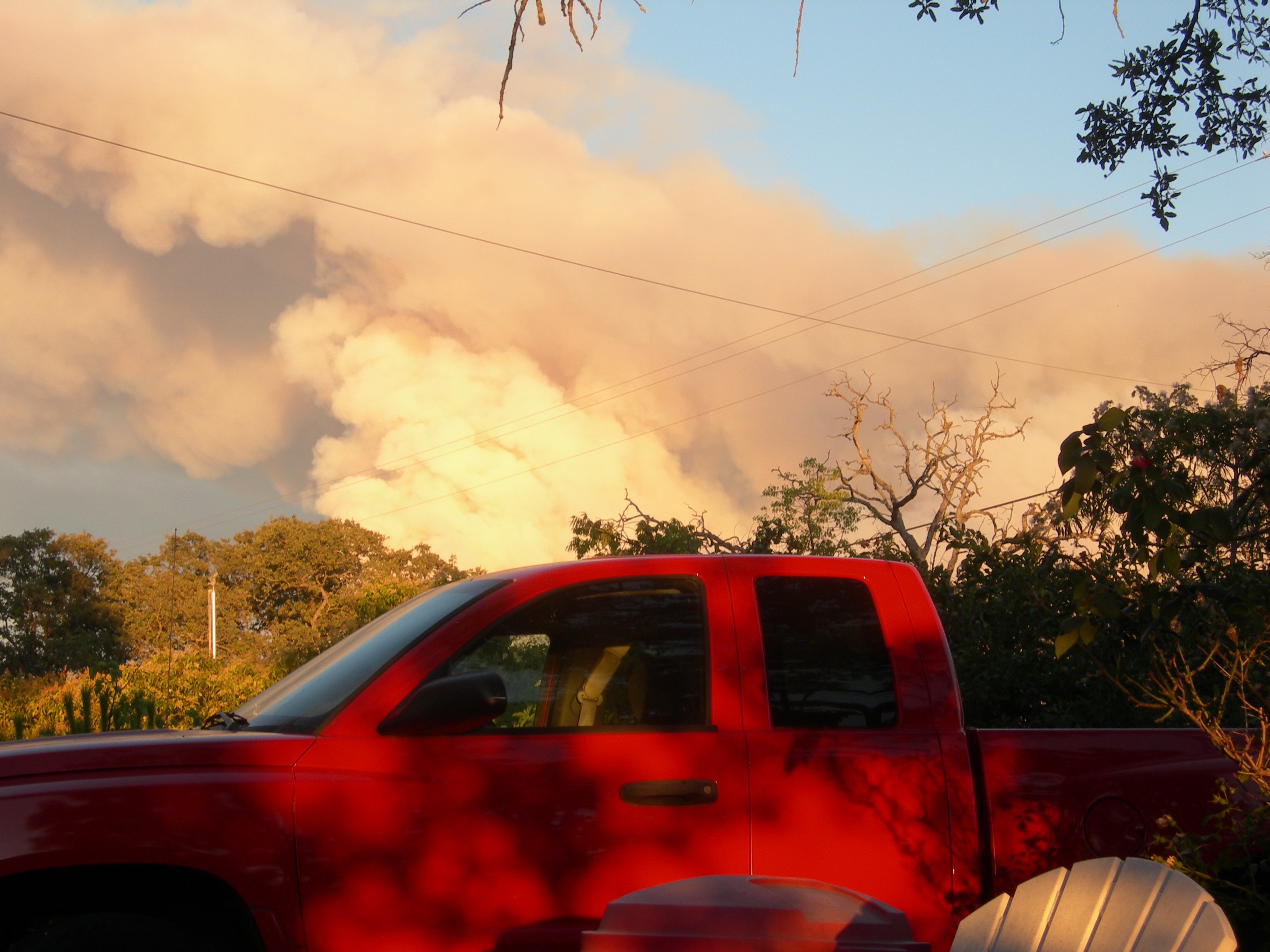
In the previous post, I opened with a picture taken from my front yard. I am opening this post with another, also from my front yard, taken a few weeks ago. In both cases, there is a lake between my house and the fire. The first fire burned 677 acres. This fire started in nearly the same place, but this time it burned 81,826 acres, so far, destroyed 63 homes, and threatened to destroy two nearby towns.

The day it started, my wife and I went down to watch the aerial ballet as DC 10s dropped fire retardant, spotter planes orbited high overhead, and Cal Fire helicopters carried tank after tank of water from the lake to douse the fire. This time they couldn’t stop it, and it eventually took thousands of firefighters to do the job. It still isn’t really over.

Then another fire broke out ten miles north of here and caused damage and confusion for two days. A day later, another fire broke out in the same area, and it is still burning.

Those helicopters I told you about? They weren’t part of any of those fires. They knocked down a fire less than a mile from my house. I heard them, closed my computer, and drove by back roads to a place I knew I could look without bothering the fire fighters. I needed to know if I should start loading the car to evacuate.

Nope. When I got to my overlook the helicopters had already knocked the fire down. To my eye, it looked like about twenty acres. When I turned around to come home, I saw a battalion of firetrucks arriving.

The helicopters got my attention at 4:55. I saw the knocked down fire at 5:05. It is now 5:45 and I am about ready to post this for tomorrow.

There aren’t enough words to thank firefighters, aerial and ground, but I do have two things to add:

I now keep my computer backup forty miles from here, and —

I’m thinking about moving to the rain forest.

392. Cold to the Bone

Poor Tim. I’ve been putting him through Hell since he wandered off and got himself lost in Post five. But you have to give me some credit. I gave him two breaks. If he hadn’t found that piece of pyrites, or something equivalent, he would have died by the second night. And if he hadn’t stumbled onto that piece of obsidian, he could not have made spearpoints and arrowheads.

The rule of fiction is: you can use all the coincidence you want in getting your hero into trouble, but be very careful in using coincidence to get him out of trouble. That is story logic, not real life logic. We dodge bullets every day by sheer happenstance, but we don’t expect our authors to cut our characters any such slack.

So I gave Tim a piece of pyrites and a piece of obsidian, then gave him rain, cold, clouds, a twisted ankle, and got him so thoroughly lost that he had no idea which way to walk out. That’s fair, in story land. Two ounces of luck and a thousand pounds of pain.

#                          #                          #

Write about what you know; the oldest cliche in the book. Well, I know cold.

Take a typical December day in Oklahoma. That means not much snow, some sleet occasionally, but typically bare, hoof churned dirt, frozen by thirty degrees of frost into a tangled mass of lumps and holes. It was deadly to walk on and the cow flop froze solid when it hit.

You will find me snug and warm in my bed until 4:30 A.M. when my dad would throw back the door and shout, “Get up!”, in his take-no-prisoners voice. He had no patience for coming back a second time and, with that voice, he never had to.

I hit the floor with a jolt of adrenaline and went in the living room to dress. The only stove we owned was there, gas burning and hot. The stove pipe in the back had been replaced with a “C” of pipe sections that redirected the fumes into the fan that sent glorious heat into the room. OSHA would not have approved, but OSHA hadn’t been invented yet.

First I held my long johns over the fan. They stood out like a wind sock briefly, then I put them on. The same with my jeans and shirt. The same with the overalls that went on next. Then two pairs of socks, boots, overshoes, then a blanket-lined jean jacket. I was warm as toast.

The comfort lasted about thirty seconds after the kitchen door closed behind me and there was no comfort for the next three hours while my dad and I milked cows.

There is nothing like three hours of arctic cold seeping into your feet from a concrete floor to make you appreciate that you would soon be in a heated classroom. I loved school. I loved learning. I also loved being where it was warm — while it lasted. After school, we did it all over again, then I got to sink into the comfort of a warm bed.

Until 4:30 the next morning.

After milking each morning we would load hay onto the truck and drive out to scatter it in the pasture. Then we would drive to the pond, and both hop out with our axes. We each cut — or recut — a series of eighteen inch square holes in the ice so the cows could drink.

There is a science to this. After you chop out the four lines which form the perimeter of the hole, you flip the loosened square out onto the ice, then splash water up and around the hole. This removes the floating ice chunks that would quickly refreeze, and also thickens the ice where the cattle will later stand.

It works well, usually. But one day there had been a rare snowfall. There were drifts, only inches deep, at the edge of the pond. Actually, over the pond, as I found out when I stepped out, thinking I was still on land, onto the ice itself.

No, I didn’t drown. I’m here to tell the story, aren’t I? But I can’t describe the shock when I went in to my knees.

Science tells us that water, under ice, is 0o Celsius or 32o Fahrenheit. Science lies! It is infinitely colder than that.

So yes, Tim, I know all about cold. I feel your pain, but you are the hero and I am the author. I am going to enjoy sitting here in front of the typewriter with my feet wrapped in a blanket while you sleep on the frozen ground. It’s nothing personal, but I’ve been there, and I ain’t goin’ back.

Welcome to Summer

Hi, just a personal note, here; not one of my usual mini-essays.

I went to Tempe, Arizona to Westercon over the Fourth of July weekend. It was from 109 to 111 or thereabouts, but I felt no pain because the Mission Palms was well air conditioned. I have a report on that scheduled for the 11th.

I came home to find things weren’t much cooler. Yesterday was 109 here in the foothills of the Sierras, so my wife and I cut out for the coast and spent a few hours walking along the beach at Carmel. Today I’m home, hiding under the air conditioner, working out the details of a new novel that was sparked at Westercon.

I am also watering our non-native trees. When I just went out to change the sprinkler, I saw two mother wild turkeys with twenty-one gawky, half-grown chicks in our yard. They were panting, and looking miserable.

They and I are both asking — is it fall yet?

354. Cattle Junkies

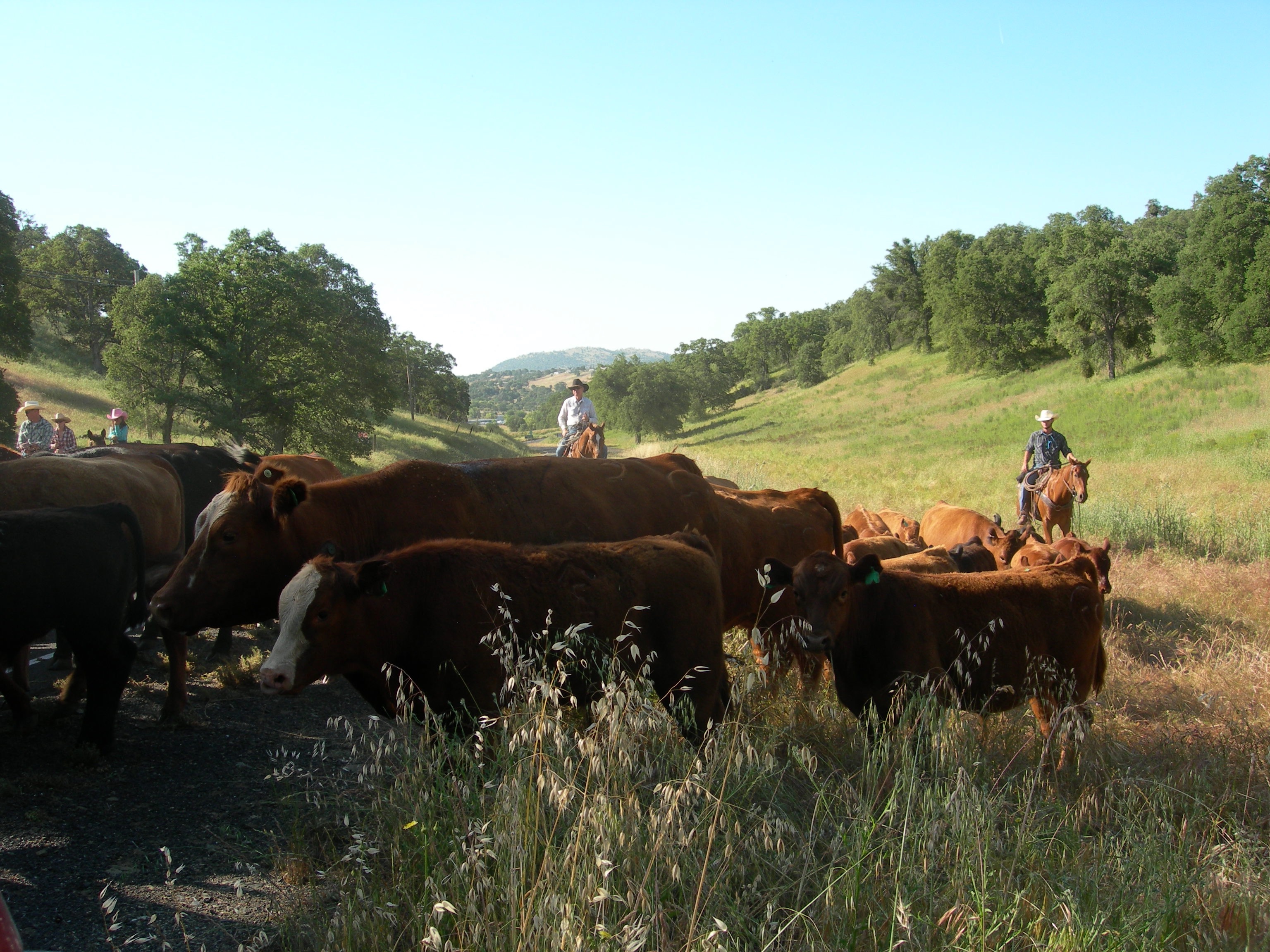
This morning (May 3rd) they moved the cattle toward their high pastures. Where I live, that movement normally happens twice a year.

Here in the foothills of the Sierras, we are coming to the end of the green season, in a year that was unseasonably wet. For five or six months every year the hills are covered with lush grass and cattle. The rest of the year is dry, burned brown, and mostly free of livestock. Most of the cattle that disappear in May migrate directly to your local grocery store meat counter. Some of the mothers and calves which will provide next spring’s herds move up the mountain to summer pasture.

Mostly, this is by trucks hauling specialized trailers. You see them everywhere on the roads and in the fields during this season. But one local rancher still holds a biannual cattle drive. I get the impression that some the herders are paid hands, but most are volunteers. After all, if you were a cowboy, or worked cattle from your pickup truck and wished you were a cowboy, wouldn’t you jump at a chance to join a cattle drive? Even if it only lasted three days?

They pass only a short distance from my house, and my wife and I never miss an opportunity to watch.

I grew up on a dairy farm in Oklahoma. Twice a day from age eleven until I left for college I was in the close company of cows, and I miss them. My wife just loves animals of any kind.

What does this have to do with A Writing Life? If you were Truman Capote, probably nothing. If you were Gore Vidal — well maybe. After all, Vidal worked for a time for his grandfather who was Senator from Oklahoma. But probably nothing; Vidal, like so many writers, was an urban type.

I’m quite the opposite, and the natural world permeates my writing. While I will never write an Andre Norton pastiche about herding frawns across Arzor (a statement Norton aficionados will instantly recognize), watching the cattle go by is likely to inspire me to rush to the keyboard. Like I just did.

I took these pictures, and picked those which would leave place and people unidentifiable. We all like some privacy.

=================

“Post”script, May 17: By coincidence, the second herd of the spring drive went by about six hours ago.

348. Spring

        Friday was Cinco de Mayo. Since I don’t post on Friday, I have placed this note here.
        Cinco de Mayo and St. Patrick’s Day are opposite sides of the same coin, as I explained in 115. St. Patrick’s Day with Juan O’Malley, last year. I also had something to say about racial identity in 144. Who Said You Were Mexican?, on Cinco de Mayo, a year ago today. I don’t want to repeat those posts, but you are welcome to click and visit.

Now, today’s post, beginning with a quote from Cyan:

For the colonists, the world that loomed beyond the perimeter fence was a fearsome enemy. Cyan’s climate aggravated the problem. The colony was situated in the region of spring — or autumn, depending on your psychological makeup. But it was neither spring nor autumn, and as the year wore on there grew up an unhealthy expectancy. Minds and bodies geared to seasonal change had a gene deep awareness that spring had been prolonged past its time — an awareness that slowly changed to a deep, unarticulated dread.

In Cyan, I made a great deal out of the lack of seasons, because seasons are so overwhelmingly important on Earth. Of course, people who were born and lived all their lives in Hawaii or Tahiti probably look at that claim and say, “What the heck is he talking about?” But most of us know.

Here in the foothills of the Sierras, half the year is harsh, brown and dry. The other half is green, and during that rainy seasons wild flowers not only come in profusion, but they also come in order.

First comes miner’s lettuce, with tiny flowers in the center of large, circular leaves. Not impressive as flowers, really, but a life saver for the the vitamin starved miners during the gold rush. Then comes Blue Dick. Now don’t blame me; I didn’t name it, and it is lovely despite its name.

The lupine come early middle and late, in a variety of colors. When my wife and I first came to the foothills, we learned most of the names, but now we mostly just look and enjoy.

What has this to do with writing? It’s the way I choose to live, and the places my characters go are mostly places I wouldn’t mind accompanying them.

Today (April 24) my wife and I drove to one of our many favorite spots. It’s late in the sequence of things, but the white lupine haven’t quite reached their peak.

In New York City today, there are writers inhabiting dim, smoky bars, gathering material for their next novel. More power to them. I couldn’t take it.

For me, I spend my green winter going out twice a week to see how the wildflowers are coming along, and gathering material for my next novel. That’s my story, and I’m sticking to it.