
Tag Archives: spaceflight

299. I Survived Skylab

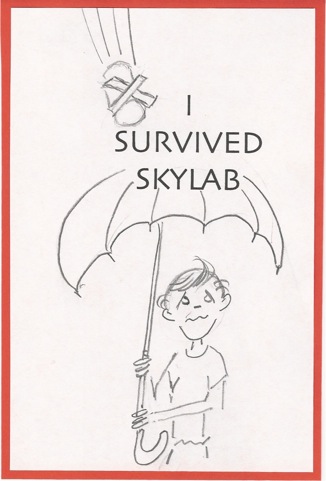
skylabAt the top of this post is a drawing, done with deliberate crudeness. I wish I could have used the original, but it existed before digital cameras and Pinterest. I have searched the internet without success for the image I remember. There are dozens of modern Skylab T-shirts. but none like what you see here.

In 1979, Skylab came crashing back to Earth. NASA knew it was going to happen, but could not prevent the event; it even predicted the date, July 11. The world partied in the face of danger – especially since the chances of being at ground zero were billions to one – and I Survived Skylab T-shirts were worn everywhere. The one I remember had a silly looking cartoon schmuck holding an umbrella over his head while Skylab was flashing down behind him.

If anyone still has a picture of one of those original T-shirts, post it on Pinterest and I’ll provide a link.

No one had intended Skylab to come to such an end. It was in reasonably high orbit, about 275 miles when he last crew came back to Earth. It still contained plenty of air and water, although the gyros were failing. It could have been remanned, and there were tentative plans to shift it to to a still higher orbit. No one took it too seriously, though; the vessel was old and battered, and NASA had turned its attention to the Space Shuttle.

In fact, most people at NASA thought the next Skylab crew would be ferried up by the Space Shuttle.

Nature had other plans.

By 1973, it was predicted that Skylab would deorbit years earlier than NASA was predicting, but NASA failed to listen. Increased solar activity had heated the atmosphere, causing it to expand. Low Earth orbits are still within the tenuous ranges of the outer atmosphere. Although the life of such orbits is measured in years, all things within a few hundred kilometers of Earth eventually come down. Now NASA was facing the fact that the Space Shuttle would not fly before Skylab’s orbit became critical. Not only could Skylab not be saved, it could no longer be equipped for a controlled deorbit.

A Russian Cosmos had crashed into northern Canada only a year before. The second stage of the Saturn which had launched Skylab had remained in orbit two years, then crashed into the North Atlantic in 1975. NASA was aware that the potential for disaster was great. It was predicted that up to 25 tons of debris might survive reentry, and there was no way to determine where it might land.

If Skylab had landed on Omaha – or Paris – we would be living in a very different world, with a very different attitude toward space exploration. In point of fact, Skylab struck the Earth in the desert of western Australia. No one was injured. Property damage was minimal.

The Shire of Esperance sent NASA a fine for littering.

*  *  *  *  *  *  *

Everybody has to carve out his own niche. In my science fiction, I concentrate on the next couple of centuries. In these posts I concentrate on the early space program. I have not yet written about the space shuttle, which always seemed to be like Grandpa’s pickup truck that he bought after he was no longer young and had sold his hot rod. Sorry, my prejudice, which I am sure I will someday reverse without apology.

I am even less interested in the ISS. I remember too well that, during its planning – before the feds told them to shut-their-mouths and not bite the hand that was feeding them – the scientific community complained loudly about all the research that would go unfunded to feed the ISS.

The ISS, symbol of American-Russian friendship, boldly going where everyone has already gone before. Sorry, my prejudice again.

If you are interested in the ISS, there is a plethora of available writing. If you want to know more about early space stations, try to find Living in Space by Giovanni Capara in your local library. Published in 1998, it is a detailed study of all the space stations before ISS.
298. Skylab (2)

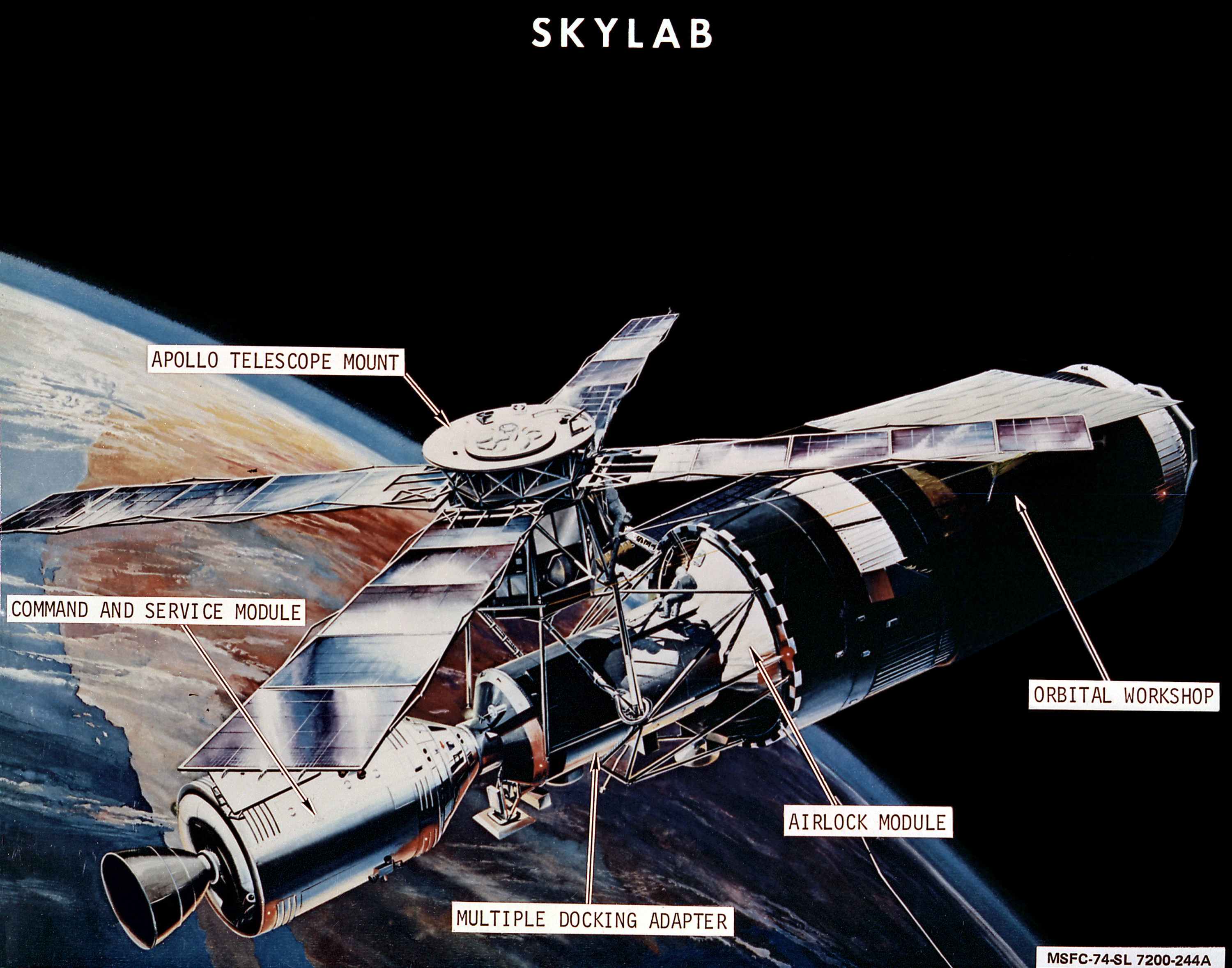
skylab_labeledTwo days after Armstrong and Aldrin stepped onto the moon, NASA announced that it would launch an orbital laboratory with space telescope, using a Saturn V rocket. Because of its great power, the Saturn V could place a large payload in low earth orbit, using only its first and second stages. The entire third stage was converted into the orbiting laboratory, and launched intact and ready for occupation. This was Skylab.

The astronauts who would man Skylab would arrive later in CSMs – NASA speak for Command Module and Service Module, considered as a package deal – launched on smaller Saturn I-B rockets.

This cylindrical third stage was divided by a floor grating into an upper work area and lower living quarters,with eating, sleeping, and bathroom areas. It was, of course, a weightless environment. At the end of the vehicle, an airlock and docking adapter allowed egress for extravehicular activities and connected Skylab to the CSM which brought the astronauts up, and remained docked to return them to Earth. A solar panel array provided power. In pictures of Skylab, this array is what looks like helicopter blades above the vehicle. The telescope mount is in the center of the solar power array.

Skylab was launched on May 14, 1973, with disastrous results. The meteorite shield, which was supposed to stay snugly against the outside of Skylab during the flight up, and deploy once in space, deployed prematurely. Once in orbit, only part of the solar panel array deployed. The rest had been trapped by the damaged meteorite shield. The result was too much heat and not enough power. Skylab was uninhabitable.

The astronaut launch was temporarily cancelled and NASA went into salvage mode. Within eleven days they had proposed, built, and tested a set of repairs, and the crew of Conrad, Kerwin, and Weitz launched on May 25th. It proved to be no easy task.

The first day, working from the hatch of the CSM, Weitz tried using a forked stick to remove some of the debris remaining from the meteorite shield in order to deploy the solar array. No luck. Then the astronauts tried to dock, only to find that part of their capsule was non-functional. They had to externally repair their docking probe before connecting with Skylab and finally getting to sleep, no closer to repair. The next day, they attacked repairs from inside Skylab. Weitz wore a gas mask as he tested the air inside the structure. Scientists had feared that the high temperature environment would release poisonous gasses from the insulation. It had not, but the temperature inside was 130 degrees. The astronauts then set up a parasol they had brought, inside the second airlock near the telescope, and slowly extended it outside Skylab. It opened successfully, providing relief from the sun. The temperature dropped, although only to 95 degrees. The second night, the astronauts slept in the docking adapter area where the temperature was reasonable.

Several days later, Conrad and Kerwin performed another EVA, used large scissors to cut away part of the meteorites shield, and finally freed the remaining solar array.

The work of the first Skylab crew not only saved the station for the work it was designed to do, but also proved the necessity of manned missions to rescue projects in danger. Twenty years later, when the Hubble needed repair to perform its functions, the precedent had long since been established.

The first Skylab crew stayed aboard a month, conducting astronomy and medical research. The second crew, Bean, Lousma, and Garriott, remained aboard for two months, continuing repairs and research.. The third crew, Carr, Pogue, and Gibson, remained in space 84 days, observed and photographed comet Kohoutek and continued other experiments.

By the time the third crew returned to Earth, Skylab was nearing the end of its service life. Beyond the damage done on launch day, many other systems were failing. There were plans to use it further, but nature had plans of her own. conclusion tomorrow

297. Skylab (1)

240px-skylab_sl-4

SKYLAB

The International Space Station has been continuously inhabited since November of 2000. if you are under twenty-five, you probably don’t remember a time when it didn’t exist. You also probably don’t know that scientists widely resisted it’s construction, feeling that far more could be learned by spending the equivalent amount in other ways. Whether or not they were right will probably never be known.

The space race that culminated in landing on the moon was fueled by the cold war. The construction of the International Space Station was fueled by the need to demonstrate that the cold war was over, and that Russia and America were now friends. How well that has turned out is also still in doubt.

There were space stations before the ISS, mostly Russian. Wikipedia has a nice list available. The US had an aborted space station project in the late sixties, the MOL (see 256. The Space Station That Never Was) and an actual one in the mid to late seventies. It came on the heels of the Apollo program and it was called Skylab.

Most Americans have forgotten it ever existed but for a few brief weeks in 1979, everyone in the world was looking at the sky and thinking about Skylab.

Gene Cernan and Harrison Schmitt were the last men on the moon in 1972 (see 293. Last Man on the Moon) because of funding cuts. Twenty Apollo missions had originally been envisioned. Apollo 20 was the first to be cancelled in January of 1970 to allow its booster to be used for Skylab. Later that year, Apollo 18 and 19 were cancelled.

If you think back only a few years, the last Space Shuttle flight brought rounds of congratulations for years of success, but at the same time the Cape, northeastern Florida, and NASA in general saw economic turmoil as thousands lost their jobs.

A similar thing happened at the height of the Apollo program. All the Saturn V boosters that were going to be built were in the pipeline, and the organization that produced them was in danger of disappearing. One of the schemes to keep the resource from disappearing was Skylab.

Space stations had always been envisioned. Early plans for reaching the moon called for building space station, then assembling the moon rockets there. It made good sense. Spacecraft have different design requirements from vehicles designed to cope with traveling through the atmosphere. Just look at the difference between the Lunar Lander and the Apollo Command Module. Now visualize a craft built in space for lunar or interplanetary travel; your vision will probably look a lot like the ISS looks today.

That plan to build a space station, then a moon rocket, made perfect sense, but it wasn’t going to happen fast enough to win a space race with the Russians. Hence the Apollo style moon missions, leading to victory in the space race, leading to an America that felt like a winner, but had no place to go next.

Enter, Skylab. more tomorrow

296. Space Walks (2)

gemini_spacecraftWe left Gene Cernan hanging onto to the side of Gemini 9, part way thorough a disastrous space walk. I’ve provided a drawing of the Gemini to orient you to what comes next.

Cernan left the hatch and began to move back to the base of the Gemini, utilizing undersized hand holds. He was weightless, which makes this sound easy, but remember that bending your arm is like “bending and inflated life raft”. As he worked his way back, he had to thread his umbilical through undersized stand-offs to keep it from tangling. When he reached the base of the Gemini, he found it surrounded by a ring of torn metal, like razor wire, that was the result of separation from the Titan rocket that had put him into orbit. Just the thing a space suit does not need to make contact with.

Once Cernan made it past the turn to the very base of the Gemini, he faced new problems. He was exhausted and overheated; the inside of his visor was so fogged that he was nearly blind. Making visibility even worse, the light NASA had provided over the MMU was a dim bulb, completely inadequate to his needs. He began to attempt to fire up the MMU, a procedure that required about thirty switches to be thrown in sequence, but he could hardly see the switches, and every time he tried to turn a dial, his untethered body spun the opposite way.

Once the MMU powered up, he had to release and position the arms and get it strapped on. By now he was far overbudget for time, and out of contact with Stafford in the Gemini. His heart was beating at three times its normal speed, he couldn’t see for sweat and fog, and the Gemini was twenty minutes away from orbital night when the impossible becomes the unthinkable. Stafford terminated the mission. The MMU was abandoned, untested. Cernan made his painful way forward and returned, not without a final struggle, to the safety of the Gemini.

Let’s let Cernan speak for himself.

Why is floating in space and turning a few dials so difficult? Let me give you a couple of tests. Connect two garden hoses and turn on the water. Now, using only one hand, try to unscrew them. Or, hold a bottle of soda or beer at arm’s length, and using a single hand, remove the twist off top. For extra reality, run a mile before you start so you’re nice and tired, do it while wearing two pairs of extra-thick gloves and close your eyes to simulate being unable to see. Stand on your head while doing some of these things to resemble tumbling in space. You get the idea. 

* * * * * *

There is one kind of space walk that always works, called a stand-up EVA. If an astronaut simply stands up on his seat, with the hatch open, he has none of the problems Cernan had.

Gemini 10 began with a stand-up EVA. Later Michael Collins performed an umbilical EVA, successfully although not easily, using a hand held maneuvering unit similar to the one used by Ed White.

In Gemini 11, Richard Gordon performed an umbilical EVA to attach a tether to an Agena target vehicle. Like Cernan, he overheated, lost vision to a fogged visor, and had his EVA cut short.

In Gemini 12, Buzz Aldrin performed two stand-up EVAs, sandwiched around an umbilical EVA. For the first time, everything went right. Aldrin had use of larger hand and foot holds, a reduced workload, and tools designed to overcome the problems of weightlessness. The lesson learned by White, Cernan, Collins, and Gordon had finally made spacewalks practical.

295. Space Walks (1)

260px-ed_white_first_american_spacewalker_-_gpn-2000-001180EVAs (extravehicular activities) or space walks are commonplace today. It wasn’t always that way. In the early days of space exploration, every space walk was a brush with death. The Russians denied that reality and the American’s downplayed it. But the fact was, in the words of Gene Cernan (see also 293. the Last Man on the Moon), “. . . we didn’t know diddly-squat about walking in space when I popped my hatch open on Gemini 9. . . It’s a sobering reflection when I think about it now, and I thank God that I lived through the experience.”

It was life threatening from the beginning. Alexey Leonov nearly died on man’s first spacewalk (see 116. Spacecraft Threatened by Bears). Three months later, Ed White’s space walk was exhilarating until it came time to reenter his Gemini craft. Then he found getting back in to be nearly impossible. Nothing is as easy as it looks in space.

There are basically three problems with spacewalks – vacuum, vacuum, and weightlessness. Vacuum outside and pressure inside makes space suits incredibly difficult to bend. Reaching over to flip a switch, which a bedfast child could do on Earth, takes great strength when suited up and in vacuum. Vacuum also provides insulation. When a spacewalking astronaut is working hard to bend in his pressure suit, the vacuum of space is keeping his body heat from dissipating. Finally, weightlessness makes it impossible to get purchase to exert one’s strength.

Both Leonov and White floated happily, but when it came time to reenter their vehicles, they found it hard to maneuver, hard to bend, and they both overheated.

Cernan’s spacewalk, the third ever attempted, was worse. He was given an impossible series of tasks to perform. Nevertheless, he was determined to perform them. People who fail, don’t remain in the astronaut corps, and trying to do the impossible nearly killed him.

First, the two astronauts fully suited up and opened the hatch. This meant that not only Cernan was suddenly encased in a “garment made of hardened plaster of paris”, but so was Stafford, reducing his ability to help. They released the “snake”, their term for the umbilical cord that carried electricity, oxygen, and communications. Ed White had also been on the end of an umbilical, but he had had a hand powered jet that he used for mobility. Cernan’s first experiment was to see if he could move around space, simply tugging on the umbilical.

He couldn’t.

The snake uncoiled and recoiled, subject to internal stresses. Any time Cernan tried to move by tugging on it, he ended up being spun out of control. This went on for half an hour until it was clear that no astronaut would ever be able to use his umbilical to maneuver.

Cernan clung to the hatch to catch his breath, then began the second experiment. The MMU was a backpack style manned maneuvering unit designed for an astronaut to fly freely at the end of  a safety line. It was a great idea, but there was no place in the Gemini to store it, so it had been fastened into a recess in the very base of the vehicle.

Now he just had to get there. concluded tomorrow

293. The Last Man on the Moon

600px-nasa_apollo_17_lunar_roving_vehicleOn one side is cynicism.

On the other, political correctness, a stiff upper lip, wearing your game face, or whatever is the most current version of refusing to acknowledge defeat or failure even while it is kicking your ass.

Somewhere in between is the truth.

I’ve been reading astronaut biographies for the last decade. You don’t really understand the American space program that made my youth so exciting until you have seen the same events through many different – sometimes sharply disagreeing – viewpoints. All of the biographies have been in that truthful middle ground, but some suffered from too much emotional distance and some from too much optimism. They all share bitterness at some contractors whose spacecraft were substandard, and ultimately deadly.

Of all these biographies, two stand out, Grissom’s Gemini (see 87. Gemini) and Cernan’s The Last Man on the Moon. I have long planned a post on Cernan’s book, but the timing of his death caught me tangled up in other matters and delayed it these last two weeks.

Cernan flew on Gemini 9, Apollo 10, and Apollo 17. He flew within 10 miles of the lunar surface, without landing on May 22, 1969. He landed the Apollo 17 craft three and a half years later, on December 11, 1972. When he stepped back aboard for the final time, he became the last man to walk on the moon, making the title of his memoir inevitable.

Unlike Glenn, Shepard, and Armstrong, Cernan didn’t become a household name, but he should have.

Cernan’s first flight was Gemini 9. Their first task was rendezvous and docking, which had been a pain in NASA’s side. Gemini 6 had been scrubbed when it docking target failed, and had flown later, using Gemini 7 as a rendezvous target, but without docking. Then Gemini 8 achieved rendezvous and docking with a subsequent Agena, only to be nearly torn apart by a thruster failure in the Gemini. Only Neil Armstrong’s skill saved the day.

When Cernan and Stafford on Gemini 9 rendezvoused with their Agena target vehicle they found that the shroud covering the docking target had only partially retracted. Docking was once again impossible. They succeeded in making three separate rendezvouses then set out to perform an ambitious EVA, or, as Cernan titled chapter 13 of his book, “The Spacewalk From Hell”.

I’ll save that story for later, when I give a full post of the trials of early spacewalks.

Three years later Stafford and Cernan were together again, along with John Young, on Apollo 10. When I taught the space program to eighth graders, I called this the most frustrating mission in the history of exploration. Leaving Young in the Command Module, Stafford and Cernan took their Lunar Lander down to about ten miles above the moon’s surface, did not land, and returned to lunar orbit to rendezvous with Young and return to Earth. Aside from de Sade level cruelty, it all seems so pointless from our perspective.

Of course, it was neither cruel nor pointless. It was necessary to calibrate the instruments which would calculate the vectors necessary to land accurately. It would be impossible to overemphasize how crude instruments were in 1969. Even with the help of Apollo 10, Apollo 11 did not land exactly where it was supposed to and nearly crashed in a rubble field.

By one number Stafford and Cernan missed being first on the moon. Stafford did not fly another mission until the Apollo-Soyusz mission of 1975. Cernan became commander of Apollo 17 which, because of funding cuts, became the last Apollo flight to land on the moon.

Back in Indiana, Purdue University holds bragging rights to having produced the first (Armstrong) and last (Cernan) astronauts to land on the moon.

256. The Space Station That Never Was

 275px-mol_usafI love conspiracy theories. I don’t believe them, but they’re fun.

We do know that much is hidden from us. The SR-71 Blackbird was a myth, sworn not to exist, for most of it’s operational life, so why not believe in the Aurora, or at least wish it were real and dream up stories that use it.

The problem with actually believing in conspiracies is that most conspirators are too dumb to pull them off. Still, occasionally . . .

In 2005 two spacesuits of unknown origin were found in a locked room in a NASA museum. They were not connected with any known program, and presented a mystery to be solved. The story of chasing that mystery was well told by NOVA in its 2008 episode Astrospies. A decade after the discovery, and seven years after the NOVA program, files and photos were declassified and the secrets of the Manned Orbiting Laboratory were fully revealed.

The Air Force has long had a hand in spaceflight. As early as 1957, it funded development of a spaceplane, the X-20 Dyna-Soar. Ultimately that project was scrapped because of the success of the Mercury and Gemini programs, but USAF shifted goals to the Manned Orbiting Laboratory and continued.

The existence Manned Orbiting Laboratory project was not secret. It was announced in 1963 but most of what went on was not revealed to the public. Essentially, it was an orbiting spy station designed to take pictures of military interest. MOL was a single use vehicle. It was designed to be launched, used for a forty day mission, then abandoned. At that time the crew would return via a Gemini B capsule which was launched with the MOL.

MOL was designed for a stacked launch. The launch vehicle was to carry the MOL with the manned Gemini B in place at the top. Once in polar orbit, the Gemini B would be powered down and the two astronauts would move into the MOL where they would spend their mission taking pictures of the Earth through advanced camera system called KH-10. At the end of the mission, the astronauts would reactivate the Gemini B and return to Earth in it, abandoning the MOL.220px-titan-3c_mol-gemini-b-test_3

The Gemini B was virtually identical to the Gemini used by NASA, except for a hatch through the heat shield that allowed astronauts to move between it and the MOL.

The initial launch took place on Nov. 3, 1966 from Cape Canaveral. The MOL launched was a boilerplate mockup made from a Titan propellant tank, and the Gemini B was the prototype, and unmanned. The capsule returned to Earth safely, proving the modified heat shield, and is on display today at the Air Force Space and Missile Museum.

In June 1969, the project was cancelled. No manned and functioning flight was made. By the time of its cancellation, progress had outrun the program, and unmanned reconnaissance satellites had proved that they could do the job more cheaply than the MOL.

In all seventeen astronauts trained to fly MOL missions. One was Robert Lawrence, the first black astronaut, who died in training in 1967. (see 167. On the Brink of Glory) When the program was cancelled, all the astronauts who were under 35 years old were offered jobs at NASA. The seven who were eligible all accepted and became NASA Astronaut Group 7. All flew on the space shuttle.

187. The Rest of the Landings

Everybody remembers Apollo 11 because it was the first, and Apollo 13 because it failed. And because they made a movie about it. There were five other moon landings.

Apollo 12 — This flight made a precision landing in the Sea of Storms, near the landing place of the Surveyor 3 unmanned probe. Pete Conrad and Alan Bean walked on the moon while Richard Gordon remained in the command module.

Apollo 13 — Once we had reached the moon with Apollo 11 and repeated with Apollo 12, public interest dropped off dramatically. The Apollo 13 flight saw reduced coverage until the explosion. In the movie, Marilyn Lovell says about the newsmen laying siege to her house, “Landing on the moon wasn’t dramatic enough for them – why should not landing on it be?” It is a fitting statement about the last half of the Apollo program.

Apollo 13 suffered a catastrophic explosion and barely got its crew back alive, without landing on the moon. Jim Lovell, Fred Haise and Jack Swigert became part of American myth, especially after the movie Apollo 13.

Apollo 14 — Alan Shepard and Edgar Mitchel piloted their lander to Fra Mauro, the planned destination of Apollo 13. Stuart Roosa was command module pilot.

Apollo 15 — Al Wordon was the command module pilot. David Scott and James Irwin landed on the moon near Hadley rille. This was the first mission to carry a lunar rover, a powered wheeled vehicle that allowed the astronauts to range further from their landing site.

Apollo 16 — Ken Mattingly – who had missed the Apollo 13 mission due to a measles scare – was command module pilot. John Young and Charles Duke landed in the lunar highlands where they collected samples that were geologically older than those brought back by previous missions. Second use of a lunar rover.

Apollo 17 — Ronald Evans was the command module pilot of the last moon mission. Gene Cernan and Harrison Schmitt became the last two men on the moon (so far). They carried the third lunar rover. Schmitt, a geologist, was the only scientist-astronaut to reach the moon.

Apollo 20 was cancelled so its Saturn five booster could be used to launch Skylab. Apollo 18 and 19 were cancelled by budget cuts. All this was done before the launch of Apollo 16, so Cernan, Schmitt, and Evans knew that they would be the last.

For now.

*          *           *

There is one good video of a lunar lander launching from the moon, taken during the last mission. You see a few seconds of it occasionally on PBS space specials. I also found it a this URL: https://www.youtube.com/watch?v=XlGis35Epvs

This appears to be legit, although the things you can find on You-Tube are sometimes outrageously fake. The pictures were taken from a video-camera mounted on the lunar rover, remote controlled from Earth. Similar filming had been attempted on Apollo 15 and 16, without much success.

186. Apollo 11

Apollo 11 was the first moon landing, but Apollo 13 got the movie because of the extra drama. Except for the absent landing, you probably won’t find a better picture of an Apollo mission than that film. This visuals are stunning and the portrayal of events is quite accurate.

Apollo 11, 47 years ago today, was a complete success, but it flirted with disaster twice, in two separate events, minutes apart during the landing. It was broadcast live, so everyone in America and half the rest of the world heard the crises in real time, but you would have needed to be an insider to understand them at the time. I was listening, glued to the TV screen, and I only later realized what was happening right in front of me.

The lunar lander separated from the command module as scheduled. Armstrong and Aldrin fired its rockets to slow its orbit. As it fell toward the moon, there was an alarm – a code 1202 – on the lander’s main computer. Only two men at mission control knew immediately what it meant. The mission was so complex that there were probably thousands of things only a few of those present fully understood.

The computer was overloading. Too many things were happening at once for it to handle. You need to remember the incredibly tiny capacity of 1969 computers. It could not keep up with events, the queue was getting long, so the alarm sounded. Steve Bales recognized that the computer was still doing everything it needed to do, that it would clear the queue in a few seconds, and said GO when most of those present were thinking ABORT. The mission continued, the computer worked through the queue, and then the alarm went off again. Bales said GO. A third time the computer overloaded and Bales shouted GO for the third time just as the lander was approaching touchdown.

The problems weren’t over. The lander had overshot its target and Armstrong found himself over a massive boulder field. There was nowhere to land.

An abort would have meant firing off the upper stage rocket and returning to the command module, allowing the now nearly empty lower section to crash to the moon, and missing the landing. Instead, Armstrong chose to adjust his rate of fall to a near hoover, tilt the entire lander – now top heavy and prone to flipping – to slide sideways and, just as the last of the fuel was nearly gone, reach a clear area where he set the lander down on the lunar surface.

On Earth, we had all been holding our breaths. We just didn’t realize how much reason we had had to worry.

185. The Flying Bedstead

300px-LLRV_2Tomorrow is the anniversary of the Apollo 11 moon landing. For most of the followers of this blog, it is part of history. I saw it happen, on a grainy black and white TV in the lounge of a college dorm. (see 27. That Was My Childhood)

You can’t land on the moon by parachute, nor by wings. No air. The only choice the Apollo program had was to land tail first, by rockets, something that had been a science fiction staple for decades, but was nothing like easy to manage. (see yesterday’s post)

Designing a craft to do the work was within the limits of the technology of the day. Vertical landings on Earth had been successfully accomplished. Pilot control on Apollo was expedited by having the astronauts stand to fly the Lunar Lander; the problem with VTOL planes had been that the pilots were strapped into a seat that kept them facing the wrong way when they landed.

The craft could be built, the astronauts were the best test pilots America had to offer. But how do you train?

Simulators? Maybe. Resurrect Pogo or Vertijet? Perhaps. Build a new craft just to use as a trainer? Better. But how do you build a trainer to react as if it were in a 1/6 gee field while landing in on Earth? You can’t just make gravity go away – or can you.

The answer is almost, more-or-less, and good enough to do the job. The first iteration of the trainer was the Lunar Landing Research Vehicle, nicknamed the flying bedstead. You may have seen it. Neil Armstrong ejected from one of them after the controls failed; the footage of the crash is both exciting and brief, which gets it a lot of air play in retrospective specials, especially on anniversaries like tomorrow.

If you see footage of the LLRV not crashing, or of the advanced version LLTV (Lunar Landing Training Vehicle), you can easily see what it is all about. The vehicle consists of an open framework of tubing with the pilot sitting upright in the front (in an ejection seat, thank goodness) with a batch of somewhat shrouded equipment balancing the rear. In the middle, attached vertically, pointing downward and clearly throwing flames, is a jet engine. The craft is uneasily hovering.

Note, I didn’t say hovering on its jet. That is what it looks like, but that is not what is happening. Not quite. When the jet is fired up at takeoff, the LLRV or LLTV simply sits there. The jet has 5/6 of the thrust needed to lift the craft. While hovering, the rest of the thrust is provided by a separate set of hydrogen peroxide thrusters which are controlled by the pilot. If the pilot were to simply turn off his thrusters, the LLTV would crash to the ground at the same speed it would crash to the moon.

The jet subtracts enough of the LLTV’s mass to make it react as if it were in a 1/6 gee gravity field, allowing the pilot to maneuver his craft as if he were coming in for a lunar landing. Armstrong made over fifty LLTV landings before he landed on the moon.

If you want to know more about this craft, there is a half hour special full of information, old footage, and interviews with retired LLRV pilot and an engineer from the project. Huell Howser is the host. If you live in California, and you watch PBS, you know Huell. He is an acquired taste that I have never quite been able to acquire, but sometimes what he covers makes up for his idiosyncrasies. This is one of those cases. The program is California’s Gold #13003 – LUNAR LANDING. Try your local PBS station or check with the Huell Howser Archives at Chapman University.