Tag Archives: teaching

314. Fleming Fellows

300px-oklahoma_medical_research_foundation_nimaphoto by Nima Kasraie

The Oklahoma Medical Research Foundation is a major research institution, but not a household word. Let me explain its importance in my life.

Everything that happens to a writer passes into his memory, sinks to the bottom, and grinds around there, knocking sparks off every other experience. Years later, it emerges, transmogrified, as stories or parts of stories.

My soul as a writer and as a human being was forged on a small farm, working essentially full time in addition to going to school. I was an only child. School and home were kept strictly separated. Except for one treasured cousin, none of my school friends ever entered my house.

I was a very smart child in a very small place. I worked hard, got strong, and loved the outdoor life, but my mind lived in other worlds, brought to me by books of science fiction. I decided to become a scientist. In that pursuit, I was torn between space science and ecology. When I was a high school junior, I put those two together (yesterday’s post).

That same year, among the many standardized tests we took, was the test to become a Fleming Fellow. There was also an application to be filled out in which I was to explain my aspirations and offer any personal projects to prove my capacity. I wrote up my ecosystem in space project.

I was notified that I was a finalist, and scheduled for an interview in Oklahoma City. At that time, I knew almost nothing about the fellowship or the OMRF.

Incorporated in 1946, the Oklahoma Medical Research Foundation was dedicated in 1949 by Nobel Laureate Sir Alexander Fleming. In 1957, OMRF started a summer program for students, which was quickly named the Fleming Scholar Program. It has evolved over the years, but in that era, from four to seven Oklahoma High School juniors were recruited, and spent eight weeks at the OMRF the following summer.

In the spring of 1965, I sat before a panel of scientists for my interview. I had expected questions on science. Instead, they asked questions on meaning and morality. What did I think of the bombing of Hiroshima? What did I think of capital punishment? Behind the questioning, they were clearly trying to find out my level of self-confidence, as the interview became quite adversarial at times. After I said that I was still uncertain about my stance on executions, one of the scientists asked, rather sharply, “Don’t you think it is our duty to think about such things?” I remember being irritated at his high-handedness. I snapped back, “I didn’t say I hadn’t thought about it. I said I hadn’t decided yet.”

I said to the panel that I intended to pursue a Ph.D. The whole panel tried to convince me that I should be getting an M.D. instead. I held my ground, and when the interview was over, one of the panelists admitted that most of them had Ph.D.s, not M.D.s.

Fortunately, self-confidence – or arrogance, if you prefer – is something I have never lacked. I received a Fellowship. I’ll tell you about it tomorrow.

313. Weightless Ecology

ecoopwegt-lessI’ve been putting off this post since I started the blog. It’s embarrassing. I’m proud of what I did, but telling it makes me feel a little like one of those old guys who never stops talking about the night his forward pass won the big game.

Still, if I hadn’t done what I’m going to tell you about today, I would never have done what I did the summer after (tomorrow’s post), and if not for that, I would still be driving a tractor in Oklahoma. So here goes.

1964-5 was my junior year in high school. That was the year I took both junior and senior English because I was running out of classes to take, and that was the year I discovered science fairs. We didn’t have one in our tiny school, but their was a regional competition one county over. I had recently discovered Shirley Moore’s Science Projects Handbook, which was the bible for the science nuts (nerd wasn’t a word yet) of my generation.

America was in space; the Mercury project was completed and Gemini was waiting in the wings. I was enthralled with space, but also with ecology. Rachel Carson’s Silent Spring was about to make ecology a household word, but no one in my world had heard of it yet. I decided to put the two together and build an “Ecosystem Operable in Weightlessness”.

Lets get real. Boy scientist builds spaceship and flies to Arcturus only happens in the very old pulp stories. I wasn’t going to build something that would actually fly in space. It was an exercise in design, with as much building as I could pull off with limited resources.

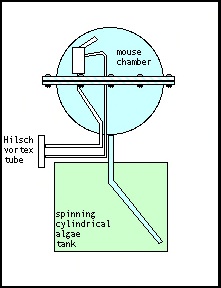
The idea was that at that time NASA needed to keep to keep some creature in weightlessness long enough to see what it would do to its body. Laika the Russian space dog hadn’t lasted long, and the longest Mercury flight had been 34 hours. I proposed a design that would put two mice in a closed ecosystem with algae. It was set up so that the algae tank would spin to provide just enough gravity to keep the water separate from the air, but the mice would be weightless in a separate chamber.

The fun was in the details. The mice would be housed in a two part plexiglas bubble, with a wire mesh floor at its equator. Waste would pass through he mesh, carried by the airstream and drop down into the algae tank.

That part actually got built. I made the algae tank of plexiglas, heated and formed around two round pieces of wood. I blew two half domes with a plywood form, an air compressor dragged up from shop class, and an oven borrowed from the home-ec teacher.

As I’ve said before, most of my education came outside of the classroom, thanks to indulgent teachers. They did the right thing, but it would get them fired if they did it today.

I bolted the half domes together through flanges formed during the blowing process. With two mice, Hing and Ho (named after the meerkats in Andre Norton’s Beast Master) in the upper chamber of the dome and a mass of Ankistrodesmus from a local stream in the algae chamber, connected by an aquarium pump, the ecosystem was as far finished as I could manage by the time of the science fair.

The physical result was limited by my resources, but the design went much further. To transfer the food to the mice, I had designed a pump, patterned after a Wankel engine (all the rage in Popular Mechanics that year). It was to send algae laden water up through a tube where it would be flushed over a fine mesh screen. The water would return to the tank on the airstream, leaving the algae for the mice to eat.

I did actually experiment with feeding them Ankistrodesmus. I strained it out of the water, dried it over a light bulb and passed the algae wafer into the mice’s cage. They went wild. You would have thought it was ice cream.

The design called for a small tube to carry a continuous airstream from above the algae water to strike the inside center of the upper dome, bringing the mice fresh air and carrying away waste as it returned. There a larger tube would carry the waste to the bottom of the algae tank.

To get water to the mice under weightlessness, the design called for the airstream from the algae tank to first pass through a Hilsch vortex tube, which split the airstream into hot and cold halves. The cold half was to pass between two thin metal plates. The warm (and moist) half of the air was to play onto the outside of these plates, leading to condensation and a continuous source of water for the mice to drink.

So why am I telling you this? Because this was the first step toward my future.

I didn’t know that at the time. I just did it because it was a challenge and more fun than I had ever had, but it led to a Fleming Fellowship, and that changed my life. more tomorrow.

312. Popular Science

full-futurecars-4When I was twelve or thirteen, my great grandfather said to me, “I used to read Popular Mechanics. You should, too.” And he handed me a quarter. It was the best piece of advice any relative ever gave me.

I bought my first popular science magazine, and I was hooked. I was soon buying three a month every month, and occasionally a fourth. Science and Mechanics, no longer published, was the best. Popular Science came next, then Popular Mechanics. Mechanix Illustrated was a lame imitation, but I always looked and occasionally bought, if there was a particularly interesting article.

In school, I usually devoured my science textbooks by the end of the first month of the school year. They provided an important, basic, bare bones understanding. But the popular science magazines put exciting flesh and blood on those bones. I learned more science from those three popular science magazines than I ever learned from a textbook.

Those were the days when GEMs were new. Ground effect machines, that is. There were articles that explained how they worked (what shape plenum chamber do you prefer?) but better still, there were articles that showed guys who had built their own out of plywood and a lawn mower engine, flying down the street of their suburban neighborhoods, six inches off the ground.

When I sent ten scientists to explore Cyan, they used skimmers, which were clearly ground effect machines.

There were always articles on how to take care of your car, and there was the new car issue every fall. You didn’t have to be a science nut to like cars.

There were always stories about the newest, hottest jet plane, including a story about a new safety device that gave pre-recorded error messages into the earphones of a pilot. The Air Force had discovered that the pilot never missed the message if the recording was a sultry female voice. Any thirteen year old boy in America could have told them that. The illustration of that article was a realistic drawing of a helmeted pilot with a tiny, bikini-clad femme whispering into his ear the words that would save him.

These guys knew their target audience.

Not everything between those covers would be politically correct today. I remember the pistol crossbow, a powerful hand-held weapon that shot sharpened six-inch pieces of quarter inch rod. Try making that in your seventh grade shop class. Maybe you could get a merit badge in Boy Scouts?

Probably not.

There were always articles on how to build something in your shop, about the latest tools, or about how to build the tools you couldn’t afford. I was hooked on that, too. My father was a farmer, not a craftsman. If a nail in a board would do the job, he was satisfied, and moved on to the next of an unending set of chores. I wanted more. I wanted to be a craftsman. Today I am, and these are the magazines that got me started on that path.

Eventually, I stopped reading popular science magazines. You can only read so many thousand articles at that level until you have absorbed enough. I moved on, but I didn’t forget how powerfully they ignite young imaginations.

When I became a teacher in a small middle school, all the other teachers were happy to load science onto me, and I was glad to accept. I taught all subjects the first year, but after that it was “science-and”. Every year I taught more science and less “and”.

The first year I subscribed to Popular Mechanics and Popular Science (Science and Mechanics was long dead), and soon I added Smithsonian Air and Space. I bought a magazine rack at a garage sale and put it up in my room. I never threw a magazine away until it was too tattered to read, and after a few years there were a hundred magazines in the rack.

Occasionally, at the end of an hour, there would be a few minutes to spare and I would say, “You can either do homework for another class, or read one of the science magazines.” It was the best advice I ever gave them.

And nobody chose homework.

275. Christmas for Lupe

Today is Thursday, December 22, 2016. Christmas will be Sunday, and this is my last post until then.

I’m going to tell you a story about a little girl I know. This is how she will spend her time today, as you enjoy preparing for Christmas.

*          *          *

Ramon came in, stamping the snow from his feet, and shook the snow from his jacket before closing the door. The sun was low in the eastern sky behind him as Lupe moved up and hugged his leg. He smelled of sweat and manure and soured milk, but she didn’t mind. She had hugged him this way every morning for as long as she could remember, and he always smelled the same. For Lupe, the smell was as familiar and welcome as his cold fingers on the top of her head.

Every morning Ramon rose before the sun was up, and left the house. His daughter greeted him when he returned hours later, and saw him off again in the afternoon. She was usually asleep when he came home at night.

It is hard work milking cattle twice a day, and the pay is low. The cattle march in from the muddy lots to take their turns in the stalls, where fast moving men attach the milking machines. The cattle resent the process and the workers have to move quickly to avoid having their hands caught against he stanchions. It goes on for hours, in heat or cold, beginning every morning before daylight, and continuing again every evening until long after dark.

Lupe stepped aside to make room for her mother. Today she seemed worried; her voice was unusually sharp as she asked, “What did he say?”

Ramon said, “I didn’t tell him.”

I translate, of course. Every word was in Spanish.

“You got your money for the week?”

Lupe’s father nodded, “I told him I needed it today, to buy things for Christmas. I was afraid to tell him the truth. He is a good man, but it seemed best that he should not know.”

Lupe’s sister came out of the single bedroom with a cardboard box in her arms, tied up with twine. Lupe looked up with interest. It was not wrapped in paper, but any box is interesting so close to Christmas. Carmella put the box down on the floor and returned a moment later with blankets and bedding, also rolled up and also tied up with twine. Lupe asked what she was doing, but Carmella ignored her.

Her father carried the box and roll outside. Her mother came out of kitchen with a box of food, and that began a procession of boxes, coming from various parts of the house and out to the car. Lupe’s mother and sister had gathered their possessions during the pre-dawn, while Lupe slept.

Now Lupe dragged at her mothers leg asking questions, but she was ignored until Carmella pulled her aside and said, “We are going away.”

“Where?”

“I wish I knew Lupita. I wish I knew.”

“But why?”

“It’s only a month until he becomes President. Everyone here knows who we are. We have to go away, somewhere where people don’t know us.”

“But why? I was born here. This is home.”

“So was I, Lupe, but mother and father were not.”

When they pulled out an hour later, Lupe stared back at the little house where she had spent her whole, short life, until it disappeared around a bend. Then she looked out the windshield, past her mother and father’s silent heads. It was a long road, wet with melted snow. Her father would not leave the house tonight before the sun went down and go to the cows. There would be no more money, no more warmth, no more little house. It would be again as it had been, before the job at the cows, before she was born. Lupe knew what that was like from hearing her parents talk. Now it would be like that again.

*          *          *

Is Lupe real? She was born from the hundreds of little Mexican-American girls I taught over twenty-seven years. How many were undocumented? I never knew. I never asked. I didn’t need to know.

Is she real? She is as real as heartache. She is as real as fear. She is as real as dislocation, cold, hunger, and injustice.

223. Arrogance

When famous writers speak of writing, other writers take notice. It doesn’t hurt if they have a Nobel prize to their credit.

Hemingway said, “The most essential gift for a good writer is a built-in, shockproof, shit detector. This is the writer’s radar and all great writers have had it.”

Interesting. I was much impressed by his observation when I first read it during the seventies, as I was just starting to write. Decades later, it still seems sound.

Harlan Ellison said that the thing a writer needs most is arrogance.

Maybe, if well mixed with competence, but even then I have some doubts. Ellison had plenty of arrogance, and he was about the best short story writer ever. But if you drop in at wikiquotes and read what he has to say there, you might wonder if arrogance and competence alone are enough. Decide that one for yourself.

Regarding ego – and a strong ego is first cousin to arrogance – take a look at the words Rex Stout put into the mouth of his fictional character Archie Goodwin.

“If your ego is in good shape you will pretend you’re surprised if a National Chairman calls to tell you his party wants to nominate you for President of the United States, but you’re not really surprised.  (Champagne for One, p. 5.)

That sounds like something Donald Trump might enjoy reading.

What Hemingway, Ellison and Stout have in common is the unstated understanding that they are talking about success on a national or international level. Ego approaching arrogance and an unfailing shit detector are necessary.

They are not enough.

One of the great American lies is that hard work will bring you success. Every time an Olympic gold medal winner is interviewed, they say with mock humility, “I wasn’t particularly talented, but I worked hard for my success.”

Whereupon my Hemingway-brand shit detector goes off like a fire alarm.

Take a thousand swimmers. Let them each work equally hard. One will win the medal and nine hundred ninety nine will fail. Fail! Yes, I said the F— word. Fail. Only the N— word is more feared.

I hear the kindergarten teachers shouting, “We are all winners!” No, we aren’t. Telling impressionable children lies like that is child abuse.

I hear middle school teachers saying, “The only difference between winners and losers is how hard you work.” There goes my shit detector again.

“If you don’t work hard, you won’t succeed.” That might be closer to the truth, although I’ve known some successful incompetents. Just go look at some of the novels sitting on book store shelves. “If you work hard you will succeed,” is simply a lie.

So, writers (who else would be reading this?), listen to your shit detector, have the ego to believe you have something to say, and the arrogance to believe that it’s their own damned fault if the rest of the world doesn’t listen. Work hard. Don’t give up.

And get a good day job.

220. Planets in Motion

planet story stick 5

Two hundred posts in a little under a year is something of a milestone. What began as an attempt to generate readers for my fiction has almost become a way of life.

I had planned to place this non-writing post as number 200, in celebration, until scheduling issues got in the way. You see, writing a blog isn’t the first activity that I began for the sake of my fiction — which then went on to take over my life. In the early eighties it was clear that I wan’t going to make a living writing novels, and needed a day job. I began working as a substitute teacher to earn some extra money. I was strong, loud, and male so they sent me to middle schools. Substitute teachers don’t like middle school. If you think back a bit, I won’t have to tell you why.

Maybe I’m odd, but I thought the kids were a hoot. I told the dispatcher that I actually liked middle school kids, and suddenly I had full employment. After a year, I went back for my credential (I already had two masters degrees) and got a job at one of the small rural middle schools where I had substituted. I taught there for twenty-seven years, mostly science.

It was an underfunded school and I was a carpenter, so I built a lot of my own science equipment. I shared some of that in posts 201 and 202. A lot of the curriculum sent down from the state was crap, and I was a writer, so I wrote a lot of my own material. I had less hassle from the bosses than most of my friends because good science teachers are hard to find. Ones who aren’t just biding their time, waiting for a chance to move on the high school, are even more rare.

I kept on writing, but at a reduced output. It wasn’t how I had planned my life, but it worked. I once figured out that about 4000 students passed through my classroom during my tenure. I’m proud of that.

Now that I’m retired, I am writing this blog and its sister blog Serial four days a week. Now that’s a day job. This post provides the details about the last big project I built for my science classroom. Pass this on to your science teacher friends.

From this point on, things get technical. If you are a planet geek or a DIY person, you will probably enjoy the details, even if you don’t need the product. Maybe you could make one for your kid’s school?

*****

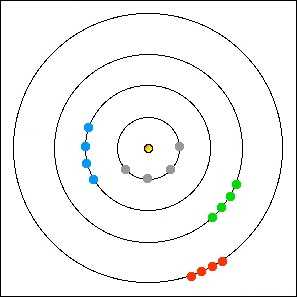
You can show the scale of the solar system with a model you build yourself (see post 202), but showing how the planetary orbits interact with one another takes some time. I figured out how to do it near the end of my career by building a poster that changed over the course of a school year.

You need a piece of hardboard, 6 ft by 6 ft, 1/8 inch thick, a pint of black or blue-black paint, four tubes of artist’s acrylic (pale gray, blue, green, and red), a one-inch brass drawer pull, four foam daubers, (half inch diameter foam cylinders attached to the end of a dowel, used for laying down stencils), and a measuring device you will have to make yourself.

You find the center of the hardboard poster by running lines from corner to corner; they cross at the center. There you drill a 1/8 inch hole and feed the bolt for the drawer pull from the back. Add a matching nut on the front, tighten, then add a drop of Super Glue to keep things from moving. After you paint the board black or blue-back, spin the drawer pull onto the bolt to represent the sun.

For the four colored circles which will represent the inner planets in their initial position, you will need to go to the website www.theplanetstoday.com. Use the double headed date arrow at the top of the page to chose the date of your initial array. Use the measuring device (building instructions below) to establish each distance from the sun and, referring to the website, make your best visual estimate of where to initially put each planet on its trip around the sun.

At the outset, it won’t look like much, but every week you will add another four dots. By the end of the year Mercury will have circled the sun more than twice, Venus nearly once, Earth about eighty percent of the way, and Mars will have moved a fairly short distance – given the length of a typical school year. I put on new planet circles every Wednesday, since Wednesday almost never has a holiday.

Your students will soon have a clear picture of how the planets move in relationship to each other. When Venus is visible in the west at sunset, or in the east at sunrise, or is not visible at all in the night sky, your wall chart will show them why – assuming that you explain it to them, and keep them at least somewhat excited with assignments like, “What is that red dot in the sky, half way up from the eastern horizon at eight o’clock tonight?”.

The measuring device you will build allows you to place additional planet-circles at the appropriate places for subsequent weeks. It has a single 1/8 inch hole at the left, and eight larger holes. Once a week you will remove the drawer-pull-sun and put the small left hole over the bolt. Place the initial Mercury-hole over the previous week’s Mercury circle and put on a new pale-gray circle into the other Mercury hole, using a dauber. Repeat for all four planets —Mercury pale gray, Venus blue, Earth green, and Mars red. Replace the sun drawer pull and  you are done for the week.

planet story stick 3To build the measuring device, begin with a piece of hardboard 36 inches wide and seven inches high. Draw a line about 1 1/2 inches above the bottom and parallel to it. Clearly mark a point on the line about 1 inch from the left side. This will locate the sun-hole. When all further measurements have been made, an 1/8 hole will be bored at the sun-point and 5/8 inch holes will be drilled at the four pairs of planet-points. Don’t drill anything until all nine holes have been marked accurately.

So far, I have used feet and inches since we have been talking about carpentry. The rest of the dimensions will be in millimeters.

On the base line, measure 215 mm from the sun-point and put a point for Mercury. Continuing on the base line, and still measuring from the sun-point, put a point at 402 mm for Venus, a point at 557 mm for Earth, and a point at 848 mm for Mars.

Each planet needs a second hole, the distance between the two representing the distance the planet moves in one week. For me, these required four radii and four calculated angles. I have simplified (honest, it’s simpler) by giving dimensions above (perpendicular to) the base line, and back toward the sun (parallel to the base line).

For Mercury, this will be 104 mm up and 26 mm back toward the left.
For Venus, this will be 78 mm up and 8 mm back toward the left.
For Earth, this will be 67 mm up and 4 mm back toward the left.
For Mars, this will be 53 mm up and 2 mm back toward the left.

These twin dimensions place the pairs of planet-points at two points on a correctly dimensioned circle, representing the orbit.

Drill the sun hole 1/8 inch to match the bolt holding the drawer pull. Drill the eight planet points 5/8 inch to allow clearance for the 1/2 inch dauber. The outline of the measuring device can be trimmed down to any convenient shape, as long as it encloses all nine holes.

219. Required to be Equal

Do you remember the game telephone? Here’s how the game is played in the halls of education.

“All kids deserve an education.”
“All kids deserve a chance at a decent education.”
“All kids deserve an equal chance at an education.”
“All kids deserve an equal education.”
“All kids deserve the same education.”
“If all your kids are not coming out of your school equal to one another, your school has failed.”

I hope we all agree on the first three statements. The fourth looks good, like a hand grenade wrapped up in pretty paper. Whether it is reasonable or crazy depends entirely on how you define “equal”. If you mean equal quality, bravo. If you mean that every kid needs to learn calculus and quantum physics, or needs to understand Chaucerian verse in its original language, or needs to know how to play basketball . . . sorry. You’re off on a well-traveled wrong road.

When Thomas Jefferson said “all men are created equal”, he didn’t mean that strangers could come in and drink his wine, or borrow books from his library. He certainly didn’t mean that children lacking math ability should be tortured with equations, or that children who already run, hike, play and explore should be forced to trade that for the tedium of organized, competitive sports.

The fifth telephone response is simply wrong on the face of it, and the sixth is the discredited concept called No Child Left Behind.   (see 48. No Child Left Behind)

*          *          *

If educators had the courage to tell the truth, these are the words which would be carved over the entrance to every school in America:

Children are NOT created equal.

Some children have many gifts, some have few, and none have the same gifts. They are all wonderful, and all different. One size does not fit all.

If a poor black child wants to be a doctor, and has the talent for the job, it would be a crime for his situation to hold him or her back. That is the impetus behind No Child Left Behind, but in education, good ideas get the life crushed out of them during implementation.

Every child deserves to go as far as his/her talent and ambition will allow. But no mother’s love, or teacher’s pity, or governmental decree will make a doctor out of a child who lacks talent or lacks ambition.

Every child who has the talent and ambition, should go to college.

That’s just good sense and nearly everyone would agree. But that statements has a flip side:

Children who lack talent or lack ambition should stay the hell out of college.

Now put that on a bumper sticker and see who salutes.

Somewhere along the line, Americans seem to have changed the reasonable notion that, “Everyone should have the chance to try his or her hand at winning,” to “Everyone should win.” That’s bad philosophy, bad morals, and bad arithmetic.

There are two casualties of this way of thinking – those who don’t make it into college because of overcrowding, and those who go to college because they were told they should, and then find out they don’t fit.

Our high schools should produce graduates who are ready for life. Instead, they focus on college prep. That’s proper for perhaps twenty-five percent of students. The rest are being cheated out of their educational birthright – a high school experience that educates them for the life they will actually live.

202. Planetary Scale

     Everything in a writer’s life is grist for the mill. For a science fiction writer that includes science itself and, in my case, the teaching of science.
     Here is some more teacher geek. In a book on teaching middle school astronomy, this would be an appendix.

When I was in my early teens and discovered the local library, it not only gave me science fiction, but science as well. I remember the dozen or so books on popular astronomy. I particularly remember How to Build a Telescope, which aroused my lust then dumped me when I found out I didn’t have enough money to but the mirror blanks.

The single issue that most challenged the writers of those books was how to convey the scale of things. Now, if you are under forty, you will have to project your mind back to the days when print technology did not include glossy paper and color photography. Visualize a few grainy black and white photos, a few drawings, and lots and lots of words. Like, “If the distance from the Sun to the Earth were equal to the thickness of a sheet of paper, then the distance to Alpha Centauri . . . “

I grew up figuring out that kind of analogy, but if I gave such a book to one of my modern students, their eyes would glaze over and the wheels would stop turning. The children of Sesame Street have to be shown.

Would you like a simple example? Did you know that a softball is moon-size in comparison to a 12 inch classroom globe of the Earth? And if you hold the softball 30 feet away from the globe, it will be proportional in distance as well as size.

For the rest of the solar system, you can’t show both proportional size and proportional distance in a classroom. You can buy a poster with the proportional sizes, but the planets are all on top of each other. If you make a chart of proportional distances, the individual planets will be too small to see.

You can do both, however, if you are willing to take the exercise outside.

We are about to make a model of the solar system. If you want to get out your calculator, be my guest, but I’ve already done the math and I’m willing to share. The scale I used was one to one billion. It would be easier in metrics, but we will eventually be using a local road map for this, so the good ole American system will have to do.

The chart below is in miles and double-steps. That’s because we want your students to get into the act and count the distance to the planets. A double step is normal walking, counting every time your left foot hits the ground, one-and-two-and-three-and . . .

Your sun will be about five feet in diameter. I looked for years for a balloon that size and never found one, so each year I made a new five foot diameter circle of paper and taped it to the outside wall of my classroom. The distances you need are:

Mercury        38 double steps
Venus            71 double steps
Earth             99 double steps
Mars            150 double steps
Jupiter         513 double steps or 0.5 miles
Saturn                                           0.9 miles
Uranus                                         1.7 miles
Neptune                                       2.7 miles
Pluto                                            3.5 miles

You can skip Pluto if you want, but when I first started doing this, it was still a planet.

Give some of your students models of the planets (we’ll talk about sizes below) and take off with the whole class, counting double steps. At 38, leave the student with the Mercury model and continue with the rest of the class. Et cetera.

My double steps go through Jupiter because our playground allowed us to get almost that far. When we reached the boundary fence, I would tell them, “Jupiter is just beyond that house.” Then I would reel off where Saturn through Pluto would be found. My recital would mean nothing to you; you need to make up your own. Find a large scale local map, measure out distances from your classroom, and memorize them. (For us, Pluto was in the next village.)

None of this would be worthwhile without models to show how small our planets are in comparison to the space they inhabit. I made Mercury, Venus, Earth, Mars, and Pluto out of  beads or glass headed pins, stuck into dowels. Be sure to paint the dowels orange for when Johnny loses one in the long grass. The rest of the planets were made of rubber balls found after multiple trips to toy stores, and painted with artists’ acrylics.

You need these sizes, and this time I’m going metric because it’s way easier.

Mercury       5 mm
Venus        12 mm
Earth         13 mm
Mars           7 mm
Jupiter     143 mm
Saturn     121 mm
Uranus      52 mm
Neptune    50 mm
Pluto            3 mm

Feel free to pass this on to anyone who might want to make this model.

201. Teaching by Feel

I taught science for 27 years in a small school in California. At first it was science and everything else, but each year I had more science classes until I retired teaching science full time. A few years before that, while I was teaching five science classes and one class of perspective drawing, our shop teacher left. I volunteered to keep his class open, so for two semesters, I taught shop. That is when I instituted Pounding Day.

Pounding Day came from my firm belief that kids learn best with their minds when they are also learning with their bodies. This is not the same thing as “hands on”, which is a good idea that too often deteriorates into doing arts and crafts instead of science.

Pounding Day is practice. If you want to learn to add, you practice your addition tables. If you want to be LeBron James, you practice basketball. Driving nails is no different. It makes no sense to drive your first nail into a project you have just spent a week measuring and cutting. Your first nail should be into something disposable, because is it will kink and flatten.

During the first week of class, I gave each student a hammer, two dozen 16 penny nails, and a chunk of 2 x 4. After minimal instruction, I turned them loose.

You’ve never heard such noise. OSHA would not have approved. My friend Adrianna did, however. Every Pounding Day she waved encouragement as she drove her herd from the exercise yard to the playing fields. Adrianna taught PE; she understood kinesthetic learning.

Kinesthetic learning also works for science.

Old science texts used to have kids making up pulleys from sewing thread spools. Modern technique uses prepackaged kits with flimsy plastic pulleys and underweight weights. You tell a kid that he has doubled his mechanical advantage, but he can’t tell because the whole setup is so lightweight he could easily pick it up and hurl it at his buddy in the next row.

Not good enough. Not at all good enough. When I was a new teacher, I built 2 x 4 frames, bought sash weigh pulleys and down-rigger cannonballs. Cannonballs are two and a half pound lead weights used for summer deep lake fishing. When one of my students doubled his mechanical advantage, he could feel the difference.

(Yes, I painted the cannonballs so my students would not be handling lead.)

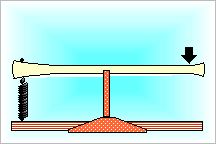
I also built a leverage demonstrator, consisting of a 2 x 4 base with a moveable fulcrum, heavy spring load, and a mattock handle lever. I only built one because there was a dangerous amount of force involved, so I never let students use it unless it was braced by my adult strength.

fulcrum demo

With the fulcrum in the middle of the handle, the downward force is equal to the force of the spring. With the fulcrum near the end of the handle, I couldn’t budge the thing myself. With the fulcrum near the spring, the smallest girl in the class could move the handle with one finger.

If you have earned your students’ trust, and if you are careful not to bruise fragile egos, you can have a lot of fun pitting big boys against little girls in contests of strength rigged to let the little girls win.

[Safety notes: If the fulcrum is next to the spring and a student pushes down, then lets go, the handle will fly 180 degrees to the left and conk whoever is sitting there. Beware. If the fulcrum is far from the spring and your heaviest student jumps up and throws himself on the end of the handle – and they will – you had better be strong enough to keep the whole mechanism from tipping sideways and crunching you both. If you aren’t strong enough, don’t let them do it.]

Our final pulley experiment moved outdoors where I had suspended a bosun’s chair from a basketball goal. Students sat in the chair with the arrangement of pulleys over their heads and lifted their own weight off the ground.

When we did inclined planes, I brought a wheelbarrow, 2 x 12, and concrete blocks from home for the day. I let a student sit in the wheelbarrow while another ran him up increasingly steep ramps. Change students and repeat.

If the subject is force, middle schoolers need to feel that force in their hands and arms, not just calculate forces and imagine how they would feel.

195. Boys at Work: Rick Brant

By at Wk atwIf you didn’t read Tuesday’s post, you might want to do so before you proceed. This week is on the subject apprenticeship literature.

Grosset and Dunlap was the most important publishing house of the twentieth century, in my opinion, because they provided literature for all the kids who didn’t have access to a library and didn’t have much money to spend. For a dollar or so, depending on the decade, you could buy books from any of a dozen or more series. This was before paperbacks made books affordable. If it weren’t for Grosset and Dunlap, I would not be a reader or writer today.

Grosset and Dunlap was almost synonymous with the Stratemeyer syndicate, which provided them with most of their titles. There were exceptions such as the Ken Holt series and the Rick Brant books. Ken Holt never appealed to me, but the Rick Brant books were the jewels of my childhood.

All of the G & D books carried pseudonyms as author. In books from Stratemeyer, this disguised the fact that they were works for hire, written to outlines which were usually provided by Stratemeyer himself. The Ken Holt books however (pseudonym Bruce Campbell) were all written by Sam and Beryl Epstein. The first three Rick Brant books (pseudonym John Blaine) were written by Peter Harkins and Harold Goodwin. The following twenty-one books were by Goodwin alone. (see also 60. Thank You, Harold Goodwin)

In other words, they had real authors, not poorly paid hacks, and it showed.

Relevant aside: Years ago I was attending a teachers’ conference, against my will. If you’ve never been at one, you don’t know what boredom means. I had settled into my normal conference stance of a calm face covering intense irritation at the endless stream of BS. The only bright spot was the keynote speaker, Steve Wozniak. When he came to the podium, he mentioned Rick Brant as a childhood influence.

I whooped. You could have heard me in the street. Then my face turned red. You see, I had never before heard anyone else mention my childhood favorite. This was before I had access to the internet; now I know that there are enough fans of the series to run a fair number of Rick Brant themed websites.

Rick Brant had the perfect life. His father was a noted scientist who lived and worked at home. Rick, his family, and his best friend Scotty all lived on Spindrift Island, which was the headquarters of a group of scientists and engineers. Zircon, Weiss, Briotti and others formed a cadre of the best uncle figures any boy ever had.

He was a junior member of the team. A member -not a mascot. He never outshone the scientists, but he pulled his own weight, mostly building electronic gadgets that the scientists had invented. This was during the electronic middle ages (first tubes, then transistors, then solid state), when a reader could go down to Radio Shack and buy the wherewithal to try his own hand at the trade.

Rick Brant was eighteen years old for 43 years, always working with his avuncular scientists and always learning. That’s good work if you can get it. During that time he went on dozens of expeditions throughout the world. He helped the Spindrift scientists launch a rocket to the moon, find a lost civilization, excavate a sunken temple – the list goes on for twenty-four books.

I so wanted to be Rick Brant.

A week is enough for now, but there are other authors that deserve attention, particularly Howard Pease. Someday soon, we’ll return to this subject.