Tag Archives: writing

258. George Mackay Brown’s Seven Poets

Most of the people who read this blog are writers, or want to be writers. I know from visiting your websites that you range from beginner to professional, and many of your writings have impressed me.

Friends, I have something for you. I’ll give you details below, after the set-up.

I discovered George Mackay Brown in 1987 when my wife and I went to Europe for the first time. We started in England, then went to Scotland to see the land of my wife’s ancestors. Along the way, I visited bookstores to pick up reading material that I wouldn’t find at home and discovered Neil Gunn and George Mackay Brown, two Scottish authors who deeply enriched my life. Both write elegantly about their own experiences in Scotland and the Orkneys (technically part of Scotland but very different). I’m sure I’ll talk about them both from time to time in this blog, but today I just want to shill for one short piece by George Mackay Brown.

I recently had reason to flip through my George Mackay Brown collection, looking for a story I read years ago, and stumbled onto The Seven Poets, the final story in his collection The Sun’s Net. It is a post-apocalyptic story, but it is a fable, not science fiction.

    *     *

The world has reverted. After machines and cities swallowed up the earth, there was a revolution. Machines were banished. Cities were destroyed. Now there is a world wide agreement that no settlement can have more than 250 members. When a village grows beyond that, some are chosen to leave and form a new village.

(Now don’t tell me this wouldn’t work. I know it and GMB knew it. It’s a fable; a set-up to make a point about writing.)

The world is calm, serene, and boring; some men can’t abide that. They become wanderers, without a village, without a community, welcome everywhere for a brief stay, but welcome nowhere as permanent residents. Our narrator is such a man. He has wandered the whole world, through a long lifetime, staying with men of every occupation, but most usually, staying with poets.

Every village has a poet, who spends his year writing a masque for the midwinter festival. In Spain, such a poet told our narrator, “The world was created by one Word. Every poet makes, in his lifetime, a tiny fraction of one letter of that Word.” Another poet’s voice had deserted him. Another was a heretic to the new order who wrote of machines, but when his villagers performed his masque, their mocking turned the performance into a parody of his thoughts. In Siberia, a poet wrote in the inhuman language of roots and salmon and blizzards . . .

    *     *

I can’t begin to convey the depth of sensible weirdness of The Seven Poets. That would require exactly a many words as GMB took, exactly the same words, and in the same order. Prose written by poets can do that to people who try to paraphrase it. I can only say that his fable has captured beautifully the strangeness of trying to nail life to the page with words.

There doesn’t seem to be an online source for The Seven Poets, but it’s probably only fair that you’ll have to seek it out in print. I guarantee you a singular experience if you do.

Raven’s Run 48

We rinsed off under the open fresh water showers, then walked down the beach carrying our outer clothing until the sun had dried us. Raven pointed up to the top of the concrete wall that lined the beach. American tourists with long lensed cameras were recording the scene below. I wondered if any of them saw the beauty, even vaguely, or felt a deep ache in their belly from knowing that they could have come down those narrow stairs and joined the dance, instead of watching and sniggering from above.

Life is not a spectator sport.

We left the beach and hid from the sun among the tree shaded streets. Raven mailed her letter, and we talked. She wanted to know more about the rest of Europe, so we could plan the weeks ahead. She only knew the Europe of tours and hotels, not the Europe of streetwandering.

We found ourselves climbing a narrow street in the south end of Nice, where the sun beat down directly out of a pale blue sky. We hid from the heat in the Musee des Beaux Arts, and wandered around the vast converted mansion admiring the delicate marble statues and sumptuous paintings. 

At the turn of the century in France, impressionism swept the art world and changed the face of painting forever. The victory was so complete that those they ousted from prominence, the pompiers, were all but forgotten. It was too bad. The pompiers had their faults; their subjects were antique, their treatment was too romantic and studied. Yet they produced a body of beautiful work, far more to my taste than the impressionists.

There was a Clement, Egyptian orange merchants, depicting two women, dark skinned and richly robed with a spill of oranges that glowed against the darkness of their clothing. The Nile behind them was shadowy, faded tan, almost like a mirage.

Down the wall was Thamar by Cabanel. It showed a powerful, robed, dark skinned man with a half nude white woman collapsed in his lap. She appeared to be sleeping, or lost in grief, but she might have been dead. The pompiers had a romantic view of death.

“I wonder if Thamar is French for Othello?”

“I don’t know, but I don’t like it,” Raven said.

“The colors are warm and rich. His face and outstretched arm are powerful statements.”

“Yes, but the girl is a half-fat, pasty wimp. I can’t get past her to enjoy the rest of the painting.”

“How about the next one?” That was Thaïs by Tanoux.

Raven laughed. “Come on, Ian. Great fruit, great cloth, great leopard skin on the bed, great background. And she’s not fat, but why is she naked while he is fully clothed? And what has he just asked her to do that she should look so shocked?”

“I can imagine.”

“Me, too. But if I were her, I wouldn’t listen to a word he said until he stripped down and joined me on the bed. Two people clothed is ordinary; two people nude is erotic; but a naked woman with a clothed man standing over her whispering shocking suggestions is pornography. It reminds me of an off-color Victorian novel.”

I smiled. “Feminism has just ruined a whole school of art for me.”

“I’ll bet.  You’d love to be him.”

“Do you really think so?”

Raven gave me her full attention. “You probably don’t want to think so, but in your heart, you would.” more tomorrow

257. Who Knows?

Who knows? Probably the internet.

The internet is science fiction at its best. Back in 1986, when I bought my first Mac, it came with a program called HyperCard. It was a crude, early version of what has now grown to be the internet. It allowed you to create mini-documents called cards and connect them via buttons so you could jump freely from one to another. I dreamed of creating a database of everything I wanted to keep at my fingertips. Then Newton came out – Newton was a proto-tablet that didn’t work very well – and I saw the pair of them as my own personal Tricorder.

Just dreams. Both hardware and software were too crude to be more than a tease, and even a tiny database takes a vast amount of time to create.

Today, the internet does what I dreamed of doing in the days of HyperCard and Newton. I use it to do research for this website. Sometimes I’m looking for things I don’t know, and it works fine for that. Primarily, however, I use it to check details on things I already know.

Here is an example. Years ago I wanted to look again at the Sherlock Holmes quote about furnishing your brain. If you don’t know what I’m talking about, here it is:

“You see,” (Holmes) explained, “I consider that a man’s brain originally is like a little empty attic, and you have to stock it with such furniture as you choose. A fool takes in all the lumber of every sort that he comes across, so that the knowledge which might be useful to him gets crowded out, or at best is jumbled up with a lot of other things, so that he has difficulty laying his hands upon it. Now the skillful workman is very careful indeed as to what he takes into his brain-attic. He will have nothing but the tools which may help him in doing his work, but of these he has a large assortment, and all in the most perfect order. It is a mistake to think that that little room has elastic walls and can distend to any extent. Depend upon it there comes a time when for every addition of knowledge you forget something that you knew before. It is of the highest importance, therefore, not to have useless facts elbowing out the useful ones.”

I thought this was in one of his middle stories. It wasn’t; it was in the first, A Study in Scarlet. To find it, I pulled down my complete Holmes in two volumes and spent an hour looking, but I couldn’t find it. I stumbled across it by accident months later.

So today I did an experiment. I went to my search engine and typed in “brain attic”. It returned a page with ten responses. Six of them referred to the Holmes quote. I opened one, copied and pasted into this post, and you just read it.

Here is another example of finding things I already knew. In my post on The Monkey’s Paw, I wanted to use a quatrain from the Rubaiyat. I knew it well, but not well enough to quote for publication. I didn’t want to spend time getting out my copy and reading through its pages, so I typed a fragment – “dId the hand of the potter shake” – into the search engine and up popped:

After a momentary silence spake
Some Vessel of a more ungainly Make;
“They sneer at me for leaning all awry:
What! did the Hand then of the Potter shake?

Notice that I scored a hit even though I had left out “then”.

Earlier today, I was writing about the Lord Darcy stories. I didn’t want to misspell Randall Garrett’s name (How many Ls, how many Rs, how many Ts?) so I typed it into the search engine and got my correct spelling along with a great deal of additional material that I didn’t need.

That I didn’t need at the moment, that is, but information that will be there when I do need it. Like I said at the top, the internet is science fiction at its best.

Raven’s Run 47

Chapter Thirteen

Nice is an exchange point where trains from France and Italy meet. When we got off at six in the morning, it was busy. Three hours later, it would be jammed.

When I had been released from the Army, the first place I visited was the Riveira. Palm trees, secluded beaches, beautiful women, bright air and warm water in an ambiance of riches – everything a kid fresh out of Wisconsin could dream of. I had spent a week in and around Nice, so there was a certain feeling of homecoming when we stepped off the train.

We stowed our packs in a locker, ate breakfast at the Freetime – France’s equivalent of McDonalds – and headed down Avenue Jean Medecin. Nice is a major city, with all the virtues and vices that implies. The storefronts displayed the latest haute coture but the gutters were filled with garbage. We shared the street with high fashion ladies and kids in ripped denim.

A lot had happened to us in twenty four hours, and a few hours sleep on the train was not enough to wipe it away. I felt gritty and irritable and Raven was keeping long silences. My mind was like a VCR stuck on replay; the events we had experienced kept repeating themselves in my mind as we walked. Raven on the beach, the night attack, the sight of tendons moving at the bottom of my wound, the night ride with Will, and the man with the newspaper. Had he only been an innocent traveler?

Probably, but I wished I had been awake when we passed back through Marseille.

Most of all, I remembered Raven’s statement that I didn’t know myself – implying that I was still trying to win a contest of wills with her. We had been happy on the Wahini, during the crossing, when I had known everything and she had known nothing. Once we were on land, it all started to fall apart.

Enough! Too little sleep and too much philosophizing are a bad combination. Mind, I said, shut up!

I began to just enjoy the day. Nice was never intended for deep thought, but for grasshopper enjoyment of the sun, the sea, women, and the day at hand. Perhaps Raven was made the same way, and I was trying too hard to understand what we had.

Raven bought a change of clothing while I waited on the street, people watching, and we went on down past the Place Massena. For several hours we alternated walking the beach and wandering through the streets near the Promenade des Anglais. We ate fruit and bread from an outdoor market, then went down to the beach and lay in the sun for an hour. I slept while Raven wrote her father a full account of all that had happened to her.

Peace, time, and the sun warmed some of the irritation out of us. Raven woke me from my nap with a gentle kiss on the forehead. When I opened my eyes, her lips moved on down to mine and we lay for a long time just holding each other.

She had gone topless again, but this time as a French woman would, quietly, naturally, and without the bravado that reveals uncertainty. As she sat up from our embrace, I saw her against the sea and sky, full breasted, smiling quietly, serene and at peace with herself. I took her hand. It would have been gauche to touch her intimately in so public a place. It embarrassed me to remember what we had done only yesterday. Like dogs rutting; not like love at all.

A little girl of six or seven was playing nude in the sand at the water’s edge. A boy of like age was chasing seagulls, his tiny penis bouncing as he ran. Old men and young men were lying in the sun; young women had wound down the tops of their one-piece bathing suits and sat by twos and threes with their boyfriends, talking and laughing. Bare breasted grandmothers followed their naked grandchildren from place to place. It was not a scene of Playboy titillation, but of serene beauty. more tomorrow

Raven’s Run 46

“There is a whole universe of things about you I don’t know, but that in itself tells me volumes.

“In ordinary life, you are friendly; in bed, you are a fireball; but in anything that touches any deep part of you, you are an ice maiden. Sexually liberated, but emotionally frigid.”

She stared out the window with such intensity that I thought the glass might melt. I shut up. You can only go so far with a monolog.

After some miles she said, “You aren’t blind.”

“I’m a lot like that, myself.”

“I know, Ian. I’m not blind, either. But we get into habits, and act out parts we have become comfortable in.” She was speaking with metronymic precision. When she joked around, her Hispanic accent sometimes became thick. When she was thoughtful, it almost disappeared. Clarity of speech was an index of her mood.

“I tend to dominate situations,” I said.

“You are a master of understatement.”

“And you don’t like being dominated.”

“Not at all.”

“So you decided to show me who was boss.”

She nodded.

“You knew I was hooked on you. So you used Will for leverage, to put me in my place. To demonstrate the precise length of my leash.”

“It wasn’t like that. It wasn’t calculated. It was an impulse.”

“So it wasn’t planned – it comes to the same thing.”

After a moment, she shrugged half agreement.

“But it didn’t work out. I wasn’t the only one who was hooked.”

Raven laughed harshly. “That is one way of looking at it.”

“How else could you look at it?”

“I could say that you answered my challenge in a way I could not resist.”

“Oh, come on!”

Raven looked puzzled. Our conversation was losing its central thread. Somehow, we had stopped talking in a shared language, and I did not know when it had happened. She said, “I can’t believe you underestimate yourself.” She stared out the window again, her face lovely and opaque. Speaking into the glass, she said, “What do you think we are?”

“I think we are two domineering people trying to fall in love, and trying at the same time to see who will end up as boss.”

That amused her. Her view was obviously different. She said, “Who is going to win?”

“I hope it will end in a draw. An equal partnership.”

“You know me a little,” she admitted, “but you don’t know yourself at all. Why do you stay with me?”

“I like you.”

Her eyes flew wide. “Like me!” she cried out. “Just like me?”

I laughed out loud. She could no more have helped that reaction, than a wet cat could keep from spitting. more tomorrow

255. Fire

dscn2539For writers – or anyone who is leading a thoughtful life – every day brings experiences that add to our understanding of the world around us. For the last half decade, my tutor has been fire.

I took the photo at the top of this post a few years ago, while standing in my front yard. The smoke was only about three miles away and my first thought was, this is finally it. Fortunately, it was on the other side of a lake that lies in the valley between my house and its location. We drove to a vantage point and spent an hour watching a scoop-equipped helicopter dropping down to the lake for loads of water, and dropping them on the fire. It took several days to put it out, so for a week we could not open any windows because of the smell of burning.

There have been weeks in late summer almost every year recently, when the smell of burning kept us indoors. You could blame our long-running drought, but that isn’t it. When there is little winter rain, things become unnaturally dry, and there is fire. When there is abundant winter rain, the grass and weeds grow tall and lush, and there is more fuel for the fires that still come.

Arthur Clarke wrote a story called Report on Planet Three, in which Martians, observing Earth through telescopes, concluded that life could not survive here because the atmosphere was so rich in oxygen that Earth might have open fires as a natural phenomenon! When I first read the story as a youth in Oklahoma, I found it humorous. Now that I live in the foothills of California, I say, “Yep, Arthur, you got another one dead right.”

A few years ago, a target shooter started a fire that burned into Yosemite. Three years ago, north of here, an illegal campfire was the spark. Two years ago, east of a foothill town I visit frequently, it was untrimmed trees rubbing against a power line. This year, someone pulled off the road into dry grass and his hot muffler started a thousand acre burn just a few miles from my home. That was the fire that caused me to write this post.

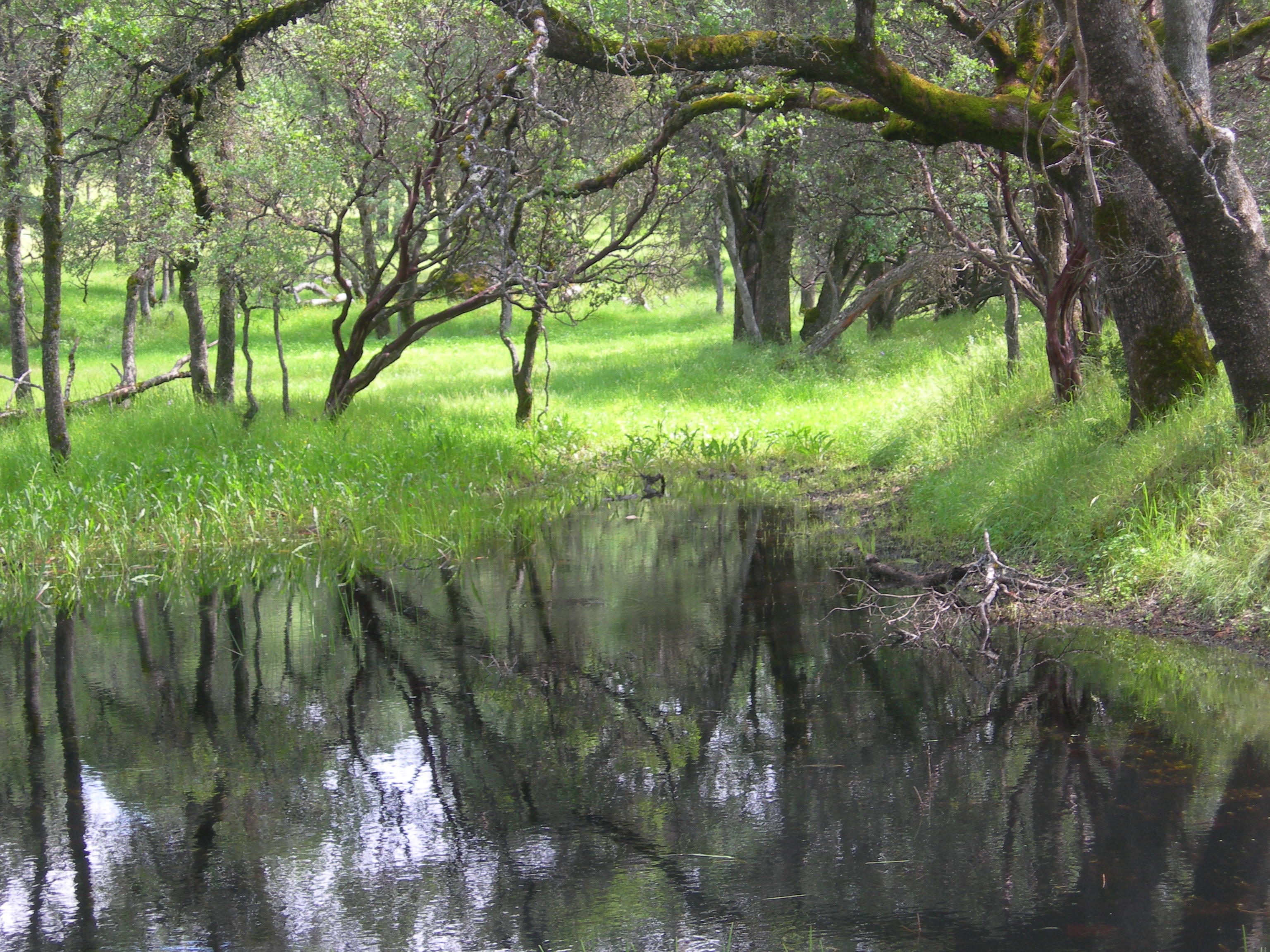
dscn4753Here is one of my favorite places. It is a vernal pond; man made, but fleeting. Right now it is probably filling with water, as it does every fall. It will look this beautiful until spring – maybe.

In the coverage of the fire this year, a newscast showed a reporter standing on a black top road. One side was untouched; the other was fire blackened. It was the point at which the fire had started, and I recognized it as the place I park when I go to the pond. I couldn’t tell whether the reporter was facing north or south, so I don’t know if my favorite place was saved, or destroyed. I haven’t yet had the heart to drive up and find out.

In my writing, I have brought nuclear war to Earth in two different fictional universes. It’s easy. I don’t see many movies, but everyone sees their trailers on TV. Massive, ubiquitous destruction prevails. A kid with his own camera and computer could illegally produce his own apocalyptic vision, using FX stolen from Blue-ray. Washington and New York have each gone up a dozen times in the last few years. He would have an abundance of destruction to call upon.

Bringing massive destruction over there is easy and cathartic. Dealing with even small destructions right here is another matter. I had no problem blowing up the Earth, twice, but I dread driving up to see if my favorite pond is still there.

Raven’s Run 45

According to the train schedule, we passed back through Marseille at 4:58 AM. I had planned to watch for any passengers who got on, but I didn’t wake up until a middle-aged Italian woman with her two grandchildren invaded our compartment at St.-Raphael. She told us in bad French that she was returning to Milan from visiting her daughter, and that her daughter would be coming along in two weeks to pick up the children. She scolded the children in a strident voice, threw open the train window and leaned out to shout across the platform to her family, then offered Raven and me cookies when she gave them to her grandchildren. I took one. It had been a long time since the picnic on the beach.

Raven spoke no French. She looked puzzled at first, trying to follow a clumsy conversation in a third language, engaged in by two people who both spoke it badly. Eventually she gave up and stared out the window.

I slipped my bare foot up beside her on the seat and nuzzled it against her hip. She looked irritated at first, but she finally put her hand on my ankle. I blew her a kiss, a brief pursing of the lips that brought an equally brief smile. She said, “Sorry, Ian. I’m not at my best when I’m short on sleep.”

“Me either. We can talk if we remain circumspect.” Raven looked sideways at our compartment mates; the woman had settled back to knit in silence and the children were mercifully asleep. I went on, “She doesn’t speak English. It is always the first question I ask, bad as my French is. But she would probably know a few words, so talk around things.”

“Where are we going?”

“Nice. It is close to Marseille in case we have to go back quickly, and it is the gateway to the Riveira. Big yachts, blue waters, topless beaches.”

She shot me fiery look. Raven did not like being teased.

I settled in against the window, with one eye on Raven and the other on the russet semi-desert outside. Past St.-Raphael the train hugs the coast and the Mediterranean is in view most of the time. I said, “I’ve been thinking a lot about yesterday. I’m not too happy with either of us.”

Raven nodded toward the grandmother and asked, “Is this the time to discuss it?”

“Why not? We’ve been more intimate in a public setting.”

She actually blushed. I said, “When you apologized to Will, you said you had been jealous. I think that was only the least part of what was going on in your mind.”

“How the hell do you know what was going on in my mind!”

“I don’t, of course, but I know what was going on in mine. Now I do, that is. Then I was just reacting. I think you were just reacting, too.”

I paused for comment, but she just shrugged. I went on, “I think you were jealous, but at the bottom of it all, I think what happened was a challenge to me.”

“That’s clear enough, Sigmund.”

“Not a sexual challenge, Raven. A much deeper challenge hidden within a sexual challenge.”

Our compartment mate’s eyes dodged furtively sideways and her whole shapeless body seemed to come alive with listening. She might not understand much English, but she knew “sexual challenge”.

“You don’t know anything about me,” Raven said. “How can you guess what I think.”

“After two months of enforced intimacy? Come on, Raven. I know a bare minimum about your family, less about your past, and you won’t even commit yourself about what kind of art and music you like. There is a whole universe of things about you I don’t know, but that in itself tells me volumes. more tomorrow

254. Legal at Last

Roughly a week ago, California legalized recreational marijuana, having legalized medical marijuana twenty years previously.

It was so much of a no brainer, that (time-travel-spoiler-alert) I am writing this post a week before it happens, with reasonable certainty that I would-will-did not have to eat my words before post date.

So why even bother to talk about it? For one thing, it is a tie in with Raven’s Run, now being presented over in Serial. In my fictional 1989, California State Senator Cabral has been trying for years to bring about legalization because he thinks prosecution itself is what has made marijuana profitable. Oddly enough, that is also my opinion; I came to that belief back in the sixties.

Ah, the sixties. There is a smoky haze of nostalgia about the era, and the smoke smells like pot. I remember it well, and one reason I remember so well is that I wasn’t partaking. It wasn’t a moral stance. I was going to college on a scholarship, and I was determined that nothing was going to stand between me and graduation. Most of the people I knew were smoking weed and popping various multicolored pills which promised multicolored results. Those were the early days when the law hadn’t caught up to the pharmacopeia. In Michigan, where I was going to school, possession of marijuana was a felony, but possession of LSD was still a misdemeanor.

My friends were reading Castaneda’s The Teachings of Don Juan as enlightenment and popping peyote. I read Don Juan as fantasy – second rate fantasy, by the way – and skipped the medicine.

They were also taking LSD. At least their supplier said it was LSD, but on the black market, who knows. I wasn’t interested. I already knew about LSD from my time as a Fleming Fellow, during high school. One of the doctors I encountered at the OMRF that summer had used LSD in an attempt to induce musth (a frenzied sexual state – think pon farr) in an elephant. It didn’t go well for the elephant, and I was in no mood to engage in unsupervised medical research in a college apartment.

I came away from the sixties disliking the idea of mind altering substances. Then someone very close to me, with a debilitating ailment, became hooked on prescription pain killers. That reinforced my feelings. Now I try to hold my intake to coffee and aspirin.

This does not give me reason to tell anyone else what to do, and the idea of a whiskey fueled police force jailing ragged people for smoking pot is beyond my comprehension. I have voted for legalization every chance I’ve had, even though I wouldn’t touch the stuff myself. It has taken the rest of society fifty years to catch up to that position.

To be fair, a lot of people have been part way there for some time. As one of my kindest, gentlest, most Christian and conservative friends said two decades ago, when the question of medical marijuana was on the ballot, “Doctors can prescribe codeine, cocaine, and heroin, but not marijuana. That’s just dumb.” I would have said it more forcefully, but I couldn’t have said it more accurately.

So, when it came time to write Raven’s Run, I made the mastermind in the background (not yet revealed in Serial, so you’ll just have to keep reading) a purveyor of pot with interests in keeping up the anti-pot laws that make his enterprise profitable. And waiting in the wings, also related to Raven’s Run, is another novel, not yet written, about the sixties drug culture and the role played by the CIA in making LSD America’s favorite abbreviation.

Raven’s Run 44

“Keep Raven safe.”

“That is my first priority.”

I caught my pack in my left hand, cradling my injured right and said, “Come on, Raven. We have to run. We’ve got second class tickets.”

I started off at a half trot, heading back down the side of the train to the gray-striped second class coaches. Raven was caught off guard, and came stumbling after. Will was left looking foolish. Raven snapped, “Ian, what are you doing?” Then the train’s brakes gave a burst of air and the doors started to close. I tossed my pack in and caught the edge of the closest one, motioned Raven aboard, and followed. The train had already started moving; we waved to Will as we passed.

“Of all the clumsy . . .,” Raven began, but I cut her off.

“Later. I’ll explain later. Right now, let’s get settled before our visitor comes.”

“What visitor?”

I was already moving down the aisle. Second class cars have six-passenger compartments. These were curtained and unlighted, but when I opened the doors there was enough light to see into them. Most of the occupants were sleeping, or trying to. I found what I wanted on the third try, and motioned Raven in. She started to object that the previous compartment had been empty.  I hustled her in anyway, and tossed my pack up into the overhead rack. She stood in angry indecision. I tossed her pack up and gestured to a seat. She sat down, furious, but unwilling to make a scene in a compartment full of half-sleeping strangers. I took the only remaining place, slumped down, and braced my feet on the opposite seat.

We sat in silence. Raven was still angry; I was just waiting. Then the door slid back again and the businessman who had sprinted after us at the last moment, looked in. I said, “Sorry, old chap. ‘Fraid the place is full.”

He just looked at me, then closed the door and moved on. I caught Raven’s eye and said, “That visitor.” Her eyes got very wide. I nodded and said, “We’ll talk later. For now, the idea is that we can’t fall asleep. We’ll watch each other for dozing, and stay ready to move fast.”

Chapter Twelve

As it happened, it was not all that hard to stay awake. I only had to lower my hand into my lap whenever I started to doze and the throbbing was more effective than caffeine. Thinking helped, too. I kept thinking of what would have happened to all those tendons if Skinny’s knife had cut just a little deeper. Whenever Raven’s head nodded, I kicked her in the leg. Maybe harder than was strictly necessary. I still wasn’t happy with her.

When the train slowed for Avignon, I put my foot against Raven’s leg and pressed gently. Her eyes met mine, and I silently mouthed, “Be ready.” She nodded. I waited until we were fully stopped, then rose, slid the door open and stepped out into the aisle. I stretched, scratched, and yawned; the man with the newspaper was not in the aisle, nor peeking out of a compartment. If he had been, I would have gone to the W.C. and tried again at Livron. I stepped back into the compartment, ignoring the muttered complaints of our fellow travelers, tossed Raven her pack, and grabbed mine. We reached the platform just as the train started to move. Whether he saw us get off, I could not tell. Whether he cared, I did not know. The windows of the train were opaqued mirrors in the light of the platform.

Ten minutes later, the southbound train for Nice pulled in. We found an empty compartment and stretched out to sleep. more tomorrow

253. Handgun Accuracy

2-gunsOver in Serial, the chapter Raven’s Run 42 came out yesterday. This post was supposed to stand across from it, but Leonard Cohen’s death caused me to push Handgun Accuracy back a day to make room for an appreciation of what he meant to me.

Everything in the night drive through Martigues and the Barre Lagoon in yesterday’s post is from research. I was never there. But I was in Marseille and everything there is from experience. You have to have some first hand knowledge, mixed with research, if you want to look like you know everything.

The bit with the .45 automatic is also accurate, and from experience. I only fired an M1911A1 once in the Navy, in boot camp, but years later I acquainted myself with it and a large variety of other handguns at a firing range near my home. I spent an hour a week there, every Tuesday for a year, and became proficient with the two dozen styles and calibers they had for rent. That was partly for writing research, and partly because we live in a dangerous world.

You have to be able to describe handgun usage accurately for the kind of fiction I write. And yes, this post title has that double meaning, like the NRA bumper sticker that says Gun Control Means Using Both Hands. I could never resist a bad joke.

Accuracy is important in science fiction weaponry as well. In Jandrax, Jan’s “express pistol” was a technologically advanced weapon that was fairly fully explained, while the other weapons were nineteenth century technology because they were meant to be repairable on a frontier world.

In Cyan, due out soon, the explorers are operating in the near future. I decided to give them handguns only slightly advanced over the present day for their initial exploration, as in:

“Gus carried a comped 12mm magnum semi-automatic in a cross draw holster.“

This led the proofreader at EDGE to highlight comped and write “?”. (See 134. The Long Road to Cyan (2) for details on proofreading in the modern era.)

Comped actually refers to mid-twentieth century technology. I replied:

Comped, pronounced compt, not comp-ed, is a standard term. It comes from compensated, and refers to a series of slits on either side of the front sight of a heavy handgun, which redirects some of the expanding gasses upward, counteracting muzzle flip. Gun nerds will know the term; others will just be puzzled.

The cross draw holster is reasonable, but it is mentioned early because it sets up a plot point I would need about forty pages later.  And 12mm magnum will certainly ruffle the hackles of purists, but again, it is so named for a reason. The largest caliber presently designated in millimeters is 10mm and magnum is applied to a new, more powerful version of an old caliber. This means the 12mm magnum is two generations away – which is what I was looking for, a near-future version of present day technology.

I made these automatics obsolete during the colonization phase by introducing a handgun called a fletcher which was, in essence, a hand held rocket launcher. If you need a powerful, hand held weapon with little recoil, replacing bullets with mini-rockets is the simplest way forward.

You can only use phasers in Star Trek novels and no self respecting science fiction author will ever say “ray gun” again, but fletchers – certainly under a different name – will probably be available within a decade or so. High caliber handguns have just about reached the limits of human hand strength, even though all of them are comped today.

Keep your eye on future issues of Field and Stream for new developments.