Monthly Archives: February 2017

299. I Survived Skylab

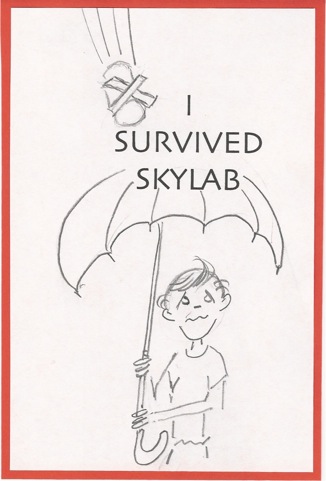
skylabAt the top of this post is a drawing, done with deliberate crudeness. I wish I could have used the original, but it existed before digital cameras and Pinterest. I have searched the internet without success for the image I remember. There are dozens of modern Skylab T-shirts. but none like what you see here.

In 1979, Skylab came crashing back to Earth. NASA knew it was going to happen, but could not prevent the event; it even predicted the date, July 11. The world partied in the face of danger – especially since the chances of being at ground zero were billions to one – and I Survived Skylab T-shirts were worn everywhere. The one I remember had a silly looking cartoon schmuck holding an umbrella over his head while Skylab was flashing down behind him.

If anyone still has a picture of one of those original T-shirts, post it on Pinterest and I’ll provide a link.

No one had intended Skylab to come to such an end. It was in reasonably high orbit, about 275 miles when he last crew came back to Earth. It still contained plenty of air and water, although the gyros were failing. It could have been remanned, and there were tentative plans to shift it to to a still higher orbit. No one took it too seriously, though; the vessel was old and battered, and NASA had turned its attention to the Space Shuttle.

In fact, most people at NASA thought the next Skylab crew would be ferried up by the Space Shuttle.

Nature had other plans.

By 1973, it was predicted that Skylab would deorbit years earlier than NASA was predicting, but NASA failed to listen. Increased solar activity had heated the atmosphere, causing it to expand. Low Earth orbits are still within the tenuous ranges of the outer atmosphere. Although the life of such orbits is measured in years, all things within a few hundred kilometers of Earth eventually come down. Now NASA was facing the fact that the Space Shuttle would not fly before Skylab’s orbit became critical. Not only could Skylab not be saved, it could no longer be equipped for a controlled deorbit.

A Russian Cosmos had crashed into northern Canada only a year before. The second stage of the Saturn which had launched Skylab had remained in orbit two years, then crashed into the North Atlantic in 1975. NASA was aware that the potential for disaster was great. It was predicted that up to 25 tons of debris might survive reentry, and there was no way to determine where it might land.

If Skylab had landed on Omaha – or Paris – we would be living in a very different world, with a very different attitude toward space exploration. In point of fact, Skylab struck the Earth in the desert of western Australia. No one was injured. Property damage was minimal.

The Shire of Esperance sent NASA a fine for littering.

*  *  *  *  *  *  *

Everybody has to carve out his own niche. In my science fiction, I concentrate on the next couple of centuries. In these posts I concentrate on the early space program. I have not yet written about the space shuttle, which always seemed to be like Grandpa’s pickup truck that he bought after he was no longer young and had sold his hot rod. Sorry, my prejudice, which I am sure I will someday reverse without apology.

I am even less interested in the ISS. I remember too well that, during its planning – before the feds told them to shut-their-mouths and not bite the hand that was feeding them – the scientific community complained loudly about all the research that would go unfunded to feed the ISS.

The ISS, symbol of American-Russian friendship, boldly going where everyone has already gone before. Sorry, my prejudice again.

If you are interested in the ISS, there is a plethora of available writing. If you want to know more about early space stations, try to find Living in Space by Giovanni Capara in your local library. Published in 1998, it is a detailed study of all the space stations before ISS.
Raven’s Run 93

“He was trying to shoot me, so I stomped his head into the pavement.”

“Very effectively, I’d say,” Wilkes added dryly.

It was an ugly picture. They had composed his features, and pushed his nose back more-or-less straight, but there was a curious flattening to his forehead that came through clearly in the grainy black and white.

“I don’t know him,” Cabral said calmly. After his early years with the FBI, the sight of death did not disturb him. “Do you?” Wilkes shook his head.

“Davis,” Cabral went on. “Why would he use his real name?”

“Assuming he did.”

“The coincidence with Alice Johnson’s maiden name is too great. I think we can assume as a near certainty that Davis is his name, that his first name probably is James, that he is related to Johnson-Fletcher, and that they are working together because they are related. So why would he use his real name?”

“Why not, Senator?” Wilkes said. “If he succeeded in killing your daughter on the cruise ship, it wouldn’t matter.”

Cabral drummed his fingers on the arm of his chair while he thought. I had a feeling that he was not so calm about all this as he tried to appear. Talking about an attempt on his daughter’s life had to make him angry. I thought I could see small indications of that anger, but his face was well schooled. Finally, he said, “No doubt that’s it. The simplest answer is often the best.”

I added, “Perhaps having used his real name, he was committed to finishing Raven in Marseille.”

“Or maybe it merely reinforced Johnson-Fletcher’s need. I am also assuming that she is the one Ramona had investigated, but we need to be sure.”

“I may be able to help there,” I said. “I need to make an overseas call.”

“Go ahead.”

I called Joe Dias. He was out, but Carmen said he had made an investigation. I gave her my number.

Wilkes said, “Joe Dias. The detective you worked for when you were going to college?”

“Damn, you are irritating. How much do you know about me?”

“When you applied for the foreign service, the CIA did a full background check. The Senator and I read it before we left California.”

That security check was the one thing that had made me hesitate about applying for the foreign service. It made me nervous. Especially about my time in Germany.

“Joe isn’t due back in his office for two hours. Meanwhile, I need some air. We can continue this later.”

“We will continue it now,” the Senator said.

“You daughter – Raven – has been on her own for two weeks. We have no reason to think she is in immediate danger. It will wait an hour while I collect myself.”

*       *       *

June was almost gone. In the two weeks since Raven and I had walked these same streets, the greens had deepened and a dusty pallor had come upon the sycamore leaves as the summer’s heat worked into them.

I found a bench overlooking a handful of grass trapped in a sea of sidewalks and streets. Things were moving too fast for me, and there were forces working at levels I could feel but could not touch. One thing I knew clearly, though. Daniel Cabral was a danger.

Ed Wilkes exuded a quiet competence and deadliness, but he was a pale candle in the sun of Daniel Cabral. Raven had spoken of competing with a powerful father, but that had been her wishful thinking. No child could have competed with him. Anything she might seem to have won over him, would have been a gift he had given without her knowing. more tomorrow

298. Skylab (2)

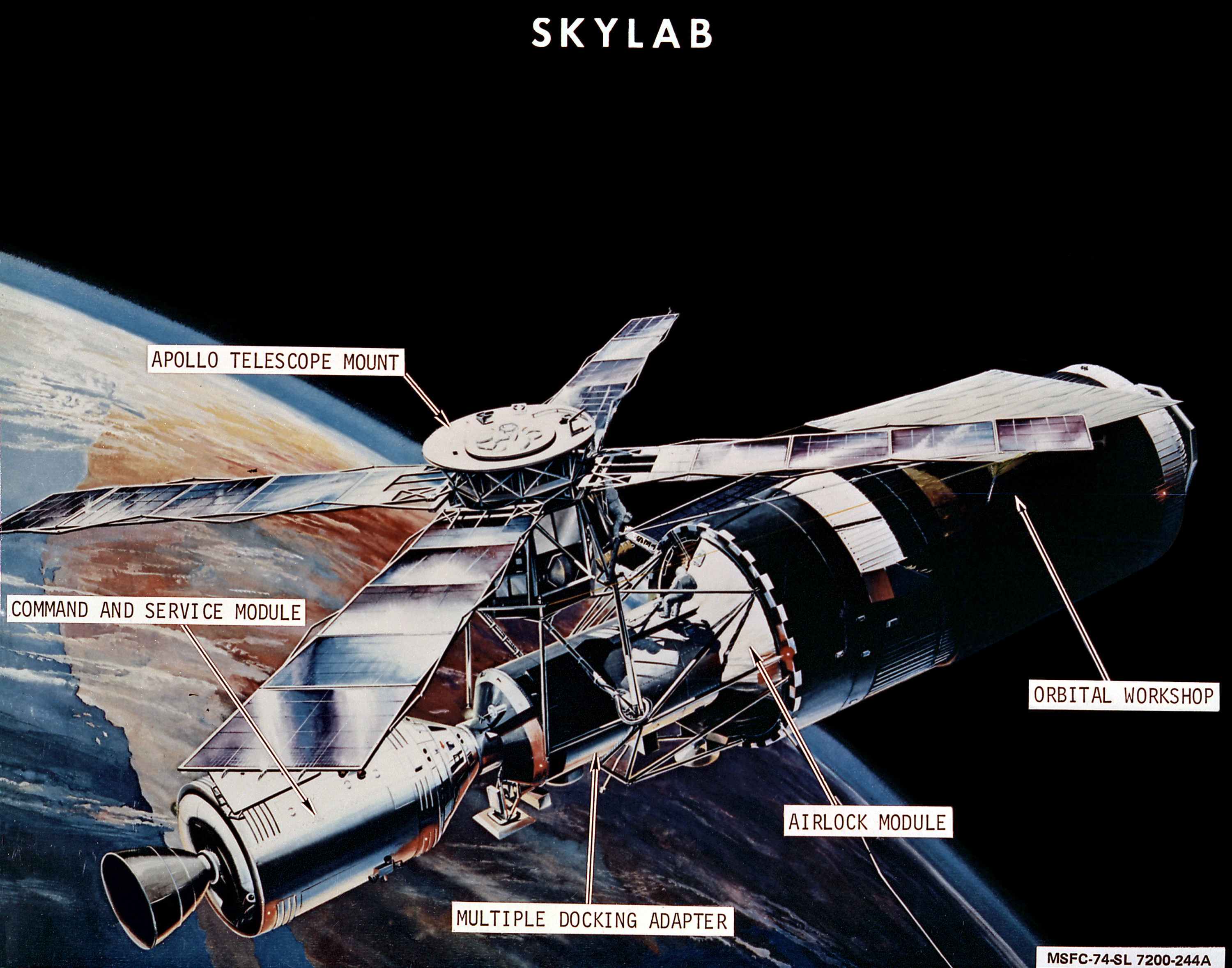
skylab_labeledTwo days after Armstrong and Aldrin stepped onto the moon, NASA announced that it would launch an orbital laboratory with space telescope, using a Saturn V rocket. Because of its great power, the Saturn V could place a large payload in low earth orbit, using only its first and second stages. The entire third stage was converted into the orbiting laboratory, and launched intact and ready for occupation. This was Skylab.

The astronauts who would man Skylab would arrive later in CSMs – NASA speak for Command Module and Service Module, considered as a package deal – launched on smaller Saturn I-B rockets.

This cylindrical third stage was divided by a floor grating into an upper work area and lower living quarters,with eating, sleeping, and bathroom areas. It was, of course, a weightless environment. At the end of the vehicle, an airlock and docking adapter allowed egress for extravehicular activities and connected Skylab to the CSM which brought the astronauts up, and remained docked to return them to Earth. A solar panel array provided power. In pictures of Skylab, this array is what looks like helicopter blades above the vehicle. The telescope mount is in the center of the solar power array.

Skylab was launched on May 14, 1973, with disastrous results. The meteorite shield, which was supposed to stay snugly against the outside of Skylab during the flight up, and deploy once in space, deployed prematurely. Once in orbit, only part of the solar panel array deployed. The rest had been trapped by the damaged meteorite shield. The result was too much heat and not enough power. Skylab was uninhabitable.

The astronaut launch was temporarily cancelled and NASA went into salvage mode. Within eleven days they had proposed, built, and tested a set of repairs, and the crew of Conrad, Kerwin, and Weitz launched on May 25th. It proved to be no easy task.

The first day, working from the hatch of the CSM, Weitz tried using a forked stick to remove some of the debris remaining from the meteorite shield in order to deploy the solar array. No luck. Then the astronauts tried to dock, only to find that part of their capsule was non-functional. They had to externally repair their docking probe before connecting with Skylab and finally getting to sleep, no closer to repair. The next day, they attacked repairs from inside Skylab. Weitz wore a gas mask as he tested the air inside the structure. Scientists had feared that the high temperature environment would release poisonous gasses from the insulation. It had not, but the temperature inside was 130 degrees. The astronauts then set up a parasol they had brought, inside the second airlock near the telescope, and slowly extended it outside Skylab. It opened successfully, providing relief from the sun. The temperature dropped, although only to 95 degrees. The second night, the astronauts slept in the docking adapter area where the temperature was reasonable.

Several days later, Conrad and Kerwin performed another EVA, used large scissors to cut away part of the meteorites shield, and finally freed the remaining solar array.

The work of the first Skylab crew not only saved the station for the work it was designed to do, but also proved the necessity of manned missions to rescue projects in danger. Twenty years later, when the Hubble needed repair to perform its functions, the precedent had long since been established.

The first Skylab crew stayed aboard a month, conducting astronomy and medical research. The second crew, Bean, Lousma, and Garriott, remained aboard for two months, continuing repairs and research.. The third crew, Carr, Pogue, and Gibson, remained in space 84 days, observed and photographed comet Kohoutek and continued other experiments.

By the time the third crew returned to Earth, Skylab was nearing the end of its service life. Beyond the damage done on launch day, many other systems were failing. There were plans to use it further, but nature had plans of her own. conclusion tomorrow

Raven’s Run 92

Chapter Twenty-six

It was noon when they returned, followed by a room service cart of breads, cheeses, and cold meats. Fifteen minutes later, fed, clean, and rested, I was ready for their questions.

Senator Cabral held out a fax and said, “Is this Susyn Fletcher?” It was grainy black and white, but there was no doubt that it was her. “Her name,” he said, consulting a second sheet, “is Alice Susyn Johnson. Her maiden name was Davis. She went by Alice around my office. She was a file clerk and relief secretary. My office manager was grooming her for more responsible work. She knew a great deal about what I was doing and, within a few months, would have known more. If she was in the employ of some enemy, she might have done a great deal to keep that position.”

“How long had she worked for you?”

“Two years, but she was unusually bright and industrious. She rose fast in my organization.”

“Then she was the one Raven suspected and had investigated.”

“Presumably. About six months ago, Ramona came to my office late one night to see me and found Alice – Susyn – there alone. She was going through some files. When Raven told me about it, I had my office manager check it out. He was satisfied with the reason she gave for being there.”

“Which was?”

Cabral shook his head. “I don’t remember her excuse. It seemed such a small incident at the time. Ramona wasn’t satisfied, but she has always been a mother hen toward my career. I didn’t listen to her doubts.”

Mother hen? Raven? That didn’t fit. Or did it? Her statement that it was hell to have a powerful father had always seemed a little too large to be completely believable.

Mostly, I couldn’t think of her as ‘Ramona’.

Cabral passed around photocopies. “This is her personnel record. See if anything strikes you strange, beyond the obvious fact of her maiden name.”

Date of birth, place of residence, social security number, salary. All of the facts and figures that constitute identity in a bureaucratic state. I read the document closely, with little enlightenment.

“Ed?” the Senator asked. Wilkes shook his head. “Ian?”

“Just one thing. On this salary, she couldn’t have so casually handed out the money she claimed was yours. Either she has been embezzling, or someone else is employing and bankrolling her.”

“I set an audit in motion this morning,” the Senator said. “I am expecting a preliminary report within twenty-four hours.”

Wilkes said, “I have been assuming that she was working for someone.”

“I think we all have, but let’s save analysis for later. What new facts do you have for us?”

I admired the crispness and efficiency of Cabral’s approach. Clearly, he had a first rate mind.

“I have a report from Interpol. The Venetians had Davis’ body on ice. Like we figured, they checked our description against their latest morgue residents and made a quick match. I got the embassy to send a courier from the nearest consulate to get photos and fingerprints. That’s where I spent my morning, waiting for the fax to come in. I forwarded the info to the Bureau and invoked your name to get a hurry-up. We should know more by evening, if his prints are on file.”

Wilkes held up a faxed photo. I nodded, “That’s Davis.”

“Or what’s left of him,” Wilkes observed, passing the fax to the senator. “What did you do to him?”

“He was walking me at gunpoint to where he could dispose of my body. I was unarmed. When he made his move, he had shifted to a knife for a quiet kill. I jumped him, and got lucky. He hesitated which weapon to use and I knocked him down. He was still trying to shoot me, so I stomped his head into the pavement.” more tomorrow

297. Skylab (1)

240px-skylab_sl-4

SKYLAB

The International Space Station has been continuously inhabited since November of 2000. if you are under twenty-five, you probably don’t remember a time when it didn’t exist. You also probably don’t know that scientists widely resisted it’s construction, feeling that far more could be learned by spending the equivalent amount in other ways. Whether or not they were right will probably never be known.

The space race that culminated in landing on the moon was fueled by the cold war. The construction of the International Space Station was fueled by the need to demonstrate that the cold war was over, and that Russia and America were now friends. How well that has turned out is also still in doubt.

There were space stations before the ISS, mostly Russian. Wikipedia has a nice list available. The US had an aborted space station project in the late sixties, the MOL (see 256. The Space Station That Never Was) and an actual one in the mid to late seventies. It came on the heels of the Apollo program and it was called Skylab.

Most Americans have forgotten it ever existed but for a few brief weeks in 1979, everyone in the world was looking at the sky and thinking about Skylab.

Gene Cernan and Harrison Schmitt were the last men on the moon in 1972 (see 293. Last Man on the Moon) because of funding cuts. Twenty Apollo missions had originally been envisioned. Apollo 20 was the first to be cancelled in January of 1970 to allow its booster to be used for Skylab. Later that year, Apollo 18 and 19 were cancelled.

If you think back only a few years, the last Space Shuttle flight brought rounds of congratulations for years of success, but at the same time the Cape, northeastern Florida, and NASA in general saw economic turmoil as thousands lost their jobs.

A similar thing happened at the height of the Apollo program. All the Saturn V boosters that were going to be built were in the pipeline, and the organization that produced them was in danger of disappearing. One of the schemes to keep the resource from disappearing was Skylab.

Space stations had always been envisioned. Early plans for reaching the moon called for building space station, then assembling the moon rockets there. It made good sense. Spacecraft have different design requirements from vehicles designed to cope with traveling through the atmosphere. Just look at the difference between the Lunar Lander and the Apollo Command Module. Now visualize a craft built in space for lunar or interplanetary travel; your vision will probably look a lot like the ISS looks today.

That plan to build a space station, then a moon rocket, made perfect sense, but it wasn’t going to happen fast enough to win a space race with the Russians. Hence the Apollo style moon missions, leading to victory in the space race, leading to an America that felt like a winner, but had no place to go next.

Enter, Skylab. more tomorrow

Raven’s Run 91

There are no guarantees in life. Sometimes you have to make a choice and take the leap.

“How much of the story do you know?” I asked.

Cabral said, “I have a copy of the story you and Ramona told at the embassy when you arrived. I have a copy of Cumming’s report of the fight on your boat. I have Hayden’s report of driving you to Nimes to put you on a train for Paris. Ed and I have read and discussed them at length.”

“When I say ‘Davis’, you know that I mean the heavier of the two attackers?”

Cabral nodded. Wilkes was leaning back in recording mode again.

“Two nights ago, in Venice, I killed Davis.”

*       *       *

The whole story took a while to tell, even though Cabral and Wilkes resisted the temptation to interrupt. When it was finished, the Senator said, “Ed, route this through the embassy and keep our names out of it. Suspicions that Davis and his partner may have gone to Venice. Give a good description. Maybe the embassy will use Interpol to send the message. We are to hear as soon as the embassy knows anything. No mention of Davis’ death.”

“Got it.”

While Wilkes was on the phone, Cabral turned back to me and said, “Thank you. Really thank you, this time. I said it before as a gesture, but I didn’t mean it. Since I didn’t know about the Fletcher woman, your actions had seemed foolish and destructive. Now I know better.”

I said, “I only had your daughter’s interest in mind. With maybe a bit of wounded pride as an added incentive.”

“Wounding people is Ramona’s special gift. You look tired.”

“In the last two days, I have only had a nap on the train. But, more than that, I need a shower.”

Cabral smiled. He said, “Now that I’ve heard your story, I will make some inquiries that may help make sense of things. One thing first: describe Susyn Fletcher.”

“About five feet one, bleached blonde hair cut shoulder length. Slim, attractive. Not beautiful, but the kind whose vivacity makes up for it. Face rather triangular. Her most prominent features – if they weren’t contact lenses – were her eyes. Violet. A most remarkable color.”

Cabral was lost in thought for a minute, then he said,  “Maybe. I may know her after all, under another name. I’ll call my staff to check. Meanwhile, make free use of the suite. Ed and I will both be out. You will be here when we get back?”

It was more an order than a question. I said, “Don’t knock when you get return; unlock the door yourself. I’ll be asleep on the couch.” more tomorrow

296. Space Walks (2)

gemini_spacecraftWe left Gene Cernan hanging onto to the side of Gemini 9, part way thorough a disastrous space walk. I’ve provided a drawing of the Gemini to orient you to what comes next.

Cernan left the hatch and began to move back to the base of the Gemini, utilizing undersized hand holds. He was weightless, which makes this sound easy, but remember that bending your arm is like “bending and inflated life raft”. As he worked his way back, he had to thread his umbilical through undersized stand-offs to keep it from tangling. When he reached the base of the Gemini, he found it surrounded by a ring of torn metal, like razor wire, that was the result of separation from the Titan rocket that had put him into orbit. Just the thing a space suit does not need to make contact with.

Once Cernan made it past the turn to the very base of the Gemini, he faced new problems. He was exhausted and overheated; the inside of his visor was so fogged that he was nearly blind. Making visibility even worse, the light NASA had provided over the MMU was a dim bulb, completely inadequate to his needs. He began to attempt to fire up the MMU, a procedure that required about thirty switches to be thrown in sequence, but he could hardly see the switches, and every time he tried to turn a dial, his untethered body spun the opposite way.

Once the MMU powered up, he had to release and position the arms and get it strapped on. By now he was far overbudget for time, and out of contact with Stafford in the Gemini. His heart was beating at three times its normal speed, he couldn’t see for sweat and fog, and the Gemini was twenty minutes away from orbital night when the impossible becomes the unthinkable. Stafford terminated the mission. The MMU was abandoned, untested. Cernan made his painful way forward and returned, not without a final struggle, to the safety of the Gemini.

Let’s let Cernan speak for himself.

Why is floating in space and turning a few dials so difficult? Let me give you a couple of tests. Connect two garden hoses and turn on the water. Now, using only one hand, try to unscrew them. Or, hold a bottle of soda or beer at arm’s length, and using a single hand, remove the twist off top. For extra reality, run a mile before you start so you’re nice and tired, do it while wearing two pairs of extra-thick gloves and close your eyes to simulate being unable to see. Stand on your head while doing some of these things to resemble tumbling in space. You get the idea. 

* * * * * *

There is one kind of space walk that always works, called a stand-up EVA. If an astronaut simply stands up on his seat, with the hatch open, he has none of the problems Cernan had.

Gemini 10 began with a stand-up EVA. Later Michael Collins performed an umbilical EVA, successfully although not easily, using a hand held maneuvering unit similar to the one used by Ed White.

In Gemini 11, Richard Gordon performed an umbilical EVA to attach a tether to an Agena target vehicle. Like Cernan, he overheated, lost vision to a fogged visor, and had his EVA cut short.

In Gemini 12, Buzz Aldrin performed two stand-up EVAs, sandwiched around an umbilical EVA. For the first time, everything went right. Aldrin had use of larger hand and foot holds, a reduced workload, and tools designed to overcome the problems of weightlessness. The lesson learned by White, Cernan, Collins, and Gordon had finally made spacewalks practical.

Raven’s Run 90

The blonde had been sitting at the other end of the couch, leaning back as if he were half asleep, but he was hearing, cataloging, and analyzing every word.

We were cutting close to the bone now. I had done nothing illegal, by American laws, and nothing I was ashamed of. But there was a body in Venice with smashed-in head that probably had my fingerprints on its throat where I had taken its pulse. At best, it could spell the end of my diplomatic career before it ever started. At worst, it might mean thirty years in an Italian prison. I had to be very careful in choosing how much to tell.

“How did this woman approach you?”

I didn’t answer. Instead, I said, “Introduce me to your friend.”

Cabral’s eyes opened wider. There was a tightness in his eyebrows that said he didn’t like to be balked. He said, “Why?”

“Because I don’t feel comfortable telling my story in front of him.”

Cabral grunted and gestured, “Ian Gunn, meet Edward Wilkes. Ed, Ian Gunn.”

“Is he your secretary?”

“He is an old friend.”

I turned to Wilkes. He was surveying me openly now out of icy, blue eyes. I asked, “CIA?”

He smiled tightly, and shook his head.

“How much do you know about me?”

The smile became a lazy grin and he said, “Everything.”

“You have the face of a narc.”

“That’s because I used to be one.”

“Ed.” Cabral’s voice was low, but commanding.

Wilkes sat up and sloughed off his guise of disinterest. “Forget it, Daniel. This one is not going to be fooled or pushed, so don’t waste your time trying.”

After a moment, Daniel Cabral gave a sharp nod of assent. He said, “Ed is an old friend, from my days at the FBI. He is doing me a favor, strictly unofficial. He came along to see if we could straighten this mess out ourselves.”

“I’m on vacation,” Wilkes interjected.

“FBI in Europe? Won’t the CIA be jealous? Not to mention the French.”

“I really am on vacation. If I get in trouble, I’ll be on my own.”

I looked at the Senator and said, “Perhaps not completely. But your superiors at the Bureau might not be so happy with you.”

“Now that,” Wilkes grinned, “is the gospel truth.”

Cabral asked, “Why are you so worried about who hears your story?”

I had a decision to make. If I trusted Cabral with the truth, my life would be simpler. I would not have to worry about tripping myself up later over any lies or evasions I told now. But I would also be giving him a sword to hold over my head. On the other hand, if my fingerprints were on Davis’ body – or if anything else led these people to know of him later – I could be in worse trouble for keeping quiet now.

Cabral’s eyes told me nothing; but, of course they wouldn’t. He was a consummate politician. I could only go by what Raven had told me about him.

There are no guarantees in life. Sometimes you have to make a choice and take the leap. more tomorrow

295. Space Walks (1)

260px-ed_white_first_american_spacewalker_-_gpn-2000-001180EVAs (extravehicular activities) or space walks are commonplace today. It wasn’t always that way. In the early days of space exploration, every space walk was a brush with death. The Russians denied that reality and the American’s downplayed it. But the fact was, in the words of Gene Cernan (see also 293. the Last Man on the Moon), “. . . we didn’t know diddly-squat about walking in space when I popped my hatch open on Gemini 9. . . It’s a sobering reflection when I think about it now, and I thank God that I lived through the experience.”

It was life threatening from the beginning. Alexey Leonov nearly died on man’s first spacewalk (see 116. Spacecraft Threatened by Bears). Three months later, Ed White’s space walk was exhilarating until it came time to reenter his Gemini craft. Then he found getting back in to be nearly impossible. Nothing is as easy as it looks in space.

There are basically three problems with spacewalks – vacuum, vacuum, and weightlessness. Vacuum outside and pressure inside makes space suits incredibly difficult to bend. Reaching over to flip a switch, which a bedfast child could do on Earth, takes great strength when suited up and in vacuum. Vacuum also provides insulation. When a spacewalking astronaut is working hard to bend in his pressure suit, the vacuum of space is keeping his body heat from dissipating. Finally, weightlessness makes it impossible to get purchase to exert one’s strength.

Both Leonov and White floated happily, but when it came time to reenter their vehicles, they found it hard to maneuver, hard to bend, and they both overheated.

Cernan’s spacewalk, the third ever attempted, was worse. He was given an impossible series of tasks to perform. Nevertheless, he was determined to perform them. People who fail, don’t remain in the astronaut corps, and trying to do the impossible nearly killed him.

First, the two astronauts fully suited up and opened the hatch. This meant that not only Cernan was suddenly encased in a “garment made of hardened plaster of paris”, but so was Stafford, reducing his ability to help. They released the “snake”, their term for the umbilical cord that carried electricity, oxygen, and communications. Ed White had also been on the end of an umbilical, but he had had a hand powered jet that he used for mobility. Cernan’s first experiment was to see if he could move around space, simply tugging on the umbilical.

He couldn’t.

The snake uncoiled and recoiled, subject to internal stresses. Any time Cernan tried to move by tugging on it, he ended up being spun out of control. This went on for half an hour until it was clear that no astronaut would ever be able to use his umbilical to maneuver.

Cernan clung to the hatch to catch his breath, then began the second experiment. The MMU was a backpack style manned maneuvering unit designed for an astronaut to fly freely at the end of  a safety line. It was a great idea, but there was no place in the Gemini to store it, so it had been fastened into a recess in the very base of the vehicle.

Now he just had to get there. concluded tomorrow

Raven’s Run 89

I was feeling grubby. I had not showered for two days, and the only sleep I had had in those days was a much broken nap on last night’s train.

I sat on the arm of the sofa. If I sank into its overstuffed embrace, I might never get up again. The blonde gestured toward the bar and said, “You want a drink?” I probably looked like I needed one.

“Do you have coffee?”

He spoke into the phone briefly, paused to look at me and asked, “Food, too?” I nodded.

Then I waited.

A couple of minutes later, the phone rang. The blonde answered, covered the receiver, and shouted, “Senator? California.” Daniel Cabral came out of the back room to take the call.

His white shirt was open at the neck and his necktie hung loosely. He was lean and athletic, about five ten with black hair swept back, and blow dried. Dark skinned, of course, but not so dark as many Mexican-Americans. More cafe-au-lait, like Raven. I knew he was over fifty, but I would have guessed his age at ten years younger.

While he talked, I revised my first impression of the blonde.  He was no hired bodyguard. His attention was on the wrong things. He was a partner of some kind.

Room service came. I took coffee with sugar and cream, wolfed a croissant and began to nibble on a second. Finally the senator finished his phone call and turned to me. He had a politician’s handshake, a quick and vigorous double pump. Take command, impress, release, and be ready for the next voter in line.

He sank into one of the chairs, regarding me. “I owe you a debt, it seems,” he said, “for saving my daughter’s life. But it also seems that you took her into new danger and then abandoned her.”

“No.”

“No? Explain, please.”

“I took her out of danger, and was protecting her by keeping her hidden when she abandoned me.”

“Why?”

“Why what? Why did I take her away, or why did she abandon me?”

“Both.”

I sighed. The tension of the last days was draining away, leaving me numb. How to explain a relationship that I did not understand myself? Simply would be best. Tell the core and let the details follow.

“I took her with me because I loved her, and she finally left me because she did not love me. Or at least, not enough to tolerate my feelings for her.”

Cabral’s eyes were riveted on me, but now there was some sympathy in them. And some old pain. “In what manner, exactly,” he asked, clipping off the words, “did she abandon you?”

“I woke up one morning to find her gone.”

The eyes never wavered. He said, “Go on.”

“That’s all.”

“She is my daughter, Mr. Gunn. I know her well. Tell the rest.”

“She was gone with another man named Eric Sangøy.”

Cabral closed his eyes then and sighed. Then he opened them again and made a pushing-away gesture. Set that aside. He said,  “According to what you told Mr. Hayden, this happened thirteen days ago.”

“That seems right. I’d have to count up the days to be sure. I’ve been searching for her since then.”

“With some female who claims to be my secretary? That’s what Hayden said.”

“She called herself Susyn Fletcher.”

Cabral slowly shook his head. “I don’t know her.” more tomorrow