
Monthly Archives: April 2017

333. Arthur C. Clarke: The Big Re-write

This is a follow-on to yesterday’s post.

There is an intellectual challenge in comparing Clarke’s Against the Fall of Night to his The City and the Stars. I could easily see someone writing a thesis in an English Literature program comparing the two in great detail. That would certainly make more sense that a thousandth thesis on Joyce’s Ulysses.

Clarke’s first version of the work, written, published, and praised, just wouldn’t let go of his mind. I get that; it happen to me twice. (The won’t let go part, not the published and praised part.) My second serious novel, Valley of the Menhir, came to me as a fragment and grew piecemeal over four decades. Cyan rolled along smoothly, and was almost finished (at about half it’s present length) when I ran into a problem I couldn’t solve without destroying the basic structure of the book. It sat in manuscript for years before I realized a way out of my dilemma.

Of course Against the Fall of Night was already out there, but the idea that a book could nag at a writer for years and finally cause a rewrite — even after it was published — makes perfect sense to me.

Truthfully, however, these two novels are the same story. Clarke would not agree, but I think he stood too close to both his works to judge. There are differences between the two, of course, and Clarke considered them significant. They don’t seem so to me.

In the introduction to Against the Fall of Night, Clarke said:

Between 1937 and 1946, at least five versions, of ever increasing length, were developed.

He also said this, which we already noted yesterday:

. . . undoubtedly, much of the emotional basis came from my transplantation from the country (Somerset) to the city (London), when I joined the British Civil Service in 1936. The conflict between a pastoral and an urban way of life has haunted me ever since.

Many people before Clarke had written to that theme without creating anything as lasting as the city Diaspar. Many people after Clarke recycled Diaspar, under many names in many novels. The movie Logan’s Run comes to mind. Yesterday I spent an hour in a local used bookstore and saw several forgettable (and actually forgotten) novels where the hero escapes from or is exiled from a sealed city and finds himself in a sylvan, or at least archaic, world.

I am glad to have reread The City and the Stars, and to have read Against the Fall of Night for the first time, but I don’t think I could recommend either to a modern audience. The writing style is not stilted, but it doesn’t sing. The premise is good, but a modern reader will have seen it already in a hundred novels published since mid-last-century. Finally, Clarke fails in his stated prime intention. He does not give a sense of deep time. When he says that some aspect of Diaspar has lasted a billion years, he could have said a thousand years instead, and the feeling would have been the same. I don’t fault him for this; I think the task was an impossible one. A thousand years or a billion years are both the same size when measured against the only yardstick that matters — “Longer than I will live.”

Diaspar, glorious as it is in Clarke’s description, had stood for billions of years and then was utterly changed by one young man is what appears to be about a year. Such an effortless transition has neither resonance nor believability. What Alvin does is powerful and meaningful, and Clarke’s creation of Diaspar, Lys, the Seven Suns, and Vanamonde is worthy of praise. But the changes that happen come too easily for full satisfaction as a novel.

Both versions of the story of Diaspar were great books for their time. Nevertheless, a modern reader encountering them today might shrug and say, “This is all old stuff. I’ve seen all this before.” He would not realize that these two novels, through their many imitators, are the reason the ideas seem familiar.

This all reminds me of Jekyll and Hyde. Almost no one has read the original, unless forced to in a literature class, but everyone knows the story. So which is great — the imitators everyone has seen, or the original everyone has forgotten?

Raven’s Run 127

Who is Jim Davis?” I asked.

“Her brother.”

“I killed him. Stomped him into the pavement and left him in a pool of his own blood. Susyn set me up and Davis was going to kill me, but he couldn’t pull it off.”

A little fear couldn’t hurt. Johnson had been about to curl up in a ball and go limp on me. Now he sat up straighter and his sorrow got pushed aside by his instinct for survival.

“I’m going to stop Susyn. I don’t want to kill her – but if I have to, I will. Do you understand?”

“Who are you? How did you get in here?”

Fear was helping Johnson grow a backbone. 

“It doesn’t matter how I got in here. It doesn’t matter who I am. You are going to help me solve my problems and nothing you can do or say will change that.”

“I’ll call the police.”

I could have threatened Johnson. He was a skinny little guy. You could see that he always had been. I could have broken him like a stick. So what? If I threatened him, I would just embarrass myself. I didn’t have the heart to lay a hand on him, and I wasn’t actor enough to convince anybody that I did.

I didn’t have to. I said, “You own five pieces of property on which marijuana is being cultivated. The rent goes to a holding company along with the rent from twelve other pieces owned by Jim and Alan and Susyn, and you get a kickback equal to your school salary every month. I knew most of that before I came here, and your computer records told me the rest. You aren’t very smart, Johnson. The way you keep records, a ten year old boy could find evidence enough to convict.

“I can take everything away from you. I can get your property seized, including this house and your car. I can get your teaching credential revoked. I can take away everything you own and everything you are, and turn you into a skid row bum. So reach for the phone. Go ahead.”

The sun flared suddenly as it found a hole in the trees, setting toward the end of the day. The sky beyond the window was going purple. It would be dark in half an hour. I watched the day die outside because I didn’t want to watch Johnson’s last thin dreams turn to paste in his hands.

Finally he said, “What has she done this time?”

So I told him. The assault on the cruise ship, the assault in Marseilles, her deception, the attempt on my life in Venice. When I finished, it was nearly dark. Charlie was scratching at the door. Johnson made no move to let him in so I went over and pushed the screen open, standing to one side so no one in the street would see me. The old cat rubbed circles around my legs while his master sat with his face in his hands, then went off to pursue his own business. more tomorrow

332. Arthur C. Clarke: The Two Diaspars

In 1949, Arthur C. Clarke wrote his first novel Against the Fall of Night. Four years later, he rewrote it, and gave it a new title, The City and the Stars. Clarke himself said that only about 25% of the first novel resided in the second. My arithmetic doesn’t add up with his. I see them as much closer to each other than that; in some ways, barely different.

If you want details, go to the Wikipedia article on the latter novel. There is a section of comparison between the two books where the differences are laid out, but I find them superficial.

I read Against the Fall of Night for the first time this month. The City and the Stars, on the other hand, was one of the first proper science fiction novels of my childhood, and a major influence on me.

I read it soon after I found the local public library. Clarke, Asimov, Heinlein, Norton and dozens of lesser science fiction writers were suddenly available, where I had previously only had Tom Swift Jr. to read. About then I was probably reading three books a week, and at least half were extremely forgettable.

This would have been about 1960 or 1961, when I was thirteen or fourteen. Clarke was my main man then. That seems entirely appropriate; I was just really learning to think, and Clarke was all head. By the seventies, I couldn’t read him any more. His prose doesn’t sing and his characters have neither heart nor cojones. They weren’t quite wooden, but they were at least cloistered.

Actually, most of all, they were extremely British. And so are these two novels. Here is a quote:

Since that far-off day, Man had explored the Universe and returned again to Earth — had won an empire, and had it wrestled from his grasp. p. 97

That’s from The City and the Stars, the one I read as a child. At that time my understanding of the twentieth century was shallow indeed. Reading it again fifty-some years later, it is clear that the novel is largely a product of its time and place. Clarke had just moved from Somerset to London and found the transition difficult. Hence the contrast between Diaspar the uber-city and Lys the sylvan paradise. Both books revolve around the elegiac feeling of a time when mankind had forged a stellar empire and then withdrawn to Earth when (as his main character believes) they were driven back from what they had conquered.

World War II had just concluded. It had driven a stake through the heart of the British Empire. India won its independence in 1947, and the fifties saw one after another of the old colonies become new countries. At home in Britain, it was a time of deep austerities as the British tried do rebuild their nation out of the ruins of war. 

America suffered during the war; I do not disparage her losses, but no one bombed our cities to rubble, nor destroyed our economy. The fifties in Britain were not like the happy days of hot rods, tract housing, TV, freeways, and kitchen appliances.

Reading Against the Fall of Night or The City and the Stars today, as an adult aware of twentieth century history, that background informs my reading much as it surely informed Clarke’s writing. In both novels, the closed city of Diaspar is the last bastion of mankind in an Earth gone to desert, in a universe on which man has turned his back. Alvin, the hero, is mankind’s last hope of recovery from those great losses. more tomorrow

Raven’s Run 126

Johnson was a record keeper, with a tidy mind. It took only a minute to discover that the cabinet was mostly filled with old lesson plans, outdated grade books, notes on projects half completed, and half a hundred personal profiles of his students. Johnson was clearly a good teacher, with a real feeling for his students. After an hour I knew which students were addicts, which ones were being beaten at home, which ones Johnson suspected were being sexually abused, and which ones he thought had a real chance to make it out of Garberville.

I didn’t want to know about his students, but what Johnson chose to say about them told me things I needed to know about him.

At four-thirty, he came home, unlocked the door, dropped a pile of papers on a chair by the door, and called, “Charlie!” The chunky old gray cat that had kept me company while I went through Johnson’s records got out of my lap and loped toward his master. Johnson saw me then, sitting with my back to the wall in a shadowed corner of his living room.

He didn’t say anything. He just opened the screen door and let the cat out. Then he looked at me and waited. He knew his world had just fallen apart. He didn’t know how, or why, but he had known for years that it was coming. I could read that between every line he had written, and I had been reading his life all afternoon.

I gestured toward the sofa. He moved over and sat down.

Silence filled up the room.

I said, “Tell me about Susyn.”

He closed his eyes. Twin tears broke loose and streaked his cheeks. I had hit him hard, where he was most vulnerable. He said, “What do you want to know?”

“When did you see her last?”

“Christmas.”

“Last Christmas? Seven months?”

He nodded.

“Do you know what she has been doing with herself?”

He shrugged. I waited. There was no fight in him. She had torn the heart out of him years ago, and left this shell behind. The divorce had told me part of that. The letters that she had written him after the divorce had told me the rest.

Johnson seemed to sink into the couch. He wiped his face and shook his head. I said, “She has been trying to murder the woman I love.”

The sound that escaped him was somewhere between a whimper and a sigh. It was the saddest sound I had ever heard.

“Who is Jim Davis?” I asked.

“Her brother.”

“He’s dead.”

A look crossed Johnson’s face, like a ripple of wind across still water. Fierce joy. 

“Good,” he said. “I’m glad.” more tomorrow

331. Solitaire for Ten

Cyan is now available for pre-order through Amazon, with the eBook arriving April 17th. Meanwhile, I plan to repeat a few year old-posts that were designed to stir the blood of would-be readers just before an earlier release date that didn’t happen. This is one of them.

————————————-

In the novel Cyan, the starship Darwin carries ten explorers at relativistic speeds to explore the Procyon system.

Ten explorers, eleven light years from Earth. As the only humans on the entire planet Cyan, the death of any one is sure to send shock waves reverberating through the group.

Keir Delacroix, groundside leader of the explorers tried to put this into perspective upon the death of one of his colleagues. You will note a deleted name, to avoid a spoiler.

It seems to me that funerals are for the living, for saying things that we already know, to put life and death in perspective and find some comfort.

“We are alone here. We are more alone than any other humans have ever been. When one of us hurts, we all hurt. When one of us dies, a piece of the whole dies. We must be very careful with one another, because we are all we have.

“We come from an Earth that is overflowing with people. One death there is nothing. Had **** stayed behind, and died, no one would have noticed. Here, that death puts our whole world out of balance. And that is why we are on Cyan — to find a world where individual lives can be valuable again. At least, that is why I am here. Not as a scientist; not even as an explorer; but as a man searching for a place where humanity can find its soul again.

Death is a hungry beast, seldom satisfied with just one victim. And exploring a new planet is no safe endeavor.

—————————————

When pioneers arrived on the east coast of North America, the forest they faced was vast. It was later said that a squirrel could travel from the Atlantic to the Mississippi without ever having to touch the ground. That forest is no more.

When Heinlein’s pioneers reached the stars, flaming laser axes in hand, they wrought similar destruction. Today’s reader would not accept that.

I wrote Cyan as an exercise in seeing, not what could happen, but what probably would happen, in near-term stellar exploration. That includes both the pressures for colonization from an overcrowded Earth, and a knowledge of the ecological disasters which need to be avoided.

The explorers on Cyan are careful in their daily actions and in planning for future colonization, but they are not prepared to find a truly half-human species. Viki Johanssen, crew anthropologist, demands that Cyan be placed off limits to colonization, for their sake. Keir disagrees, and colonization plans go forward.

Viki is faced with a decision. What if she stayed behind when the Darwin returned, to study these creatures while they were still pristine, before human colonists come in? What would you do, if you knew that mankind’s only chance to study this half-human species was now, even at the expense of becoming the only person on an entire planet, certainly for decades, perhaps forever?

Would you choose to stay behind?

Raven’s Run 125

It is a classic trap. Individual cops fall into it, and so do whole police departments. It’s drug money, so it isn’t real. The drug dealers don’t deserve to have it, so taking it isn’t really stealing. No one knows who the money originally belonged to, so it is free money. Like air, breathed without thought. Or like wild game, belonging to no one and free for the taking.

There is enough truth to the proposition to make it compelling and plausible. But if the money is not genuinely the property of the drug dealer, then what about the things he buys with that money. Like the BMW I hid behind. I could take the money, why not the car? Or the house?

Of course, I couldn’t. But by some new and morally questionable laws, the state of California could, and did. 

If there was a drug bust, and half a million in drugs were recovered, the police eventually have to destroy the drugs. But if half a million in money from drug sales is recovered, they get to keep it. Or if a drug dealer is driving a new car and living in a new house, and the police can make a half way plausible case that they were bought with drug money, they can seize them and sell them. And keep the money.

Joe Citizen wants drugs off the street, but he doesn’t want to pay for more police. No problem. Need a new police car? Catch a few drug dealers and take their houses. Seize and sell. Whole drug enforcement units are financed by confiscation. Never mind what it does to the cops when they know that it doesn’t matter how much drugs they get off the street. It only matters how many airplanes and mansions and BMWs they can confiscate.

Maybe the boy had done me a favor by removing the money before I had a chance to take it. I know that if he had come by ten minutes later, that money would be in my bank account right now. Maybe I was glad he had saved me from making a mistake.

Yeah, sure! 

*       *       *

Some people become addicted to burglary. They get off on the adrenaline rush. Not me. I didn’t like it a bit, but that afternoon I did it again.

William Johnson’s house was easy. He had left a back window open. I went through his house more quickly than I had Davis’. He was further out of the loop, and I had less time. Bedroom, garage with workshop, a spare bedroom set up with a small but elaborate model train layout, kitchen, and a scuttle hole to storage in the attic; none of them held anything of interest. But in a corner of the living room was a battered desk surrounded by a spill of books, with a computer on top and a file cabinet off to one side. 

Meat! more tomorrow

330. Dred Scott Rides Again

The issue at hand is constitutionality v. right and wrong.

My respect for the constitution is profound, but terrible things have been done in the name of constitutionality. Some of them are being done right now. (see yesterday’s post)

There is no question of the constitutionality of the move to deport undocumented immigrants, but a great deal of question as to its wisdom and its morality. Trump’s motives are unknowable and irrelevant. It doesn’t matter if he thinks he is saving America from an enemy within, or if he just jumped on an issue to provide a path the white house. The real question is — should it happen.

History has lessons for us on this issue. The constitution allowed Chinese immigrants to be deemed unfit for citizenship. The same was true of Japanese immigrants. Chinese were, eventually and quite constitutionally, denied entry into the US altogether simply for being Chinese. (see 306. White Men Only)

Andrew Jackson used his constitutional powers to make treaties in his removal of the southern Indian tribes. He also used trickery and deceit, but that is politics. American Indians living a settled life in agricultural villages, whose ancestors had been in America since before Columbus was a gleam in his father’s eye, were led by trickery and force to sign away their lands and were removed from the United States by military force, all quite constitutionally through the Indian Removal Act of 1930. (see 247. The People’s President)

Let’s turn the calendar forward from Indian removal to 1857. This was the era of the Missouri Compromise, which allowed new northern states to enter the union as non-slave states, while new southern states entered the union as slave states.

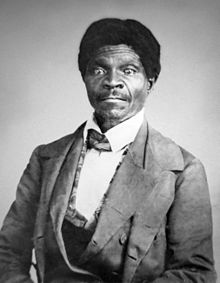
Dred Scott was born a slave in Virginia. His owner took him to Illinois and later to what is now Minnesota. Later, he was returned to Missouri where he eventually sued for his freedom based on his long residence in free states. The litigations passed through multiple trials, which Scott sometimes won and sometimes lost, and finally made it to the U. S. Supreme Court as Dred Scott v. Sandford.

Scott lost. Chief Justice Taney stated that any person descended from Africans, whether slave or free, is not a citizen of the United States, according to the constitution. He further stated that the government could not confer either freedom or citizenship to non-whites, and the Missouri compromise could not exclude slavery from the northern territories.

All this in the name of the constitution. It brought anger, the election of Lincoln, and the civil war.

At the end of the Civil War, the 14th amendment stated that “all persons born or naturalized in the Unites States .  . . are citizens.”  That did nothing to help the Chinese and later Japanese who came to this country, but could not be naturalized because they weren’t white. (again, see 306. White Men Only)

And it does nothing for the Mexican-Americans who came to America illegally because the laws made it impossible to come in legally. If you read yesterday’s post, and if you followed the link and actually looked at the Permanent Residence application form, you know this to be true. If we native born Americans were required to positively answer all the questions on that form, three-quarters of us would have to leave the country.

I respect the Constitution, but I don’t respect those who misuse it. Trickery and deceit gave Andrew Jackson his way, but this is not 1830, and it should not happen again.

Raven’s Run 124

Fifty thousand dollars, more or less. Green and gray, and full of lovely possibilities. No one would know if I took it. No one would know my noble sacrifice if I didn’t.

Fifty thousand dollars. Give or take. And I was about to take it when I heard the chatter and bang of an old car with a sad muffler as it rolled into Davis’ driveway. By the time it stuttered to a stop and I heard the door slam shut, I had shoved the money back into its box, and the box back into its hiding place. There was a dirty window high in the south wall of the garage. Standing on tiptoe, I could just see out. The car was a Trans-Am, about as ancient as my Pinto and not half as well maintained. The driver was a lean, hard boy of fifteen or sixteen in faded jeans and a ball cap that said, “WEED WORKS WONDERS”. Advertising the company business, I suppose. It didn’t seem wise, but Garberville is a narco-redneck town and probably nobody thought anything about it.

I knew he would find the broken window in the kitchen. I was planning to lay low until he started investigating the inside of the house, then split. Instead, he headed straight for the garage.

It didn’t take long to decide where to hide. There wasn’t all that much choice. I slid in behind the BMW, and reached for the .44. It was a reflex. I caught myself, and left it where it was.

I heard him come in while I hid behind the car, hunched over and keeping my feet behind a tire. The door closed behind him and his sneakers made little noise on the concrete. I could hear the partition being pulled back, and the metallic scrape as he pulled out the ammunition box.

He was taking my money! I almost stood up and challenged him, before I came to my senses.

Finally the garage door closed again, the old car coughed to life, and the boy roared back into the street and off toward the center of town. I straightened up and went to the partition. The ammo can was gone, but a similar one had been put in its place. Inside was an envelope, and in the envelope were pictures Harvey Jacks would have been proud of. They showed an aging, white haired man having sex with a girl who looked to be about thirteen. Whether it was love or rape would probably not matter to the girl. She was sprawled back, semiconscious. What she had been smoking was anyone’s guess, but it had been potent.

I had seen the man before. I couldn’t place him, but I knew that I should be able to.

I took the pictures. Three blocks of skulking through alleys, then I walked back to the motel. It was a hot afternoon and I needed a shower. And food. And time to think. more tomorrow

329. Green Card Blues

Just before Christmas, I wrote a post from the viewpoint of a little Mexican girl, born in the US, whose parents were about to be deported. I received a comment suggesting that the problem was caused by Mexicans breaking the law. I posted that comment because everyone has a right to his opinion.

Why don’t Mexican immigrants just follow the law? I’m no expert, so I did a bit of research. Here is what it says on the Homeland Security website.

Because more people want a green card than there are visas available, not everyone who wants a green card can get one immediately. Therefore, some people have to wait in line until a visa is available. The U.S. Department of State (DOS) gives out 140,000 employment-based visas each year. . . . Currently, about 234,000 people have employment-based adjustment of status (green card) applications pending in the United States and are waiting to get a visa.

And from the site of the North American Immigration Law Group

Each application must also be supported by evidence that the alien will not become a public charge.

That suggests the applicant has to already have an employee, or has to be rich.

According to information scattered through half a dozen websites, the wait for a visa can easily take up to nine months. I can’t credit this to an official source, so call it a strong rumor.

Okay, let’s say you have a visa? That gets you over the border, but to stay, you have to apply for permanent residence. So what does that application look like? Here are some excerpts; you can download a PDF if you want to look at the whole thing.

List your present and past membership in or affiliation with every organization, association, fund, foundation, party, club, society, or similar group in the United States or in other places since your 16th birthday. Include any military service in this part. If none, write “None.” Include the name of each organization, location, nature, and dates of membership. If additional space is needed, attach a separate sheet of paper.

Have you received public assistance in the United States from any source, including the U.S. Government or any State, county, city, or municipality (other than emergency medical treatment), or are you likely to receive public assistance in the future?

Have you EVER been a member of, or in any way affiliated with, the Communist Party or any other totalitarian party?

Have you EVER received any type of military, paramilitary, or weapons training? 

These are a few of the most egregious questions found in five tightly packed pages of questions. It looks a bit like an IRS tax form on steroids.

If you were a Mexican doctor or businessman facing this document, you would set down for a hour with your lawyer and all would be well. But what if you were an uneducated, non-English-speaking farm worker?

Trump wants to build a wall. There is already a wall, built of paper, keeping poor and uneducated Mexicans from legally entering the US, and sending them across the border illegally to find work to feed their families.

This post is only a first look at a process full of complications and permutations. I’ve followed the paper trail as far as I care to. Knowing the full story of any government program would take a lifetime, and I have other things to do. But I have one more question to ask:

Is the system set up this way to turn Mexican laborers into virtual slaves, afraid to speak up from fear of the INS? No one can answer with certainty. But we can suspect, and I do.

Raven’s Run 123

People make too much of burglary. It isn’t brain surgery. I broke the window in Davis’ kitchen door and let myself in. I was wearing rubber gloves and carrying the .44 out of sight under my shirt, with a pocket full of spare ammo. No alarms sounded as I entered. Either there were no alarms, or they were silent. I went through the kitchen quickly, and moved into the living room, deciding where to begin my search. After the incident in Jacks’ office, I was in a state of high readiness, but nobody came boiling out of the woodwork. In ten minutes I had made one quick pass through the house, memorizing the layout. No one had come to shoot me, so I went methodically to work.

It takes time to properly search a house. Davis’s place had two bedrooms, a kitchen, a living room and all the personality of a Holiday Inn. He had a rack of shotguns and rifles in the hall leading to his bedroom. Recreational weapons: a twenty gauge over and under, a long barreled 12 gauge pump, and a lever action .270 Winchester. His business weapons were in a suitcase at the back of his closet: an assortment of nine mm. automatics and a sawed off double barrel shotgun. There was a bag of suspicious looking white powder taped under the bathroom vanity, and a wad of pot stowed more casually in a shoe box under the sink. 

He had pants and shirts and shoes and flour in a bag, and coffee in a can, and all the thousand and one things we all have in our houses. I looked at it all, and none of it gave me a clue that would help me get Raven out of trouble.

*       *       *

It took hours to search Davis’ house. Then I started on the garage. Fortunately, Davis hadn’t been a keeper. There was a BMW, a bicycle and a lawn mower, a toolbox with wrenches and screwdrivers . . . and fifty thousand dollars in wrinkled bills stuffed down into an ammunition can and hidden behind a false partition.

I say fifty thousand. I didn’t count it, but I counted a handful and did a quick estimate. They were twenties and fifties, and there were a lot of them.

It was interesting fodder for speculation. If Davis was carrying the money for his boss, it certainly would not have been left untouched all these weeks since his death. It could be his share of the profits, but it didn’t look like the place a person would put his life savings. It looked like a hurried hideaway. Was he skimming? Maybe. Did it have any bearing on Raven? Probably not.

I sat for a while, just looking at the money. I’ve gotten used to being broke, but I don’t like it. Fifty thousand is no fortune, but it was more money than I’ve ever seen in one place before. Or might ever see again. And no one else knew it existed. And it was certainly drug money. My enemy had no legitimate claim on it and it could not be returned to his victims. more tomorrow