Author Archives: sydlogsdon

586. Slogging Toward Space

One of the things I have to offer is a viewpoint that reaches back half way through the twentieth century. That can be a problem, actually. I don’t want to talk about the good old days. Fortunately, I never thought the good old days were all that good. They were, however, both exciting and hard.

It has become almost cliché to point out how little computing power the Apollo 11 computer had, but there are a thousand other instruments which we take for granted now, which were also not available during the early space program. I used a few of them myself, early on.

Some of these instruments became fossilized into early science fiction, as in Slip-stick Libby, one of Heinlein’s regular characters. Slip-stick was a slang term for a slide rule, an instrument of sliding scales which was used in computation. It was only good for estimating to about three significant figures. I learned to use one in high school in 1966. Early Texas Instrument portable calculators made them obsolete a few years later, although you will still see them in use at Mission Control when things began to go bad in the movie Apollo 13.

Another nearly obsolete instrument from the Apollo era is the theodolite. I learned to use one in the same class. We took it out to the back lot of the school for some practical examples of the uses of trigonometry. We didn’t call it a theodolite, however. We called it a transit, which is somewhat less accurate. Real surveyors called it a gun.

A transit measures elevations and angles. You level the instrument on its tripod and align it to true north, then you look through a telescopic sight, with crosshairs, at a distant target, usually a rod with red and white inch markings.

(We’re talking sixties here — everything in America was in inches, feet, and miles.)

This instrument was used in surveying everything from house foundations to radar installations before lasers replaced them. It gave you direction. It didn’t give you distance. For that you walked, dragging a measuring device called a chain.

The dictionary will tell you that a chain is a unit of length equal to 66 feet, subdivided into 100 links. It may not tell you that a chain (of length) was represented by a heavy, physical, steel chain that the rod man dragged behind him — for thousands of miles during a career.

Today, laser radar does it all.

An alidade or plane table worked like a transit except that it was attached to a narrow steel plate which moved freely on a plywood table. It was used for mapping. You would slide the alidade around on the table, over a sheet of paper, take your sightings, and use the edge of its base as a ruler. It allowed you to  draw a map as you went. I used one of them two years after high school at an archaeological site in Bay City, Michigan.

To fully understand what a tremendous undertaking the space program was, you should remember that a line of radio/radar stations was built all around the world to track spacecraft in orbit. At the same time, the same Russian missiles which scared American into the space race had to be watched for. A line of radar installations (the DEW — distant early warning — line) was built across Canada for that purpose.

The building of these two sets of installations was an immense undertaking. Even before the first foundation was laid, the positioning of these instruments had to be determined to the highest possible tolerances. This was done by survey engineers working with transits and doing their calculations by hand, with rod men dragging chains. A slide rule might provide estimates, but after that it was paper, pencil, and mathematical tables — which had themselves been calculated by hand.

The word calculator first meant a person who calculated such tables. By hand.

These engineers didn’t all come from Harvard, or other prestige colleges. There were thousands of them, possibly tens of thousands, and they came from every college in America. Bear that in mind as we contemplate the present college entry cheating scandals.

Speaking of which — prestige colleges my &#^$%!  Math is math, whether you learn it at USC or Palomar Junior College.

===============

I want to introduce you to a survey engineer you have never heard of. He is a distant in-law, a fine man I only met once. I ran across a decades old newspaper clipping of his obituary the other day, and it triggered this post.

I’m appending a copy of that clipping, minus family matters, to give you an idea of how the space race, and the missile defense of America, looked from the mud below. The gentleman’s name was William Mussetter.

===============

Mr. Mussetter graduated from Willmington College in 1917 and also attended Haverford College in Haverford, Pa. He retired after working 40 years in government service as an astronomical geodetic engineer. He served with the US Coast and Geodetic Survey, Army Map Services, InterAmerican Geodetic Survey United States Department of Foreign Services where he worked in many different countries.

Mr. Mussetter was a veteran of World War I, serving as a second lieutenant. In World War II he served as a captain and taught artillery.

At the end of the World War II, Mussetter received a call from Washington, D. C. He was assigned to head a survey group to be based in Panama and to work in south America, principally on the west coast of Chile, Peru, Ecuador, Columbia to Venezuela. This project lasted four years.

The Mussetters came home to Wilmington and he worked with the Ohio State University doing contract research for the U.S. Air Force. There was a need to connect the continents of the world, locating them with respect to each other, then to lay out guided missile courses from Cape Canaveral to the Bahamas. [This means during the early testing of IRBMs and ICBMs, before they began to be used to launch space vehicles. The same tracks were used through Mercury, Gemini, and Apollo. See 578. That Odd Spiral.]

In 1953, he transferred to the U.S. Army Corps of Engineers to define the Earth’s parameters, its diameters, flatness at the Poles and other data. [We are talking about building the DEW line here.]

He worked with a survey team measuring the arc of the Meridian at 30 degrees East Longitude from the Mediterranean Sea at Egypt to South Africa, down through Egypt, the Sudan, Uganda, Belgian Congo, Tanganyika, and into North Rhodesia; 4800 miles. [Many of these names no longer exist.] He also did some survey work for the Aswan Dam on the Nile River.

In 1964 he was sent to Antarctica, to Byrd Station, and the South Pole.

He had retired in 1964, but during the last four months of 1964, he worked in Peru, S. A. on a contract for a hydro-electric project; and in 1966 he was sent back to Afghanistan for three months, to inspect the work that was begun in 1961, and complete the Tri-lateration of Afghanistan.

===============

All this without a computer. Imagine that.

585. A Life of Reading

Trying to write a post on The Road to Corlay has turned out to be tough. I remember the book clearly, and I didn’t remember it at all. That is, I remember how I felt when I read it. I remember the feel of its countryside, and the slow grace of its human interactions, but I can’t remember one name, and can hardly remember one scene. I would drop the whole thing, but I “made my brag” by posting the list early. I need to read Corlay again, but that poses a problem. I don’t have the time.

It was scheduled for today, but I’m going to have to postpone it for now.

I retired from teaching about seven years ago and went back to writing full time. I had written quite a few books in the seventies and eighties, before hunger sent me to get a day job, and a few more while I was teaching, but that wasn’t nearly enough to satisfy me. Don’t get me wrong; this isn’t about mortality. I plan to live to be a hundred because I’m just too damned busy to die.

The fact is, reading a book is ten times better than watching a movie, but writing a book is fifty times better than reading one. And takes fifty times as long.

Besides the hundred thousand words a modern novel demands, there are the other hundreds of thousands of words you have to go through while getting to the right ones. And there are all those books you have to burrow through looking for just the right bit of information or inspiration to help you understand how that next chapter is supposed to come out.

Just reading a book for fun gets lost somewhere. I read the things I need to read, and late in the evening I read comfort books, like the thirtieth Nero Wolfe, which isn’t that different from the other twenty-nine.

It wasn’t always that way.

I was an only child on a farm in the fifties. We had one black and white TV that got two channels, which my parents watched while I read. Of course I became a reader; what else was there to do. From the time I discovered the county library, there was no time I didn’t have a stack of books awaiting my attention.

But I didn’t talk about it. My mother read occasional romance novels but she didn’t talk about it. My dad read the Bible, but he didn’t talk about it. The habit started early.

I read books about hunting and outdoor life. I lived outdoors, but on a tractor. I never hunted, barely fished, and I had never seen a tent. The real outdoors wasn’t for play, it was for work, and that didn’t satisfy me.

Looking back, I know that the place I lived as a boy was rather lovely, in a muted sort of way. It was farm country, lightly populated by humans, but with plenty of birds, and occasional coyotes and possums. Nevertheless, every patch of ground was either under the plow or turned into grazing land. There was nothing truly wild. I wanted forests and streams, fish and game, and snow, along with the freedom to wander through them.

It was all available in books, along with a thousand other adventures all over the globe.

My school mates read because they had to read — but nobody talked about it. Nobody read science fiction. Nobody wanted to know any more about science than they were required to. I was reading and studying continuously, preparing to head for college to be a scientist — but I didn’t talk about it, because no one else really wanted to know.

When I got to college, one of my roommates was a science fiction fan. We talked about it, but only a little. By then, my habit of silence was pretty well set.

A lifetime later I started this blog. It’s the first time I’ver really talked about the books I love and why I love them, right here, talking to you —

Hi. You see, there was this book called The Road to Corlay . . . but I guess we’ll just have to chat about that later.

584. The Old Man and the Sea

Back when the Great American Read was happening I promised my own best list. I tried for a long list and settled for fifteen, of which I have presented twelve so far. Looking at that list, I find that only three were written by “classic” authors. Today’s entry is one of them; Stevenson and Dickens were the other two. The other twelve choices just write better than most of those old guys.

I once said that Hemingway is the greatest writer who ever wrote a novel where the hero won a fight, made love to a woman, caught a fish, and died on the final page. I wasn’t referring to Santiago’s fish, but to all the fish his heroes caught in a sporting fashion in nearly every book he ever wrote.

Hemingway was the master of a small set of circumstances, but those did not represent all of the human condition — not even a significant chunk of the human condition. Shakespeare wrote about all of mankind. Hemingway wrote about roughly 1%.

What he wrote was wonderful, if you thought like he did. But it didn’t have much depth or breadth, and it certainly never tackled a situation where there were two ways of looking at something. There was only one way — his way.

I have to be a bit careful here, so you don’t think I’m trashing him. I love to read Hemingway. He is a fine writer, within his limits. He isn’t a great writer. He isn’t even close. His focus is too narrow and his reach is too small. But I still love to read him.

Hemingway won a Nobel prize for literature. If he had won it for The Sun Also Rises or For Whom the Bell Tolls, that would bother me, but he won it for his masterpiece, The Old Man and The Sea.

It’s likely that you have read The Old Man and The Sea; most people have. Hemingway’s style was minimalist, which makes him easy to read, so he ends up on a lot of high school required reading lists, and The Old Man and The Sea is his shortest book.

In case you haven’t read it, Santiago, an old Cuban fisherman, hasn’t caught a fish in months, but he still goes out every day. We see him first in preparation for another trip, then we spend the day with him. Eventually, he hooks and lands a giant marlin. This amounts to too much success; he can’t get it into his small boat, so he has to lash it alongside. Then he spends painfully long hours bringing it in, while sharks tear it to bits. He reaches shore, with only a small portion remaining. The next day, he will have to go out again.

It doesn’t sound like much of a plot, but that is the point. It isn’t about what he does, but about how he does it.

I think there are two reasons that The Old Man and the Sea worked so well, one minor and one major. The piece is short. It is not a novel by any reasonable reckoning, but a novella. Hemingway is a man with a few ideas which he presents well. The Old Man and the Sea let him say everything useful he had to say, without padding or repeating.

More importantly, Santiago spends most of the book alone. He does not have to be a man before women. He also does not have to be a man before other men. He can simply be a man.

He didn’t have to win a fist fight. He didn’t have to have sex with a woman. (The term “make love” does not really apply to anything Hemingway wrote.) And when he caught the fish, it was a real fish to sell for pesos, not some allegorical event.

He also didn’t cop out by dying on the last page.

Let’s look at a short passage. Santiago is alone at sea in a small boat, so he his talking to himself.

Don’t be silly,” he said aloud. “And keep awake and steer. You may have much luck yet.”

“I’d like to buy some if there’s any place they sell it,” he said.

What could I buy it with? he asked himself. Could I buy it with a lost harpoon and a broken knife and two bad hands?

“You might,” he said. “You tried to buy it with eighty-four days at sea. They nearly sold it to you too.”

The first time I read The Old Man and the Sea, in high school, I missed that passage. That is, I read it, but I read it wrong. I read it like it was something from television.

Let me I tell you what I heard on TV this morning, so that will make sense. The pitch woman for a self-help book said, “You won’t get your dream job right out of college. But if you work, you will get it eventually, when you find the job you were meant for.”

She actually said meant for! This is Christianity turned up a notch, and given a bank loan. It was also, by actual count, the five millionth time I had heard that particular load of crap.

“Everything happens for a reason,” is the pure quill version of this notion. And floating in the air, unsaid but understood, is the implication that the reason will be for your own good. Work hard and you will succeed. If things don’t seem to be going right, it is just life’s way of getting you ready for better things to come.

The Great American Lie.

The flip side of the GAL is that, if you don’t succeed, you weren’t trying hard enough, because “Everything happens for a reason.”

Hemingway knew better. Santiago knew better. He knew that 84 days of trying wouldn’t buy you any luck. When I was in my teens, I read that it did, even though the words on the page were clear enough. When I read Santiago’s statement a few years later, I read it like Hemingway wrote it. I had learned a few things by then.

583. Mutually Assured Destruction

I taught middle school science for twenty-seven years, and every year I taught the manned space program. It was never called for in the required curriculum, but I always managed to shoehorn it in while still teaching everything I was required to. It wasn’t just because I loved the subject, although I did. There were plenty of things in science that I loved but never mentioned.

The plain fact is that seventh graders don’t listen unless you excite them, and the manned space program was exciting.

Here is a schtick I used in my middle-school classroom all through the eighties and nineties. The subject was, “What motivated Americans who didn’t care about space to spend billions to outrun the Russians in the Space Race?”

I would choose two pushy, self-assured young guys and call them to the front of the room. I would put them face to face, about ten feet apart, and say, “Now, imagine each of you has a .45 automatic, and each of you hates the other one. We’ll call one of you America and the other Russia. I don’t want to insult you, so I won’t say which is which.

“Point your guns at each other. (They would gleefully assume the position.) If either one of you fires, the other will have just time enough to pull the trigger, too. You will both go down. If you sneeze, though, you’re a goner. If you blink, you’re a goner. If you look away, same thing.

“Now hold that pose for fifty years.”

Clearly, I couldn’t get away with that today, but this was pre-Columbine. My kids were thinking about cops and robbers, not  a terrorist who was out to kill them.

Do I have to point out that the guns represented the American and Soviet nuclear armed arsenal of missiles? It was a demonstration of Mutually Assured Destruction, also known by its entirely appropriate acronym MAD. If either side had attained an overwhelming superiority in number of missiles, the delicate balance would have been disrupted. Witness the Soviet’s parading their missiles in Moscow, and taking them several times around the block to look like they had more than they did.

The balance could be disrupted by having missiles closer to the enemy than the enemy did to us. Witness secret American missile bases in Turkey, on the Soviet border, which led them to put missiles in Cuba. The Cuban Missile Crisis was not an unprovoked Soviet threat.

The balance would have also been disrupted by an effective missile defense system. There is no such thing as defensive in the MAD scenario.

What does this have to do with space travel? Two things, one positive and one negative. The entire business was a race for the nuclear high ground. If either side had managed to put an orbital missile platform into orbit, it would have been bad news for the other side. That was not possible, so each side tried to maximize their capabilities in space while proving to the hundred plus other nations on the Earth that they were the firstest with the mostest.

I would repeat that in Russian if I could write Cyrillic.

All this turned into the Space Race, culminating in a manned lunar landing, It’s nice that something good came out of all that nonsense.

The other side of the coin was a reinforcement of fear of nukes, whether it was bombs, powerplants, or space drives. In the fiction of the sixties, the solar system was filled with nuclear powered spacecraft. In the real world, fear killed the idea.

Should we have nuclear spacecraft? I think so, but it isn’t for me to say. It isn’t for you to say, either. It isn’t even for the people to say.

Why? Because we’ve shifted our focus from the Russians to the Chinese.

If history is a guide, we will have a nuclear spacecraft — a few years after the Chinese launch their first one. We’ll be running behind and playing catch-up as usual.

Remember Sputnik?

582. Newtonian Nukes

Everybody who read the last generation of science fiction juveniles before Apollo knew Newton’s third law:

For every action, there is an equal and opposite reaction.

The demonstrations in popular science books of that same era usually went something like this: imagine a person on a frozen pond wearing ice skates, throwing bricks. Every brick he throws will move him backward. If we could ignore the friction of skates on ice, it would be proportional. That is, if a hundred pound man  . . .

Okay, side issue. Most Americans back then, and even today, don’t think in kilograms or kilometers, nor distinguish mass from weight in everyday thought, so . . .

If a hundred pound man throws a one pound brick at ten miles per hour, it will propel him backward at one tenth of a mile per hour. 1 times 10 = 0.1 times 100. We are ignoring friction from the ice, the atmosphere, and probably a bunch of other things.

So, if you want to go faster, throw more bricks, right? If you throw a thousand bricks, you should be able to go pretty fast, right? Wrong, because the first brick your throw in the new scenario will have to move not only the hundred pound man, but also the other 999 pounds of bricks.

Increasing the amount of fuel carried quickly brings about diminishing returns. More fuel alone is not the answer.

In a Newtonian scenario, the faster the propellant leaves the rocket engine, and the more propellant you use, the faster you can go. LOX and LH are probably near the practical  maximum for propellant speed by chemical reaction. The logical next step would be to use a non-chemical energy source to activate our propellants, such as a nuclear powered rocket. Even that won’t get us to the stars, but it makes sense for travel inside the solar system.

Before Apollo, everyone who read science fiction knew that, which is why the Scorpius and her sisters in the Rip Foster book are nuclear powered. So were the ships in Bullard of the Space Patrol, a marvelous fix-up novel by Malcolm Jameson that no one remembers today. So were the ships in the Dig Allen series (1959 – 1962), six great but forgotten novels, and the ships of the Tom Corbett books, which were not so great and are not completely forgotten.

Star Trek put all these early concepts out of business. Warp speed was a necessity for roaming the galaxy, but it made nuclear rockets look old fashioned. I think that’s too bad. There is still room for them in science fiction, and certainly in real life.

I haven’t mentioned Heinlein yet. The Rolling Stone was nuclear, but he quickly moved on to torch ships, which had the capacity of total annihilation of matter. He never explained how that could be done, but the result would be “propellant” moving at essentially lightspeed. You can’t get faster than that without warp drive. His torch ships roamed the solar system and went on to explore nearby stars.

I stole that schtick for my coreships in Cyan, with a twist. See 23. Star Drives.

In a rational world — which we will probably never inhabit, but we can still write stories about — you would use chemical rockets to get to LEO (low Earth orbit), nuclear powered rockets to zip around the solar system (fission powered if you were writing in the sixties, fusion powered if you were writing today), and “torch ships” to reach nearby stars. Beyond that, you would need FTL (faster than light) vehicles which, by our present understanding of the universe, are impossible.

Too bad about FTL, but why are we still using chemical propellants in the real world fifty years after Apollo? Fear of nukes, of course. There will be more to say about that on Wednesday.

581. The Traveler in Black

(The traveler in black) has many names, but one nature, and this unique nature made him subject to certain laws not binding on ordinary persons. In a compensatory fashion, he was also free from certain other laws more commonly in force.

John Brunner was a successful and popular author of science fiction and fantasy, but he is rarely mentioned in the same breath with Clarke or Asimov. He has fifty-nine books listed inside the cover of my copy of Traveler, and he won a Hugo for Stand on Zanzibar, but he never quite made it to the top rung of the ladder. I have a theory about that.

The blurb-quoted reviews on the back cover of my Traveler praise Brunner for his competence. Competence may get you to the party, but it doesn’t make the fans gather ’round you once you are there; and that isn’t completely fair either, since he once wrote a book that was as good as any in science fiction or fantasy. The Traveler in Black was his Old Man and the Sea.

My theory is that, like Clarke, Brunner was an idea man. His characters have just enough blood in their veins to carry the ideas, and not one drop more. Zanzibar is a prime example; all the characters in that novel were cyphers. It was a big book about big ideas, populated by little tiny people.

Traveler avoids the curse of dull character by the oddest of twists; the traveler has no character at all. His character is to not have character. And it works.

The traveler moves through a world of chaos, having no will and no agenda, and changes everything. He is cursed-blessed-given-created to answer wishes in the exact words they were asked.

It’s like a wishing well with a mean streak, but there is no mean streak in the traveler. He sadly shakes his head and does what he was created to do — gives people exactly what they ask for. And since people aren’t too bright, they don’t see the consequences that will attend their wishes. They almost always get what they really didn’t want. Many do not survive their wish fulfillment, and no one survives unscathed.

As you may guess, this uses up a lot of lesser characters. These are précis people; sketched out in a few words and gobbled up by the march of change. Only the traveler survives.

This sounds a bit like a Mad magazine view of history, but Brunner pulls it off through the non-personality of the traveler. He has no backstory. He has no motivations, only the geas to grant wishes. He is slowly carving reason out of chaos by letting chaos devour itself. There is a tremendous cost in human suffering, and the traveler witnesses it all, unable to warn or advise, compelled to grant whatever wish he encounters, whatever the cost to the wisher.

We don’t hear him think about this. He does not converse, although he is often the object of conversations. We only know his inner feeling by a shake of the head, a hesitation to speak, and the slow pace of his progress through the world. That this is one sad and weary entity is only acknowledged in passing. It is all a game of subtlety, conveyed by the stately beauty of the language in which it is written.

Traveler is a fix up novel of individual stories previously published in SF magazines, and stitched together by the traveler himself. It comes in two versions. The one I read first, many years ago, was called The Traveler in Black. Its cover is pictured here. The cover pictured at the top of the post is a later version with one more story called, of course, The Compleat Traveler in Black.

The odd spelling is a literary reference. I won’t elucidate. I’ll just let you feel superior if you recognize it.

580. Pavane

During the Golden Age, most science fiction was in the form of short stories, published in science fiction magazines. When paperbacks became popular, there was a need for novels, mostly short by modern standards. Authors and editors mined the SF magazines for interrelated short stories that could be linked together and somewhat rewritten to appear as if they were novels. They became known as fix-up novels. The next three on my best list are all fix-up novels: Pavane today, The Road to Corlay (set for April 17, but these things sometimes change), and The Traveler in Black this Wednesday.

Pavane by Keith Roberts (publication date 1968) is not to everybody’s taste, but is one of my all time favorites. It is an alternate universe novel, set in the twentieth century in a world where the Catholic Church has maintained its power. The universe-changing event was the assassination of Queen Elizabeth the First, shortly before the arrival of the Spanish Armada.

Of course, the people of Pavane don’t know that they are an alternate. Their world is simply the world. Other than a brief introduction, the novel is written from that perspective. Things are explained, as they must be in any novel, but only enough that someone in the world of Pavane would understand.

(If I wrote a story about a blacksmith, I would explain enough that a college student could understand, not enough for an alien from Alpha Centauri to understand.)

This makes Pavane a bit challenging, but Roberts does his job well. The challenge is slight, and the reward is an abundance of ambiance.

Pavane takes place in a cold, hard world, and the characters fit their situations. Jesse Strange, in the first story The Lady Margaret is so dedicated to the family business (haulage by steam road waggons) that he passes up love and ignores friendship. Rafe, the student signaler, is engaging, but doomed. The story of the artist Brother John is positively grim.

All this sounds like I’m saying, “Don’t read this book,” but in fact I give it my highest recommendation. You will be forced to confront this alternate culture by digging deep into what makes it work, and any time one has to learn another way of thinking from the inside, the mind and the heart are enriched.

The ending called Coda is a disappointment. Roberts gets up on his soap box for a brief but embarrassing moment to try to justify his culture. Cultures don’t need justification; they just are. And every one of them, including yours and mine, is a mixture of joy and horror.

Probably the most notable part of the novel is the sheer beauty of the writing. At least, that is my take. I have found beauty of writing to be extremely subjective, but Pavane hits the sweet spot for me. I invite you to see if it hits yours.

One thing for sure. Thirty pages in, you will already know if you love it or hate it.

Pavane is available used or e-book from Amazon, or if you are lucky at your local used book store.

579. Guilt

How many times have you seen it: the massive city, the grinding machinery of the state, the downtrodden under the wheels of the machine — it’s a classic dystopia. One man (or, rarely, woman) fights back, foments a rebellion, and it all comes crashing down, ushering in a new day.

End of movie or novel.

Well, maybe . . .

It seems to me that this trope has been overused. I have no real argument with all those stories that end with the destruction of a dystopia, but I was looking for something a bit more subtle in Like Clockwork. There is something resembling a downfall (you’ll get no spoilers here) but it doesn’t come at the end, and those who bring it about have to face the reality of what they have done. Here’s a taste.

(Hemmings) laid his head on his crossed arms. His heart hurt.

Life may be nasty, brutish, and short. Life may be eternal in the lap of Jesus. Or life maybe a recurring year, extended far too long, but it is still life. And Hemmings had taken the lives of men who had done him no wrong.

He had not known the others who had died, but he clearly remembered the guard at the waggon door. He grieved for him.

I know exactly where this scene originated.

I was a young teen. I had recently discovered the local public library and my hundredth-or-so book was Underwater Adventure by Willard Price. Overall, it was a good book, although no better or worse that the average I was reading at the time. However, one scene knocked me out.

The villain, posing as a friend, went for a dive with the mentor. The two brothers who were the heroes of the book were elsewhere. The villain contrived to have the mentor trapped underwater, and left him there to drown.

Two things about this affected me. First, the mentor did not make a brilliant and heroic escape. He actually did drown. Second, the villain — who was pretty scummy and eventually came to a well deserved bad end — came up out of the water full of remorse. Not enough remorse to go back and save the mentor, but enough to be shaken.

The scene was told from the villain’s perspective. In that moment, I identified with him far more than I had identified with the cardboard heroes. Through him, I came to an understanding of how it would feel to take the life of a good man. It was something worth knowing, and something a bit more real than most of what I was reading at the time.

So here I am, decades later. I have a debt to Willard Price for that moment of clarity, and I’m paying it forward.

578. That Odd Spiral

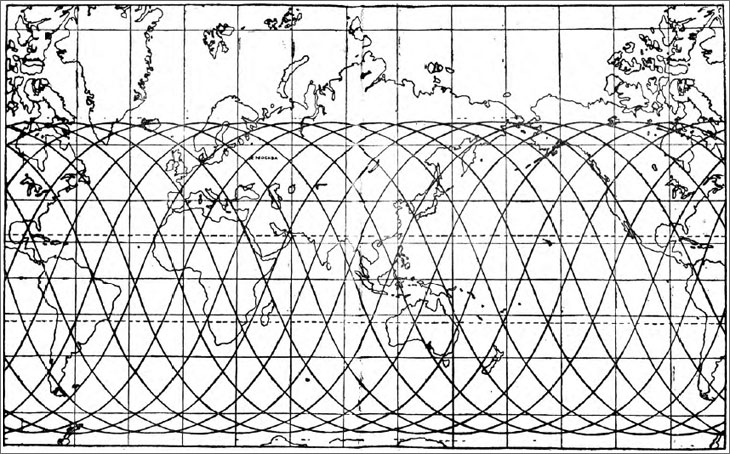
This is the track of Sputnik, the first satellite launched from Baikonur Cosmodrome at latitude 46 degrees north. Launches from Cape Canaveral followed paths that were more flattened out because they were launched from 28 degrees north.

The orbital path shown above was to be found in thousands of publications at the dawn of the space age. Everyone carried the image in their heads, but today I had a hard time finding it on the web. My how times change.

Every space geek in 1960 would have known everything in this post, but then Star Trek came along. Kirk and Spock, and especially Uhura, went at warp speed and walked around on the floor like it was a sound stage in Hollywood. No weightlessness there. Then Star Wars came along and all veracity went out the viewplate.

There were a lot of very basic principles of physics that governed the space program, which Hollywood had to ignore.

Let’s begin on the ground. The Earth rotates eastward at a certain number of miles per hour. (We are channeling 1960 here. None of the published reports on space used the metric system back then.) Any geek with a pencil could figure out rotational speed by dividing equatorial circumference (25,000 miles to any 1960’s space fan, forget the decimals.) by the length of the day. !042 miles per hour eastward at the equator.

A spacecraft in low Earth orbit flies at 17,500 miles per hour. Actually that varies, but that was the figure in all the space enthusiasts books at the time. If you launched a rocket eastward, you started with about 1000 mph of free speed. If you launched westward, it would cost you 2000 mph of extra speed. You wouldn’t gain the natural advantage, and the rocket would be going 1000 mph the wrong way as it sat on the ground.

Everyone launched eastward.

There was actually another reasonable option, launch north or south. We’ll look at that choice at the bottom of the post.

Actually you don’t get all of that speed advantage. The circumference of the Earth is less as you move northward, lowering the eastward speed. If a United World wanted to choose the most advantageous place for a spaceport, it would be at high altitude somewhere on the equator. That happened frequently in science fiction.

Neither America nor Russia had a far southern point suitable for a space port. America’s best choices were Texas and Florida — the same two states Jules Verne pointed out in From the Earth to the Moon. Florida had the added advantage of having the Atlantic ocean to eastward, which provided a place to drop first stages and failed rockets, without landing on anybody’s house.

Russia built in the desert at the same latitude as Portland, Oregon, but they always chose secrecy over other factors.

Launching eastward is an exaggeration, of course. Straight east from either site won’t work; launches had to be aimed south of east to bring the center of the orbit into line with the center of the Earth’s gravity.

You might think that a launch from Canaveral would return to Canaveral after one orbit, but that isn’t true. The Earth is rotating eastward, so a spacecraft launched from Canaveral will pass over a spot about a thousand miles west of Canaveral on its first return. And so forth. Which is why the cosmonauts were a thousand miles off target after one extra orbit in yesterday’s post.

All this gives us that odd spiral at the top of the post.

In fact, you could launch a spacecraft into orbit from any point on Earth as long as its orbital path circled around the Earth’s center of gravity. Further south is simply more efficient.

You could even launch satellites due north, and we do, from Vandenberg Air Force Base on the west coast of California. Such satellites also spiral around the Earth, but they cover every part of the Earth eventually. Weather and spy satellites use this orbit.

Southeastward launches from Canaveral and Baikonur don’t cross over the far north or the far south.

What about a satellite exactly circling the equator? In low Earth orbit, it would circle the Earth about every 90 minutes. The moon, a quarter of a million miles further out, circles the Earth in 29 1/2 days. Clearly, even for math challenged enthusiasts, the further out the satellite, the slower it travels in orbit. At some distance from the center of the Earth, it would take a satellite one day to circle the Earth. Seen from Earth, it would appear to hang in one spot above the equator.

Everybody should know that, because that is how communication satellites work. The first person to recognize the fact and calculate the distance was Arthur C. Clarke, known even to non-SF readers from 2001, a Space Odyssey. The connection between science and science fiction has always been close.

577. The First Space Walk (2)

The space suit worn by Alexei Leonov on the first human space walk. On display at the Smithsonian National Air and Space Museum. Author: Nijuuf

This is the rest of Tuesday’s post. If you haven’t read it yet, take the time to do so, or this won’t make much sense.

Alexey Leonov had extreme difficulty reentering the airlock. His space suit had over inflated; the boots and gloves had slipped beyond his toes and fingertips, and his suit had increased in girth. He had to vent part of his rapidly depleting oxygen in order to bring his suit down in size, and even then he entered the airlock head first, instead of feet first as planned. Once inside the airlock, he had extreme difficulty contorting his body to close the outer door. All this time, his body was heating up dangerously; surrounded by vacuum, there was nothing to carry away the heat his body was generating.

Once air pressure had been restored in the airlock, Belyayev opened the inner door and Leonov was safe. For the moment. As he said in an article for Smithsonian’s Air and Space magazine in 2005, “the difficulties I experienced reentering the spacecraft were just the start of a series of dire emergencies that almost cost us our lives.”

The mission had achieved it’s goal and it was time to return, but just before the scheduled time for firing retro rockets the cosmonauts discovered that their automatic guidance system was malfunctioning. It took time to prepare for manual entry, so they had to wait one orbit, which would make them miss their return point by a thousand miles. (To find out why it would be a thousand miles, see the post coming on March 25.) Most of that orbit they were out of radio communications. (The Americans had built a string of radio relay stations around the world to maintain constant communication with their astronauts, but the Soviets had not.)

When communications were restored, ground control asked them where they had landed.

Their orbital path was set; the moment of firing their retro rockets would determine where on that orbit they would land. They chose a target just past the Urals. Using the clumsy and difficult manual backup equipment, they achieved the correct attitude and fired the retro rockets in the conical rear portion of the craft called the orbital module. The orbital and landing modules were supposed to separate ten seconds after retrofire. They didn’t.

The two cosmonauts knew immediately that something was terribly wrong. Instead of the steady press of force against their backs as they decelerated, they found themselves whipped about by confused forces that exceeded ten gravities. A communication cable between the two modules had failed to release, and now both modules were whipping about each other, tethered by the cable.

Finally, about 60 miles up, the cable burned through and the cosmonauts were freed. The drogue chute deployed, and then the main. All was peaceful and in order – briefly. Then it became dark as they dropped below cloud cover, the final rocket fired to slow them to landing speed, and they touched down in six feet of snow.

They were 1200 miles beyond their intended landing point.

They blew the explosive bolts to release the hatch. It didn’t open. They had landed in the middle of a forest and the hatch was held shut by a tree. By yanking violently they dislodged it and it fell away, lost in the snow.

They made their way out of the spacecraft and waded through snow to a small clearing. Those back at headquarters had not heard their landing signal, but a passing cargo plane had. It circled, and was soon joined by other planes and helicopters, but none of them could land in the rough taiga. Pilots threw a bottle of cognac; it broke. They threw warm clothing which got caught in the trees, but at least two pairs of wolfskin boots made it to the ground.

The light was failing. The cosmonauts returned to their craft for shelter. Leonov was walking in calf deep sweat still trapped in his space suit from his space walk. Both cosmonauts stripped, removed the liners from their space suits and wrung them dry, then put the on again along with the wolf skin boots. They abandoned the useless space suits and crawled into the landing module for the night, well aware that the taiga was filled with bears and wolves, and that this was mating season, when they were most aggressive.

The hatch was out of reach. The lights failed, but the circulation fan ran all night, adding to their misery. The temperature dropped to 22 below zero.

A rescue party arrived on skis the next morning; they chopped trees to build a small log cabin and a big fire. The cosmonauts spent a second night, then skied out to where a second, larger party had chopped down enough trees for a helicopter to land.

I guess they made ‘em tough in those days. I suspect they still do.