Author Archives: sydlogsdon

A Graveyard Christmas 1

Charles Dickens invented Christmas.

That is an oft repeated observation; an exaggeration of course, but not that far from the truth. His book A Christmas Carol written in 1843 forever changed the holiday. That story has become a part of the world’s DNA, and has been represented in numerous films, cartoons, and rewritings, frequently of low quality. I’m sure that anyone in America above the age of five has seen some version.

Dickens wrote four other Christmas novellas, which I have referred to in the past. In fact I have made so many references to Christmas, real and literary, that I will be providing a list of links on the twenty-fourth.

There is one more Christmas tale that will appeal to completists. It is part of the Pickwick Papers, but it sometimes appears separately. I present it here because it is somewhat hard to find. You will see that it presages the same themes that Dickens returned to in A Christmas Carol, although Gabriel Grub in this version is meaner than Scrooge, and less warm and fuzzy after his redemption.

I don’t return to this tale often, but I wouldn’t have missed reading it once.

By the way, my post title is accurate, if odd, and designed to pique the interest of search engines. Sorry about that.

            Syd Logsdon

The Story of the Goblins Who Stole a Sexton
by Charles Dickens

In an old abbey town, down in this part of the country, a long, long while ago – so long, that the story must be a true one, because our great-grandfathers implicitly believed it – there officiated as sexton and grave-digger in the churchyard, one Gabriel Grub. It by no means follows that because a man is a sexton, and constantly surrounded by the emblems of mortality, therefore he should be a morose and melancholy man; your undertakers are the merriest fellows in the world; and I once had the honour of being on intimate terms with a mute, who in private life, and off duty, was as comical and jocose a little fellow as ever chirped out a devil-may-care song, without a hitch in his memory, or drained off a good stiff glass without stopping for breath. But notwithstanding these precedents to the contrary, Gabriel Grub was an ill-conditioned, cross-grained, surly fellow – a morose and lonely man, who consorted with nobody but himself, and an old wicker bottle which fitted into his large deep waistcoat pocket – and who eyed each merry face, as it passed him by, with such a deep scowl of malice and ill-humour, as it was difficult to meet without feeling something the worse for.

A little before twilight, one Christmas Eve, Gabriel shouldered his spade, lighted his lantern, and betook himself towards the old churchyard; for he had got a grave to finish by next morning, and, feeling very low, he thought it might raise his spirits, perhaps, if he went on with his work at once. As he went his way, up the ancient street, he saw the cheerful light of the blazing fires gleam through the old casements, and heard the loud laugh and the cheerful shouts of those who were assembled around them; he marked the bustling preparations for next day’s cheer, and smelled the numerous savoury odours consequent thereupon, as they steamed up from the kitchen windows in clouds. All this was gall and wormwood to the heart of Gabriel Grub; and when groups of children bounded out of the houses, tripped across the road, and were met, before they could knock at the opposite door, by half a dozen curly-headed little rascals who crowded round them as they flocked upstairs to spend the evening in their Christmas games, Gabriel smiled grimly, and clutched the handle of his spade with a firmer grasp, as he thought of measles, scarlet fever, thrush, whooping-cough, and a good many other sources of consolation besides. continued tomorrow

Back for Now

On September fifth I temporarily closed out Serial. The reason was:

It has been three years, almost to the day, and I’m out of stuff.

I’m still out of stuff, since all my recent writings are looking for more traditional publishing opportunities, but I reserve the right to bring Serial back to life  long enough to bring in ringers like:

The Story of the Goblins Who Stole a Sexton
by Charles Dickens

This is the short story that later became A Christmas Carol. I will be presenting it in Serial in eight installments, starting Monday.

547. Where Do You Get Your Ideas (2)

Continued from Monday.

In the movie Scrooge, just after Bob Cratchit leaves Scrooge to return home on Christmas eve, he meets his two youngest children outside a toyshop. Inside is a wonderland of toys, including mechanical marvels. Most notable is a clockwork strongman who lifts himself horizontally and then holds himself suspended by one arm. You’ll no doubt see the movie on TV sometime this month; you can watch for the scene.

When I saw it — and every time thereafter — I found myself asking who, in an obviously poor corner of London, would buy such toys? Who would make them? Why were they there?

I buy into Christmas and its magic 100%, but I also look behind the curtain. If you are a writer, you know the feeling.

Clearly, historically, these were late Victorian toys. Their existence was a product of Dickens’ push for humanity, kindness, and his desire to make childhood the joy it never was for him. In short, these toys existed in the 1970 version of Dickens’s Christmas Carol precisely because Dickens had called them forth by the writing of the novel in 1843.

If that confused you, don’t try to write time travel stories.

As I saw the toyshop, and the poor children outside who would never have such toys, I said to myself:

Let’s write a story about the toyshop, and the man who inhabits it. Let’s make him the toy maker, not simply the proprietor. How does he feel when he see children pressing their faces against the glass, knowing that they cannot afford the toys he makes? Why is he in this poor part of London? What is his backstory?

Let’s not make him a simple fellow like the one in the movie. Let’s make him a brooding figure. Let’s unfold his story slowly, and let him find his own kind of redemption. Let’s not make him anything like Scrooge, but the product of some irreversible tragedy outside himself. And then let’s reverse the irreversible, but slowly.

The skeleton of this idea floated about in the ether for decades. The final connections came when I was writing The Cost of Empire and getting acquainted with steampunk traditions.

Clockwork. Steampunk worlds work on steam and on clockwork. The toys in the toy shop are clockwork. Clocks are clockwork. Clocks measure time. Steampunk is full of time travel. Time travel is based on unsupportable science, so it touches on fantasy. A Christmas Carol is full of fantasy, if you count ghosts impinging on the “real” world as fantasy.

Remember, the subtitle of Dickens’ story was Being a Ghost Story of Christmas.

When you come right down to it, A Christmas Carol is a story about time travel. Three ghosts take Scrooge to the past, present, and future. And it displays the most cliché time paradox, that Scrooge goes back in time (from the future to the present) and becomes a different person than he would have been if he had never seen the future.

So suppose a time traveler from the future goes back to Victorian London to — no, I don’t want to tell you that yet. I have to leave something for the book.

Don’t think of all this speculation as something that moves in linear order, like an outline. Think of it as ten thousand bees in a swarm inside the author’s head. Nine thousand of those bees will be blind alleys and will never appear in the final product.

The ones that made the cut were dragged out of the cosmos by hard thought and reflection over the year it took to write Like Clockwork. Those are the “ideas” no one ever asks about, but they are the ones that really count.

The ironic thing is that Like Clockwork ended up not being a Christmas story at all. In fact, it takes place in a universe where Christmas has been all but forgotten. The part of the novel actually dependent on the toy shop ends up as about ten percent of the whole.

So if, on some future date, you are reading Like Clockwork and you ask yourself, “Where the hell did all this come from?” — the answer is, “Dickens made me do it.”

Or the answer could be, “Out of the ether.” Both answers are true.

546. Where Do You Get Your Ideas (1)

Everybody who doesn’t write, wants to know where writers get their ideas. Everybody who writes knows the answer is, “Everywhere,” and also knows that answer won’t satisfy anyone.

I think that those who ask really want to know is where we get the initial idea, the one that sets everything in motion. For instance, I have one like that which I haven’t used yet. It’s a winner for sure. It has hippies and drugs and the . . . nope! I might still write that one, so I’m keeping it to myself.

I’ve actually already told the origin stories of one novel, one series and one fragment. You can check them out if you want. I have one more answer that covers four stories, and that answer is Scrooge.

My fascination with Dickens’s classic began during the Christmas season of 1970. I was a new college graduate, married, waiting for my date to enter the Navy. My immediate future looked grim, and possibly short.

The musical Scrooge was released that year and it went straight to the heart when my wife and I saw it in the theatre. I immediately bought the videotape, even though I had no way to play it at the time. I knew I didn’t want to lose that powerful story of redemption.

In the  years that followed, I read the original story several times, along with the other four Christmas stories that Dickens followed up with in later years. I also made a collection of other Christmas Carol movies, some good, some dull, some awful. Every actor seemed to want to play Scrooge.

Five years after the release of Scrooge, I started writing novels. I concentrated on science fiction and fantasy, but deep down I wanted to write my own Christmas classic. And yes, I know, there are ten million other writers who have had the same idea.

I won’t go into detail, but over the years the idea grew from one story to three.

Nathaniel Gunn returns from a long voyage on a trading ship to Philadelphia in 1791 to find his wife dead from disease and his two children apparently dead as well. Throughout the following Christmas season he gives away his money to the needy around him, but it does his heart and soul no good until he has to give away the one thing that means the most to him.

The children, who are not really dead, make their painful way back from their uncle’s farm toward Philadelphia. Along the way they find themselves taking shelter with a family of Moravian’s, the Christian sect that was that era’s the strongest advocate of Christmas, long before it’s celebration became generally accepted.

These two stories are bracketed by a later story. Nathan, the son, finds himself in New York in 1823 where he befriends the despondent Clement Clarke Moore.

Those stories grew out of a desire to bring early Christmas to the new world, and tie the birth of Christ to the birth of the nation. (The first congress met in New York in 1789 and Philadelphia in 1791, before moving on to the newly built Washington City.)

It needs writing. Maybe someday if I can find the time . . .

Those were literary and historical ideas. Meanwhile, there was a purely visual idea that also came out of Scrooge. I’ll tell you about it in two days.

Continued Wednesday.

545. Lottery Day at the Big Casino

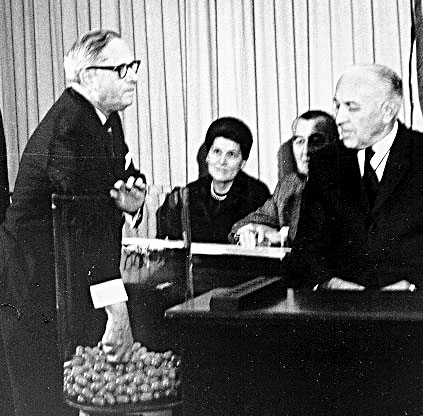
Rep. Pirnie draws the first number.

The place was a class at Michigan State University, just about this time fifty years ago. I wasn’t in the room, so I may be wrong on a few details, but the basic story spread quickly all over campus.

The professor was a young radical. There were a lot of those at MSU in the late 60s. Finals were near when he announced that grades would be given out a little differently this year. He opened a notebook and began to call roll. As he did, an assistant drew notes from a bowl. The professor read, “Adams.” The assistant took a folded paper from the bowl, opened it, and said C. The professor read, “Baker,” and the assistant said F.

As you may guess, it left the room in an uproar. I’m sure the actual grades were given in the normal manner, but the young professor had made his point.

About a week later, a similar lottery took place nationwide, televised, and determined life or death for thousands of young Americans. I was listening closely, because I was a contestant. It was the first draft lottery since World War II.

There were three of us paying attention, my two college roommates and I. One of them didn’t have to worry; he had blown his knee out as a high school wrestler and was 4-F. That’s a medical deferment. The other roommate and I were on student deferments, but we were both going to graduate in June. He drew a high number and never served. I wasn’t so lucky.

I have said often that the draft leveled the playing field. It was a favorite saying in that era that Viet Nam was a war where black people were sent to kill yellow people for the sake of white people. Without the draft, that would have been even closer to the truth.

I wasn’t feeling so charitable when that bastard got to my birthday and pulled a 41.

Ain’t it fun to gamble in the big casino?

544. Apollo 7

We are coming up on the fiftieth anniversary of the first moon landing.

Apollo One, the fire on the pad that caused the deaths of Grissom, White and Chaffee, took place February 21, 1967, causing a long delay. About a year and a half later things were just getting back up to speed. Apollo 7, the first successful manned flight took place on October 11, 1968.

The fiftieth anniversary of that flight was about a month ago, and I missed posting about it. That’s hard for me to believe, since I have been following the space program since 1957.

Purchased today, foot to butt kit, for self-application, apply immediately.

Apollo 7 is too important to simply mention, and too controversial for someone out of the loop to cover with authority. Nevertheless, here is a thumbnail.

Mission Commander Wally Schirra’s attitude toward NASA after the Apollo one disaster was — not positive. The space program had grown into a massive source of funds for companies. Engineers and the builders in the trenches were fully committed to excellence, however top brass decisions were sometimes questionable. The choice of North American Aviation to build the Command Module was controversial. McDonnell Aircraft had built the Mercury and Gemini craft, and many pointed out that the shift to North American Aviation wasted the talent and experience that had made the space program a success so far.

To put it bluntly, the Apollo Command Module NAA originally turned out was a lemon, and everybody knew it.

During the year and a half from the disaster to the launch of Apollo 7, Wally Schirra made it his personal mission to see to it that the craft he and his fellow astronauts were to ride in was of top quality. He was abrasive and relentless, and when Apollo 7 flew successfully, it was largely because of his persistence.

The flight, which he considered an engineering test mission, was cluttered up with scientific and PR projects. When they interfered with testing out the craft, he refused to do them. In space, where nobody could override his decisions. His acerbic interchanges with ground control would have banned him from future missions, but he had already announced that he would retire at the end of the flight. What could NASA do?

Apollo 7, the first manned Apollo mission, was an engineering success but a failure in personal politics. Eisele and Cunningham were never allowed to fly again, but the subsequent missions had a CSM that they could trust.

Wally Schirra became the only astronaut to fly on Mercury, Gemini, and Apollo missions.

======

I have recently worked out a series of posts covering events in the run-up to the moon landing. As I was doing so, I also became aware of another, less joyful anniversary. Since it took place on December first, which is a Saturday this year, I will skip Wednesday’s post and fill you in this Friday.

543. The Door


Photo: Marcin Konsek / Wikimedia Commons

Here is a quote for you, hot off the grill.

There is a door. On one side is written Science Fiction. On the other side is written Fantasy. You can come from either side, and pass through either way, but it will still be the same door.

You can write pure, hard science fiction, and you can write pure fantasy. At least you can try to, but no matter how much you try there will always be a modicum of fantasy in science fiction. And fantasy will always have a hard edge of life and death, or it won’t be worth reading.

Like Clockwork sounds like fantasy until half way through, when all the weird things are shown to have a scientific basis — more or less. And in the middle of the setting of the story, there is an arch between Inner London, which looks like a Dickens movie set, and Outer London, which looks like an equation.

 Snap’s world lay pinned against the Thames, from St. Paul’s to the Clock and on to the Tower, with London Bridge somewhere near the middle. It would be hard to chart the boundaries of Snap’s world, as it was a world of fogs.

Balfour walked with Snap as far as Pickwick’s and took his leave. From there, his path took him along the wider thoroughfares — and the widest were none too wide — past the shell of St. Paul’s. It was familiar territory for Balfour. He was one of the few whose nature allowed him to move freely between Inner and Outer London.

Eventually, he reached The Wall at Newgate Arch. As he faced the opening, it was a weathered arch with carvings mellowed by the corrosive fog until they were quite unreadable.  He passed through and looked back. On this side of the wall, the gate was foursquare and framed in brick. Every brick was identical and a caliper could not have found a variation in the lines of mortar.

The city beyond was foursquare as well, with rectangular buildings on rectilinear streets. A small fragment of humanity lived with Snap in Luddie London; the rest lived here.

Yin and yang. Dark and light. Old and new. The look of fantasy and the look of science fiction. It makes for a nice tension.

542. Characters

Characters in science fiction are . . . different. Let’s look at a few.

I have little interest in sterling characters who fight for the right, without a blemish or a flaw. That’s a good thing actually, since no one else does either. My only exception is Kimball Kinnison (of the Lensman series). That’s him overhead, walking with his buddies Tregonsee and Worsel.

I have no interest in literary characters who live their little lives and make novels out of the trivialities of existence. Here is a test; if a book seems to only have readers because it is required in college literature classes, maybe you should just go read some science fiction.

I like people — and characters — who do their job and a little more; who don’t think that the sun rises and sets in themselves, but who are also not passively afraid to assert themselves.

I don’t like villains who are deeply and intractably evil. I make use of such characters if I need them, but I keep them off stage. They are boring, seen up close.

I like my villains to be like my other people, rational and a little bigger than life, but affected by a flaw of character or aligned to the wrong side. They are usually selfish, but good heroes always have a bit of selfishness as well.

An interesting hero is necessary; an interesting villain is a nice bonus.

I don’t expect other authors to have similar taste, and some of my favorite books have characters I would not have chosen to write. Genly Ai comes to mind. If you don’t recognize him, he is the character through which we experience Ursula le Guin’s the Left Hand of Darkness. It is a fine book, and he does the job her story requires of him, but he is a bit of a cypher. I like Sparrowhawk better, and that is probably a big part of why I like A Wizard of Earthsea better.

And then there’s Alvin (or any other character that Arthur C. Clarke ever wrote). The City and the Stars, in either of its incarnations, (See 332. and 333.) is a mind expanding tour of the universe, but its protagonist is dull, dull, dull.

Zelazny’s characters are universally smart assed, universally delightful, and hard to tell apart.

Heinlein’s characters are all Heinlein.

541. Who is Balfour?

If there is a single characteristic of Steampunk that stands out as nearly universal, it is the use of changed versions of real persons. For instance, in The Cost of Empire, I made some fundamental changes in the British royal family (Victorian era) to get the Prince of Wales I needed for the story.

In Like Clockwork, there are quite a few alternate real people who pop up at the very end, but the most important is Balfour who is one of the main characters. You met him just before and on Halloween. Today we find him ruminating on what he has learned.

#     #     #

What do you do the day after your alter ego calls you out? Balfour spent the day in bed.

First he replayed the moment Hyde — he still thought of him as a separate person — had said, “Why now? Why not now?” It was a valid observation, but it missed the point. For endless iterations of the year, Balfour had not remembered.

“Why now?” was a valid question, and Hyde had not answered it. Why not yesterday, or a year ago, or a hundred years ago? How could Balfour change in a changeless land? Or was the land itself finally beginning to change?

Balfour took The Strange Case of Dr. Jekyll and Mr. Hyde from the shelf where it had lain unread and unremembered. He spent some time with it. It now seemed cumbersome and circuitous, but the ghost of Hyde had understood it well. It was a piece of rebellion against his father’s religion and a piece of youthful arrogance, all jumbled together.

Balfour remembered other books he had written, or Stevenson had written, now that the dam against memory had partially broken. He remembered his youthful travelogues, and he remembered Treasure Island, the book that had made him rich. When he wrote Kidnapped he had finally given David Balfour one of his own names, and now he was using it again. He thought fondly of that character, and fondly of his young self, so far in the past that even the memories were ghostly.

He remembered Edinburgh and thought, “London is not my town. Give me Auld Reekie any time, with its narrow twisted streets stretching from Holyrood to the Castle.”

He remembered Fanny, his wife, and how hard it had been to win her. He remembered her children. He had written a book of poems for them, and for all the other children of the world.

He remembered a race of dark skinned people who had found him strange, but had made him one of their own. He also remembered a single poem written on a grave in that hot and humid land.

Under the wide and starry sky,
Dig the grave and let me lie.
Glad did I live and gladly die,
And I laid me down with a will.

It was a lie. He had not laid himself down with a will. He had laid down in exhaustion after a lifetime of fighting tuberculosis, happy to have the pain stop and happy not to face once more the terror of being unable to breathe; but not happy to let go of the life and the people he had loved.

Robert Louis Balfour Stevenson was born in 1850, and now he was living in an eternal 1850, not as an infant, but as a grown man with the accomplishments of a lifetime behind him.

A whole lifetime. A lifetime that tunneled all the way from that squalling infant in Scotland to a tombstone on a mountaintop in Samoa.

How could that be?

He had some of the memories of Stevenson, but the man himself had lived and died, and surely was no more. Hyde, who lived in his soul, had said to call himself Stevenson, but what was he really? Not the man himself; at best, a shade of the man. A memory, lying in bed, remembering.

He squirmed and groaned, and fought with those memories that were his, and yet were not his.

The first memory he could call his own, separate from Stevenson, was this room. He had no memory of choosing the Clock in the time Before. Whatever had brought him here, it was by a different path than any other citizen of this new London had taken.

Whatever else he was, he was Balfour, and he had been Balfour for endless iterations of the year. He had a face that looked like the face on the cover of Stevenson’s books. He had a lean body that served him well. Stevenson had been sickly, consumptive, and Balfour was not.

The man — or the shade of the man — who had passed from Edinburgh to Samoa, wracked with tuberculosis, fighting weakness all the way, through poverty to riches, from obscurity and parental disapproval to universal fame, was not content to leave things the way they were.

He was not truly Stevenson and this was not truly 1850 by a wide margin. He was Balfour, and he was ready to do battle once again to find out what it all meant.

Curious? Sure you are. Want more? It’s coming.

540. Where Are the Vets?

Here are some statistics, tailored for those who read this blog. I know most of you are young. I see your pictures on your likes, and I check out your websites.  I’m not young, so I see changes you may not be aware of.

Harry Truman, Dwight Eisenhower, John Kennedy, Lyndon Johnson, Richard Nixon, Gerald Ford, Jimmy Carter, Ronald Reagan, and both presidents Bush all served in the military in wartime. Regan and Bush Two served stateside in wartime; the others all saw combat.

Bill Clinton, Barack Obama, and Donald Trump did not serve.

In the current House of Representatives only 70 of 435 have served in the military. In the current Senate, only 13 of 100 have served. Those numbers will go up slightly with the incoming congress.

Veterans were not so under represented in previous congresses.

These figures relate the the reduced number of persons in the military. That is not quite the same as a smaller military, since the persons now serving tend to spend more years in service. Draftees from previous eras tended to go home as soon as they were allowed to do so.

I come from a long line of draftees. My father served in Europe in WW II, was wounded, and remained during the occupation of Germany. His younger brother was drafted, trained, and was on a ship “heading for Japan to die” (his words) when the US dropped the A bomb. He ended up in the occupation of Japan. I joined the Navy, Vietnam era, but not by choice. My draft number was 41, which meant my number was up (in both senses of the word) before I finished college. And no, I did not see combat.

I hated the draft and I still do, but it had one positive aspect. It leveled the playing field. More Americans had to step up, whether they wanted to or not, and that led to more protests. Without the draft, we would have been in Vietnam much longer.

Today is the hundredth anniversary of the end of WW I. All those veterans are gone. WW II ended in 1945. Very few of the vets from my father’s generation are still around.

America left Vietnam in 1973. Any vet who saw that day at age 18 would be 63 today. That was also the last  year American’s were drafted.

I’m not suggesting a return to the draft, God forbid. I have no particular agenda at all; I just want to give you this to think about.

A country which everyone has to defend, or at least has to stand in jeopardy of military service, is a very different thing from a country that depends on a volunteer military.

Better? Worse? That will be your decision going forward.

======

The numbers in this post come from PBS.