Category Archives: A Writing Life

623. Hanging a Shotgun on the Wall

They call it foreshadowing, or sometimes hanging a shotgun on the wall. That’s from the old mystery novel rule, “If you hang a shotgun on the wall in chapter one, you had better shoot somebody with it by chapter three.”

You want to let your reader know what is about to happen, but not too much, and you don’t want to bore him in the process. It really isn’t easy. The 648 word prolog-as-teaser at the bottom of this post took me three days to get just right, and that was after I was already 12,000 words into Dreamsinger.

Time will tell if it actually gets used. I needed to give my reader a small look at family life on Home Station and tease him about the mystery of the exiles, without making it look too ordinary or too outré.

=============

During the 115th year of the escape from Earth, Antrim was decanted. Four others had preceded him and three followed, all so close together that they shared a birthdae.

For a while, Antrim’s world was smelly, wet, loud, and untidy, full of strange hands and faces. Eight new babies and a rotating cadre of adults occupied Natal Intensive. Slowly the frequency of feedings and the incidence of fecal outflow slowed and soon only Ma and Da remained with the eight new children. Finally the spray hoses were removed, the floor drains were sealed, and the newbies were introduced to their first ferds.

There had once been a different name for them, but since the computer categorized them as Fecal Emission Retention Devices, they were now called ferds.

There also used to be a word for a group of young humans raised together by an adult male and female, but that word was out of fashion by 2242. Antrim and his seven sibs were Socialization Group number 1352.

Never mind that. They fought, hugged, smiled, frowned, screamed, sulked, and bonded with one another. They were a family, even though no one used the word.

Ma and Da actually had names, although the children didn’t learn them until much later, and they were unrelated to their kinder. They had high ma-pa-ternal indexes, and that was all that mattered.

For their first seven years, the children lived in their crèche and did not interact with the outer world. Da and Ma provided them with their education, aided by the central computer. It seemed normal to be a society of ten, since they had never known anything else.

They knew that at age eight they would join with three other socialization groups to become a schooling group. At age fourteen, they would begin to interact with the rest of Home Station.

Most of the adults on Home Station had never seen a child younger than fourteen, and did not want to. That also seemed normal. For now, eight children and two adults seemed just right.

Da taught history, mostly the history of their own small group of refugees, but also enough of Old Earth history to know why they had fled. Ma taught science and math.

When Antrim was six, they learned the planets. The computer provided a holograph in the center of the crèche with Sirius A in the center, Forge next out, then the broken cluster of planetoids called The Swarm, then Stormking, and finally Bifrost. Home Station was there, endlessly circling Stormking. Sirius B, various asteroid belts, and the other fourteen planets were missing from this first lesson.

Tril asked to see the surface of Stormking and the computer obliged. A three-D holograph filled the center of the room with a surging hellscape of rain and storm, but comp had made a mistake. This was not a censored version for an elementary lesson but a real-time display complete with struggling, nearly naked humans being battered by Stormking’s winds.

A sharp command from Ma cut it off and Mosh said, “Those were people. Why were there people on Stormking?” Ma refused to answer.

A few daes later, Antrim got Da aside and asked the same question. Da usually answered the questions Ma wouldn’t, but this time he was evasive. Antrim persisted, and Da finally said, “They are being punished.”

“For what? What did they do that got them into that much trouble?”

Da shook his head, and when it was evident that Antrim planned to persist, he said, “Stop asking. I’m not allowed to answer.”

“Why?”

“If I tell you, they will take me away from you.”

That put a stop even to Antrim’s curiosity. Then Da said, “If you still want to know when you are grown, come and ask me then.”

=============

One page later, Antrim is twenty years old and his question to Da has not yet been satisfactorily answered. It will guide his life and the novel Dreamsinger as he chooses to study the exiles by living among them.


622. My Place or Yours?

If you didn’t read Monday’s post yet, go there first.

The most difficult problem I’ve had in getting under way with Dreamsinger is that I wouldn’t want to live as part of the culture of Home Station, the orbital habitat which most humans occupy. I need it as the flip side of the culture of the exiles on the surface, but I don’t like it.

Never fear, I’m a professional. I’ll get there, but there will be a lot of moaning, groaning, and cussing under my breath along the way.

One thing is in my favor — in world building, problems are answers. A perfect world might be pleasant to live in, but it would have no fodder for storytelling.

The situation in Cyan which led to the beltmen leaving Earth created a culture of enforced, extreme civility. That’s not natural for us hairless apes, so there has to be an enforcement arm with no sense of humor. That is the system of directed dreaming, explained Monday.

Directed dreaming is a system that needs overthrowing, and that will clearly be a major theme of the novel. But what else does it imply?

On Home Station, you don’t sleep. Therefore you don’t need a room. Your exercise/dreaming time is brief, so what do you do with yourself when you aren’t working? Where do you go? Once I had asked myself that question, I filled Home Station with lounges.

Also, if you don’t have a bed or a bedroom, where do you have sex? Let’s see what the rough draft says:

Antrim headed down to Heaviside Lounge for companionship and to purge his mind of the problems posed by Riff.

Beneath a flowering mimosa he saw a girl he knew. She had removed her shirt as a signal of readiness, but no one had yet joined her. Her name was — Broa. His mental hesitation triggered the Farleyfile which gave him a précis. Broa 14284. The number told him that she was one or two crèche releases older than he was. He had copped with her three times before, but he already remembered that. She was a tech working in hydroponics.

He stopped and smiled down at her. She said, “Want to cop?” and he said, “Sure.” He peeled off his shirt and she unfastened his pants. There was a snarl when they hit the floor and snagged on his shoes. Broa was already barefooted, and laughed at him as he extricated himself. He came down on her without bothering to remove her pants and met her mouth to mouth and tongue to tongue.

The pants came off soon after, and they put on a clinic of the four positions and the eight variations. Several of the other occupants of Heaviside Lounge wandered over to watch and admire.

Afterward, they talked for a while. Her eyes were on him, but her attention had wandered and so had his.

She levered herself up, pushed back her tangled hair, and said, “I have to shower before I go back to the hydros.” She kissed him again, lightly and briefly, picked up her clothes and walked away.

Antrim lay there admiring her back side. Nothing in the moment impelled him to run after her.

His mind was cleared, his body was spent, and the pleasure had been profound. But she was still, after four sexual meetings, so much a stranger that he had reflexively triggered the Farleyfile when he saw her. If he never saw her again, he would feel no loss.

It didn’t seem like enough.

Sex right out there in the open? Well, the future is supposed to be different and there are no secluded, grassy riverbanks on a space station. Actually, if you are living in society that controls your dreams, privacy is non-existent already. On Home Station, even the desire for privacy is considered a mental aberration.

In some ways, this culture is a bit of a feminist dream since everyone is completely equal and there is no power structure of dominance — except for the dream therapists, but that is a whole other level of this novel which we’ll get to eventually.

Everybody is comely. I don’t have space here to tell you where babies come from, but take my word for it, they all come out perfect. And it is considered impolite to refuse an offer to cop(ulate).

It sounds like a 14 year old boy’s idea of paradise, but it isn’t that either. Everybody on Home Station is so damned equal that nobody needs anybody. Want sex? Do it. Twenty minutes later you can each go your way without even exchanging names.

It’s very unromantic.

The culture of the exiles on Stormking, which we will see later, is based on survival. It is totally different, but also completely unromantic.

Antrim, our main character, has imbibed all kinds of romantic notions from reading the literature of Old Earth. He is seeking something neither culture stands ready to provide. He is going to have a rough time of it.

Corollaries, implications, and unexpected consequences of the structure of directed dreaming are falling out onto the page every day, often surprising the hell out of me. Weird things are happening and I haven’t even gotten to the culture of the dissidents who have been exiled to Stormking. Their lives are really different.

621. Dream Culture

For the last month or so I have been fleshing out one corner of a universe that I began writing about decades ago. My first SF novel was Jandrax, a lost colony story. Cyan came later, filling in the backstory of that same universe. Dreamsinger, which I am writing now, continues the process.

If you have read my novel Cyan, you will remember that when Keir visited the asteroid belt to view the B&A coreship, he discovered that the beltmen were secretly preparing an expedition of their own. They feared the impending destruction of Earth, but had no interest in colonizing a new planet. They had come to prefer life in space.

In the Cyan and Jandrax universe, the exploratory expedition to the Sirian system had found that the planet occupying the Goldilocks position — the distance from Sirius with the same level of radiation as Earth — was taken by a planet with a Uranian inclination. That is, it was tilted onto its back like a sad tortoise, with first one pole and then the other pointed toward it’s star as it moved through its orbit.

With no habitable planet, it was likely that Sirius would never again be visited by man. This made it an ideal destination for the beltmen who wanted to live in space without interference from planetbounds.

When the Procyon colonization expedition departed for Cyan, the beltmen were nearly ready to leave for Sirius. Keir’s last message was of farewell and good luck to them.

The beltmen had to build their craft in secret with minimal resources. It was a crowded, spinning torus which held 2000 refugees from impending disaster. Under-funded and under-powered, it would take an eighty-seven year journey to reach Sirius, and a generation would die in transit.

During that long, slow, crowded journey, civility became essential to survival. The refugees evolved a system called directed dreaming.

Once each day, each person entered into a dream like state during which her/his body (not under his/her conscious control) underwent rigorous exercise, followed by dreams tailored to keep them civil.

This is how it all sounds in the rough draft:

The dreamers were hanging, heads encased in sensory deprivation helmets, in ten rows of ten. They had already gone through their exercises, contortions that had stretched and strained every muscle and left them all soaked in sweat. Now they settled into a deep, quiescent, unmoving sleep

It looked like a grotesque mass hanging, but that was an illusion since their weight was just sufficient to keep them from bouncing off the ceiling. Being suspended by their necks at this level of gravity did not even cause discomfort.

Now, one by one, they began to move. An arm shot out here, fingers gripped nothing over there, arms crossed over chests to hold something in, legs shot out to kick some threat away. Each one was now in his own directed dream. Carefully tailored images were fed into their brains and they reacted. Uncivil inhibitions were destroyed; fears were dredged up and alleviated; prejudices were wallowed in until they seemed foolish. Angers were expressed in dreams, so they could be suppressed in waking life.

Dream therapy was every person’s right and obligation. Dream therapy was the key to civility. Dream therapy kept them all sane and happy.

It took less than an hour and a half, and afterward every person was ready to go back to his life. Each one was exercised, refreshed in mind and body, cleansed and cleared of all angers and resentment. There was no more need to waste a third of your life in sleep.

Sleep had never really knitted up the raveled sleeve of care anyway, but directed dreaming did.

You understand that I am setting this up as something that seems like a good idea, but isn’t.

Once the refugees arrived at Sirius, they immediately undertook the building of a larger station to be their new home. Directed dreaming continued to lubricate the wheels of progress, but not everyone agreed with this new way of life. Those who could not conform were exiled to Stormking, which was a place of Trenconian extremes, and a death sentence for most of those transported there.

I had already outlined all of this while I was still writing Cyan. For the last month or so, I have been fleshing it out. We’ll see some of the new thinking on Wednesday.

620. Wikipedia

I love the Internet. I had access to it for a decade or so at work, but rarely used it. When I retired and returned to full time writing, that all changed.

I don’t do Facebook or Twitter or games or most of that kind of thing, but I couldn’t live without e-mail. It saves me a lot on paper and ink, and even more in time. It used to take a week to get a paper manuscript ready to send by USPS, fifteen dollars at the window, a week for it to get to a publisher, and a year before they replied. Now I can send an e-mail manuscript in a few minutes, it arrives in an hour, and then I only have to wait a year for them to reply. Much better.

For this blog, I do a lot of research. That usually doesn’t including trying to find out things I don’t know about. It typically means finding out details I’ve forgotten about things I already know about.

For example, I would never do a review of Eragon because I haven’t read it, and I wouldn’t repeat someone else’s opinion of something I hadn’t read. I have read A Wizard of Earthsea, and I speak of it often, but it has been years and I might need to find out some things I don’t remember. Perhaps the name of the wizard who was Sparrowhawk’s friend (I actually do remember; it was Vetch), or perhaps the year it was published. I might need to find out how to spell some weird made-up name — or some weird name that isn’t made up. That is the thing I find the internet most helpful for, and when I run a search, the Wikipedia response is usually the most useful.

I have several other go-to spots on the internet, but I couldn’t live without Wikipedia.

Every once in a while, Wikipedia asks for a donation, and I always give them something. They sent me a nice letter a few days ago and I asked for permission to quote part of it. I forgot to ask if I could borrow their logo as an eye-catcher, but I think they’ll forgive me.

The essential story of Wikipedia is the story of individuals giving a little to keep the doors of discovery open.

You probably donated because Wikipedia is useful to you. That’s one of the main reasons people tell me when I ask them why they support Wikipedia. But what may surprise you is that one of the top reasons people don’t give is because they can’t afford to.

At the Wikimedia Foundation, we believe that no one should have to pay to learn. We believe knowledge should always be free. We will never charge anyone to use Wikipedia.

Wikipedia is yours: yours to read, yours to edit, yours in which to get lost. We’re not the destination, we’re the beginning.

No one should have to pay to learn. Knowledge should always be free. Now that’s a notion I can get behind.

619. The Crash Heard Round the World

Two days ago on the news, a Tesla driver was caught on camera asleep at the wheel on a freeway. We all got to see him snooze, then eventually got to see him jerk awake. Chit-chat ensued. One talking head said, “Someday sleeping at the wheel will probably be legal and safe.” Another replied, “Not in my car!”

When I was ten years old, everybody knew that men would never walk on the moon. In the subsequent decades, the public’s default position on what science plans to do has switched from can’t to can. The public isn’t any smarter; they’ve just changed their prejudices.

Driverless cars have been around for a long time in science fiction. Here is page 2, paragraph 1 of Methuselah’s Children by Heinlein, first published in 1941.

Mary had no intention of letting anyone know where she was going. Outside her friend’s apartment she dropped down a bounce tube to the basement, claimed her car from the robopark, guided it up the ramp and set the controls for North Shore. The car waited for a break in the traffic, then dived into the high-speed stream and hurried north. Mary settled back for a nap.

Good fun in ’41, but no one would have expected to see it happen this soon. Even science fiction aficionados might have said 2119, or maybe 2219, yet here we are, on the brink.

In 1941, the world was very different. Heinlein might imagine driverless cars, but he never imagined something else that is now part of our world — computer hacking.

Hang on, folks, I’m going to make a prediction.

At a near future date every car on the highway will be driverless. The old curmudgeons like me who wouldn’t even trust cruise control will all be dead, mostly from auto crashes with drivers who did trust cruise control. The text-and-drive crew will have won the battle of the public consciousness. Science will have proved that humans are inferior to computers in driving, and science will be right because it will be comparing computers to the text-while-driving generation. Human drivers will be outlawed as unsafe — which they will be.

Driverless cars will talk to each other and to central control, adding another layer of safety to the whole enterprise. Central control will be heavily protected against hacking, for obvious reasons. Science will prove that central control is impenetrable.

Science always proves something like that, just before the cataclysm. See Three Mile Island and Chernobyl.

All that was just set-up for the prediction.  Here is the prediction.

Sometime in August of 2035, a kid named Morrisey, who isn’t even born today, will hack the un-hackable central control. No one will notice. He will place a delayed command, and head for a hill overlooking an LA freeway.

On August 26th, 2035, at peak rush hour, central control will send out an order and every automobile in America will speed to 100 mph, then simultaneously make a ninety degree left turn.

Registering 4.6 on the Richter scale, it will be the Crash Heard Round the World.

St. Peter will have to put on extra staff.

618.1 Over There

Things are still busy here, the posts I had planned for this week are not quite ready for prime time, and I have one more short piece of fiction ready for you. It was originally scheduled for next week. I’m going to swap the posts and the fiction, then I’ll bow out of the regular posting business for a week and let you read Coulter and the Gray Man instead. This link will carry you to the first of three posts over in Serial

618. Digging Up the Dead

I would love to show the excavations I took part in
but I have no such pictures.
This eyecatcher is an excavation of a
Roman site in London.

Last post I told about doing survey archaeology in Michigan in 1967, ending with the statement that suddenly, when the summer was almost over, everything changed . . .

We got a phone call from the University, and within hours we had packed up, left our base, and were heading half way across Michigan to Bay City.

The Sagnaw River runs through Saginaw, then northward about twenty miles to Bay City where it empties into Lake Huron. It is a major shipping channel which frequently silts up. In Bay City, a project was under way to dredge the shipping channel. An area along the river had been designated to receive what the dredges removed.

The dozers preparing to receive the outflow exposed human remains and everything came to a stop. The police came, but it was clearly not a crime scene. The remains were skeletons in what little remained of wooden coffins, surrounded by grave goods. It was an Indian burial ground.

Yes, Indian. That’s what they were called in 1968 and it was just a designation, like Dutch or French. It wasn’t an insult word. There were plenty of insult words, like redskin, but Indian was just a word. It still is.

Mr. Fletcher, who owned the site, gave permission to Michigan State to do salvage archaeology. We had two weeks to work before the bulldozers were scheduled to go back to work.

When we arrived on the site, we found a flat basin a hundred yards wide and a quarter of a mile long, of mostly pure sand. Those are “close enough” figures from memory. Bulldozers were impatiently poised to return to work.

The site was surrounded by dikes, perhaps twenty feet high. Once we were finished, the dredgers would pump a slurry of sand and water from the river bed into the basin, the water would make its way out through the sand dikes, and whatever remains we could not remove would be lost forever under twenty feet of fill.

There were four archaeology crews out that summer. Three of them had specific tasks that could not be abandoned. Our survey work could be done any time, so we were elected.

It was frantic work. The site, we learned eventually, dated from about 1750. The Indians were in contact with traders and settlers, both English and French, and the graves were full of trade goods. There were a lot of copper pots. Other than bone beads (well preserved) and furs which were barely recognizable, most of the grave goods were of European origin. That did not mean that these were westernized Indians, only that they had trading relationships.

We found a lovely silver cross, but that did not mean the deceased was a Christian. We found a flintlock pistol — or rather, a lump of rust that had once been a flintlock pistol. We found the remains of a musket, badly preserved; the wood was marginally better preserved than the iron.

One of the skeletons we found had a row of brass buttons down its sternum and scattered in the dirt in the belly area, along with tarnished epaulets above the points of the humeri. There was no fabric, but he had clearly been buried wearing a military great coat. That didn’t mean he was a scout for the French or the English (there wasn’t enough remaining to know which), although he might have been. He might also have traded for it, or have taken it off a dead European after combat.

Despite the hype about pyramids and Schliemann finding Troy, there is much that can be implied by an archaeology site, but much less that can be proved.

When I say skeletons, you should not picture the dead happy pirates of Pirates of the Caribbean. Bones do not last well in moist ground, and not all bones are created equal. Skulls and femurs last better than pelvi and ribs. The bones of the hands and feet don’t preserve even that well. Tiny bones hardly last at all. There were miniature coffins for infants, but they were pretty much empty, with maybe a few grave goods and a few flakes of skull.

I have to touch on the morality of all this. These were Indians buried by their own people. How would you like to have someone digging up the graveyard where your grandmother is buried? There are valid complaints to be made which I understand and have no intention in arguing against.

This particular case, however, was salvage. To me, it was no different than salvage of European bones. If during the construction of a modern building, a two hundred year old white folks cemetery was discovered in the basement excavation, the bones would be removed and reinterred. You may not realize it, but those bones would certainly pass through the hands of physical anthropologists who would study them for what they had to tell about the history of disease in early America, before being returned to the earth.

We were careful with everything we found because every piece had a story to tell. I spent hours drawing the remains in situ before they were removed, and hours with an alidade (described in post 586) making sure that the locations were well mapped.

We were careful with bones and copper pots, but we didn’t treat either as sacred objects. A pot is not a meal, and a bone is not a person. Everything went to the museum and the bones were, I believe, eventually reburied.

There are a few more personal bits to this story. My future wife was also on archaeology crews those two years, but not with me. She lived in Saginaw, and when she came home for the weekend during our salvage operation, she drove up to the site and volunteered to help.

When someone asks me where I met my wife, I say we met in a graveyard. Then I explain further. The following winter, she and I worked together upstairs in the MSU museum cataloging the results of the dig. Two years later, we were married.

The site was so rich that the land owner had it diked off. The dredging went on, but the fill went elsewhere, and the site was not lost. I spent the following summer there, this time accompanied by my college roommate. The site later became a field school, and my roommate wrote up the results as his Ph.D. dissertation. It is on line. The site ended up on the National Register of Historic Places, and has its own brief spot on Wikipedia.

Archaeology wasn’t an occupation I could continue, but I wouldn’t have missed the experience for the world.

617. Raiders Before the Ark

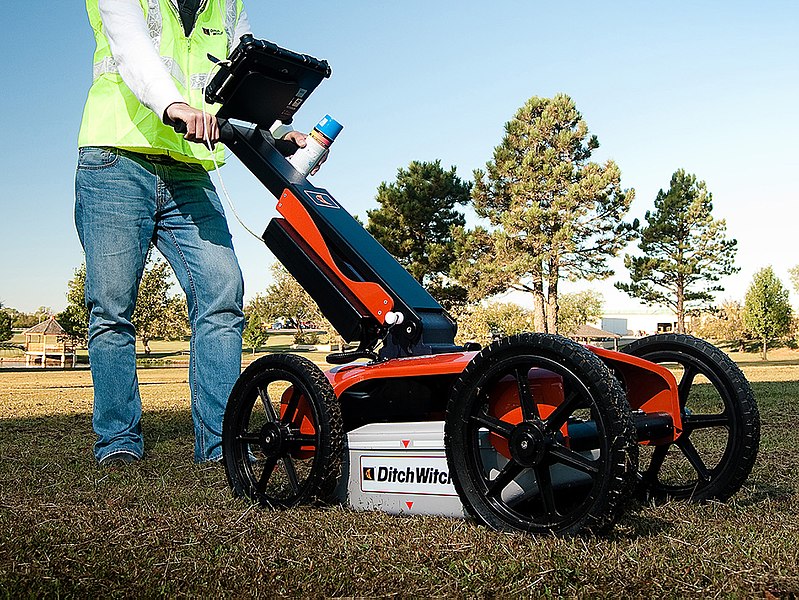
Ground penetrating radar used in survey archaeology.
I’m jealous; in 1967, we just walked and looked.

Anthropology has been a major part of my life. I spent five years in pursuit of it, and it forms the backbone of everything I think and write, even though my dislike of field work was pushing me away at the same time that writing was drawing me away.

When I discovered the field during the sixties, forensic anthropology was nearly unheard of and the tools of modern physical anthropology were just being assembled. Social anthropology, my specialty, and archaeology were the two choices for students then, and we all took classes in both.

My first class in archaeology was in spring quarter of 1967. The professor was a lean, fit man in his late thirties with thin blonde hair and a beard. He had great tales to tell. The class was taught in the MSU museum and there was a stuffed moose standing in the corner of the room. How cool can you get?

My roommate and I immediately started growing beards. I still have mine. In a miracle of convergence, I had a full beard about the time I saw them growing on faces all over campus. I had become a hippie, when all I wanted to do was look like Dr. Cleland.

It was an Indiana Jones moment, fourteen years before the movie came out.

I had escaped Oklahoma and had no intention of going back to spend my summers working on the farm. There are no summer jobs in social anthropology, but you an sign on to an archaeology crew, and I did for two summers.

1967 and 1968. Keep those numbers in mind. I was nineteen, then twenty. Keep those numbers in mind, too. Feminism was on the horizon, but I hadn’t heard of it yet. Political correctness, in those days, meant hating the Commies, supporting the Vietnam war, beating up hippies and draft dodgers, and voting Republican. I wasn’t politically correct.

The definition has changed since then, and I still am not.

Archaeology was an alpha male enterprise, in an alpha male era, and it was an alpha male time of my life. Sorry. Not bragging, not apologizing, just reporting.

Archaeology is hard, dirty work in the hot summer sun. It was much like what I left in Oklahoma, minus the manure but plus an intellectual content. I enjoyed it, but I didn’t fall in love with it. Like everything else in science, you spend a thousand hours of work for one tiny nugget of knowledge. The work didn’t bother me. Work is just work; I’ve always done it and I will as long as my body holds out. But there weren’t enough rewards.

My crew was doing survey archaeology all over northwestern lower Michigan. Our home base was Kalkaska just southwest of Traverse City. It’s a small town known for its giant fiberglass trout statue. The local young guys yelled insults at us when they saw us on the street. We were too cool (in our own minds) to be bothered. You know the drill. If there were any local young girls in town, they kept them well hidden.

We spent our days walking up and down the local rivers, looking for evidence of camp sites along the banks, or walking the shore of Lake Michigan for the same reason. Evidence of habitation meant chips of chert (the local low grade version of flint), pot sherds (broken pieces of pottery), or midden (trash heap) mounds. You had to learn to distinguish chips of worked stone from natural breakage while walking along at a normal pace.

If we found enough surface evidence, it was time to make a test pit. That meant a ten foot by ten foot square, taken down with flat bladed shovels in four inch lifts. All the dirt from each lift was tossed into a sieve — a wooden sided box with a 1/4 inch screen bottom. This was suspended from a sapling tripod and shaken. Dirt went through, chips, flakes, arrowheads, stone knives, or bits of pottery would be left behind.

Or, more often, nothing would be left behind and the test pit would be abandoned.

Sometimes we would be on public land, but most of the time we had to negotiate for permission to enter. The grad student who was leading our group spent more time making friends with local farmers — or trying to — than he did looking or digging.

So it went for most of two months and then everything changed for the better. It was about to get exciting. I’ll tell you about it Wednesday.

616. Anthropology

If you took my advice and watched Worlds of Ursula K. Le Guin, you know now that the K. stands for Kroeber, after her father A. L. Kroeber, who was one of the important early anthropologists, and that her work was influenced by growing up in the atmosphere of Berkeley. My work has also been influenced by my study of anthropology, as I was ready to share in this post. I wrote it a few weeks before I saw the American Masters presentation. I moved my post down to shoehorn in my recommendation that you watch the TV show while it is still around. 

==========

I was seduced by novel writing in 1975 and that ended my five year study of anthropology, but there is more to it than that.

There were two things in anthropology that were driving me out before I wrote my first novel. One was cultural relativism, the philosophy that underlies the whole field. I didn’t buy it. I still don’t. You’ll hear more about that in a future post.

The other thing was field work. I did field work in archaeology for two summers, and that was fun, but my specialization was South Asian social anthropology. That meant sitting in some village in India for a year asking questions about local relationships, and there was no way to avoid it. It’s an absolutely required rite of passage and doing it once isn’t enough. You have to do it again and again. It is the way anthropologists do their research.

It offended my sense of privacy. If anyone were to ask me the kind of questions anthropologists ask their subjects, I would tell them to take a long walk off a short pier. Needless to say, being the person doing the asking wouldn’t make it feel any better.

There is also a deep triviality to field work. It resembles lab research in other sciences in that way. The end result of scientific research is not trivial, but the day to day weighing, titrating, or looking at slides from a telescope or an electron microscopes is exceedingly tedious.

That would also be true of asking questions about who is related to whom in the village, and making out kinship charts so you can tell who is a parallel-cousin and who is a cross-cousin. No, I’m not going to tell you what those two phrases mean; it’s better you don’t even have to think about it.

Encountering anthropology in college is like eating at a good German restaurant. It is laid out on your plate, already prepared, and delicious. It is still the same in grad school until the day you reach the field. Then you have to butcher the hog and make the sausage. It’s no fun any more.

I love ethnologies, treatises explaining in detail how other cultures work. The variety of ways in which mankind has organized his work, his time, and his beliefs is both staggering and fascinating. I would have enjoyed writing them, but the research needed to reach that stage would have been more than I could have borne.

I use what I learned in anthropology every time I write a novel. Sometimes it’s only a little; sometimes it forms the backbone of the whole enterprise.

I also wrote a long article on the subject called How to Build a Culture. I presented it at Westercon 34 in Sacramento, and later archived it on this website. It it’s present form, I have divided it into eleven virtual chapters to make navigation easier. The internal links to reach individual chapters are at the top of the file.

If you want to see it, click here. I think you’ll like it. It’s still anthropology, but you don’t have to do the fieldwork.