Category Archives: A Writing Life

332. Arthur C. Clarke: The Two Diaspars

In 1949, Arthur C. Clarke wrote his first novel Against the Fall of Night. Four years later, he rewrote it, and gave it a new title, The City and the Stars. Clarke himself said that only about 25% of the first novel resided in the second. My arithmetic doesn’t add up with his. I see them as much closer to each other than that; in some ways, barely different.

If you want details, go to the Wikipedia article on the latter novel. There is a section of comparison between the two books where the differences are laid out, but I find them superficial.

I read Against the Fall of Night for the first time this month. The City and the Stars, on the other hand, was one of the first proper science fiction novels of my childhood, and a major influence on me.

I read it soon after I found the local public library. Clarke, Asimov, Heinlein, Norton and dozens of lesser science fiction writers were suddenly available, where I had previously only had Tom Swift Jr. to read. About then I was probably reading three books a week, and at least half were extremely forgettable.

This would have been about 1960 or 1961, when I was thirteen or fourteen. Clarke was my main man then. That seems entirely appropriate; I was just really learning to think, and Clarke was all head. By the seventies, I couldn’t read him any more. His prose doesn’t sing and his characters have neither heart nor cojones. They weren’t quite wooden, but they were at least cloistered.

Actually, most of all, they were extremely British. And so are these two novels. Here is a quote:

Since that far-off day, Man had explored the Universe and returned again to Earth — had won an empire, and had it wrestled from his grasp. p. 97

That’s from The City and the Stars, the one I read as a child. At that time my understanding of the twentieth century was shallow indeed. Reading it again fifty-some years later, it is clear that the novel is largely a product of its time and place. Clarke had just moved from Somerset to London and found the transition difficult. Hence the contrast between Diaspar the uber-city and Lys the sylvan paradise. Both books revolve around the elegiac feeling of a time when mankind had forged a stellar empire and then withdrawn to Earth when (as his main character believes) they were driven back from what they had conquered.

World War II had just concluded. It had driven a stake through the heart of the British Empire. India won its independence in 1947, and the fifties saw one after another of the old colonies become new countries. At home in Britain, it was a time of deep austerities as the British tried do rebuild their nation out of the ruins of war. 

America suffered during the war; I do not disparage her losses, but no one bombed our cities to rubble, nor destroyed our economy. The fifties in Britain were not like the happy days of hot rods, tract housing, TV, freeways, and kitchen appliances.

Reading Against the Fall of Night or The City and the Stars today, as an adult aware of twentieth century history, that background informs my reading much as it surely informed Clarke’s writing. In both novels, the closed city of Diaspar is the last bastion of mankind in an Earth gone to desert, in a universe on which man has turned his back. Alvin, the hero, is mankind’s last hope of recovery from those great losses. more tomorrow

331. Solitaire for Ten

Cyan is now available for pre-order through Amazon, with the eBook arriving April 17th. Meanwhile, I plan to repeat a few year old-posts that were designed to stir the blood of would-be readers just before an earlier release date that didn’t happen. This is one of them.

————————————-

In the novel Cyan, the starship Darwin carries ten explorers at relativistic speeds to explore the Procyon system.

Ten explorers, eleven light years from Earth. As the only humans on the entire planet Cyan, the death of any one is sure to send shock waves reverberating through the group.

Keir Delacroix, groundside leader of the explorers tried to put this into perspective upon the death of one of his colleagues. You will note a deleted name, to avoid a spoiler.

It seems to me that funerals are for the living, for saying things that we already know, to put life and death in perspective and find some comfort.

“We are alone here. We are more alone than any other humans have ever been. When one of us hurts, we all hurt. When one of us dies, a piece of the whole dies. We must be very careful with one another, because we are all we have.

“We come from an Earth that is overflowing with people. One death there is nothing. Had **** stayed behind, and died, no one would have noticed. Here, that death puts our whole world out of balance. And that is why we are on Cyan — to find a world where individual lives can be valuable again. At least, that is why I am here. Not as a scientist; not even as an explorer; but as a man searching for a place where humanity can find its soul again.

Death is a hungry beast, seldom satisfied with just one victim. And exploring a new planet is no safe endeavor.

—————————————

When pioneers arrived on the east coast of North America, the forest they faced was vast. It was later said that a squirrel could travel from the Atlantic to the Mississippi without ever having to touch the ground. That forest is no more.

When Heinlein’s pioneers reached the stars, flaming laser axes in hand, they wrought similar destruction. Today’s reader would not accept that.

I wrote Cyan as an exercise in seeing, not what could happen, but what probably would happen, in near-term stellar exploration. That includes both the pressures for colonization from an overcrowded Earth, and a knowledge of the ecological disasters which need to be avoided.

The explorers on Cyan are careful in their daily actions and in planning for future colonization, but they are not prepared to find a truly half-human species. Viki Johanssen, crew anthropologist, demands that Cyan be placed off limits to colonization, for their sake. Keir disagrees, and colonization plans go forward.

Viki is faced with a decision. What if she stayed behind when the Darwin returned, to study these creatures while they were still pristine, before human colonists come in? What would you do, if you knew that mankind’s only chance to study this half-human species was now, even at the expense of becoming the only person on an entire planet, certainly for decades, perhaps forever?

Would you choose to stay behind?

330. Dred Scott Rides Again

The issue at hand is constitutionality v. right and wrong.

My respect for the constitution is profound, but terrible things have been done in the name of constitutionality. Some of them are being done right now. (see yesterday’s post)

There is no question of the constitutionality of the move to deport undocumented immigrants, but a great deal of question as to its wisdom and its morality. Trump’s motives are unknowable and irrelevant. It doesn’t matter if he thinks he is saving America from an enemy within, or if he just jumped on an issue to provide a path the white house. The real question is — should it happen.

History has lessons for us on this issue. The constitution allowed Chinese immigrants to be deemed unfit for citizenship. The same was true of Japanese immigrants. Chinese were, eventually and quite constitutionally, denied entry into the US altogether simply for being Chinese. (see 306. White Men Only)

Andrew Jackson used his constitutional powers to make treaties in his removal of the southern Indian tribes. He also used trickery and deceit, but that is politics. American Indians living a settled life in agricultural villages, whose ancestors had been in America since before Columbus was a gleam in his father’s eye, were led by trickery and force to sign away their lands and were removed from the United States by military force, all quite constitutionally through the Indian Removal Act of 1930. (see 247. The People’s President)

Let’s turn the calendar forward from Indian removal to 1857. This was the era of the Missouri Compromise, which allowed new northern states to enter the union as non-slave states, while new southern states entered the union as slave states.

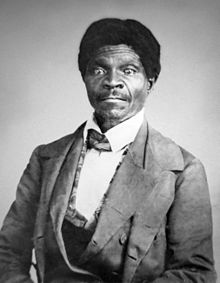
Dred Scott was born a slave in Virginia. His owner took him to Illinois and later to what is now Minnesota. Later, he was returned to Missouri where he eventually sued for his freedom based on his long residence in free states. The litigations passed through multiple trials, which Scott sometimes won and sometimes lost, and finally made it to the U. S. Supreme Court as Dred Scott v. Sandford.

Scott lost. Chief Justice Taney stated that any person descended from Africans, whether slave or free, is not a citizen of the United States, according to the constitution. He further stated that the government could not confer either freedom or citizenship to non-whites, and the Missouri compromise could not exclude slavery from the northern territories.

All this in the name of the constitution. It brought anger, the election of Lincoln, and the civil war.

At the end of the Civil War, the 14th amendment stated that “all persons born or naturalized in the Unites States .  . . are citizens.”  That did nothing to help the Chinese and later Japanese who came to this country, but could not be naturalized because they weren’t white. (again, see 306. White Men Only)

And it does nothing for the Mexican-Americans who came to America illegally because the laws made it impossible to come in legally. If you read yesterday’s post, and if you followed the link and actually looked at the Permanent Residence application form, you know this to be true. If we native born Americans were required to positively answer all the questions on that form, three-quarters of us would have to leave the country.

I respect the Constitution, but I don’t respect those who misuse it. Trickery and deceit gave Andrew Jackson his way, but this is not 1830, and it should not happen again.

329. Green Card Blues

Just before Christmas, I wrote a post from the viewpoint of a little Mexican girl, born in the US, whose parents were about to be deported. I received a comment suggesting that the problem was caused by Mexicans breaking the law. I posted that comment because everyone has a right to his opinion.

Why don’t Mexican immigrants just follow the law? I’m no expert, so I did a bit of research. Here is what it says on the Homeland Security website.

Because more people want a green card than there are visas available, not everyone who wants a green card can get one immediately. Therefore, some people have to wait in line until a visa is available. The U.S. Department of State (DOS) gives out 140,000 employment-based visas each year. . . . Currently, about 234,000 people have employment-based adjustment of status (green card) applications pending in the United States and are waiting to get a visa.

And from the site of the North American Immigration Law Group

Each application must also be supported by evidence that the alien will not become a public charge.

That suggests the applicant has to already have an employee, or has to be rich.

According to information scattered through half a dozen websites, the wait for a visa can easily take up to nine months. I can’t credit this to an official source, so call it a strong rumor.

Okay, let’s say you have a visa? That gets you over the border, but to stay, you have to apply for permanent residence. So what does that application look like? Here are some excerpts; you can download a PDF if you want to look at the whole thing.

List your present and past membership in or affiliation with every organization, association, fund, foundation, party, club, society, or similar group in the United States or in other places since your 16th birthday. Include any military service in this part. If none, write “None.” Include the name of each organization, location, nature, and dates of membership. If additional space is needed, attach a separate sheet of paper.

Have you received public assistance in the United States from any source, including the U.S. Government or any State, county, city, or municipality (other than emergency medical treatment), or are you likely to receive public assistance in the future?

Have you EVER been a member of, or in any way affiliated with, the Communist Party or any other totalitarian party?

Have you EVER received any type of military, paramilitary, or weapons training? 

These are a few of the most egregious questions found in five tightly packed pages of questions. It looks a bit like an IRS tax form on steroids.

If you were a Mexican doctor or businessman facing this document, you would set down for a hour with your lawyer and all would be well. But what if you were an uneducated, non-English-speaking farm worker?

Trump wants to build a wall. There is already a wall, built of paper, keeping poor and uneducated Mexicans from legally entering the US, and sending them across the border illegally to find work to feed their families.

This post is only a first look at a process full of complications and permutations. I’ve followed the paper trail as far as I care to. Knowing the full story of any government program would take a lifetime, and I have other things to do. But I have one more question to ask:

Is the system set up this way to turn Mexican laborers into virtual slaves, afraid to speak up from fear of the INS? No one can answer with certainty. But we can suspect, and I do.

328. Still not a Frog or a Kangaroo

220px-Litoria_tyleri    220px-RedRoo

Cyan is now available for pre-order through Amazon, with the eBook arriving April 17th. Meanwhile, I plan to repeat a few year old-posts that were designed to stir the blood of would-be readers just before an earlier release date that didn’t happen. This is one of them.

——————————————-

Flashback: 1963, riding in a car, reading an article, probably by Arthur C. Clarke, on why humans should go into space. A little fish, swimming in shallow water, said to his father, “Why don’t we go up on the land and see what we can find?” The father fish responded, “Why would you want to do that?”

I read the passage out loud, but no one was interested, so I relapsed into nerdy silence.

Years later I found that the now accepted theory is that fish in shallow waters, accustomed to using their fins against the sea bottom, began to use them to navigate mud flats at low tide as mud skippers still do in mangrove swamps today. Legs evolved from fins.

It didn’t happen this way on Cyan. (This is a follow-on to posts 320 and 321. If you missed them, we’ll wait for you to read them. Done? Good.)

On the planet Cyan, hundreds of millions of years ago, primitive chordates developed a split vertebral column, which resulted in twin tails. When they moved onto land, their tiny front steering fins were never used for locomotion and their twin tails (they had no back fins) became legs.

As Gus Lienhoff said when he dissected the first one Cyanian creature the explorers had collected:

Look, no pelvis. Look at this complex of bones. Some are fused, some flex, and these four are cantilevered. And look up here; no scapulae, just three extra thick, specialized vertebrae. Tiny front legs, powerful back legs with twice as many joints as you would expect, and absolutely no hint of a tail. Not even anything like a coccyx. A truly tailless, truly hopping biped. I wouldn’t have believed such a thing was possible.

Not a frog, not a kangaroo.

Frogs are quadrupeds with overdeveloped hind legs, like rabbits. They have a vestigial tail, like a human coccyx. If you look at a frog’s skeleton, it looks a bit like a massively deformed human. They can leap, but they also walk.

Kangaroos have a five-legged gait when walking. They lift up on a tripod made of small front legs and a powerful tail to shift their massive hind legs forward. Then they stand balanced on their hind legs while moving their forelegs and tail forward. 3 – 2 – 3 – 2, etc. When they run, they depend on their tail for balance, just as some dinosaurs used a massive tail to keep their foreparts from tipping forward.

Cyanian bipeds, from the simplest to the most complex are hoppers. They all have short, grasping forelimbs; not quite T-rex hands, perhaps, but too weak to knuckle walk, as apes do. They can move miles with grace and speed, but moving inches puts them into a condition of stumbling clumsiness. There are tree dwelling tailless bipeds on Cyan; how they navigate is a mystery I didn’t get around to investigating.

When a trio of Cyl (intelligent Cyanian creatures created through recombinant DNA – its a long story) first enter a human habitat . . .

They were awkward inside the dome where the furnishings of the place made a maze for them to negotiate. As bounders, they were creatures of the unobstructed open plain. This human habitation was utterly foreign to them, not because of the steel from which it was made, or the interlocking triangles of its geodesic construction, but because it was cluttered. How could one hope to move about in it?

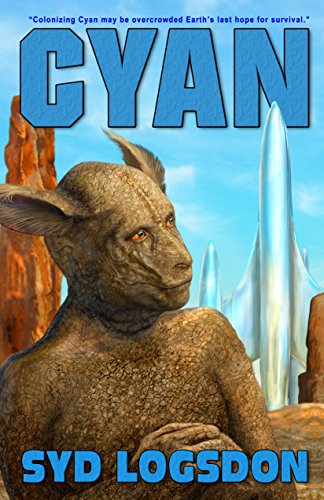
I explained all this to the artist who did the cover for Cyan. I also sent a crude sketch of what I had in mind, with many disclaimers about my (non)skills as an artist. The resulting cover shows a Cyl slightly different from my vision, but better. That’s what good SF cover artists do. However, it is an upper body portrait, so the secret of bipedal tailless hopping remains unresolved.

If I really want to know how it works – and I do – I would have to construct a skeletal robot and see how he moves. But there is no way I’m going to have that much free time anywhere in my near future. I have too many other books to write.

327. The Lone Hero

bks275-1

                         A note before we start  ——

     Yesterday, someone searched on the sub-title of this blog (be not ashamed . . .) but my software doesn’t tell me who. For your information, unknown and curious person, I explained my relationship to this poem on the last day of 2015, and included a copy of the poem the same day.

     And now to our regularly scheduled business ——

===============

In my youth, before Star Trek and Star Wars and computer generated effects, the typical movie hero was a cowboy, riding into town alone, beholden to no one, ready to stand or fall on his own.

Even the word “beholden” seems old fashioned. Ancient. Outmoded — like the western hero himself. And to be fair, he never really existed. If you spend any time at all reading histories of the old west, you’ll find out that things were done by groups, not by lone heroes. When the Dalton gang tried to hold up two banks at once in Coffeyville, Kansas, it wasn’t a John Wayne figure standing tall in the street that stopped them. It was a dozen or so armed citizens that blew them out of the saddle from windows and doorways. Same story in Northfield, Minnesota when the James gang bit the dust.

I called them armed citizens. That sounds pretty good. Put them up on horses with Winchesters and send them as a posse after the bad guys. It still works — unless you are the one they are after. Call them vigilantes, and some people will start to feel uncomfortable, but not everyone. Call them a gang and people will start thinking about locking their doors.

Put them in white hoods. What do you think of them now?

It’s all a matter of perspective, isn’t it?

The lone, self-sufficient individual or small family did exist. There were soddies on the Kansas prairie miles from the next settler. Or log cabins in the deep woods of Ohio and Indiana — back when Ohio and Indiana had deep woods. And there were the mountain men. You can’t get more independent than that — except that they moved across the prairie in companies, and only dispersed once they were in the mountains.

One thing is certain. The idea of the loner was always there.

I wrote my first book, a young adult novel called Spirit Deer, with the idea of the loner front and center. The young man Tim — he didn’t need a last name — got lost in the Sierras while deer hunting and found his way out without help despite innumerable trials and tribulations. You can still sell that kind of book (see Two Hands and a Knife), but they are becoming rare. Today’s YA novels seem to be about how to get along in the world.

There’s nothing wrong with that. It better fits the world today’s youth live in. The — ask a friend, seek companionship, don’t rock the boat, politically correct, do no harm, love yourself, make no judgments, everything is morally right as long as you don’t hurt someone’s feelings — world.

Granted, there is much good in these “civilized” changes, but whatever happened to standing up on your hind feet and saying, “I don’t agree. That’s not for me.” There’s nothing wrong with having an opinion different from the crowd.

No wonder Trump won.

He’s as fake as Rooster Cogburn, but he represents something Americans have come to miss. The cowboy hero, riding into town alone, beholden to no one, ready to stand or fall on his own.

There is one thing to remember though. When the smoke cleared and the sound of six guns faded at the end of that movie, half the town was dead in the street. That may work when you can leave the theatre and drive home to your secure suburban house. It doesn’t work so well when you have to pick up a shovel and go bury your dead.

The self-certain loner and the soft spoken conformer. As Kirk said to Spock, “The truth probably lies somewhere in between.”

326. Dogwood Spring

The California dogwoods are in bloom. Today (March 20) my wife and I took a drive along our favorite semi-secret road to see them. The road isn’t really secret, nor even secluded, but it is off the beaten track. People who don’t live on it, rarely use it. We wound through twists and turns, admiring the green fields and placid cattle, down a steep trail to a hairpin curve at the bottom where a vernal creek rushes through a culvert.

In summer, this is a pool and a trickle, but it has been an exceptionally wet spring and the steep hill behind the pool now provides a double waterfall. We stopped. I admired the bounty of water while my wife took pictures of the dogwoods.

Just at the point where the pool empties into the culvert, there was a clump of grass, rooted in a crack in the rock, partially submerged in the rushing stream. You could see that it had only been growing a few weeks, and shortly the water will fall. When that happens, there will not be soil enough to support the clump, and it will die. But for now, the clump of grass was wiggling and tossing in the water, happy as a hummingbird.

This quatrain occurred to me as I watched.

Though the bee did not come,
And the fruit did not form,
            It does not follow
That the blossom lived in vain.

Like any natural poem, you could apply it to a number of situations. Any un- or under-published author will know what I mean.

325. Exploring Challenger Deep

300px-challenger   300px-bathyscaphe_trieste

HMS Challenger 1874 and bathyschaphe Trieste 1960

Challenger Deep is located in the western Pacific about 2000 kilometers east of the Philippines. It is the deepest part of the Mariana’s Trench, which makes it the deepest part of any ocean.

March 23, 1875, the British research ship H.M.S. Challenger rolled out a line with a weight on the end to measure the oceans depth, something it had been doing throughout its four year journey. It was quite a line. When the weight hit bottom, Challenger’s crew had paid out five miles of hemp — a depth of 4475 fathoms in the measurements of the day.

Although cruises like the Beagle and the Endeavour had set the stage for such exploration, the Challenger expedition was rigged out specifically to study the world’s oceans beneath their surface. It essentially initiated of the science of oceanography. Our space shuttle Challenger was named after H.M.S. Challenger, as was the ship H.M.S. Challenger II which returned to the spot in 1951 and remeasured the depth using an echo-sounder. This time the figure was seven miles, not five.

Reaching the bottom of Challenger Deep remained impossible until two world wars, submarines, frogmen, sonar, and the invention of the Aqualung wedded modern technology to oceanographic exploration. A new invention by Auguste Piccard, the bathyscaphe, finally made very deep dives possible.

In its essential function, a bathyscaphe is more like a dirigible than a submarine. The crew is suspended beneath the vessel in a steel sphere designed to withstand great pressure. The skin of this pressure sphere is so thick, five inches in the case of the Trieste, that it would sink immediately. To prevent this, it is suspended beneath a large, thin skinned, self-propelled float filled with gasoline. This provides buoyancy and, since gasoline is a liquid, is not affected by pressure. Air tanks allow the bathyscaphe to float on the surface as it is being prepared for use. Once the air tanks are emptied, the negatively buoyant bathyscaphe sinks to the bottom — seven miles down in the case of Challenger Deep. The pressures there are so great that it is impossible to refill the air tanks, so the bathyscaphe also carries several tons of steel shot in open bottom containers, held in place by powerful electromagnets. When it is time to return to the surface, the electromagnets are shut off, the steel shot is released, and the now positively buoyant craft returns to the surface. In case of a power failure, the shot would automatically fall away.

The bathyscaphe Trieste was built in Italy to a modification of a Belgian design by Swiss inventor Piccard for the French navy, who subsequently sold it to the American Navy, who rebuilt it with a new and stronger pressure sphere made in Germany. Globalization, anyone?

On the twenty-third of January, 1960, the Trieste was ready to plumb Challenger Deep. The crew consisted of Jacques Piccard, son of the designer, and Navy Lt. Don Walsh. They boarded the vessel, moved down to the seven foot diameter pressure sphere and sealed the hatch. The air tanks were allowed to fill with water and the descent began. It took nearly five hours to sink to the bottom of the Deep. Three quarters of the way down, one of the plexiglas windows cracked, but not enough to cause disaster.

As they cruised above the deep ocean floor, Piccard and Walsh reported a bottom of smooth ooze and saw bottom fish swimming, proving that vertebrate life could survive such high pressure and eternal darkness. They spent only twenty minutes at the bottom, in part because of the cracked viewport, and hours more returning to the surface.

No one would return to those depths for another half century.

Trivia for the faithful: Jean-Luc Picard of Star Trek: TNG seems to have been named after the Jacques Piccard, or after his father Auguste Piccard and his twin brother Jean Felix Piccard. Different sources credit different family members with the name origin. Also, in TNG episode “11001001” a small, slow starship named Trieste is mentioned.

324. Scientific Entrepreneurs

ksc-20160408-ph_kls0001_0005_25704320894In Heinlein’s original stories, a visionary entrepreneur named D. D. Harriman put the first man on the moon. In our world, NASA did it.

Recently, NASA has been in one of its periodic slow periods and entrepreneurs like Elon Musk have been taking center stage. Just this week (I’m writing this on March second) both groups were in the news. Musk announced that two unnamed underwriters had put down sizable deposits for a trip around the moon in the near future, riding in a Dragon spacecraft on top of one of his Falcon rockets. And NASA has announced that the first launch of its Space Launch System booster might carry astronauts around the moon again, for the first time since 1972.

Both are big news, if they happen. Of course, if you follow the space program, you know that there are always more big stories of upcoming events than there are actual events. We’ll have to wait and see.

There are many space enthusiasts who feel that private enterprise should lead in the exploration of space. “Boy genius builds rocket in basement and travels to Alpha Centauri” has a long history in science fiction. I don’t see it.

American industry built all the components of the Apollo missions, and the government paid the bill. Elon Musk has built the Falcon rocket (see photo) on his own, but a NASA contract to supply the ISS pays at least part of the bill. Different, yes, but how different? Privately owned trucks carry goods to your town every day, but on government built roads. Private enterprise is always entangled with government support.

Perhaps it all comes down to a case of, “Who do you trust?” Do you trust private enterprise? Or do you trust the government? Personally, I don’t trust either one of them, so I don’t care who carries the torch for space exploration, as long as it happens.

All this brings us to the anniversary of the day.

Since innumerable interesting things have happened throughout history, and there are only 365 days in a year, you can find something worth celebrating almost any day.

On March 26 (yesterday) or March 25 — depending on which side of the international date line you’re sitting on as you read this — in 2012, James Cameron made a solo descent to the deepest point in the ocean.

The Challenger Deep, in the Marianas Trench, had not been visited by humans since 1960. That expedition was sponsored by the government, specifically the U. S. Navy. Cameron’s visit was self-financed.

Rich men spending their money on their passions, without regard for profit, is not just a twenty-first century phenomenon. Rockefeller made his money in oil, then set up the Rockefeller Foundation. Alfred Nobel made his fortune in armaments, then set up a Peace Prize. Andrew Carnegie made his money in railroads, then set up a chain of libraries across America, including one which illuminated my youth.

Cameron became rich through such films as Titanic and Avatar. His passion for undersea exploration is of long standing. Like Musk with manned space flight, Cameron is continuing an exploration that the government began, then partially abandoned.

Tomorrow we will look at earlier explorers of Challenger Deep.

323. Five by Heinlein

Most of the reviews of science fiction novels are primarily plot summaries, with personal comments. When they are good, it is usually as much from the voice of the reviewer as for the novel in question. A case in point is Schlock Value, my inevitable Sunday night guilty pleasure, which cracks me up weekly with reviews of novels you couldn’t pay me to read.

I don’t write that kind of review myself. I only review favorite books, so I am usually saying, “Here is something great you may have missed. You should consider finding a copy, because it’s worth reading.” That being the case, I prefer giving an appreciation with a bare minimum of summary.

All this makes for short reviews, so I am able to offer you five of Heinlein’s pre-Stranger, non-juvenile, short and polished novels in one post. They are in order of book publication, although two were serialized in magazines years before they were published independently.

Beyond This Horizon, 1948, original serial 1942, is interesting in part because it doesn’t exactly sound like Heinlein. Future society is gun-toting and very polite, rather slow moving and just a little bit prissy. Beyond This Horizon’s tone reminded me a little of Bellamy’s Looking Backward, which I read because it was mentioned as an early influence on Heinlein.

Hamilton Felix (everybody’s name reads like an alphabetical list with the commas dropped, which is actually a pretty neat bit) is looking for the meaning of life, and finds it, more or less. If you’ve read a dozen Heinleins and are curious about what he sounded like before he was fully formed, I recommend this one.

The Puppet Masters, 1951, is probably familiar to everybody, if only from movie versions. This is not one of my favorites. It’s too much of an alien possession horror story for my taste, although, to be fair, it’s a pretty good alien possession horror story. There is one thing about the novel I don’t understand. Heinlein always complained about Star Trek’s tribbles being a rip-off of his flat cats (from The Rolling Stones), so why didn’t he complain about the Star Trek episode Operation: Annihilate!, which is a full blown rip-off of The Puppet Masters?

Double Star, Hugo winner, 1956, has as a main character an out of work actor who is hired to stand in for a prominent politician who has gone missing. He starts out very much unlike a typical Heinlein hero, but grows into one as the story progresses. Heinlein had several of what he called “the man who learned better” stories, and this is probably the best of them.

Door Into Summer, 1957, is my favorite of the early, short, polished Heinlein novels. Daniel Davis, inventor, is duped out of his work and exiled, only to return for revenge and more. He is a bit of a sap at the beginning, but gets over it. The opening page alone, which sets up the title, it worth the price of admission.

Methuselah’s Children, 1958, original serial 1941, is the first appearance of Lazarus Long who later appeared prominently in just about everything Heinlein wrote during the last third of his career. That alone is reason enough to read the book, but if Heinlein had stopped writing after completing this novel, Methuselah’s Children would still rank as a classic of science fiction.

For those who remember the seventies – or lived through them and therefore don’t remember them – this is the novel that launched the Jefferson Starship album Blows Against the Empire.

(No, not that empire! The Viet Nam bashing American empire.)