Category Archives: A Writing Life

322. Time Enough for Love

tefljpg

Heinlein gets mentioned in this blog fairly often. I can’t really say he is my favorite, although I probably read him more often than any other science fiction writer. He isn’t the smartest writer, or the most thoughtful, certainly his longer novels drag, and his writing style doesn’t sing. But he’s the most fun.

I’ve heard several reviewers bemoan the lumbering style of the novels from the late part of his career, then admit that they still read them all the time. I get that.

It recently occurred to me that I have said I don’t much like his two most famous works, Starship Troopers and Stranger in a Strange Land, but I’ve never named my favorites.

Favorites. Plural. There have to be two, because books from the first half of his career are utterly different than books from the second half. In the beginning, Heinlein novels were short, tightly plotted, and polished to a high shine. Most of them are very good, but the pinnacle of that era for me is The Door into Summer. It and four others will be presented in tomorrow’s post.

Stranger . . .  was the watershed in Heinlein’s career. It was long, disjointed, and sloppy. He attempted to shake up the status quo after the rest of the culture had already moved on. Worst of all, it was boring.

He wrote other short, polished works in his middle period, but the long novels gradually prevailed. Twelve years later, Time Enough for Love was published and quickly became my favorite among the new type.

(My near favorite is The Number of the Beast. I read the opening to that novel a couple of times a year, but when they all set of for Mars, I close the book. It goes down hill into useless, irritating bickering, then wanders out of science fiction altogether into fairy land. Sorry, that’s not a place I care to go, but that first hundred-plus pages are perfect.)

If you like tightly plotted novels, don’t waste your time on Time Enough for Love. If you like long winded, rambling stories like your Grandpa used to tell, that is closer, but not fully accurate either. Lazarus Long, the grumpy, selfish, charming oldest man alive is at the center of the novel, but there is also a large cast of (mostly interchangeable) characters to break up the storytelling with current events. Oddly, the most compelling character other than Long is a computer.

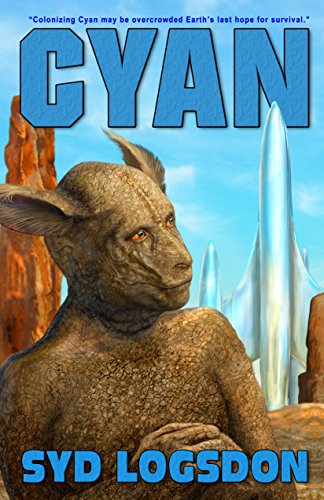
One of the stories buried in the middle of the book is of novella length. It isn’t named, but I call it the Happy Valley interlude. If you’ve read the book, you know which part I mean. When I wrote my novel Cyan, it was largely because I had never found a novel that told the story of a planet from exploration through colonization, without getting sidetracked by ray guns and space battles, or some lame bit about lost Earth colonies, parsecs from home. The Happy Valley interlude was the sole exception to that lack, although it was way too short to satisfy me.

After Happy Valley, the story wanders on, stumbling from one interesting bit to another, with lots of throwaway philosophy, and sex about as exciting as seeing your dad pat your mom on the butt as they wander off to bed.

Sounds like I hated it. No, I loved it. i can’t explain it, and I don’t plan to try.

Heinlein is a storyteller with a voice that many find charming – and many dislike intensely. I can’t argue with those who hate him, but he’s got my number. I could sit and listen to him ramble on for hours and, metaphorically, I often do.

321. Home Grown Ecosystems (2)

Cyan is now available for pre-order through Amazon, with the eBook arriving April 17th. Meanwhile, I plan to repeat a few year old-posts that were designed to stir the blood of would-be readers just before an earlier release date that didn’t happen.

 —————————————-

Continuing our look at the creation of an ecology for Cyan. If you missed yesterday’s post, you might want to go there first.

We can take grasses and weeds for granted. Let’s give our trees multiple trunks bound together, like a strangler fig without its victim, and that should be enough. We need something like insects. We’ll call them Chitropods – chitro sounds like chitin, and pod means foot, so our reader will infer an exoskeleton without any further work on our part. Continuing the idea of inference, if we call the flying creatures who eat the chitropods pouchbats, the reader will draw a better picture in his mind that we could on paper.

The number of legs is important to Terrestrial arthropods, but lets bypass that by giving all our chitropods many legs, but with only one joint each where it meets the body. Now they have a rolling gait “like caterpillars on crutches”. Humor helps keep description from limping along. (Sorry, couldn’t resist!)

These are throw-away inventions. They could have been applied to any ecosystem and they are not systemically related to each other. They alone would be good enough for almost any SF novel, but not for one about scientists teasing out the essence of their planet.

Here we need a key differentiation, from early in evolution, from which a thousand lesser differences can be derived. Here it is for Cyan. Early in the development of chordate life, the vertebral column doubled at the posterior, giving the Cyanian version of fish twin tails. That changed everything. I’ll explain more fully later in a separate post.

On Cyan, the classes are Pseudo-pisces, Amphibia, and Inturbia. No reptiles, no birds, no mammals, no dinosaurs. The Amphibia are cold blooded. Inturbia are inefficiently warm blooded. The term Inturbia should imply “internal body temperature un-perturbed by external changes”. Not every reader will get that, but we need to reward our best readers by not spelling out everything.

There are a thousand other details, but for that, you will just have to download the book when it comes out July 5th.

***

I do have one more thing to share. I wouldn’t bother you, but since you’re reading a post about the backstage secrets of writing science fiction, I can assume that we are all nerds together here .

Inturbia have live birth. Cyanian amphibs have to return to water to lay their eggs, except for one group, the Sphaeralvids, who produce globewombs.

(Globewombs were) the closest thing to an amniote egg that Cyan’s fauna had developed – a transparent, leathery sac extruded by a Sphaeralvid mother and filled with a clear fluid like seawater. Into this she deposited fertile ova, then defecated. Then she separated from the globewomb and left it cached in the crotch of a tree, high up where it would receive full sunlight. On a bright day millions of these globewombs glinted in the treetops.

Algae from the Sphaeralvid mother’s bowels converted the feces into biomass and the Sphaeralvid nymphs fed off the algae.  When the feces were gone, the globewomb walls would break down, leaving the now sizeable nymphs free to face Cyan on their own.

Neat, huh? The globewombs are glinting in the treetops from the first day planetside. By the time the explorers understand what they are, the reader will have been wondering for some time. Globewombs don’t contribute anything to the plot, but since these are scientists trying to tease out the ecology of Cyan, we need some concrete examples of their work. Globewombs provide that.

They make me want to be there when they make the discovery – but that’s why I wrote the book.

320. Home Grown Ecosystems (1)

Cyan is now available for pre-order through Amazon, with the eBook arriving April 17th. Meanwhile, I plan to repeat a few year old-posts that were designed to stir the blood of would-be readers just before an earlier release date that didn’t happen.

——————————-

Over in Backfile, you will find an eleven part document called How to Build a Culture, inspired by Poul Anderson’s How to Build a Planet.

I could also write a paper called How to Build an Ecosystem, but who needs to read all that. A couple of posts here should cover the subject, without boredom or overload.

The fact is, simply peppering your planet with a few well chosen and deeply odd critters is enough in most cases. Andre Norton did it all the time, and it worked for her. The frawns and yoris on Arzor are simply transmogrified bighorn sheep and alligators, but so what? They provide plot points and local color, and that is all that is asked of them. Marion Zimmer Bradley gave us a mammalian snake, a hyper-weasel, and an intelligent dinosaur who sent out pheromone soaked calling cards in Hunters of the Red Moon. What more could you want?

When I wrote Cyan, I faced a different situation. My crew was set down on an alien planet for one year, with the task of coming to understand its weather, geology, and ecology in order to prepare for colonization. They were all scientists, so their actions and conversations called for a deeper understanding of their new world than any other kind of science fiction novel would have required. That challenge was half the fun.

When I began Cyan, I had been studying ecology for about twenty years, starting back when I had to explain what the word meant. I later came to understand the essence of Earth’s taxonomy in the most rigorous possible way – I had had to condense it to a level which middle school students could understand without dying of boredom.

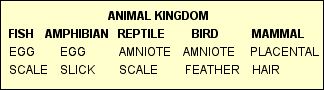
Scientists should forgive the following chart and paragraph.taxon

Drop a salmon egg on the gunwale of your canoe and it will dry out in minutes. A chicken or turtle egg would survive the same treatment. This is the meaning of amniote egg (although there are other, competing meanings). Creatures who lack them, must lay their eggs in water. The rest of the chart should be clear, although simplified. For example, birds have scales on their legs as well as feathers elsewhere, and I skipped Dinosauria altogether.

Now pull up a chair and lets build Cyanian ecology. It needs to be wierd but recognizable – that’s the key to all science fiction invention. We also need restraint. You can only explain so much to your reader without losing them, and beyond a certain point, your backstory is wasted effort.

Come back tomorrow and we’ll dive more deeply into Cyanian ecology.

319. What’s in a Name

nam-pgIt is said that Louis L’amour wrote the same novel a hundred times. It has been said that Robert Heinlein wrote the same character a thousand times.

Do you remember All You Zombies? No? Well, that’s not surprising. It was first published in 1959 and it isn’t about zombies, but about a man(sic) who is every character in the short story, by means of time travel and a sex change operation.

Even Lawrence Smythe, the lead character in Double Star, who starts out an anti-Heinlein character, becomes a true Heinlein character by the end of the novel.

Before we decide that this is a fault, lets look at the names Heinlein uses.

Valentine Michael Smith
Woodrow Wilson Smith
Maureen Smith
Johan Sebastian Bach Smith
Lawrence Smythe
Max Jones
Oscar Gordon
Wyoming Knot (All right, that one was a bad pun that doesn’t fit the pattern, but I had to include it.)
Thomas Paine Bartlett
Patrick Henry Bartlett
Daniel Boone Davis
Andrew Jackson Libby
D. D. Harriman (Think E. H. Harriman, tyrant of American railroads.)

Good God, what bigger clue do you need? Do you think Heinlein couldn’t think of interesting or unusual last names? Or that he couldn’t think of names not already used by famous Americans? These are American everymen. (Or women. Or both, in alternation.) No wonder they all look alike.

They’re also Bob Heinlein clones. And that’s okay by me.

318. Too Many Exoplanets

trappppIt’s official. The good old days are gone.

About a year ago, I said:

(T)he party is nearly over. We now have the capacity to discover extrasolar planets, and new ones are found every year. Fortunately for latecomers to the planet builders guild, megaplanets are easier to find that Earth sized ones, and NASA keeps cutting funding. Still, it won’t be too many years before you can’t decide for yourself where, within the limits of orbital mechanics, you want the planets of Alpha Centauri or Procyon to be.

Science has a way of getting somewhere a lot faster than you would expect. Manned space exploration doesn’t fit that statement, because it runs on politics, not science.

On February 22, in Nature, it was announced that seven Earth size planets had been discovered circling a single star only thirty-nine light years from Earth. Far more important, all seven orbit within the band of temperature where liquid water is a possibility. By contrast, our system has one such planet, Earth, and maybe Mars for a few minutes on a hot afternoon near the equator in mid-summer – if the ice doesn’t sublimate instead. Seven; its unheard of.

The star is TRAPPIST-1, an M dwarf. 

In fact there has been a mini-revolution in the search for exoplanets. NASA’s Kepler space telescope has found more that 4700 potential planets. Many of these will no doubt turn out to be false positives, since the techniques of the search are not perfected, but it is still a staggering number. Most of these were found around stars similar to our sun – where else would you look first? Very few of them are both Earth sized and at the right distance from their star to have the possibility of liquid water.

As I said in Cyan, “planets of no use as real estate.”

Since a mechanical failure in 2013 compromised its ability to orient itself, Kepler has concentrated on observing red dwarfs. To eveyone’s surprise, the planet candidates found around these small, dim stars tend to be more Earth sized. And there are a lot of them.

The TRAPPIST-1 discovery, however, was not by NASA but by the TRAnsiting Planets and Planetesimals Small Telescope group operating out of the University of Liège, Belgium. That explains the use of caps; TRAPPIST is an acronym.

If you want details – and of course you do – the best source is here. This page from the University of Liège is in French, but the video which will self-start is in English, and gives enough details to stir the blood of any space or science fiction fan.

It took me about three seconds to start speculating about what kinds of novels could be written about the exploration of the TRAPPIST-1 system. Suppose most or all of the seven planets had some form of life, all evolving independently. Suppose we write about a paleontological mission on a planet which had vertebral life, then lost it; these dwarfs have a solar wind that operates heavily on planets so close in. Suppose at some time in the deep past, a spacefaring civilization arose on one of these planets, colonized the others, and then died out. Or didn’t die. Or seems to have died until our intrepid explorers begin to poke around.

Okay, I was wrong. The golden age is still here.

317. SF in the Wild

Cyan is now available for pre-order through Amazon, with the eBook arriving April 17th. Meanwhile, I plan to repeat a few year old-posts that were designed to stir the blood of would-be readers just before an earlier release date that didn’t happen.

——————————-

This post was originally number 128.          If you are what you eat, I used to be beefsteak, fried okra, and hominy. That comes from growing up in Oklahoma. I also lived outdoors most of the hours of every spring, summer, and fall day, and way too many hours of every winter day. That comes from growing up on a working farm.

If you are what you read, then I used to be an Andre Norton protagonist, at least in my imagination. Although I never met or corresponded with her, Andre Norton was something of a long distance mentor.

Alice Mary Norton legally changed her name to Andre Norton early on, in an era when being a woman was no help to a science fiction writer. I didn’t know that when I first read her; I thought Andre Norton was a man. Not that I thought about it much, but she didn’t write like a girl. Looking back, I see that she actually wrote like a person, but I wasn’t that sophisticated then.

One reason Norton got away with writing gender neutral fiction was that her characters spent most of their time alone. Even in their relationships with others of their own kind, they were loners, if not complete outcasts.

Star Man’s Son was the first Norton I read. In it, Fors spent all but a few pages on a quest away from his people; that was a pattern to which Norton frequently returned. I could easily identify with the solo quest while I spent endless hours alone on a tractor. The only variations in my daily life were whether I was pulling a disk or a hay rake, and which Norton novel was replaying in my head.

Every time Shann Lantee on Warlock, or Naill Renfro on Janus, or any of a dozen other young men found himself stranded alone, or nearly alone, on an alien world, I could look up from my tractor seat at the Oklahoma prairie and say, “Yup, been there.”

The best thing about Norton’s characters was that they didn’t whine about being alone. They liked it. So did I.

I didn’t live in a city until I went to college. I spent my adult life living in the suburbs of a reasonably small city, and taught school in a very small town. As soon as I could retire, I moved to a few acres in the foothills. I would move further out if I could afford it.

I was born not liking cities, and my opinion never changed. It should be no surprise that my first novel was about a hunter surviving alone in the woods, or that my first science fiction novel Jandrax was about a hundred or so humans stranded on an alien world.. My three fantasy novels have a rural and medieval feel. David Singer, in A Fond Farewell to Dying, is a mountain boy who has to go urban to get his life’s work done. And Cyan, due out soon, begins with ten explorers on an empty world, then continues with the story of the peopling that world by hyper-urbanized refugees from an overcrowded Earth.

You write what you’ve lived.

316. Cyan is Here

Finally, after a long wait, CYAN is available for pre-order at Amazon.

If you click here they will take your $2.99. That’s half price to those who pre-order. Pre-ordering puts you first in the queue and gives you the discount; the book itself will arrive in your Kindle on April 17.

Cyan will be available exclusively to Kindle customers at full price on April 17, and available to all eBook retailers on July 17.

Yea! (The dates I gave in an earlier post are now defunct.)

____________________________________________________

It think it would be fair to assume that, if you aren’t reading here for the very first time, you know that I started this blog to support Cyan. By now you know my writing style, and you’re still here, so it’s safe to assume you will like it. 

In the days before the internet, writers didn’t have to publicize their own work, unless they were a best seller and went on book signing tours. Writers also couldn’t publicize their own work, so the sword cut both ways. If you had a good book that didn’t find its audience, there was nothing you could do about it.

Now authors can and must be their own publicist. Hence this blog — even though writing it has become an ongoing pleasure.

Now its your turn. Brian at EDGE said to me:

One of our goals is to get 50 reviews posted on Amazon as quickly as possible.  Reviews can be posted any time after April 17th.  However, there is a catch. Only Amazon customers can post reviews.  A qualified Amazon customer does not have to have purchased CYAN to post a review, but they must have purchased something from Amazon in the past.

It would be good for you to contact as many of your supporters and ask if they would post a review. (That’s you.) If they are not currently an Amazon customer, they can become one by purchasing a copy of CYAN any time (and at the pre-order price of 2.99) and then post their review after the book becomes available on the 17th of April.

So that’s it. No hidden agenda. The agenda is in plain sight and always has been. However, I do have an additional inducement.

If you read Cyan, and like it, and review it, and it becomes successful enough to warrant publishers taking on other books of mine, then you will soon see:

Valley of the Menhir

Scourge of Heaven

Who Once Were Kin

All fantasy novels, already written. You might soon see two planned but not yet written sequels to Cyan. You might even see:

Raven’s Run (in Serial now)

Symphony in  a Minor Key (a teacher rebuilds his life after a false accusation of abuse)

Both are contemporary fiction. Your kids might even get to read the young adult Spirit Deer. (Either soon or later — I don’t know your life plans.)

Right now, I’m concentrating on Amazon, but if you also send a review to Goodreads, I wouldn’t mind at all.

There is a lot riding on electronic word of mouth.

315. Apprentice in Science

fleming-schola-rs-1966For eight weeks in 1965, I was a Fleming Fellow (see yesterday’s post).

The gist of the program was that a Fellow was assigned to a research scientist as something like an apprentice. My personal research had been a hybrid of ecology and space science (see Tuesday’s post) Nothing like that was available in a medical research facility; instead, I was assigned to Dr. Gunnar Sevelius who was doing research on determining renal flow through use of radioisotopes. He had just finished editing Radioisotopes and Circulation the preceding year.

Dr. Sevelius gave me a small lab room and access to a supply of radioactive iodine, along with sensors for radioactivity and a strip chart recorder. He sat me down to talk about his work and tell me what he expected from me. He treated me as if I could figure things out for myself – which I could. I didn’t see him often after that, although I hung out with his young lab assistants.

I don’t need to give a lot of detail here. It has all been superseded.

Everything sophisticated in science was crude when it was being developed. Any kid in a high school metal shop today could reproduce one of Goddard’s original rockets — but only because Goddard taught them how. Any trained technician can slide you into a machine and look at images of the inside of your head — but only because to the work done by people like Dr. Sevelius. Everything at OMRF was cutting edge for 1965, and probably none of those machines are even stored in dusty basements any more. Science moves on, and quickly.

Computers? Video monitors? Forget it. A strip chart recorder had a moving roll of paper, a moving head with roll of typewriter ribbon and a striker that made a dash on the paper every time the sensor detected radioactivity. An image of a pair of kidneys looked something like this:

renal

You can see a strip chart recorder at the top of this post. That’s me in 1965, with a haircut that was already going out of fashion.

I learned a lot that summer, not least that I would never again spend eight weeks in a windowless room doing repetitive research. I love the results of science, but the doing of it can be damned boring. I also got to test myself against other smart kids, and be satisfied with the result. Every other Fleming fellow had done more sophisticated work than I had, but they were the products of sophisticated high school science programs, or the children of scientists.

There were lectures and activities for us. I met a scientist who had done research on the reaction of elephants to LSD — two years before I chose to avoid it when it became mind candy.

I learned about Michigan State, and was encouraged to apply there. I got a tour of the basement where research was being done using a sensory deprivation tank. Fifteen years later that became the basis for my second published novel.

I learned about the infamous Dr. Sexauer. From a former fellow, I got the names of two of my former incarnations, in a late night seance. Tidac and Javernan became characters in my three fantasy novels. I wrote about that incident, and it led to an odd occurrence. The OMRF was trying to find all its Fleming Fellows to prepare for the 60th anniversary of the program. I had mentioned the name of the girl who seemed to be running the ouija board. The OMRF had googled her name, found my post, and connected with me. It was good to hear from them again.

When I returned to my tiny high school that fall, I had touched the larger world and I would never turn back.

314. Fleming Fellows

300px-oklahoma_medical_research_foundation_nimaphoto by Nima Kasraie

The Oklahoma Medical Research Foundation is a major research institution, but not a household word. Let me explain its importance in my life.

Everything that happens to a writer passes into his memory, sinks to the bottom, and grinds around there, knocking sparks off every other experience. Years later, it emerges, transmogrified, as stories or parts of stories.

My soul as a writer and as a human being was forged on a small farm, working essentially full time in addition to going to school. I was an only child. School and home were kept strictly separated. Except for one treasured cousin, none of my school friends ever entered my house.

I was a very smart child in a very small place. I worked hard, got strong, and loved the outdoor life, but my mind lived in other worlds, brought to me by books of science fiction. I decided to become a scientist. In that pursuit, I was torn between space science and ecology. When I was a high school junior, I put those two together (yesterday’s post).

That same year, among the many standardized tests we took, was the test to become a Fleming Fellow. There was also an application to be filled out in which I was to explain my aspirations and offer any personal projects to prove my capacity. I wrote up my ecosystem in space project.

I was notified that I was a finalist, and scheduled for an interview in Oklahoma City. At that time, I knew almost nothing about the fellowship or the OMRF.

Incorporated in 1946, the Oklahoma Medical Research Foundation was dedicated in 1949 by Nobel Laureate Sir Alexander Fleming. In 1957, OMRF started a summer program for students, which was quickly named the Fleming Scholar Program. It has evolved over the years, but in that era, from four to seven Oklahoma High School juniors were recruited, and spent eight weeks at the OMRF the following summer.

In the spring of 1965, I sat before a panel of scientists for my interview. I had expected questions on science. Instead, they asked questions on meaning and morality. What did I think of the bombing of Hiroshima? What did I think of capital punishment? Behind the questioning, they were clearly trying to find out my level of self-confidence, as the interview became quite adversarial at times. After I said that I was still uncertain about my stance on executions, one of the scientists asked, rather sharply, “Don’t you think it is our duty to think about such things?” I remember being irritated at his high-handedness. I snapped back, “I didn’t say I hadn’t thought about it. I said I hadn’t decided yet.”

I said to the panel that I intended to pursue a Ph.D. The whole panel tried to convince me that I should be getting an M.D. instead. I held my ground, and when the interview was over, one of the panelists admitted that most of them had Ph.D.s, not M.D.s.

Fortunately, self-confidence – or arrogance, if you prefer – is something I have never lacked. I received a Fellowship. I’ll tell you about it tomorrow.

313. Weightless Ecology

ecoopwegt-lessI’ve been putting off this post since I started the blog. It’s embarrassing. I’m proud of what I did, but telling it makes me feel a little like one of those old guys who never stops talking about the night his forward pass won the big game.

Still, if I hadn’t done what I’m going to tell you about today, I would never have done what I did the summer after (tomorrow’s post), and if not for that, I would still be driving a tractor in Oklahoma. So here goes.

1964-5 was my junior year in high school. That was the year I took both junior and senior English because I was running out of classes to take, and that was the year I discovered science fairs. We didn’t have one in our tiny school, but their was a regional competition one county over. I had recently discovered Shirley Moore’s Science Projects Handbook, which was the bible for the science nuts (nerd wasn’t a word yet) of my generation.

America was in space; the Mercury project was completed and Gemini was waiting in the wings. I was enthralled with space, but also with ecology. Rachel Carson’s Silent Spring was about to make ecology a household word, but no one in my world had heard of it yet. I decided to put the two together and build an “Ecosystem Operable in Weightlessness”.

Lets get real. Boy scientist builds spaceship and flies to Arcturus only happens in the very old pulp stories. I wasn’t going to build something that would actually fly in space. It was an exercise in design, with as much building as I could pull off with limited resources.

The idea was that at that time NASA needed to keep to keep some creature in weightlessness long enough to see what it would do to its body. Laika the Russian space dog hadn’t lasted long, and the longest Mercury flight had been 34 hours. I proposed a design that would put two mice in a closed ecosystem with algae. It was set up so that the algae tank would spin to provide just enough gravity to keep the water separate from the air, but the mice would be weightless in a separate chamber.

The fun was in the details. The mice would be housed in a two part plexiglas bubble, with a wire mesh floor at its equator. Waste would pass through he mesh, carried by the airstream and drop down into the algae tank.

That part actually got built. I made the algae tank of plexiglas, heated and formed around two round pieces of wood. I blew two half domes with a plywood form, an air compressor dragged up from shop class, and an oven borrowed from the home-ec teacher.

As I’ve said before, most of my education came outside of the classroom, thanks to indulgent teachers. They did the right thing, but it would get them fired if they did it today.

I bolted the half domes together through flanges formed during the blowing process. With two mice, Hing and Ho (named after the meerkats in Andre Norton’s Beast Master) in the upper chamber of the dome and a mass of Ankistrodesmus from a local stream in the algae chamber, connected by an aquarium pump, the ecosystem was as far finished as I could manage by the time of the science fair.

The physical result was limited by my resources, but the design went much further. To transfer the food to the mice, I had designed a pump, patterned after a Wankel engine (all the rage in Popular Mechanics that year). It was to send algae laden water up through a tube where it would be flushed over a fine mesh screen. The water would return to the tank on the airstream, leaving the algae for the mice to eat.

I did actually experiment with feeding them Ankistrodesmus. I strained it out of the water, dried it over a light bulb and passed the algae wafer into the mice’s cage. They went wild. You would have thought it was ice cream.

The design called for a small tube to carry a continuous airstream from above the algae water to strike the inside center of the upper dome, bringing the mice fresh air and carrying away waste as it returned. There a larger tube would carry the waste to the bottom of the algae tank.

To get water to the mice under weightlessness, the design called for the airstream from the algae tank to first pass through a Hilsch vortex tube, which split the airstream into hot and cold halves. The cold half was to pass between two thin metal plates. The warm (and moist) half of the air was to play onto the outside of these plates, leading to condensation and a continuous source of water for the mice to drink.

So why am I telling you this? Because this was the first step toward my future.

I didn’t know that at the time. I just did it because it was a challenge and more fun than I had ever had, but it led to a Fleming Fellowship, and that changed my life. more tomorrow.