Category Archives: A Writing Life

273. Jesus and Joseph

I have a mental image that I would convert into a painting, if I had the skill. I don’t. I can draw; I can paint; but I lack the spark that turns such work into art. It’s frustrating — I’ll have to make do with words.

Imagine the interior of a carpenter’s ship, two millennia ago, somewhere in the middle east. Research won’t help much on this one. The best you can find is a painting from the European middle ages, or the Japanese middle ages, and then you have to reason backward with few facts to help you.

There will be two figures in the painting, and of course, you already know who they are. Joseph is planing a board he has just riven. Jesus is sweeping the floor. From time to time their glances meet, but there is little conversation.

If you have read many of these posts, you know I am not a Christian, but I started out as one, and Biblical images live in my bones. I have always wondered at the strangeness of the Son of God growing up apprenticed to his human father. And I’ve wondered how Joseph must have felt about it all.

Joseph gets little respect. Catholics give their affection to Mary. Protestants ignore him altogether. The ancient Cherry Tree Carol sees him as an insensitive doubter who thinks Mary is carrying another man’s child.

I have also wondered how Jesus must have felt. Even if you believe he was God, he was also a boy, with a child’s limitations, trying to understand his human father.

So . . .   Joseph and Jesus are in the carpenter’s shop. Jesus is sweeping the floor, since he is not yet trained. HIs father is planing the board he has just riven. Jesus looks up from time to time. There is affection in his gaze, even though he knows that his father’s love is limited by Jesus’s own strangeness. Then he drops his eyes back to his sweeping.

Joseph looks up in turn, stern and a little puzzled by the child’s silences. His hands pause a moment at his work. A traditional picture would fill his eyes with wonder. I don’t think so. I see them filled with frustration and resentment. And yet, with affection. The two sides of the moment are at war in his eyes. Then he draws back his hands and the plane moves through another stroke, because, for God or for man, there is always work to do.

Father – it’s a tough job description. Son isn’t much easier.

272. The Hard and the Soft

DSCN1841Welcome to winter. For northern folk, and that’s what we all are in Europe and America, the coming of winter is an inevitability that rounds out our lives and prefigures the end of our lives.

The poem which follows is not full of summer graces, nor flowers, nor joy. I wrote it in August, when the temperature outside was above a hundred, but it is still a winter poem. I would say I don’t know where it came from, but that would only mean that it came unbidden when I was working on other things. It was committed to paper in five minutes, in its first form, and polished in twenty. That is rare for me.

In truth, I know where it came from, and so will you.

The Hard and the Soft

There is a soft season and a hard season,
And now the hard season has come.

Through the springtime and the summer,
When green was the color of the world,
Fruits of the earth abounded.
Children were conceived in joy
And brought forth in fullness.

Now is the hard season,
The color of the earth is stone gray,
The water is hard and the ground is stony hard.
Children of this season come out hungry
Crying with harsh voices that give no joy,
Troubled by deep hungers that allow no rest.

She was born of summer,
He was born of winter.

They joined together, and she made him whole,
     for a space,
          for a little space.
But now it is the season of cold
And he has turned back
     to his true nature.

271. Here Comes Santa Claus

This is the last of three posts based on The Battle for Christmas, a book by Stephen Nissenbaum. You should read them in order.

Now we are on the verge of Christmas as we know it. Good old Santa Claus is about to take the stage. His midwife will be a group of stodgy old men who hated the rise of the common man, and longed for good old days that never were. Washington Irving was their leader, but a one-poem wonder named Clement Moore would be the one to change the world.

St. Nicholas and his companion delivered presents or coal to the children of Holland, but he never crossed the Atlantic to New Amsterdam. The notion that he did is a common myth, reading subsequent events backward.

John Pintard, founder of the New York Historical Society, played a role in establishing the Fourth of July and several other events as national holidays. He also brought St. Nicholas to the attention of America when he tried to make him the patron saint of New York City. In 1810, he published a broadside that showed a picture and accompanying poem with St. Nicholas delivering presents to children on St, Nicholas Day, Dec. 6.

Washington Irving’s Sketch Book came along a decade later. Everyone knows that Rip van Winkle, from that book, fell asleep and woke to a different era. Not many people remember that he hated the new America he found upon waking. So did Washington Irving and his cohorts, who called themselves the Knickerbockers, and patterned themselves after the old Dutch burghers they imagined to have inhabited New Amsterdam — all based on Irving’s fanciful Knickerbocker’s History of New York.

In the Sketch Book, Irving portrayed Old Christmas in England as a joyful celebration between good masters and their servants. In Knickerbocker’s History, he related a dream which included:

. . . and, lo! the good St. Nicholas came riding over the tops of the trees, in that self-same wagon wherein he brings his yearly presents to children. . . .  And when St. Nicholas had smoked his pipe he twisted it in his hatband, and laying his finger beside his nose, gave the astonished Van Kortlandt a very significant look, then mounting his wagon, he returned over the treetops and disappeared.

St. Nicholas, giver of presents to children, had won over a group of grumpy old men, but the rest of America did not know him yet. He was still confined to the Knickerbockers who, despite their fantasies, were of British heritage, not Dutch, and were High Church Episcopalians, not post-Puritan religious conservatives.

Clement Moore changed that, not overnight, but over about a decade. He was not the first poet of St. Nicholas. You will find the text of an earlier poem near the bottom of one of last year’s posts. If you check it out, you will agree that it would never have taken the world by storm.

If you read A Visit from St. Nicholas (which I have tacked onto the bottom of this post in case you don’t have it handy), you will see that almost the whole modern Santa is there, repackaged from the Knickerbocker mold, and made charming and familly friendly. It would be wrong to say Moore invented Santa, given St. Nick’s Dutch origins and his twenty year history with the other Knickerbockers, but it would be hard to imagine Santa conquering the world without Moore’s poem.

The only major thing missing is his red suit. We can thank Thomas Nast and Coca-Cola for that.

Could even so charming a poem have so changed the world by itself? It is doubtful. It is more reasonable to see it as a perfect summing up of forces already at work. Wassailing had turned to riot, tinged with felonious assault. Peasants wandering from door to door had become masses of overcrowded urban poor spilling wildly into the streets. A few tipsy peasants had, by sheer population growth, turned into a dangerous mob.

The middle class was rising. Respectability had become something to strive for. Falling from middle class respectablity had become something to fear. Children were no longer just a source of free labor, but were quickly becoming the center of the family. Clement Moore’s poem rode that wave of change into the hearts of America.

Bacchus was still God of the street, but Santa was becoming God of the hearthside. Frankly, I like it better that way.

Postscript: They do it differently in Shetland. I’ll tell you that story on December 26th.

A Visit from St. Nicholas (AKA The Night Before Christmas)
by Clement Moore

‘Twas the night before Christmas, when all through the house
Not a creature was stirring, not even a mouse;
The stockings were hung by the chimney with care,
In hopes that St. Nicholas soon would be there;
The children were nestled all snug in their beds;
While visions of sugar-plums danced in their heads;
And mamma in her ‘kerchief, and I in my cap,
Had just settled our brains for a long winter’s nap,
When out on the lawn there arose such a clatter,
I sprang from my bed to see what was the matter.
Away to the window I flew like a flash,
Tore open the shutters and threw up the sash.
The moon on the breast of the new-fallen snow,
Gave a lustre of midday to objects below,
When what to my wondering eyes did appear,
But a miniature sleigh and eight tiny rein-deer,
With a little old driver so lively and quick,
I knew in a moment he must be St. Nick.
More rapid than eagles his coursers they came,
And he whistled, and shouted, and called them by name:
“Now, Dasher! now, Dancer! now Prancer and Vixen!
On, Comet! on, Cupid! on, Donner and Blitzen!
To the top of the porch! to the top of the wall!
Now dash away! dash away! dash away all!”
As leaves that before the wild hurricane fly,
When they meet with an obstacle, mount to the sky;
So up to the housetop the coursers they flew
With the sleigh full of toys, and St. Nicholas too—
And then, in a twinkling, I heard on the roof
The prancing and pawing of each little hoof.
As I drew in my head, and was turning around,
Down the chimney St. Nicholas came with a bound.
He was dressed all in fur, from his head to his foot,
And his clothes were all tarnished with ashes and soot;
A bundle of toys he had flung on his back,
And he looked like a pedler just opening his pack.
His eyes—how they twinkled! his dimples, how merry!
His cheeks were like roses, his nose like a cherry!
His droll little mouth was drawn up like a bow,
And the beard on his chin was as white as the snow;
The stump of a pipe he held tight in his teeth,
And the smoke, it encircled his head like a wreath;
He had a broad face and a little round belly
That shook when he laughed, like a bowl full of jelly.
He was chubby and plump, a right jolly old elf,
And I laughed when I saw him, in spite of myself;
A wink of his eye and a twist of his head
Soon gave me to know I had nothing to dread;
He spoke not a word, but went straight to his work,
And filled all the stockings; then turned with a jerk,
And laying his finger aside of his nose,
And giving a nod, up the chimney he rose;
He sprang to his sleigh, to his team gave a whistle,
And away they all flew like the down of a thistle.

photo by By Sander van der Wel from Netherlands (Intocht van Sinterklaas in Schiedam 2009) [CC BY-SA 2.0 (http://creativecommons.org/licenses/by-sa/2.0)%5D, via Wikimedia Commons

270. Colonial Christmas

puritanchristmasbanThis is the second of three posts based on The Battle for Christmas, a book by Stephen Nissenbaum. You should read yesterday’s post first.

The Battle for Christmas is not about the worldwide history of Christmas, but about American Christmas. The origin of the cult of St. Nicholas, the Christkindl, the black companion to Holland’s Sinterklass, Germanic Christmas trees and the rest are outside its view.

The Puritans of New England disliked Christmas. In fact, they outlawed it. The birth of Christ was of no particular interest to them. They were focused on his death and resurrection, and what that meant for sinners.

That was also the attitude of my childhood church. We had no Christmas services; if Sunday fell on Christmas, the sermon would begin with the story of Jesus’ birth, but would quickly turn our attention to his death and resurrection, with a full complement of fire and brimstone, and Hell to come for any who did not believe.

In point of fact, however, what the Puritans focused on was not their real problem with Christmas. They didn’t like it because it was a drunken party, with sex besides.

It comes back to leisure, full larders, and full kegs, and to the fact that the food and drink did not belong to the poor. It was the larders of the rich which were full. It was the poor who wanted some.

In agricultural times in Europe, it could be said that they wanted their share, because they had traditional rights to handouts during the season. There may have been a time when it was all respectful and friendly, as Washington Irving tried to portray it in Old Christmas (an excerpt from his Sketch Book), but the exchange was always tinged with threat, as in:

Come butler, come fill us a bowl of the best
Then we hope that your soul in heaven may rest
But if you do draw us a bowl of the small
Then down shall go butler, bowl and all

This, of course is wassailing, but it reeked of uppity servants, harrassment of their masters, and a general overturning of authority. Which was part of the point.

In Puritan days in New England, nobody was celebrating the nativity. The Puritans were going about their work, soberly and solemnly, with no acknowledgement of the day. The lower orders, especially the sailors down by the harbor, were making merry. Very, very merry, and the Puritans didn’t like that. They made the celebration of Christmas against the law, and you never make a law unless someone is already doing what you want to forbid.

The Puritans didn’t last, but the raucous celebrations they hated did. Newer, more liberal churches began holding religoius services on Christmas day. That didn’t last long either, the first time around.

A good, old fashioned Christmas is what a lot of people think they want today, but the real old fashioned Christmas looked a lot like what we now do on New Year’s Eve.

It got worse. As society moved from an agricultural base to an industrial one, the distance between the classes increased. The upper classes were less inclined to provide the handouts that the lower class demanded. What had looked like harmless, low level intimidation — not unlike today’s trick-or-treaters — began to look like a social revolution, especially in New York City shortly after the founding of the United States.

The rich stayed home on Christmas and feasted with their friends. It was an adult celebration; children were not yet the center of Christmas. The poor took to the streets. Where else would they have to go? Their all night, loud, drunken partying brought fear to the respectable upper crust. Gentlemen spoke of riots when they referred to the raucous Christmas season celebrations by the poor.

Riot is actually not a bad description of the state of affairs.

These poor were the mob that sometimes worried the staid burghers who wrote the Consititution. They were good at killing the British during the Revolution, but they weren’t respectable. By the late 1820s, the backwoods unwashed would put Andrew Jackson into the White House, and change the future of America. Decades earlier, their urban counterparts were already making life rough for respectable rich folks in New York City and elsewhere.

These rampaging mobs frequently broke into respectable homes, harassed the homeowners, and demanded food and, especially, drink. Wassailing, yes, but carried to a new level. One old wassailing song said:

We are not daily beggars
That beg from door to door;
But we are neighbours’ children,
Whom you have seen before.

These new urban mobs could not say that. click here to continue the story

269. Old European Christmas

DSCN1839In Dickens’ A Christmas Carol, when confronted by the Ghost of Christmas Past, Scrooge says, “Long past?”, and the ghost replies, “No, your past.” We’re going to turn that on its head. You already know about your childhood; you don’t need me for that. During the next three posts, we are going to travel several hundred years into the past and watch Christmas evolve into what we enjoy today.

Last night I watched a DVD of Santa and Pete, in which Saint Nicholas leaves Amsterdam to visit the New World. There he finds his red hat and coat, learns to come down chimneys, trades his horse for reindeer, and they learn to fly after drinking an old African potion. It’s a sweet movie, but it has nothing to do with reality.

Christmas has a real history, which is not as sweet, but is absolutely fascinating. Our guide for this will be an academic history of Christmas called The Battle for Christmas, written by Stephen Nissenbaum, which I first mentioned last year in A Christmas Booklist.

Some historians are dry as dust: others have a novelists touch and bring history to life. Nissenbaum is one of the latter. If you like Christmas and you like history, you can look forward to a good time with him if you seek out the book for yourself. Of course, he is a historian, so the book is dense.

*             *              *

I imagine that everyone knows that many of the traditions of Christmas, like holly and the yule log, are pagan in origin. It is also widely known that the date of Jesus birth is not found in the Bible. Put those two ideas together, and it is no surprise that the Puritans did not celebrate Christmas in early New England. It’s all very logical, but it isn’t the whole reason – probably not even the major reason.

Puritans were little worried about Paganism itself. Odin and Balder did not enter into their thinking. Their world was strung between two poles – God on the right and the Devil on the left. They weren’t afraid of holly and evergreens, but they were afraid of disorder. And disorder was always waiting in the wings, locked into the agriultural cycle.

All across northern Europe, both before and after Christianity, fresh foods were available in spring and summer, and into autumn. Grains were planted in spring and harvested in fall. Some was kept to be ground into flour for winter bread. Some was preserved by fermentation to form a variety of beers. Cabbage was fermented into sauerkraut, which kept millions of German peasants alive through the winter.

In America, as late as the Revolution, apples were preserved as hard (fermented) cider which would store through the winter. Most of the excess grain grown anywhere west of the Appalacians went to market as the portable and storable product called whiskey. Alcohol may bring a tipsy smile, but it is also a food that does not spoil.

From peasants in the Middle Ages until the Industrial Revolution, the only leisure for the European lower classes was in winter, when farm work could not be done. Early in the winter, the season’s barley had become beer, the extra animals who could not be kept alive through the winter had been slaughtered, and the pantries were as full as they would ever be. It was time for a party.

*              *              *

When I first read The Battle for Christmas about ten years ago, finding this tie to seasonality was like meeting an old friend. I spent my youth tied to the Oklahoma-farmer version of agricultural seasonality, with planting times and harvest times, with putting up vegetables for the winter for the family and putting away grain and hay for winter feed for the animals. The season of cattle breeding was keyed to bring on late fall births, so there were new calves and new milk just in time to provide work and income during the winter when no grains were growing.

I had already based the entire Menhir series on a hero who grew up tied to the agricultural cycle in a land of peasants and lords, where drought and overpopulation made life a struggle for food. In such a place, early winter is a time of relative plenty and late winter is the starving time — a subject I will address here next month in an excerpt from those books.

*              *              *

So we have the onset of winter, enforced leisure, plenty of food and beer (at least for a while). The celebrations of this point in the year were raucous, with plenty of drunkenness and, no surprise, plenty of sex.

Along came Christianity — always the enemy of a good time — and tried to Christianize the holiday by tying it to Jesus birth. It didn’t work. click here to continue the story

268. Rick Brant Bibliography

Here is the list of the Rick Brant books I promised in last Thursday’s post. Numbers 1 through 18 were published by Grosset and Dunlap and widely distributed. They are hiding in thousands of dusty attics and can frequently be found in the children’s sections of used book stores, and used onlline through Amazon.

I have never seen books 19 through 24. although I’ve looked for them everywhere. According to Series Books numbers 19 through 23 were also published by G & D; I don’t dispute this, but clearly they were not well distributed. Also according to Series Books, number 24 was published by Manuscript Press. I have little to say about the last six books since I have not read them.

The list below is coded. KS (Kindle, single) means that the book is available for individual download to Kindle through Amazon. U (used) means the book is available used at reasonable prices, if you shop around or order through used bookstores carried by Amazon. $ (Egads!) means it is available used in the same way, but at ridiculous prices. I’ll buy these last six myself when I win the lottery.

GK (Gutenberg/Kindle) indicates an interesting phenomenon. These appear to be public domain works, and were made available for free through Project Gutenberg. Click to go to the Browse By Author:G page, then scroll down to Goodwin, Harold L.

I downloaded one novel into iBooks using EPUB format with images, and another into my desktop Kindle app using Kindle format with images. Both seem equally good. This was just a test for your sake; I still have treasured copies from my youth. While you are at Gutenberg, do yourself a favor and download the non-series SF novel Rip Foster —, under either variant title.

These Gutenberg books are also available from Amazon in the form of The Rick Brant Science-Adventure Series (Halcyon Classics). This Kindle download is a compendium of the eleven books available from Gutenberg. I had no reason to download it, but I have bought compendiums before and find them harder to navigate that individual titles. It’s your call.

KS  1.  The Rocket’s Shadow, 1947
KS  2.  The Lost City, 1947
KS  3.  Sea Gold, 1947
U    4.  100 Fathoms Under, 1947
U    5.  The Whispering Box Mystery, 1948
   6.  The Phantom Shark, 1949
GK  7.  Smugglers’ Reef, 1950
GK  8.  The Caves of Fear, 1951
U    9.   Stairway to Danger, 1952
GK 10. The Golden Skull, 1954
GK 11. The Wailing Octopus, 1956
GK 12. The Electronic Mind Reader, 1957
GK 13. The Scarlet Lake Mystery, 1958
GK 14. The Pirates of Shan, 1958
GK 15. The Blue Ghost Mystery, 1960
GK 16. The Egyptian Cat Mystery, 1961
GK 17. The Flaming Mountain, 1962
GK 18. The Flying Stingaree, 1963
$    19. The Ruby Ray Mystery, 1964
$    20. Veiled Raiders, 1965
$    21. Rocket Jumper, 1966
$    22. The Deadly Dutchman, 1967
$    23. Danger Below!, 1968
$    24. The Magic Talisman, 1990

I had considered doing a mini-review of each of the first 18, but I found a site that already has good mini-reviews of all 24. Go to http://tomswiftfanfiction.thehudsons.com/TS-Yahoo/author-TH-RickBrant.html . I’ve read these reviews and the eighteen I am familiar with are accurate, so I would trust the rest. This site also offers paperback (print on demand) versions of 19 – 24, but I can’t vouch for their legality regarding copyright issues.

*            *            *

I have been in contact with the people at Gutenberg. Most of that institution’s work is done by volunteers, including volunteer proofreaders. I would like to do that job myself, but only on a work I already love. Proofreading a novel is not like reading a novel. The experience is both long lasting and intense.

Gutenberg’s copyright research is also by volunteers, so the person I contacted could not tell me if more of the novels were copyright free, and therefore available to be proofread for release by Gutenberg. There are ways of finding out, and I am pursuing them. If anything comes of this, I’ll keep you updated.

267. Books Under the Christmas Tree

DSCN3974This is a slight reworking of post 60. Thank You, Harold Goodwin

I have a December birthday, which worked out well as a kid since books were my favorite gifts, and winter is a prime time for reading. The books I got were locally sourced and cheap, mostly published by Grosset and Dunlap, Whitman, or Golden. For anything by a normal publisher, I depended on libraries.

Nobody, not even Heinlein, wrote better juveniles than Harold Goodwin, although the comparison is apples to oranges. Heinlein’s juveniles were set in space and used future science reasonably extrapolated from the present. Goodwin’s stories, with one exception, were set in the present and built on extant science.

If you’ve never heard of Goodwin, its largely because he worked under the pseudonyms Blake Savage and John Blaine. If he gets no respect, it’s largely because he was published by Grosset and Dunlap. That meant Goodwin’s Rick Brant books shared bookstore space with Tom Swift, Jr and the Hardy Boys – series that were written to outline by anonymous authors.

I read all three G & D lines as a kid. They taught me to read and to love reading. But when I try to reread Hardy Boys books today, they come off dull and dumb. Tom Swift, Jr. – well, I can’t force myself through them.

Rick Brant holds up. A few years ago I reread the whole series from start to finish and they were as good as I remembered them. The same was true of Goodwin’s single outer space adventure, sometimes titled Rip Foster Rides the Gray Planet and sometimes Assignment in Space with Rip Foster. You won’t find Rip in a used bookstore, although he shows up occasionally in antique stores, right next to the BB guns and old, rusted roller skates. (See Monday’s post for a source.)

Rick Brant lived the perfect life. I would have traded with him in a heartbeat. He had adventures, twenty-six eventually, which he shared with Scotty (Don Scott) who was the ideal older brother figure. They appeared to be seventeen and eighteen in the first book and were still the same age forty-three years later. That’s good work if you can get it.

Rick lived with his family on Spindrift Island where his father was the head of a diverse group of scientists. Each had a different specialty, allowing for a wide range of stories, and they formed a dozen of the best uncle figures any boy could imagine.

Rick was bright and a bit precocious, but he wasn’t a wunderkind. Elsewhere he might have seemed nerdy, but on Spindrift he simply seemed a bright young scientist among brilliant experienced older scientists. He was always learning. He often saved the day, but he never had to save the world. In short, he seemed real.

The same timeliness that made the Rick Brant series perfect for its time makes it seem a bit dated today. A kid with a smart phone is not likely to be impressed when Rick invents a miniature walkie talkie, and that’s too bad. However, if you have a kid with an e-reader, and you can’t keep him supplied with enough good books, Rick Brant is available on the internet. For fifteen minutes of your time and no dollars, you can send him to Spindrift. The experience might surprise both of you.

Or maybe you remember reading one or two of these books yourself and want to indulge in a little nostalgia. Christmas is a good time for that. I’ll give you the details tomorrow.

266. The Other War

dscn5408

I was once interviewed, while in high school, for a summer internship in science. I had expected science questions, but they turned out to be philosophical. I suppose they wanted to see what kind of citizens we would be.

I was asked what I thought of the decision to drop the bomb on Hiroshima. I said that it shortened the war, saved American and Japanese lives (based on estimates of casualties incurred in taking Japan by conventional warfare), and was not essentially different from the firebombing of Dresden, which went mostly unquestioned because it was not nuclear.

I have become much more liberal since that faraway interview, but I still hold those same views. I mention that to point out that I am not a knee-jerk liberal who always assumes that America is wrong. I also don’t assume she is always right.

On December 7, 1941 – seventy-five years ago today – the Japanese attacked Pearl Harbor. You might expect me to write about that, but instead I intend to remind myself and my readers that, although war with Japan was necessary and right, the war waged against Japanese-American citizens at home was not.

On December 8, America declared war on Japan. On February 19, FDR signed executive order 9066, which led to the internment camps. I will say more about that in later posts, but today I want to show you some photos from a memorial on the Merced County Fairgrounds, near where I live.

dscn5410Between May and September of 1942, nearly five thousand Japanese-Americans were rounded up and sent to an assembly camp on the Merced County Fairgrounds, before being dispersed to relocation camps away from the West Coast. Today there is a memorial to that event. The photo above shows the top half of one of the plaques that were placed there. It takes six tall, bronze tablets, with closely spaced lettering, to hold all the names.

The first plaque is headed by the instructions given to the detainees. The last one contains the statement Never Again . . . May We, As A Democratic Society, Never Forget the Injustice.

dscn5406

The sculpture that stands before the wall of names tells the story in its own way.

The internment of the Japanese residents of America was a racial act, aimed at a group whose hard work and success had engendered jealousy among their neighbors. Citizens and non-citizens alike were caught up in the event. Older, non-citizen residents and their American born offspring were both at risk.

Families were not torn apart. Rather, they were moved intact out of their homes and their communities, both non-citizens and their citizen children.

Sounds a little familiar, doesn’t it? Even contemporary? What was it the last plaque said? Oh, yes — Never Again . . . May We, As A Democratic Society, Never Forget the Injustice.

265. The Last Day of Peace

Tomorrow is the seventy-fifth anniversary of the attack on Pearl Harbor. It was the last day of a peace which American’s had clung to even while war surged across Europe, North Africa, and Asia. The next day came war, and after the war was over America found herself to be a super-power engaged in a cold war with the USSR. Nothing would ever be the same.

I had intended to write a post giving a picture of that last day of peace, but when I began my research, I found that it had already been done, and done well. Here are two examples:

Roosevelt to Japanese emperor: “Prevent further death and destruction”

The day before infamy: December 6, 1941.

There have been other last days of peace. No one needs to be reminded of the day preceding 9/11. We probably ought to remember March 19, 2003, the day before we invaded Iraq in search of weapons of mass destruction that never existed. We might also consider Viet Nam, but there is no “day before” to a war we stumbled into one foolish step at a time.

The most poignant last day of peace in American history is November 6, 1860. That was the election day which gave us Abraham Lincoln. By December, South Carolina had seceded. By January, Mississippi, Florida, Alabama, Georgia, and Louisiana had followed suit. By May the rest of the South had also broken off, and the Civil War was already underway.

As I write this protesters are in the streets carrying signs that say “Trump is not my President”. They haven’t seceded yet, although there are many who would like to. Yesterday I saw a petition for California to withdraw from the Union.

I opposed Trump. I could write thousands of words telling you why, but that time has passed.

Some of what Trump said during the campaign made sense, if you stripped away the racism, the insensitivity, and the bombast. It was no accident that people voted for him. We were all faced with choosing the lesser of two evils.

The time has come to regroup and become what the Brits call “the loyal opposition”.

Loyal.

And opposed. Oh, yes, very much opposed to the part of his message which was racist, exclusionary, and backward looking. That was the bulk of his message, but it wasn’t all. Not quite.

264. Last Christmas

DSCN1839Welcome to my favorite season.

Last Christmas, this blog was only a few months old, but I still enjoyed writing Christmas themed posts. I would have enjoyed it more if I had thought anyone was listening.

I could recycle, but that seems like cheating, and besides, I have new things to say. How about a compromise? Here are tags which will take you to six of last year’s posts, then tomorrow we will move on into the future.

DSCN3975

*

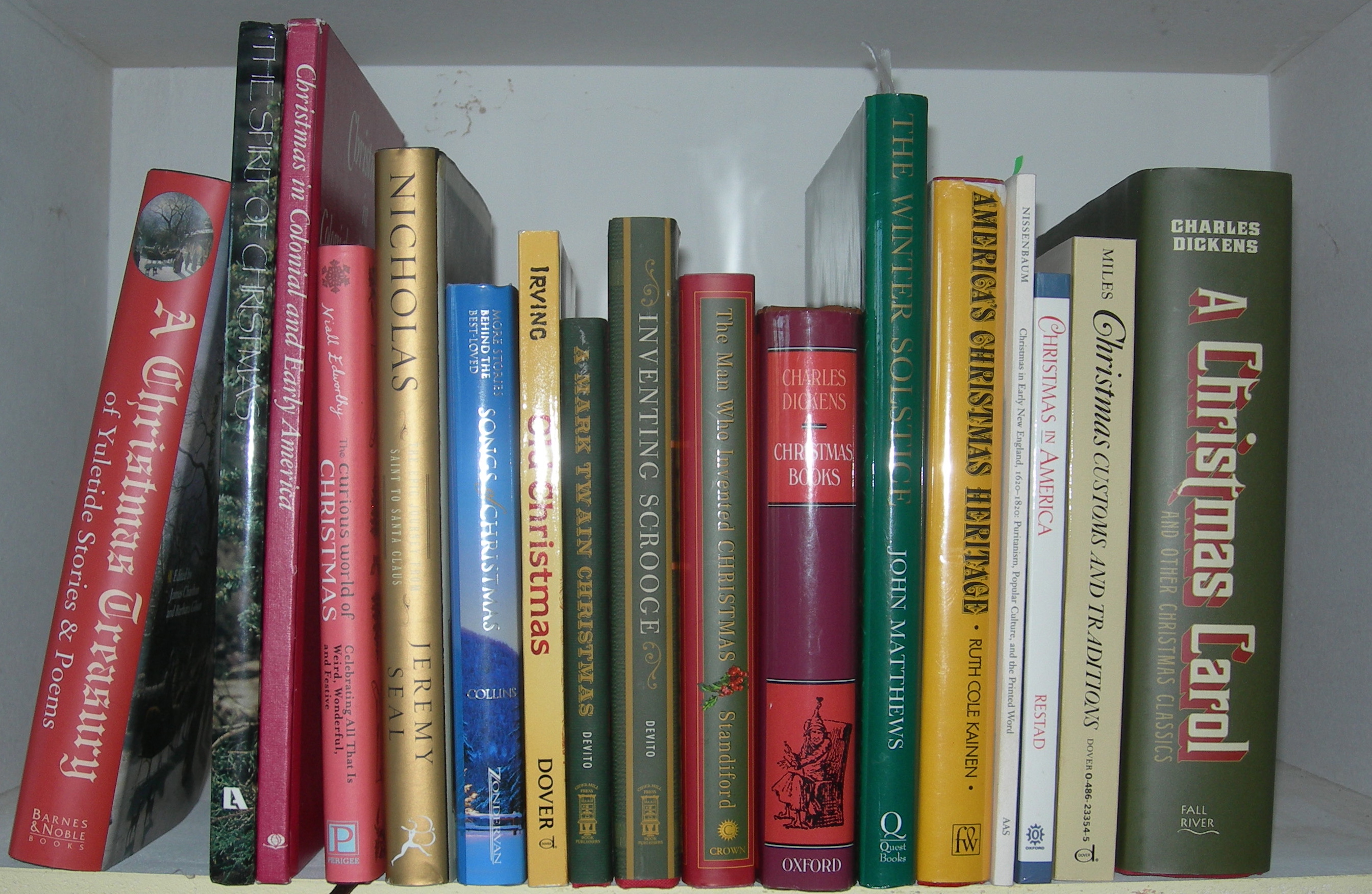
62. A Christmas Booklist – plenty of Christmas reading.

DSCN1795

*

*

*

63. ‘Twas the Season (post 1) – Christmas in Oklahoma during the fifties.  

DSCN1841

*

*

*

*

  64. ‘Twas the Season (post 2) – Christmas in Oklahoma during the fifties.

DSCN3975

*

*

*

*

66. Five by Dickens – Dickens wrote more than A Christmas Carol.

220px-Diedrich_Knickerbocker

*

67. ‘Twas the Night . . .  – the story of The Night Before Christmas, extended  version.

Dec 25th

*

*

*

68. Nostalgia – some personal reflections on what Christmas means to me.