Tag Archives: Cyan

328. Still not a Frog or a Kangaroo

220px-Litoria_tyleri    220px-RedRoo

Cyan is now available for pre-order through Amazon, with the eBook arriving April 17th. Meanwhile, I plan to repeat a few year old-posts that were designed to stir the blood of would-be readers just before an earlier release date that didn’t happen. This is one of them.

——————————————-

Flashback: 1963, riding in a car, reading an article, probably by Arthur C. Clarke, on why humans should go into space. A little fish, swimming in shallow water, said to his father, “Why don’t we go up on the land and see what we can find?” The father fish responded, “Why would you want to do that?”

I read the passage out loud, but no one was interested, so I relapsed into nerdy silence.

Years later I found that the now accepted theory is that fish in shallow waters, accustomed to using their fins against the sea bottom, began to use them to navigate mud flats at low tide as mud skippers still do in mangrove swamps today. Legs evolved from fins.

It didn’t happen this way on Cyan. (This is a follow-on to posts 320 and 321. If you missed them, we’ll wait for you to read them. Done? Good.)

On the planet Cyan, hundreds of millions of years ago, primitive chordates developed a split vertebral column, which resulted in twin tails. When they moved onto land, their tiny front steering fins were never used for locomotion and their twin tails (they had no back fins) became legs.

As Gus Lienhoff said when he dissected the first one Cyanian creature the explorers had collected:

Look, no pelvis. Look at this complex of bones. Some are fused, some flex, and these four are cantilevered. And look up here; no scapulae, just three extra thick, specialized vertebrae. Tiny front legs, powerful back legs with twice as many joints as you would expect, and absolutely no hint of a tail. Not even anything like a coccyx. A truly tailless, truly hopping biped. I wouldn’t have believed such a thing was possible.

Not a frog, not a kangaroo.

Frogs are quadrupeds with overdeveloped hind legs, like rabbits. They have a vestigial tail, like a human coccyx. If you look at a frog’s skeleton, it looks a bit like a massively deformed human. They can leap, but they also walk.

Kangaroos have a five-legged gait when walking. They lift up on a tripod made of small front legs and a powerful tail to shift their massive hind legs forward. Then they stand balanced on their hind legs while moving their forelegs and tail forward. 3 – 2 – 3 – 2, etc. When they run, they depend on their tail for balance, just as some dinosaurs used a massive tail to keep their foreparts from tipping forward.

Cyanian bipeds, from the simplest to the most complex are hoppers. They all have short, grasping forelimbs; not quite T-rex hands, perhaps, but too weak to knuckle walk, as apes do. They can move miles with grace and speed, but moving inches puts them into a condition of stumbling clumsiness. There are tree dwelling tailless bipeds on Cyan; how they navigate is a mystery I didn’t get around to investigating.

When a trio of Cyl (intelligent Cyanian creatures created through recombinant DNA – its a long story) first enter a human habitat . . .

They were awkward inside the dome where the furnishings of the place made a maze for them to negotiate. As bounders, they were creatures of the unobstructed open plain. This human habitation was utterly foreign to them, not because of the steel from which it was made, or the interlocking triangles of its geodesic construction, but because it was cluttered. How could one hope to move about in it?

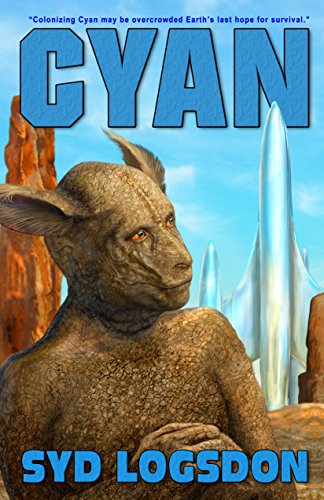
I explained all this to the artist who did the cover for Cyan. I also sent a crude sketch of what I had in mind, with many disclaimers about my (non)skills as an artist. The resulting cover shows a Cyl slightly different from my vision, but better. That’s what good SF cover artists do. However, it is an upper body portrait, so the secret of bipedal tailless hopping remains unresolved.

If I really want to know how it works – and I do – I would have to construct a skeletal robot and see how he moves. But there is no way I’m going to have that much free time anywhere in my near future. I have too many other books to write.

321. Home Grown Ecosystems (2)

Cyan is now available for pre-order through Amazon, with the eBook arriving April 17th. Meanwhile, I plan to repeat a few year old-posts that were designed to stir the blood of would-be readers just before an earlier release date that didn’t happen.

 —————————————-

Continuing our look at the creation of an ecology for Cyan. If you missed yesterday’s post, you might want to go there first.

We can take grasses and weeds for granted. Let’s give our trees multiple trunks bound together, like a strangler fig without its victim, and that should be enough. We need something like insects. We’ll call them Chitropods – chitro sounds like chitin, and pod means foot, so our reader will infer an exoskeleton without any further work on our part. Continuing the idea of inference, if we call the flying creatures who eat the chitropods pouchbats, the reader will draw a better picture in his mind that we could on paper.

The number of legs is important to Terrestrial arthropods, but lets bypass that by giving all our chitropods many legs, but with only one joint each where it meets the body. Now they have a rolling gait “like caterpillars on crutches”. Humor helps keep description from limping along. (Sorry, couldn’t resist!)

These are throw-away inventions. They could have been applied to any ecosystem and they are not systemically related to each other. They alone would be good enough for almost any SF novel, but not for one about scientists teasing out the essence of their planet.

Here we need a key differentiation, from early in evolution, from which a thousand lesser differences can be derived. Here it is for Cyan. Early in the development of chordate life, the vertebral column doubled at the posterior, giving the Cyanian version of fish twin tails. That changed everything. I’ll explain more fully later in a separate post.

On Cyan, the classes are Pseudo-pisces, Amphibia, and Inturbia. No reptiles, no birds, no mammals, no dinosaurs. The Amphibia are cold blooded. Inturbia are inefficiently warm blooded. The term Inturbia should imply “internal body temperature un-perturbed by external changes”. Not every reader will get that, but we need to reward our best readers by not spelling out everything.

There are a thousand other details, but for that, you will just have to download the book when it comes out July 5th.

***

I do have one more thing to share. I wouldn’t bother you, but since you’re reading a post about the backstage secrets of writing science fiction, I can assume that we are all nerds together here .

Inturbia have live birth. Cyanian amphibs have to return to water to lay their eggs, except for one group, the Sphaeralvids, who produce globewombs.

(Globewombs were) the closest thing to an amniote egg that Cyan’s fauna had developed – a transparent, leathery sac extruded by a Sphaeralvid mother and filled with a clear fluid like seawater. Into this she deposited fertile ova, then defecated. Then she separated from the globewomb and left it cached in the crotch of a tree, high up where it would receive full sunlight. On a bright day millions of these globewombs glinted in the treetops.

Algae from the Sphaeralvid mother’s bowels converted the feces into biomass and the Sphaeralvid nymphs fed off the algae.  When the feces were gone, the globewomb walls would break down, leaving the now sizeable nymphs free to face Cyan on their own.

Neat, huh? The globewombs are glinting in the treetops from the first day planetside. By the time the explorers understand what they are, the reader will have been wondering for some time. Globewombs don’t contribute anything to the plot, but since these are scientists trying to tease out the ecology of Cyan, we need some concrete examples of their work. Globewombs provide that.

They make me want to be there when they make the discovery – but that’s why I wrote the book.

320. Home Grown Ecosystems (1)

Cyan is now available for pre-order through Amazon, with the eBook arriving April 17th. Meanwhile, I plan to repeat a few year old-posts that were designed to stir the blood of would-be readers just before an earlier release date that didn’t happen.

——————————-

Over in Backfile, you will find an eleven part document called How to Build a Culture, inspired by Poul Anderson’s How to Build a Planet.

I could also write a paper called How to Build an Ecosystem, but who needs to read all that. A couple of posts here should cover the subject, without boredom or overload.

The fact is, simply peppering your planet with a few well chosen and deeply odd critters is enough in most cases. Andre Norton did it all the time, and it worked for her. The frawns and yoris on Arzor are simply transmogrified bighorn sheep and alligators, but so what? They provide plot points and local color, and that is all that is asked of them. Marion Zimmer Bradley gave us a mammalian snake, a hyper-weasel, and an intelligent dinosaur who sent out pheromone soaked calling cards in Hunters of the Red Moon. What more could you want?

When I wrote Cyan, I faced a different situation. My crew was set down on an alien planet for one year, with the task of coming to understand its weather, geology, and ecology in order to prepare for colonization. They were all scientists, so their actions and conversations called for a deeper understanding of their new world than any other kind of science fiction novel would have required. That challenge was half the fun.

When I began Cyan, I had been studying ecology for about twenty years, starting back when I had to explain what the word meant. I later came to understand the essence of Earth’s taxonomy in the most rigorous possible way – I had had to condense it to a level which middle school students could understand without dying of boredom.

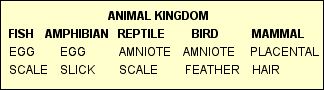
Scientists should forgive the following chart and paragraph.taxon

Drop a salmon egg on the gunwale of your canoe and it will dry out in minutes. A chicken or turtle egg would survive the same treatment. This is the meaning of amniote egg (although there are other, competing meanings). Creatures who lack them, must lay their eggs in water. The rest of the chart should be clear, although simplified. For example, birds have scales on their legs as well as feathers elsewhere, and I skipped Dinosauria altogether.

Now pull up a chair and lets build Cyanian ecology. It needs to be wierd but recognizable – that’s the key to all science fiction invention. We also need restraint. You can only explain so much to your reader without losing them, and beyond a certain point, your backstory is wasted effort.

Come back tomorrow and we’ll dive more deeply into Cyanian ecology.

317. SF in the Wild

Cyan is now available for pre-order through Amazon, with the eBook arriving April 17th. Meanwhile, I plan to repeat a few year old-posts that were designed to stir the blood of would-be readers just before an earlier release date that didn’t happen.

——————————-

This post was originally number 128.          If you are what you eat, I used to be beefsteak, fried okra, and hominy. That comes from growing up in Oklahoma. I also lived outdoors most of the hours of every spring, summer, and fall day, and way too many hours of every winter day. That comes from growing up on a working farm.

If you are what you read, then I used to be an Andre Norton protagonist, at least in my imagination. Although I never met or corresponded with her, Andre Norton was something of a long distance mentor.

Alice Mary Norton legally changed her name to Andre Norton early on, in an era when being a woman was no help to a science fiction writer. I didn’t know that when I first read her; I thought Andre Norton was a man. Not that I thought about it much, but she didn’t write like a girl. Looking back, I see that she actually wrote like a person, but I wasn’t that sophisticated then.

One reason Norton got away with writing gender neutral fiction was that her characters spent most of their time alone. Even in their relationships with others of their own kind, they were loners, if not complete outcasts.

Star Man’s Son was the first Norton I read. In it, Fors spent all but a few pages on a quest away from his people; that was a pattern to which Norton frequently returned. I could easily identify with the solo quest while I spent endless hours alone on a tractor. The only variations in my daily life were whether I was pulling a disk or a hay rake, and which Norton novel was replaying in my head.

Every time Shann Lantee on Warlock, or Naill Renfro on Janus, or any of a dozen other young men found himself stranded alone, or nearly alone, on an alien world, I could look up from my tractor seat at the Oklahoma prairie and say, “Yup, been there.”

The best thing about Norton’s characters was that they didn’t whine about being alone. They liked it. So did I.

I didn’t live in a city until I went to college. I spent my adult life living in the suburbs of a reasonably small city, and taught school in a very small town. As soon as I could retire, I moved to a few acres in the foothills. I would move further out if I could afford it.

I was born not liking cities, and my opinion never changed. It should be no surprise that my first novel was about a hunter surviving alone in the woods, or that my first science fiction novel Jandrax was about a hundred or so humans stranded on an alien world.. My three fantasy novels have a rural and medieval feel. David Singer, in A Fond Farewell to Dying, is a mountain boy who has to go urban to get his life’s work done. And Cyan, due out soon, begins with ten explorers on an empty world, then continues with the story of the peopling that world by hyper-urbanized refugees from an overcrowded Earth.

You write what you’ve lived.

316. Cyan is Here

Finally, after a long wait, CYAN is available for pre-order at Amazon.

If you click here they will take your $2.99. That’s half price to those who pre-order. Pre-ordering puts you first in the queue and gives you the discount; the book itself will arrive in your Kindle on April 17.

Cyan will be available exclusively to Kindle customers at full price on April 17, and available to all eBook retailers on July 17.

Yea! (The dates I gave in an earlier post are now defunct.)

____________________________________________________

It think it would be fair to assume that, if you aren’t reading here for the very first time, you know that I started this blog to support Cyan. By now you know my writing style, and you’re still here, so it’s safe to assume you will like it. 

In the days before the internet, writers didn’t have to publicize their own work, unless they were a best seller and went on book signing tours. Writers also couldn’t publicize their own work, so the sword cut both ways. If you had a good book that didn’t find its audience, there was nothing you could do about it.

Now authors can and must be their own publicist. Hence this blog — even though writing it has become an ongoing pleasure.

Now its your turn. Brian at EDGE said to me:

One of our goals is to get 50 reviews posted on Amazon as quickly as possible.  Reviews can be posted any time after April 17th.  However, there is a catch. Only Amazon customers can post reviews.  A qualified Amazon customer does not have to have purchased CYAN to post a review, but they must have purchased something from Amazon in the past.

It would be good for you to contact as many of your supporters and ask if they would post a review. (That’s you.) If they are not currently an Amazon customer, they can become one by purchasing a copy of CYAN any time (and at the pre-order price of 2.99) and then post their review after the book becomes available on the 17th of April.

So that’s it. No hidden agenda. The agenda is in plain sight and always has been. However, I do have an additional inducement.

If you read Cyan, and like it, and review it, and it becomes successful enough to warrant publishers taking on other books of mine, then you will soon see:

Valley of the Menhir

Scourge of Heaven

Who Once Were Kin

All fantasy novels, already written. You might soon see two planned but not yet written sequels to Cyan. You might even see:

Raven’s Run (in Serial now)

Symphony in  a Minor Key (a teacher rebuilds his life after a false accusation of abuse)

Both are contemporary fiction. Your kids might even get to read the young adult Spirit Deer. (Either soon or later — I don’t know your life plans.)

Right now, I’m concentrating on Amazon, but if you also send a review to Goodreads, I wouldn’t mind at all.

There is a lot riding on electronic word of mouth.

307. Give Me Air

I exist for open spaces. I lived a long time in a small city, but I could walk to the edge of town in five minutes. I spent four years at Michigan State, but that campus was a sylvan paradise. I only lived in a true inner city once, and it almost killed me.

It was Chicago. I know people who love Chicago – Andrew Greeley made a carreer out of loving that city – but they didn’t live where I did. 53rd street, student housing for the University of Chicago, a few blocks from the true south side. The same general area where President Obama got his start.

No, I didn’t meet him. He was in Hawaii, still in middle school, when I was at Chicago.

I never felt more at home intellectually, or more adrift in every other aspect of my life, than the year I spent there. It wasn’t just the dirt and the crowding and the nightly killings. It was that I would have to drive for hours through packed traffic to get to see open space. Without a car, I could have walked until my heart broke and never have reached the open sky.

I left after nine months with a master’s degree and a permanent case of cold chills.

When Keir Delacroix, in the novel Cyan, finds himself stranded on Earth after returning from exploring that virgin planet, I knew how he felt, and I knew where I had to put him. Chicago.

* * * * * * * * * *

The sky was slate gray to match Keir’s mood.    

Snow had been trickling down from ruptures in the sooty sky since noon, and now the dark of evening was upon him. He squatted against the bole of a smog blasted tree, staring at the house where he had been born. It was a half century older now than it had been then, although Keir was only thirty-nine. Even then, it had been old; a two story cottage subdivided to hold a dozen apartments. Now it had endured fifty more years of smog, fifty new layers of winter soot from a thousand chimneys, and half century more of the assault of air borne chemicals from the steel plants.

The orbital factories around L-5 were supposed to have removed the stigma of pollution, but even they were unable to cope with the needs of an Earth groaning under the weight of twenty billion people.

Someone came out the front door. Like Keir, he was bundled against the cold and he kept his right hand in the pocket of his coat. He looked around uneasily, saw no one but Keir, and advanced across the lawn. The grass was dead and brown, withdrawn from the sidewalk near the street to leave a barrier of frozen mud.

Keir drew a deep lungful of cannabis and threw the drag away.

The man was lean to the point of emaciation. His eyes were sunken in deep hollows. Keir nodded a greeting, but he only responded, “What do you want?”

“Nothing,” Keir answered. “Not a damned thing in this world!”

It was not the answer the stranger had looked for, but Keir let it hang between them for a moment before he went on, “I was born in that house – grew up there. In the little apartment to the left at the head of the stairs.”

“Who are you?”

“Keir Delacroix.”

The man knew him; it was written on his face. “What do you want with us?” he demanded. His voice was as tight as his face, all hard edges and deep hollows.

Keir sighed and shook his head. “Like I said; nothing. I don’t even know you.”

“I think you had better move along.” The stranger gestured with the hand in his pocket, and Keir finally decided that he did not have a gun. It was a foolish and dangerous bluff. Keir rose stiffly and threw back his shoulders to ease the strain of sitting too long in one position. The man stepped sharply backward toward safety.

Keir only shook his head and turned away.

302. The Drought Has Broken

dscn4470What is weather to a writer? If you live in the city, it might invoke a passing mood,. Beyond the city, where I live, it is everything.

I grew up on a farm, living in the glorious outdoors sixteen hours a day for half the year, and the other half freezing my #%*# off six hours a day milking cows. Weather was everything. Through the middle of my life, when I lived in cities, weather was mildly interesting. Now I live on three acres in the Sierra foothills, and weather is back with a vengeance.

I posted a picture at the top. This is an fold in the hills which is dry ninety percent of the year, and recently has been dry all year for half a decade. This is what it looks like now.

The drought has broken. Grass is green and knee deep in my yard. Yesterday was Valentines Day or, as my wife and I call it, the first day of spring.

That began as a joke. When we first came to where we live now, I bought her a tomato plant and we planted it together on Valentines Day, with high hopes and no expectations. A few months later we were eating tomatoes from it.

It doesn’t always work that way. In another year, a hard freeze on April 15th killed everything in the garden. Taxes and a hard freeze on the same day — it seemed appropriate. Life is like that in the real world. Sometimes you get the bear; sometimes the bear gets you.

If all this talk of green grass in February is making you jealous, take heart. By May, the rains will stop and they won’t return until winter. When you are having a picnic in June, on green grass under the trees, with cool breezes, here in the foothills it will be a hundred degrees with dry brown hills in every direction. The rattlesnakes will be carrying their canteens again.

But for now, the drought has broken. The grass is green, the weather is clement, and the lakes are full. And my novel Cyan is due out this summer, after the long dry spell since Jandrax and A Fond Farewell to Dying.

The drought has broken. Finally.

********

I have to offer a PS to my metaphorical connection of our breaking drought and the end of my publishing dry spell. Three days after I wrote this post for today’s release, the Oroville dam about two hundred miles north of here, hit the national news for excessive water and a failing spillway. Be careful what you ask for.

301. Cyan in the Making (2)

This is a continuation of the Cover Design Questionnaire for Cyan.

Describe the main characters and their physical appearances.

Okay, I cheated a little on this one. When I first sat down to outline Cyan, I intended the crew to be truly multinational, and made sure that no two were from the same country. As I continued writing, it became clear that the Earth from which they came would not be that cooperative, so I transferred the crew to a single country, a successor of the US, and that’s how I described them here.

Also, when you see xxxxx xxxxx below, that is me restricting what you can read to avoid spoilers. 

All the ten original explorers are athletic, but normal looking. Like the original astronauts, they are of compact build; none are above 6 feet. They were chosen to be racially mixed, a goal made easy since their home nation is the USNA (formerly USA) after it has absorbed Canada, Mexico, and the Caribbean. The women of the group are independent souls. If an artist were to put one of them in a damsel-in-distress pose on the cover, she would hunt him down and beat the crap out of him.

Keir Delacroix, groundside crew leader, French ancestry, the most physically active crew member, survivalist, a generalist whose main job is keeping everyone else alive

Stephan Andrax, spaceside crew leader, Danish ancestry, more slender, he spends little time on Cyan

Tasmeen Rao, second in command in space and on the ground, Dravidian ancestry, from Trinidad, very dark smoky grey skin, darker than Leia, strong but so slender as to appear frail

Ramananda Rao, meteorologist, married to Tasmeen, similar in appearance, but without her seeming frailty

Leia Polanyi, paleontologist, African ancestry, of medium dark skin (think Uhura), small

Gus Leinhof, biologist, German ancestry, slightly older than the other crewmembers

Uke Tomiki, Japanese ancestry, powerful but slender body of a martial artist

Debra Brunner, biologist, mixed caucasian ancestry, movie star beautiful and hates it because it gets in the way of her work. No hipshot poses if she appears in illustration

Petra Crowley, geologist, xxxxx xxxxx xxxxx xxxxx xxxxx xxxxx

Viki Johanssen, anthropologist, Scandinavian ancestry, 6 feet tall, a powerful, lanky amazon, dirty blonde hair (really blonde, chopped short, and always dirty). xxxxx xxxxx xxxxx xxxxx xxxxx xxxxx xxxxx xxxxx xxxxx xxxxx xxxxx xxxxx xxxxx xxxxx xxxxx xxxxx xxxxx xxxxx

On Cyan, as explorers and later as colonists, they wore khaki and denim, with 12 mm automatic pistols in cross draw holsters on the left side – out of the way but easily accessible. If you need to draw Gus, he also carried a long barreled .22 revolver in an open holster low on his right. As the crew biologist, he used this to gather specimens without blowing them apart. Yes, it is a cowboy look, but it is how field biologists actually used to gather their specimens, before eco-consciousness and electro-miniaturized high tech equipment was available.

Who is your favorite/ Why? I like them all. Even the villain Curran has redeeming characteristics. Tasmeen is the one I would most like to meet, if she were a real person.

What sparked the book? Over the years, tales of exploration have always been my favorite kind of science fiction, but they are rare, and I couldnʼt think of one that took a planet all the way from initial exploration through colonization. It was the book I had always wanted to read, but I had to write it myself.

300. Cyan in the Making (1)

Three hundred posts in A Writing Life. That’s a milestone, more so since there are more than three hundred additional posts over in the companion blog Serial.

This calls for a celebration and, since this blog was begun in support of my upcoming novel Cyan, it seems like a good time to announce the publication dates.

==The dates that were here were accurate==
==when I gave them, but have been changed.==
Click here to go to  post 316 for corrected dates.

I’ve seen the cover and I like it, but I’m not allowed to show it yet. Sorry.

Close to a year ago, my communication with EDGE became more intense. Cyan was scheduled for a near future release, which ended up being delayed, but the back and forth was useful and fascinating. I had no idea that they would ask for so much input. Certainly I had almost no input when Jandrax and A Fond Farewell to Dying were published, long ago. (see 133. and 134.).

One of the questionnaire’s I filled out was on cover design. I’m going to share part of it with you, because it is interesting, and because it is a good teaser for the upcoming novel.

Cover Design Questionnaire (in part)
this was for the editors and to be forwarded to the artist

Primary genre? science fiction

A potential subgenre? hard SF; near neighborhood, near future stelar exploration; SF realism —every company had it own definitions for subgenres. The guiding principle of Cyan was to tell a story about the kind of things that probably will happen in the next century or so.

List three comparative novels for cover suggestions–I went to B&N today to see what this monthʼs crop of covers look like. They are all beautifully done but essentially interchangeable. None of the covers gave much of a clue of what is going on inside the book, with the exception of Kim Stanley Robinson’s Red, Blue, and Green Mars.

My take on covers is that they should give the reader an idea of what he is buying. Cyan is a realistic, day-after-tomorrow story of colonization and exploration, with no battles and no fantasy elements. Most of the covers I saw today could as easily have been put on video games; that wonʼt work for Cyan. Cyanʼs cover should have no Terminator wannabes, no Conan clones, no Frazetta girls, and no Dystopian ruins.

Seven phrases for google searches:

science fiction
Procyon
space exploration, fiction
space colonization, fiction
first contact
recombinant DNA
overpopulation, fiction

Hypothetically, pick a scene for the cover — A lot of things happen in Cyan; there are many scenes that would look good on a cover, but the one that most clearly conveys the overall sense of the book is the first ten minutes the crew spends on the ground. I will enclose the text of the scene. (To the artist, I didn’t enclose it here.)

If you do that scene, here is some backstory on the landing craft. Starships are built in space with unstreamlined, open structures. The landing craft is a squat cone with added complexities. It is fusion powered, so its tanks are small, but it has some cargo space for specimens. The tug, during the colonization phase, is similar in appearance but much larger, with a large cargo hold. Both are VTOL craft, landing upright. This is because of the absence of landing fields, but such craft have also become popular on Earth. Given compact fusion reactors, their inherent inefficiencies are of no consequence.

If you prefer to include the non-human characters, I have included an excerpt of Cyl on the hunt. I have also enclosed further descriptions of the Cyl. (Again,to the artist, not here.

this questionnaire excerpt concludes tomorrow

292. I’m back

dscn5448I’m back.

It’s been a weird month. Every two years my wife and I organize her guild’s quilt show. It’s a big deal and the amount of detail work is massive, but I won’t give any details. This is a blog about A Writing Life, not about the personal, private, non-writing life that sometimes jumps in with both feet. I did put in a photo of some of the quilts from the show as a teaser.

Things are progressing with Cyan, and I’ve been working hard to keep everything moving smoothly. One of the side effects of the excess of non-writing obligations is that I haven’t been able to work as unhurriedly on Cyan as I would prefer. I hate deadlines, and I am living in the middle of a snarl of them.

On January fifth I saw the first “rough” draft of Cyan’s cover. Excellent, exciting, and it looks like it will sell some books. That is of first importance. As much as we authors complain when covers are inaccurate, a naked female that sells books is always better than an accurate depiction that leaves books unsold.

By the way, this cover is not a naked female. It is a Cyl – and a rather well envisioned one at that – in a desert landscape looking up a the landing craft from the Darwin. It will all make sense when you read the book.

In the “rough” draft – which was slick, professional, and not rough at all – the Cyl was looking down toward stage left and there was no landing craft. On the more finished version I saw next, the Cyl had turned his head slightly left to look at the landing craft.

So what? So this was done by a skilled digital artist, using a high-end illustration program. You couldn’t turn the head of such a sophisticated image in a painting without starting from scratch. I know a little about this. I have been using graphics programs almost daily since the late eighties, making drawings of things I was about to build in the woodshop, drawing illustations for my science class, and designing dozens of oddball musical instruments and hundreds of quilts. I never had the opportunity to work with a really high-end program, nor had the time to spend on their leaning curve, but I recognize quality when I see it.

Even though the image looks finished, there are still a few tweaks coming, so EDGE is not letting me show you yet. As soon as I can, I will.

I have also been told that although Cyan will be an ebook, it will also be available in print-on-demand format. I’ll tell you more as things progress. It looks like the full release will be about the time of Westercon. For those of you in the eastern half of the US and the rest of the world, that is July fourth weekend.

So, I’m back, ready to pick up where I left off with a diverse mix of posts. Tomorrow we’ll look at the contributions of Gene Cernan, the astronaut who died two weeks ago.