Tag Archives: Donald Trump

Running From President 4

It’s hard to say who made the first mistake. Certainly Leap’s mother should never have named him Leap, even if he was born on Leap Day. Some temptations just have to be resisted. Worse, she should have spoken his name out loud when she named him. Leap Alan Hed, for heaven’s sake. How could she have missed that Alan would become A., and no one could ever meet her son without saying Leap A. Hed.

Leap wasn’t blameless himself. By fighting back to the point of absurdity, he made himself famous enough to come to the public’s attention. Counting his age by leap-day-birthdays and calling himself 16 when he was in his sixties — that’s just asking to be noticed.

Of course Billy Joe Barker was to blame for touting him as a write-in candidate for President. Then when he said that Leap was sane because he really didn’t want to be President, it was the last nail in Leap’s coffin.

People never give you what you want, but they always give you what you don’t want. Didn’t anybody know that?

Shelia Barnstaple of Wilmington, Ohio started a blog called I Want Leap for President. Wilton Damonson of Ash Fork, Arizona started a competing blog called Leap on the Bandwagon, also using the hashtag #LeaponforLeap. You would not believe how many people have 140 characters worth of something to say.

Throughout August, as Donald sank in the polls, people first sighed with relief, then suddenly realized that Hillary would probably win. Someone published a poem anonymously that read:

When Donald came I feared the worst,
If he won it just might kill me.
He surely was the worst of worst,
But second worst was Hillary.

Within days the doggerel was re-posted four million times, and a hundred and ninety-two people were claiming authorship.

Meanwhile, Shelia Barnstaple and Wilton Damonson combined forces and the draft Leap movement really took off. Leap found his house in Dannebrog surrounded by reporters. It looked like Marilyn Lovell’s lawn in Apollo 13. Leap came out with a shotgun to run them off, but they only clicked their cameras faster. He retreated. The shotgun was never loaded, since Leap was basically a peaceful fellow, but the hashtag #Leapforlawandorder raced around the globe at the speed of light.

Leap drew the shades and locked his doors, turned out all the lights but one, and settled in to wait out the silliness with his paperback collection of Nero Wolfe novels. After an hour, the reporters started pounding on his door, then on his windows, and finally on the walls of his house. He couldn’t call for help since he didn’t have a phone, but his neighbors took pity and brought in the county sheriff. He drove the mob back into the street.

That night, Barnstaple and Damonson posted a call to join Leap in his Silent Vigil for America. Three hundred thousand people promised that they would.

Sometime during the night, a darkly clothed figure joined the reporters briefly, then quietly faded away. Once it was light the next morning, Armin Arkin of WFUD noticed that the back door was ajar and announced that he was going in. Within minutes, the street was empty and the house was jammed with anchors and their cameramen elbowing for room to broadcast.

Leap had disappeared. more tomorrow

565. Great (?) Men

This post was begun December 5, 2018, before the shutdown, right after watching President Bush’s funeral. Most of the posts from that time until now were already written to make time for some non-writing activities, so I watched the Federal shut-down from the sidelines. I will summarize my take in one sentence.

Another damn-fool stunt by the Damn-Fool-in-Chief.

Now back to December fifth.

=========

As I watched President Bush’s funeral this morning, I was once again struck by an understanding of how Trump became president. I am not going to offer similarities between the two men; I would be hard pressed to find any. I will suggest instead that the nation’s response to Bush One’s death tells us uncomfortable things about hero worship, individual liberty and responsibility, and America’s closet love affair with The Great Man.

America threw off a king in 1776, and has been in the habit of electing would-be kings to the presidency ever since.  They even asked George Washington to become king. He refused. If there has been a president since who didn’t want the powers of a king, I apologize for lumping him in with the rest. I don’t think I will have to apologize to many. Maybe none.

I get that. I also get that without a combination of arrogance and obstinance, and a massive need for power, no candidate would ever get through a campaign. Obama strikes me as a nice guy, someone I would like to know personally, but he had the need. Bush II was touted as the candidate you would most like to have a beer with — and I would, even though I never considered him competent. Vote for Bush II, hell no; share a laugh with him, of course. Bush II had the need. Bush I had the need. They all had the need for power.

You can be pretty sure that any humility shown by any president is feigned. Was Lincoln humble? He appeared humble, but I seriously doubt that he was. Overwhelmed and saddened by what fate had saddled him with, certainly, but a truly humble man would have withdrawn in favor of someone more qualified.

But Presidents don’t believe anyone else could be more qualified; if they did, they would never make it to the White House.

I understand the motivation of Great (?) Men; I don’t really understand why Americans, who otherwise cling to their liberties, continue electing them. Perhaps they are convinced that the alternative to the Great (?) Man is the wimp. Or maybe it’s just the John Wayne syndrome gone wrong.

Here’s what happens. There is trouble in the town. Every man knows what needs to be done. But only one man has the fastest gun and the toughest fists. So (the Lone Ranger) (John Wayne) (Chuck Norris) (millennials, fill in your own selection, I’m out of touch with current heroes) takes care of business because he is The Great Man.

That’s adequate for TV, but not for governing America. Presidential power has been growing at Congressional expense for several decades. Why? Maybe at the core it is because the President is one man and Congress is many. Is it just part of the American myth that the individual stands up to the mob?

Maybe.

I get it — but I don’t buy it.

Running From President 3

It was a bad week in mid-August. Donald was imploding and Hillary should have been, but Donald kept grabbing the microphone. Nobody was thinking about e-mails because Donald kept spinning out one-liners. The Democrats were simultaneously frightened that he might win, and exulting in the poll numbers that said he never could. The Republicans were furious at lost opportunities, and tearing their hair out over the poll numbers.

On Sunday, August 14th, Billy Joe Barker sat down in front of his computer to compose his weekly commentary for the Tulsa World. The column was called Thank God Its Monday, but this night he simply couldn’t find anything to be thankful for. He had had such high hopes for Trump, but that was only a bitter memory now.

Then inspiration took him by the throat. His fingers flew across the keyboard and he hummed happily as he typed out the doom of a poor schmuck who had never done him any harm.

Please Mr. Custer

If you are old enough, you may remember a novelty song from 1960 called Please Mr. Custer. A trooper was complaining to commanding officer, who happened to be George Armstrong Custer, that he really didn’t want to go with him on his ride out to see what the Indians at the Little Big Horn were up to.

I don’t blame him. Nobody blamed him. It was a good laugh and nobody thought the trooper was unpatriotic for yelling, “I don’t want to go.”

I thought of that trooper today as I remembered my column of August first. It was about Leap Alan Hed, the boy who was born on leap day. Kids teased him so much when he was young about his name, Leap A. Hed, that he got back by counting his age by leap-year birthdays. He told me himself, when I interviewed him over the phone, that it was a piece of silliness he regrets to this day.

I invited him to run for President as a humor candidate, and offered to carry his campaign in this column. He turned me down flat, and I called him the sanest man in America because he really doesn’t want to be President. He doesn’t even want to pretend he wants to be President.

The trooper in the old song said, “I don’t want to go,” and Leap said, “I don’t want to be President.” Fifty-six years apart –- the last two sane men in America.

I wanted to vote for Trump, I really did, but I can’t. Hillary –- never mind. And the outliers, not them either.

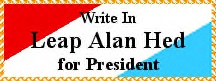
On November 8, I am going to write in Leap Alan Hed, the last sane man in America. If you find Donald and Hillary as unpalatable as I do, I invite you to join me.

The piece was picked up by AP and UPI. All across the nation, every anchor with two minutes to spare read part of it on his broadcast. It became a phenomenon.

The reason was clear to those who paid attention. For a year, Donald Trump had given the talking heads something to cover. He was fun; he was colorful. He was safe. Nobody in his or her right mind thought he would ever win anything, and the rest of the Republican candidates were a dreary lot.

Then he won the nomination. The talking heads felt panic, and a massive sense of guilt at the idea of “What have we done?”

By the time relief arrived through Donald’s spiraling self-destruction, they were really tired of him. And they had always been tired of Hillary. Leap was a breath of fresh air. Leap was something different they could talk about, and he was safe. No one could ever take seriously the candidacy of a man who refused to run.

It seemed as safe as betting against Donald had seemed.

How quickly we forget. more Monday

Running From President 2

Billy Joe Barker, newsman, regular contributor to the Tulsa World was a long time Republican. He had a dalliance with liberalism during the sixties when he thought he was a hippie. He had the hair for it back then, and it’s the only part of that era he misses. By the mid-seventies he was back to a buzz cut and back to being a Republican.

Billy Joe hated Hillary, passionately. He was a Ted Cruz supporter, despite the hesitation Okies have for anything from Texas, but Cruz didn’t last. Billy Joe really tried to like Donald Trump, but he couldn’t. The last straw was watching Trump’s first interview with his new running mate Mike Pence. After that, Barker had a continuing  vision of Edgar Bergen with Charlie McCarthy on his knee. He gave up on Trump even before Cruz said, “Vote your conscience.”

Barker couldn’t begin to support Hillary, couldn’t stand the Libs and Greenies, and knew there was no hope for a third party. He was flummoxed. That’s when he decided to use the Tulsa World to push a pseudo-candidacy. He didn’t care who he ran, it was just a joke in a political season that had lost any taste of humor. He needed someone like Pat Paulsen, back when Billy Joe was briefly a hippie.

On the same day that he came to that conclusion, he read about Leap Alan Hed in Reader’s Digest. The article told about Leap celebrating birthdays only on years with a leap day, and about his claim to be 16 even though he was born in 1952. Billy Joe Barker had found his candidate.

First he had to locate him; that took two days. Leap had moved to Dannebrog, Nebraska, a bustling metropolis of 307 people. Wiki says 306, but that was before Leap moved in. Billy Joe called him long distance. That took a day of phone tag since Leap didn’t have a phone, and had to take the call at a neighbor’s house.

Billy Joe explained his proposition. Leap almost fell off his chair laughing. He said, “You’ve got to be out of your damned mind. The second worst part of what you want me to do is the campaigning. The worst part is, if I lie well enough, I might win. The answer is no!”

Billy wrote up his weekly column for the Tulsa World, telling the story of his aborted search for a candidate. At the end, he said, “If only crazy people run for the office of President, then Leap Alan Hed is the sanest person in America. He really doesn’t want the job.”

Beware of what you ask for. Or what you don’t ask for. more tomorrow

564. The Tale of Leap Alan Hed

In 2016, after a month and a half of extremely serious writing about race in America. I decided to celebrate with a bit of total nonsense. I chose to do it on Leap Day, because what better time for silliness than a day that only comes every fourth year.

I had intended it to be a one time bit of humor about an accidental President. It wasn’t anti-Trump, because at that time the idea that Donald Trump would become president was a million miles from anyone’s mind.

I went on with my life, getting ready for the release of Cyan and writing blogs on writing, science, and science fiction. I wasn’t worried about Trump. I was worried about Clinton. I eventually voted for her, while holding my nose, but my sympathies were with Bernie, or some other Democrat. Apparently a lot of people felt the same way.

I was aware of Trump, but I wasn’t thinking much about him. I just hoped the Republican candidate would be someone I could vote for if Clinton became the Democratic candidate.

By July, Trump was in the race and looking more and more ugly. But lest we forget, the prospects of Clinton as President didn’t look that good to a lot of us either. 2106 was beginning to stack up as a lose-lose situation. Reasonable candidates were failing fast in both parties.

I brought Leap Alan Hed, the nobody who won the Presidency by accident, back for a reprise and continued his story throughout the summer and fall. I bid him farewell the night before the election and faced reality with a post written in September but posted the day after the election.

In September I reprised the poem Hungry, about a border wall. That is another prophetic piece that I wish weren’t so accurate.

All the things I wrote fearfully about that summer have come true, along with more misery than I could have anticipated. Now I am bringing Leap back for a re-run, beginning today over in Serial. Everything has been tweaked to read smoothly, but ninety-nine percent remains unchanged.

Think of this as a presidential campaign in an alternate universe. And besides, politics aside, it’s just a good story about a nice guy who found himself in completely over his head. These posts have never been put in one place before, to simply be enjoyed as a story.

Running From President 1

In 2016, after a month and a half of extremely serious writing about race in America. I decided to celebrate with a bit of total nonsense. It didn’t work out the way I had anticipated. For a longer version of that story, look at today’s AWL post.

This is the story of Leap Alan Hed and his unintended write-in bid for the presidency. Think of this as a presidential campaign in an alternate universe.

======

Once upon a time – 1952, I think it was — there was a kid who was born on Leap Day.

His Dad was named Alan Hed, and he wanted to give his son the same name, but his wife had a quirky sense of humor. She told the nurse to call the boy Leap, as in Leap Alan Hed. When he was really young, his dad called him Alan and his mother called him Leap, but when he got old enough for school, his kindergarten teacher — who was a mean bastard, anyway  — called him Leap A. Hed. That brought about a sudden parent conference and after that the dad got his way, and the boy tried to forget that his first name was Leap.

People wouldn’t let him forget, and finally he gave in and refused to answer to a Alan any more. He went further. He decided that if he was going to be the boy with all those nicknames:

Leap Boy
Leap Frog
Leap for Cover
Leap Forward
Leap Back
.  .  .  and of course, still, interminably, Leap Ahead  .  .  .

.  .  .  if he was going to have to put up with all those stupid names, he was going to go all the way. I refused to celebrate his birthday on the twenty-eighth of February or the first of March. He only celebrated it on February twenty-ninth.

Worse, he counted his age by birthdays. When he was sixteen, he started putting his age down as four. He spent a lot of time talking to the principal about that, but they finally got tired of the whole business. You might say he out-stubborned them.

He couldn’t out-stubborn the draft board. When they said he was eighteen and he said he was four, they didn’t buy it. He claimed discrimination under the Civil Rights Act. He might have made it all the way to the Supreme Court, but when the 1969 draft lottery was held, February twenty-ninth drew number 285, so the draft board dropped the case.

After that his life calmed down. He never married (he claimed he was too young) and the IRS was indulgent. They figured he would regret his claims when he wasn’t eligible for Social Security until he was 260 years old.

Unfortunately for Leap – or Leap Boy, as the media eventually called him – some joker heard about his claims and put him up for President in 2016. This is the story of that event. more tomorrow

560. We All Learn

Race has a persistent and powerful influence on America for something that really doesn’t exist.

Take the whitest non-albino in America and stand him on the western border of Kansas. Take the blackest black in America and stand him on the eastern border of Kansas. Now line up all the rest of us in a single line, whitest to blackest, in between those two. There would be no break in the continuum.

That should be no surprise to anyone. We have had black slaves (and their descendants) and white immigrants in America rubbing up against one another for four hundred years.

For four hundred years, white DNA patterns have been entering black America through force and black DNA patterns have been entering white America by passing. Lately, that DNA has been going both directions for kinder, gentler reasons.

It’s all been a giant blender — powered at first by hatred and eventually by love —- mixing up the vanilla with the chocolate. There is no use pretending that we are two races any more.

Right!

Try telling that to a white guy. Or try telling it to a black guy.

Clearly, there’s more to the story.

============

When I was growing up in rural Oklahoma in the fifties, the idea of two separate races seemed real and normal, but theoretical.

In my small town and the countryside around there were no black folks. Also no Jews. Nor Mexicans. No Italians either, come to think of it. There was one Catholic family who lived there briefly, but they didn’t last.

It was white, white, white, and Protestant, for as far as the eye could see, with one exception, —— Eddie. I’ll leave it to you to guess what word went into the blank; hint, it began with “N”.

The gentleman didn’t live in my community, but we saw him driving by in his pickup from time to time. He lived somewhere north; I never knew where. I never met him. I only knew him as a blurred, black face in a passing vehicle.

All the adults knew him and spoke well of him. He minded his own business; he took care of his family; he was a good farmer (wherever his farm was); he was quiet and he went his own way.

Now, if I weren’t talking about race, that would sound like a description of The Quiet Man. The archetype. The lone cowboy who rides into town, minds his own business and bothers no one. But don’t cross him because he takes no guff from anybody.

Nope, that’s not it at all. Not even close. But take away the last sentence — the one about “don’t cross him” — and change it to “gives no offense to anyone but quietly backs away”. Now you are closer to the truth. You have just defined the difference between The Quiet Man and Uncle Tom.

The Quiet Man knows his worth; Uncle Tom knows his place. Even growing up in whiteland, with no blacks around, I knew the difference.

============

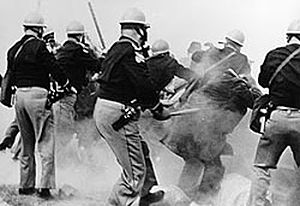
In my childhood, the only black folks I saw other than a blur on the highway, were on television. They were marching in Selma and across the South. And yes, now we are getting to why this post is coming on Martin Luther King Day.

My father called them troublemakers. He liked the phrase “outside agitators”, as well. I disagreed. I looked at the black people being washed down southern streets by fire hoses and said, “They’re right. We’re wrong.”

I didn’t say it out loud. I didn’t say much of anything out loud in those days except, “Yes, sir.” But a few years later when I escaped to college, I had decided for myself that black folks were as good as I was.

Now that may seem a rather obvious decision to you, but a lot of people from my generation and the one that followed never got the message. You see a lot of them now at rallies for a certain orange faced politician.

Martin Luther King and the tens of thousands he represented showed me an alternative to my father’s thinking. I thank them for giving me another option.

552. Links to Christmas

Tomorrow is the big day, when nobody should be on the internet, so I’ll have my say today. This is the fourth Christmas season since I began this website, and every year I say the same thing. I love Christmas.

I stand with Dickens, who called Christmas “a good time; a kind and forgiving, charitable, pleasant time; the only time I know of, in the long calendar of the year, when men and women seem by one consent to open their shut-up hearts freely.”

Over the years, I have posted many Christmas or Midwinter posts. If you are new to this site, here’s your chance to check some of them out.

My first year I posted a list of Christmas books, covering pretty much every aspect of the holiday. That same year, I talked about Dickens’s five Christmas novellas. Everybody knows A Christmas Carol; here is your chance to check out the rest.

When the ghost of Christmas Past appeared, Scrooge asked, “Long past?” and was told that she meant his past. My own early Christmases on the farm wouldn’t make a Christmas card, but I told about them in Twas the Season, posts 1 and also 2. I also talked about the Nostalgia for those days that never were .

Everyone talks about Mary and Jesus, but what about Jesus and Joseph?

Christmas itself has a history beyond the biblical story. It has always fascinated me, and I summarized what I have learned in three posts from 2016, Old European Christmas, Colonial Christmas, and Here Comes Santa Claus.

In 2016 and 2017, Christmas was overshadowed for my Latin friends by a grinch with an orange face and wild yellow hair. I wrote about Christmas for Lupe two years ago and about Jose, Maria, y Jesus in Trumpland last year. I didn’t have the heart to tackle the current occupant one more time this year. Maybe by next year I won’t need to.

Anyway, whether you check out any of these links or not, Merry Christmas.

Trump World

I’ve been working on Like Clockwork, my latest steampunk novel. Today I was rereading a chapter from about the middle of the manuscript when this caught my attention. Let me share a few paragraphs.

“But lately it has all been falling apart.”

“You must expect that. Not everyone believed in the Founder’s ideas completely. One little girl didn’t believe at all. After He left, there was no one to answer prayers, and belief doesn’t last forever.”

“Are you saying that You — He — one or both of You  — answered prayers?”

“Of course not. But We did have the capacity to convince people that their prayers were being answered, even when they got the opposite of what they asked for. Any good religion can do that. You people are very easy to convince.”

Okay, I see the uncomfortable resemblance too, but I wasn’t thinking of Trump when I wrote this. Honest!

Then I read on and found another thought two pages later:

“So how do we get our world back to reality?”

“Reality? Never heard of it. You don’t get back to reality, you create reality. Didn’t you understand a word I said? If you want a different reality, tear this one down, and build a new one.”

Now that I can stand behind.