Tag Archives: Donald Trump

498. Living in the Promiseland

There is a winding road across the shifting sand
And room for everyone living in the promiseland
Willie Nelson

I began this website in the fall of 2015. It was to be about writing, particularly about writing science fiction, and I had no intention of responding to political events.

Fat chance of that happening, given what has happened in America since.

In fact, I had written about twenty numbered posts when events in the world forced me to stick some personal political comments in between posts 10 and 11. It was called Walls Against the World. It wouldn’t be the last time I had to interrupt my regular programming to speak out.

That was the day after Hungary closed it’s borders to Syrian refugees. It reminded me too forcibly of the Russians closing Hungary’s borders in 1956, to keep Hungarian refugees from reaching the west and freedom.

East Germany had built a wall across Berlin in 1961, and then-candidate Trump was running on the promise to build a wall across the border with Mexico. I didn’t buy in. At the time I said, “Hitler would be proud. East Germany would understand. Russia is laughing.”

Was that only thirty-three months ago? Time flies when you are running from a forest fire.

I opened that post with these words:

          Have you ever asked yourself, “How could Germany have been fooled into following Adolph Hitler?” The answer is on your television this morning, and it is Donald Trump.
          I’m not saying that Trump is a Nazi. I don’t see him as evil, merely foolish. But the techniques that have brought him to prominence are the same techniques that Hitler used.

Then Trump won and here we are. I have tried since then to be fair and at least somewhat balanced. After all, he was elected by the American people (aided by Putin and Comey) and the Democrats hadn’t given Americans much of an alternative.

I have resisted calling Trump evil, and I have resisted refusing to see why many Americans chose to vote for him. I understand them; I just don’t understand him. I have not called him by the H****r word, even as Trump has become increasingly dictatorial. I have tried to avoid pointing out that Hitler was initially elected to office, before he took over everything.

All that was before Trump opened concentration camps on the Mexican border in the name of Zero Tolerance. We haven’t seen this in America since 1942.

Maybe I’ll send the White House a copy of Willie Nelson’s Living in the Promiseland. At least I would if I thought it would do any good.

Give us your tired and weak and we will make them strong
Bring us your foreign songs and we will sing along
.               from Living in the Promiseland

466. Nothing But White

The first African slaves arrived in America in 1619. That’s 399 years ago. If we count twenty-five years as a generation, that’s 16 generations.

Now, lets look at you and your ancestors. Chances are, they haven’t been in America for 16 generations. In fact, this being the internet, chances are you aren’t even in America, so let me explain.

Here in America, whether you are white or black is a big deal.

If you are from India, or Indonesia, or the Philippines, or just about any place else in the world, you are likely to have your own racial and ethnic issues. Your tangle may be different from our tangle, but it’s probably just as tangled.

Being black or white in America isn’t as big a deal as when I was a kid, but it’s still big. And that is true even though there is probably no American black who is actually, fully, and truly black. Don’t take my word for it. Here is what Langston Hughes, negro poet,  said in his autobiography:

You see, unfortunately, I am not black. There are lots of different kinds of blood in our family. 

Being white in America is a big deal too, in the other direction. And that is true even though very few whites are actually, fully, and truly white. Don’t take my word for it. In 1895, speaking against defining whiteness in the new South Carolina constitution, Congressman George Tillman said:

It is a scientific fact that there is not one full-blooded Caucasian on the floor of this convention. Every member has in him a certain mixture of… colored blood…It would be a cruel injustice and the source of endless litigation, of scandal, horror, feud, and bloodshed to undertake to annul or forbid marriage for a remote, perhaps obsolete trace of Negro blood.

A generation later, several southern states did define race, declaring that one black ancestor, however distant, was enough to turn a white man black. It was a sad day for those perceived to be black, and a bad day for truth.

Back to your ancestors. You had two parents (we’re speaking biologically here) and they had four parents and they had eight parents . . .; up the line 16 generations, that’s just under 33,000 ancestors sending their DNA down the line.

Can that be right? Let’s look. The first generation is you, alone, and for the rest we will need a chart.

generation     number of ancestors

               2                     2
               3                     4
               4                     8
               5                    16
               6                    32
               7                    64
               8                  128
               9                  256
               10                512
               11                1024
               12                2048
               13                4096
               14                8192
               15                16384
               16                32768

You have 32,768 great . . . great grand parents. If you are a “white” person in America, what are the chances that not one of them was out of Africa?

If you are just of the plane from rural Norway with ancestors going back unbroken into antiquity, as soon as you have a child with an American who has been here, that child’s number becomes 16384. You can run scenarios to lower the number, but it will never drop below BIG.

All right, let’s say you are a member of the Aryan Nation, and your father and his father were Klansmen all the way back to Appomattox Courthouse. You only marry white girls, and only natural blondes at that. What are the chances that her thirteenth great grandmother wasn’t partly black and passing for white?

You don’t think so? Your ancestors knew better back in the 1800s.

Let’s go at this from the other direction. Suppose one black woman was made pregnant by her master in the first generation. How many of her descendants would carry at least a trace of African DNA? All of them. How many would that be?

Historically, women bore many children, and many of them died while young. Let’s say that the average woman had four children who lived long enough to have children of their own. That original black woman would have one billion, seventy three million, seven hundred forty one thousand, eight hundred twenty four descendants.

You don’t believe me? Get out your calculator. No, better make it a spreadsheet. You don’t think I did that math with pencil and paper, do you?

What are the chances than none of those children passed for white, and begat a line of offspring who are convinced that they are actually, fully, and truly white?

Let me put it another way —

Donald Trump is partly black. David Duke is partly black. Steve Bannon is partly black. You’re partly black. I’m partly black.

And my relatives just disowned me. That’s mighty white of them!

461. Undesirables

Emigrants statue, Helmsdale, Scotland, commemorating the eviction of Highlanders from their land. A father and child and, hard to see in this photo, the mother looking back at her home which she will never see again.

Black History Month is human history month. I’ll have plenty to say about the position of blacks in America, but today they are not the most threatened group. As I write this, Congress is fighting over DACA.

Two Christmases ago I wrote a fictional story about a little girl who was going underground with her parents because Donald Trump had become president. One of my readers replied with a short fictional addition in which one of my characters said, “If only our parents had followed the law, we would be all right.” That reader had a right to his opinion, and I published his reply. I’m not here to disrespect him. I am here to disagree with him. Strongly.

Deportation is a kind of eviction. Eviction is the act saying, “You can’t stay in this place any more, because the rights to this place belong to someone else.” That someone is usually a person or a corporation. Deportation makes the same statement, except that the someone else is you and me.

Eviction is old. It has been around since Og the caveman kicked his mate’s brother out of the hut. It wasn’t long after that before force of boot was traded for force of law.

Between 1710 and 1850 in northern Scotland, Scots who had lived on their lands for hundreds of years were forced off, their houses burned, and their livelihoods destroyed. It was all quite legal. Scotland had become an adjunct nation to England, de facto. Ancient laws had been misrepresented and changed to match an English model. Clan chiefs, whose existence was traditionally enmeshed in reciprocal obligations with their clan, were now seen as landowners.

It equivalent to Donald Trump shifting his legal position from President of the United States to owner of the United States, but on a smaller scale.

These “landowners” forced their clansmen off the land, sometimes with great violence. In early clearances, they were moved to undesirable lands within Scotland. When this failed, later clearances moved them off to the Americas.

In Ireland, during the Famine, undesirable Irishmen were moved out by eviction or allowed to starve in place. Most of them went to the Americas.

It was a pretty practical solution. If you don’t want undesirables around, send them to America. Ironic, isn’t it, that those undesirables’ descendants are now about to evict a new set of undesirables from America.

Meanwhile in America, the American Indians . . . but you know that story. If you don’t, check out 247. The People’s President.

You may not realize that in 1941, all those undesirable Japanese with their rich farms in California were moved into relocation camps. It was supposed to be for our protection, because they might attack from within. Maybe; but if so, why did they never get their farms back. (266. The Other War)

So let’s get back to DACA. This is an act protecting persons brought to the United States illegally as children. They are American in every way but a technicality. They may well not speak any language other than English. They may never have stepped foot outside the United States.

Now we are going to send them home. Home? They are home.

Let’s consider a pair of hypothetical children. Jose was born in Mexico, an hour before his parents crossed the border illegally into the United States. Ramon’s parents were on the same trip north, looking for work. Ramon’s mother gave birth just an hour after they crossed the border, illegally, into the United States.

We’ll let Ramon stay. He is a citizen. We’ll deport Jose. That’s fair, isn’t it.

Maybe, but . . .

What about (hypothetical) Barta Kovacs? He was brought over in 1956 by his parents, who were refugees from the Hungarian Revolution. Today he is 64 years old. He never married, but he spent thirty years as a school teacher, rising to be principal of a local high school before running for office. He has been a State Senator in one of those northern states for eleven years, and now he’s ready to retire.

However, as he applied for Social Security it was discovered that there had been an irregularity in his application for citizenship years before. Technically, he has never been a citizen, even though he has spent 62 of his 64 years here, and has no memory of Hungary.

Will the present administration deport him back to Hungary? I don’t think so.

Good thing our hypothetical Barta Kovacs wasn’t Mexican.

448. The Good King

Merry Christmas and why are you on the internet when you should be sitting by the Christmas tree?

Christmas is my favorite holiday. Of all the masses of Biblical knowledge I accumulated in my religious childhood and youth, the story of the Nativity is the only part that still moves me to joy.

I particularly enjoy Christmas carols, even the unsingable ones. However, I never understood the appeal of Good King Wenceslas until I saw and heard it in the movie Miracle Down Under, where it is sung by a poor family and some swagmen to the accompaniment of a washboard. Then I understood the bump-bump-bump-bump-bump-bump-bump non-melody as something that could be handled even by coarse voices without instruments.

I also paid attention to the lyrics for the first time. The King is watching over his people, and when a poor man is spotted gathering wood for his fire, the King goes to his hut with food. The final few lines are particularly moving, despite their awkwardness as they are tacked on as a sort of “moral of the story”.

Therefore, Christian men, be sure,
    wealth or rank possessing,
Ye who now will bless the poor,
    shall yourselves find blessing.

Not bad. Even today, we could use a President who understands that simple message.

447. Lupe Revisited

Last Christmas, I told the story of Lupe in a world where Donald Trump was going to be President. Now he is President, and things have not gotten better. Here is Lupe’s story again.

Ramon came in, stamping the snow from his feet, and shook the snow from his jacket before closing the door. The sun was low in the eastern sky behind him as Lupe moved up and hugged his leg. He smelled of sweat and manure and soured milk, but she didn’t mind. She had hugged him this way every morning for as long as she could remember, and he always smelled the same. For Lupe, the smell was as familiar and welcome as his cold fingers on the top of her head.

Every morning Ramon rose before the sun was up, and left the house. His daughter greeted him when he returned hours later, and saw him off again in the afternoon. She was usually asleep when he came home at night.

It is hard work milking cattle twice a day, and the pay is low. The cattle march in from the muddy lots to take their turns in the stalls, where fast moving men attach the milking machines. The cattle resent the process and the workers have to move quickly to avoid having their hands caught against he stanchions. It goes on for hours, in heat or cold, beginning every morning before daylight, and continuing again every evening until long after dark.

Lupe stepped aside to make room for her mother. Today she seemed worried; her voice was unusually sharp as she asked, “What did he say?”

Ramon said, “I didn’t tell him.”

I translate, of course. Every word was in Spanish.

“You got your money for the week?”

Lupe’s father nodded, “I told him I needed it today, to buy things for Christmas. I was afraid to tell him the truth. He is a good man, but it seemed best that he should not know.”

Lupe’s sister came out of the single bedroom with a cardboard box in her arms, tied up with twine. Lupe looked up with interest. It was not wrapped in paper, but any box is interesting so close to Christmas. Carmella put the box down on the floor and returned a moment later with blankets and bedding, also rolled up and also tied up with twine. Lupe asked what she was doing, but Carmella ignored her.

Her father carried the box and roll outside. Her mother came out of kitchen with a box of food, and that began a procession of boxes, coming from various parts of the house and out to the car. Lupe’s mother and sister had gathered their possessions during the pre-dawn, while Lupe slept.

Now Lupe dragged at her mothers leg asking questions, but she was ignored until Carmella pulled her aside and said, “We are going away.”

“Where?”

“I wish I knew Lupita. I wish I knew.”

“But why?”

“It’s only a month until he becomes President. Everyone here knows who we are. We have to go away, somewhere where people don’t know us.”

“But why? I was born here. This is home.”

“So was I, Lupe, but mother and father were not.”

When they pulled out an hour later, Lupe stared back at the little house where she had spent her whole, short life, until it disappeared around a bend. Then she looked out the windshield, past her mother and father’s silent heads. It was a long road, wet with melted snow. Her father would not leave the house tonight before the sun went down and go to the cows. There would be no more money, no more warmth, no more little house. It would be again as it had been, before the job at the cows, before she was born. Lupe knew what that was like from hearing her parents talk. Now it would be like that again.

*          *          *

Is Lupe real? She was born from the hundreds of little Mexican-American girls I taught over twenty-seven years. How many were undocumented? I never knew. I never asked. I didn’t need to know.

Is she real? She is as real as heartache. She is as real as fear. She is as real as dislocation, cold, hunger, and injustice.

439. Jose, Maria, y Jesus in Trumpland

[Don’t expect even handedness here.]

In English we call him Joseph, in Italian he is Giuseppe, in Basque he is Joseba, in Spanish he is just plain Jose.

In English we call her Mary, in Hebrew she is Miryam, in German she is Maria, and also in Spanish.

In English he is Jesus, in Cornish he is Jesu, in Italian he is Gesu, and in Spanish he is Jesus again, but pronounced Hey-sous.

We are going to walk with these three in this sermon for the Christmas season.

And it came to pass in those days, that there went out a decree from Caesar Augustus, that all the world should be taxed. And all went, every on into his own city. And Jose also went up from Galilee, out of the city of Nazareth, into Judaea, unto the city of David, which is called Bethlehem, to be taxed with Maria his espoused wife, being great with child.

Of course that could be written as Joseph and Mary, but surely they are the same couple, in any language. Jose was a carpenter. He built things out of wood to feed his family, and he paid his taxes like everybody else. All the world was to be taxed, and he had to go back to the place from which his people came.

Where would that be? Perhaps a land with cities named Sacramento for the Holy Sacrament, or maybe Atascadero, Alameda, Camarillo, El Segundo, or Escondido. Perhaps cities like Fresno, La Mesa, Madera, or Mariposa show where his people once lived. Certainly they must have lived in cities like Los Angeles, Merced, Paso Robles, Salinas, or San Francisco. Even if his people no longer own the land, certainly the city named after him, San Jose, must once have belonged to his people.

And so it was, that, while they were there, the days were accomplished that she should be delivered. And she brought forth her firstborn son, and wrapped him in swaddling clothes, and laid him in a manger, because there was no room for them in the inn.

I think Luke shortened this a bit. Was there only one inn in Bethlehem? We can see the young couple, going from place to place, Jose leading, Maria on a burro since she cannot walk so late in her pregnancy. Everywhere they are turned away. Are all the sleeping places truly full? It may be. Or perhaps something about the two of them, perhaps the color of their skin, makes the innkeepers turn them away. Luke does not tell us.

I see migrant housing everywhere I go in California and I think, perhaps, a manger was preferable.

Now they are in a place where their people once lived, but to which they are no longer welcome. And here, their son is born.

Donald Trump would call Him an anchor baby. I wonder what He will call Trump, when they finally meet.

And there were in the same country shepherds abiding in the field, keeping watch over their flock by night. And, lo, the angel of the Lord came upon them, and the glory of the Lord shone round about them: and they were sore afraid. And the angel said unto them, Fear not: for, behold, I bring you good tidings of great joy, which shall be to all people.

To all people. ALL people. Imagine that!

=============

Luke’s story is complete, but ours is not. It is up to every one of us to see that it turns out right.

361. Take This Test

Berlin WallMexican Wall

TAKE THIS TEST TO SEE IF YOU ARE FIT TO BE AN AMERICAN

Have you ever knowingly committed any crime for which you have not been arrested? [Never mind the fifth amendment. It does not apply here.
Have you ever been arrested? [Whether convicted or acquitted.]
Have you ever received public assistance?
Are you likely to receive public assistance in the future? [As if you could know that.]
Have you ever gambled illegally? [Yes, the Super Bowl counts.]
Have you ever encouraged an act of illegal immigration? [Yes, that includes hiring the maid who cleans you toilet, cooks your meals, and babysits your kids.]
Did you smoke pot before it was legal?
Have you ever been a member of the Communist Party? [Yes, Joe McCarthy is dead, and yes, the question can still be asked, and no, you can’t refuse to answer.]
Did you, in support of the Nazi party, aide in the persecution of any person because of race, religion, national origin, or political opinion. [If such aid was to the KKK, answer no.]
Have you ever assisted any organization engaged in kidnapping, political assassination, or any other form of terrorist activity. [If that organization was the CIA, answer no.]
Have you ever left the U.S. to avoid the draft?
Have you ever served in the armed forces?
Have you ever been a police officer?
Have you ever been a prison guard?
Have you ever been been a Boy Scout?

If you answered yes to any question above, you may not be eligible to enter the United States.

If you could not read any question above, you may not be eligible to enter the United States.

If you could not afford a lawyer to help you answer any question above, you may not be eligible to enter the United States.

If you were too repulsed to finish the test, you may not be eligible to enter the United States.

Finally: List your present and past membership in or affiliation with every organization, association, fund, foundation, party, club, society, or similar group in the United States or in other places since your 16th birthday. Include any military service in this part. If none, write “None.” Include the name of each organization, location, nature, and dates of membership. If additional space is needed, attach a separate sheet of paper. If you are unable to remember and list these affiliations, you may not be eligible to enter the United States.

—————-

All of these questions were drawn, with snide but accurate rewording, from Form I-485, Application to Register Permanent Residence. If you think this is a joke, click here to read the actual form.

Aren’t you glad you are an American citizen? If you weren’t, we probably wouldn’t let you in.

355. Quotations

As I was listening to Trump’s address to the Coast Guard graduates, and his overnight tweets, I was reminded of another voice from years ago. Let me offer all three, side by side.

No politician in history, and I say this with great surety, has been treated worse or more unfairly.
          Trump speaking to Coast Guard graduates.

and also . . .

This is the single greatest witch hunt of a politician in American History.
          Trump tweet.

Setting aside the sound of Andrew Johnson rolling in his grave, let’s hear Robert Heinlein talking about one of his characters:

He had to be the bride at every wedding and the corpse at every funeral.

Yep. That sounds about right.

352. A Modern Maverick

The old TV show Maverick has been on local channels lately. It was one of my favorite programs when I was twelve years old, but I’ve pretty much outgrown it. I don’t watch the reruns, but they started me thinking about an American archetype — the lovable con man.

There are a lot of them in literature, and a lot more moving among us in our everyday lives. You know him, weird Uncle Bob who always has a beer in his hand but never buys drinks. Or Uncle Jim who thinks it is wonderful that you are planting trees in your mother’s yard, and drives home to get his favorite shovel, but never comes back.

What all these slick dealers have in common is that they are funny, charming, and it is almost impossible to stay mad at them. They’ll steal your beer, or steal your heart, or steal your money, and leave you laughing at how easy you were to take.

In the movie version of Maverick, he says, “There is no more deeply moving religious experience, than cheating on a cheater.” Cute, but in point of fact, Bret and Bart and Beau cheated everybody. It doesn’t matter though, because they were charming.

There were others before Maverick. Starbuck, in The Rain Maker, teaches Lizzie that she is beautiful, but she marries her home town swain. Good thing. If she had run off with Starbuck, it would not have ended well.

Harold Hill, in The Music Man, made a career of separating suckers from their money. He was charming and slick and thinks faster than the locals. When he falls in love with the librarian, it changes his attitude. She reforms him. Okay, fine, but for me that doesn’t saves the movie; the line that saves the movie is when he tells Winthrop, “I always think there’s a band.”

See, he didn’t mean it. He thinks he’s giving something back. He’s a good Joe at heart.

If a con man believes his own lies, does that make us forgive him? In the movies it frequently does. But what if a real Marian the librarian married a real Harold Hill. We would probably find her later with eight kids, hungry and living on skid row, after Harold Hill moved on. I like the movie version better.

Does our charming American con man believe his own lies? Does he even know himself where the truth is? Does it matter to him? Does it matter to us?

If he is slick enough, and fast enough, and plausible enough — if he can tell one lie to cover another until we get lost in the shell game — there is no limit to how far he can go.

He could even become President.

330. Dred Scott Rides Again

The issue at hand is constitutionality v. right and wrong.

My respect for the constitution is profound, but terrible things have been done in the name of constitutionality. Some of them are being done right now. (see yesterday’s post)

There is no question of the constitutionality of the move to deport undocumented immigrants, but a great deal of question as to its wisdom and its morality. Trump’s motives are unknowable and irrelevant. It doesn’t matter if he thinks he is saving America from an enemy within, or if he just jumped on an issue to provide a path the white house. The real question is — should it happen.

History has lessons for us on this issue. The constitution allowed Chinese immigrants to be deemed unfit for citizenship. The same was true of Japanese immigrants. Chinese were, eventually and quite constitutionally, denied entry into the US altogether simply for being Chinese. (see 306. White Men Only)

Andrew Jackson used his constitutional powers to make treaties in his removal of the southern Indian tribes. He also used trickery and deceit, but that is politics. American Indians living a settled life in agricultural villages, whose ancestors had been in America since before Columbus was a gleam in his father’s eye, were led by trickery and force to sign away their lands and were removed from the United States by military force, all quite constitutionally through the Indian Removal Act of 1930. (see 247. The People’s President)

Let’s turn the calendar forward from Indian removal to 1857. This was the era of the Missouri Compromise, which allowed new northern states to enter the union as non-slave states, while new southern states entered the union as slave states.

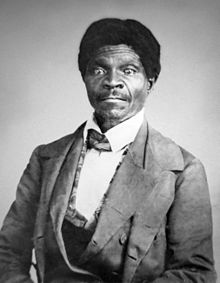
Dred Scott was born a slave in Virginia. His owner took him to Illinois and later to what is now Minnesota. Later, he was returned to Missouri where he eventually sued for his freedom based on his long residence in free states. The litigations passed through multiple trials, which Scott sometimes won and sometimes lost, and finally made it to the U. S. Supreme Court as Dred Scott v. Sandford.

Scott lost. Chief Justice Taney stated that any person descended from Africans, whether slave or free, is not a citizen of the United States, according to the constitution. He further stated that the government could not confer either freedom or citizenship to non-whites, and the Missouri compromise could not exclude slavery from the northern territories.

All this in the name of the constitution. It brought anger, the election of Lincoln, and the civil war.

At the end of the Civil War, the 14th amendment stated that “all persons born or naturalized in the Unites States .  . . are citizens.”  That did nothing to help the Chinese and later Japanese who came to this country, but could not be naturalized because they weren’t white. (again, see 306. White Men Only)

And it does nothing for the Mexican-Americans who came to America illegally because the laws made it impossible to come in legally. If you read yesterday’s post, and if you followed the link and actually looked at the Permanent Residence application form, you know this to be true. If we native born Americans were required to positively answer all the questions on that form, three-quarters of us would have to leave the country.

I respect the Constitution, but I don’t respect those who misuse it. Trickery and deceit gave Andrew Jackson his way, but this is not 1830, and it should not happen again.